The third row is occasional
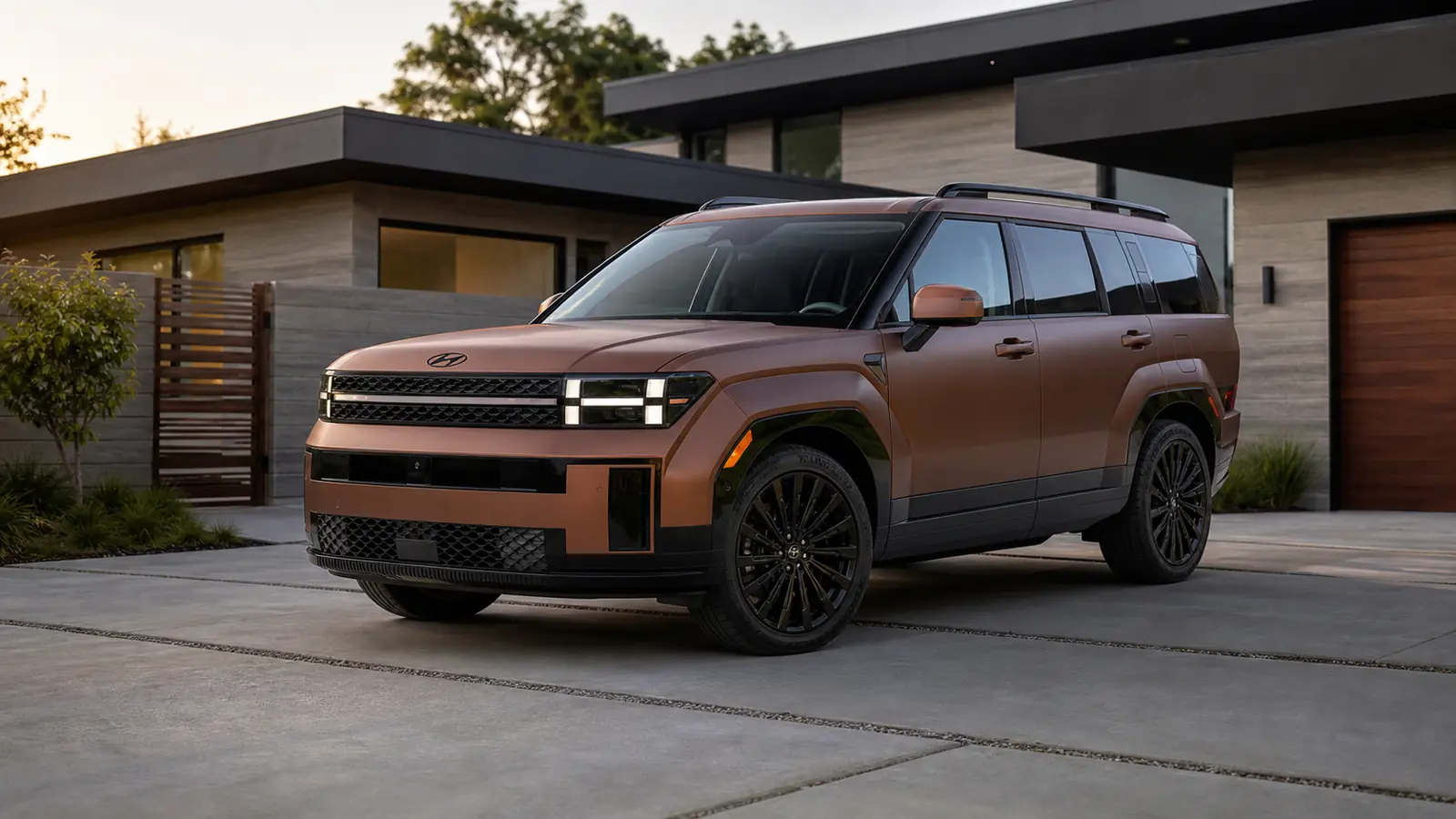
The 2026 Hyundai Santa Fe has a real third row, but the useful question is who will sit there, how often, and for how long.
Children and smaller adults can fit for local travel. Taller adults may accept a short ride but notice a low cushion, limited knee clearance, and a tight foot path.
Treat the third row as flexible family capacity, not as a smaller Palisade hidden inside a shorter body.
Bring every regular passenger to the test. Move the second row to a position that gives its occupants comfortable knees, then enter row three without changing it.
Check the door opening, step height, aisle width, head clearance, foot space, thigh support, air vents, cupholders, charging access, and view out.
Stay seated for at least fifteen minutes rather than judging from one quick entry.
A child restraint changes the access plan. Install rear-facing and forward-facing seats where they will actually go.
Attach the top tether when required. Then see whether the second row can tilt or slide without disturbing the restraint.
Never move a secured child seat just to create a showroom demonstration that cannot be repeated safely at home.
| Passenger | Check | Reject sign |
|---|---|---|
| Child in harness | Tether, buckle, adult reach | Seat blocks safe access |
| Booster user | Belt fit and buckle access | Belt crosses neck or buckle is buried |
| Small adult | Knee, foot and head room | Forced posture on a short ride |
| Tall adult | Entry and exit without injury | Cannot place feet or clear roof |
Compare the exercise in the Kia Sorento and Kia Telluride. Sorento uses a similar occasional-row idea in a smaller package.
Telluride gives regular third-row users more room. The Hyundai Palisade is the direct move-up within the brand.
Seat count also changes with the second row. Captain chairs create a center aisle and make row-three access easier, but reduce capacity to six.
A bench allows seven and may be better when three children need the middle row. The correct layout is the one that keeps the most common passengers in the safest, easiest positions.
Cargo decides the family fit
A three-row family vehicle must carry passengers and their objects at the same time. Maximum cargo with both rear rows folded does not answer whether the Santa Fe can take six people, a stroller, school bags, groceries, or airport luggage.
Test the smallest cargo condition first, with every needed seat raised.
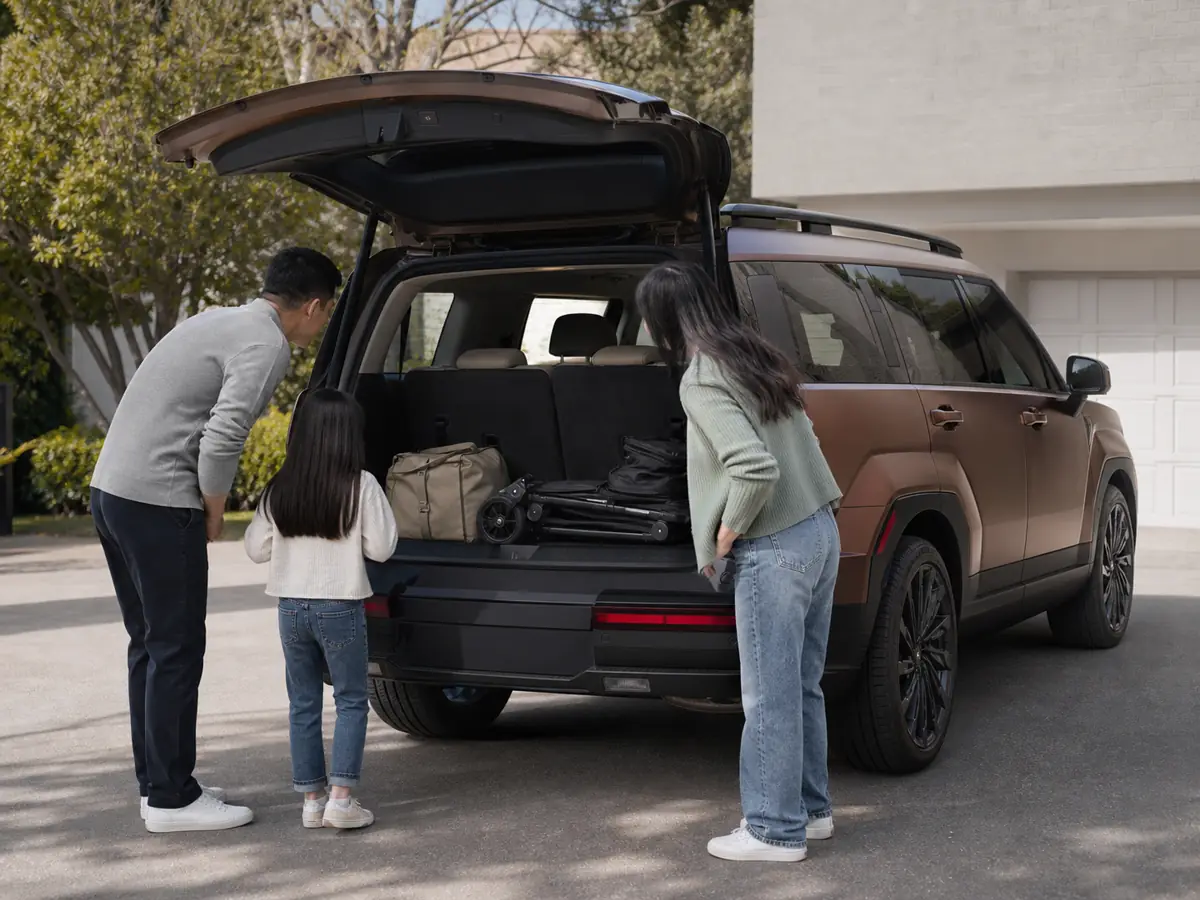
Bring the largest routine item. Load it without pushing against the glass or blocking the driver's rear view.
Add the bags that travel with it and close the hatch gently. Check whether the cargo cover can remain, whether loose items can be tied down, and whether the underfloor area accepts emergency gear.
A boxy roofline helps, but floor length behind row three remains limited.
Use the 50/50 split third row as a tool, not an assumption. Folding one side can carry long items while keeping one passenger in back.
That arrangement may work for five people but fail for six. A roof box adds volume but raises loading height, wind noise, fuel use, total height, and the need to store the box.
A small trailer adds payload and towing calculations.
- Load the stroller or mobility device first
- Add one bag for every passenger
- Close the hatch without pressing the glass
- Check rear visibility and camera views
- Fold one seat and repeat the passenger count
- Open the liftgate below the home garage door
The square hatch also needs a parking test. Open it in the garage and in the normal curb space.
Set the programmable height if equipped, then confirm that it still clears the tallest user. Try grocery loading in rain and reach the third-row release from both the hatch and side door.
Compare the same load in the Honda Pilot and Toyota Highlander.
Those vehicles may use their length differently. A minivan can deliver a lower floor and more space behind its third row.
The Santa Fe should win because its shorter footprint and cargo shape make ordinary days easier, not because an empty cabin looks large.
Small storage matters after luggage fits. Phones, tablets, bottles, wipes, headphones, and charging cables need secure places in every occupied row.
Test outlets with the actual devices and confirm that cords do not cross an aisle.
The Santa Fe passes the family test only when every required person and object fits together without a weekly workaround.
Hybrid suits the daily route
The gas Santa Fe makes 277 hp and 311 lb-ft, while the hybrid makes 231 hp. Peak output favors gas, but family driving includes school traffic, parking lots, short errands, and steady highway travel.
The hybrid's smooth low-speed response and lower fuel use make it the better daily starting point for many households.
| Measure | Gas | Hybrid |
|---|---|---|
| Output | 277 hp and 311 lb-ft | 231 hp combined |
| Transmission | 8-speed dual-clutch | 6-speed automatic |
| Best use | Towing and stronger passing | Traffic and lower fuel use |
| FWD rating | 24 mpg combined | 36 mpg combined |
| Main test | Low-speed DCT response | Price premium and brake blending |
Drive both versions with passengers, climate control, and normal cargo. Start in a parking lot, climb a ramp, merge at highway speed, and pass on a safe two-lane section if the normal route requires it.
The gas model should engage smoothly and respond consistently. The hybrid should move between electric assist, engine operation, and regenerative braking without warnings or an awkward pedal transition.
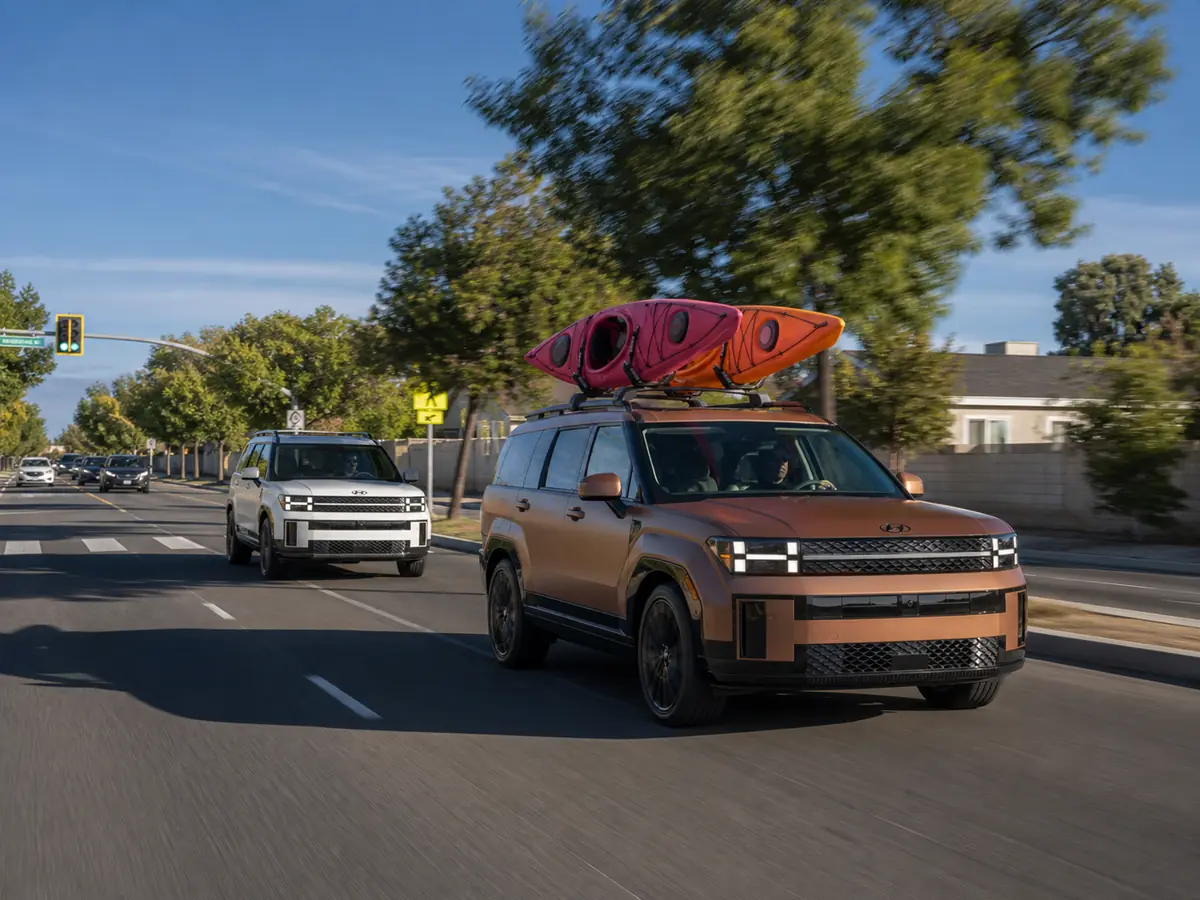
At 15,000 miles, a 24 mpg gas model uses about 625 gallons.
A 36 mpg hybrid uses about 417. The 208-gallon difference can be multiplied by a conservative local fuel price.
Then compare annual savings with the actual hybrid price difference, added interest, insurance, and expected ownership period.
AWD ratings are lower, so use the exact trim.
Highway-heavy drivers may save less because hybrids often show their largest advantage in lower-speed operation.
Cold weather, short trips, roof cargo, fast travel, tires, and elevation also change results.
Build a second calculation using a poor year. If the hybrid case works only with perfect ratings and high resale, it is too fragile.
The hybrid vehicle hub gives useful alternatives. Compare the Santa Fe with the Hyundai Tucson if five seats are enough.
Moving down a size can save more than changing drivetrains. Compare with the Honda CR-V Hybrid when a third row is only an imagined future need.
Gas remains sensible for drivers who tow, cover fewer miles, or receive a large discount.
Hybrid remains strongest for repeated traffic and longer ownership.
Choose the drivetrain from the route used every week, then make its price prove itself over five years.
Bench or captain chairs?
A second-row bench gives the Santa Fe seven seats. Captain chairs reduce capacity to six but create a center aisle and separate passenger space.
Neither is automatically better. The decision depends on child restraints, adult seating, third-row access, cargo, and whether the household needs the seventh place more often than it needs an aisle.
A bench can keep three children together, but three-across fit depends on restraint width and buckle position.
Install every seat and booster. Check that each can be tightened and that an adjacent child can buckle without reaching under another restraint.
Move the front seats to normal positions and verify rear-facing clearance.
Captain chairs can make third-row entry easier when no restraint blocks the slide mechanism.
They also allow two passengers to sit without rubbing shoulders. The gap can become a path for loose cargo during hard braking, so bags need secure storage.
A pet may also move between rows unless restrained properly.
Ask every passenger to enter and exit without assistance. Check door opening, grab handles, sill height, seat belt reach, and whether the second row returns to its marked position after sliding.
A seat that looks flexible can cause arguments when one child must climb past another at every stop.
Seat layout can also lock the buyer into a trim. Compare the out-the-door cost of the preferred layout rather than assuming it is a small option.
Price seat covers, floor mats, and cargo barriers only after confirming they do not interfere with airbags, rails, tethers, or folding mechanisms.
Review seven-seat vehicles with the actual passenger count. Some families will discover that five comfortable seats and a second car for rare group trips cost less than driving a three-row every day.
Others need the aisle enough to justify six seats.
Choose the bench or captain chairs by rehearsing the hardest school, carpool, or family trip, not by treating one layout as more luxurious.
XRT earns its keep towing
Most gas Santa Fe versions can tow up to 3,500 pounds when properly equipped. XRT raises the maximum to 4,500 pounds and adds all-terrain tires plus 1.3 inches of additional ground clearance.
That hardware has value when a real trailer or rough access road uses it.
It also adds purchase, tire, fuel, noise, and replacement cost.
Start with the trailer's loaded weight, not its empty brochure figure.
Add water, fuel, batteries, food, tools, accessories, and personal gear.
Measure tongue weight. Then read the payload label on the Santa Fe and subtract people, cargo, accessories, and tongue load.
A 4,500-pound rating can still be unusable when the family fills the cabin.
| Item | Standard gas | XRT |
|---|---|---|
| Maximum rating | Up to 3,500 lb | Up to 4,500 lb |
| Ground clearance | Standard ride height | About 1.3 inches higher |
| Tires | Road-focused by trim | All-terrain equipment |
| Best fit | Light occasional trailer | Heavier trailer or repeated rough access |
| Required proof | Manual, label, hitch | Manual, label, hitch, exact equipment |
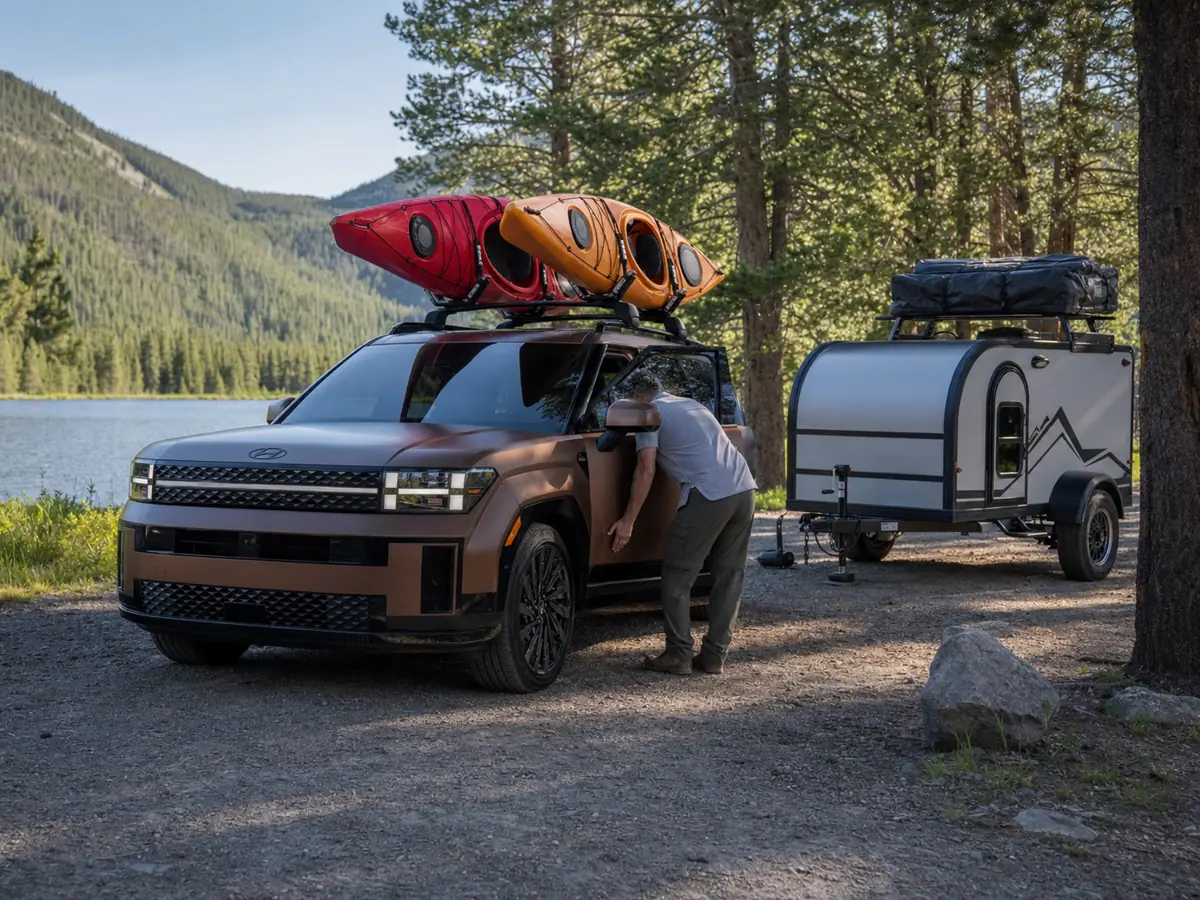
Confirm the hitch, wiring, cooling, brake controller, tire load rating, spare access, and owner's-manual instructions for the exact VIN.
Ask the dealer to identify factory towing equipment in writing. An appearance package or receiver installed after delivery does not automatically create the maximum rating.
All-terrain tires can improve grip on loose surfaces, but they do not create extra payload or shorten braking on pavement.
Compare wet braking, highway noise, steering response, and replacement cost. If the route is paved and the trailer is well below 3,500 pounds, another trim on road tires may be calmer and cheaper.
The AWD SUV index helps identify vehicles with more towing reserve. A larger Ford Explorer reaches 5,000 pounds in the right configuration.
If the combination regularly approaches the Santa Fe limits, choosing more vehicle is safer than relying on the maximum every trip.
Pay for XRT when its higher tow rating and clearance are used regularly. Otherwise, choose the quieter and cheaper family configuration.
Protect the rear passengers
A family SUV must protect people in every occupied row. Match crash-test evidence to the exact model year because structures, airbags, headlights, and driver-assistance software can change.
The current Santa Fe includes nine airbags, including rear side-impact coverage, but equipment still needs to be present, undamaged, and paired with correct restraint use.
Open the IIHS page for the exact year and read the updated side and moderate-overlap results, not only a broad award.
Check headlight ratings by trim. Use the VIN in the NHTSA recall lookup and save the result.
If a campaign shows complete, ask for the dated repair order and verify that warning lights behave normally at startup.
Test automatic emergency braking alerts, blind-spot monitoring, lane support, adaptive cruise, cameras, and parking sensors on a legal route.
Learn the controls while parked and clean every sensor. Assistance may be limited by rain, snow, faded markings, glare, dirt, or collision damage.
It never replaces an attentive driver.
Headlights deserve an after-dark test. Confirm low and high beams, aim, automatic switching, and corner visibility on the roads used most.
Larger wheels and all-terrain tires can also change wet and winter behavior. Four suitable tires with correct pressure matter every mile, while AWD only helps distribute driving power.
Collision history needs more than a clean paint finish. Ask for invoices when a windshield, bumper, radar, camera, pillar, roof rail, seat, belt, or airbag was repaired.
Require calibration records. Scan every module, not only the engine computer, because restraint and driver-aid faults can be stored without a constant dashboard warning.
KnowMotors explains the separate roles of manufacturer data, government recalls, and independent tests in its source standards. Use that evidence to compare the Santa Fe, then complete the safety plan with correct child restraints, secured cargo, suitable tires, and a driver who understands each setting.
The safest Santa Fe choice is the exact vehicle whose crash evidence, restraints, lights, sensors, tires, and repair history all match the family's real seating plan.
New hardware needs proof
The fifth-generation Santa Fe arrived for 2024, so long-term evidence is still developing. Its 2.5L turbo gas model uses an eight-speed dual-clutch transmission, while the hybrid has different engine, transmission, battery, and cooling hardware.
Reliability questions must be answered by the exact powertrain, build date, service history, scan, and road test.
Start the gas model cold. Check oil and coolant by the manual, watch every warning light, and listen for abnormal rattle, smoke, fuel odor, or uneven idle.
Test reverse and drive engagement, parking-lot creep, a hill start, stop-and-go traffic, and a highway merge.
A dual-clutch unit can feel different from a torque-converter automatic, but repeated shudder, harsh engagement, overheating messages, or inconsistent response need diagnosis.
The hybrid should move smoothly among electric assist, engine operation, regenerative braking, and friction braking. Inspect the battery cooling intake, check for warning history, and verify that software campaigns are complete.
A short silent movement does not prove the hybrid system is healthy. Request a full-module scan and road test it after a cold soak.
| Area | What to test | Evidence |
|---|---|---|
| Powertrain | Cold start, low-speed response, highway load | Drive plus full scan |
| Hybrid system | Transitions, brake feel, cooling intake | Scan and service history |
| Cabin hardware | All seats, releases, screens, cameras | Hands-on demonstration |
| Body | Roof, hatch, seals, glass, underbody | Inspection and repair invoices |
| Safety | Alerts, sensors, restraint warnings | Calibration records and scan |
| Warranty | Remaining terms and owner status | VIN printout and booklet |
Operate every seat, third-row release, liftgate, window, lock, outlet, climate zone, display, camera, phone connection, driver aid, and panoramic roof.
Pouring water into drains is not a casual test, but inspect headliner edges, spare area, carpet, seals, and odor for signs of entry.
Check underbody shields and the XRT area for impact damage.
Four tires should match in size, load rating, model, date, and similar tread.
Uneven wear can point to alignment, suspension, collision, or pressure problems.
Price replacements before purchase. A new tire beside three worn AWD tires may require more work than the seller suggests.
Use the used car guide to compare the discount with remaining warranty. Confirm coverage by VIN, original in-service date, title status, mileage, owner status, and market.
A warranty reduces repair risk only after the vehicle passes inspection and the buyer proves what coverage remains in writing.
Price the family equipment
Santa Fe ownership cost changes with drivetrain, trim, seat layout, AWD, tires, glass, insurance, financing, accessories, and the time the family keeps it.
Hybrid SEL is a useful cost baseline because it combines daily equipment with lower fuel use.
Gas Calligraphy and XRT serve different needs, but both can raise recurring expenses.
| Cost | Controlled pattern | Expensive trigger |
|---|---|---|
| Purchase | SEL at a clean total | Calligraphy or packages chosen for appearance |
| Fuel | Hybrid on traffic-heavy routes | Gas AWD, short cold trips, fast highway use |
| Tires | Moderate road wheel | Large wheel or XRT all-terrain set |
| Insurance | Exact VIN quote | High trim value, glass, roof, towing use |
| Accessories | Mats and restraint-safe storage | Roof box, bars, hitch, electronics without a plan |
| Finance | Shortest affordable term | Long loan hiding a large total |
Get insurance quotes for exact VINs and drivers. Ask about windshield camera calibration, panoramic roof claims, towing use, and original-equipment parts.
Price a full set of tires with installation and alignment. An XRT set may cost more and wear differently from a standard road tire.
A large wheel can also increase pothole risk.
Build five-year gas and hybrid estimates with the same annual miles. Include purchase, interest, fuel, insurance, service, tires, registration, accessories, and a repair reserve.
Use conservative MPG and resale. The worksheet is not a promise.
It exposes whether one choice works only when every assumption is favorable.
Family accessories deserve the same discipline. A roof box may solve rare cargo problems but changes height and fuel use.
A hitch carrier uses tongue capacity and can affect camera or liftgate operation.
Floor liners must not interfere with pedals. Seat protectors must be allowed by the child-seat and vehicle instructions.
Compare the out-the-door total with three-row SUV choices and the best family SUVs. A larger vehicle may cost more to fuel but avoid purchasing a roof box or replacing the Santa Fe early.
A smaller two-row vehicle may save thousands if the third row would remain folded.
Keep trade value, financing, and purchase price separate. A high trade allowance can hide a high Santa Fe price, while a low payment can hide a long loan.
Compare 48, 60, and 72-month interest totals.
The best-value Santa Fe is the least expensive configuration that carries the actual family safely, not the trim with the longest equipment list.
When should you go larger?
Choose Santa Fe when its third row is occasional, its boxy cargo area handles the normal load, and its shorter footprint makes parking or fuel use easier. Move to a larger SUV or minivan when adults use row three every week, every seat must stay raised on trips, or cargo regularly blocks vision and passenger comfort.
Run one final rehearsal with the exact vehicle. Install restraints, assign every seat, load the stroller and bags, close the hatch, drive the difficult route, park at home, and let every passenger exit.
Then verify safety evidence, inspect the chosen drivetrain, quote insurance and tires, and compare out-the-door totals.
A household may discover that the Santa Fe is perfect for five people plus two occasional guests. Another may find that grandparents cannot enter row three or that sports gear consumes the cargo area.
That result is useful. It prevents the family from trading again after one uncomfortable trip.
Compare larger alternatives on the same day.
Telluride emphasizes regular three-row utility. Palisade offers Hyundai controls in a bigger package.
Pilot provides another family-first layout. A minivan should be included when sliding doors, a low floor, and luggage behind row three matter more than SUV styling.
Do not let a discount change the passenger requirement. A cheap trim that forces an adult into a poor seat or leaves a stroller at home is expensive in use.
Do not let a rare trip define every commute either. Renting a larger vehicle twice a year can cost less than driving extra size every day.
The Santa Fe third row works for families that use it as flexible capacity and confirm cargo at the same time. Regular seven-person travel deserves a larger vehicle.