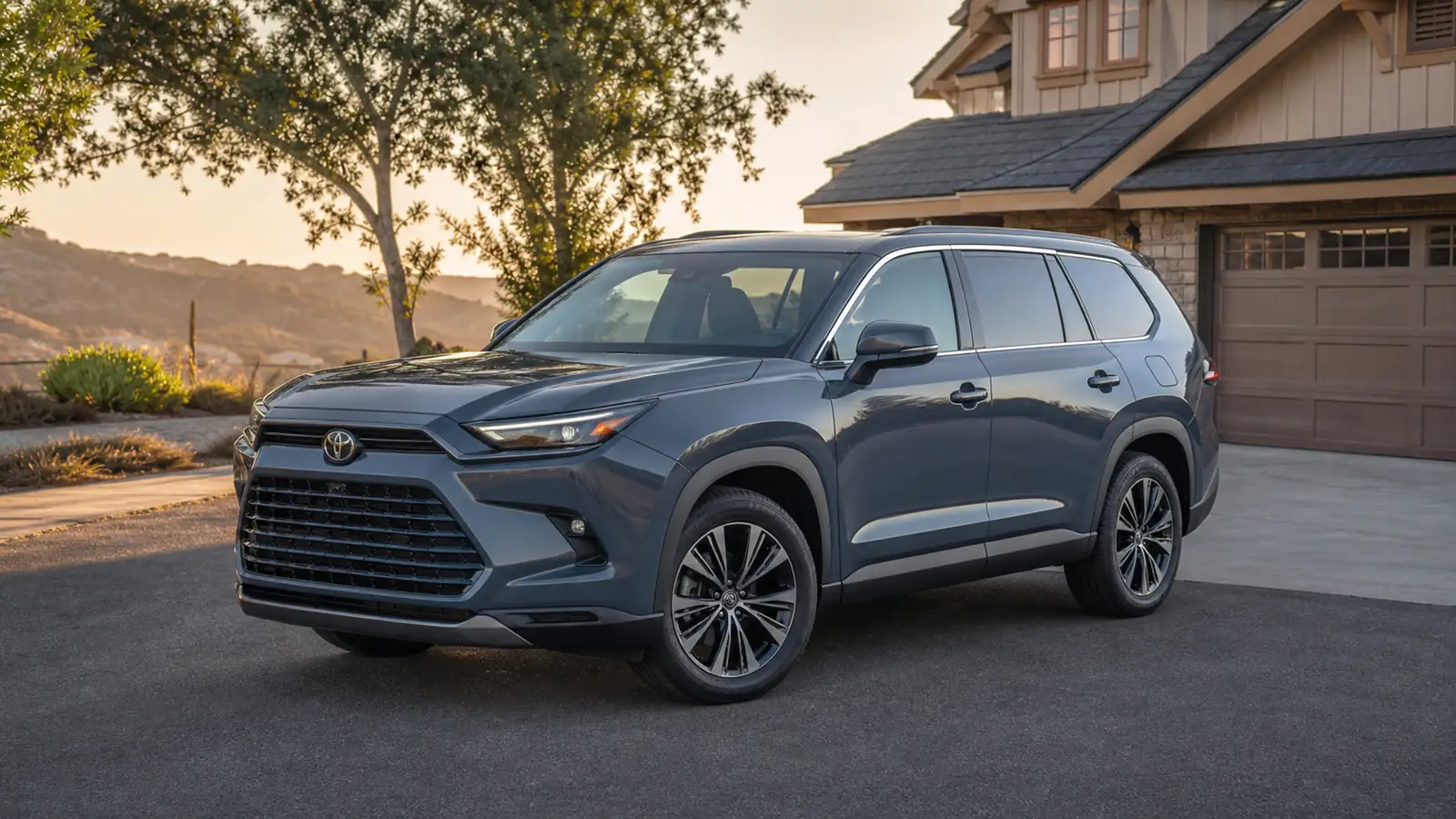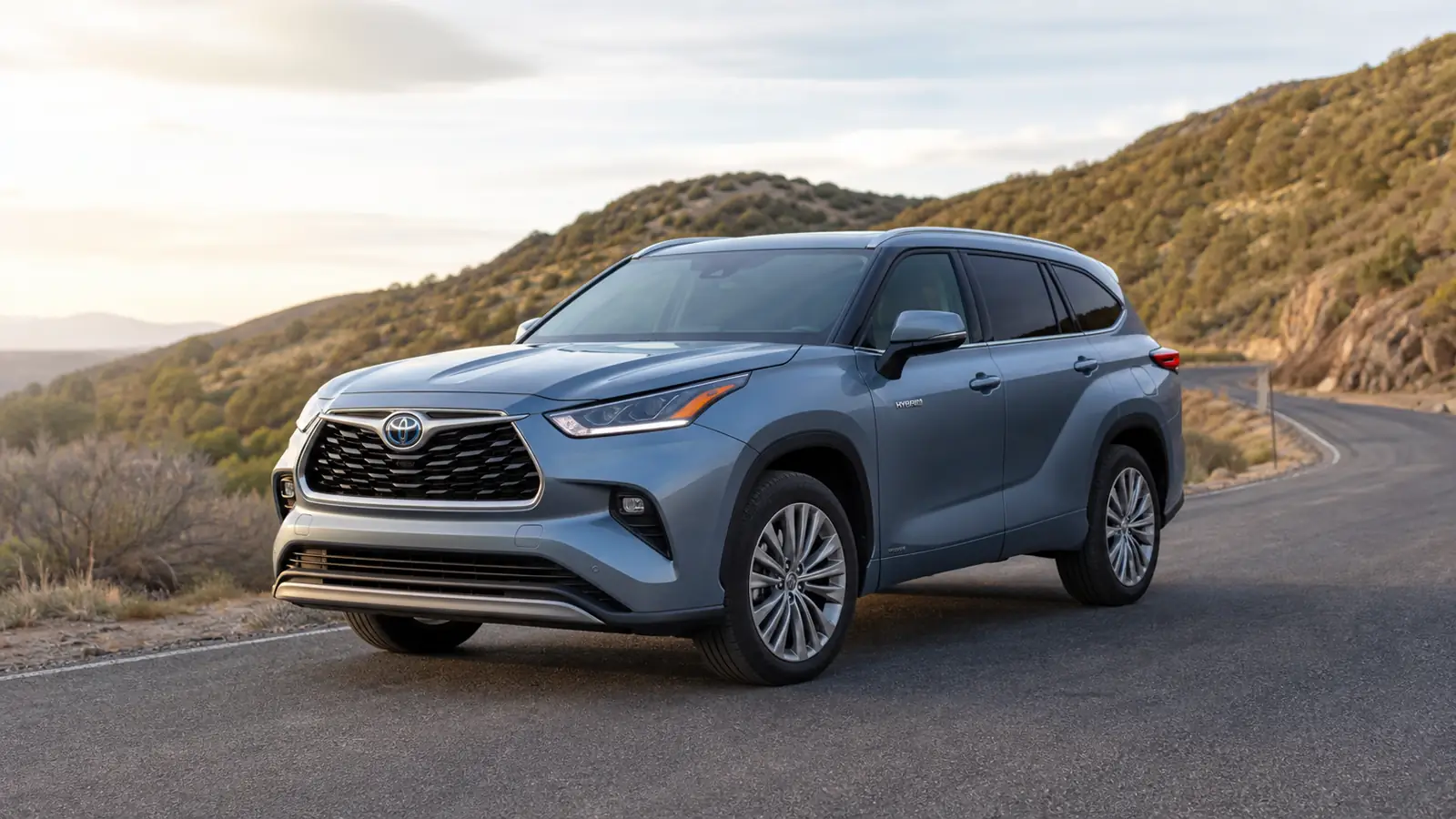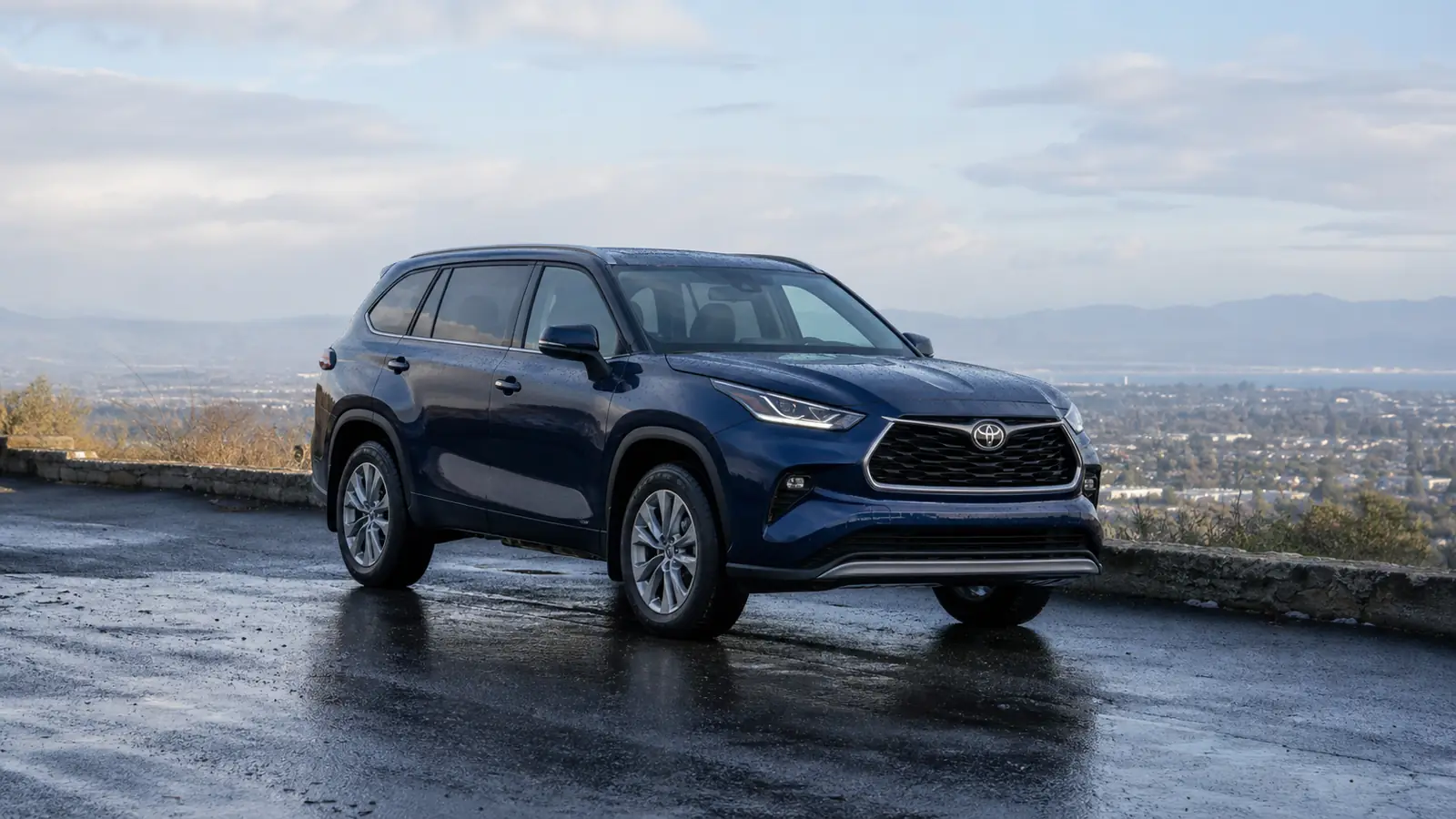
Hybrid XLE is the Highlander to beat
The 2026 Toyota Highlander starts at $45,270 for gas XLE and $47,020 for Hybrid XLE before destination. Every version now has all-wheel drive, so the first decision is powertrain rather than traction.
Hybrid XLE is the best starting point for most families. Its 243 hp system carries a manufacturer-estimated 35 mpg combined rating, while the 265 hp turbo gas model is estimated at 24 mpg combined.
That 11 mpg gap is large enough to matter for school runs, commuting, and suburban errands.
The Highlander belongs in the three-row SUV category and the mainstream price tier, but its third row is best for children or occasional adult trips. The body is easier to park than larger rivals, and its road manners feel closer to a family crossover than a truck.
XSE is gas-only and changes suspension tuning, wheels, and styling. Before paying for it, compare the same pothole and highway curve in XLE.
The firmer setup and larger wheels can make steering response feel sharper, but they also reduce tire sidewall and raise replacement cost.
XSE does not increase passenger space, hybrid economy, or towing beyond the gas configuration.
Limited and Platinum should be judged the same way. Ventilated seats may matter in a hot climate, a surround-view camera can reduce parking stress, and a heated steering wheel helps in winter.
Premium audio, ambient light, and trim finishes are personal wants. Write down which features solve a repeated annoyance, then price the lowest trim containing them.
This prevents a package from turning one useful feature into several thousand dollars of unused equipment.
Limited and Platinum add leather, larger screens, audio, cameras, and comfort equipment. Those upgrades can improve daily life, but they do not fix the small third row.
- Choose Hybrid XLE for the best fuel and equipment balance
- Choose gas XLE when a heavier trailer is part of normal use
- Choose Limited for ventilation, audio, and camera equipment used every day
- Choose Platinum only when the panoramic roof and top comfort package justify the price
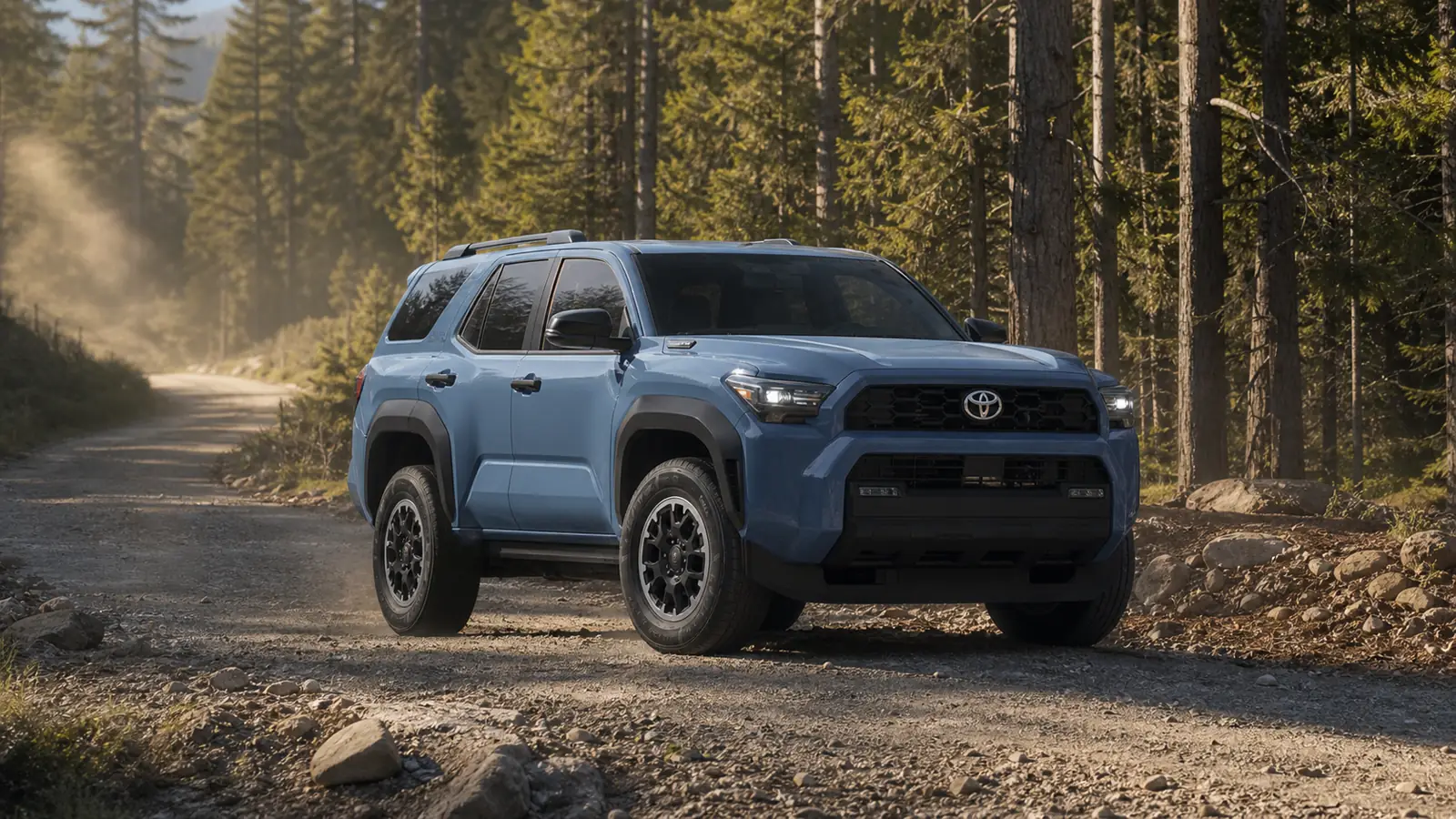
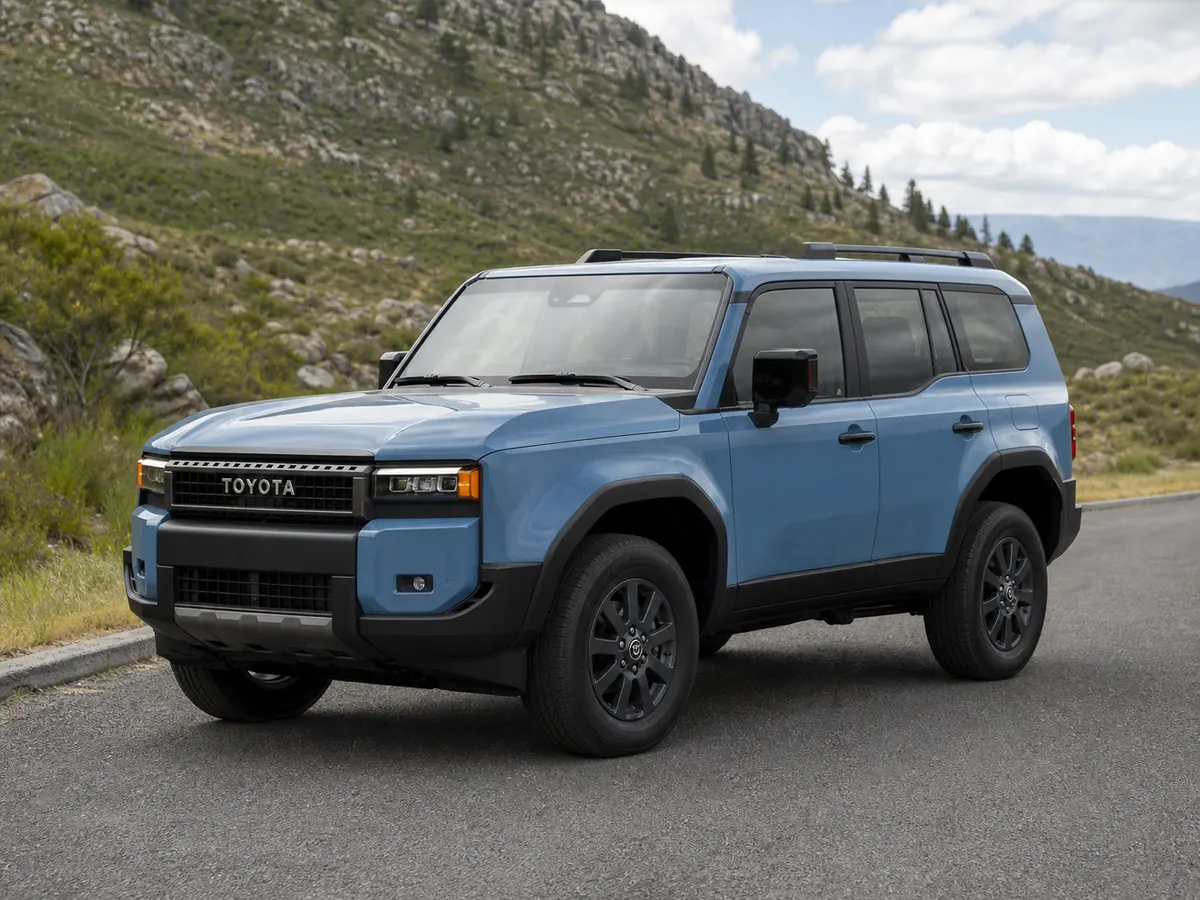
The Toyota SUV range includes the larger Grand Highlander and the truck-based 4Runner. Test those only when the Highlander's rear space or towing ceiling creates a real problem.
Hybrid XLE keeps the Highlander's strongest qualities without paying to make it something larger or more specialized.
Gas and hybrid solve different family workloads
The gas Highlander uses a 2.4L turbo four-cylinder rated at 265 hp and 310 lb-ft.
It pairs with an eight-speed automatic and standard AWD. The hybrid combines a 2.5L engine with electric motors for 243 total hp and uses an electronic rear motor for AWD.
Neither version is a performance SUV. The gas model has stronger passing response with a full cabin and better towing capacity.
The hybrid is smoother in stop-and-go traffic and uses much less fuel where frequent braking lets it recover energy.
| Question | Gas AWD | Hybrid AWD |
|---|---|---|
| Combined fuel estimate | 24 mpg | 35 mpg |
| System output | 265 hp | 243 hp |
| Maximum towing | Up to 5,000 lb | Up to 3,500 lb |
| Best route | Highway, hills, trailer duty | City, suburbs, high annual miles |
| Main cost risk | Fuel use | Higher purchase price |
Towing deserves a separate ownership test because the gas model can pull more but also uses more fuel while doing it.
Weigh the loaded trailer, measure tongue weight, and compare the result with the vehicle payload label. Add every passenger, child seat, cooler, and hitch component before deciding the gas rating is usable.
A trailer near 5,000 pounds may leave less room for people and cargo than the seat count suggests.
Drive the planned combination on a grade and at highway speed only with a qualified setup.
Watch engine temperature, transmission behavior, mirror coverage, braking stability, and rear suspension level. Store the hitch when not needed if it blocks the rear camera or creates a shin hazard.
The hybrid remains the better family-mile choice when a light utility trailer stays within 3,500 pounds and the payload calculation works.
Gas becomes rational when the heavier load is real, frequent, and safe, not when towing is a someday possibility.
A 12,000-mile driver using $3.50 fuel would burn about 500 gallons at 24 mpg and about 343 gallons at 35 mpg.
That rough difference is 157 gallons, or about $550 a year.
Actual results depend on speed, temperature, load, and route.
The $1,750 starting-price difference between comparable XLE powertrains can be recovered in a few years for a city-heavy household.
A low-mile highway driver may take much longer. Include finance interest and the exact dealer quote rather than using MSRP alone.
The hybrid does not plug in. Its efficiency case becomes stronger when the household combines short errands with repeated braking, because electric assistance can reduce engine-on time.
Cold highway travel narrows the benefit because cabin heat, speed, and aerodynamic drag keep the engine working.
Record one week of trips before estimating payback. A family that drives 15,000 miles with half in urban traffic has a different result from a household that drives 7,000 steady highway miles.
Compare gallons, not the MPG gap alone, then add the interest charged on the hybrid premium.
The hybrid does not plug in. Its battery sits beneath the second row, and the system charges through the engine and regenerative braking.
It cannot provide a normal electric commute, but it also needs no charging routine.
Gas earns its place when towing is frequent. Confirm the receiver, wiring, cooling equipment, trailer brakes, tongue weight, and payload on the exact vehicle.
The planned Highlander towing breakdown should handle that calculation in detail.
Drive both with the number of passengers you normally carry. Use a highway ramp, a hill, a low-speed parking section, and a rough road.
Choose hybrid for repeated miles and gas for a documented load, because the badges alone do not reveal the cheaper fit.
The third row sets the Highlander's family limit
Toyota offers seven seats with second-row captain's chairs and up to eight with an available bench on selected XLE and Limited versions. The seat count sounds generous, but the third row has less adult space than the Honda Pilot or larger Grand Highlander.
Access is easier with captain's chairs because a child can walk between them. A bench carries one more person and may suit three children across the middle row, yet it makes the path rearward more dependent on sliding and folding a seat.
Bring every child seat, booster, stroller, and sports bag that determines whether the SUV works.
Install the seats instead of holding them near the anchors. Check whether a rear-facing seat leaves a safe front-passenger position and whether third-row riders can buckle without help.
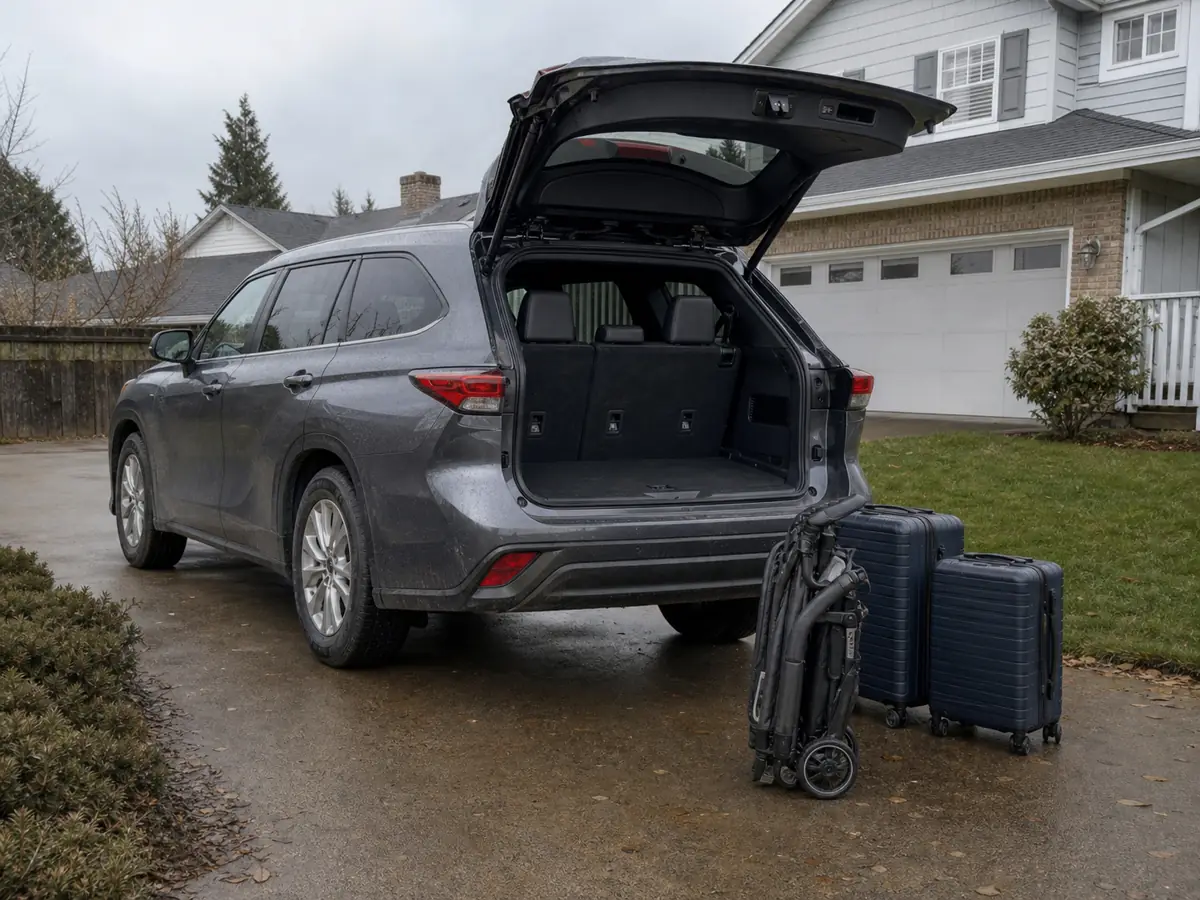
With every seat raised, luggage room is the constraint. Measure the space from the seatback to the closed hatch at floor and belt height because a sloped hatch can shorten the usable top half.
Test whether grocery bags stand upright without touching the glass and whether a stroller can remain loaded while the third row is occupied.
Second-row captain chairs create an aisle, but loose bags can slide forward through it under braking.
Use tiedowns or a cargo barrier where appropriate. A bench blocks that aisle and changes how passengers reach row three, so the seating decision affects both movement and load security.
That limit becomes obvious on a full-family trip. A three-row SUV can carry people or bulky vacation gear more easily than it carries both.
Fold half of the split third row and see whether the remaining seat still works beside bags.
- Test third-row knee room behind the actual second-row position
- Measure cargo depth with every seat raised
- Check the hatch angle in a garage
- Confirm captain's chairs or bench before signing
- Use every tether anchor and buckle with the chosen child-seat layout
Families who need six or seven seats every day should compare the Pilot and a minivan body such as the Toyota Sienna.
Families who need them twice a month may prefer the Highlander's smaller footprint and fuel economy.
Buy the Highlander only after the full passenger-and-cargo rehearsal works, because maximum volume hides the configuration used on a real trip.
Road comfort is stronger than performance or trail ability
The Highlander feels easy from the first mile. Steering is light, controls are predictable, and the suspension keeps normal bumps from upsetting the cabin.
That calm behavior is useful when passengers are talking, sleeping, or using screens.
Gas XSE uses firmer tuning and larger wheels. It turns more eagerly but can send more impact into the cabin.
The standard versions match the Highlander's family purpose better unless the XSE's appearance and response are specific priorities.
Hybrid response is smooth at neighborhood speed. The engine can sound busy under a long climb because the eCVT lets it hold the speed needed for power.
That sound is normal, but vibration, warning lights, or an uneven handoff between electric and engine drive are not.
Use this mixed test route:
- Start cold and listen through the first minute
- Accelerate onto a fast road with the cabin loaded
- Hold 65 to 75 mph long enough to judge wind and tire noise
- Cross broken pavement to compare wheel packages
- Park in a tight space using mirrors and cameras
- Climb a grade to compare gas shifting with hybrid engine sound
The Highlander is not designed for the low-range work handled by the Toyota 4Runner.
The Subaru Forester is a smaller standard-AWD alternative when five seats are enough. Its AWD helps on wet roads, snow, and maintained dirt, but ground clearance and road tires still set limits.
Winter tires may help more than an expensive trim.
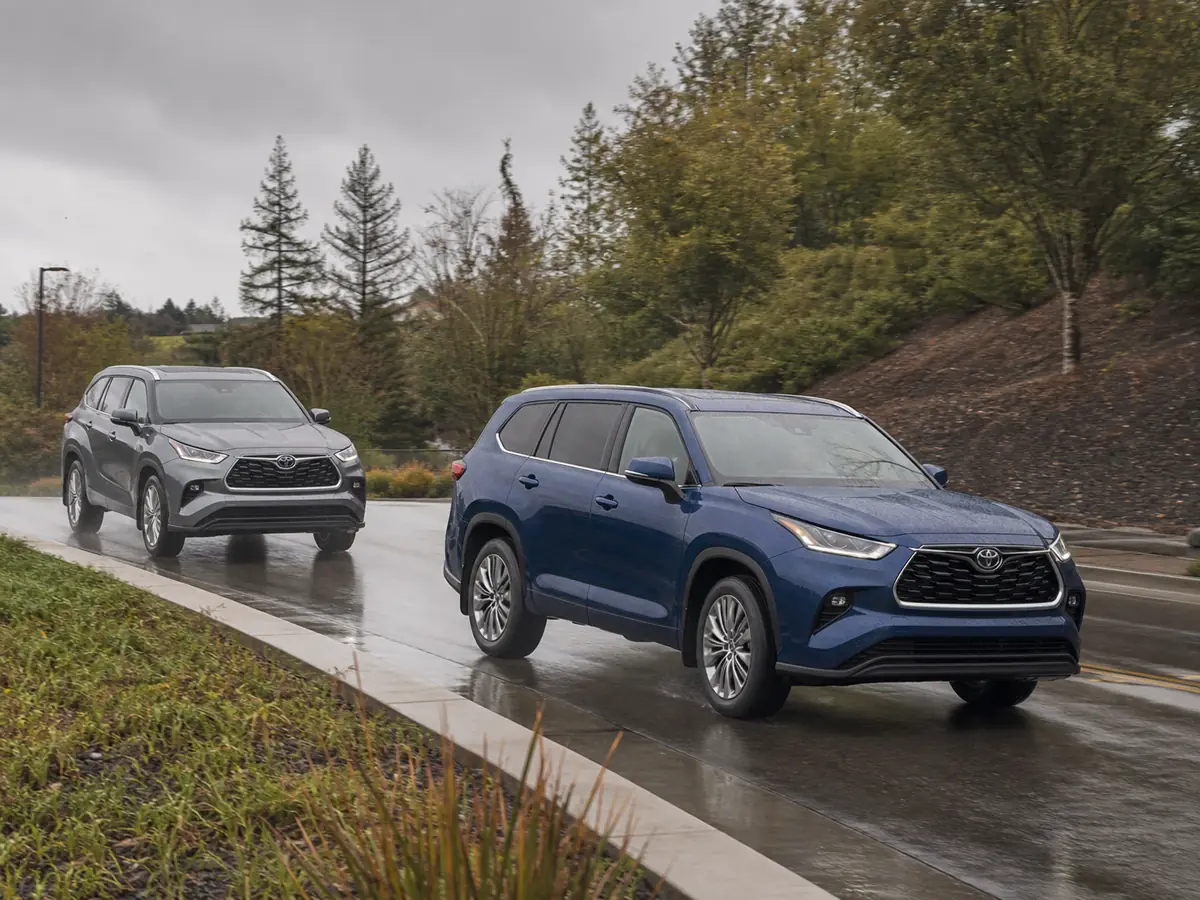
Driver assistance should engage and cancel cleanly. Toyota Safety Sense 2.5+ is standard, but the driver remains responsible for braking, lane position, and speed.
Test adaptive cruise and lane support rather than assuming every system behaves the way a previous Toyota did.
The Highlander wins by reducing effort, so a trim that rides worse or a powertrain that sounds wrong on your route defeats the reason to buy it.
Current safety results carry one rear-seat caution
IIHS gives the 2026 Highlander Good ratings in the small-overlap and updated side tests. The updated moderate-overlap result is Marginal, with rear-passenger restraints contributing to the lower result.
That distinction matters for a vehicle bought to carry children and adults in back. It does not make the Highlander unsafe, but it prevents a broad claim that every crash result is equally strong.
Compare the exact test categories, not an old award badge.
Standard blind-spot detection, lane-departure prevention, and pedestrian crash prevention add useful layers.
IIHS rates the standard pedestrian system Good. Headlight performance varies by trim or equipment, so check the exact configuration.
A safety comparison should use the people who sit in each position. Put the smallest child in the correct restraint, place a taller teen or adult in row three, and ask each rider to buckle without twisting.
Check head restraint height, roof clearance, knee contact, and whether second-row occupants move their seats so far forward that their own belt geometry suffers.
Repeat the exercise in a Pilot or Grand Highlander. The Highlander may still win if the third row is rare, but the family should understand the compromise before a crash test makes it abstract.
Night driving adds another check. Use low and high beams on an unlit road, observe glare, and confirm automatic high beams respond without distracting other traffic.
Headlight performance varies by configuration, so the exact test car matters. Adjust head restraints, confirm every seat belt retracts and latches, and install the actual child seat.
A system rating cannot correct a loose installation or a child who has outgrown the seat.
Visibility is good for the class, though the rear pillars and raised head restraints still create blind areas. Clean every camera, test rear cross-traffic alerts, and use mirrors before depending on the screen.
The family SUV shortlist should compare safety evidence with space, fuel, and price. Treat the Marginal updated moderate-overlap result as a reason to compare, not a reason to ignore the Highlander's other Good results.
A used Highlander needs generation-specific checks
The fourth-generation Highlander began for 2020. Early models used a V6 or hybrid, while later gas versions changed to the 2.4L turbo.
A 2021 V6, 2024 turbo, and 2026 hybrid are different mechanical decisions even though the body looks similar.
Toyota's hybrid record is a strength, but it does not remove inspection work. Check the hybrid battery cooling intake for blockage, scan every control module, and verify smooth engine starts and stops.
Service history should show regular oil, coolant, brake, and tire care. For a hybrid, inspect the rear-seat area around the battery cooling intake and ask whether pets, blankets, or cargo regularly blocked it.
Listen for the battery fan after a demanding drive. A loud fan does not prove failure, but it deserves a scan and temperature review.
For a turbo gas model, examine coolant condition and hose connections only when the engine is cool, then monitor temperature during a long climb.
Ask the technician to inspect fuel trims, misfire history, boost behavior, and pending codes. For every version, measure brake rotor condition rather than assuming regenerative braking makes brakes permanent.
Low brake use can allow corrosion in wet or salted climates. Check the spare or repair kit, jack tools, and tire date codes because family trips expose missing equipment at the worst time.
Gas-turbo examples need a cold start, stable idle, predictable eight-speed shifts, correct coolant level, and no oil or coolant leaks.
Ask about warning lights or software updates. A clean dashboard after the seller cleared codes proves little.
- 2014 to 2019Third generation, commonly sold with V6 and hybrid power
- 2020 to 2022Fourth generation begins with V6 and hybrid choices
- 2023 to 2025Turbo four-cylinder replaces the V6 on gas models
- 2026AWD becomes standard and the trim range is simplified
Check all four tires for matching size, model, and similar tread depth. AWD can hide poor tire choices until vibration, noise, or driveline stress appears.
Look underneath for impact damage and inspect every wheel for bends.
Electronics deserve a complete pass. Test both screens, every USB port, cameras, climate zones, power seats, liftgate, moonroof, driver aids, and keys.
A weak 12-volt battery can create several warnings, but battery replacement should not be used to dismiss a stored fault without diagnosis.
Use the planned Highlander reliability research for model-year detail and the Highlander recall lookup for current campaigns. A technician should scan the vehicle and inspect it cold before money changes hands.
A strong used Highlander has a clear powertrain history, four matched tires, clean cooling systems, working electronics, and invoices that explain its care.
Fuel, tires, and trim price shape the ownership bill
The hybrid's fuel advantage is the largest recurring difference. Use annual miles, local fuel price, and a realistic city-highway split.
Do not compare the 35 mpg combined estimate with the gas model's best highway number.
Trim price matters because a loaded Highlander can overlap larger or newer three-row SUVs. Extra equipment also adds 20-inch tires, more glass, power accessories, and higher insurance value.
Those features may be worthwhile, but they raise repair and replacement exposure.
| Cost | Lower-cost pattern | Higher-cost trigger |
|---|---|---|
| Purchase | Hybrid XLE or gas XLE at a fair quote | Limited and Platinum equipment |
| Fuel | Hybrid in mixed and city driving | Gas AWD with high annual miles |
| Tires | Smaller XLE wheel package | 20-inch wheels and neglected rotations |
| Insurance | Exact VIN quoted before purchase | High trim value and panoramic glass |
| Depreciation | Mid trim kept beyond the loan | Loaded trim traded early |
| Towing | Hybrid within 3,500-lb limit | Gas, hitch equipment, trailer brakes, added fuel |
Price a full tire set before choosing wheels. The correct comparison includes mounting, balancing, alignment, and the possibility that AWD needs four closely matched tires rather than one replacement.
Get insurance quotes for the exact VINs. Hybrid, gas, XSE, Limited, and Platinum can carry different replacement values and equipment.
Add glass coverage terms if the panoramic roof or camera-equipped windshield makes a claim expensive.
The planned Highlander cost-to-own analysis can extend the estimate. For the purchase decision, compare out-the-door price, loan interest, annual fuel, insurance, tires, and the first major service across exact trims.
A used hybrid also deserves a remaining-warranty check. Toyota hybrid components have longer factory coverage than the basic vehicle in many states and model years, but the exact term depends on original sale, location, and component.
Confirm coverage by VIN with Toyota rather than assuming every battery or inverter repair is covered. Warranty can reduce near-term risk, yet it does not replace a clean cooling intake, correct fluids, and service history.
Strong resale helps only if the purchase price is controlled. Paying several thousand dollars for unused equipment is not recovered simply because the badge holds value.
Hybrid XLE is usually the cost center because it combines the fuel advantage with a restrained equipment bill.
Where the Highlander helps and where it feels small
The Highlander hybrid returns roughly 35 combined mpg with standard all-wheel drive, a fuel-economy and traction combination most three-row rivals cannot match without a plug-in battery.
The tradeoff is interior space: the third row fits children comfortably but restricts adult legroom on trips longer than 30 minutes, and cargo behind that row measures only 16 cubic feet.
A buyer who needs adult third-row capacity or flat-floor cargo should test the Grand Highlander or a competing platform before committing.
The list below isolates what the standard Highlander does well from what the buyer gives up at this price.
Pros
- 35 mpg hybrid estimate
- Standard AWD
- Easy road manners
- Strong resale
Cons
- Tight third row
- High 2026 entry price
- Gas model uses more fuel
- Aging platform
Who should buy a Highlander
Buy a Highlander if you carry four or five people most days, need a third row occasionally, and want an easy-driving SUV with strong hybrid fuel economy. Hybrid XLE is the broad recommendation.
Choose gas when a properly calculated trailer exceeds the hybrid's rating or when the purchase quote makes hybrid payback unreasonable. Do not choose gas for a vague idea that more power is always better.
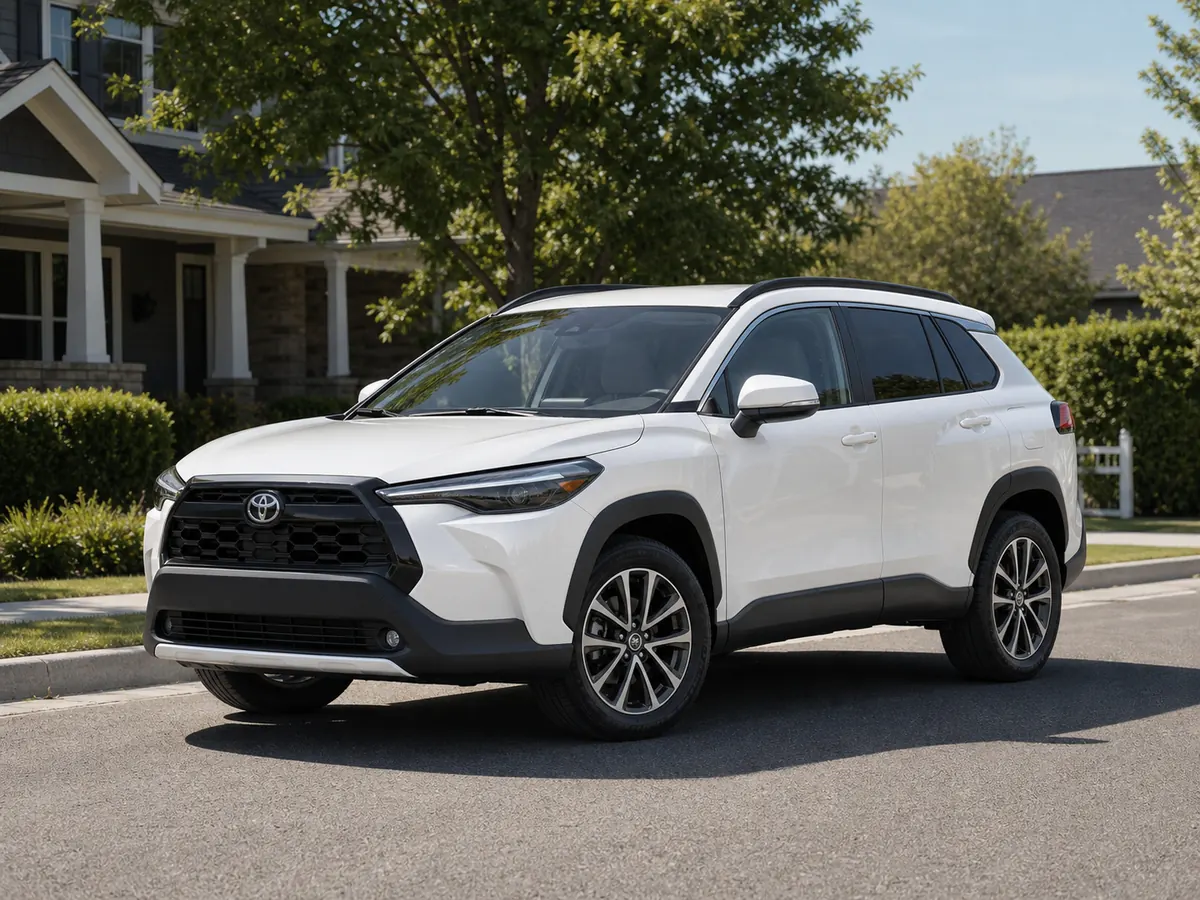
Compare the Honda CR-V or RAV4 Hybrid when five seats are enough, the Pilot when third-row room leads, and the Sienna when sliding doors and maximum family packaging matter. A shopper who needs low-range 4WD should move toward the 4Runner instead.
Before signing, complete the cargo rehearsal, child-seat installation, mixed road test, insurance quote, tire-price check, and fuel calculation. Verify the window sticker and VIN because bench seating, screens, wheels, and safety equipment vary.
The Highlander is best for the family that needs an efficient five-seat SUV most days and a usable third row some days.