Which Toyota Highlander years should you avoid?
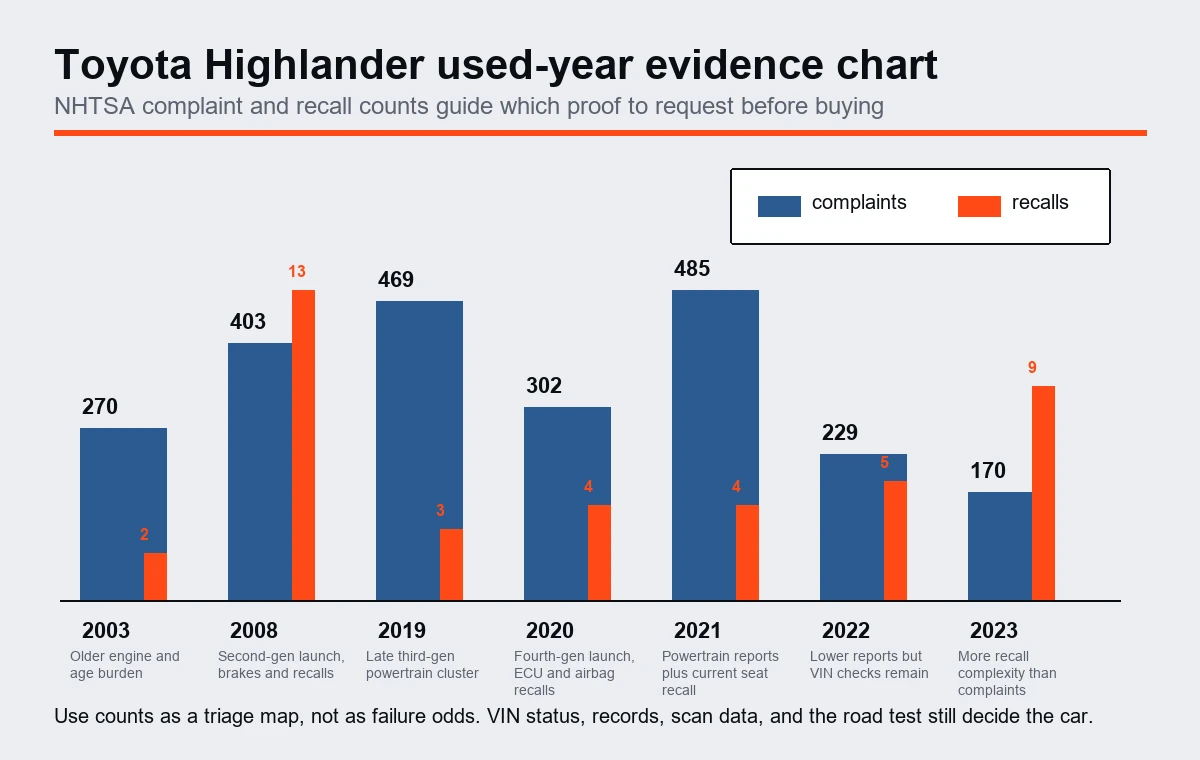
Put 2008, 2019, 2020, and 2021 at the back of the list first. The 2008 is the highest-burden second-generation year in the current NHTSA data, 2019 shows a strong powertrain complaint cluster, and 2020 to 2021 combine fourth-generation launch evidence with current recall questions.
The older 2003 also deserves caution, but for a different reason. It now asks an age, engine, cooling, corrosion, and maintenance question more than a modern recall question.
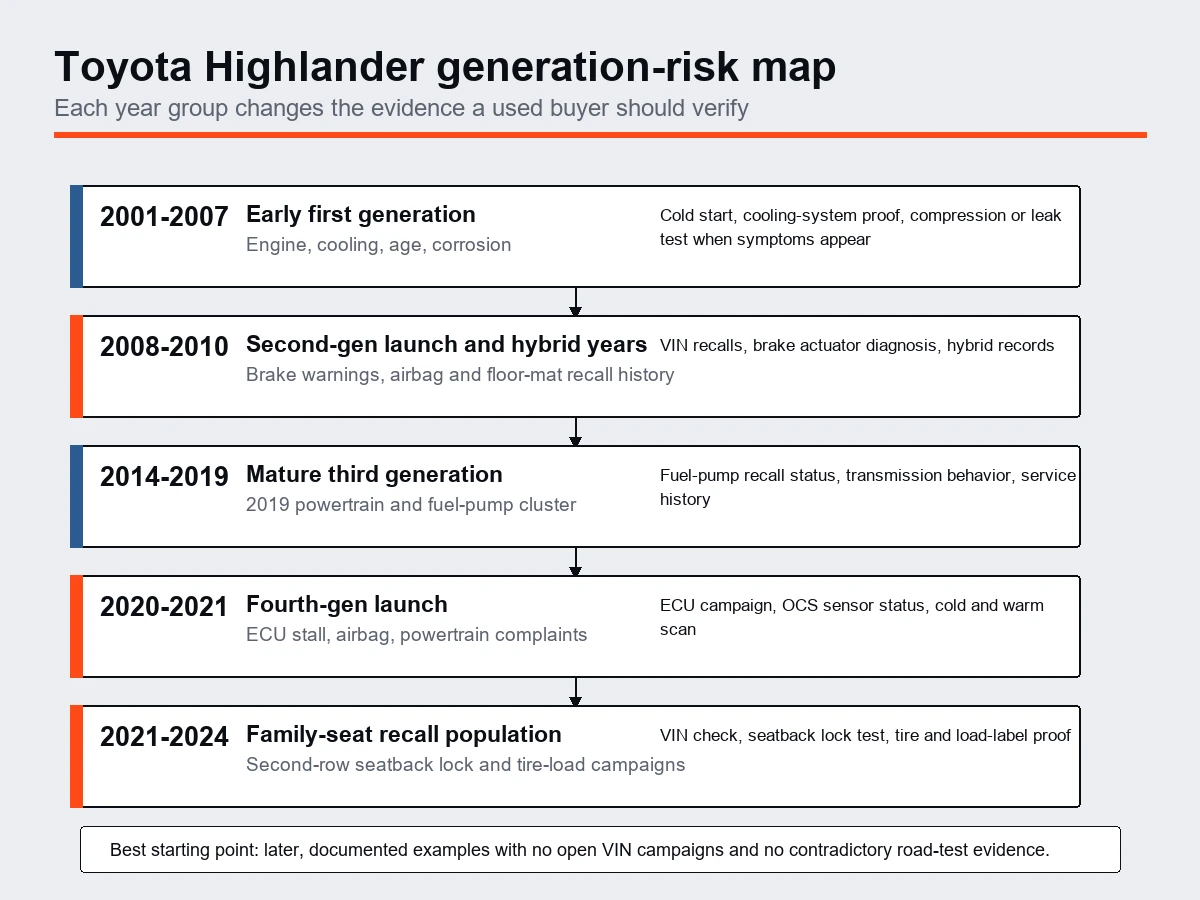
Use those years as screening flags, not as failure odds. The NHTSA complaint database shows where owners reported concerns, but it does not normalize by sales volume, mileage, road salt, owner behavior, completed repairs, or years on the road.
A clean year is not a warranty either. Service history, tire condition, crash repair, warning lights, hybrid battery cooling, and a cold-to-hot road test can make a supposedly better Highlander worse than a documented example from a risky year.
The 2008 to 2010 Highlander needs brake and recall proof
The 2008 Highlander is the clearest second-generation caution point. The current NHTSA API returns 403 complaints and 13 recalls for 2008, with complaint categories led by engine, service brakes, air bags, vehicle speed control, and steering.
That does not identify one universal defect. It tells you that a 2008 to 2010 Highlander needs several separate checks before the price looks attractive.
| Concern | Evidence to request | Present check | Buying response |
|---|---|---|---|
| Brake warnings | Diagnostic history, actuator or hydraulic work, warning-light record | Pedal feel, ABS or brake lights, scan data, hybrid brake behavior | Do not buy around unexplained brake warnings |
| Airbag and seat-belt campaigns | VIN status for 08V181, 11V245, and related airbag work | Airbag light, seat-belt locking function, crash-history review | Continue only when recall closure and present function agree |
| Window switch and floor-mat recalls | VIN status for switch and accelerator-pedal floor-mat campaigns | Driver mat fit, pedal clearance, window switch heat or odor | Reject missing or improvised fixes |
| Hybrid system | Hybrid service history, 12-volt health, cooling intake condition | Smooth engine stop-start, no hybrid warnings, scan after road test | Inspect with a hybrid-capable shop when history is thin |
NHTSA campaign 08V181 covered certain 2008 Highlanders with third-row seats because rear seat belts might not lock a child restraint correctly. Campaign 11V245 covered certain 2008 Highlander and Highlander Hybrid vehicles for a curtain-shield airbag sensor issue.
Toyota also had power-window switch and floor-mat related campaigns across the 2008 to 2010 period. A seller saying "all recalls were done" is weaker than a VIN printout and repair orders that name the campaign, date, mileage, and work performed.
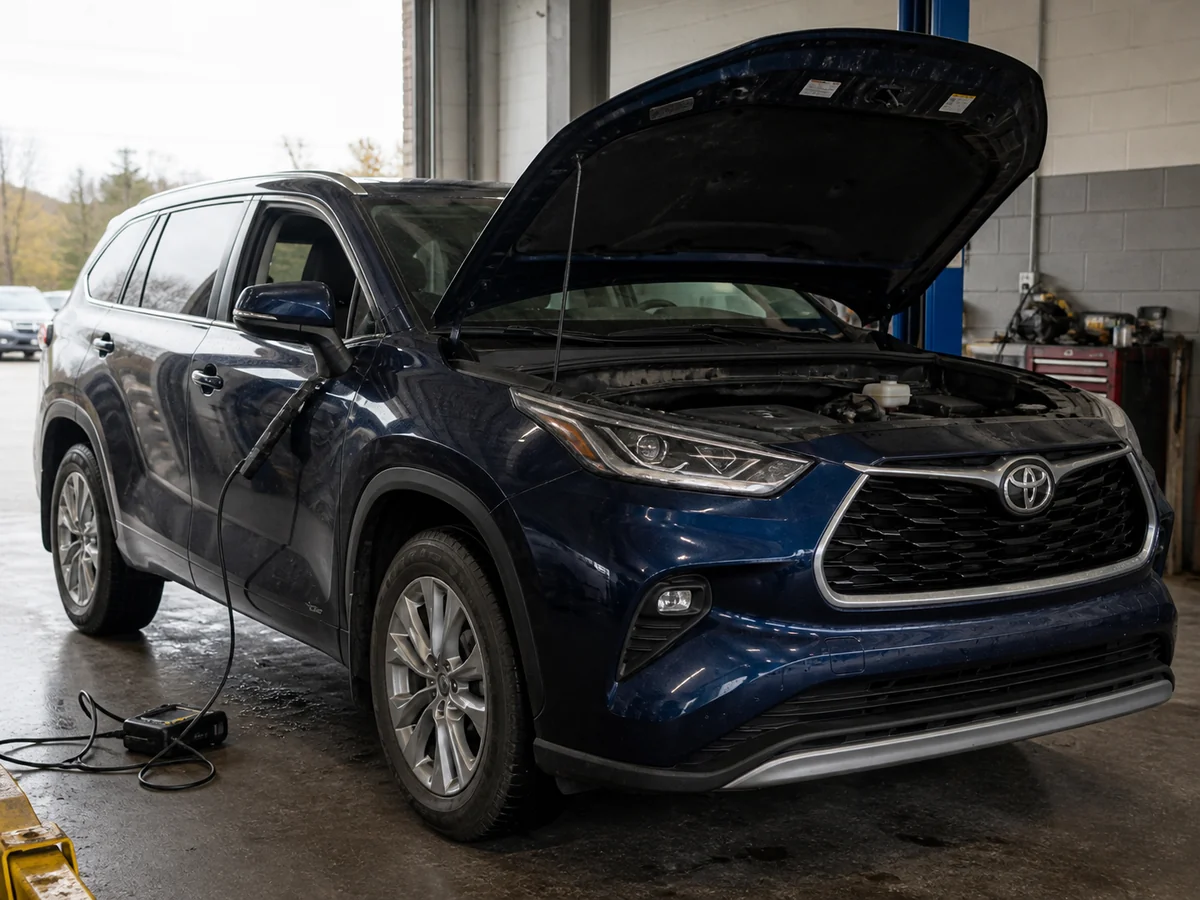
The brake check matters because a used family SUV often hides warning history behind a fresh battery or cleared code. Scan the vehicle before the drive, test it from cold to warm, then scan again so stored or pending brake, ABS, stability, and hybrid codes are not missed.
Walk away from a 2008 to 2010 Highlander when the brake warning, airbag light, recall status, or seller paperwork conflicts with what the scan and road test show. A lower price cannot turn unknown brake or restraint evidence into a normal maintenance item.
The 2019 to 2021 risk is powertrain proof, not brand reputation
The 2019 Highlander has the strongest late third-generation signal in the current NHTSA query. It returns 469 complaints, with 158 grouped under power train and 48 under fuel or propulsion system.
The 2020 and 2021 years carry their own proof burden. NHTSA currently returns 302 complaints for 2020 and 485 for 2021, with power train as the largest component group in both years.
The 2021 count should not be read as a claim that the redesigned Highlander is fragile. It means the test drive needs to spend more time on cold engagement, low-speed hesitation, shifting response, stop-start behavior, warning messages, and scan data than it would on a quieter year.
Powertrain complaints can also describe different driver experiences. Some reports name hesitation, delayed movement, gear-selection behavior, or a warning message, so the useful purchase step is to reproduce the symptom or prove that it is absent after a normal full-temperature drive.
The 2019 question starts with the low-pressure fuel pump population. NHTSA campaigns 20V012 and 20V682 include certain 2017 to 2019 Highlanders because the fuel pump may fail, which can cause the engine to stall and increase crash risk.
A completed recall matters, but it does not replace the drive. Hesitation, stall history, hard starting, fuel odor, warning lights, or a seller who recently cleared codes should push the vehicle into diagnosis before negotiation.
The 2020 Highlander launched the fourth generation and added a separate V6 ECU programming recall. NHTSA campaign 20V162 covers certain 2020 Highlanders with the 3.5-liter V6 because fuel may not be correctly supplied while using stop and restart, which can cause a stall.
Campaign 20V633 covered certain 2020 Highlander and Highlander Hybrid vehicles for incorrect front-seat trim covers that could prevent proper deployment of the seat-mounted side air bag. Campaign 23V865 later included certain 2020 to 2021 Highlanders for an occupant classification sensor short circuit that could prevent the front passenger airbag from deploying.
Treat 2019 to 2021 as a full-temperature road-test and scan group. Start cold, confirm smooth engagement, drive through city speeds, merge onto a highway, test stop and restart where safe, then scan again after heat and load have had time to expose faults.
Buy only when the VIN recall printout, repair orders, scan results, and actual drivability agree. If one of those four disagrees, the Highlander needs diagnosis before it needs a price discussion.
Newer Highlanders need a family-seat and VIN recall check
A newer Highlander is not automatically a bad buy. The issue is that a family SUV can carry safety campaigns that matter most to the passengers sitting in the second row and to the tires carrying the load.
NHTSA campaign 26V128 covers certain 2021 to 2024 Highlander and Highlander Hybrid vehicles because the second-row seatbacks may fail to lock into position during adjustment. That is not a small paperwork issue when the SUV is being bought for children, relatives, or daily school duty.
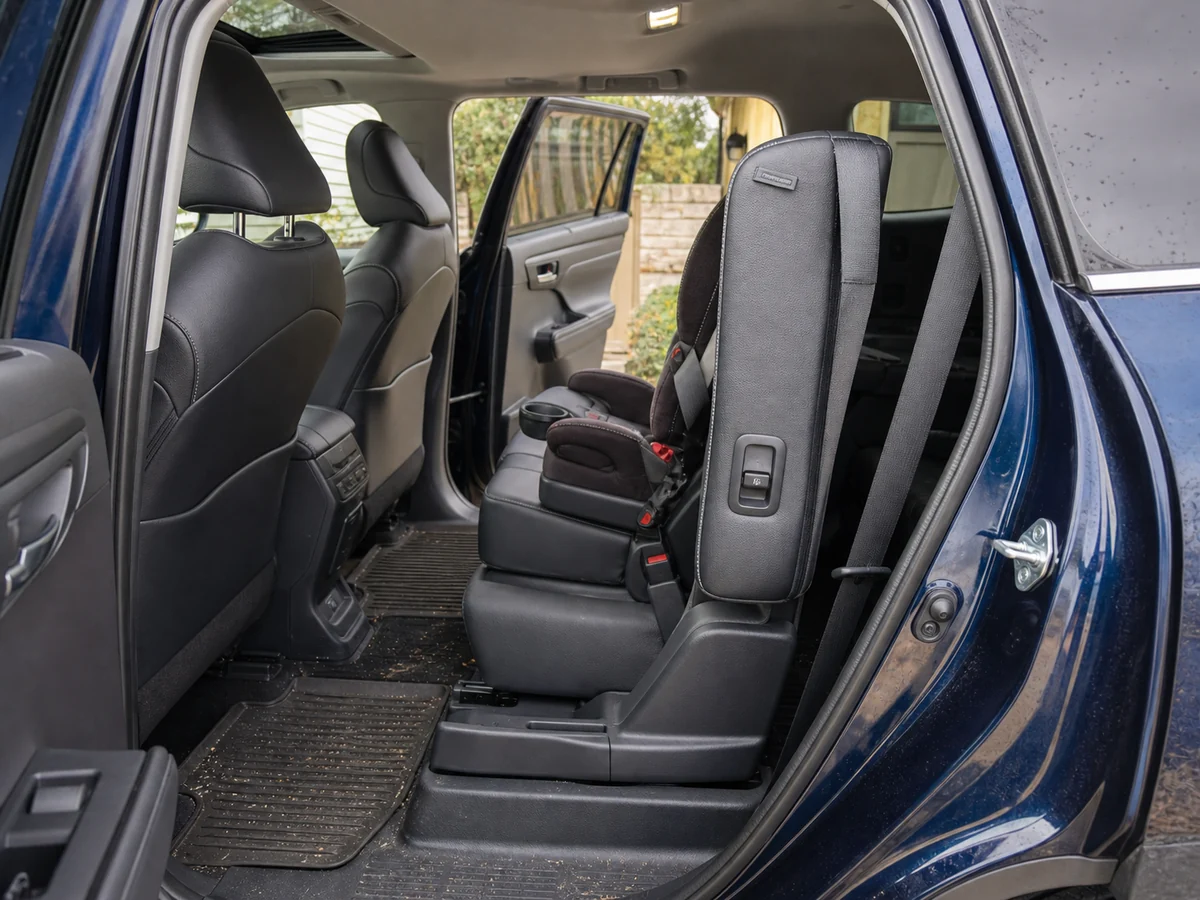
Several newer-year campaigns are also configuration-specific. NHTSA 24V419 and 24V452 involve certain 2021 to 2024 Highlanders with insufficient tire load rating in specific accessory or package populations, while 25V744 includes certain Toyota and Lexus vehicles with rearview camera software that may freeze or display a blank screen.
Those recalls do not mean every 2021 to 2024 Highlander should be avoided. They mean the VIN, tire size, load rating, load label, seatback function, camera operation, and completed repair order should be verified before a family signs.
Ask the dealer or seller for the current recall printout on the day you decide, not a screenshot from months earlier. A newer Highlander can receive a campaign after its last service visit, and a listing that says no open recalls may be stale by the time money changes hands.
The physical seat check still matters after paperwork. Move each second-row seatback through its adjustment range, lock it upright, tug it firmly, then install the child seat or booster layout the family will actually use.
Older first-generation Highlanders are condition calls
The early Highlander does not need the same verdict as the 2020 launch year. A 2001 to 2007 Highlander is now an old vehicle, so its buying risk comes from age, engine and cooling history, corrosion, suspension wear, fluid leaks, and neglected repairs.
The 2003 stands out because current NHTSA component grouping returns 45 complaints under engine and engine cooling and 34 under engine. That is enough to make cold-start behavior, coolant condition, oil leaks, overheating history, and compression or leak-down evidence important when symptoms appear.
Do not turn that into an unsupported claim that every early Highlander will fail. A documented one-owner 2005 with clean cooling history can be a better buy than a cheaper 2003 with a fresh coolant smell, mismatched tires, and no records.
Inspect an early Highlander from the ground up. Look for subframe and suspension corrosion, uneven tire wear, oil seepage, coolant residue, exhaust rust, brake-line condition, strut noise, steering play, window function, and evidence that timing, fluids, and cooling service were not ignored.
A first-generation all-wheel-drive Highlander also needs four closely matched tires and quiet driveline behavior. A mismatched set can create vibration or driveline stress that has nothing to do with the engine reputation.
A cheap early Highlander should still start cold, idle smoothly, reach operating temperature without overheating, shift consistently, stop straight, and show no active warning lights. If the seller has warmed it before you arrive, reschedule or pay an independent shop to repeat the cold test.
Which Highlander years are better used starting points?
The better starting points are documented 2016 to 2018 examples and well-kept 2022 or newer examples after VIN recall status is checked. They are not magic years, but they usually ask fewer first questions than 2008, 2019, 2020, or 2021.
Current NHTSA counts support that screening logic. The 2016 query returns 109 complaints, while 2018 returns 258 and 2022 returns 229, all below the 2019 and 2021 peaks reviewed here.
Better Highlander starting points
- 2016
- Lowest current complaint count in this review, still inspect age, tires, fluids, and crash history
- 2017 to 2018
- Mature third-generation years, still verify fuel-pump campaign exposure by VIN
- 2022
- Lower current complaint count than 2020 and 2021, but still check bumper, tire, camera, and seatback campaigns
- Any year
- Let service history, scan data, tire match, and road behavior override the year label
The Highlander also has a packaging limit that the year list cannot fix. If adults use the third row often, compare a roomier three-row SUV or Toyota Sienna before spending inspection money on a Highlander that will feel too tight even when it is mechanically clean.
Hybrid versions can be strong used choices when the records are boring and the battery cooling intake is clean. Gas versions need ordinary engine, transmission, cooling, and fuel-system proof, especially in the 2019 to 2021 group.
Use the better years to decide which listings get inspected first. Do not pay a premium for a clean year when the SUV has poor maintenance, mismatched tires, an open recall, or a road test that contradicts the paperwork.
What proof makes a risky Highlander worth buying?
A risky-year Highlander can move forward when its documents and current behavior agree. That means a live VIN recall result, repair orders naming the campaigns or parts, clean scan data before and after the drive, and a physical inspection that does not find the problem the year group warned you about.
Ask for records before the test drive. A seller who has real repair proof can usually show dates, mileage, part names, dealer or shop names, and the exact system repaired.
Paperwork is not enough when the SUV disagrees. A fuel-pump recall closure does not explain a current stall, and an airbag recall completion does not explain an active airbag light.
The same rule works in the other direction. A 2008 or 2021 Highlander with complete records, clean scan data, correct tires, current recall status, and a calm road test can be a better buy than a supposedly safer year with missing history.
Buy the exact Highlander only when the VIN, records, scan, road test, seat checks, tires, and physical inspection all point in the same direction.