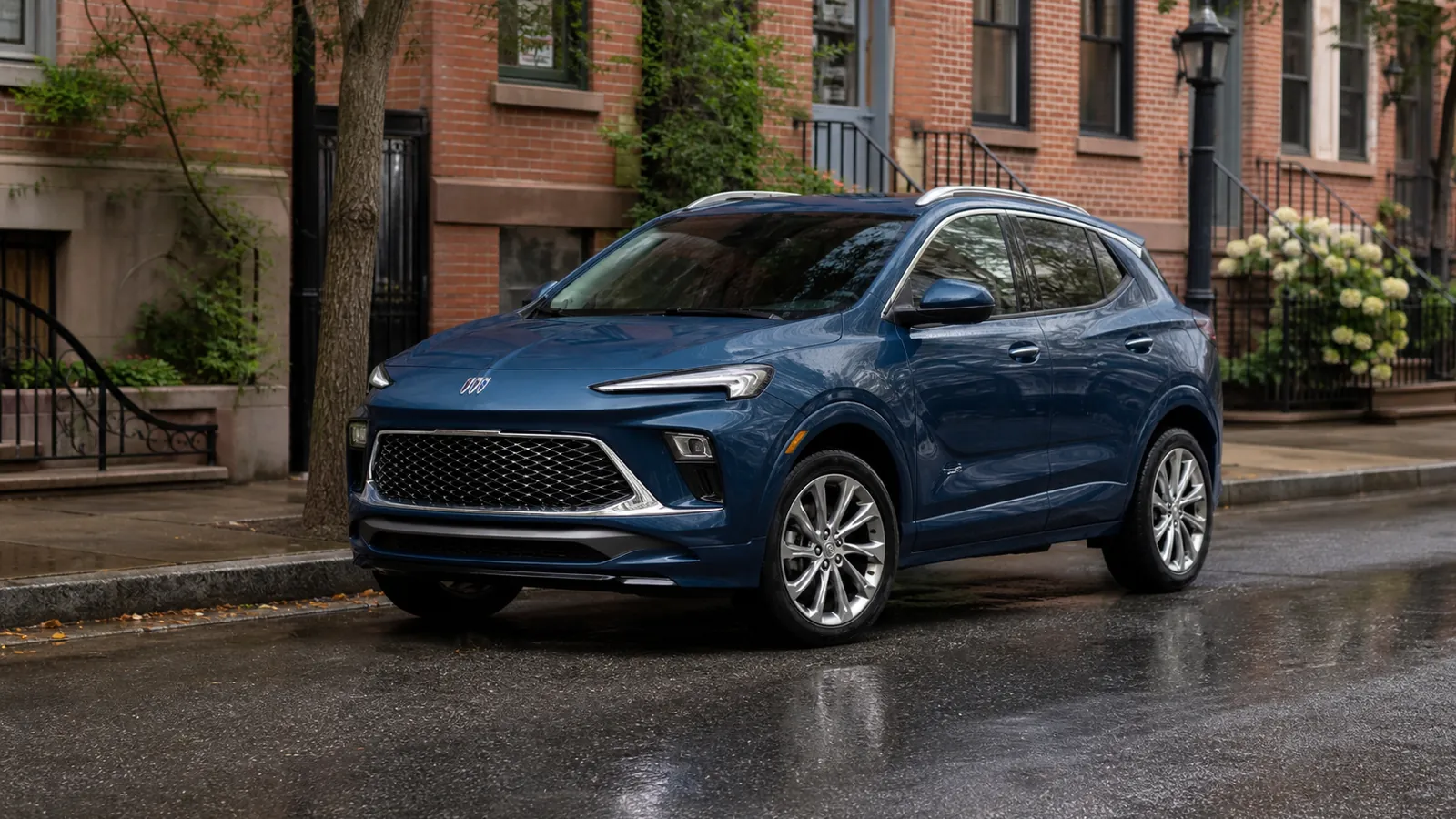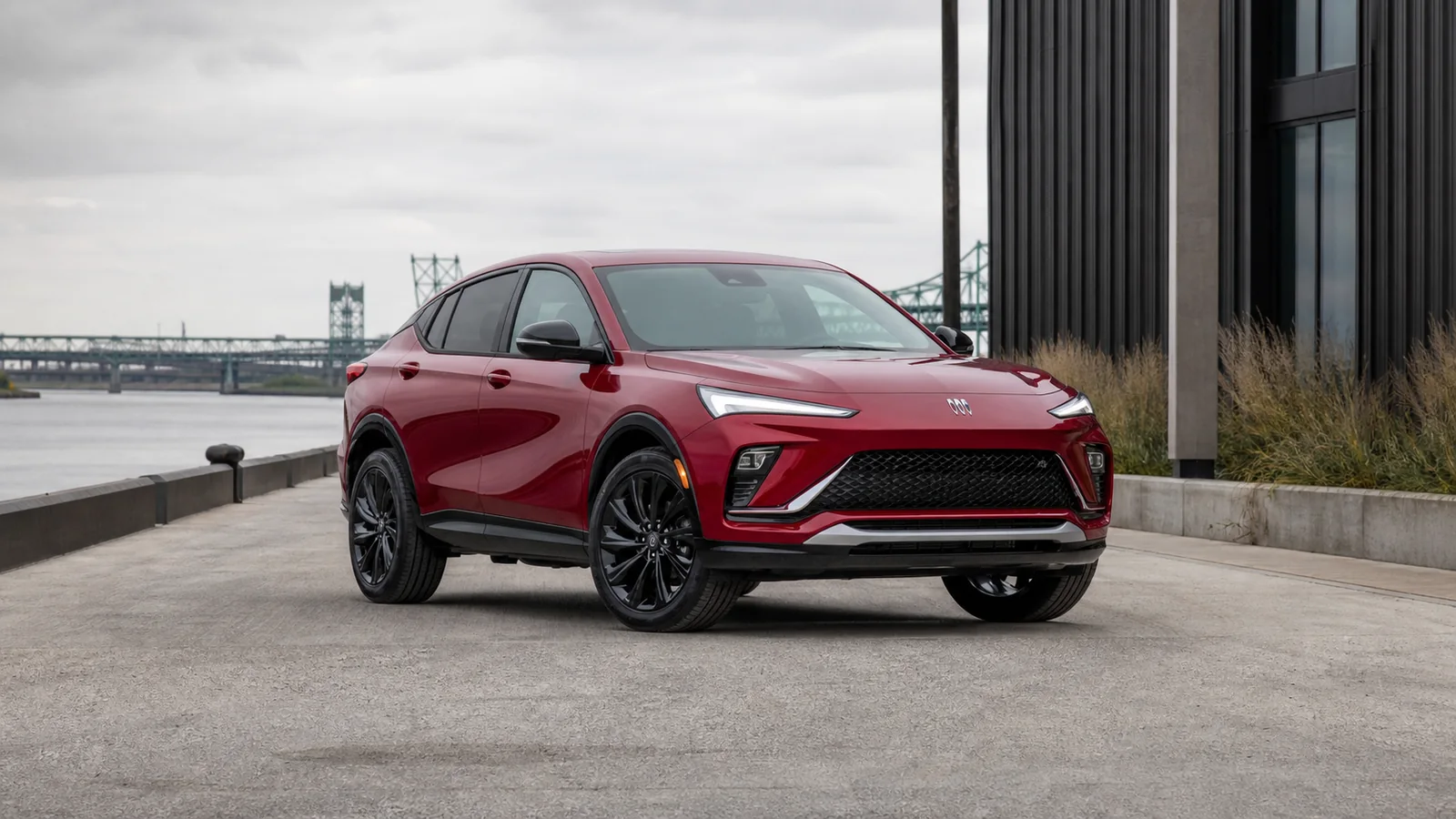
The one powertrain defines this Envision
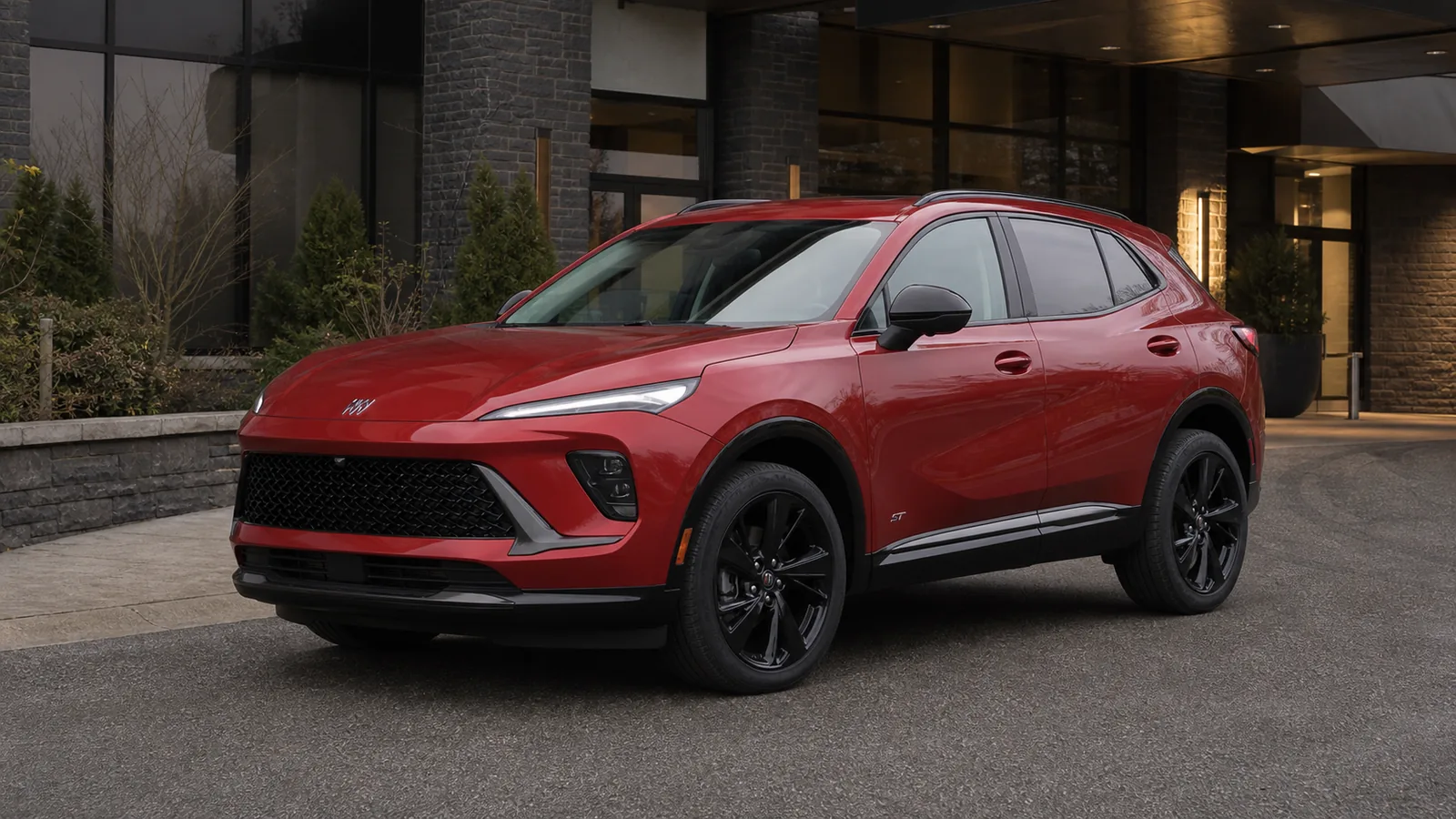
The 2026 Buick Envision is a five-seat compact crossover built around one mechanical package. Every trim uses a 2.0-liter turbocharged four-cylinder, a nine-speed automatic transmission, and all-wheel drive.
The engine produces 228 hp and 258 lb-ft of torque. There is no front-wheel-drive discount, stronger engine, or hybrid branch, so the buyer chooses equipment rather than performance.
The EPA rates the Envision at 22 mpg city, 28 highway, and 25 combined. Buick specifies regular unleaded gasoline rated at 87 octane or higher, which avoids the premium-fuel expense that sometimes comes with a turbocharged near-luxury SUV.
That fixed package gives the Envision a clear identity. It offers more standard traction and cabin polish than a basic mainstream compact SUV, while its output and fuel economy remain ordinary for the price.
The Envision makes sense only if its one engine, standard AWD, and 25-mpg combined rating already fit your life. A higher trim cannot change any of them.
Three trims can erase or protect the value
Buick's current configurator lists Preferred at $42,995, Sport Touring at $45,495, and Avenir at $52,695. Those starting figures include the $1,995 destination charge but exclude taxes, title, license, dealer fees, options, and incentives.
All three trims share the 228-hp engine, AWD, 30-inch display, wireless phone projection, active noise cancellation, and core driver-assistance equipment. The price steps therefore buy appearance and comfort equipment, not a stronger vehicle.
| Trim | Starting MSRP including destination | Decisive equipment | Best fit |
|---|---|---|---|
| Preferred | $42,995 | 30-inch display, AWD, active noise cancellation | Buyer who wants the Envision's core experience at the lowest price |
| Sport Touring | $45,495 | 20-inch black wheels, dark exterior details, flat-bottom steering wheel | Buyer who values the sport appearance enough to pay the gap |
| Avenir | $52,695 | Ventilated front seats, richer trim, additional seat adjustment and comfort equipment | Long-commute buyer who will use the comfort additions every day |
Sport Touring is mostly a visual decision. Its black trim and 20-inch wheels change the stance, but they do not improve acceleration, efficiency, passenger room, or cargo capacity.
Avenir has the strongest comfort case, especially for a driver who values ventilation and added seat adjustment. Its price also moves the Envision closer to vehicles with more power, greater cargo room, or a more consistently luxurious cabin.
At $52,695, Avenir also costs more than the $46,595 delivered base of the Cadillac XT5 Luxury, a larger model with 30 cubic feet behind its rear seat. Avenir's seat comfort, standard AWD, and 30-inch display must justify staying with the smaller Envision.
Preferred protects the Envision's near-luxury value most clearly. Pay more only after the exact window sticker shows an upgrade that improves a trip you make every week.
Comfort is the performance feature
The Envision responds promptly at low speed, but its 228 hp has to move an AWD compact SUV. Edmunds measured 7.7 seconds from zero to 60 mph, which is adequate for normal merging without making speed a reason to buy it.
The nine-speed automatic generally keeps the engine in its useful torque range. Ask for a quick pass and it may need a downshift, so test rolling response with passengers aboard if loaded highway travel is common.
Ride isolation is the stronger argument. The suspension takes the edge off patched pavement, while Buick's QuietTuning measures and active noise cancellation reduce the amount of road and powertrain noise that reaches the cabin.
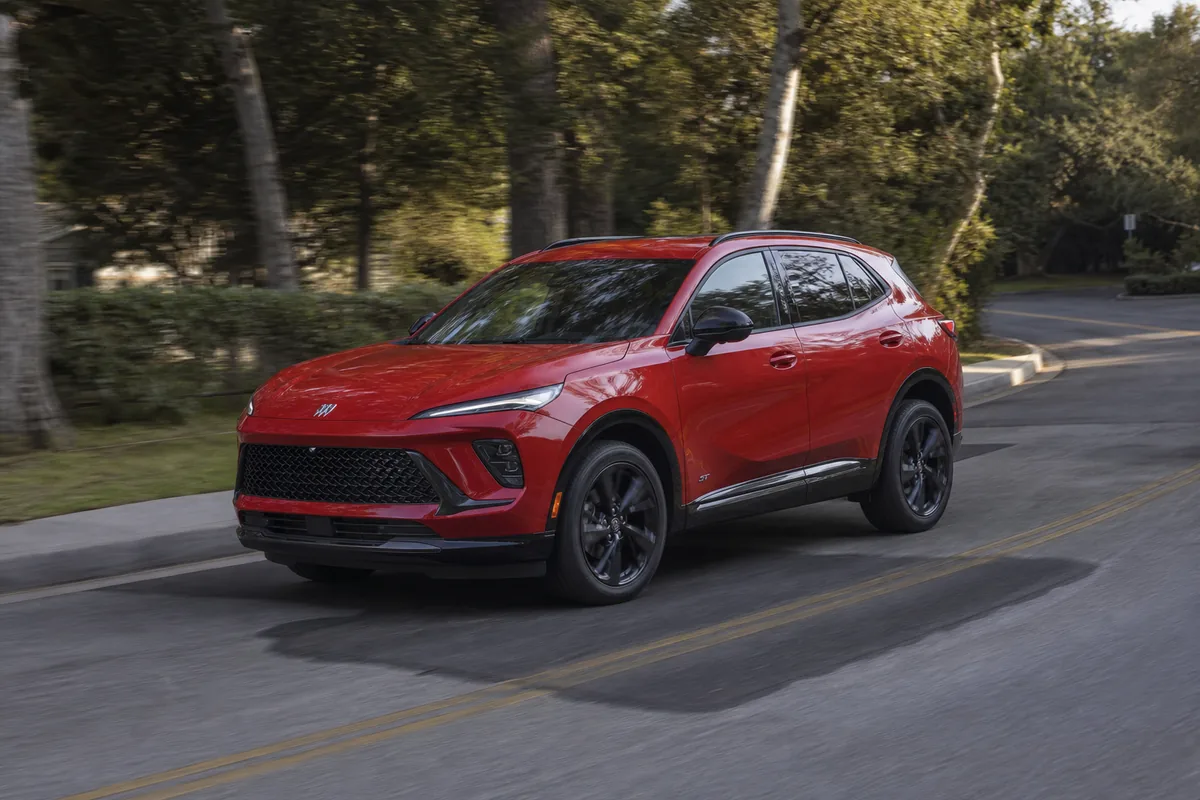
That softness also permits body roll in a quick bend, and the steering prioritizes easy placement over detailed feedback. The Envision feels composed when driven smoothly, not eager when pushed.
Use a test route with a rough street, a sweeping ramp, a 40-to-70-mph merge, and one firm legal stop. Turn off the audio and listen for tire impact, wind noise, engine effort, and any suspension thump.
The Envision's performance advantage is calm progress rather than quick acceleration. Buy it when reduced fatigue over ordinary roads matters more than sharp responses.
The 30-inch cabin must work after the showroom
The ultrawide 30-inch display creates the Envision's strongest premium first impression. It combines driver information and infotainment in one curved panel, while the broad layout keeps navigation and vehicle data within the driver's sightline.
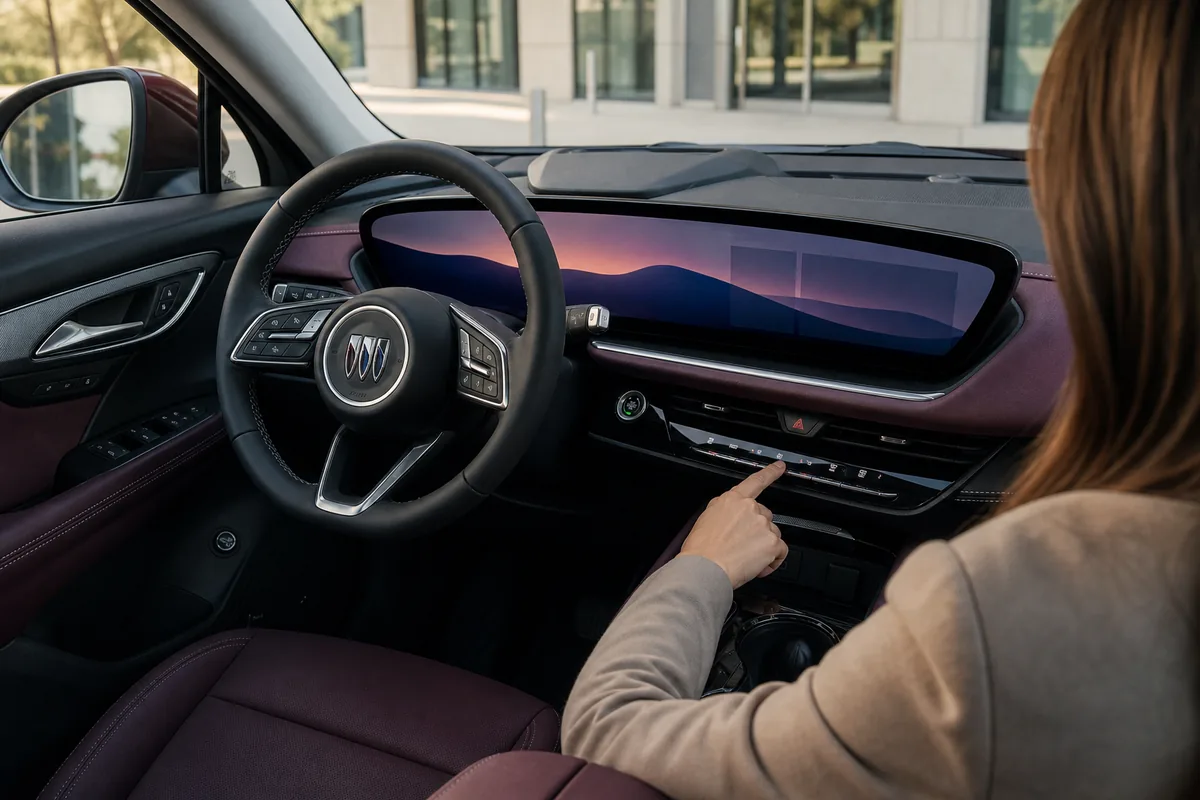
Wireless Apple CarPlay and Android Auto are supported for compatible phones. Google built-in compatibility adds navigation, apps, profiles, and voice functions, though availability varies and some services require an account, data connection, or active plan.
Cabin test before you buy
- Check the display for glare from the driver's normal seating position
- Pair your phone, restart the vehicle, and confirm it reconnects
- Enter a destination by touch and voice without looking down for long
- Use every camera in daylight and a dim parking area
- Adjust the seat for 20 minutes and check thigh, lumbar, and shoulder support
- Ask which connected functions remain after any included plan ends
The screen does not eliminate physical controls, but several tasks still depend on menus or touch targets. Try climate changes, camera selection, audio adjustment, and driver-assistance settings while parked before judging the interface.
QuietTuning, active noise cancellation, and the wide display make the front cabin feel more expensive than a typical mainstream crossover. Material quality is less uniform below eye level, which is where Avenir's higher price deserves closer scrutiny.
The screen earns its place when it shortens routine tasks after your phone is paired. A dramatic panel that causes glare, lag, or service confusion will feel less premium after the first week.
Passenger comfort wins more space than cargo
The Envision gives rear passengers 39.3 inches of legroom and seats five. Two adults can use the rear bench comfortably, though three-across width and child-seat buckle access still need a hands-on check.
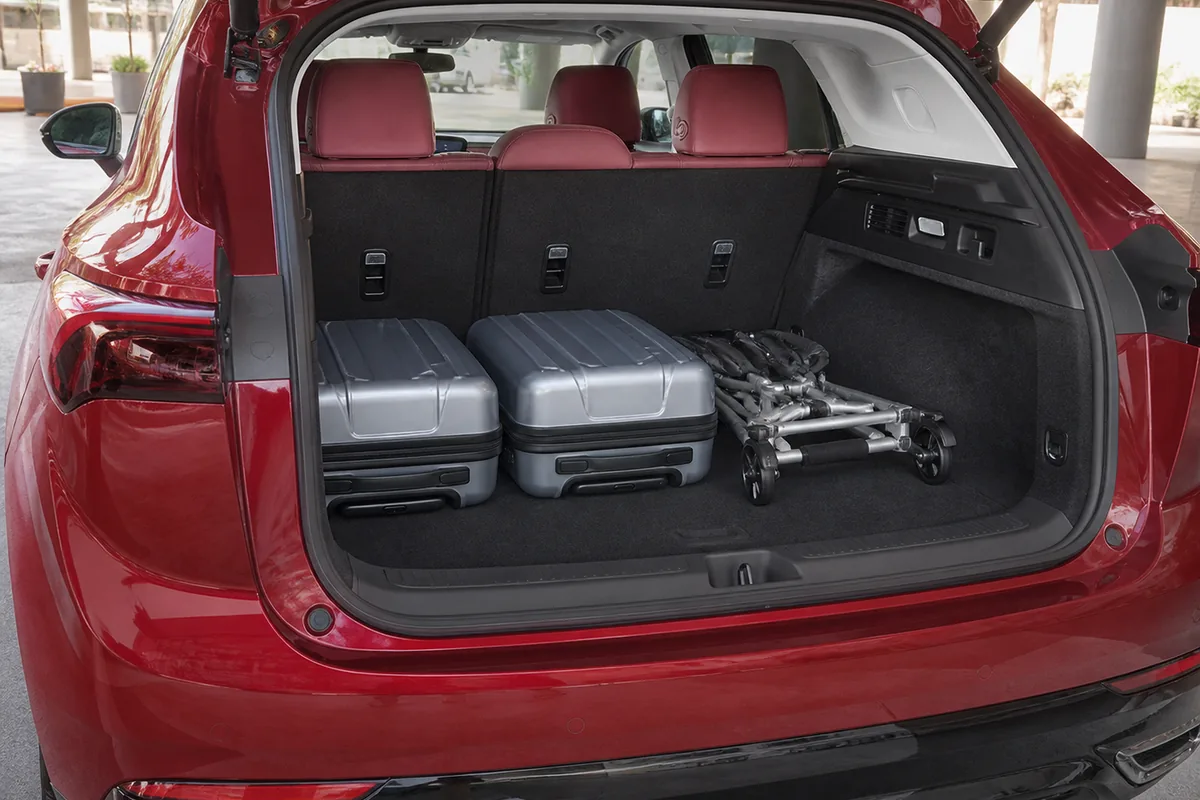
Buick lists 25.2 cubic feet of cargo space behind the rear seat and 52.7 cubic feet with it folded. Those numbers trail roomier compact SUVs, so the Envision favors passenger comfort and exterior proportion over maximum carrying capacity.
Envision packaging
- Rear legroom
- 39.3 inches, useful for adult passengers
- Cargo, seats up
- 25.2 cubic feet, enough for routine luggage but modest for the class
- Cargo, seats folded
- 52.7 cubic feet, useful for occasional long loads
The 182.7-inch body is easy to place in a typical parking space. Cargo usability still depends on the hatch opening, wheel-well intrusion, floor height, and the slope of the rear glass.
Bring the stroller, mobility aid, dog crate, or largest regular suitcase to the dealer. Load it with the rear seat raised, close the hatch without pressing against the glass, and confirm that the remaining luggage does not block the rear view.
The Envision is generous to rear passengers and merely adequate for cargo. A household that fills the hatch every week should trust a physical load test more than the vehicle's compact-SUV label.
What it costs to run, and where the money actually goes
The Envision asks about $42,995 to $52,695 including destination before options. Every trim in that range uses the same engine and the same drivetrain, so the running costs barely move across it.
One 2.0-liter turbocharged four of 228 hp and 258 lb-ft drives all four wheels through a nine-speed automatic, on every trim. There is no engine or drivetrain decision to price.
What the numbers settle
- EPA combined
- 25 mpg
- City / highway
- 22 / 28 mpg
- Output
- 228 hp / 258 lb-ft
- Drivetrain
- all-wheel drive, standard
- Rear legroom
- 39.3 in
A rated 25 mpg combined is respectable for an all-wheel-drive crossover of this size. All-wheel drive being standard rather than optional is what makes the comparison fair, because rivals often quote economy from a front-drive version.
That single specification is also what stops trims from changing the sums. Moving up the range buys material, sound insulation and equipment, and it does not buy speed or efficiency.
So the money question here is unusually clean. Decide how much cabin you want, because that is the only thing the price is buying.
If the answer is less than this, the smaller Buick Encore GX covers the same ground on a shorter footprint and a lower price.
The complaint record further down supports leaving it there. With no pattern to inspect around, the decision rests on the drive and the cabin rather than on risk.
Safety equipment is stronger than the available test record
The 2026 Envision includes a broad set of driver-assistance features. Buick lists Blind Zone Steering Assist, Front Pedestrian and Bicyclist Braking, Rear Cross Traffic Braking, Intersection Automatic Emergency Braking, and Side Bicyclist Alert among the available standard systems.
Feature availability and tested performance are different evidence. A system name describes what the vehicle is equipped to attempt, while a crash or avoidance test records performance under a defined protocol.
| Evidence class | What it establishes | Current 2026 Envision status |
|---|---|---|
| Buick equipment list | Systems installed on the vehicle | Broad assistance suite listed, subject to operating limits |
| NHTSA recalls | Defined safety defects and remedy populations | Check the exact VIN at purchase and delivery |
| NHTSA complaints | Reports submitted by owners | Signals questions, not a defect rate |
| NHTSA investigations | Agency review of a possible issue | Keep separate from complaints and recalls |
| NHTSA ratings | Results of federal crash tests | Verify the exact model-year page before relying on a score |
| IIHS testing and awards | Performance in institute protocols | No exact 2026 Envision rating page or award was located |
Absence from an IIHS award list does not prove poor crashworthiness. It means the exact current-year result needed for that conclusion was not available in the reviewed record.
Driver aids also have operating limits involving speed, weather, light, road shape, sensor condition, and target position. Keep a safe following distance and test camera views, alerts, lane support, and braking settings without treating them as substitutes for attention.
Judge the Envision's safety equipment as useful backup, not as an unverified crashworthiness score. Run the VIN again immediately before delivery because recall status can change.
The crash rating that does exist
There is a federal crash record for this vehicle, and it is a strong one. The 2025 Envision with all-wheel drive carries five stars overall.
The detail behind that overall figure matters more than the headline. Frontal impact scores five stars and side impact scores five, with rollover resistance at four.
Federal crash ratings, 2025 Envision all-wheel drive
- Overall
- 5 stars
- Frontal impact
- 5 stars
- Side impact
- 5 stars
- Rollover
- 4 stars
A four-star rollover result is normal rather than poor for a raised crossover. Height and track width set that score, and every vehicle of this shape sits in the same place.
No record has been published for the 2026 vehicle yet. That is ordinary timing rather than a signal, and the 2025 result applies to a mechanically unchanged car.
Put that beside the complaint record further down and the evidence points the same way twice. A five-star crash result and 89 filings across five model years is about as quiet as this class gets.
Both still describe the population rather than the individual car. A crash rating cannot tell you whether the one in front of you was repaired properly after an accident, and that is what an inspection and a history report are for.
Ownership evidence needs a narrow claim
The current Envision does not support a broad promise of trouble-free ownership. Recall records, complaints, investigations, warranty claims, and owner anecdotes answer different questions, and none alone establishes how often a component will fail.
Check each class separately and require VIN-specific proof before drawing a conclusion about one vehicle.
Buick lists three years or 36,000 miles of bumper-to-bumper coverage and five years or 60,000 miles of powertrain coverage, whichever comes first. The 2026 configurator also lists five years or 60,000 miles of roadside assistance, subject to the current warranty terms and original in-service date.
Warranty coverage sets a floor for defects in materials or workmanship. It does not cover routine maintenance, normal wear, collision damage, misuse, or neglected service, so the booklet and repair order still control a claim.
Before buying, run the VIN through current NHTSA and GM records, confirm the in-service date, and test every screen, camera, phone connection, warning light, and driver aid. A used example also needs maintenance records, a cold and warm road test, and an independent inspection.
The official 25-mpg combined figure is the clearest fuel-cost starting point. Apply your annual mileage and local regular-gas price without turning that estimate into a full ownership projection.
The responsible ownership verdict is conditional on the exact vehicle's records, behavior, and remaining coverage. Detailed fault patterns, repair costs, and maintenance schedules need model-specific evidence before they support a broader conclusion.
What a genuinely quiet record looks like
Most defect sections exist to warn somebody. This one exists because the absence of a warning is itself worth showing.
Owners filed 89 complaints against Envision model years 2021 to 2025. Spread across five model years, that is among the lowest counts in this class.
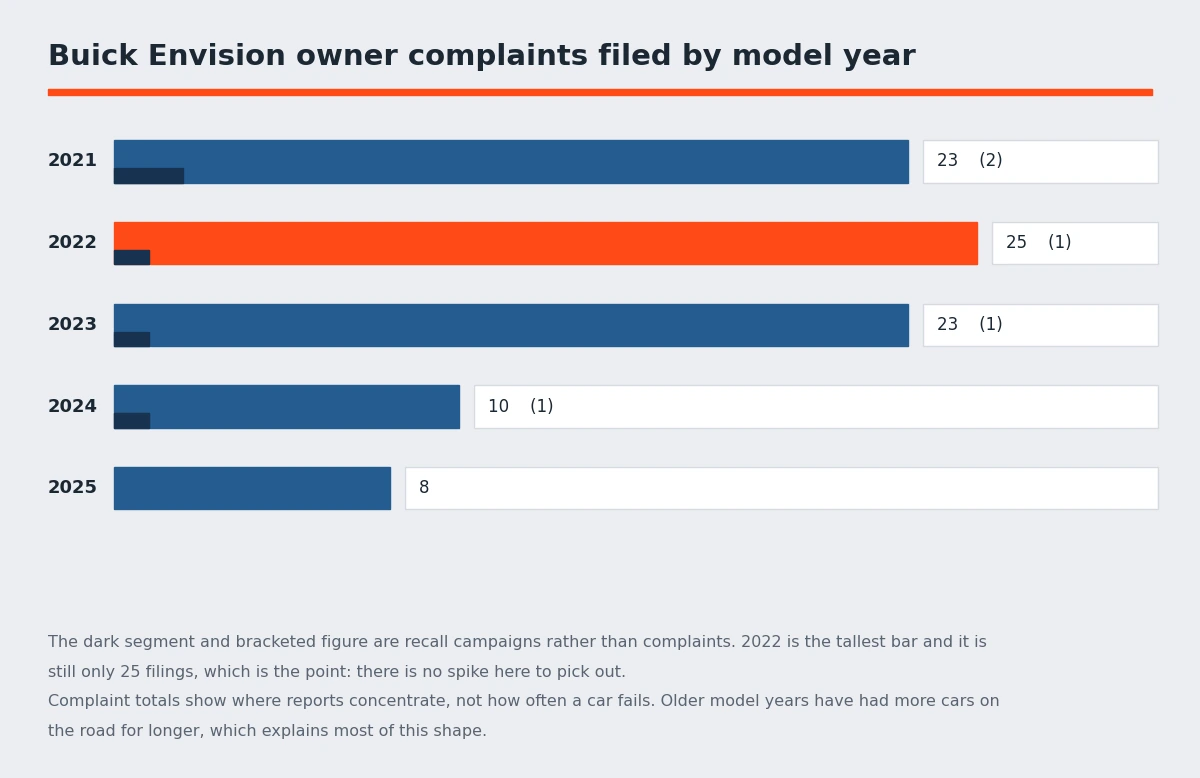
There is no launch-year spike, which is unusual for a redesigned model. The tallest bar is 2022 at 25 filings, and the years either side sit at 23.
Categories are spread rather than concentrated. Electrical systems lead at 30, then engine at 17, then brakes and powertrain level at 14 each.
The recall record matches. Four distinct campaigns touch the whole run, covering lighting control software, an airbag warning lamp and a set of equipment labels.
So the record supports a narrow claim and no more. Nothing here suggests a pattern a buyer needs to inspect around, which moves the weight of the decision back onto the test drive and the cabin.
Buy the quiet daily experience, or skip the compromise
Buy the Envision when a quiet ride, standard AWD, adult-friendly rear space, and an easy-to-use wide display improve nearly every trip. Preferred keeps those strengths near the bottom of the price range.
Skip it when quick passing power, hybrid fuel economy, maximum compact-SUV cargo room, or a fully verified current crash-test record ranks above cabin calm. Avenir cannot solve those limits because it keeps the same engine, drivetrain, body, and EPA rating.
Set the trim ceiling before negotiating, then compare out-the-door price rather than a promotional payment. Repeat the same rough-road, merge, seat, screen, and cargo tests in every vehicle on the shortlist.
The 2026 Envision is a sensible near-luxury choice when quietness and standard AWD matter more than speed, efficiency, and cargo volume. Its value is strongest in Preferred and weakest when Avenir pricing asks the fixed mechanical package to feel like a true luxury SUV.