The $59,400 Lyriq becomes a trim-and-cabin value decision
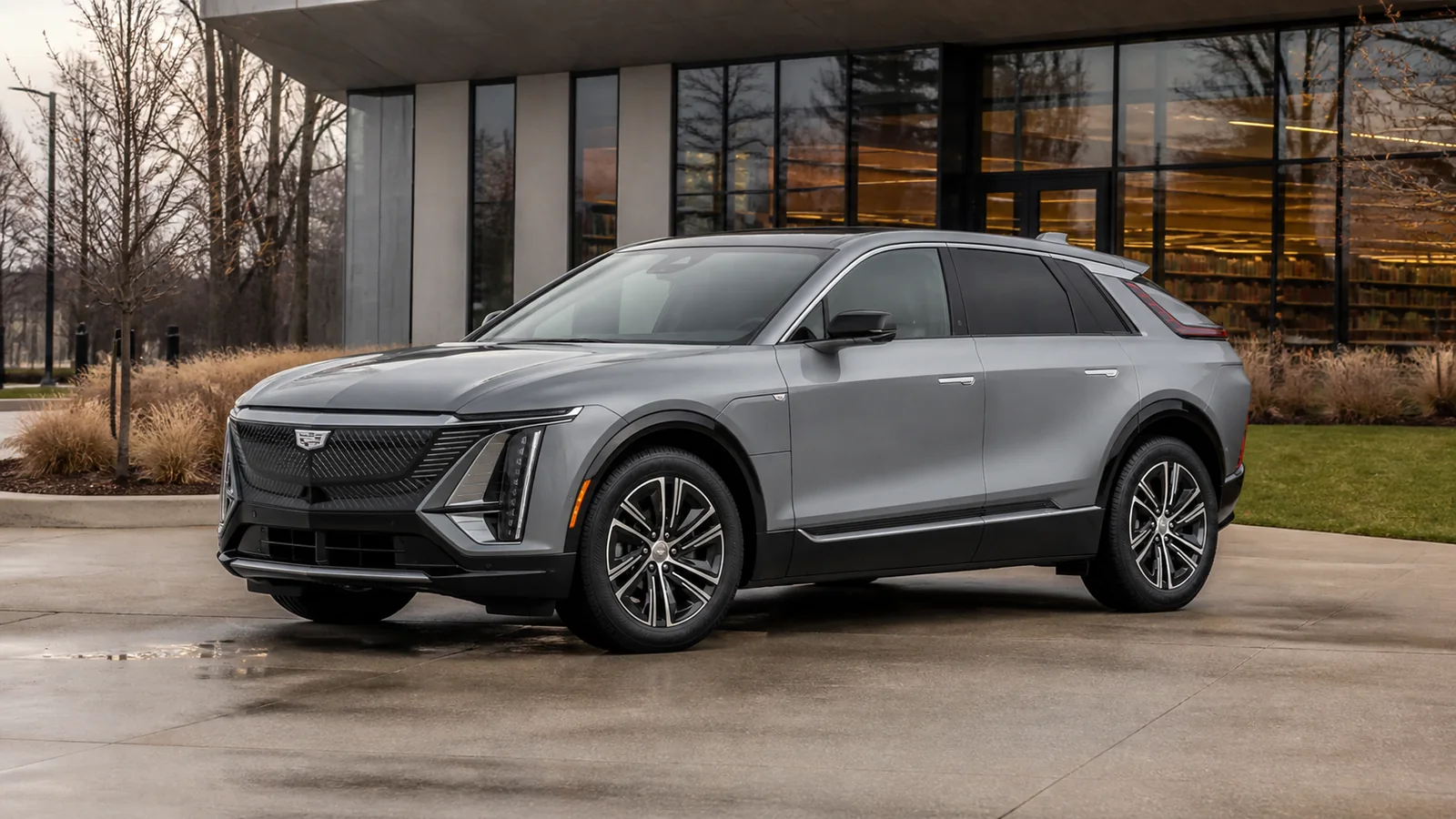
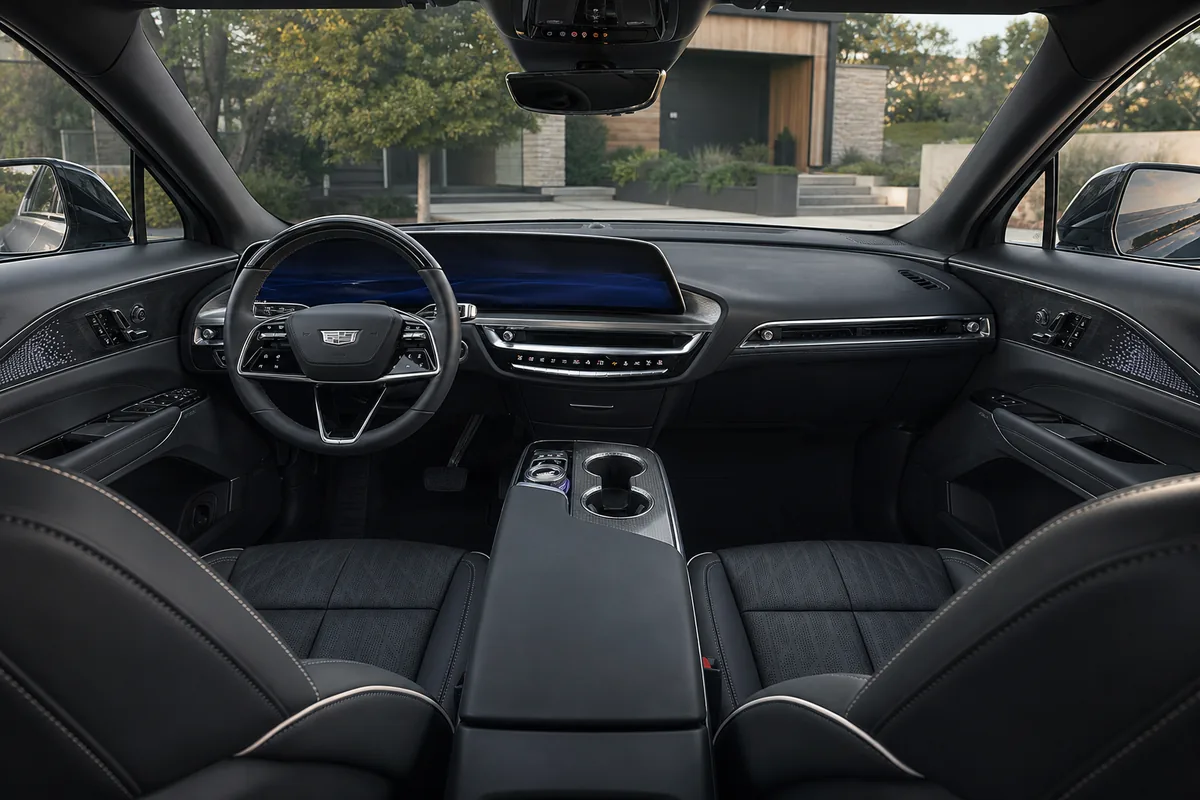
The 2027 Cadillac Lyriq starts at $59,400 for Luxury and $59,900 for Sport before destination, tax, options, or dealer fees. Both are five-seat electric crossovers with a 102-kWh battery, single-motor RWD as standard, a 33-inch 9K display, Google built-in, wireless phone mirroring, Super Cruise with a three-year OnStar One plan, and heated front seats.
That standard equipment makes the base tier the value reference. A buyer who likes the Inteluxe seats, fixed SkyGlass roof, 20-inch wheels, and standard audio system does not need an upper trim to obtain the core screen, charging hardware, or driver-assistance package.
Premium Luxury starts at $63,400 and Premium Sport at $63,900. The extra money buys changes the driver and passengers can use every day, including a 23-speaker AKG system, active noise cancellation, ventilated and lumbar-massaging front seats, an eight-way passenger seat, a rear-camera mirror, and a hands-free liftgate.
Signature Luxury at $66,800 and Signature Sport at $67,300 add heated rear outboard seats, tri-zone climate control, a cargo cover, and 22-inch wheels. Those additions favor households that regularly use the rear seat, but the larger wheels also deserve a rough-road test before the cabin upgrade earns its price.
2027 regular Lyriq trim value
Luxury or Sport
$59,400 or $59,900. Start here for the complete 33-inch interface, Super Cruise, heated front seats, and 20-inch wheels.
Premium Luxury or Premium Sport
$63,400 or $63,900. Pay more for quieter audio, ventilated and massaging front seats, rear-camera mirror, and hands-free liftgate.
Signature Luxury or Signature Sport
$66,800 or $67,300. Add rear-seat heat, tri-zone climate, cargo cover, and 22-inch wheels.
LYRIQ-V
Separate 615-hp performance derivative with a 285-mile manufacturer range statement. Its chassis and range do not describe regular trims.
Dual-motor AWD remains available across the regular trim ladder, so trim price and drivetrain price are separate decisions. Fix the cabin tier first, then compare the RWD and AWD range labels on the exact build rather than assuming the most expensive regular trim also changes propulsion.
LYRIQ-V starts at $78,700 and belongs in a different performance decision. For most buyers, the useful upgrade is the lowest trim whose seats, sound, rear visibility, and rear-passenger comfort improve a task they repeat.
Choose 326-mile RWD or equipment-labeled AWD without guessing why range changes
The regular RWD Lyriq uses one motor, produces 365 hp, and carries an official 326-mile range statement. The regular AWD model uses two motors and produces 515 hp.
Cadillac also publishes 319-mile and 303-mile AWD figures under different official equipment labels. Those labels identify which statement belongs to which build, but they do not by themselves prove why the figures differ.
| Configuration | Motor layout | Output | Official stated range | Buyer check |
|---|---|---|---|---|
| RWD | Single motor | 365 hp | 326 miles | Confirm the exact RWD equipment label |
| AWD configuration A | Dual motor | 515 hp | 319 miles | Match the vehicle to Cadillac's exact 319-mile equipment label |
| AWD configuration B | Dual motor | 515 hp | 303 miles | Match the vehicle to Cadillac's exact 303-mile equipment label |
RWD protects the longest stated distance and may cover a household that does not need four driven wheels. AWD provides much more output and added traction capability, but the buyer must accept the range figure attached to the exact equipment.
Do not attribute the 319-mile and 303-mile difference to wheels, trim, tires, or another feature unless Cadillac or the applicable official record states that relationship. Report the label, then use the lower applicable figure when planning a route.
Choose AWD for a traction or response benefit you will use, not because 515 hp looks better in isolation.
The road test should expose mass, response and brake blending
Electric output arrives quickly, but horsepower alone cannot establish how the Lyriq feels in traffic. Test the exact RWD or AWD vehicle because motor layout, wheels, tires, and fitted equipment can change the experience.
Begin in a parking area and check low-speed pedal response, steering effort, camera views, and the space required to place the vehicle accurately. Then drive across broken pavement without the audio playing so sharp impacts, body motion, and cabin noise remain easy to detect.
On a highway entrance, ask for smooth and predictable acceleration rather than the hardest launch. The 365-hp RWD model and 515-hp AWD model both have substantial output, but the useful question is whether passing response remains easy with the people and cargo you normally carry.
Regular Lyriq road test
- Check low-speed accelerator response in a parking maneuver
- Cross patched pavement and a sharp road joint at normal speed
- Merge and pass with the normal passenger load
- Hold a steady line on a sweeping highway curve
- Slow repeatedly and judge the transition between regenerative and friction braking
- Set mirrors and cameras, then check rear and three-quarter visibility
Brake blending deserves its own repeated test. Slow gently, then more firmly, and judge whether pedal response stays predictable as regenerative braking and the friction brakes share the work.
A quiet cabin can make speed less obvious, so watch how easily the vehicle gathers pace and how much room it needs to stop. Buy the drivetrain whose response, ride, and braking remain comfortable on the roads you drive every week.
Native NACS changes the plug plan before the first trip
The exact 2027 Lyriq uses a native NACS inlet, which removes the adapter step associated with earlier connector arrangements. Verify the inlet on the actual vehicle because connector guidance from an older model year does not establish the hardware on a 2027 build.
A native connector does not guarantee that every charging site works. Network access, payment, charger status, delivered power, cable reach, and the way the parking stall aligns with the Lyriq's port remain separate checks.
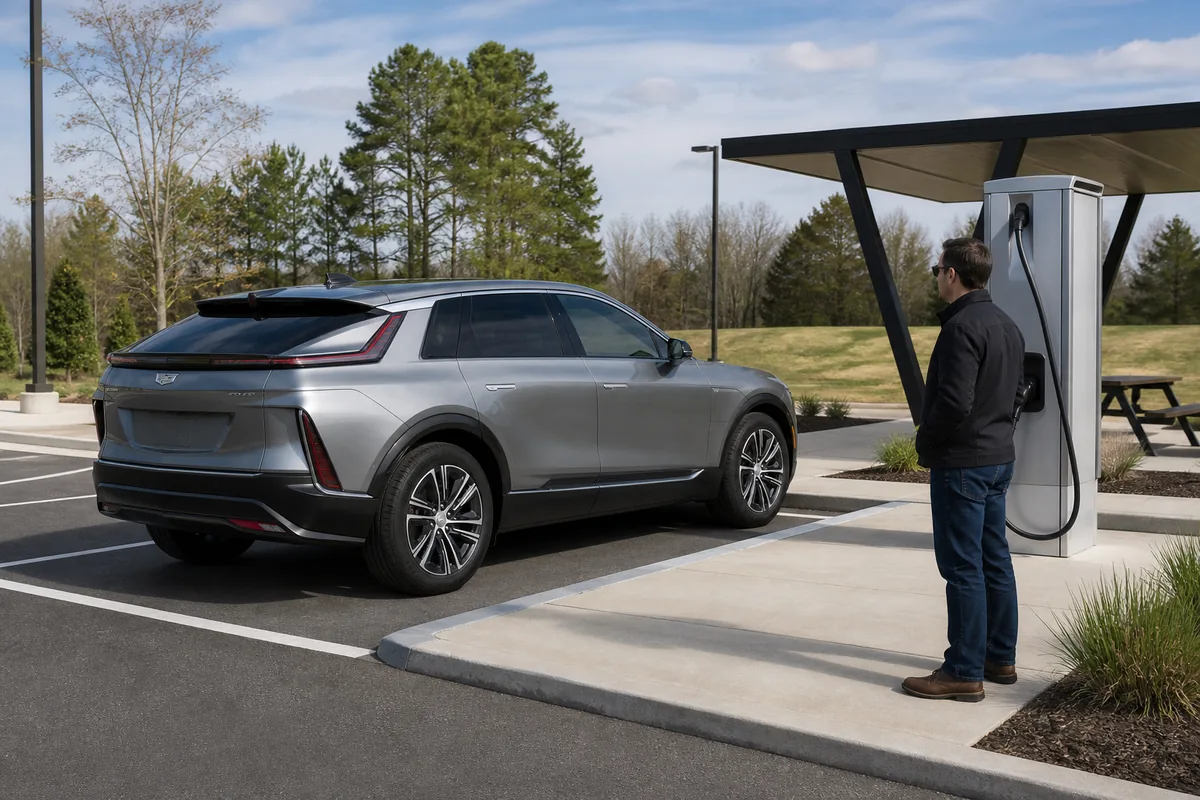
Verify the 2027 Lyriq charging path
- Confirm the vehicleInspect the exact native NACS inlet and its location on the 2027 Lyriq
- Match the home setupConfirm the circuit, EVSE connector, cable reach, and installation capacity
- Choose public backupsIdentify two compatible sites on routes you actually drive
- Check accessVerify network account, payment method, operating hours, and recent charger status
- Rehearse the stallConfirm the cable reaches without crossing the vehicle or blocking another space
Home charging remains the easiest way to begin most days with a predictable energy level. Ask a qualified installer to assess the electrical service and circuit rather than assuming an existing outlet or EVSE can provide the desired charging rate.
At a public site, port location and cable geometry can determine whether the stall is usable even when the connector is correct. Check the actual vehicle and stall layout before relying on that location.
Native NACS removes one compatibility obstacle, but a buyer still needs a verified home plan and real public backups. Complete those checks before relying on the Lyriq for a time-sensitive trip.
The 10-minute charging claim is a conditioned estimate
Cadillac lists a DC fast-charging capability of up to 190 kW for the regular 2027 Lyriq. The company also estimates approximately 86 miles of range added in about 10 minutes under its stated conditions.
Peak power and added range measure different things. The 190-kW figure describes a maximum capability, while the 86-mile statement describes one manufacturer-estimated charging window.
A road-trip stop normally begins with a battery that is neither empty nor at the ideal condition for peak charging. Power can rise and fall during the session, so a useful plan includes time to connect, authenticate, charge, and move the vehicle.
Use the exact range label for the vehicle, then leave a reserve for speed, temperature, elevation, wind, and detours. A displayed added-mile estimate also cannot know the energy demand of the next road segment with certainty.
Treat about 86 miles in about 10 minutes as a favorable manufacturer estimate, not a schedule guarantee. A conservative stop plan protects the trip when the charger or battery cannot reproduce the headline condition.
Twenty-eight cubic feet must pass the household loading test
Cadillac lists 28 cubic feet of cargo space behind the second row and 60.8 cubic feet with that row folded. The smaller number matters for airport runs, weekly shopping, strollers, mobility gear, and trips that still need all five seating positions.
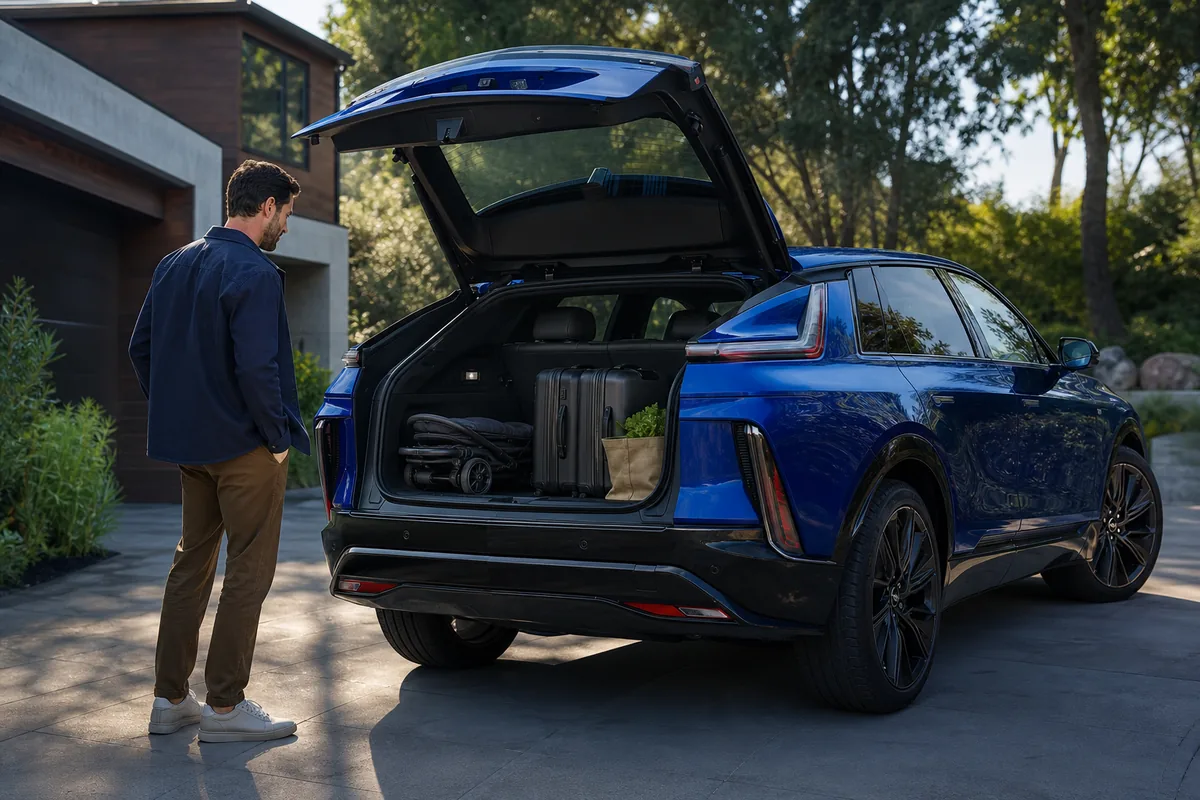
Cubic volume does not reveal the hatch aperture, floor length, width between the wheel housings, loading height, or rear-glass slope. Bring the rigid item that creates the hardest monthly load, then check whether it passes through the opening without tilting into the glass or resting above the seatbacks.
Set both front seats for the normal occupants before judging rear space. The Lyriq offers 39.6 inches of rear legroom, but knee clearance, foot space under the front seats, roof clearance, and door access still depend on the people who will use it.
Load the cargo area with the second row upright first. Keep the rear view clear and confirm that groceries or loose equipment have secure places, because a large volume figure does not prevent items from sliding across a wide floor.
The 60.8-cubic-foot maximum helps with long or bulky objects, but folding the entire second row removes passenger space. A split-fold test can show whether one rear passenger and the household's longest item can travel together.
The useful packaging verdict comes from fitting the normal people and objects at the same time. Treat the seats-folded maximum as occasional capacity, then decide from the 28-cubic-foot daily state.
The 3,500-pound tow rating belongs to an exact build
Cadillac publishes a 3,500-pound towing figure for a specific 2027 Lyriq configuration with the required equipment. Do not transfer that maximum to every RWD, AWD, or LYRIQ-V merely because the vehicles share a name.
| Evidence | What must match |
|---|---|
| Official configuration | Exact drivetrain and equipment that own the 3,500-pound rating |
| Vehicle labels | Gross vehicle weight, axle limits, and available payload on the actual build |
| Hitch equipment | Approved hitch, wiring, brake-control requirements, and installation |
| Loaded vehicle | Driver, passengers, interior cargo, accessories, hitch load, and tongue weight |
| Trip plan | Trailer mass, route, weather, charging stops, and energy reserve |
Tow rating and payload are different limits. Passengers, luggage, accessories, and hitch load consume available payload before the trailer reaches the headline maximum.
Electric towing can also increase energy use substantially, and no universal range-loss percentage applies. Route, speed, elevation, weather, trailer shape, mass, and charging access all affect the result.
Read the certification label and current towing instructions for the exact vehicle. Confirm hitch hardware and trailer-brake requirements with qualified sources before attaching a trailer.
Use 3,500 pounds only after the build, equipment, payload, and loaded trailer all pass their separate checks. A photo of a Lyriq towing cannot prove any of those conditions.
No applicable exact-year crash rating was found
No applicable exact-year 2027 Cadillac Lyriq rating from NHTSA or IIHS was found during the evidence review, so no star rating, award, crash-test grade, or equivalent numerical verdict applies here.
Driver-assistance equipment also answers a different question from crashworthiness. A list of cameras, alerts, or automated functions cannot replace an applicable crash test, and each fitted function still needs an operational check on the exact vehicle.
Before delivery, search NHTSA and IIHS again by make, model, body style, drivetrain when relevant, and model year. Record the date because an authority may publish or revise information after the evidence check.
Test seat belts, head restraints, child-seat anchors, cameras, warning indicators, and fitted driver aids according to the owner's information. Those checks confirm operation and fit, not an untested crash outcome.
The honest 2027 conclusion is that an applicable exact-year rating was not found. Keep that uncertainty visible rather than filling it with an older result or unsupported safety claim.
Battery coverage and charging access set the ownership boundary
Reliability evidence must match the exact model, model year, system, and study scope before it supports a claim about the 2027 Lyriq. A warranty term, recall, owner report, repair invoice, and broad brand study each answer a different question.
Cadillac lists 4 years or 50,000 miles of limited vehicle coverage and 8 years or 100,000 miles for the EV propulsion battery. Confirm the exact booklet, original in-service date, exclusions, roadside terms, state-specific provisions, and what battery-capacity standard controls a claim.
The available evidence does not establish a 2027 failure rate, common-problem inventory, broad software defect, or model-year ranking. Those conclusions require mature exact-year data rather than anecdotes or older campaigns.
Charging location controls much of the energy cost. Home electricity rates, time-based pricing, charging losses, public-session fees, subscriptions, idle fees, and the share of energy purchased away from home can materially change the result.
Insurance, registration, taxes, financing, tires, maintenance, repairs, depreciation, transaction price, annual mileage, and vehicle condition also require buyer-specific inputs. A broad five-year total would hide those differences behind unsupported assumptions.
Treat warranty as a coverage boundary and calculate ownership from your charging mix and written quotes. Reliability confidence must come from applicable evidence and the exact vehicle's records and behavior.
Buy the Lyriq configuration that completes the charging week
The regular 2027 Lyriq suits a buyer who can verify home charging, map dependable public backups, and fit normal passengers and cargo inside the five-seat body. RWD makes the strongest range case with its 326-mile statement and 365 hp.
AWD earns consideration when the buyer will use its traction or 515-hp response and accepts the exact 319-mile or 303-mile equipment label on the selected build. The range label must come from the vehicle's official configuration rather than an assumption about equipment.
LYRIQ-V is a different purchase with 615 hp and a 285-mile manufacturer statement. Choose it only when the added performance is a repeated priority that outweighs its range and ownership tradeoffs.
Repeat the road, charging-port, cargo, and control checks on the exact vehicle. Verify its equipment label, connector, warranty, towing applicability, and current safety records before signing.
Buy the least specialized Lyriq that completes your real charging week. Another EV is the better answer when the route depends on optimistic charging, the wrong range label, or utility the exact build cannot prove.