The Venue works best when the city is the mission
The 2026 Hyundai Venue is a 159.1-inch subcompact SUV with five seats, front-wheel drive and a 121-hp engine. Hyundai lists it from $20,550 before destination, while every trim carries the same EPA estimate of 29 mpg city, 33 highway and 31 combined.
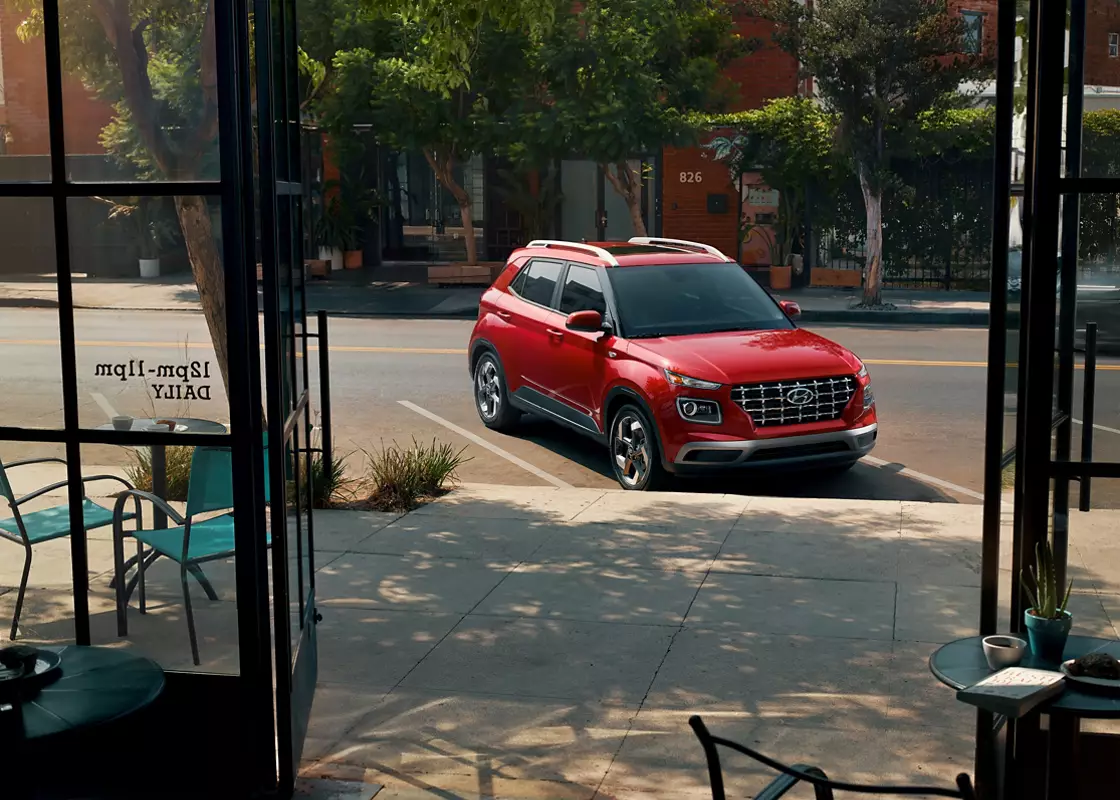
Those numbers give the Venue a clear job: make new-car ownership, parking and low-speed errands manageable without asking the buyer to accept a two-seat cabin or a sedan trunk. Its short body is 7.8 inches shorter than a 2026 Hyundai Kona, according to Hyundai's published dimensions, so the difference is large enough to feel in a tight garage or curbside space.
Hyundai calls the Venue an SUV, though its dimensions and front-wheel-drive-only layout put it close to a tall hatchback in daily use. The upright seating and square cargo opening are useful, but the 121-hp drivetrain and 34.3 inches of rear legroom establish the limits.
Buy the Venue for its low price and small footprint, then make sure its rear seat and cargo area fit the people and equipment you carry.
SE or SEL: buy equipment, not a different drivetrain
The Venue has one mechanical specification across the range: a 1.6-liter four-cylinder, an Intelligent Variable Transmission and front-wheel drive. Moving from SE to SEL changes wheels, brakes and convenience equipment, not power or fuel economy.
Hyundai's current comparison page lists the SE at $20,550, the SEL at $22,825 and the SEL with Two-Tone Roof at $22,600 before destination. Because the published two-tone price sits below the regular SEL price, confirm the window sticker and destination charge on the exact vehicle instead of treating the website order as a guaranteed price ladder.
| Trim | Hyundai-listed starting MSRP | Wheels and rear brakes | Equipment that changes the decision |
|---|---|---|---|
| SE | $20,550 | 15-inch alloy wheels, rear drums | Wireless Apple CarPlay and Android Auto |
| SEL | $22,825 | 17-inch alloy wheels, rear discs | Blind-spot collision warning, rear cross-traffic warning, Snow Mode, heated seats and mirrors, wireless charging |
| SEL with Two-Tone Roof | $22,600 | 17-inch alloy wheels, rear discs | SEL equipment with contrasting roof treatment |
The SE is the value choice because it preserves the same output, fuel rating, cabin dimensions and core forward-collision equipment. Its smaller wheels should also make replacement tires cheaper and leave more sidewall between the rim and a pothole.
The SEL earns its price through equipment that a driver can use every day, especially blind-spot warning and rear cross-traffic warning in busy parking lots. Snow Mode can adjust power delivery on a slick road, but it does not add driven rear wheels or turn the Venue into an all-wheel-drive vehicle.
Choose the SEL when its driver-assistance and cold-weather equipment solve a real need; otherwise the SE delivers the same drivetrain and EPA economy for less.
Passenger and cargo space need a physical fit check
The front row has 41.3 inches of legroom, while the rear has 34.3 inches. That rear figure can work for children and shorter trips, but it leaves little spare room once a tall driver moves the front seat back or a rear-facing child seat enters the cabin.
Cargo volume measures 18.7 cubic feet behind the rear seat and 31.9 cubic feet with it folded. Folding the seat creates useful space for two people and bulky gear, while keeping five people aboard leaves the smaller number in charge.
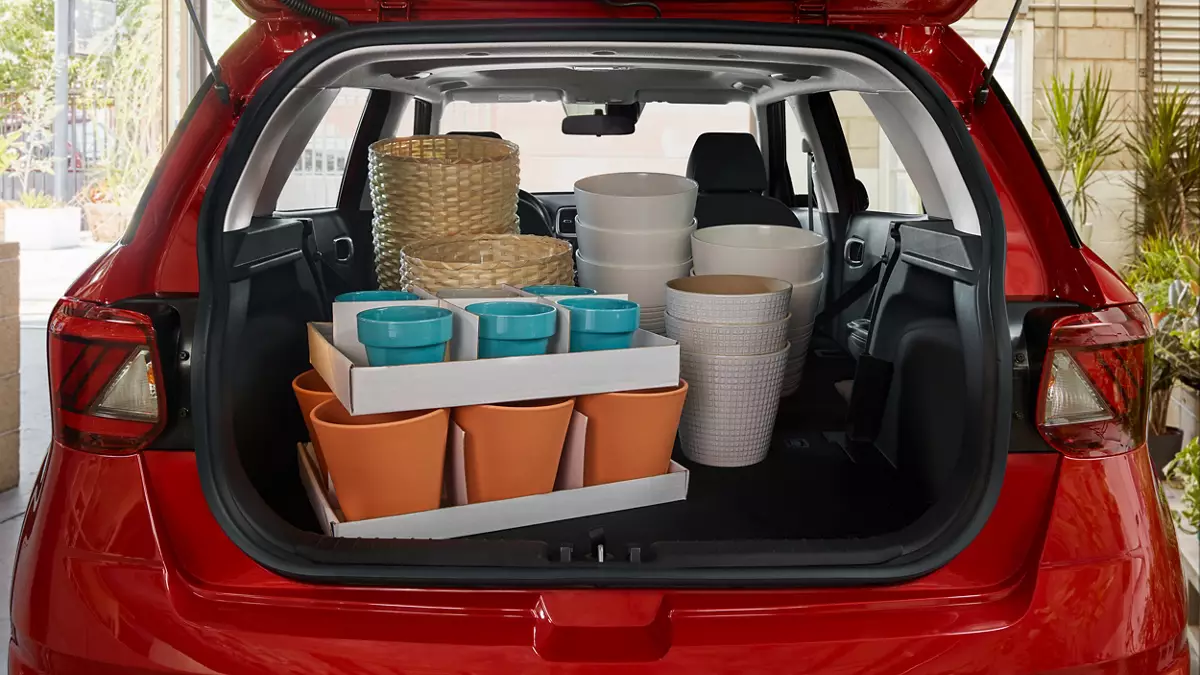
A specification sheet cannot show whether a stroller clears the parcel shelf or whether a child seat leaves enough room for the front passenger. Take the items that create the space problem to the dealership and run the following checks:
- Install the largest child seat used by the household and set the front seat for its normal occupant
- Load the stroller, wheelchair, work case or sports bag that travels every week
- Close the hatch with the rear seat upright rather than assuming the folded-seat figure applies
- Sit in the rear seat behind the normal driving position for at least ten minutes
The Venue seats five on paper, but four adults and their luggage can ask more of the cabin than its short body can provide. The cargo test should happen before the price discussion, because no trim adds another inch of room.
The 121-hp drivetrain favors low-speed use
Hyundai's 1.6-liter four-cylinder produces 121 hp at 6,300 rpm and 113 lb-ft of torque at 4,500 rpm. An Intelligent Variable Transmission sends that output to the front wheels, and Hyundai offers no turbo engine, hybrid system or all-wheel drive on the 2026 Venue.
The modest output fits stop-and-go streets better than repeated high-speed merging with passengers and luggage. Buyers should test an on-ramp and a 50-to-70-mph pass with the cabin loaded as it will be used, because horsepower alone cannot answer whether the available response feels adequate.
EPA estimates are identical across all three trims at 29 city, 33 highway and 31 mpg combined. At 12,000 miles a year, 31 mpg works out to about 387 gallons, so every $1 change in the local price of a gallon changes the annual fuel bill by roughly $387.
Numbers that shape the drive
- Engine
- 1.6-liter four-cylinder
- Output
- 121 hp and 113 lb-ft
- Transmission
- Intelligent Variable Transmission
- Driven wheels
- Front only
- Fuel tank
- 11.9 gallons
- EPA estimate
- 29 city, 33 highway, 31 combined mpg
The official rating is a comparison point rather than a promise. Speed, temperature, short trips, tire pressure and load all change the fuel a particular driver uses, so local mileage and pump price belong in the calculation.
Estimate your annual fuel cost
The Venue makes sense when low purchase cost and city maneuverability matter more than effortless passing power or all-wheel-drive traction.
Safety evidence is useful but incomplete
The Insurance Institute for Highway Safety gives the 2020 to 2026 Venue a Good result in the driver-side small-overlap front test. That test was performed on a 2020 model and carries forward through 2026, while the current IIHS page does not publish results for the updated moderate-overlap or updated side tests.
Headlight performance needs closer reading. IIHS rates the halogen projector configuration Marginal, and Hyundai's 2026 specifications list halogen projector headlights on every current trim.
For vehicle-to-pedestrian prevention in daylight, IIHS rates the standard system Advanced on the SE and SEL configuration. Hyundai also lists forward collision-avoidance assist with pedestrian detection, lane-keeping assist, lane-following assist and driver-attention warning as standard equipment.
| Evidence | Published result | Limit |
|---|---|---|
| Driver-side small-overlap front crash | Good | 2020 test applies to 2020 through 2026 |
| Halogen projector headlights | Marginal | Rating concerns illumination performance, not crash structure |
| Day pedestrian front crash prevention | Advanced | IIHS evaluation applies to the standard SE and SEL system |
| Updated moderate-overlap and updated side tests | No current result shown | Do not infer a rating from the older small-overlap test |
The missing current tests keep this record from supporting a broad claim that the Venue performs well in every crash type. They also make trim equipment and driver visibility worth checking directly rather than relying on a badge or a single rating.
The published small-overlap result is strong, but the incomplete current crash-test set and Marginal halogen headlights deserve a direct check.
Reliability depends on model year and campaign completion
The 2026 Venue is a carry-over model, according to Hyundai's model-year change announcement, so it benefits from several years of the same basic platform. A carry-over designation does not create long-term evidence for a new car, and the public record is more useful for identifying checks on earlier used examples.
Hyundai service campaign T8X covers certain 2020 to 2022 Venues built from September 17, 2019 through October 20, 2021. The bulletin calls for transmission-control software and, when diagnostic trouble codes remain or return, inspection and possible replacement of the Intelligent Variable Transmission.
A separate Hyundai warranty extension covers the horn on certain 2020 to 2022 Venues for 10 years or 120,000 miles from the original retail date or first use. The bulletin attributes an inoperative horn to foreign material or oxidation inside the low-pitch horn.
- 2020 to 2022Certain vehicles fall under IVT service campaign T8X; verify completion and investigate applicable warning codes
- 2020 to 2022Certain vehicles receive the 10-year or 120,000-mile horn warranty extension
- 2020 to 2022NHTSA campaign 22V458 covers certain Venue seat-belt pretensioners that may deploy abnormally and send fragments into the cabin
- 2024NHTSA campaign 24V308 covers certain Venues whose EGR valve assembly may short and cause a loss of drive power
- 2026Hyundai describes the model as carry-over; check the VIN rather than transferring an earlier campaign to a new vehicle
These records define inspection work, not a verdict on every Venue. Build date, model year, VIN and repair history decide whether a campaign applies, and a completed remedy changes the condition of the car being considered.
Used Venue checks
- Run the VIN through NHTSA and keep the result with the purchase paperwork
- Confirm campaign T8X completion on an applicable 2020 to 2022 vehicle
- Scan for transmission codes and test for warning lights, hesitation or abnormal engine speed
- Sound the horn repeatedly and ask whether the warranty-extension repair has been performed
- On a 2024 vehicle, verify the EGR recall remedy and test for stored fault codes
- Review oil-change records, tire wear and accident repairs on the exact vehicle
For a used Venue, a clean VIN record and documented campaign work carry more weight than a general reliability label.
Ownership cost stays controlled when the Venue fits
Low starting price, 31-mpg combined economy and a naturally aspirated engine give the Venue a straightforward cost structure. The largest avoidable ownership expense is buying the wrong amount of space or traction and replacing the vehicle early.
Wheel size changes a recurring bill. The SE uses 15-inch tires, while both SEL versions use 17-inch tires; compare like-for-like replacement quotes before paying for the larger-wheel trim, because tire brand and local availability can outweigh the visual upgrade.
Hyundai's new-vehicle limited warranty lasts 5 years or 60,000 miles, and roadside assistance lasts 5 years with unlimited mileage. The 10-year or 100,000-mile powertrain warranty is limited to the original owner, while a later owner receives powertrain coverage only within the remaining 5-year or 60,000-mile new-vehicle term.
Cost facts to write down
- Starting MSRP
- $20,550 before destination for SE
- Estimated annual fuel at 12,000 miles
- About 387 gallons at 31 mpg
- New-vehicle warranty
- 5 years or 60,000 miles
- Original-owner powertrain warranty
- 10 years or 100,000 miles
- Subsequent-owner powertrain coverage
- Remainder of 5 years or 60,000 miles
- Roadside assistance
- 5 years, unlimited mileage
A used listing that says the car has a ten-year powertrain warranty can therefore be misleading unless the seller is the original owner transferring within a Hyundai program that states otherwise in writing. Establish the original in-service date and current owner status before assigning money to remaining coverage.
The Venue is inexpensive to run when its space and front-drive layout fit the job; warranty status and tire size are the two ownership details most likely to be priced incorrectly.
Where the Venue earns its price, and where it gives ground
The Venue's strengths come from using one simple drivetrain in a short, inexpensive body. Its weaknesses are equally concrete, so the right choice depends more on the trips and passengers than on trim marketing.
Pros
- Low $20,550 starting MSRP before destination
- Short 159.1-inch body is easy to place and park
- Same 31-mpg combined EPA estimate on every trim
- SEL adds useful blind-spot and rear cross-traffic assistance
Cons
- No all-wheel-drive option
- 121 hp leaves limited reserve for loaded highway driving
- 34.3 inches of rear legroom needs a child-seat or adult fit check
- Current IIHS record lacks updated moderate-overlap and side results
Who should buy the Hyundai Venue
The Venue suits a driver who spends most days in traffic, parks in tight spaces and wants a new-car warranty at a low entry price. The SE covers that job with the fewest added costs, while the SEL is easier to justify for drivers who value blind-spot assistance, heated equipment and rear disc brakes.
It becomes a poor fit when adults regularly occupy the rear seat, a stroller and luggage must remain aboard together, or winter travel requires all-wheel drive. A test drive with the usual passengers and equipment can settle those limits before financing turns them into an expensive correction.
The trim decision should follow the fit test rather than precede it. If the rear seat, cargo area and front-drive traction all meet the household's real use, the Venue is one of the clearest low-cost new-SUV choices.