Before the split there were three different problems
The nameplate has never had one story. The years before 2013 make that plain.
The 2007 car holds 683 filings led by air bags at 79, with fuel and propulsion items close behind at 77. The 2008 car is larger still on that second category, at 177 of its 541.
Those filings are mostly emissions and evaporative faults rather than anything dramatic, with owners quoting stored codes for large leaks in the system.
By 2010 the leading category has changed again.
Power train takes 95 of that year's 258 filings. Owners describe the transmission slipping at motorway speeds.
- 2007 to 2009Air bags and fuel or evaporative items lead, on totals of 683, 541 and 358
- 2010Power train leads at 95 of 258, with transmission slipping described at speed
- 2011 onwardEngine takes over and stays in front until 2020
Then the engine arrives and does not leave. From 2011 it leads every year through to 2020, which is the run that produced the campaigns in the next sections.
Four distinct eras in eighteen model years is why a single reliability score for this nameplate tells you very little. The useful question is always which era the car in front of you belongs to.
Two vehicles carried this name at the same time
From 2013 to 2018 there was a three-row Santa Fe and a two-row Santa Fe Sport, sold side by side in the same showroom.
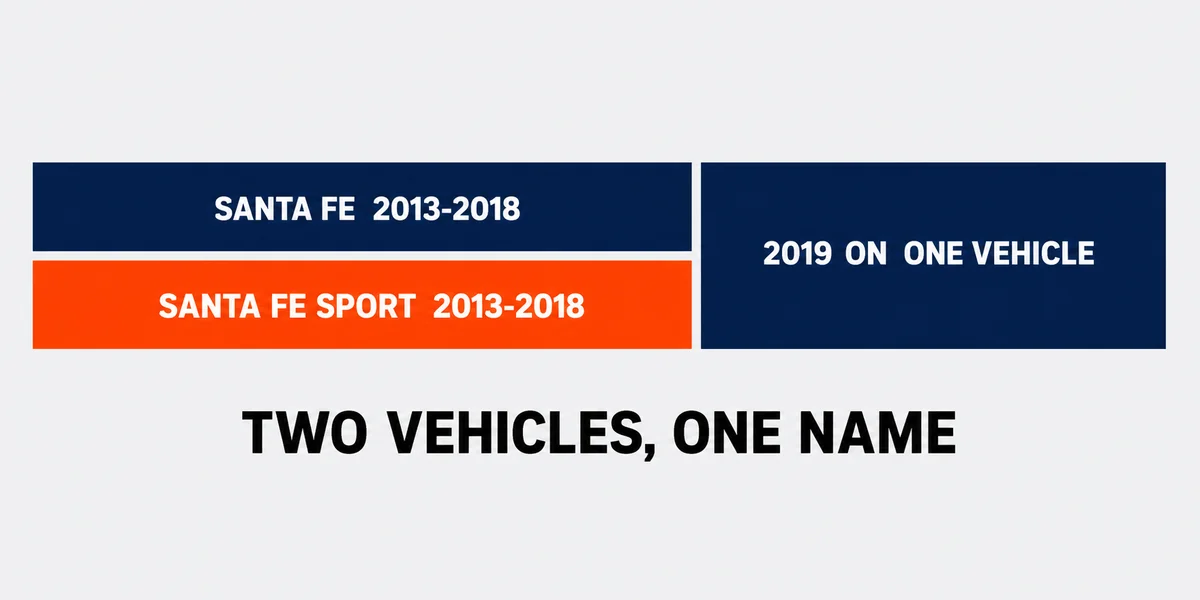
They were not trims of one another. The Sport was shorter, lighter and sold with different engines, and the database treats it as a separate vehicle throughout.
The difference reaches running cost as well. A Sport and a three-row car of the same year share neither tyre sizes nor engine parts, so read any Hyundai Santa Fe reliability figure for those years knowing which of the two it describes.
That separation is testable rather than assumed. Compare the two record sets by filing number for 2013, 2015, 2016 and 2017 and they share nothing at all, not one report in common.
One year breaks the pattern. In 2018, as the Sport was retired, 96 records appear under both labels, which is the only overlap anywhere in the run.
From 2019 the Sport label disappears entirely.
A Santa Fe XL label picks up 25 filings that year. After that the nameplate is one vehicle again.
What a Santa Fe search leaves out
Once you know to query both labels, several published figures stop being usable.
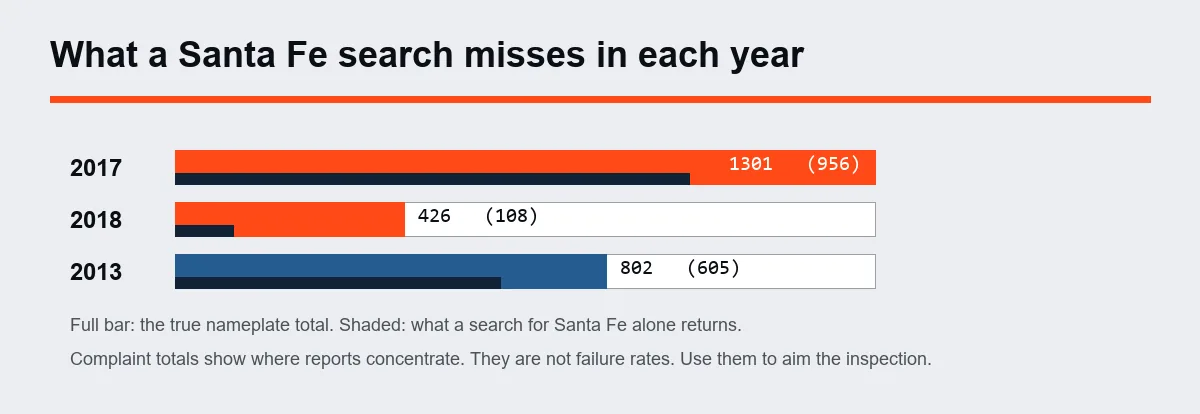
The worst distortion is the 2018 model year. A Santa Fe search returns 108 filings, while the Sport carries 414 more, so the year that every list treats as a recovery is really the fourth busiest in the run.
The other direction matters too. The 2017 model year holds 1,301 filings once both labels are counted, against the 956 that gets published, making it comfortably the worst year this nameplate has recorded.
| Model year | Santa Fe | Santa Fe Sport | True total |
|---|---|---|---|
| 2013 | 605 | 197 | 802 |
| 2014 | 494 | 161 | 654 |
| 2015 | 254 | 82 | 336 |
| 2016 | 235 | 66 | 301 |
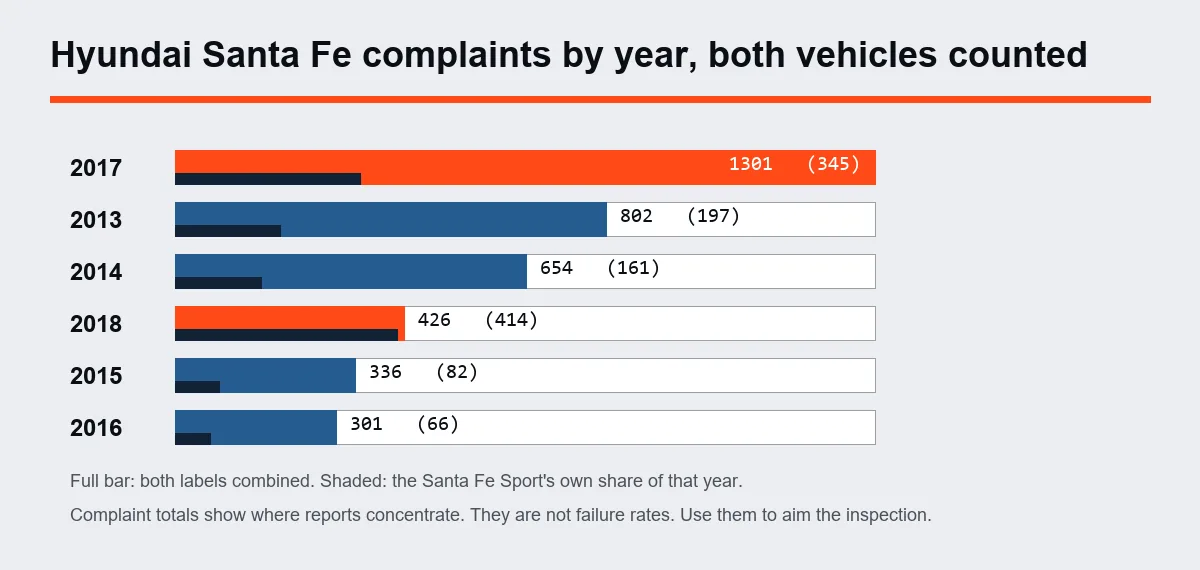
| 2017 | 956 | 345 | 1,301 |
| 2018 | 108 | 414 | 426 |
Read down the last column and the ranking changes. 2017 first, then 2013, then 2014, with 2018 sitting well above the 2015 and 2016 cars rather than below them.
Both vehicles share the same engine fault
The obvious next question is whether picking one body style avoids the problem that made those years large. It does not.
The engine leads the three-row car's record every year from 2012 to 2020. On the Sport it leads as well, at 79 filings in 2013, 133 in 2017 and 168 in 2018.
Read the worst year on each and the same failure appears. Of the 2017 Santa Fe's 470 engine filings, 253 name seizure, knocking, stalling or lost power.
One hundred and seven of those 470 use fire wording, and 38 record an engine that was replaced. The Sport's own worst year carries the same mix at a smaller scale, with 62 hard failures and 41 fire mentions among its 168 engine filings for 2018.
The detail worth carrying to a viewing is what comes first. One hundred and fifty of the 2017 car's 470 engine filings describe the car using or losing oil before anything else went wrong.
That is the highest oil count anywhere in this record, and the Sport shows it too at 75 of its 168 for 2018. Owners describe topping up between services, often with no leak and no smoke.
So the check is a dipstick and a service history, not a noise. An engine that has been quietly drinking oil is the one these filings describe going on to fail.
Hyundai has issued campaigns against both. They are separate entries carrying separate numbers.
Which engine campaign applies to which car
- 2013 to 2014 Santa Fe Sport
- Campaign 17V226, for machining errors causing premature bearing wear
- 2017 Santa Fe
- Campaign 17V578, covering the three-row car specifically
- Stated consequence
- The engine seizing, which Hyundai links to an increased crash risk
- Why it matters
- One engine family across two body styles produces the same fault in both
The two vehicles do not peak together, which is the last reason a merged figure misleads. The Santa Fe's engine record tops out in 2017 at 470 filings, while the Sport's tops out in 2018 at 168, the same year the Santa Fe's own engine count falls to 36.
So the label tells you which campaign number to ask for, not whether you have avoided the issue. A Hyundai Santa Fe of either shape from this period needs the engine entry checked.
The brake module campaign Hyundai issued twice
A second entry on the Sport is easy to mark as settled, for an unusual reason.
Campaign 20V520 covers 2013 to 2015 Santa Fe Sport models. Brake fluid may leak inside the anti-lock brake module, which can cause an electrical short and an engine compartment fire.
A year later campaign 21V303 arrived. It covers the same model years, the same vehicle and the same defect, described in almost the same words.
The pattern continues into the later cars. Campaign 22V056 reaches 2016 to 2018 Santa Fe and Sport models with the same failure mode, so the whole overlap period is covered by one brake module problem in instalments.
One more entry catches both labels. Campaign 17V358 covers a secondary hood latch cable that may corrode and bind on 2013 to 2017 cars, leaving the hood able to open if the primary catch releases.
Widen the view and this stops looking like a Santa Fe problem at all. Hyundai and Kia have issued at least six campaigns for the same hydraulic control unit failure, in wording that barely changes between them.
The same failure across the group
Hyundai Santa Fe
20V520, 21V303 and 22V056 cover the Sport and the three-row car across the overlap period
Hyundai Tucson
22V056 reaches the 2014 and 2015 cars, 20V543 the 2019 to 2021 ones
Kia Sportage
Three further campaigns cover 2010 to 2021 with no year left out
Shared wording
Each names an engine compartment fire, most specifying while parked or driving
So a buyer moving between these badges carries the same question rather than leaving it behind. The Tucson and the Kia Sportage each have their own version of it, on their own model years.
After 2018 the numbers start telling the truth
The reconstruction stops being necessary once the Sport is gone.
From 2019 there is one vehicle, one label and one set of figures. The 2019 car holds 193 filings, the 2020 car 203 and the 2021 car 164.
What that consolidation reveals is a genuine change in kind. The engine leads the 2019 car at 38 filings and the 2020 car at 43, which is a fraction of the 470 it took on the 2017 record.
By 2023 and 2024 the engine has dropped behind power train entirely, at 16 and 17 filings against 22 and 23.
That is the clearest signal in this whole record that the engine era ended rather than quietened. A component that led for nine consecutive years does not fall to a sixth of its peak by chance.
The leading category changes too. Power train replaces the engine from 2021, and the engine drops well down the list.
The 2024 redesign is a separate proposition again. It holds only 138 filings, but its first two years carry campaigns covering the transmission, the airbags, the wiring and the reversing camera software.
That is a normal launch load rather than a defining fault. It still means a VIN search on a two-year-old car is worth as much as on a ten-year-old one.
Which Santa Fe to look for
The useful window is the single-vehicle years before the latest redesign, because that is where the published figures mean what they say.
The 2021 car holds 164 filings and the 2022 car 195. Neither has the engine leading its record, which is the first time that is true since 2011.
One campaign reaches both.
Campaign 23V181 covers trailer hitches on 2019 to 2023 cars. That is a single confirmation rather than a list.
The hardest part of buying this car is knowing which vehicle the numbers describe. Settle that, ask for the engine entry and the later brake module entry, and the rest is an ordinary used purchase.