The engine led twelve consecutive model years
From 2011 through 2022 the leading complaint category against the Sportage is the engine. Twelve model years without a single break.
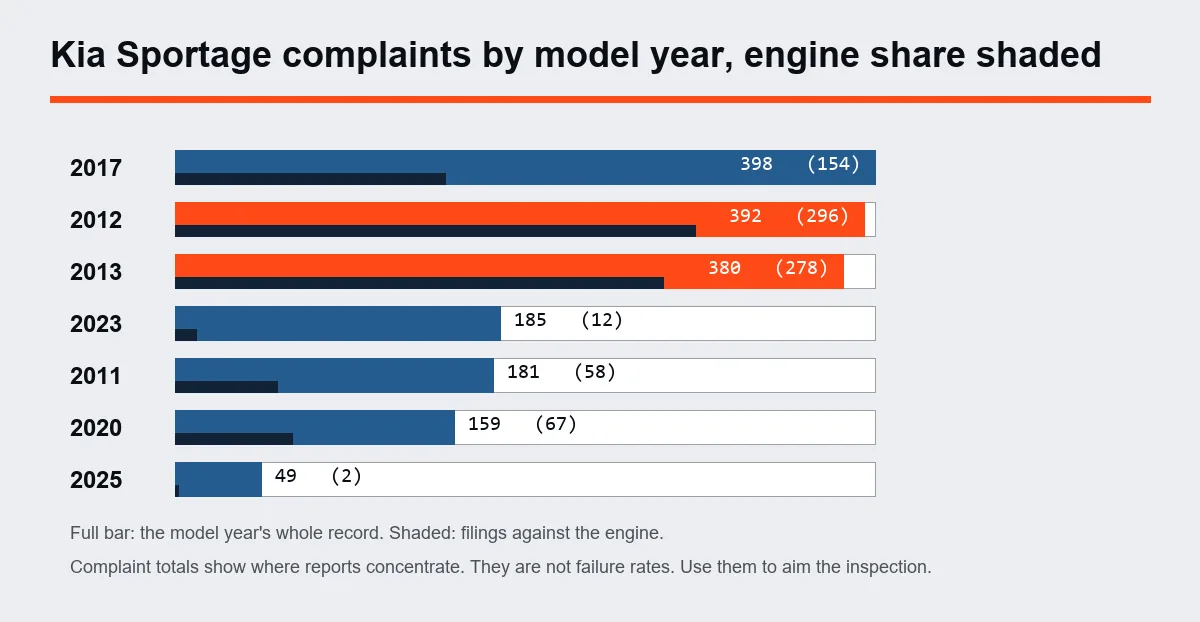
The totals alone would send you to the wrong year. The 2017 car has the highest count in the whole record at 399 filings.
Look at what those records are made of and the ranking inverts. The 2012 car holds 291 engine filings out of 392, and the 2013 car 262 out of 380, which is around seven in ten of everything filed against each.
The 2017 car, for all its volume, puts 139 of its 399 against the engine. That remains a serious share without being the same vehicle-defining concentration.
So rank these years by how much of the record is one component rather than by how tall the bar is. On that measure 2012 and 2013 are the two to walk away from.
What 291 engine filings on one model year describe
The word failure does a lot of hiding here, so it is worth reading what owners actually filed.
Of the 2012 car's 291 engine filings, 174 name a hard failure: seizure, knocking, stalling or lost power. A further 42 use fire wording.
On XXX, my 2012 Kia Sportage experienced a catastrophic engine failure while traveling on the interstate. The connecting rod failed, breaking through the engine block.
The 2013 car repeats the pattern almost exactly. One hundred and fifty nine of its 262 engine filings fall in the same group.
What matters for a buyer is that these are event reports rather than symptom reports. A rod through the block is not something the car was doing quietly for a month beforehand.
That removes the tool most used-car advice reaches for first. There is no road test that reveals this, because the filings describe cars that were driving normally until they were not.
Which means the purchase is decided on paperwork, and the paperwork on this vehicle is more complicated than it looks.
The later engine years burn more often than the early ones
The engine story is not one failure repeated for twelve years. It changes character partway through.
On the 2012 car, 42 of the 291 engine filings use fire wording, which is about one in seven. Most of that record describes a mechanical failure instead.
Hard failure is what the early years are made of. 174 of those 291 filings name seizure, knocking, stalling or lost power.
Move forward and the balance shifts. On the 2017 car, 37 of the 139 engine filings mention fire, closer to one in four, and the 2020 car runs at a similar rate with 17 of 57.
- 20114 of 50, roughly one in twelve
- 201242 of 291, about one in seven
- 201510 of 55, closer to one in five
- 201737 of 139, about one in four
- 202017 of 57, near three in ten
- 20224 of 13, a third of a small record
- 20230 of 10, after the redesign
The climb is steady, not sudden. No single model year is where the record turns, which is what an ageing component across a long production run looks like.
The absolute numbers fall while the proportion climbs. Fewer owners of later cars filed about the engine at all, but those who did were more likely to be describing smoke or flames.
Hard-failure counts fall faster than fire wording does. They drop from 174 on the 2012 car to 47 on the 2017 and 20 on the 2020, while the fire share roughly doubles across the same span.
A shrinking record that is increasingly about fire is not a vehicle getting better. It is a smaller number of owners reporting a more serious outcome.
That span matters for a second reason. The 2017 to 2021 cars are exactly the years brake module campaign 21V137 reaches, which is also an engine compartment fire risk from a different component.
Fire risk on this vehicle belongs to no single system. Seven campaigns across the run name it, and they reach four different parts of the car.
Campaigns that name a fire risk on this vehicle
- 18V907, a fuel feed hose that may leak in the presence of an ignition source
- 19V101 and 20V750, engine damage giving an engine compartment fire
- 21V137, 22V051 and 23V652, the brake module, all three worded as a fire while parked or driving
- 22V703, a trailer hitch harness, the only entry with nothing to do with the engine bay
So on a 2017 to 2021 car there are two separate fire-risk entries to settle, arriving from opposite ends of the engine bay.
Ask for them by number and by system. A seller who confirms the engine campaign has answered one of four.
There is a recall for cars that already had the recall
Kia replaced engines across several models under campaign 17V224. On the face of it, a Sportage that received one is a Sportage with the problem removed.
Then campaign 18V907 arrived. It covers 2011 to 2018 Sportages, and the population it names is the part worth reading twice.
A companion entry sits on the earliest cars. Campaign 19V101 covers an oil pan that may leak on 2011 and 2012 Sportages, where Kia lists engine damage, fire and stalling among the consequences.
So on any Kia Sportage from this era, ask for both numbers by VIN. A seller who volunteers that the engine was replaced has told you which campaign to check, not that you can skip it.
Three brake-module campaigns cover the run without a gap
Running alongside the engine story is a second one that most year lists miss entirely, because it is filed under brakes rather than fire.
Three separate campaigns cover the hydraulic electronic control unit. All three describe the same failure, which is an electrical short causing a fire in the engine compartment.
| Campaign | Model years covered | Stated risk |
|---|---|---|
| 23V652 | 2010 to 2013 | Engine compartment fire while parked or driving |
| 22V051 | 2014 to 2016 | Engine compartment fire while parked or driving |
| 21V137 | 2017 to 2021 | Fire in the engine compartment |
Set the spans end to end and the point becomes obvious. Twelve consecutive model years are covered by one failure mode addressed in three instalments, with no year falling between them.
For a buyer that simplifies rather than complicates. Whatever year you are looking at between 2010 and 2021, there is exactly one brake module entry that applies, and the dealer can confirm it in the same call as the engine campaigns.
The brake module problem is bigger than this model
The three instalments above are not a Sportage story. They are one corner of something Kia and Hyundai have been working through across both brands.
Between them the two manufacturers have issued at least six campaigns for the same failure. A hydraulic control unit shorts, and the stated consequence is an engine compartment fire while parked or driving.
The wording repeats almost exactly from one campaign to the next. What changes is the model list.
Where the same failure turns up
Kia Sportage
23V652, 22V051 and 21V137 between them cover 2010 to 2021
Hyundai Tucson
20V543 covers 2019 to 2021 cars and 22V056 reaches the 2014 and 2015 ones
Hyundai Santa Fe
22V056 and 23V651 cover the overlap period from both directions
Shared wording
Every one of them names an engine compartment fire, most specifying while parked
That matters if you are cross-shopping rather than settled on one badge. Moving from a Sportage to a Tucson or a Santa Fe does not leave this particular question behind.
It also changes how to read a clean history on any of them. A car built in a covered year with no brake module entry recorded is a car whose paperwork is incomplete rather than a car that escaped.
The 2023 redesign ends one story and starts another
The fifth-generation car breaks the pattern completely, and the numbers are unusually clean about it.
The 2023 Sportage holds 185 filings with just 10 against the engine. None of those ten use fire wording.
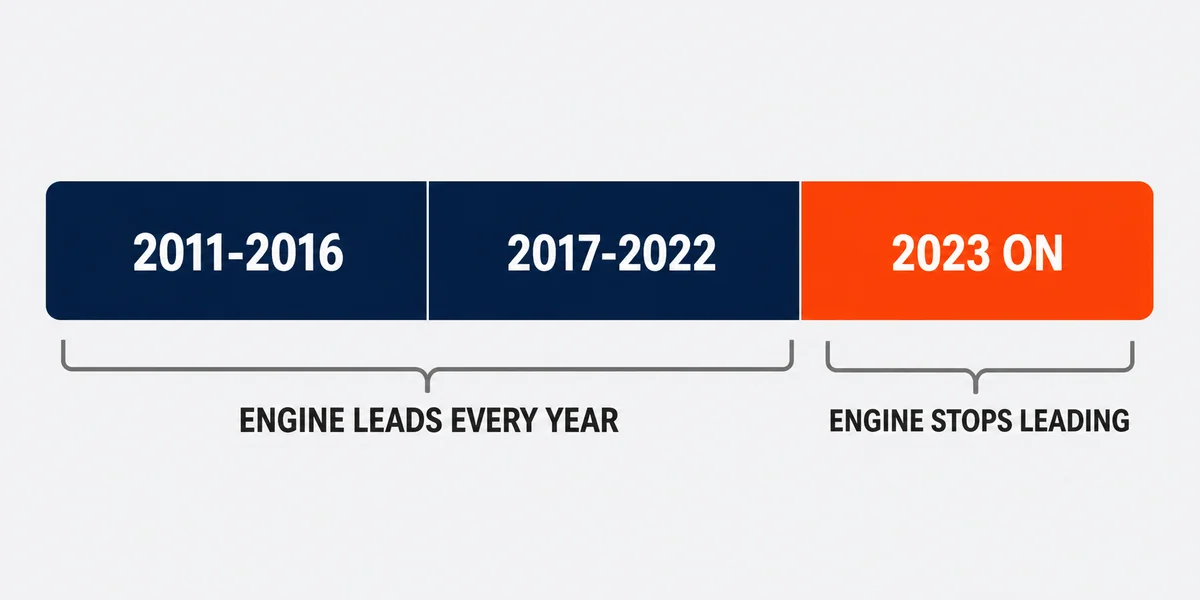
That is a genuine break rather than a quiet year. Two full generations led by one component, and then a third where it drops out of the top three entirely.
The redesign did not arrive empty-handed, though. Its first two model years carry a campaign list of their own.
What clears a 2023 or 2024 car
- 23V531, oil pump assembly
- Repair order for the electronic controller, since the stated risk is a vehicle fire
- 24V025, roof molding
- Confirmation the molding was secured, as a detached piece is a hazard to other traffic
- 23V410, brake booster
- Dealer record, separate from the older brake module entries
- 22V878, curtain airbag
- Applies to 2023 cars specifically, so check it by VIN
Read that list next to the older one and the difference is in kind. These are first-year assembly items rather than a component that defines the vehicle.
Which Sportage to look for
The quiet window sits at the end of the fourth generation, after the engine years have thinned and before the redesign's launch campaigns.
The 2022 car holds 45 filings, the lowest of any Sportage with real time on the road. Behind it sit the 2021 car at 50 and the 2019 car at 69.
One detail separates 2022 from 2021. The brake module campaign 21V137 reaches 2021 cars and stops there, so a 2022 car sits outside all three of those entries.
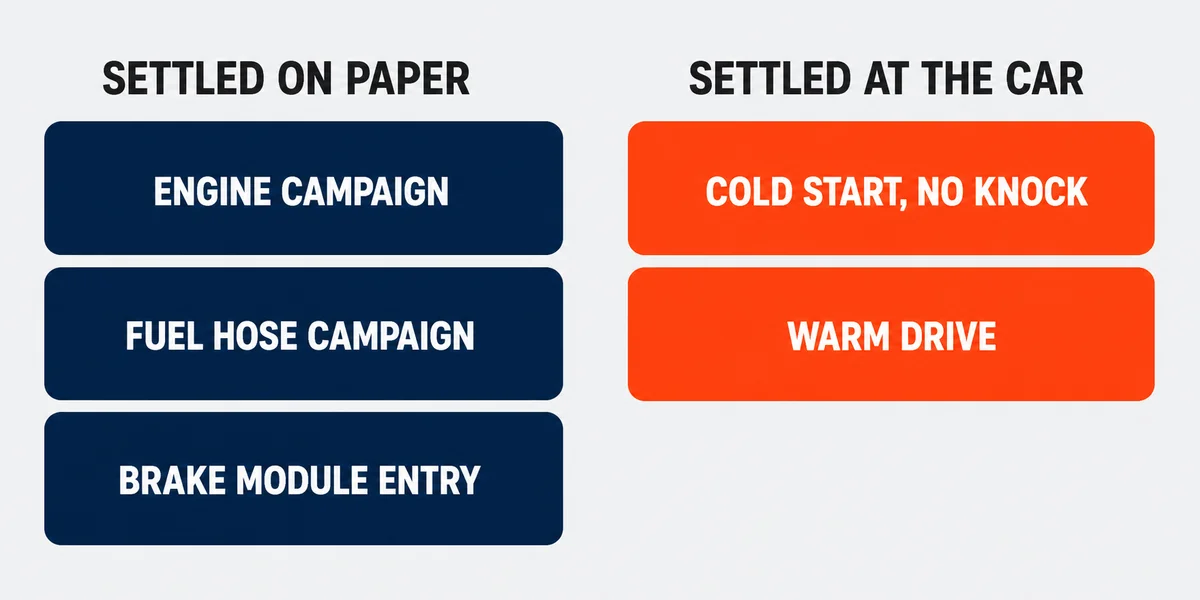
The engine question is answerable on paperwork, and the paperwork is specific enough to settle it in one phone call. Ask for the engine campaign, the follow-on fuel hose campaign and the brake module entry for that year.
A replaced engine changes the arithmetic after the sale as much as before it. A car running newer internals under an older body is not the same ownership proposition as an untouched one, and the Kia Sportage reliability record is where that difference gets costed.