One year would not move, another stops on its own
Set the model years side by side and one of them is not close to the others.
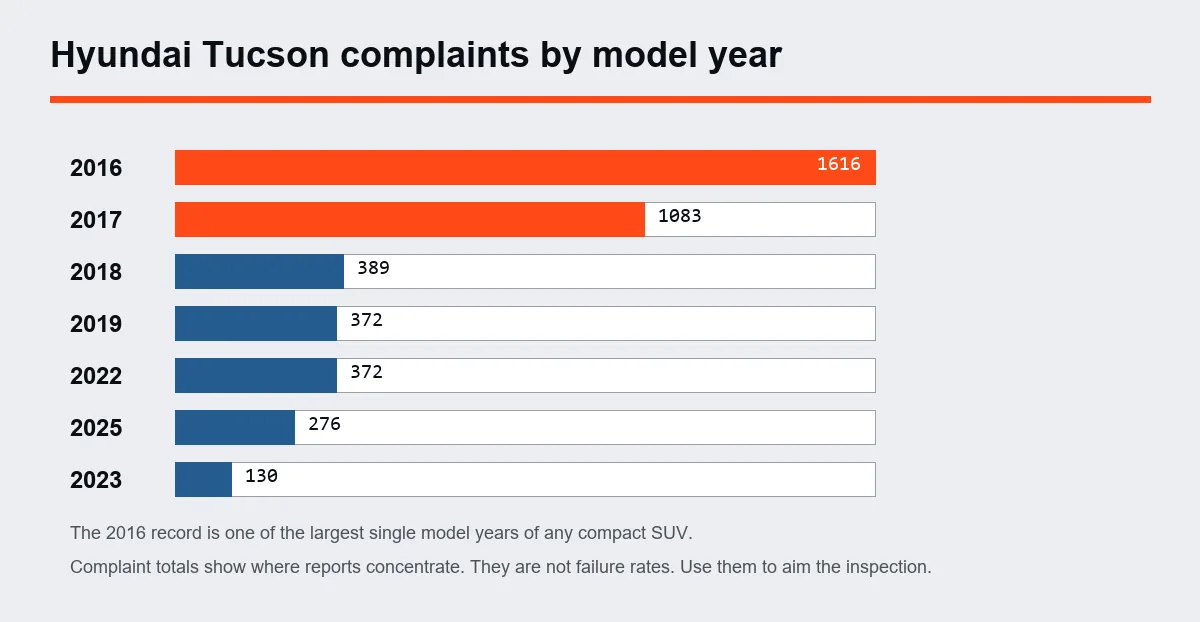
The 2016 car holds 1,616 complaint filings, which is one of the largest single model-year records of any compact SUV. The 2017 car follows at 1,083.
Then it collapses. The 2018 car holds 389 filings and the 2019 car 372, back into the range you would expect.
The current car looks quiet by that standard at 276. What the total hides is that more than half of it, 145 filings, is one system, and that system is the automatic braking.
Two failures pointing in opposite directions cannot share a warning. That is why a reader who arrives knowing about 2016 walks past the thing most likely to affect a car bought this year.
The 2016 record is one of the largest anywhere
Four figures in a single model year needs explaining, and the explanation is the gearbox.
The power train category holds 317 of the 2016 car's filings on its own. Counted with every filing that names power train alongside another system, the figure reaches 516.
Read those 317 filings and one behaviour dominates. 129 of them describe hesitation, shuddering or jerking, almost always from a standstill.
The vehicle severely shudders, jerks, and hesitates from a stop and while making a turn, during both acceleration and deceleration, making it entirely unsafe to drive.
Where owners say it happens is what makes it serious. One hundred and four of the 317 name an intersection, a turn across traffic, a merge or pulling out of a junction.
Thirty-four go further. They describe a near miss or being struck from behind while the car failed to move.
The descriptions are specific about the sequence. One filing records the car slowing down when the accelerator is pressed, another the engine revving before the vehicle lunges forward.
That behaviour also explains the volume as much as the fault does. A gearbox that hesitates every time you pull away gives an owner a reason to file after almost every drive, where a component that fails once produces a single report.
Eighty-one of the 317 name the dual clutch gearbox directly. Campaign 16V628 covers it, applying to 2016 Hyundai Tucson models fitted with the seven-speed EcoShift dual clutch transmission.
Hyundai gives inability to move the vehicle in traffic as the consequence, which is the event the owners are describing.
The dealer response completes the pattern. Fifty-four of the 317 record being told the behaviour is normal, and 16 record a dealer unable to reproduce it.
A fault a dealer calls normal is one you have to rule out yourself. This is the one failure on this page that a test drive reaches easily.
Pull away from a complete stop a dozen times, including uphill and turning across a junction. A bad one will show you inside ten minutes.
The latches are counted twice and noticed once
There is a second problem on the 2016 car that ranking by largest category will never surface, because it has been split in half.
The structural category holds 227 filings and a separate latches category holds 145. Read them and they are largely the same complaint.
The latch filings are specific about where. One hundred and forty one of the 145 name a door, which leaves four for every other latch on the vehicle.
Sixty of them describe something that will not open, close, latch or shut at all. The rest describe a door that needs several attempts before it responds.
Two categories that describe the same door are one problem wearing two labels. Ranked separately, neither reaches a size that a year list would bother mentioning.
The year after, it is gone. The 2017 car holds 13 latch filings against the 2016 car's 145, which is a bigger fall than any other category managed between those two years.
Campaign 16V348 covers the other end of the car. On 2016 Tucsons the secondary hood latch may fail to hold if the primary catch has been released, and Hyundai gives the hood unexpectedly opening while driving as the consequence.
What to work before you drive a 2016 car
- All four doors
- Open and close each from outside and inside, several times, listening for a latch that hesitates
- Tailgate
- Same test, since the complaints are not confined to the side doors
- Hood, campaign 16V348
- Confirm the campaign by VIN, then check the secondary catch holds when the primary is released
- Combined counts
- Treat 227 structural and 145 latch filings as one problem, not two small ones
None of this is expensive to fix. It is simply invisible to anyone reading a category ranking rather than the filings underneath it.
2017 is an engine year rather than a gearbox year
The second four-figure year is not the first one continuing. The leading category changes completely.
The 2017 car holds 1,083 filings with 405 against the engine, and the gearbox no longer leads. Campaign 21V727 covers engines on 2017 Tucson models.
| Model year | Filings | Leading component |
|---|---|---|
| 2016 | 1,616 | Power train at 317 |
| 2017 | 1,083 | Engine at 405 |
| 2018 | 389 | Engine at 145 |
| 2019 | 372 | Engine at 119 |
So the checks differ. On a 2016 car you are testing how it pulls away, and on a 2017 car you are checking an engine campaign and a service history.
A replaced engine also changes what the car costs from then on. A 2017 car carrying newer internals is a different ownership proposition from one that has never been opened, which is worth weighing against the Hyundai Tucson reliability figures for that era.
By 2018 and 2019 the totals have fallen to a normal range, though the engine still leads both. Two consecutive four-figure years led by different systems are two problems, not one long one.
The brake module campaigns leave a gap in the middle
There is a third problem on the older cars that sits outside both the gearbox and the engine, and it is shared with the rest of the group.
Hyundai and Kia have issued at least six campaigns for a hydraulic control unit that can short and start an engine compartment fire. Two of them reach the Tucson.
Campaign 22V056 covers 2014 and 2015 Tucson models alongside several Santa Fe variants. Campaign 20V543 covers the 2019 to 2021 cars.
| Model years | Campaign | Stated risk |
|---|---|---|
| 2014 to 2015 | 22V056 | Engine compartment fire while parked or driving |
| 2016 to 2018 | none of this family | No brake module entry for these cars |
| 2019 to 2021 | 20V543 | Engine compartment fire, with crash risk noted |
The middle of that table is the interesting part, because the 2016 to 2018 cars sit outside this particular family of campaigns entirely. They are the gearbox years instead, which is a different problem with a different check.
The same failure reaches the corporate siblings. Campaigns cover the Kia Sportage across 2010 to 2021 and the Santa Fe across its overlap period, in wording that barely changes between them.
So a cross-shopper moving between these three badges carries the same question rather than escaping it. Ask which brake module entry applies to the exact model year in front of you, because the answer is different for each.
The 2025 car brakes when nothing is there
Here is the part no year list has reached yet, and it is the largest single concentration anywhere in this vehicle's current record.
Forward collision avoidance accounts for 145 of the 2025 car's 276 filings. The share has been climbing steadily rather than appearing overnight.
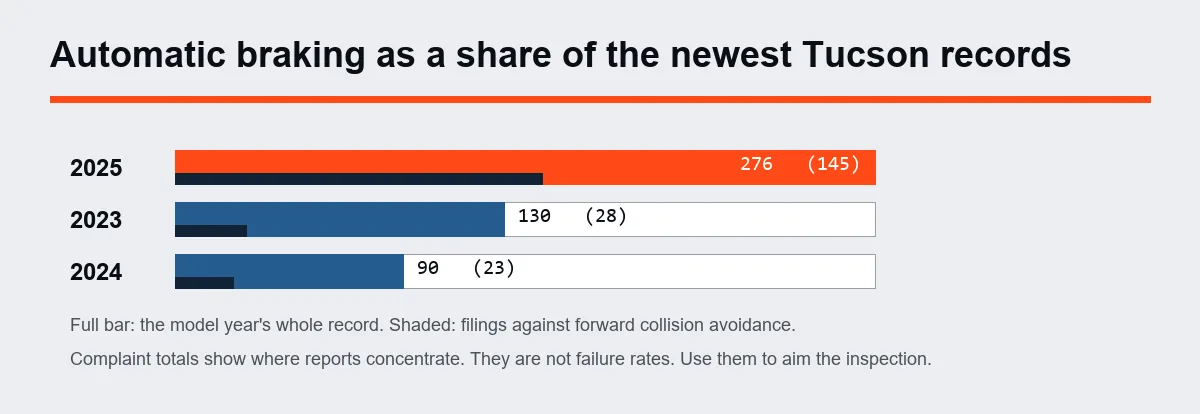
On the 2023 car that category is 22 percent of the record and on the 2024 car 26 percent. On the 2025 car it is 53 percent.
Owners describe the car braking hard with an empty road ahead. Campaign 26V316 now covers exactly that, on 2025 and 2026 Tucson models, where software in the front cameras can cause the forward collision system to act unexpectedly.
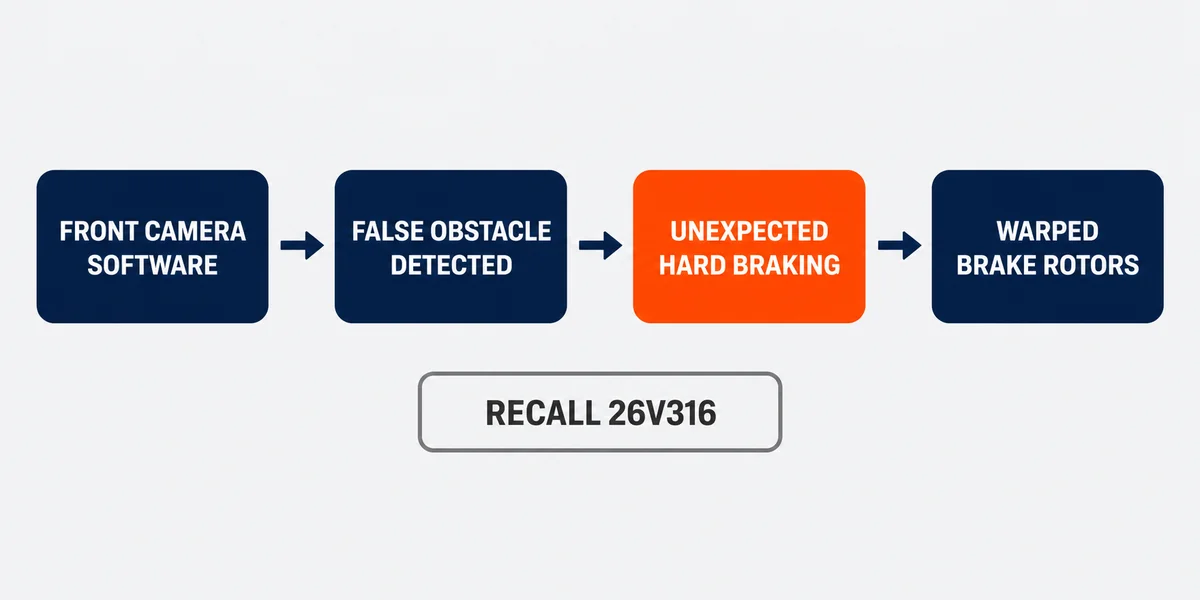
The consequence owners report goes beyond the fright. One filing describes front rotors resurfaced for overheating at about 12,200 miles, with the pads still in good condition.
So the check on a nearly new car is unusual. Confirm the campaign by VIN, then look at the front discs and ask what work they have already had.
A brand-new engine campaign sits alongside it
The braking software is not the whole story on the newest cars, and the second entry is the more serious of the two.
Campaign 25V549 covers 2025 and 2026 Tucson models where the connecting rod bolts may have been tightened improperly. Hyundai lists loss of drive power and an oil leak near hot engine components among the consequences.
The distinction between the two matters when you are checking. An assembly fault like the rod bolts is confined to a build window, so a VIN search settles it completely.
A software fault is different, because it affects every car until the update is applied. Campaign 23V526 separately covers an oil pump on 2023 and 2024 cars, which is worth knowing if you drop back a year or two.
Which Tucson to look for
The quiet window here is narrow, and it sits between two eras that fail in opposite directions.
The 2024 car holds 90 filings and the 2023 car 130, the lowest totals in the modern run. The 2021 car holds 77 but is now several years older.
One caveat keeps that honest. Forward collision avoidance is already 22 and 26 percent of the 2023 and 2024 records, so the braking behaviour is present before it concentrates.
The one useful thing about a fault you can provoke is that you can also rule it out. Pull away repeatedly on a 2016 car, watch the road ahead on a 2025 one, and the rest is settled on campaign numbers.