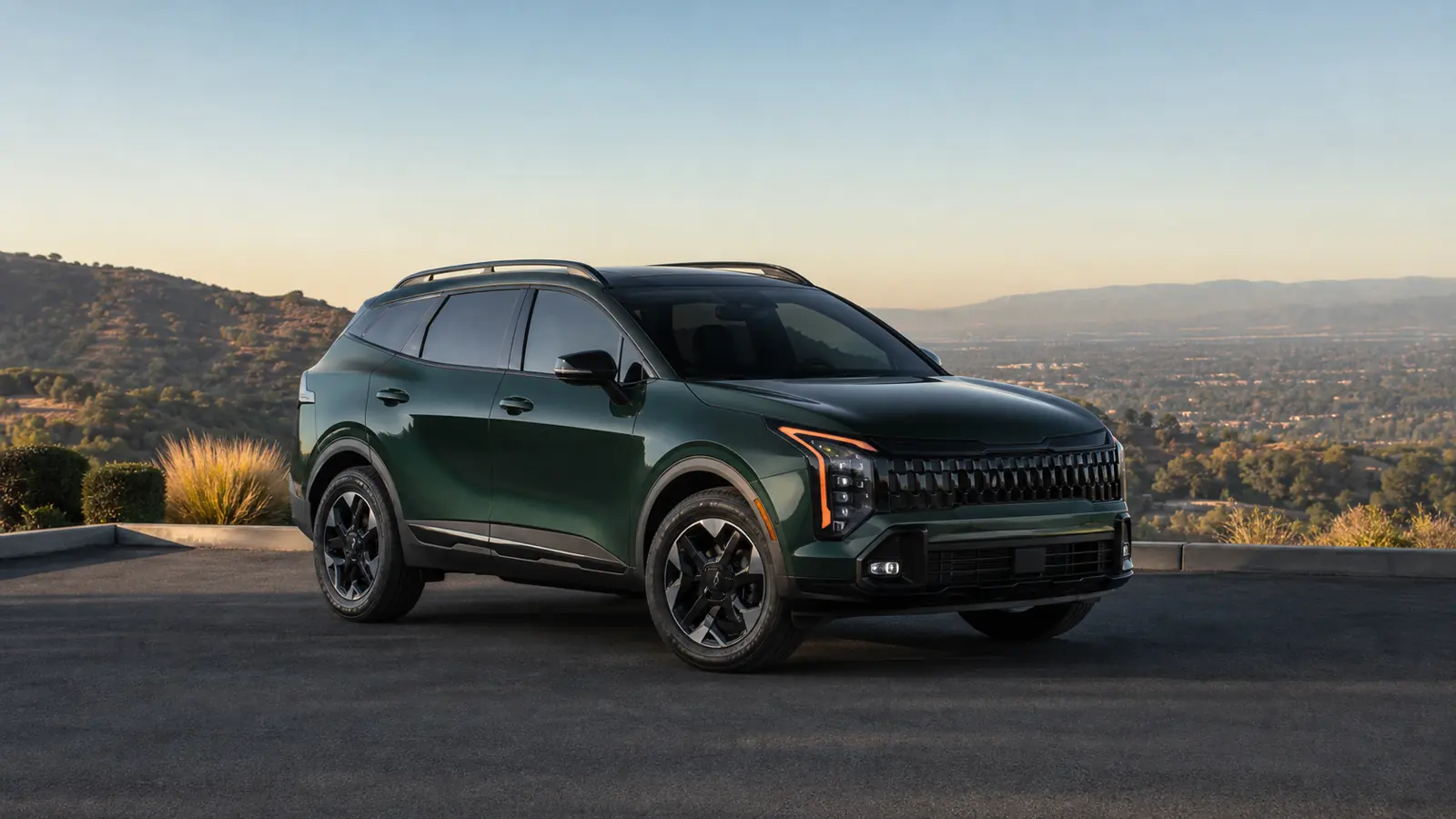
Is the Kia Sportage reliable?
Yes, a well-documented gas-powered Kia Sportage can be dependable. The answer changes by generation because the nameplate has used different engines, electrical hardware, transmissions, and safety remedies.
The older 2011 to 2013 group contains two important engine branches. Certain 2.0-liter turbo models have a connecting-rod bearing recall, while certain 2012 models with the 2.4-liter engine have a separate engine-compartment fire action.
The 2017 redesign moved the buying question toward engine condition, a conventional six-speed automatic, HECU campaign proof, and optional tow-hitch wiring. The 2023 redesign then introduced a 2.5-liter engine and eight-speed automatic, plus a brake-booster action for certain early vehicles.
A safety recall identifies a defined vehicle population and required remedy. It does not show how often every Sportage fails, and a closed campaign does not prove that unrelated systems are healthy.

The strongest candidate starts cold, carries a coherent service record, has no unresolved recall, behaves consistently after a full warm drive, and passes a complete module scan plus physical inspection.
A vehicle warmed before you arrive or supported only by a seller's verbal assurance leaves the expensive questions open.
A Sportage is reliable enough to shortlist when its records and present behavior agree with the hardware installed in that exact vehicle.
Does Kia's 10-year warranty follow a used Sportage?
Usually not in the way a private used-car buyer expects. Kia's current U.S. warranty information describes 10-year or 100,000-mile limited powertrain coverage for the original purchaser and the purchaser of a qualifying Kia Certified Pre-Owned vehicle.
The same page lists a 5-year or 60,000-mile basic limited warranty. Time runs from the vehicle's original in-service date, and each limit ends when either the stated years or miles is reached.
A Kia model-year warranty manual says the remaining basic warranty is transferable, while the original-owner 10-year or 100,000-mile powertrain term is not transferable to an ordinary subsequent owner. Exact terms can change by model year, use, market, and sale category, so the handbook for the VIN remains the controlling document.
Kia Certified Pre-Owned coverage is a separate contract rather than a label a seller can apply informally. Kia's CPO benefits describe powertrain coverage measured from the original in-service date, an additional Platinum term, and program conditions that should appear in the sale paperwork.
| Buyer status | Advertised protection | Proof to obtain | Common mistake |
|---|---|---|---|
| Original retail purchaser or lessee | Up to 10 years or 100,000 miles of limited powertrain coverage, subject to the handbook | Original in-service date, ownership record, mileage, exact handbook, and diagnosis | Treating every engine or drivability complaint as a covered powertrain failure |
| Ordinary subsequent owner | Remaining transferable coverage defined by the model-year handbook, commonly the 5-year or 60,000-mile basic term | VIN warranty inquiry, in-service date, mileage, use history, and written dealer confirmation | Assuming the original-owner powertrain term transfers automatically |
| Qualifying Kia CPO purchaser | CPO powertrain and other program coverage under the CPO contract | CPO certification, inspection record, contract, coverage dates, and exclusions | Accepting a dealer's word that a used vehicle is certified |
| Out-of-term buyer | Recall remedies remain free when applicable, but ordinary repairs are the owner's responsibility | Current VIN recall result and diagnosis of all non-recall work | Confusing a free safety remedy with a general repair warranty |
Warranty coverage and reliability answer different questions. Coverage may pay for a qualifying failure, while reliability describes the likelihood and consequence of needing work in the first place.
Maintenance items, wear, damage, misuse, modifications, commercial service, prior repair quality, and failures outside the contract can change a claim.
Ask the Kia service department to state the remaining coverage in writing before price negotiation, then confirm that the diagnosed part and cause are covered.
Value a used Sportage with the warranty that survives the transaction, not the largest number in an advertisement.
Three records tell you more than a reliability score
Start with the VIN result, but do not end there. The NHTSA recall lookup identifies unrepaired safety recalls attached to a VIN, while a Kia dealer's campaign printout can add manufacturer campaigns and completion history.
A clear lookup means no unrepaired safety recall appears in that system at that moment.
It does not prove that the engine has stable oil pressure, the transmission shifts correctly, the wiring repair was performed neatly, or the vehicle has never had a major replacement.
The second record is the repair invoice. A useful invoice names the campaign or complaint, date, mileage, diagnostic result, performed operation, software or calibration where relevant, installed parts, and post-repair verification.
The third record is the vehicle itself. A true cold start, full-module scan, varied road test, post-drive scan, fluid check, and lift inspection reveal current evidence that a historical receipt cannot supply.
Sportage proof ladder
- VIN lookup
- Shows open safety recalls recorded for that VIN, but not current mechanical health
- Campaign invoice
- Shows which prescribed operation the dealer recorded, but only for the named system and date
- Software entry
- Proves a calibration was installed, but not that worn hardware was replaced
- Part replacement record
- Identifies renewed hardware, but not the health of every related system today
- Cold-to-hot inspection
- Tests present behavior, but cannot reconstruct missing years of service history
Evidence becomes valuable when the layers agree.
A VIN marked complete, an invoice naming only a software update, and a present engine knock do not combine into a good result.
Watch for chronology gaps. An engine replacement at 72,000 miles followed by no oil-change or cooling records for the next 50,000 miles leaves a different risk from a documented replacement followed by stable maintenance and clean current testing.
A recently cleared diagnostic monitor or disconnected battery reduces confidence because it can erase useful fault history.
Ask the seller not to start or clear the vehicle before the appointment, and verify readiness status during the scan.
No single record clears a Sportage. The VIN, remedy detail, service chronology, and present condition must tell the same story.
Which engine is in a 2011 to 2013 Sportage?
Identify the engine before interpreting an older Sportage's recall history. The 2.0-liter turbocharged GDI engine and the naturally aspirated 2.4-liter engine belong to different official actions with different vehicle populations.
NHTSA campaign 17V224 covers 2011 through 2013 Sportages equipped with the 2.0-liter turbo GDI engine in the defined production period. The report identifies factory machining debris and uneven crankpin surface roughness that can restrict oil flow, raise bearing temperature, and cause premature connecting-rod bearing wear.
A worn bearing can produce cyclic knocking, an engine warning, or an oil-pressure warning. Continued driving can lead to bearing failure and an engine stall, so those signs require shutdown when safe and professional transport rather than a longer test drive.
The recall remedy calls for inspection and engine long-block replacement when necessary. An engine replacement record should identify the recall, finding, installed long block, date, mileage, and any related fuel-pipe work because later campaign 18V907 addressed possible high-pressure fuel-pipe damage after some engine replacements.
Certain 2012 Sportages with the 2.4-liter Theta II MPI follow a separate path. NHTSA campaign 20V750 calls for an engine-compartment inspection for fuel or oil leaks, an engine test, necessary repairs that may include replacement, and a Knock Sensor Detection System update when available.
The campaign documentation also describes extended long-block coverage for connecting-rod bearing damage after completion of the KSDS update, subject to its conditions.
Confirm eligibility against the VIN and dealer record instead of assuming that every 2012 Sportage receives the same extension.
| Vehicle scope | Documented concern | Warning evidence | Remedy evidence to request |
|---|---|---|---|
| 2011-2013 Sportage with 2.0L T-GDI in 17V224 scope | Restricted bearing oil flow from machining debris and crankpin surface condition | Cyclic knock, engine warning, oil-pressure warning, or stall | SC147 inspection outcome, long-block replacement when required, current engine identity, and related fuel-pipe inspection where applicable |
| Certain 2012 Sportage with 2.4L MPI in 20V750 scope | Engine-compartment fire risk associated with possible fuel leak, oil leak, or engine damage | Fuel or oil odor, visible leak, warning light, knock, smoke, or abnormal running | SC200 leak inspection, engine test, completed repairs, KSDS entry, and written extended-coverage status |

Inspect either engine completely cold on level ground. Check oil level and condition, look beneath the engine and along the undertray for fresh fluid or recent cleaning, listen through cold idle, and monitor warning lights before and after a full warm drive.
Do not accept thick oil, an additive, a fresh battery disconnect, or a warmed engine as a substitute for diagnosis. These conditions can mute or erase evidence during a short appointment.
A KSDS update helps detect a defined abnormal vibration pattern. It does not repair a bearing that is already worn, so software completion and current engine condition remain separate findings.
The engine code and campaign branch matter more than the shared model year. Match the record to the installed engine before assigning confidence.
Why were some 2017 to 2021 Sportages told to park outside?
Certain Sportages have an electrical fire risk in the HECU, the unit that manages anti-lock braking and stability functions. NHTSA campaign 21V137 identifies certain 2017 through 2021 Sportages whose HECU electrical circuit may short and cause an engine-compartment fire.
Owners of included, unrepaired vehicles were instructed to park outside and away from structures until the recall repair was complete.
Follow the current VIN-specific direction because a vehicle can be at risk while parked as well as driving.
The HECU remedy replaces specified fuses in the electrical junction box. Vehicles equipped with an electronic parking brake also receive a HECU software update, which means two similar Sportages can have different recorded operations under the same campaign.
A second fire-risk action sits at the rear of the vehicle. NHTSA campaign 22V703 includes certain 2017 through 2022 Sportages equipped with a Kia tow-hitch harness, where debris and moisture can accumulate on the module circuit board and cause a short.
A mechanical hitch receiver does not prove that the recalled electrical harness is present.
Trace the wiring safely, identify the module or installation record, and let the VIN plus dealer campaign history establish whether the vehicle is included.
The listed tow-harness remedy can involve inspection, fuse work, and replacement of the harness module as necessary. The HECU fuse record does not complete the rear harness action, and a tow-harness invoice does not clear the front HECU circuit.
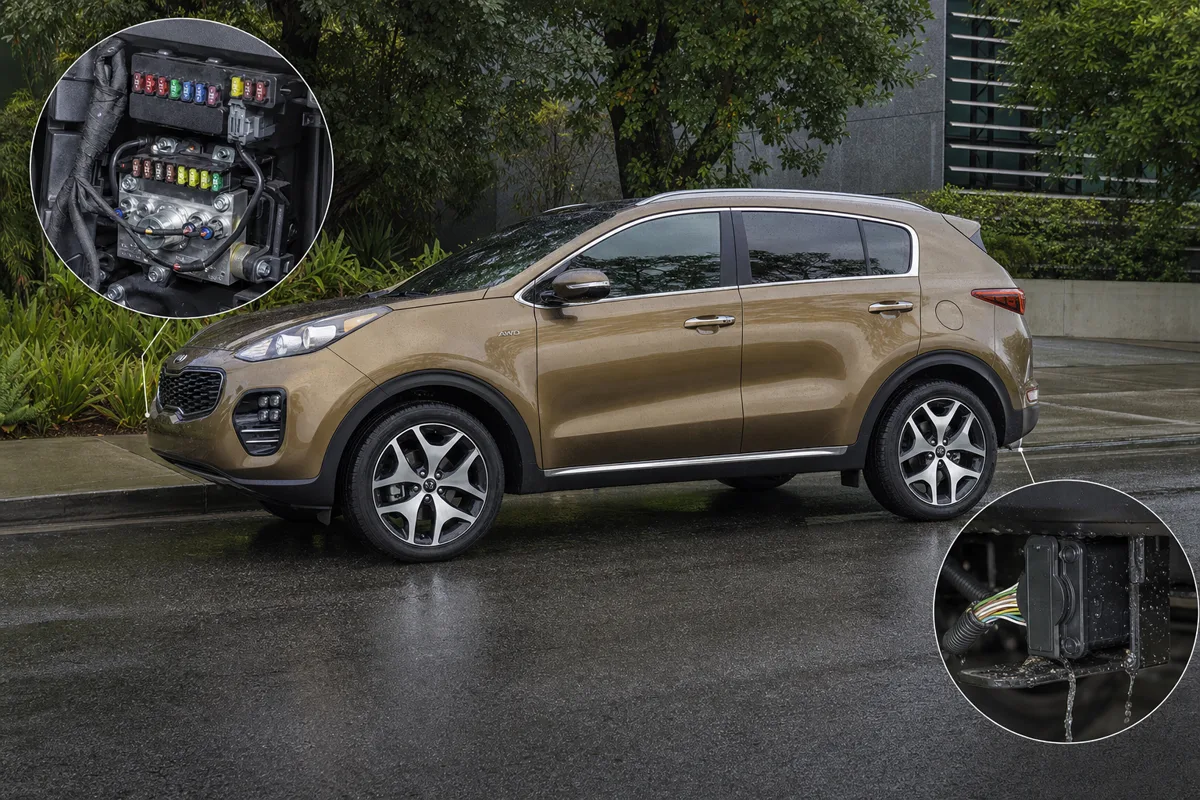
After the documented repairs, confirm that ABS, stability-control, and parking-brake warning lights prove out normally.
Scan the related modules, inspect visible wiring and connectors for heat or moisture damage, and test trailer lighting only with correctly connected equipment.
A burning odor, smoke, melted insulation, repeated fuse opening, brake-system warning, or improvised wiring stops the purchase until a qualified shop identifies the source.
Do not let a completed campaign code turn visible current damage into a price negotiation.
Clear the front HECU path and the rear accessory path independently. They share a fire consequence, but they do not share hardware or proof.
What changed with the 2023 Sportage redesign?
The 2023 gas Sportage is a mechanical reset rather than a continuation of the older platform. Kia's 2023 specifications list a 2.5-liter GDI four-cylinder rated at 187 horsepower and 178 pound-feet, paired with an eight-speed automatic.
This hardware avoids the older 2.0-liter turbo bearing population and does not use a dry dual-clutch transmission.
It also has a shorter high-mileage record, so fewer inherited concerns do not prove fifteen-year durability.
Current gas Sportage evidence
- Engine and transmission
- 2.5L GDI four-cylinder with an eight-speed automatic
- Long-term history
- Less mature than the 2011 or 2017 generation
- Brake-booster action
- VIN and build-date specific, with inspection or replacement as required
- Warranty value
- Depends on in-service date, mileage, owner category, diagnosis, and exact handbook
Certain early vehicles need focused brake evidence. Kia's NHTSA campaign information for 23V410 covers certain 2023 Sportages manufactured from January 12, 2022 through February 15, 2023.
The brake-booster diaphragm may become misaligned and create an internal vacuum leak. The brakes still have a mechanical connection, but loss of power assist can create a hard pedal, demand much greater effort, and increase stopping distance.
The remedy is dealer inspection and brake-booster replacement when necessary. An invoice stating inspection complete and one showing booster replacement represent two valid branches, so the current VIN result and recorded finding must agree.
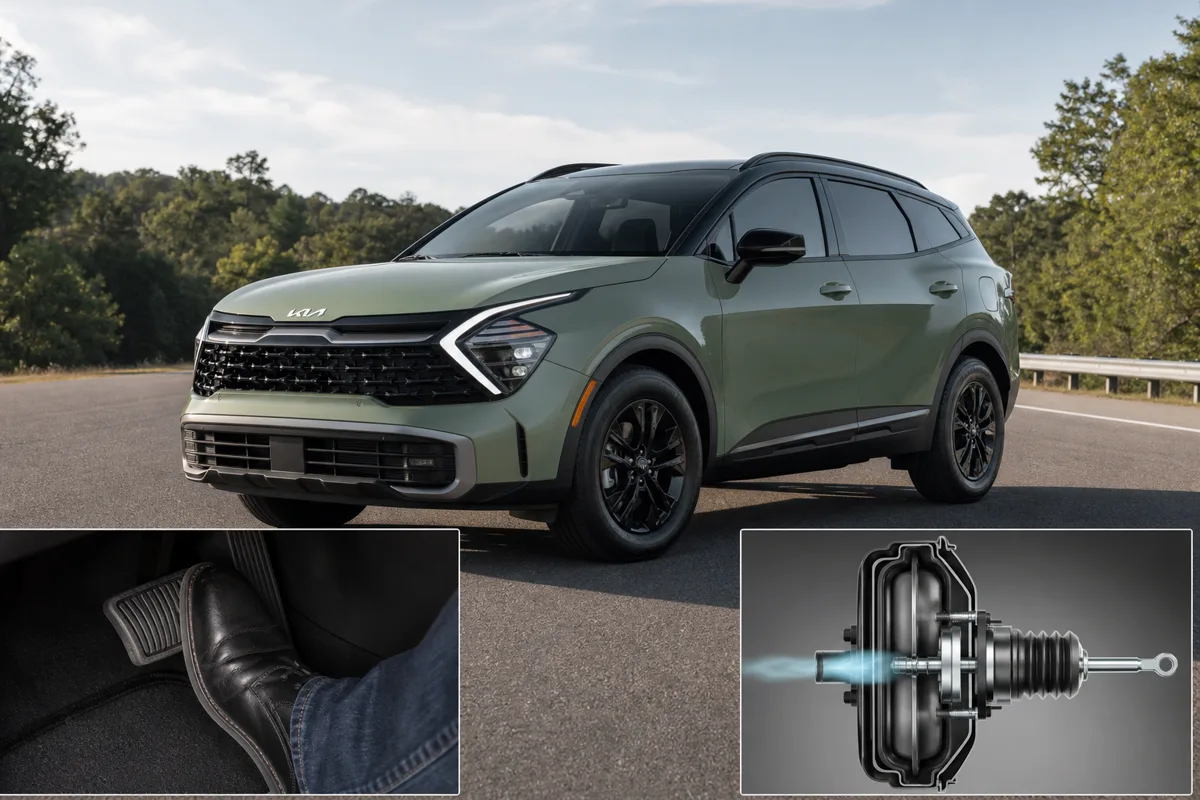
Before moving the vehicle, press the brake several times with the engine off, hold steady pressure, then start the engine while following the owner's-manual procedure.
A normal booster usually allows a modest pedal movement as assist becomes available, while an unusually hard pedal, hissing, inconsistent assist, warning, or changed stopping effort requires professional diagnosis.
Use an empty, controlled area for the first low-speed brake application. Stop immediately if pedal effort is abnormal, the vehicle pulls, warning lights remain on, or stopping distance does not match the input.
A 2023 VIN can have other campaign history involving electrical or restraint systems, so one brake-booster invoice is not a complete recall check.
Run the VIN, read every open item, and match each completed action to its own record.
The redesigned eight-speed should engage Drive and Reverse consistently, shift without repeatable flare or bang, and remain warning-free from cold operation through a full warm drive. Diagnose stored ratio codes, delayed engagement, recurring slip, or worsening hot behavior before discussing price.
The newer gas Sportage is easier to separate from the older engine history, but it earns confidence only through correct brake feel, a complete VIN record, stable powertrain behavior, and coverage that actually applies.
Can a Kia Sportage reach 200,000 miles?
A Sportage can reach 200,000 miles, but no official source can promise that result for one vehicle.
The odometer also does not reveal how many engines, transmissions, HECU repairs, suspension parts, or electrical modules were required along the way.
Reaching a mileage and reaching it economically are different outcomes. A running vehicle can still have accumulated repair costs that would have caused another owner to replace it.
Usage changes the evidence. Long highway operation can mean fewer cold starts, while short trips, hot idling, towing, winter salt, rough roads, delayed fluid service, and long storage create different exposure for oil, cooling, brakes, wiring, suspension, and corrosion.
On a 2011 to 2013 Sportage, engine identity, stable oil level and pressure, quiet bearing behavior, cooling integrity, and the correct campaign branch dominate remaining-life judgment. A replacement engine can be positive evidence when the invoice explains why it was installed and the later service record is complete.
On a 2017 to 2022 model, current engine and transmission behavior matter alongside independent HECU and tow-harness proof. A clean dashboard cannot replace a full scan because historical or intermittent electrical faults may not illuminate a warning during a short drive.
On a 2023 or newer gas model, the record is younger. Consistent brake assist, clean recall status, stable fluids, smooth eight-speed operation, correct software, and meaningful warranty coverage support the purchase without proving a 200,000-mile outcome.
All-wheel drive adds tire and driveline evidence. Four tires should match the specified size and remain close enough in circumference and wear to avoid continuous driveline stress, while tight low-speed turns should be smooth and free from binding or repeated clunks.
Build a service chronology by date and mileage. Oil changes, coolant work, transmission diagnosis, brake fluid, tires, batteries, campaign work, collisions, and major repairs should form a plausible sequence rather than a stack of undated receipts.
Arrange a true cold start, full-module scan, complete warm-up, varied road test, post-drive scan, fluid inspection, and lift inspection. Record the VIN, build date, engine, transmission, drivetrain, tow equipment, original in-service date, and owner category before deciding which tests and warranty terms apply.
Do not pay extra merely because a major part was replaced.
The useful record names the original cause, supporting diagnosis, installed part, follow-up work, warranty, and test that confirmed normal current operation.
The lower-risk Sportage is the one with coherent evidence at every layer, even when another example is newer or shows fewer miles.