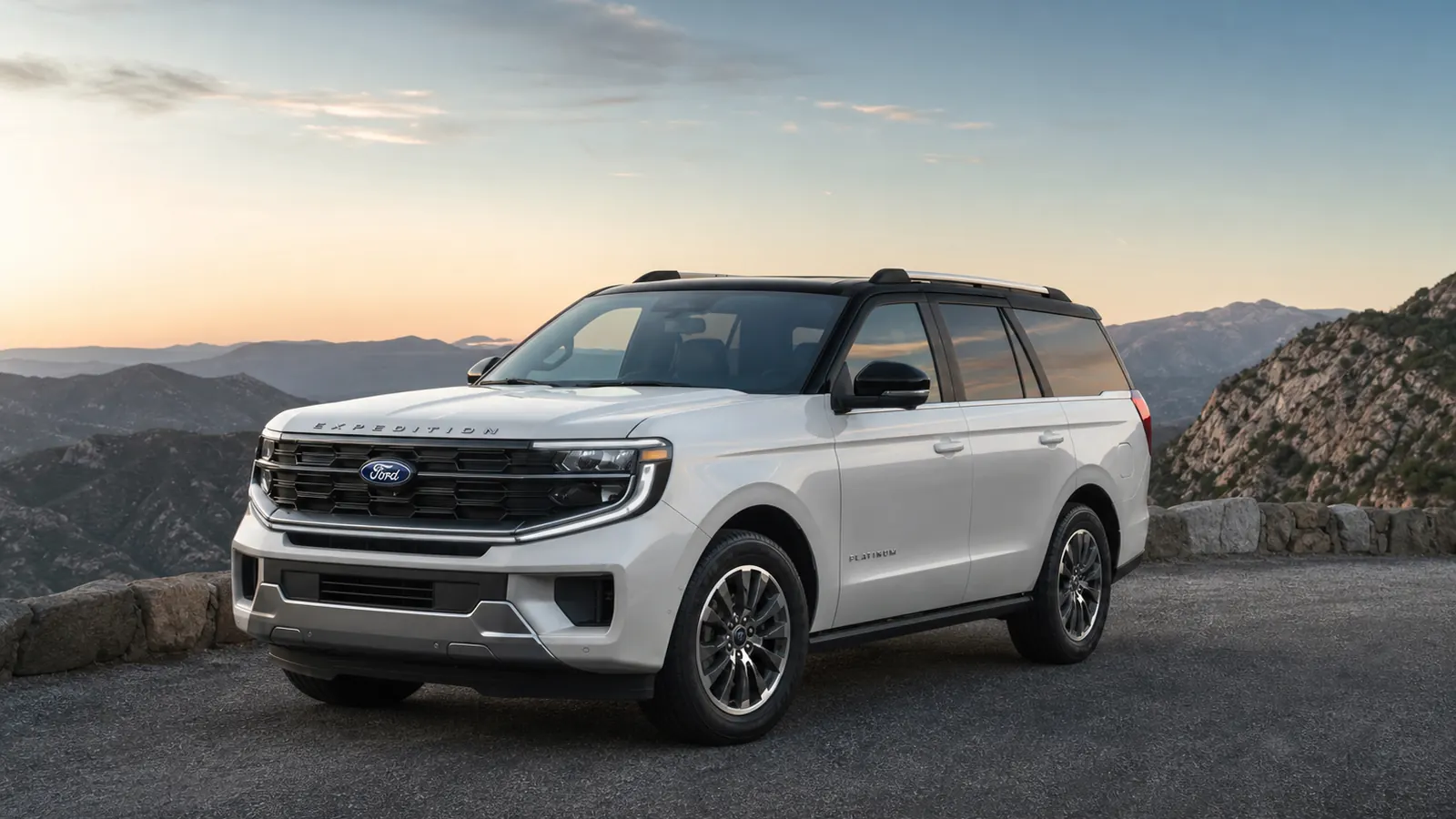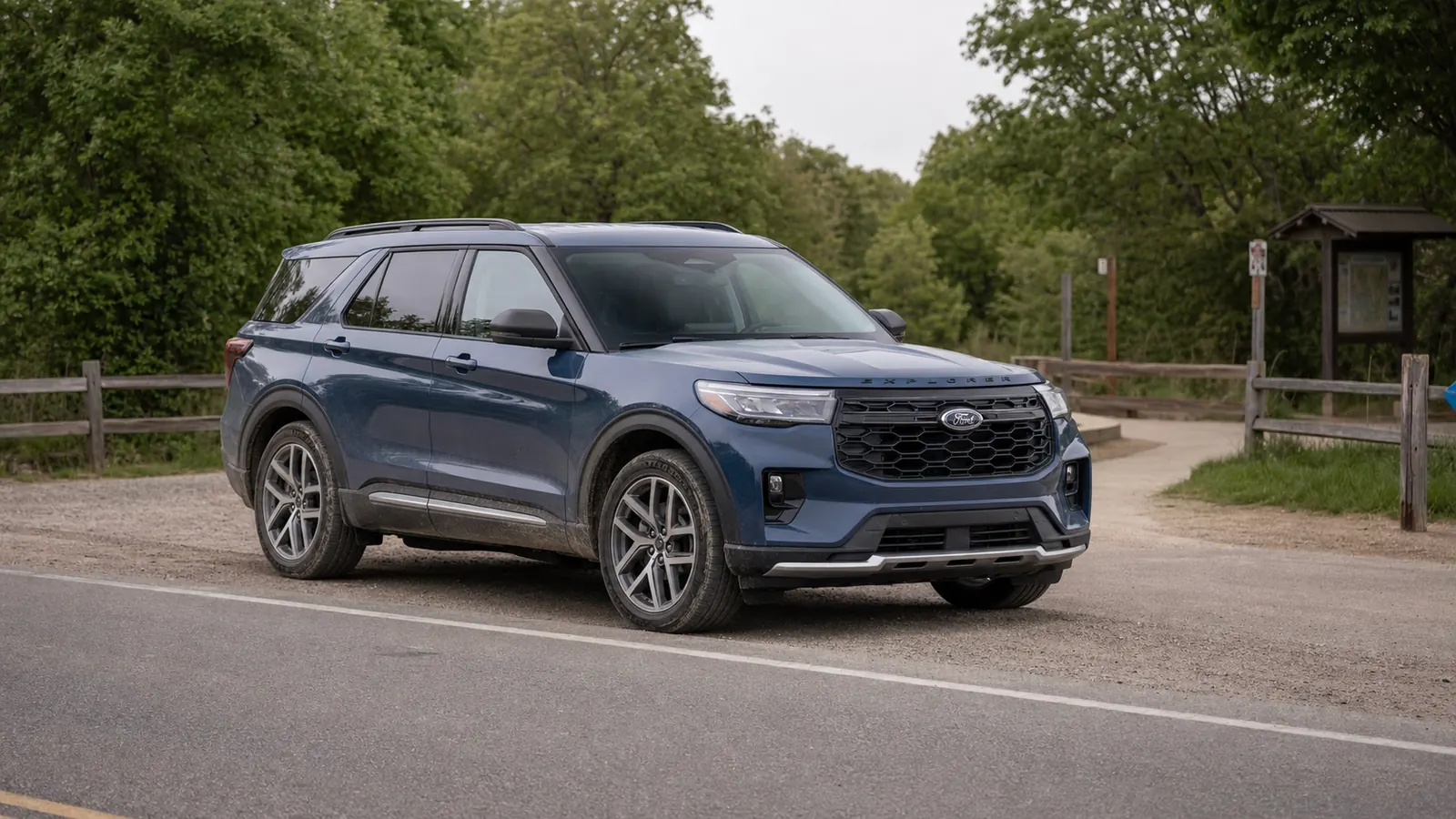
Active is the sensible starting point
The 2026 Ford Explorer Active gives most families the hardware they came for. Its 300 hp turbo engine has enough reserve for highway merging, grades, and a cabin full of people.
Within the Ford SUV lineup, the basic question is whether a higher trim solves a repeated problem or merely looks better in the showroom.
Use the SUV selection guide first if the household has not confirmed that a three-row midsize SUV is the right size.
ST-Line is easy to misunderstand because it looks connected to ST but keeps the standard 2.3L engine.
That can be a useful combination for a buyer who likes darker exterior details and added technology without paying for V6 fuel use.
It is less useful when the same money buys an Active with the exact comfort package the household needs.
Platinum moves the decision toward luxury. Better materials, more seat equipment, premium audio, and large wheels can make long trips calmer.
They do not create more third-row knee room, raise the towing ceiling, or lower fuel use. Compare its total price with other choices in the mainstream price range, then sit in every row before treating a nicer front cabin as a whole-family upgrade.
Tremor and ST serve narrower jobs. Tremor adds all-terrain tires, suspension and traction changes, and the option of the V6.
ST uses the 400 hp V6 as its main event. Both can be satisfying, but their tires, insurance, fuel, and purchase price move away from the Explorer's practical center.
Ask each upgrade one plain question. Will the family use it at least twice a month?
A heated second row in a cold climate may pass. A surround-view camera in a tight garage may pass.
Extra power that appears only during a test drive may not.
The right Explorer trim is the lowest one that removes a real weekly frustration.
The third row sets the limit
The Explorer can seat six with second-row captain's chairs or seven with a bench, depending on configuration.
That number does not explain whether the seating plan works. As with other seven-seat SUVs, the third row must be tested behind the actual driver and second-row positions, with the same child seats, boosters, and bags used at home.
Captain's chairs create a useful aisle. Children may reach row three without sliding a seat, and adults can separate two child restraints.
The tradeoff is one less seat and an open channel that lets loose cargo move forward under braking. A bench carries seven and can keep bags behind a seatback, but access to the rear depends more on tipping or sliding one side.
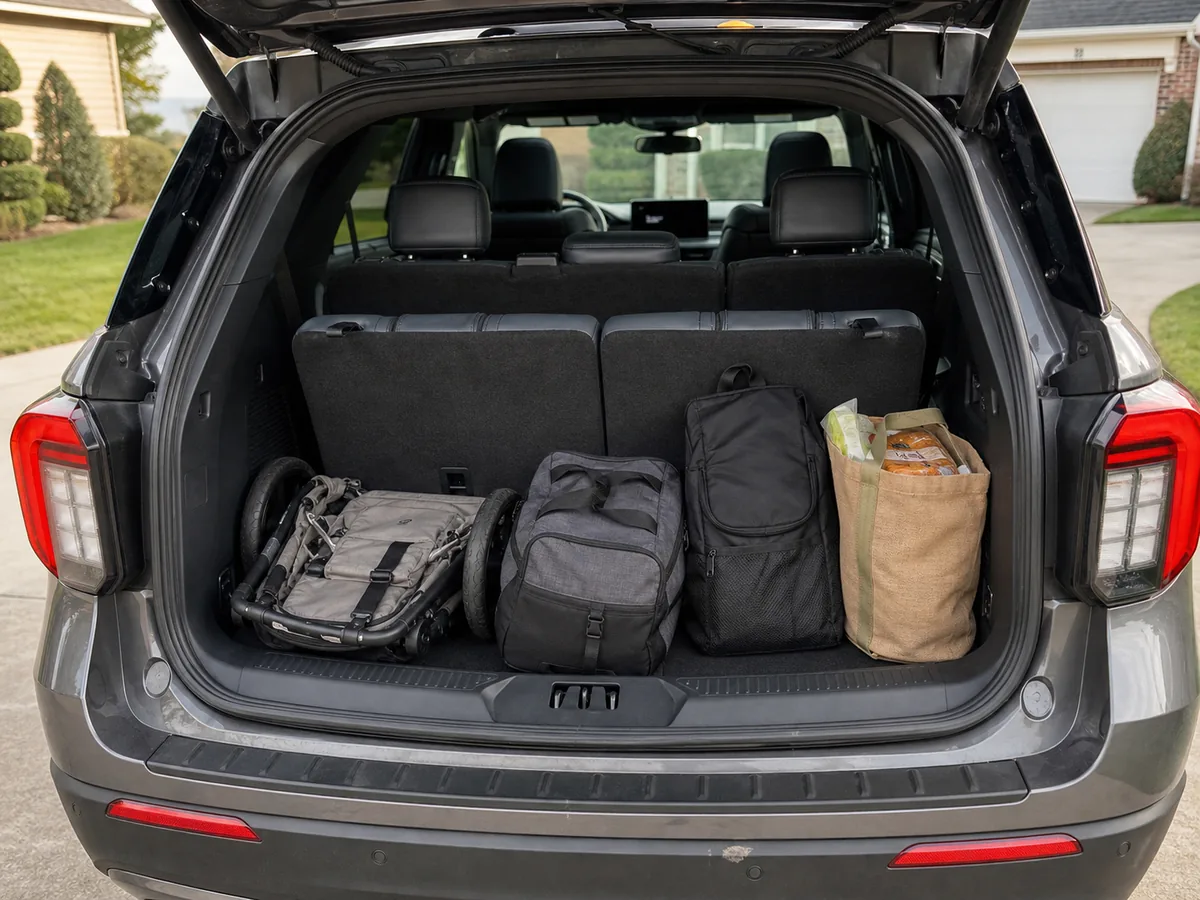
Start the test with every seat upright. Put the stroller, sports bags, grocery bins, or airport luggage behind row three and close the hatch without forcing it.
Check space at floor level and near the glass because a sloped hatch can remove usable height.
Then fold only one side of the third row. Compare the result with the Honda Pilot and Toyota Highlander using the same bags.
A family may discover that carrying six people and their luggage requires a roof box, a trailer, or a larger SUV.
Use every buckle and tether anchor. A rear-facing child seat can push the front passenger forward, while a booster may block an adjacent buckle.
Ask a third-row passenger to enter, sit, buckle, and leave without an adult rearranging the cabin. Repeat the exercise after moving the second row to a position its occupant can tolerate for an hour.
- Install the real child restraints
- Measure cargo with row three raised
- Check headroom and knee contact
- Test the aisle or folding mechanism
- Close the hatch over the normal load
The Explorer fits families that use row three often but can fold part of it for larger trips. A household carrying six or seven people plus luggage every weekend should also test a Toyota Sienna with the same people and bags.
Buy the seat-and-cargo combination that works at the same time, not two maximum figures that cannot happen together.
Which Explorer engine fits your driving?
The standard 2.3L EcoBoost four-cylinder produces 300 hp and 310 lb-ft of torque. That is strong output among gas-powered SUVs, and it avoids making the base Explorer feel like a compromise.
The ten-speed automatic keeps engine speed low during easy travel and drops several gears when the driver asks for passing power.
The available 3.0L EcoBoost V6 makes 400 hp and 415 lb-ft.
It is standard in ST and available in Tremor. The extra torque is clear on a highway ramp or a grade, especially with passengers.
It also brings higher purchase cost and usually higher fuel and insurance expense.
| Question | 2.3L turbo | 3.0L twin-turbo V6 |
|---|---|---|
| Output | 300 hp, 310 lb-ft | 400 hp, 415 lb-ft |
| Best fit | Family travel and normal towing | Strong acceleration and specific ST or Tremor use |
| Fuel pressure | Lower | Higher |
| Buyer test | Loaded merge and grade | Same route plus insurance quote |
Drive the 2.3L before deciding it is the lesser engine. Load the people who normally travel, turn on climate control, and accelerate from 40 to 70 mph on a safe highway section.
Hold a long grade and listen to the transmission. A healthy Explorer may downshift and raise engine speed, but it should respond predictably without shudder, harsh flares, or warning messages.
The V6 earns its premium when quick response is a lasting priority, not a five-second thrill. ST also changes suspension tuning and wheels, so a buyer is purchasing a different ride and tire bill with the engine.
Tremor uses its power within a package aimed at traction and rougher surfaces.
Neither choice adds a larger third row.
Fuel estimates change with drivetrain, trim, tires, speed, temperature, and load. Compare the exact window stickers and calculate gallons from annual miles.
A two-mpg difference at 15,000 miles matters more than it does at 6,000 miles.
Add premium-fuel recommendations, if applicable to the desired performance, to the household calculation.
The 300 hp engine is already the full family answer. Choose 400 hp because you want its response enough to pay for it every year.
Towing depends on payload first
Ford lists a maximum 5,000-pound towing capacity for the Explorer when properly equipped. That number is useful for sorting vehicles, but it is not permission to attach any trailer under 5,000 pounds.
The door-jamb payload label may become the tighter limit once people and cargo enter the cabin.
Tongue weight normally presses a meaningful share of trailer weight onto the vehicle. Add that load to every passenger, child seat, cooler, pet barrier, and item stored inside.
The total must remain within the specific Explorer's payload allowance. A loaded family can use most of that allowance before a trailer is connected.
A worked example shows why. Imagine that the door label on one vehicle permits 1,450 pounds of occupants and cargo.
Two adults at 350 pounds combined, three children at 240 pounds, a 60-pound dog, 150 pounds of cabin gear, and 70 pounds of hitch equipment use 870 pounds.
Only 580 pounds remain for trailer tongue weight. At a 12 percent tongue-weight estimate, that points to about 4,830 pounds of loaded trailer before adding a safety margin.
The actual label, people, hitch, and trailer scale weights must replace every sample number.
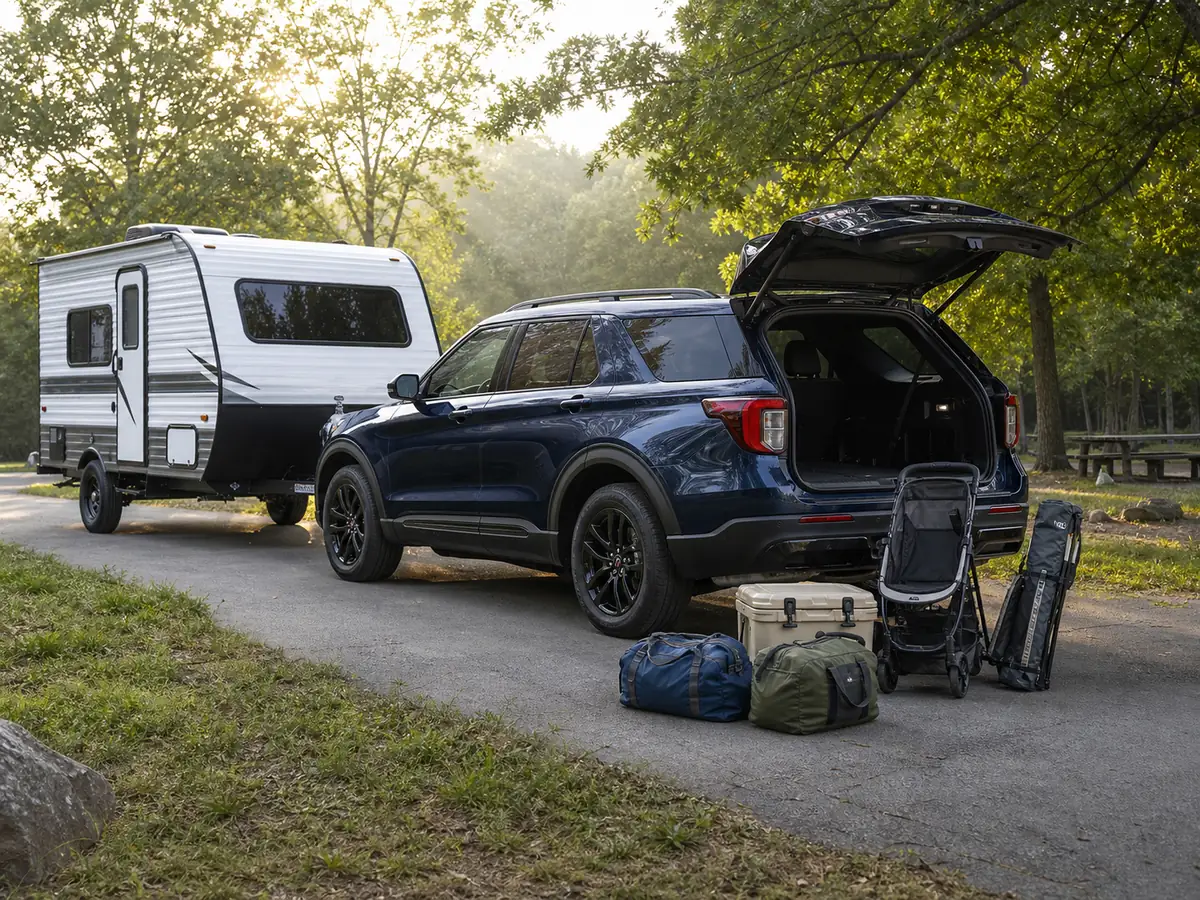
Confirm the factory tow equipment, receiver rating, wiring connector, cooling hardware, and trailer-brake requirements. Do not assume a hitch added by a previous owner gives the same capability as the complete factory package.
Check the owner's manual for the exact engine, drivetrain, axle, and model year.
A proper road test includes a grade, a controlled highway section, and low-speed turns with a qualified trailer setup.
Watch transmission temperature and shift behavior, mirror coverage, braking stability, steering correction, and rear suspension height.
Tow/Haul mode can change shifting, but it cannot correct poor loading or insufficient brakes.
Families that tow near the ceiling frequently should compare vehicles with more payload margin, such as a properly configured Ford F-150.
The Jeep Grand Cherokee and Toyota 4Runner also deserve a payload-label check because their capabilities and cabin layouts solve different towing needs.
The Explorer is well suited to moderate boats, utility trailers, and small campers when the numbers work.
A trailer that fits the headline rating can still be too heavy after the family climbs aboard.
Road comfort changes with the trim
The Explorer's rear-drive-based platform gives it a more settled, long-wheelbase feel than compact crossovers such as the Mazda CX-5.
Steering is light enough for parking, and the standard engine makes normal acceleration easy. The body still moves over uneven pavement, so wheel, tire, and suspension choices decide whether the ride feels calm or busy.
Active is the useful ride baseline. Drive it over patched pavement, expansion joints, and a curved highway ramp before trying a higher trim.
ST-Line and Platinum can wear larger wheels with less tire sidewall. They may look sharper, yet a pothole reaches the cabin more directly and a replacement set costs more.
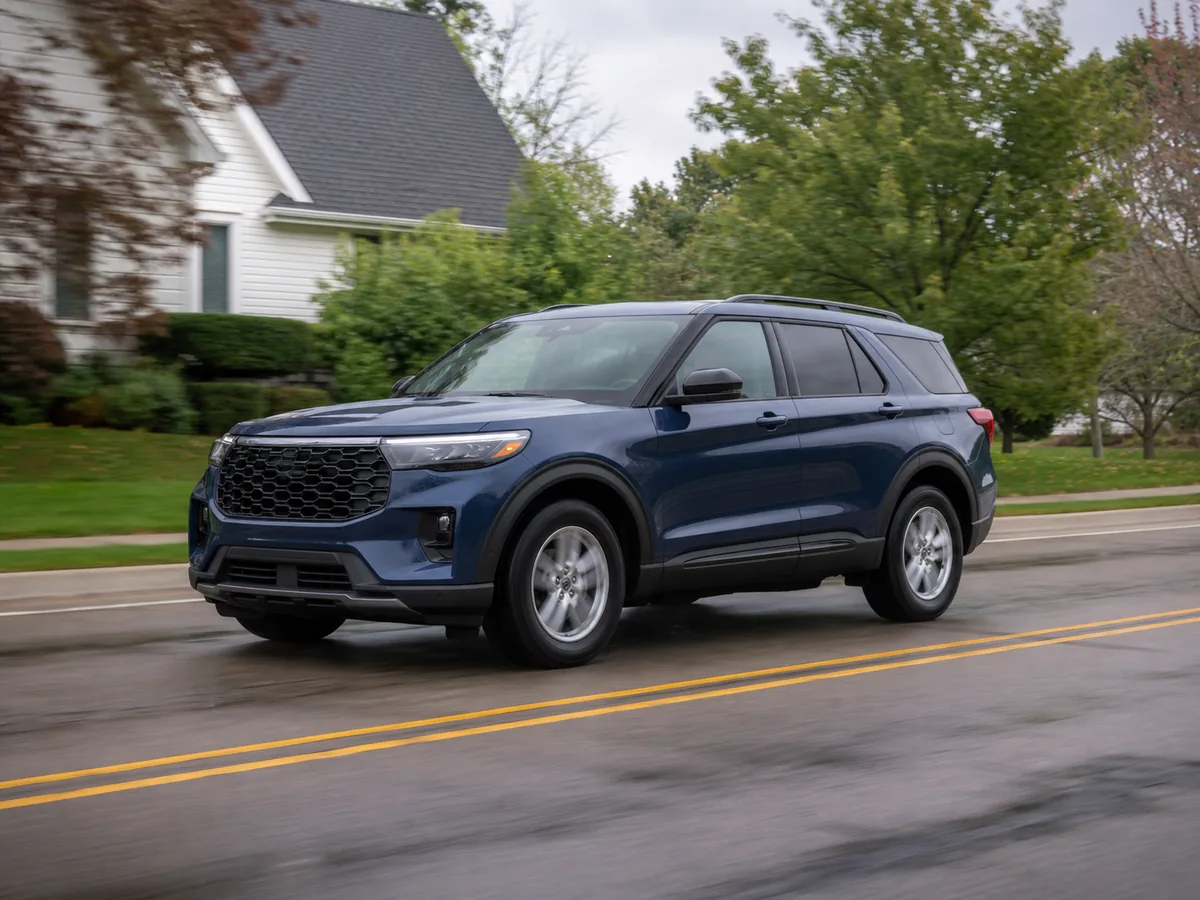
ST changes the experience further. Its acceleration is immediate for a three-row SUV, and firmer responses can feel more controlled to an enthusiastic driver.
Passengers may prefer the softer trim after an hour. Test both with the family rather than letting the driver make a solo decision.
Tremor's all-terrain tires and suspension serve gravel, snow, trail access, and rough roads.
Those tires can add noise and slower steering response on pavement. They also need correct rotations and may cost more to replace.
Buy them for a route that exists, not for an image.
Use one mixed loop for every trim:
- A cold start and neighborhood section
- Broken pavement at normal speed
- A loaded highway merge
- Ten minutes at cruising speed
- A tight parking space
- A grade with the cabin occupied
Listen for wind around the mirrors, tire roar from the rear, trim rattles, and abrupt ten-speed shifts.
Test driver aids without removing attention from the road.
The Explorer should make a family trip easier, so any trim that adds noise or impact without solving another need is moving backward.
Current safety evidence is strong
IIHS names the 2026 Explorer a Top Safety Pick and gives it Good ratings in the small-overlap front, updated moderate-overlap front, and updated side tests.
Current headlights and pedestrian crash prevention also receive Good ratings in the tested configurations. Those results are meaningful because the updated tests put more pressure on rear-occupant protection.
The details still matter. IIHS rates LATCH ease of use Acceptable rather than Good.
A family should not translate a crash-test award into an assumption that every child seat installs easily in every position.
Find each lower anchor and tether, tighten the actual restraint, and check whether adjacent buckles remain usable. Install the seat at the angle required by its maker, push and pull at the belt path, and confirm movement stays within the seat instructions.
A captain's chair that installs one seat easily may still block the aisle needed to reach row three.
With a bench, the restraint may prevent the seat from tipping for access. The safe layout must work on an ordinary school morning, not only when every seat is removed and reinstalled in a showroom.
Driver assistance is a support layer. Blind-spot monitoring, lane support, automatic emergency braking, and rear braking can reduce risk, but weather, dirty sensors, faded markings, and unusual traffic can limit performance.
Test the alerts and learn how to cancel them without looking away.
Visibility deserves a physical check. Raise the third-row head restraints, fill the second row, and look through the rear window.
Use mirrors before cameras, then confirm every camera remains clear in rain or road salt. A surround-view system can justify a trim upgrade for a narrow garage, but only if the driver uses it correctly.
Safety begins with fit. Every passenger needs a usable belt, head restraint, and seating position.
Cargo needs tiedowns or a barrier so it cannot enter the cabin during hard braking.
Use the strong ratings as evidence, then finish the job with correct restraints and an honest seating layout.
Used Explorers need a cold inspection
The current Explorer generation arrived for 2020. Early production matters because IIHS notes structural changes after May 2020 for improved small-overlap protection.
That does not make every early vehicle a bad purchase, but it shows why build date and VIN-specific records belong in the inspection.
Start with the vehicle cold. Confirm coolant and oil levels only by the procedures in the owner's manual, then listen through startup.
The engine should settle without persistent knocking, smoke, fuel smell, or warning messages. Drive before the seller warms the vehicle because heat can hide a weak battery, rough idle, delayed shift, or cooling issue.
- 2020Rear-drive-based generation begins
- After May 2020Structural changes noted in IIHS applicability
- 2022 onwardUpdated moderate-overlap rating covers specified models
- 2025Major cabin and exterior refresh
- 2026Active, ST-Line, Tremor, Platinum, and ST range
The ten-speed should engage Drive and Reverse promptly, creep smoothly, and shift predictably under light and firm throttle. One unusual shift does not diagnose a transmission, but repeated bang shifts, flares, shudder, delayed engagement, or stored codes require professional diagnosis.
Match the VIN and option list to the equipment in front of you. Appearance packages can make one trim resemble another, while replacement wheels can hide the original tire specification.
Confirm whether four-wheel drive, the factory tow package, BlueCruise hardware, and seat functions were actually fitted. Ask the seller to demonstrate paid connected features separately from hardware that remains useful without a subscription.
Test both keys, every camera, the touchscreen, audio, phone connection, climate zones, power seats, folding seats, liftgate, moonroof, outlets, and driver aids.
Inspect the spare or repair kit. A weak 12-volt battery can trigger several warnings, but replacing it should not be used to dismiss stored faults without a scan.
Read maintenance invoices for oil-change intervals, cooling-system work, transmission complaints, tire replacements, and repeated electronic visits.
A clean history report cannot show every curb strike, overheated tow, or repair paid without insurance.
Look underneath for leaks, impact damage, tow-hitch wear, and fresh undercoating that hides repairs.
Four tires should match in size and have similar tread depth. Large-wheel trims can turn worn tires and bent wheels into an immediate four-figure bill.
Order an independent pre-purchase inspection with a full-module scan and use the new versus used guide to compare warranty value with repair exposure.
Verify recalls by VIN and ask for invoices rather than accepting a verbal service history.
A good used Explorer starts cold, shifts cleanly, carries four matched tires, and has records that explain its life.
Trim choices drive ownership cost
The monthly payment hides several Explorer costs. Engine, wheel size, tire type, glass, cameras, insurance value, and how soon the owner trades all change the bill.
Active usually controls those pressures because it keeps the standard engine and a less expensive equipment level.
| Cost | Lower-cost pattern | Higher-cost trigger |
|---|---|---|
| Purchase | Active at a clean out-the-door price | Loaded Platinum, Tremor, or ST |
| Fuel | 2.3L and moderate highway speed | V6, heavy throttle, all-terrain tires |
| Tires | Smaller wheel package and rotations | Large wheels or specialized tires |
| Insurance | Exact Active or ST-Line VIN quote | 400 hp ST and high replacement value |
| Repairs | Simpler equipment and warranty coverage | Panoramic glass and added electronics |
| Depreciation | Mid trim kept beyond the loan | Loaded trim traded early |
Get insurance quotes for exact VINs before choosing ST. Horsepower, trim value, wheels, driver age, location, and coverage can change the premium more than an online average suggests.
Do the same for glass coverage if the windshield carries cameras or the roof has a large glass panel.
Price a full set of correct tires with mounting, balancing, disposal, and alignment.
Tremor all-terrain tires solve a different task from road tires.
ST and Platinum wheels may use expensive sizes. One damaged tire can become a multi-tire decision when tread depths differ too much.
Fuel cost should use actual annual miles and a conservative MPG estimate. High-mile commuters should compare the result with hybrid SUVs and a smaller model such as the Toyota RAV4 Hybrid before accepting the Explorer's extra space and fuel use.
A 400 hp engine driven gently may not create a crisis, but the purchase makes little sense if the owner avoids using its main benefit to save fuel.
Finally, compare out-the-door price rather than MSRP. Dealer accessories, finance interest, taxes, and trade value can erase an apparent trim deal.
The lease versus buy guide helps separate a lower payment from a lower total cost.
A restrained Explorer kept for years protects the family budget better than a loaded one traded while the loan is still young.
Who should buy the Explorer?
Buy the Explorer when the household needs a comfortable second row, a third row that will be used without carrying vacation luggage at the same time, strong passing power, and moderate towing. It belongs on a family SUV shortlist for drivers who prefer the balance of a rear-drive-based SUV but do not want the size of a full-size model.
A roomier three-row rival may fit better when adults use the back regularly. A minivan may be easier when child-seat access and cargo behind every row matter more than towing.
A hybrid rival may cost less to fuel for a high-mile urban household. A full-size SUV may be more appropriate when a heavy trailer and a full cabin travel together, though its purchase and fuel costs rise sharply.
Run the final decision in this order: seating rehearsal, cargo load, engine test, insurance quote, tire price, and out-the-door number.
If the Explorer still wins, choose the lowest trim that passed every step.
The Explorer is a smart three-row buy when its real passenger load fits and the buyer resists paying for capability the family will not use.