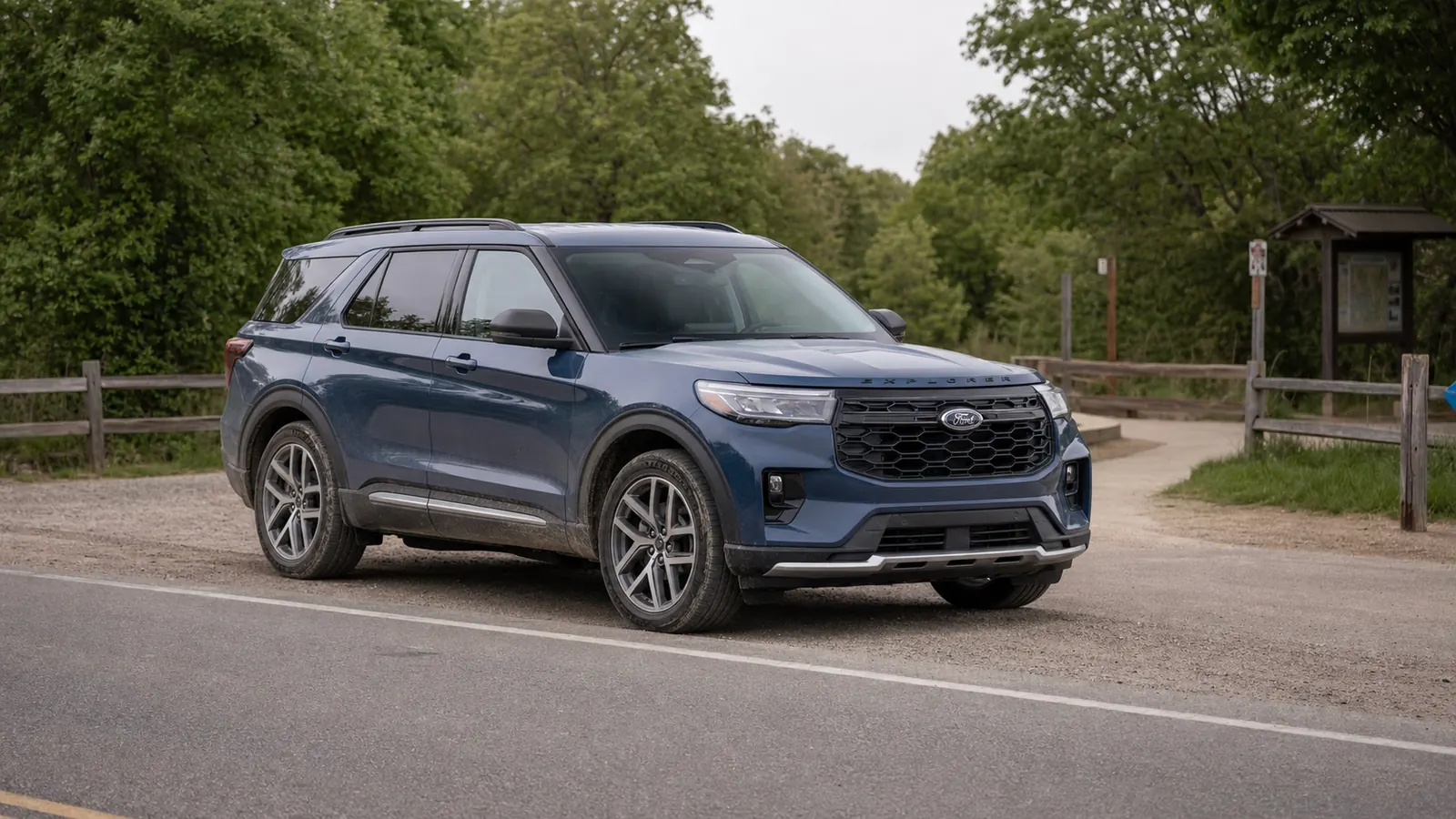
Is the Ford Explorer reliable?
Yes, a carefully selected Ford Explorer can provide reliable family service. The honest overall rating is average because the name spans mechanically different generations and several high-consequence concerns that an aggregate score cannot locate on one vehicle.
RepairPal's invoice-based analysis gives the Explorer 3.5 out of 5. It reports $732 in average annual repair and maintenance cost, 0.2 unscheduled shop visits per year, and a 14 percent probability that a repair is severe under its methodology.
Those figures combine model years, engines, drivetrains, climates, and use patterns.
They provide population context, not a diagnosis or forecast for the Explorer in front of you.
The purchase therefore begins with the VIN, model year, engine, drivetrain, and build history. A clean score cannot clear an internal coolant leak, an open axle-bolt action, a camera fault, or a transmission that shifts differently after it warms.
A Ford Explorer model profile can answer the broader questions about size, specifications, and buyer fit. Reliability requires a narrower question: does this exact vehicle have the records and test results that its platform demands?
The 2020 platform change divides Explorer reliability
Ford redesigned the Explorer for the 2020 model year around a longitudinal, rear-wheel-drive-based platform. That change moved the engine orientation, transmission, driven-axle layout, and many supporting systems far enough that older-generation problem lists cannot simply be carried forward.
The 2011 to 2019 Explorer is front-wheel-drive-based, with optional all-wheel drive and transverse 3.5 or 3.7-liter V6 engines in most versions. Its mature evidence concentrates attention on the internal water pump, power-transfer unit on all-wheel-drive examples, cabin sealing, electric power steering on early vehicles, and age-related cooling and suspension condition.
The 2020 and newer Explorer normally uses a turbocharged 2.3-liter four or 3.0-liter V6, a longitudinal 10-speed automatic, and rear-wheel drive or four-wheel drive. It does not inherit the older transverse V6 water-pump architecture, but it brings a different set of transmission, rear-axle, camera, software, and newer-engine questions.
| Model years | Mechanical layout | Evidence that matters most | First proof to request |
|---|---|---|---|
| 2011-2019 | Transverse V6, front-drive-based, optional all-wheel drive | Internal water pump, coolant and oil condition, PTU, cabin sealing, early electric steering, A-pillar trim | Cold pressure test, oil inspection, underbody and cabin check, VIN campaigns |
| 2020-2024 | Longitudinal turbo engines, 10-speed automatic, rear-wheel drive or four-wheel drive | Shift quality, rear axle bolt, camera operation, module software, driveline noise | Cold-to-hot road test, full scan, physical campaign invoices, repeated camera test |
| 2025-2026 | Updated current design with newer engine and electronics | Limited long-term history plus current engine and camera actions on defined vehicles | Warranty status, VIN lookup, dealer campaign record, cold and loaded drive |
The generation split also changes repair economics.
Reaching a timing-driven water pump on the older transverse V6 is a substantially different job from diagnosing a rear axle mount or 10-speed shift complaint on the newer platform.
Do not let the exterior badge collapse those differences. The correct reliability history starts with the installed hardware, not the model name.
Why does the 2011 to 2019 water pump change the risk?
The naturally aspirated transverse 3.5 and 3.7-liter engines place the main water pump inside the timing system. Coolant still circulates through the engine in the usual way, but the pump's location changes both access and the possible consequence of a failed seal.
An external weep path can leave dried coolant, a fresh drip, or a falling reservoir level. An internal leak can allow coolant to reach engine oil, which threatens lubrication and can turn a cooling repair into major engine damage.
A low reservoir alone does not locate the source.
Hoses, radiator seams, the reservoir, heater plumbing, and other joints must be pressure-tested rather than assigning every loss to the pump.
Inspect the dipstick and oil-fill area for an abnormal milky mixture, but do not use appearance as the only test.
Recent oil service can hide earlier contamination, while short-trip condensation can create light residue without a coolant breach.
Ford's Motorcraft 3.5 and 3.7-liter water-pump listing identifies the dedicated pump and describes durability testing equivalent to ten years or 150,000 miles. That laboratory target does not establish a field failure rate or guarantee that one installed pump will reach the same interval.
A proper inspection starts with the engine fully cold. Record coolant level, inspect for dried residue and fresh moisture, pressure-test the system, check engine oil, scan temperature and misfire data, and observe the vehicle through a complete warm-up.
Ask whether the pump has been replaced and request an invoice that names the pump, timing components, seals, coolant, and related work.
A receipt for a coolant flush does not prove that the internal pump was inspected or renewed.
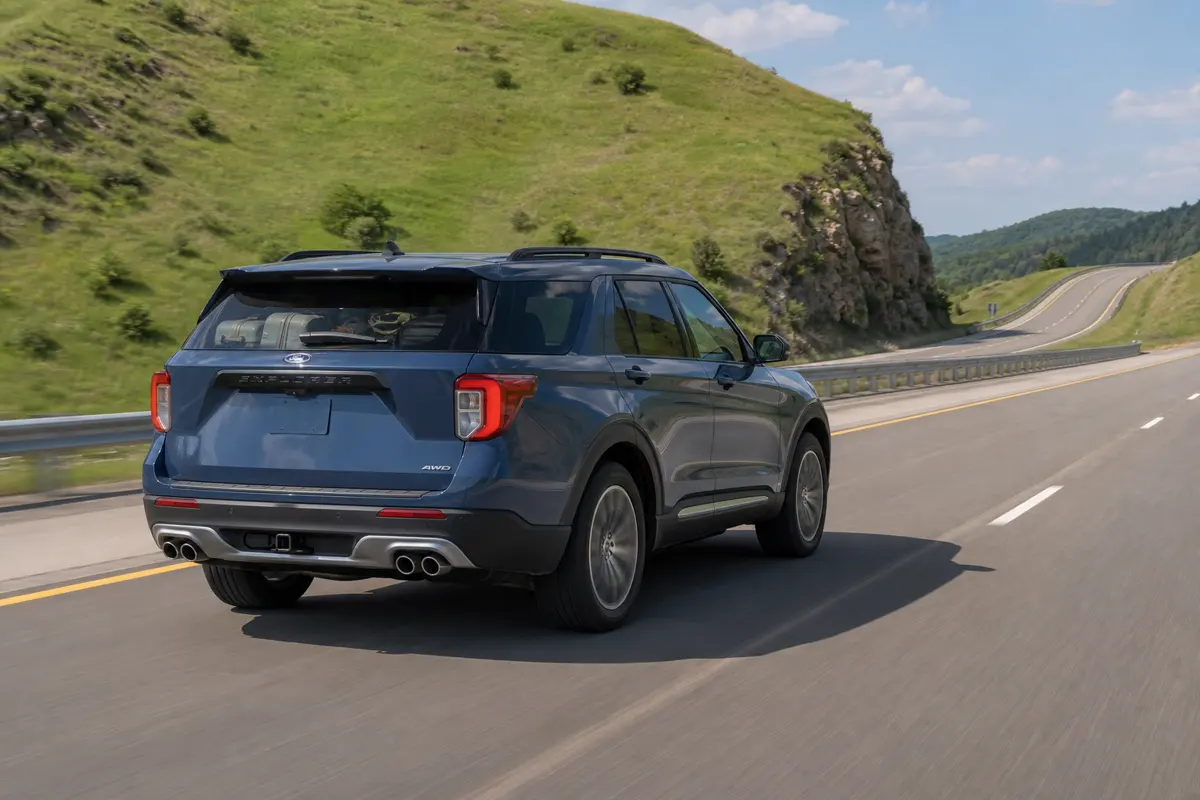
Family use raises the consequence of guessing because long grades, hot weather, a full cabin, and towing sustain heat and load. The vehicle should hold temperature, keep its coolant level, and return with clean oil rather than merely survive a five-minute loop.
Buy an older transverse-V6 Explorer only when the cooling system is stable and the oil shows no evidence of coolant contamination. A seller who will not permit a cold inspection and pressure test is asking the buyer to accept the largest uncertainty.
What did NHTSA find about exhaust odor in the cabin?
NHTSA opened Engineering Analysis EA17-002 after reports of exhaust odor and possible carbon-monoxide exposure in 2011 to 2017 Explorers, including Police Interceptor Utility vehicles. The agency's closing report says it reviewed more than 6,500 complaints, inspected vehicles, and conducted independent testing.
The findings were more specific than a claim that every Explorer leaked exhaust.
The highest measured carbon-monoxide levels in tested consumer vehicles usually traced to sealing problems after rear crash repairs, while the highest police-vehicle readings involved openings created during emergency-equipment installation.
Police vehicles also had evidence involving cracked manifold-catalyst assemblies.
That fleet mechanism should not be assigned automatically to a privately owned Explorer that never carried police equipment.
Ford's consumer field action included sealing work and an HVAC control update. NHTSA reported that the HVAC reprogramming substantially reduced carbon-monoxide levels attributable to cabin entry and closed the investigation without finding an unreasonable safety defect.
Closure does not mean an owner should ignore odor, headache, nausea, or light-headedness.
Leave the vehicle, move into fresh air, seek medical attention when symptoms warrant it, and have the exhaust and body sealing inspected before driving it normally again.
The investigation also found that some sulfur-like odor complaints were associated with power-transfer-unit failure. On an all-wheel-drive vehicle, inspect the PTU for leaks, overheated fluid odor, noise, binding, and documented service rather than treating every smell as a cabin-seal problem.
Rear crash history matters because repaired seams, plugs, liftgate areas, and pressure-relief paths can admit gases under acceleration.
A body-shop invoice should identify the repaired area, while a smoke or pressure test and controlled road test should confirm that the passenger compartment remains sealed.
An air freshener, open window, or erased complaint does not constitute a repair. The useful evidence is a located leak or mechanical source, a documented correction, and a symptom-free verification drive.
What should a 2020 and newer road test prove?
A sixth-generation Explorer needs to be tested from cold through full operating temperature. The 10-speed automatic may make more shifts than an older transmission, but every change should remain coordinated rather than producing repeatable flares, bangs, neutral sensations, or delayed engagement.
Before starting, note whether the seller has warmed the vehicle. Select Reverse and Drive with the brake held, record the engagement delay, then use light throttle through the lower gears without forcing a harsh test on a cold powertrain.
Repeat the same route after the fluid is warm. Include gentle acceleration, a firmer merge, steady highway speed, a coast-down, stop-and-go operation, and a low-speed turn in both directions.
A single rough shift does not prove internal transmission damage.
Low voltage, software, adaptation, mounts, fluid condition, driveline lash, and hardware faults can produce different symptoms, which is why the scan and repeatability matter.
- Before startConfirm a true cold soak, inspect fluids and leaks, measure battery voltage, and scan all modules before codes are cleared
- First movementCompare Reverse and Drive engagement, steering effort, brake release, and initial axle noise
- Urban driveUse light and moderate throttle, track repeated shift events, and make tight turns without driveline binding
- Highway and gradeCheck loaded acceleration, converter behavior, vibration, temperature, and noise under coast and power
- After driveRescan current, pending, history, and network codes, then inspect for new leaks and odors
Defined 2020 to 2022 Explorers also require rear-axle campaign proof. NHTSA campaign 23V675 says the rear axle horizontal mounting bolt could fracture, disconnect the driveshaft, cause loss of drive power, or permit rollaway when the parking brake was not applied.
The later remedy is physical, not merely a dashboard update.
Dealers replace the subframe bushing and rear axle bolt, inspect the axle cover near the bolt hole, and replace the cover when damaged.
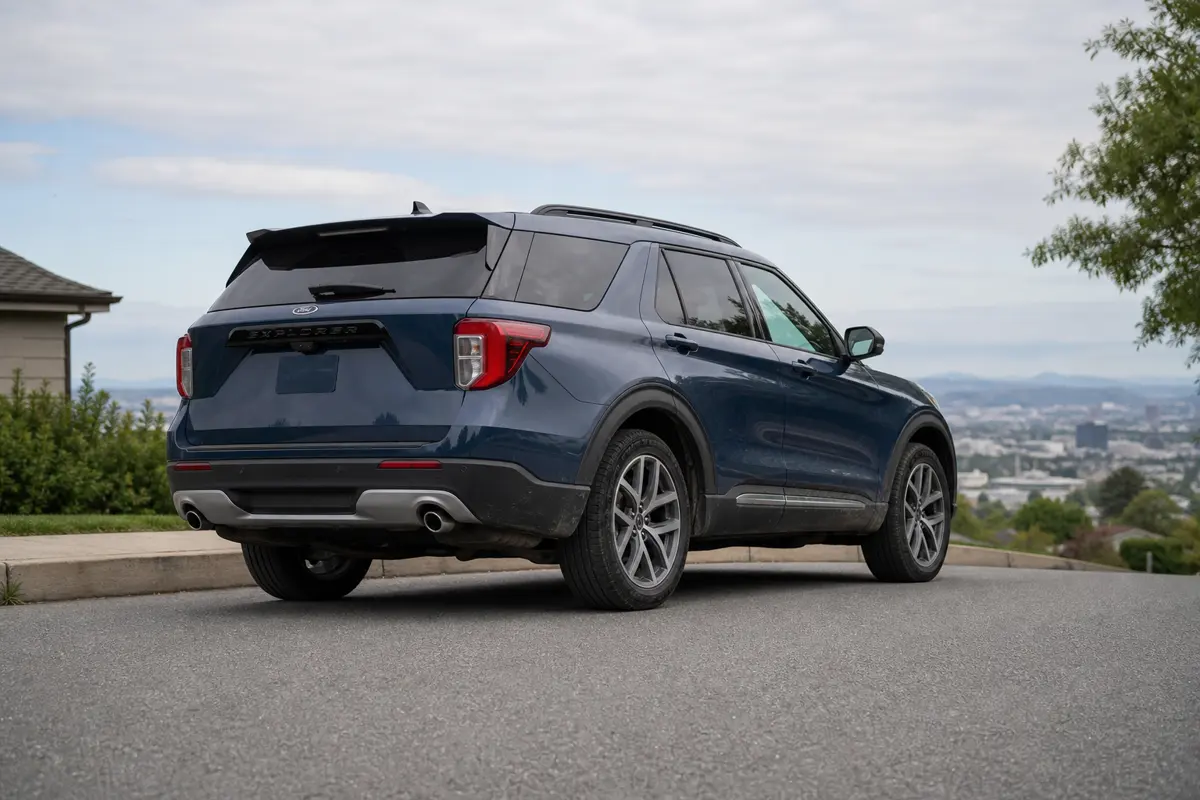
Use the parking brake every time and do not crawl under an unsupported vehicle to look for the bolt. Ask for the campaign invoice, then have a qualified shop inspect the rear mounting area, axle cover, bushings, fasteners, leaks, and driveshaft condition on a lift.
A software receipt from an earlier campaign stage may not prove that the later bolt-and-bushing remedy was completed. Match the repair number and parts to the VIN rather than accepting a seller's statement that all recalls were done.
Which Explorer safety actions still change the decision?
Safety work deserves priority because a free campaign remedy can involve steering effort, rollaway, rear visibility, road debris, or loss of drive power. The correct list comes from the VIN, while broad model-year ranges only tell you which evidence to seek.
NHTSA campaign 14V286 covers certain 2011 to 2013 Explorers whose electric power-steering gear can lose the motor-position signal. The mechanical connection remains, but steering effort rises, especially at low speed, and the instrument cluster warns the driver.
For 2011 to 2019 vehicles, campaign 24V031 addresses exterior A-pillar trim that may detach. Ford's chronology says seven clips attach the trim to its bracket and the complete model-year population was included after field review.
The newer platform has overlapping camera actions. Some defined 2020 to 2023 vehicles could show a blue or black image, while campaign 26V123 covers certain 2020 to 2024 Explorers whose rearview image may flip or invert.
An image that is present but reversed or upside down is still a safety defect.
Test Reverse repeatedly across separate ignition cycles and confirm that the display orientation agrees with the mirrors and actual objects behind the vehicle.
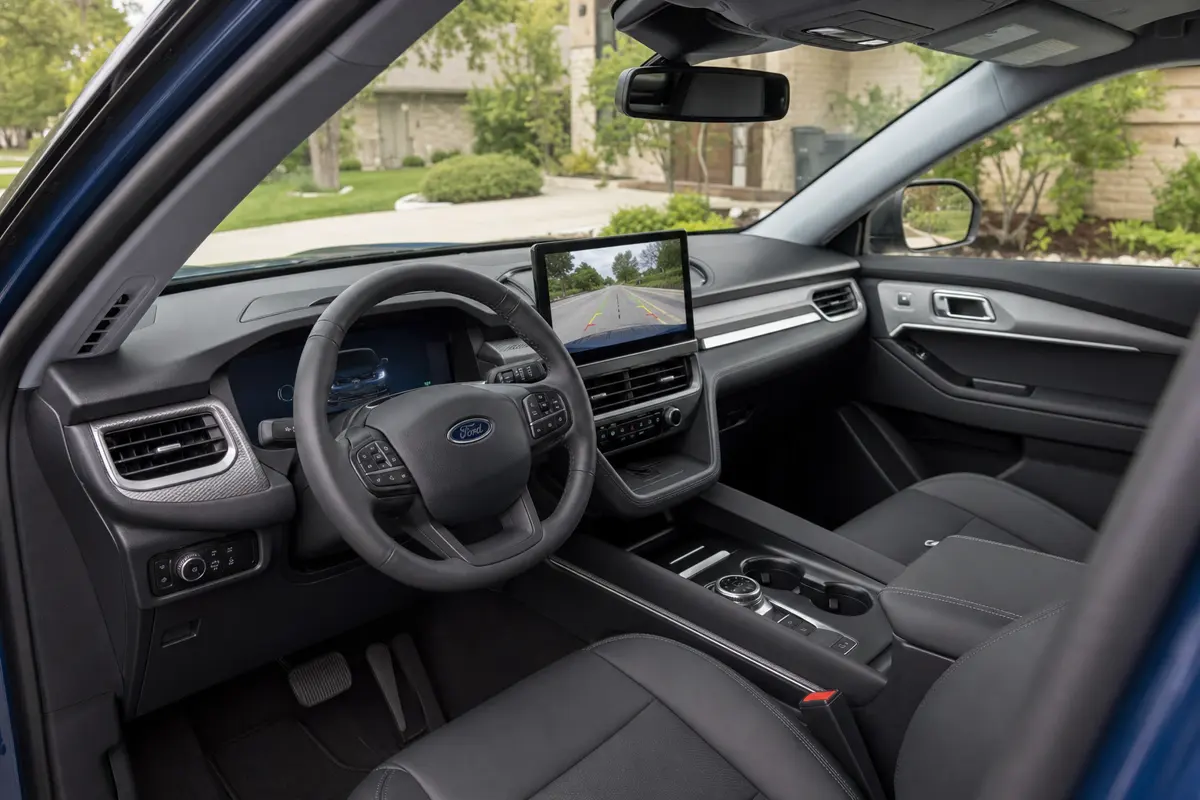
Certain 2025 and 2026 Explorers have a newer engine action. NHTSA campaign 26V343 covers a defined population whose engine may fail and cause a loss of drive power, with long-block replacement listed as the remedy.
As of the campaign record, the affected Explorer population is VIN-specific and much narrower than every vehicle in those two model years. Do not apply the action to an uninvolved engine, but do not accept an affected vehicle before the remedy and dealer record are complete.
| Vehicle scope | Campaign | Consequence | Evidence required |
|---|---|---|---|
| Certain 2011-2013 Explorers | 14V286 | Loss of electric steering assist and higher steering effort | VIN completion plus a warning-free low-speed steering test |
| Certain 2011-2019 Explorers | 24V031 | Exterior A-pillar trim may detach and become a road hazard | Inspection or replacement record and secure trim |
| Certain 2020-2022 Explorers | 23V675 | Rear axle bolt fracture, loss of drive, or rollaway | Later physical bolt and bushing remedy plus axle-cover inspection |
| Certain 2020-2024 Explorers | 26V123 and related camera actions | Missing, blue, black, flipped, or inverted rearview image | Current campaign record and repeated correct camera operation |
| Certain 2025-2026 Explorers | 26V343 | Engine failure and loss of drive power | VIN-specific long-block remedy and dealer documentation |
Use the NHTSA VIN or license-plate lookup, then ask a Ford dealer to print the campaign history. Save invoices that name the campaign number, repair date, mileage, parts, and software level because a clean dashboard does not establish completion.
Resolve open steering, rollaway, rear-visibility, road-debris, and engine-failure actions before delivery. Ordinary tires or brakes can be priced afterward.
Can a Ford Explorer reach 200,000 miles?
A Ford Explorer can exceed 200,000 miles, but no trustworthy source can promise that result for one vehicle. Reaching the number also says nothing about how many cooling, transmission, suspension, electronic, or driveline repairs were required along the way.
Mileage becomes useful when paired with duty cycle.
Long steady trips can reduce cold starts and moisture accumulation, while towing, repeated short trips, idle time, winter salt, poor roads, and a full family load create different heat, fluid, brake, suspension, and corrosion exposure.
For a 2011 to 2019 V6, remaining life depends heavily on stable coolant and oil, engine temperature, timing-system condition, PTU health when fitted, body sealing, steering operation, and underbody corrosion. An odometer reading cannot reveal internal coolant contamination or a repaired rear-body leak.
For a 2020 and newer vehicle, shift quality across temperature, rear driveline condition, axle campaign completion, camera function, module history, and current engine action matter more than a broad reputation inherited from the earlier generation.
A full cabin also changes normal behavior.
Passengers and cargo increase acceleration time, braking distance, transmission downshifts, tire load, and suspension movement without proving that the vehicle is defective.
The useful test is whether those responses remain predictable and within ratings. Weigh a regularly loaded vehicle when necessary, maintain tire pressure for the specified load, and inspect brakes, tires, cooling, and hitch equipment according to actual use.
Service records should show dates and mileage rather than a stack of undated receipts. Look for stable oil-change intervals, coolant work with the correct specification, transmission and driveline attention appropriate to use, brake-fluid service, battery history, tires matched in size and wear, and campaign completion.
Condition, configuration, and verified repairs describe remaining life more accurately than the odometer alone. A higher-mileage Explorer with coherent evidence can be a safer decision than a lower-mileage example with overheated oil, unresolved campaigns, cleared codes, or unexplained coolant loss.
Buy the Explorer whose evidence matches its generation
Start by recording the VIN, model year, engine, drivetrain, build date, and campaign history. Then arrange a true cold start, complete module scan, long road test, lift inspection, fluid examination, and cabin check before negotiating.
On a 2011 to 2019 vehicle, require stable coolant, clean oil, a located explanation for any odor, sound PTU evidence when all-wheel drive is fitted, reliable steering assist, secure trim, and no hidden moisture after rear body repair.
On a 2020 and newer vehicle, require repeatable cold and hot shifts, a quiet and secure rear driveline, proof of the later axle remedy when applicable, correct rear-camera operation, a clean network scan, and completion of any current engine action.
Do not pay a premium for a recent repair unless the invoice identifies the cause and the verification test proves the symptom is gone.
Parts replacement without diagnosis can leave the original fault in place.
The lower-risk Explorer is the one whose evidence fits its generation and survives the same conditions your family will impose on it. That conclusion may favor an older, documented vehicle over a newer example with missing campaign and diagnostic history.