Which Ford Explorer years should you avoid?
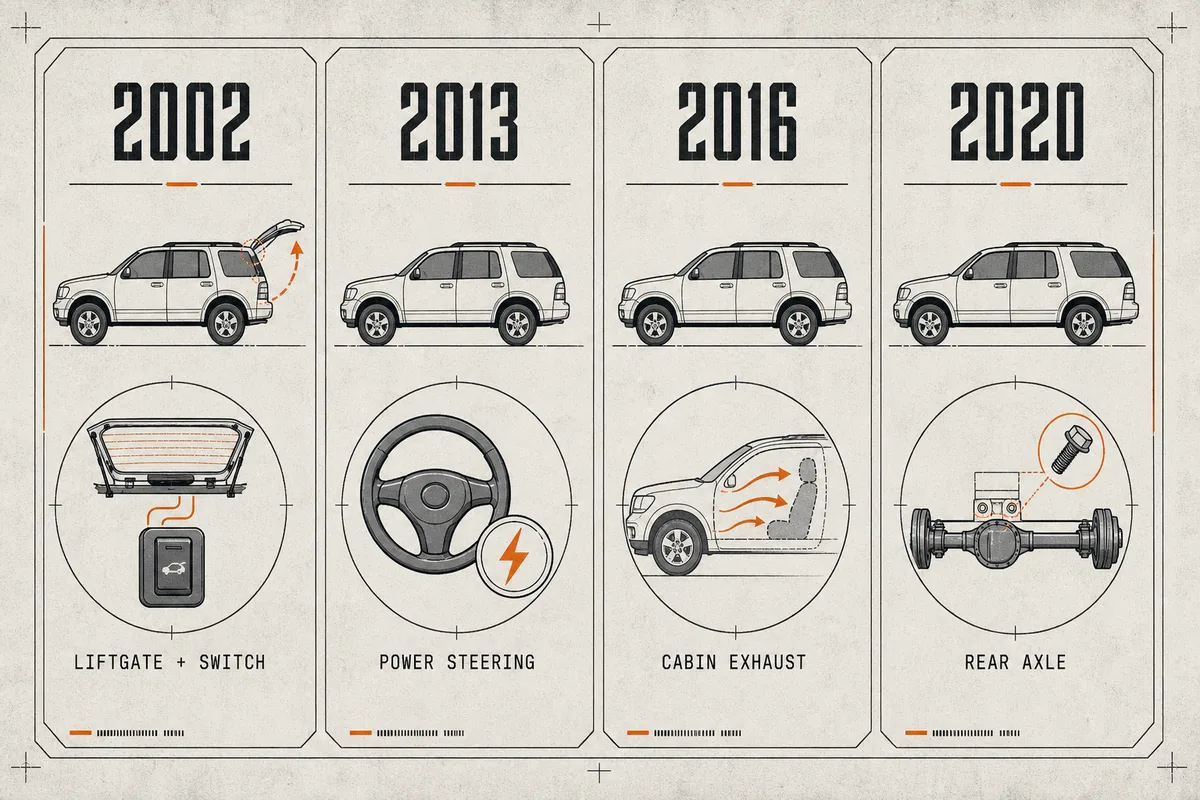
Start with 2002, 2013, 2016, and 2020 when comparable Explorers are available. The 2002 and 2020 are redesign years, while 2013 and 2016 sit inside a complaint-heavy front-wheel-drive generation with separate steering and cabin-odor evidence.
That shortlist is a screening tool, not a claim that every example will fail. Sales volume, vehicle age, mileage, and years of exposure differ, so raw reports cannot establish the probability that one Explorer will develop a fault.
A lower asking price is useful only after the unresolved risk has been identified. Missing campaign paperwork, a warning during the drive, or a seller who will not permit an independent inspection should move the vehicle behind a cleaner alternative.
Why does the 2002 Ford Explorer still belong on the avoid list?
The 2002 Explorer launched a new four-door generation and currently returns 3,621 complaints and 10 recalls from the NHTSA APIs. That is the highest raw complaint total among the years reviewed here, but its age and long exposure mean the number identifies an evidence burden rather than a failure probability.
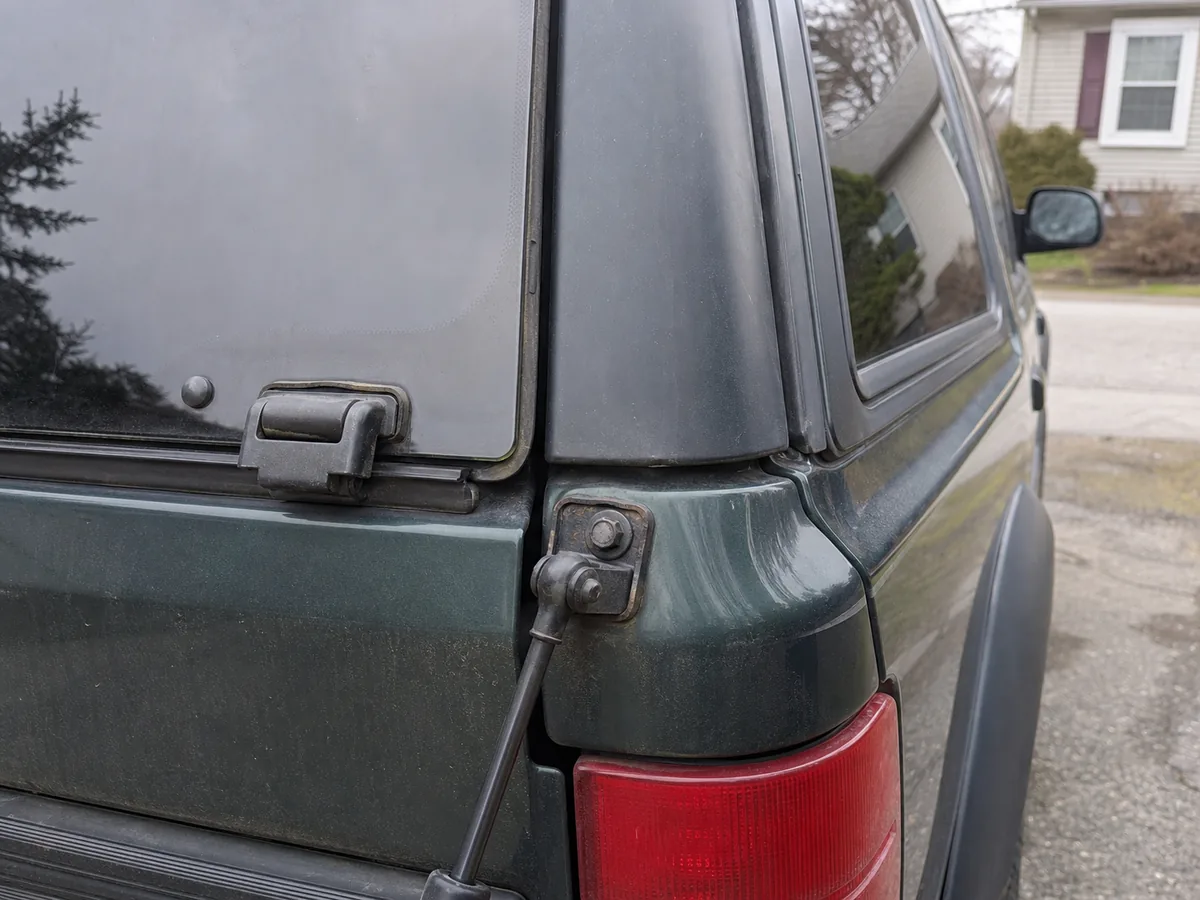
Ford recall 04V-442 covered certain 2002 and 2003 Explorers because a liftgate-glass strut bracket could disengage or a hinge could fracture. The glass could fall from its open position and break, so a seller should provide VIN closure and the rear glass should remain closed until the hinge and bracket condition are confirmed.
| Concern | Official evidence | Present check | Buying response |
|---|---|---|---|
| Liftgate glass | 04V-442 completion and hinge or bracket repair detail | Cracks, looseness, misalignment, replaced glass, and supported operation | Do not operate or buy around damaged hardware |
| Speed-control switch | 09V-399 inspection and fused-harness or switch repair | Brake-fluid contamination, heat damage, burning odor, and clean wiring | Hold the purchase until the campaign and any damage are resolved |
| Age and use | Service, collision, corrosion, and transmission history | Cold engagement, shifts, underbody, cooling system, and structural condition | Price only diagnosed wear, not unknown deterioration |
Recall 09V-399 also included 1995 to 2002 Explorers equipped with the specified speed-control deactivation switch. Ford's repair instructions called for inspecting the connector for brake-fluid contamination, then adding a fused jumper harness or replacing the switch when required.
Completed campaigns settle only the defects they cover. A 2002 still needs a cold transmission test, cooling-system and corrosion inspection, collision-history review, and an underbody check that reflects more than two decades of use.
A 2002 is worth further inspection only when both campaign histories are documented and its present mechanical and structural condition gives no contradictory evidence.
Why is the 2020 Ford Explorer the worst modern year to buy?
The 2020 Explorer changed to a rear-wheel-drive-based architecture, new body structure, new electronics, and a ten-speed automatic. A clean-sheet launch creates more opportunities for production and calibration problems than a mature final-year vehicle, and NHTSA currently returns 1,181 complaints and 33 recalls for the 2020 model.
The decisive concern is the rear axle horizontal mounting bolt on certain 2020 to 2022 Explorers. NHTSA investigation RQ23-002 explains that a fractured bolt can allow the axle housing to move, produce severe noise or vibration, disconnect the driveshaft, reduce motive power, or let the vehicle roll after Park is selected.
| Model year | Current NHTSA complaints | Current NHTSA recalls | Buying implication |
|---|---|---|---|
| 2019 | 287 | 6 | Mature previous platform, inspect age and service history |
| 2020 | 1,181 | 33 | Highest proof burden because the platform and campaign history changed together |
| 2021 | 406 | 26 | Rear-axle population still applies to certain VINs |
| 2022 | 250 | 24 | Verify the final campaign remedy rather than assuming later means clear |
Ford's first remedy for some vehicles used software to apply the electronic parking brake when Park was commanded. The 23S55 chronology states that this contained rollaway risk but did not repair a broken bolt or address loss of motive power, which led to a later hardware-focused campaign.
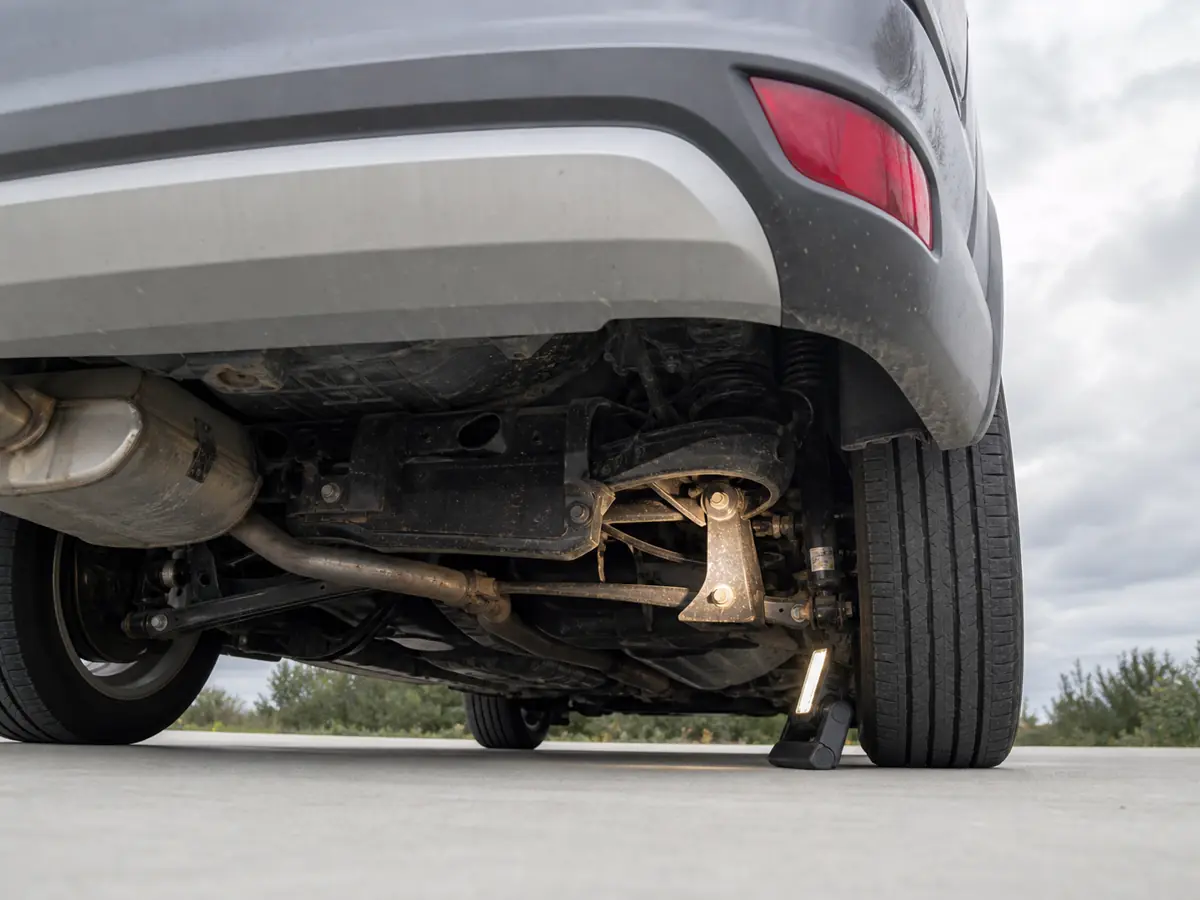
Ask the dealer to print every completed field action by VIN and identify whether the rear axle bushing, axle cover, or mounting hardware was inspected or replaced. Do not accept "the software recall was done" as complete proof when the vehicle belonged to the later hardware campaign.
The 2011 to 2013 steering recall needs repair proof
NHTSA campaign 14V-286 covers certain 2011 to 2013 Explorers built through February 28, 2012. Ford reported that an intermittent electrical connection in the steering gear could remove power assist and leave the driver with much higher steering effort.
The mechanical connection between the steering wheel and the road remains, but that does not make the event harmless. A sudden increase in effort matters most during parking, a low-speed turn, or an evasive maneuver where the driver expects normal assistance.
Run the VIN through both NHTSA and Ford, then ask whether the campaign required software work or steering-gear replacement on that vehicle. A recall marked complete is stronger evidence when the repair order names the work, date, and mileage.
During the drive, make repeated low-speed turns in both directions and let the wheel return naturally. A power-steering fault message, sudden effort change, binding, uneven assistance, or a recently cleared steering code needs diagnosis before price enters the discussion.
Exhaust odor changes the 2013 to 2017 road test
Ford created customer satisfaction program 17N03 for certain 2011 to 2017 non-police Explorers after complaints of exhaust odor entering the cabin. This was a service program rather than a safety recall, so a clean recall screen alone does not prove that the sealing and climate-control work was completed.
The condition may appear during hard acceleration, when exhaust flow and pressure rise. A vehicle that smells normal while idling can still produce odor on a highway merge, a long grade, or another higher-load event.
Use a safe route that includes moderate acceleration and normal ventilation settings, with another adult present to observe the rear seating area. Do not deliberately create an extreme test, block vents, or use a handheld carbon monoxide meter as a substitute for professional diagnosis.
The Ford program document distinguishes police vehicles from the separate 17N03 support for non-police Explorers. Ask for the 17N03 invoice and inspect rear body seals, liftgate alignment, exhaust condition, and evidence of collision repair that could reopen an air path.
Walk away from persistent cabin odor or physical symptoms even when a seller says the service program was completed. The present vehicle must demonstrate that the concern is resolved.
Complaint totals point to clusters, not odds
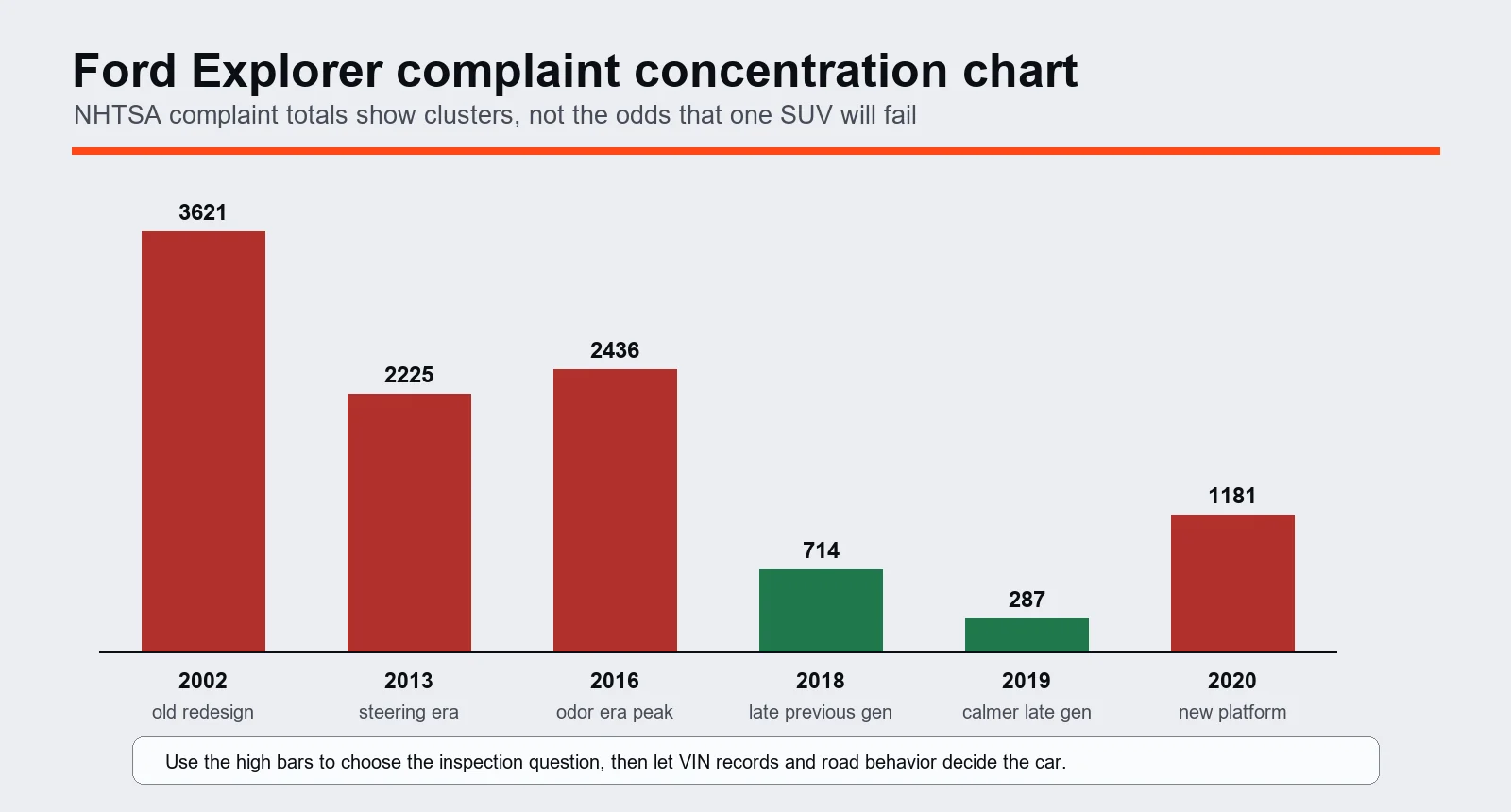
The current NHTSA API returns 3,621 complaints for 2002, 2,225 for 2013, and 2,436 for 2016. The 2018 and 2019 return 714 and 287 respectively, while the 2020 redesign returns 1,181 despite having fewer years on the road than the older vehicles.
Those totals reveal where owners reported concentrated concerns, but the database does not supply a model-year exposure denominator. It also does not verify every diagnosis, distinguish all fleet use, or show how many vehicles completed a remedy and never had the problem again.
- 2002 to 2003Liftgate-glass campaign and old-vehicle condition define the earliest high-burden group
- 2011 to 2013Electric power steering campaign defines the first safety check
- 2013 to 2017Cabin exhaust-odor program adds a load-dependent road test
- 2018 to 2019Later production of the older platform has a lighter report concentration
- 2020 to 2022Rear-axle bolt campaigns define the redesigned model's proof burden
Use the totals to choose questions, not to calculate failure odds. A report cluster becomes valuable when it leads to an official campaign, a repeatable symptom, a documented repair, or a specific component that an independent shop can inspect.
Are 2018 and 2019 Ford Explorers safer starting points?
The 2018 and 2019 are reasonable places to start when condition, mileage, equipment, and price are comparable. Both sit late in the fifth-generation run, after the 2011 launch and before the 2020 platform reset.
Their current NHTSA report concentrations are also lighter than 2013 and 2016. The 2018 returns 714 complaints, while 2019 returns 287 complaints and 6 recalls, but those raw differences still lack equal exposure and sales denominators.
A lower report burden does not erase ordinary Explorer wear. Confirm transmission behavior, water leaks, electronics, rear suspension, brakes, tires, collision history, and every open VIN campaign before treating either year as the better purchase.
Use 2018 and 2019 as lower-uncertainty search starting points, then let service history and the independent inspection choose the vehicle.
What evidence can make a risky Explorer worth considering?
Official completion evidence comes first because a VIN defines campaign eligibility more precisely than a model-year label. Obtain the current Ford field-action printout and the NHTSA VIN result on the day of purchase, since new campaigns and remedy updates can appear after an older service visit.
Evidence that changes the Explorer verdict
- 2011 to 2013 steering
- Campaign record, steering-gear history, stable assist, and no stored steering faults
- 2013 to 2017 cabin odor
- 17N03 invoice, intact rear sealing, sound exhaust, and a clean loaded road test
- 2020 to 2022 rear axle
- Final campaign status plus documented mechanical inspection or replacement when required
- Any Explorer
- Cold and warm scan, service history, collision inspection, matched tires, and underbody condition
Paperwork must agree with the SUV. A rear-axle invoice cannot explain fresh movement, clunking, or vibration, and a steering recall closure cannot explain a warning that returns during parking maneuvers.
Drive from cold to full operating temperature, include city traffic and a highway merge, then repeat low-speed turns and Park engagement on level ground. Scan all available modules after the drive so a code that returned under heat or load is not missed.
Inspect the body and underbody for collision work, corrosion, fluid leaks, tire mismatch, and loose suspension hardware. A three-row SUV may also carry towing, fleet, or heavy-family use that accelerates brakes, tires, wheel bearings, and rear suspension wear independently of its model-year reputation.
Repair invoices narrow uncertainty only when they identify the failed part, remedy, VIN, and mileage. A vague line such as "recalls done" should not earn the same price as complete evidence.
Should you buy the Explorer in front of you?
A 2002, 2013, 2016, or 2020 Explorer can survive a strict review when its system-specific history is complete and its present behavior confirms the repair. That is different from buying it because the price is low and planning to investigate later.
A later year with clean history will often cost more because it carries less unresolved uncertainty. Compare that premium with the price of steering gear, driveline, collision, or exhaust diagnosis rather than comparing monthly payments alone.
Buy the exact Explorer only when its VIN history, repair documents, scan data, road behavior, and physical inspection tell the same story.