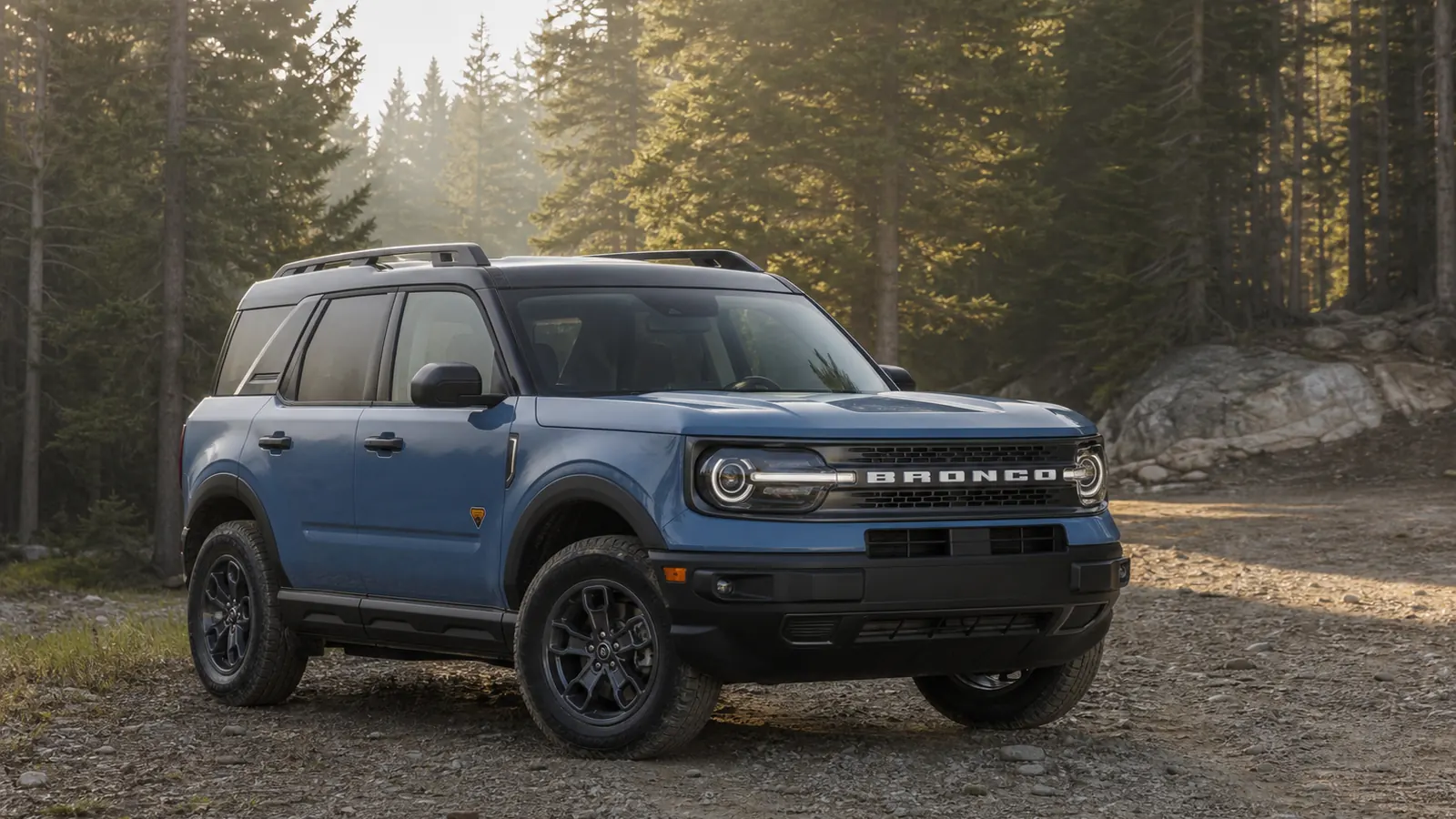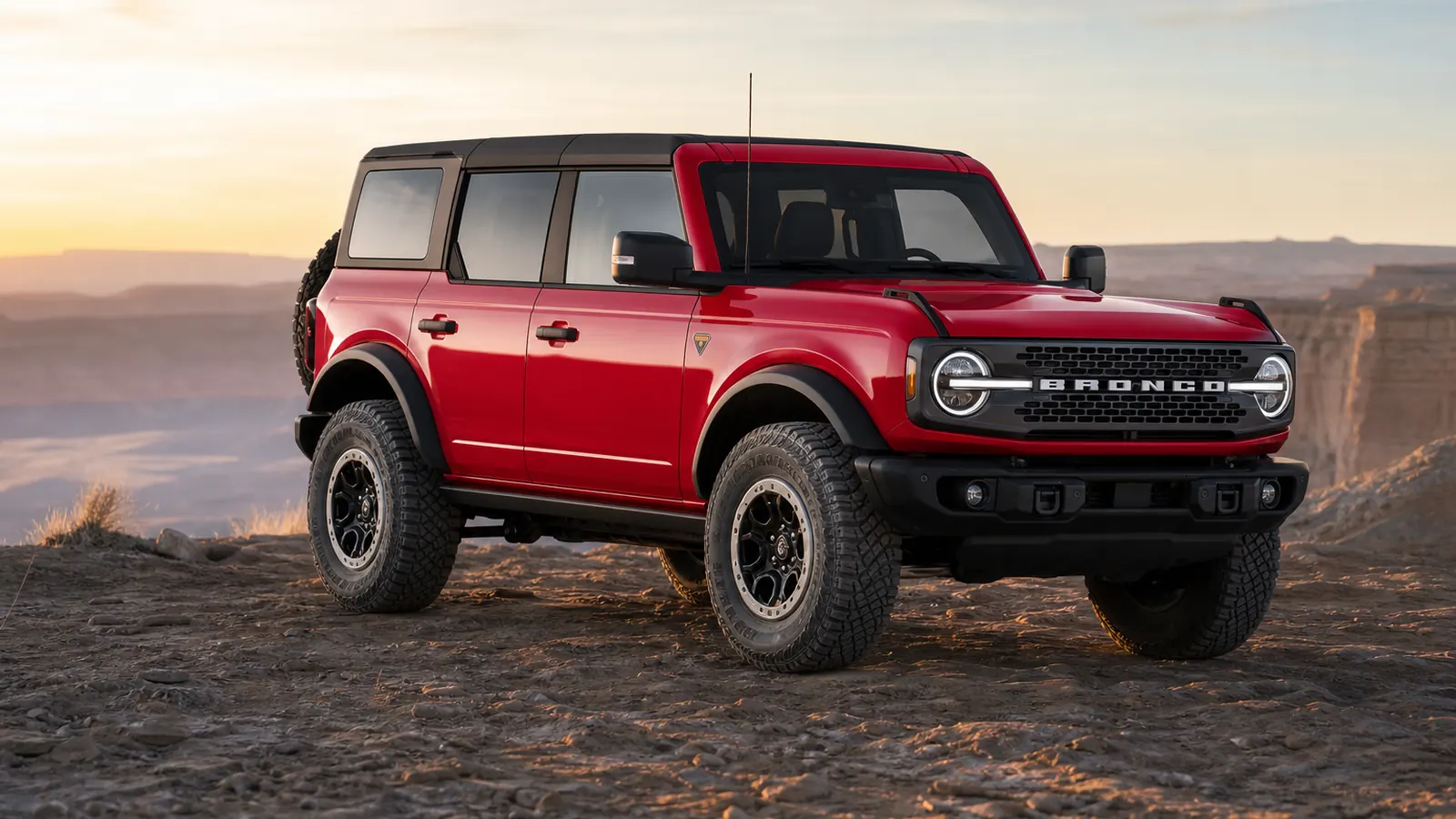
Big Bend is the sensible start when trails are occasional
The 2026 Ford Bronco starts with standard four-wheel drive, a two-speed transfer case, removable doors and roof panels, and a 300-hp 2.3-liter EcoBoost engine.
Big Bend adds useful daily equipment without forcing the tire, suspension, fuel, and replacement costs of the most specialized builds.
For a buyer who drives to work all week and reaches a trail on some weekends, that balance matters more than the most aggressive brochure photo.
Outer Banks moves toward comfort and appearance. Badlands adds the equipment that changes what the truck can do on difficult ground.
Stroppe Edition and Raptor sit far above the normal family budget and bring wider bodies, larger tires, and parts that cost more to replace.
The right trim is the first one whose hardware solves a repeated surface or obstacle.
Drive a Big Bend and the intended trail trim on the same paved route before deciding. Check steering corrections, tire noise, braking, crosswind response, parking, wet-road grip, and the effort required for every passenger to climb in.
A Jeep Wrangler is the closest removable-body rival, while the Toyota 4Runner keeps a fixed roof and a more conventional cabin.
Buy the Bronco configuration that covers the hardest trip you actually repeat, because unused off-road hardware raises the daily cost every mile.
Two doors save length while four doors solve passenger and cargo work
Bronco body choice changes the vehicle more than a trim badge. The two-door uses a 100.4-inch wheelbase, seats four, and provides 20.6 cubic feet behind its rear seat.
The four-door stretches to a 116.1-inch wheelbase, seats five, and holds 35.6 cubic feet behind the second row with the hard top or 38.3 with the soft top.
| Question | Two-door answer | Four-door answer |
|---|---|---|
| Parking and tight trails | Shorter wheelbase and body | Larger turning and parking footprint |
| Rear passengers | Two seats with front-seat access | Three-position rear bench and rear doors |
| Cargo behind rear seat | 20.6 cu ft | 35.6 to 38.3 cu ft |
| Maximum cargo | 52.0 cu ft | 72.9 to 83.0 cu ft |
| Normal buyer | One or two people | Family, pets, luggage, or work gear |
The short body can turn and place its tires more easily on tight terrain, but rear access becomes a routine inconvenience.
A child restraint, dog, cooler, recovery kit, and weekend luggage can consume the two-door cargo area quickly. The four-door is easier to live with, though its longer wheelbase can touch down sooner over a sharp crest.
Bring the people and gear that travel most often. Set the front seats for both drivers, climb into the rear, install child restraints according to both manuals, and close the cargo door around the real load.
Test whether the swing gate can open in the garage or a tight parking space.
The planned Bronco and Wrangler comparison will separate their packaging in detail.
The five-seat SUV list gives more conventional alternatives. Choose the four-door unless the two-door's shorter wheelbase solves a specific parking or trail problem often enough to repay its access and cargo penalties.
The 2.3-liter engine keeps the manual and avoids unnecessary weight
Ford rates the 2.3-liter four-cylinder at 300 hp and 325 lb-ft on premium fuel. The available 2.7-liter V6 makes 330 hp and 415 lb-ft, while the Raptor-only 3.0-liter reaches 418 hp and 440 lb-ft.
Those numbers do not make the V6 an automatic choice, because gearing, tire size, curb weight, altitude, load, and throttle response shape the drive.
The seven-speed manual, which includes a crawler gear, is paired with the 2.3-liter engine.
The ten-speed automatic is available with the four-cylinder and required with both V6 engines. A manual buyer should test clutch takeup, hill starts, low-speed crawling, highway revs, and whether every household driver can use it safely.
Bronco powertrain facts
- 2.3L EcoBoost
- 300 hp and 325 lb-ft
- 2.7L EcoBoost
- 330 hp and 415 lb-ft
- 3.0L Raptor
- 418 hp and 440 lb-ft
- Manual
- 2.3L only, six road gears plus crawler
- Automatic
- 10 speeds, available across the core range
The V6 earns its cost when a heavy four-door, large tires, elevation, or repeated passing load makes the four-cylinder work harder than the buyer accepts.
It also adds purchase price and can increase fuel and service cost. Premium fuel is how Ford states maximum output, so compare the fuel recommendation and local price before treating the rating as free performance.
A Toyota Land Cruiser offers a hybridized turbo powertrain with a fixed configuration, while the Ford Ranger puts related turbo engines in a pickup body. The 2.3-liter is the broad-value engine, and the 2.7-liter should answer a tested response or load need rather than a fear that four cylinders are automatically inadequate.
Sasquatch changes clearance, tire leverage, and the daily bill
A base Bronco on 30-inch tires has 8.3 to 8.4 inches of ground clearance. Badlands on 33-inch tires reaches 10.5 inches, and a Sasquatch-equipped core model on 35-inch tires reaches about 11.5 to 11.6 inches.
Raptor sits at 13.1 inches on 37-inch tires. The extra clearance helps only when the driver also understands line choice, breakover, traction, and the vehicle's width.
Large tires alter acceleration, braking, steering feel, spare-tire weight, step-in height, garage clearance, and replacement cost.
They also place more leverage through steering and suspension parts. Price one matching tire and a full set before ordering.
Confirm that the spare, jack, roof, garage door, car wash, parking deck, and trail permit can handle the chosen build.
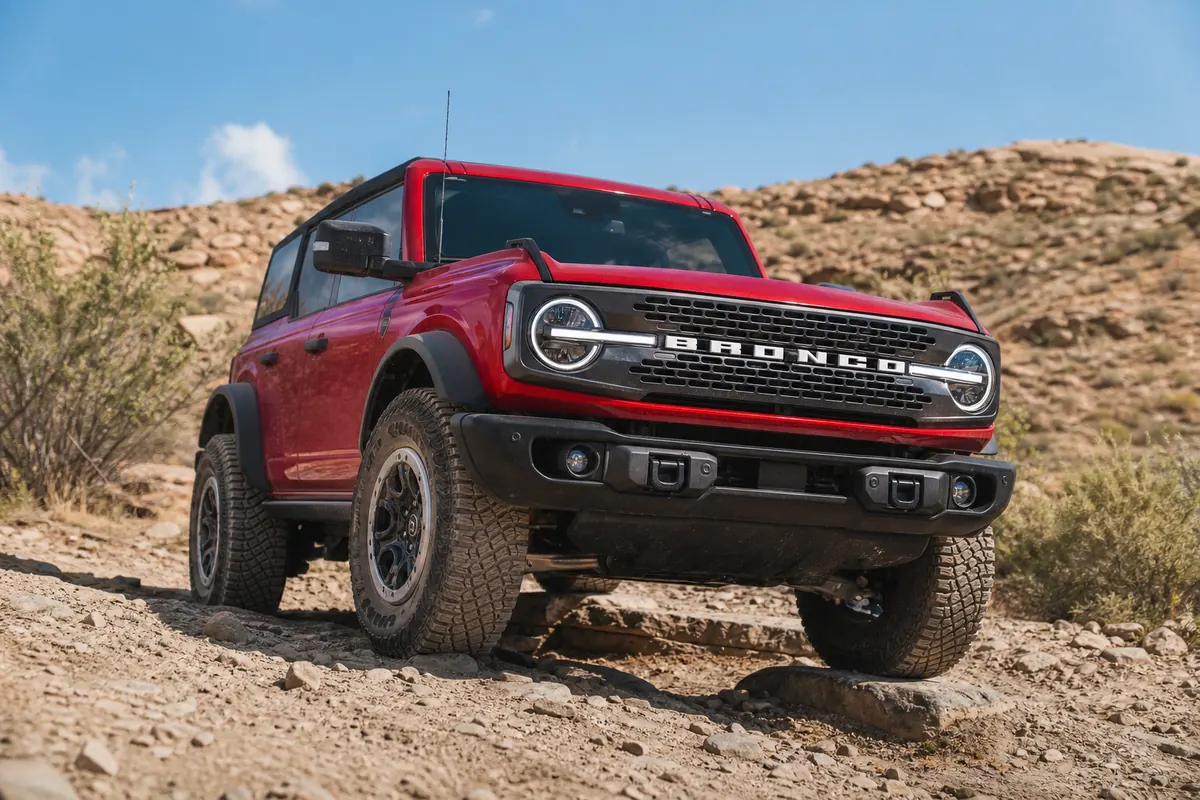
Badlands brings a front stabilizer-bar disconnect and stronger terrain hardware that can matter on uneven ground.
Sasquatch adds 35-inch tires, locking differentials, lower gearing, and suspension changes to compatible trims. A driver who stays on maintained forest roads may get more value from good tires, training, recovery equipment, and conservative judgment than from the largest package.
Use the all-wheel-drive and 4x4 browse page to compare traction-focused vehicles. Order Sasquatch when measured obstacles require its clearance and lockers, not when the truck will spend nearly every mile on pavement.
Payload is the limiting number before the 3,500-pound tow rating
Core 2026 Broncos are rated to tow up to 3,500 pounds when properly equipped, while Raptor reaches 4,500 pounds.
Ford's technical sheet lists maximum payload from about 1,067 to 1,417 pounds across many two-door and four-door configurations, with the exact certification label controlling the vehicle in front of you.
Options, people, roof gear, accessories, and trailer tongue weight all consume that allowance.
Start with the driver-door payload figure. Subtract every passenger, cabin item, cargo-area load, roof load, winch, bumper, rock rail, drawer, refrigerator, recovery kit, and hitch component.
Add the measured tongue weight of the loaded trailer. A 3,500-pound trailer can be legal by trailer rating and still push a heavily equipped Bronco past payload or an axle limit.
- Read GVWR, axle, tire, and payload labels on the exact vehicle.
- Weigh the trailer loaded with water, batteries, propane, food, and equipment.
- Use the hitch and braking equipment required by Ford and the trailer maker.
- Reduce speed and load for heat, grade, wind, or poor surface conditions.
- Recheck added accessories because each one reduces remaining capacity.
A fixed roof rack also has dynamic and static limits, and Ford notes restrictions with some 35-inch-tire configurations.
Never combine isolated maximums from different trims. The planned Bronco ownership-cost page will carry the full expense model, while a Jeep Grand Cherokee may suit buyers who need road comfort more than removable panels.
The door label, axle ratings, and loaded scale weights decide whether a Bronco can tow the trip, not the largest number printed for another configuration.
Removable panels require a storage, weather, and noise plan
The removable roof and doors are central to Bronco appeal, but they create work that a normal SUV avoids.
Before buying, identify where each panel will be lifted, protected, and stored. Measure ceiling height, wall space, door width, cart clearance, and the path between the vehicle and storage area.
A heavy panel handled alone can damage paint, glass, weather seals, or a person.
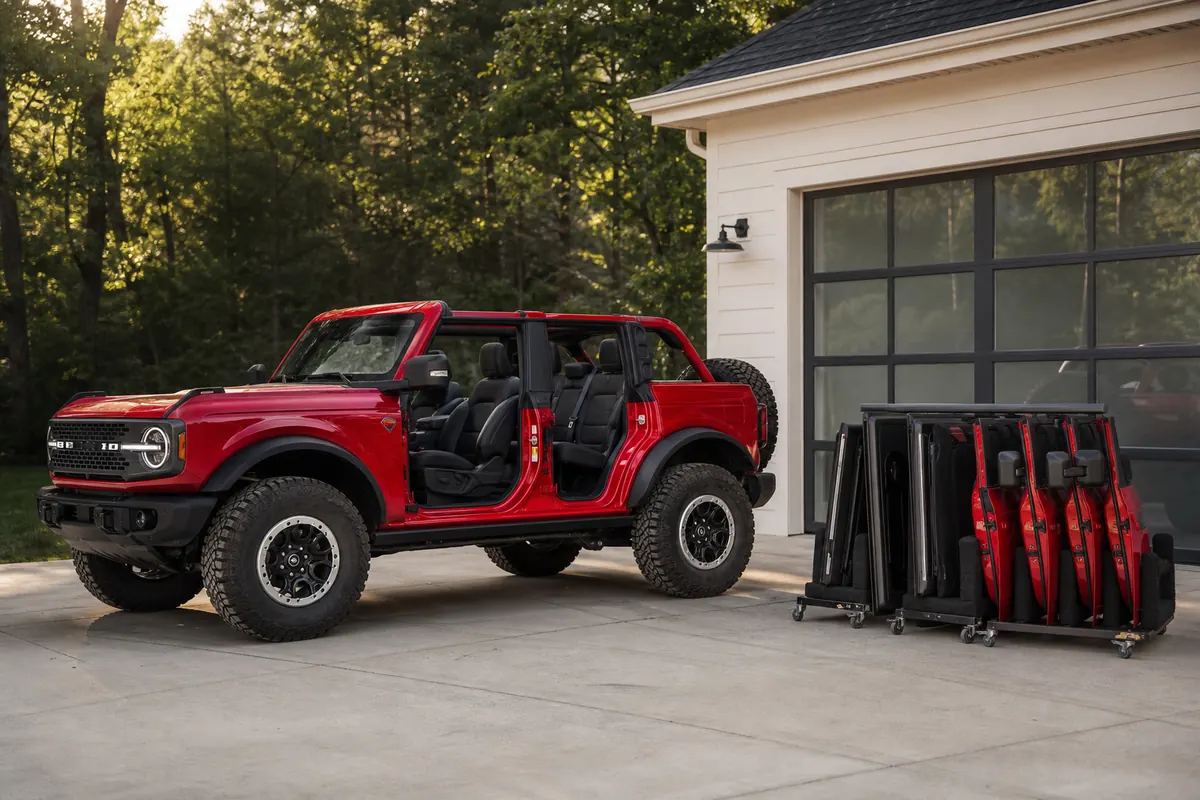
Drive both hard-top and soft-top versions at the speeds used most.
Listen around header seals, side glass, rear quarters, and the cargo area. Check water drains and seals after a wash, then inspect carpet, trim edges, seat mounts, cargo-floor wells, and electrical connectors for moisture.
A leak should be diagnosed rather than dismissed as normal removable-roof behavior.
Door removal changes mirror requirements and exposes hinge, connector, and storage risks. Follow the owner's manual, use the supplied or specified tools, protect painted edges, and keep every bolt identified.
Never place a removed door where it can fall or block an exit.
Confirm local equipment laws before driving.
The Bronco Sport keeps a fixed roof and conventional doors in a smaller crossover body. Buyers who love the Bronco shape but do not want panel handling, cabin noise, or open-air weather compromises should drive both.
Treat the roof and doors as equipment that needs safe handling and dry storage, because the feature loses value when removal is too difficult to use.
IIHS results are mixed despite the Bronco's substantial size
IIHS ratings for the 2025 to 2026 four-door Bronco include Good small-overlap and updated side results, but a Marginal updated moderate-overlap result.
Headlights are rated Marginal, vehicle-to-vehicle front crash prevention is Acceptable, and pedestrian front crash prevention is Marginal.
These categories measure different jobs, so one strong result cannot erase a weaker one.
The rating applies to the tested four-door context described by IIHS. Two-door buyers should not assume every result transfers without checking the rating details.
Large tires, lifts, bumpers, lighting changes, and added weight can also change handling, braking, sensor aim, and crash behavior without creating a new official rating.
Inspect belts, airbags, head restraints, child anchors, tires, brakes, lamps, glass, cameras, radar areas, and any previous body repair.
Require calibration records after windshield, bumper, steering, suspension, or alignment work. Test driver-assistance features in safe conditions and read their limits in the manual.
Install every child restraint during the test drive instead of relying on the seating count. The four-door rear opening and three-position bench are easier to use, but a rear-facing shell can still change front-passenger space.
Confirm lower-anchor access, top-tether routing, buckle position, and the ability to close the door without pushing the seat.
In the two-door, practice moving the front seat and reaching the restraint because that access step happens on every trip.
Also test visibility with the roof and spare tire in place. Set the mirrors, reverse toward a low marker, and confirm that the camera image, parking alerts, and rear glass provide enough information.
Mud, an accessory carrier, or a larger spare can block a view that looked acceptable on a clean stock vehicle.
These checks do not replace IIHS testing, but they reveal whether the exact configuration supports the driver's daily safety routine.
A five-seat family SUV with a fixed roof may offer easier child-seat access and lower step-in height. Bronco buyers should read the individual IIHS categories and preserve the factory safety systems instead of using vehicle size as a substitute for evidence.
Early 2.7-liter engines and 2025 rear latches need VIN proof
NHTSA campaign 24V635 covers certain 2021 to 2022 Ford and Lincoln vehicles with 2.7-liter or 3.0-liter EcoBoost engines, including affected Broncos, because an intake valve can fracture and cause engine damage and loss of motive power.
NHTSA's investigation linked the concern to a defined production period and noted that most reported failures occurred before 20,000 miles.
The campaign is VIN-specific, so engine size and model year alone do not prove coverage.
NHTSA campaign 25V397 covers certain 2025 Bronco four-door vehicles because the left rear child-safety lock may not prevent the door from opening from inside.
The remedy is an inspection and rear-door-latch replacement when needed. Check completion by VIN even when a seller says all recalls were handled.
Start a used Bronco completely cold.
Scan every module before codes are cleared, then check oil and coolant levels, battery condition, turbo plumbing, transmission behavior, transfer-case operation, locking differentials, steering, brakes, roof seals, underbody damage, wheel bearings, tires, modifications, and recall records.
Off-road use is not automatically abuse, but damage and missing maintenance need a price and a repair plan.
Use the planned Bronco reliability record and Bronco recall lookup for model-year detail. No used Bronco should pass inspection without a VIN recall check, cold diagnostic scan, and close review of modifications and underbody damage.
Tires, fuel, roof hardware, and modifications shape the five-year cost
Bronco ownership cost rises in steps. A four-cylinder Big Bend on moderate tires is one budget.
A V6 Sasquatch with a soft top, winch, rack, lighting, armor, and financed accessories is another. Purchase price is only the first difference because larger tires, lower fuel economy, higher insurance, special alignment needs, and replacement hardware continue after delivery.
| Cost | Quote before purchase |
|---|---|
| Fuel | Engine, tire size, annual miles, local fuel grade |
| Insurance | Exact VIN, household drivers, off-road use, accessories |
| Tires | One matching tire and a full mounted set |
| Roof and doors | Storage cart, bags, seals, hardware, labor |
| Trail equipment | Recovery gear, armor, winch, rack, lights |
| Service | Ford schedule plus 4x4 fluid and local labor |
| Repairs | Deductible and post-warranty reserve |
| Finance | APR, term, fees, and interest on every option |
Get insurance quotes on the exact VIN before signing.
Disclose modifications and how the vehicle is used. Some equipment can raise value without being covered automatically.
Keep receipts, installation instructions, alignment records, and photographs. A poorly wired light bar or incorrectly mounted winch can create a repair rather than useful capability.
Estimate fuel from the chosen body, engine, tires, route, and speed. Boxy shape and off-road tires make highway consumption sensitive to wind and pace.
Compare the total with the gas-vehicle browse page and a simpler SUV when difficult trails are rare.
Use the EPA estimate on the exact window sticker as the starting point, then compare it with the owner's normal route.
A Bronco that averages 17 mpg over 12,000 miles uses about 706 gallons a year.
One that averages 20 mpg uses 600. At $3.50 a gallon, that three-mpg difference is about $371 every year.
This is an illustration, not a promise of either result, but it shows why body, tires, wind, speed, and engine choice belong in the purchase calculation.
The Ford brand hub connects other Ford choices with lower tire or fuel costs. The least expensive Bronco to own is usually the least modified configuration that still clears the repeated route and carries the real load.
Choose the body first, then add only the capability the route proves
Bronco succeeds because it offers real low-range four-wheel drive, removable panels, short- and long-wheelbase bodies, useful turbo engines, and factory packages that can tackle difficult terrain. Those same choices make it easy to buy width, tire, noise, fuel, and replacement costs that a normal commute never uses.
Pros
- Standard low-range four-wheel drive
- Two-door and four-door body choices
- Manual transmission remains available
- Strong factory off-road package range
Cons
- Removable panels add noise and storage work
- Large-tire builds cost more every mile
- Mixed IIHS results need close reading
- Early V6 trucks require VIN recall proof
Before ordering, repeat four tests. Load the normal passengers and gear.
Drive the exact tire and roof combination on rough pavement and highway.
Measure the garage, cargo, and panel-storage spaces. Walk the most difficult regular trail or job and write down the hardware it truly requires.
A Toyota 4Runner comparison can clarify fixed-roof alternatives, while the broader SUV browse page shows less specialized choices. For most mixed-use buyers, a four-door Big Bend with the 2.3-liter engine is the sound baseline, and every upgrade should answer a measured obstacle, load, or comfort need.