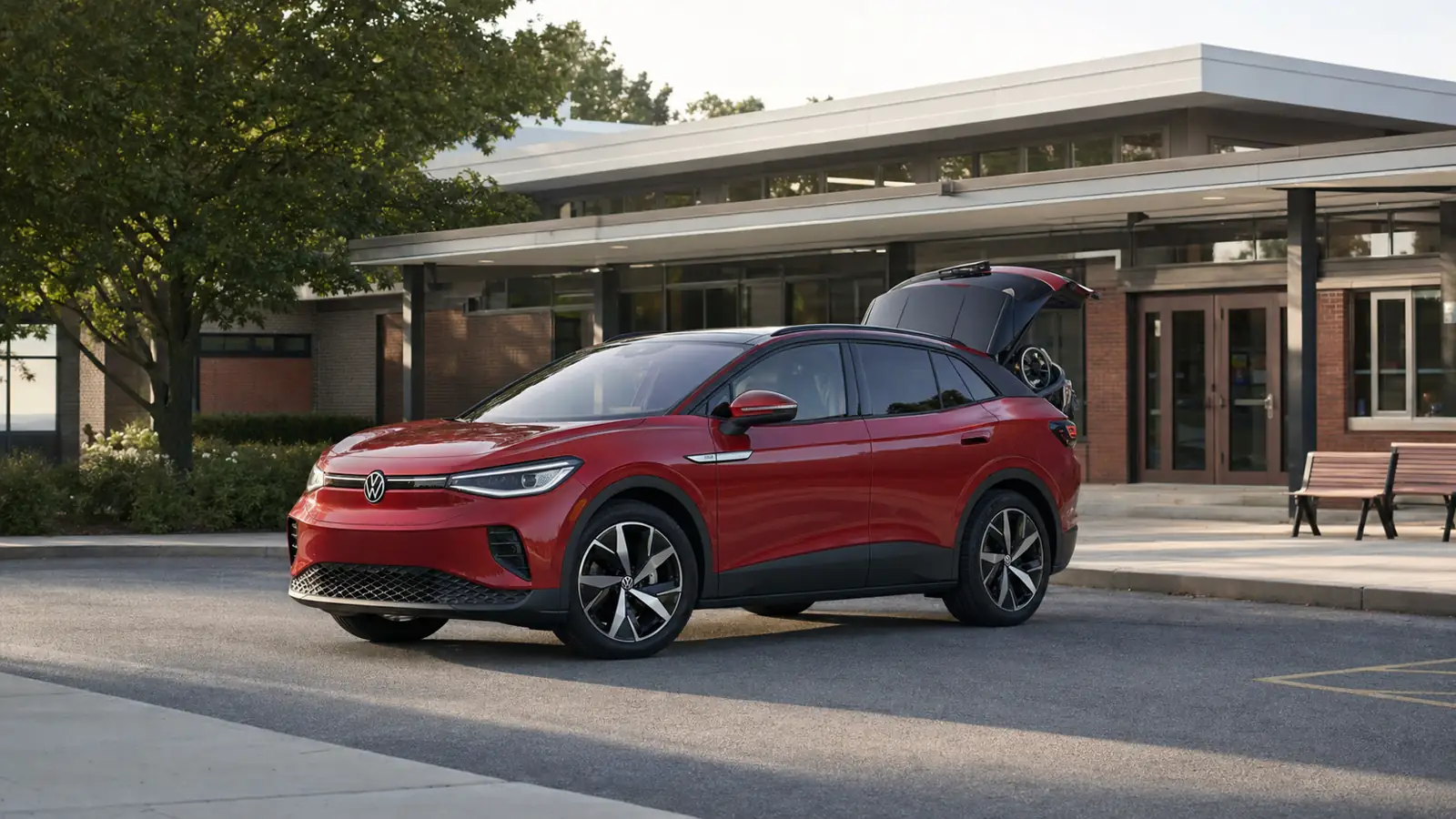
The 82 kWh RWD model is the strongest ID.4 starting point
The 2025 Volkswagen ID.4 lineup includes a lower-cost 62 kWh version and 82 kWh Pro versions.
Volkswagen lists 291 EPA-estimated miles and 282 hp for the 82 kWh rear-drive models.
The 82 kWh AWD versions make 335 hp and carry a 263-mile estimate.
The smaller battery lowers price but also reduces the range and performance case.
The RWD car has enough response for normal merging and preserves the best range. AWD adds front-motor traction and stronger acceleration, but it costs more and uses more energy.
Choose it for repeated steep snow, loose access roads, or wet grades rather than for the larger output number.
Suitable tires remain essential for stopping and cornering.
Wheel size and equipment also change ride, tire cost, and efficiency. Drive the exact trim over broken pavement and price a full tire set.
A lower transaction price on the 62 kWh model may be useful for short local driving, but it should be compared with the 82 kWh car after incentives, charging time, and resale expectations.
The electric vehicle hub contains different range and charging approaches. The 82 kWh RWD ID.4 is the strongest starting point because it combines the strongest range, useful power, and lower complexity than AWD.
The 2024 powertrain update separates newer cars from early ID.4s
Volkswagen revised the 82 kWh models for 2024 with a more powerful rear motor, longer EPA estimates, quicker DC charging, and an updated infotainment system. Early 2021 to 2023 cars can cost less, but their interface, software history, charging behavior, and recall completion deserve more attention.
- 2021U.S. ID.4 launch with early software and control layout
- 2022 to 2023Equipment and production changes continue
- 202482 kWh motor, range, charging, and interface update
- 2025Updated 82 kWh models continue with limited 62 kWh availability
A used listing often describes battery size poorly. Obtain the original window sticker or build information, then confirm the range and equipment for that VIN.
Do not infer the newer motor from a similar wheel or exterior color. A 2024 or 2025 model may justify more money when it removes a charging stop or makes the controls easier to live with.
Software version matters, but a version number is not the whole inspection. Test boot time, phone connection, navigation, climate changes, charging menus, driver display, windows, locks, and every steering-wheel control.
Repeat after the car sits and after a charge session.
The Volkswagen brand hub provides the wider lineup context. Compare an early ID.4 with a Ford Mustang Mach-E from the same price range only after checking warranty and condition.
A 2024 or 2025 82 kWh car is worth prioritizing because the update improves several daily systems at once.
Family comfort is the ID.4's clearest advantage
ID.4 uses an upright body and flat electric platform to give adults useful rear-seat space without the length of a three-row SUV.
The ride favors comfort over sharp response, and the cabin remains quiet at suburban speed. Those traits matter to a family every day, while maximum acceleration may be used only occasionally.
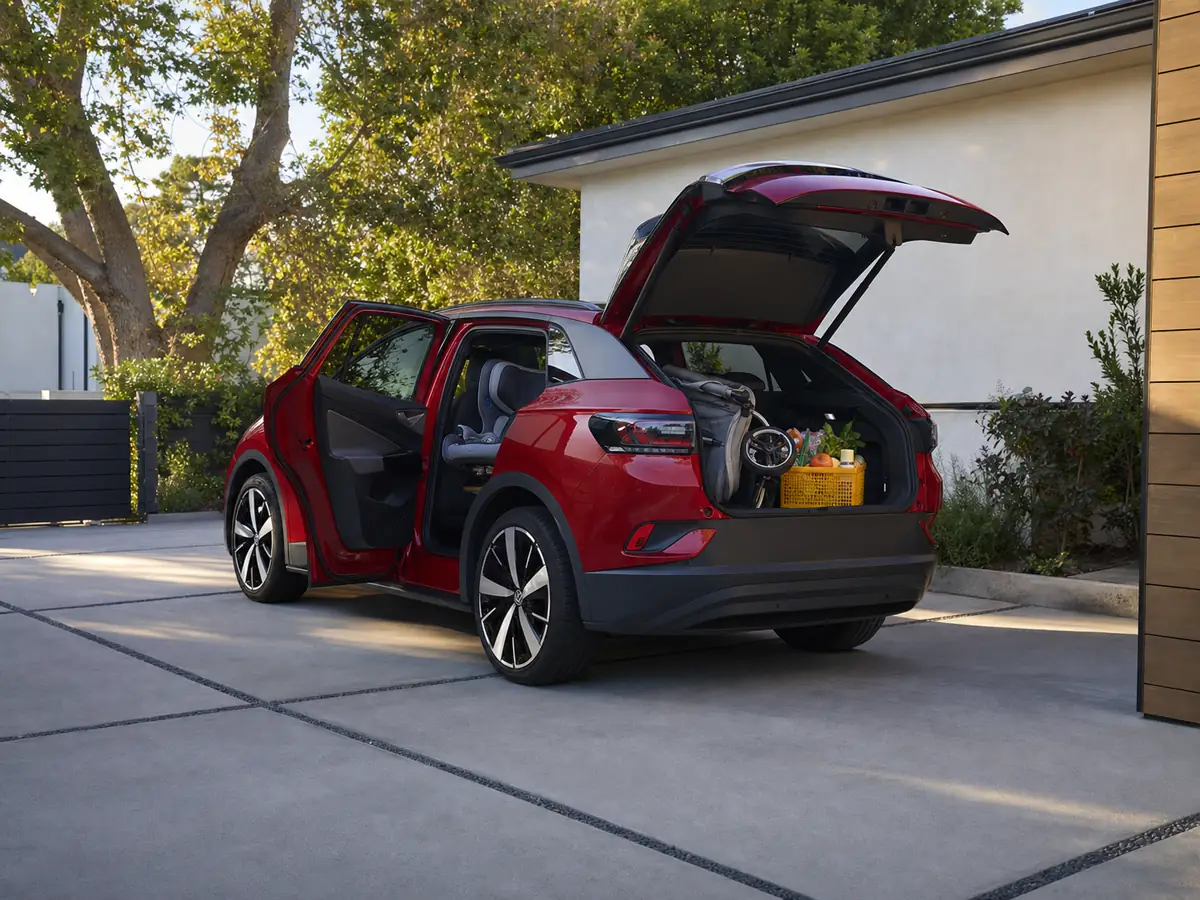
Set the front seats for the regular drivers, then install every child restraint. Check rear-facing clearance, buckle access, door opening, headroom, and the center position.
Ask rear passengers to ride over patched pavement because seat shape and suspension feel can be different from a showroom sit.
Load the largest stroller, mobility device, sports bag, or grocery crate used each week.
The hatch angle and cargo cover set a practical height limit. Store charging cables where they remain accessible under a loaded cargo floor.
Check the powered hatch where fitted and confirm it clears the garage.
- Bring the actual child seats and cargo
- Check front-seat space after rear installation
- Keep luggage below the rear sightline
- Measure hatch clearance in the garage
- Drive the whole family over normal rough roads
A five-seat SUV can prioritize sportier handling or more cargo height.
The Kia EV6 charges faster but sits lower.
ID.4 earns its family-EV case through easy seating, a calm ride, and useful shape rather than a dramatic specification.
Charging is competitive but not class-leading
Volkswagen lists up to 175 kW DC charging for the 2025 82 kWh ID.4 and estimates roughly 30 minutes from 10 to 80 percent on suitable equipment.
That is workable for occasional travel, but an EV6 can complete a comparable ideal-condition percentage window much faster.
The route and charger network decide whether the difference matters.
| Use | Best method | Planning point |
|---|---|---|
| Daily commute | Home Level 2 | Refill the longest normal day |
| Workplace day | Level 2 | Confirm access and parking rules |
| Regional trip | Home plus destination | Verify overnight permission |
| Highway travel | DC fast charging | Arrive low with a backup site |
| Apartment use | Shared or public | Price, uptime, and queue risk |
The 82 kWh car can accept 11 kW AC charging, and Volkswagen estimates about eight hours for a full charge under suitable conditions.
Most owners do not arrive empty, so the daily question is how many hours return the energy used.
Get an electrical quote before buying and include panel work, permits, cable route, and parking location.
Battery temperature, starting percentage, charger limits, station sharing, and weather change DC speed. Use route planning to arrive with a lower state of charge and enough reserve for an alternate site.
Chasing the last 20 percent is often slower than leaving for the next charger.
A Hyundai Ioniq 5 offers faster compatible charging with a different cabin design. ID.4 charging is sufficient when most energy comes from home and road trips are occasional, but frequent fast-charge travel favors an 800-volt rival.
The interface requires a real night and winter test
Early ID.4 criticism often centers on screen response, menu depth, touch-sensitive steering-wheel controls, and climate shortcuts.
Volkswagen revised the 82 kWh interface for 2024, including a larger screen and illuminated climate controls.
Improvement does not guarantee that every driver will like the logic.
Park and complete common tasks without a salesperson. Adjust cabin temperature, fan speed, seat heat, mirror defogging, audio, navigation, driver aids, charging limit, and instrument information.
Repeat in darkness while wearing winter gloves. A control that feels acceptable in a bright showroom may become distracting on a wet night.
ID.4 control test
- Climate
- Temperature, fan, defrost, seat heat
- Navigation
- Route, charger, and battery planning
- Driver display
- Speed, warnings, and trip data
- Steering wheel
- Volume, cruise, and accidental inputs
- Phone
- Pairing, calls, audio, and reconnect
- Charging
- Limit, schedule, and departure setup
Look for restarts, blank screens, delayed touch response, lost settings, or warnings. Check service records for software campaigns and ask which updates are installed.
A reset may hide a recurring problem temporarily, so test after a drive, shutdown, and charge session.
The Tesla Model Y places even more functions on a central screen, while other crossovers retain more physical controls. The updated ID.4 is easier to recommend only after the buyer can operate its daily functions without taking attention from the road.
The door-handle recall needs physical and documentary proof
NHTSA recall 24V651 covers certain 2021 to 2024 ID.4 vehicles because water can enter the door-handle electronics and allow a door to open unexpectedly.
Volkswagen's remedy calls for inspection and replacement of handles when needed plus updated vehicle software, performed at no charge.
The campaign expands earlier handle recalls.
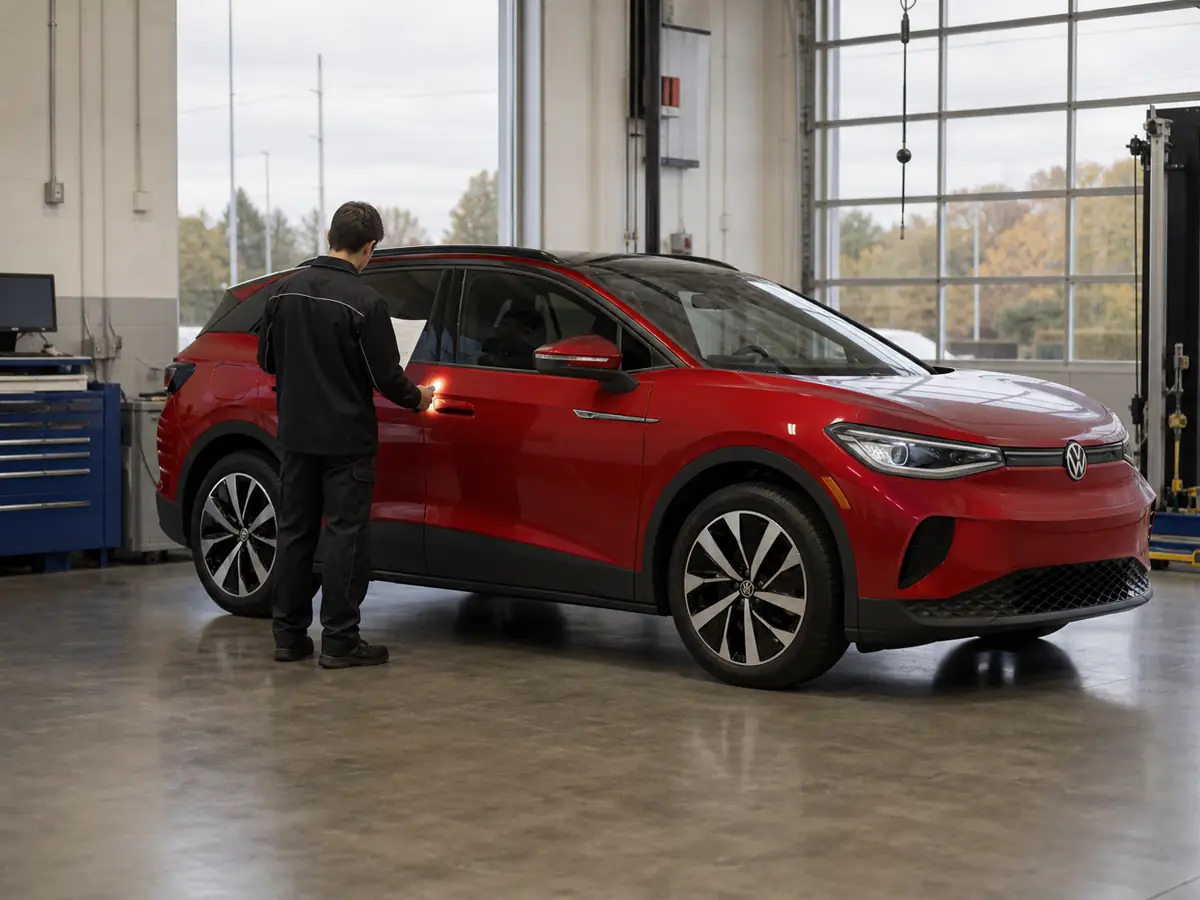
Run the full VIN through NHTSA and Volkswagen, then obtain completed repair records.
Test every exterior and interior handle repeatedly from locked and unlocked states. Check keyless entry, child locks, windows, warning messages, and door-ajar indications.
Ask whether any door opened unexpectedly or showed intermittent touch behavior before the repair.
Recall completion answers the specified defect. It does not prove every handle, latch, seal, wiring connection, or previous body repair is sound.
Inspect door alignment, water entry, paint edges, trim removal marks, and collision records. A recent door replacement needs evidence that electronics and sensors were calibrated correctly.
- Save both VIN lookup results
- Match campaign number and repair date
- Test all handles and locks several times
- Check for water entry and door alignment
- Resolve every door or restraint warning
The research standards explain why a government campaign, dealer repair, and physical test each add different evidence. Do not buy an affected ID.4 until the recall record and all four doors pass the same inspection.
A used ID.4 road test should start with the 12-volt system
The high-voltage battery moves the car, but the 12-volt system wakes computers, locks, and control modules.
A weak low-voltage battery can create warnings or failed startup. Check its date and test result, then scan the vehicle before and after a long drive.
Recently cleared faults deserve an explanation.
Start cold when possible. Check normal warning-lamp operation, steering, low-speed sounds, brake blending, highway tracking, tire noise, heat, air conditioning, cameras, driver aids, windows, locks, charge door, and every key.
Perform safe friction-brake stops because strong regeneration can leave rotors corroded in wet climates.
Inspect tire size, brand, age, load rating, tread, sidewalls, wheel damage, and inner-edge wear.
EV weight and instant torque make alignment and rotation important. A car that pulls, vibrates, or wears one shoulder needs diagnosis before another expensive tire set.
Review the underside for battery-shield impact and incorrect lifting. Collision repair near the floor, charge port, or sensor areas requires an EV-qualified structural inspection.
The new versus used process covers title and seller evidence. A used ID.4 passes only when low-voltage health, software, charging, tires, brakes, doors, and repair history agree.
IIHS ratings are strong in several current tests
The 2025 ID.4 earns Good IIHS results in the small-overlap front and updated side tests. Headlights range from Good to Acceptable by trim, pedestrian crash prevention is Acceptable, and LATCH ease of use is Good.
The 2024 model received a Top Safety Pick designation, but buyers should use the rating page that matches the model year and build.
| Area | Rating | Buyer action |
|---|---|---|
| Small-overlap front | Good | Confirm structure was not repaired poorly |
| Updated side | Good | Inspect side and battery area after collision |
| Headlights | Good or Acceptable | Match trim and drive at night |
| Pedestrian prevention | Acceptable | Test warnings and stay attentive |
| LATCH ease of use | Good | Install the actual child restraint |
Crashworthiness does not describe every driver-assistance situation. Test the fitted warnings and cameras on suitable roads, keep normal following distance, and remain responsible for braking.
Dirty sensors, poor weather, road geometry, and target type can change system response.
A used vehicle needs belt, airbag, seat, head-restraint, glass, body, and calibration evidence after a crash.
Check whether windshield replacement included required camera work. An old award cannot correct a poor structural repair or an open recall.
Compare with the Honda CR-V when easy refueling and conventional controls matter more than electric driving. Use the current test-by-test results and the exact trim's headlights rather than repeating a broad award from another year.
Battery warranty helps but does not replace an ownership budget
Volkswagen states that the high-voltage battery is warranted to retain at least 70 percent net capacity for eight years or 100,000 miles under the stated terms. A used buyer should confirm the original in-service date, mileage, transfer conditions, exclusions, and the process Volkswagen uses to measure capacity.
Create a five-year estimate with transaction price, tax, total loan interest, insurance, registration, home charger, electrical work, electricity, public charging, tires, alignment, scheduled service, repairs, and resale. Use the exact trim because Pro S equipment, AWD, and larger wheels change both purchase and wear cost.
| Cost | Evidence | Common mistake |
|---|---|---|
| Battery coverage | In-service date and terms | Assuming full replacement for any loss |
| Home charging | Written electrical quote | Ignoring panel or cable work |
| Insurance | VIN-specific quote | Using another trim's premium |
| Tires | Exact size and load rating | Forgetting alignment |
| Public charging | Actual route prices | Using home rate for every mile |
| Finance | Rate, term, total paid | Comparing monthly payment only |
Insurance and depreciation can outweigh a small efficiency difference. Quote a complete tire set before choosing large wheels.
Keep a repair reserve after the down payment because warranty coverage has time, mileage, and defect limits.
The mainstream-price hub includes gas, hybrid, and electric alternatives. Use the lease versus buy guide when a subsidized lease competes with a used purchase.
The ID.4 cost case is strongest with home charging, modest wheels, a competitive transaction price, and ownership long enough to use the battery warranty.
Choose ID.4 for comfort and space, then verify the controls
Begin with a 2024 or 2025 82 kWh RWD ID.4. It provides the strongest published range, 282 hp, the revised interface, and lower energy use than AWD.
Add AWD only when the route repeatedly needs driven front wheels. Choose the 62 kWh version only when the lower price clearly outweighs its shorter-range and performance limits.
Drive the weekly route with every regular passenger. Test the screens at night, install child seats, load cargo, use AC charging, and complete a DC session.
For a used car, verify recalls, low-voltage condition, tires, brakes, collision history, and software before discussing monthly payment.
Compare a Kia EV6 fast charger and Hyundai Ioniq 5 family EV on the same route. The Chevrolet Equinox EV is another mainstream family choice with a different control and charging experience.
The EV6 wins on compatible charging speed, while the ID.4 makes its case with an upright cabin and calm ride.
The ID.4 is easy to live with when home charging handles the week and the driver accepts the control layout. Buy it for the space and comfort, but walk away if the interface remains distracting or the VIN evidence is incomplete.