The 18-minute charge is real only under the right conditions
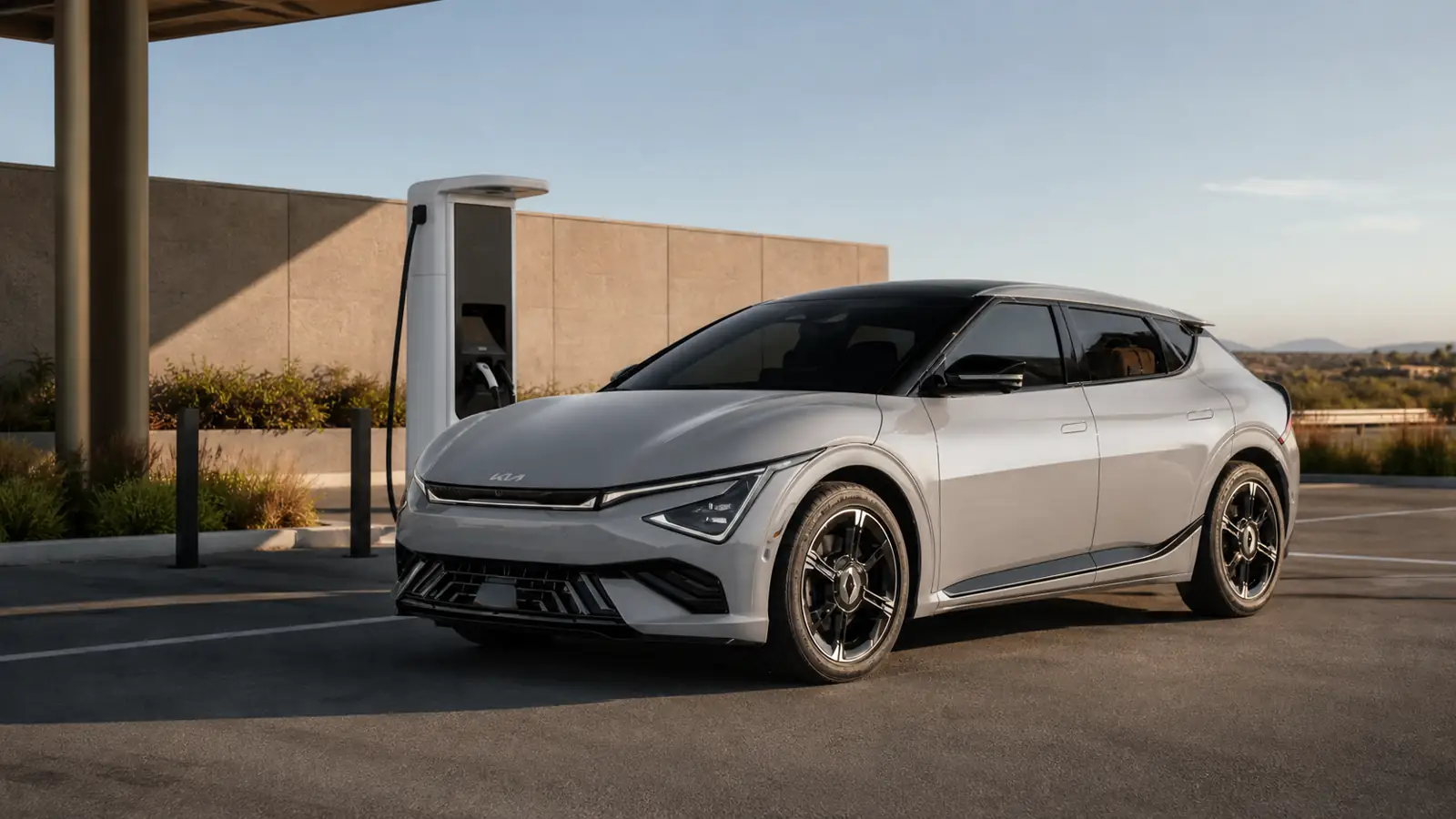
Kia states that the 2025 Kia EV6 can charge from 10 to 80 percent in about 18 minutes on suitable 350 kW equipment under ideal conditions. The 800-volt architecture enables that result, but the charger, battery temperature, starting percentage, station sharing, weather, and charging curve decide the session a driver actually receives.
Arriving too full wastes the strongest part of the curve. Arriving with a cold battery can delay the peak unless route planning and battery conditioning prepare it.
A charger labeled 350 kW may also deliver less because of site limits or a fault.
Plan the next stop with reserve instead of waiting for one exact number.
| Condition | What helps | What slows the stop |
|---|---|---|
| Starting charge | Arrive near 10% with reserve | Arrive already half full |
| Battery temperature | Navigate to charger for conditioning | Cold unprepared battery |
| Charger | Working 350 kW-class site | Shared or limited dispenser |
| Trip plan | Leave near 80% when practical | Chase the last 20% |
| Weather | Mild temperature | Deep cold or high heat |
Complete a live session before buying used. Watch the connector latch, session start, power ramp, battery cooling, messages, and clean disconnect.
A screenshot from another day does not prove the port and present software work correctly.
The electric vehicle hub includes cars with different voltage systems. Fast charging is the EV6's biggest advantage for drivers who repeatedly use compatible highway sites, while home-only commuters gain less from it.
The 2025 refresh changes the battery and connector decision
The refreshed 2025 EV6 increases the long-range battery to 84 kWh and reaches up to 319 EPA-estimated miles in rear-wheel-drive form.
Kia also moved most U.S. trims to a NACS charge port, while the 2025 GT remains an exception.
Older 2022 to 2024 cars use CCS, so the adapter and network plan must match the exact vehicle.
2025 EV6 update
- Battery
- 84 kWh on long-range versions
- Maximum EPA estimate
- 319 miles for long-range RWD
- Port
- NACS on most trims, verify GT and build
- Cabin
- Revised screens, wheel, and controls
- Body
- Updated front and rear styling
- Assembly
- U.S. production for most trims
A connector does not guarantee network access or maximum power. Verify compatible stations, adapter status, account rules, and current vehicle software before a road trip.
Keep the native port and any approved adapter clean, dry, protected, and within Kia's instructions.
A discounted 2024 car can still be attractive when its CCS routes work and recall remedy is complete. The 2025 version earns its premium through the larger battery, refreshed cabin, and charging convenience only when those changes improve the owner's normal travel.
The Hyundai Ioniq 5 shares the broad fast-charging idea with a taller cabin shape.
The Kia brand hub helps compare EV6 with Kia's larger electric choices.
Choose between 2024 and 2025 by battery, port, cabin, and out-the-door price rather than model year alone.
Long-range RWD is the efficient EV6 baseline
Kia rates the 2025 long-range rear-drive EV6 at 225 hp and up to 319 miles. All-wheel drive adds a front motor, stronger acceleration, and traction under power, while larger wheels and higher output reduce the published range.
The GT moves performance much further and requires a larger budget for energy, tires, insurance, and restraint.
RWD is enough for maintained roads with suitable tires. AWD helps drivers who repeatedly start on steep snow, loose surfaces, or wet grades, but it cannot improve braking grip beyond what the tires provide.
Compare winter tire cost before spending on a second motor out of general fear.
Drive the trims on the same route. Check low-speed response, highway merging, steering, tire noise, ride over sharp edges, and the transition from regenerative to friction braking.
GT speed belongs on suitable roads and controlled venues. Its extra output can turn a small pedal error into a large one.
A rear-wheel-drive vehicle often protects EV range, while the AWD vehicle group covers genuine traction use. Long-range RWD is the strongest EV6 starting point because it preserves the fast-charging advantage while controlling price, range loss, and tire demand.
The EV6 cabin is wide and low rather than SUV-upright
EV6 provides a long wheelbase and useful rear legroom, but its roof and seating position feel closer to a low crossover than a tall family SUV.
The floor lifts rear passengers' knees, and the sloping roof can affect headroom. Drivers moving from a sedan may like the position, while buyers expecting an upright SUV should sit in back before ordering.
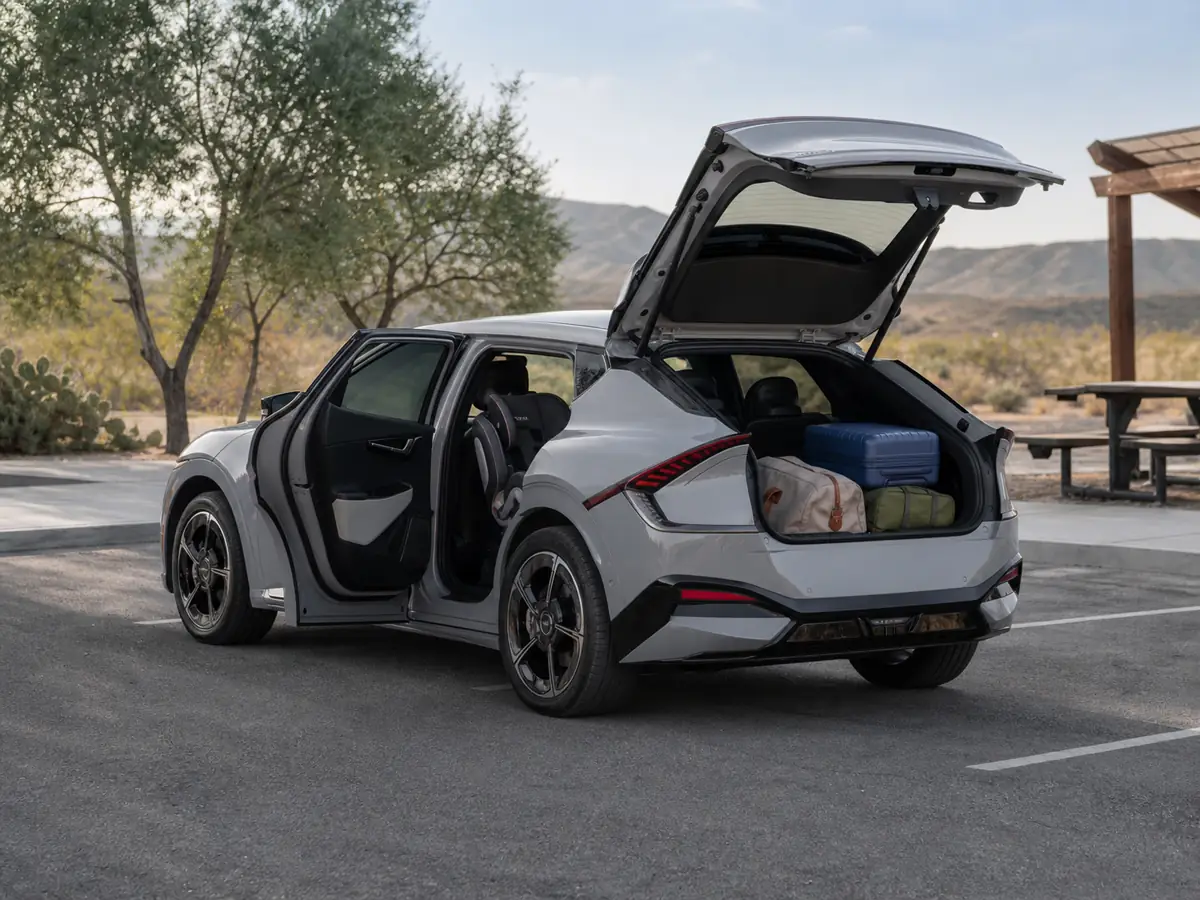
Set the front seat for the tallest regular driver. Install child restraints, test buckle access, and place adults in the outboard seats.
Check the rear door opening and whether a rear-facing seat leaves enough front space.
The center rear position needs its own comfort and restraint test.
Load the largest weekly cargo. A low roof can limit tall boxes, and a sloping hatch changes the usable shape.
Check the underfloor area, charging-cable storage, hatch height, parcel cover, and whether luggage remains below the rear sightline.
The front compartment is small and should not be treated like the large storage area in an electric pickup.
The five-seat vehicle hub includes taller and lower alternatives. A Volkswagen ID.4 gives a more upright family layout, while EV6 feels more responsive and charges faster.
EV6 suits families who value rear legroom and road manners more than maximum cargo height or a commanding seat.
Vehicle-to-load power is useful when the load is planned
EV6 can supply external AC power through its vehicle-to-load system when equipped and used with the correct adapter.
That can run selected campsite equipment, small tools, or emergency household devices. It does not turn the car into an unlimited home generator, and every connected load reduces driving energy.
Add the rated wattage of the equipment and leave margin below the system limit.
Inspect extension cords for outdoor rating, current capacity, and damage. Keep connections dry and ventilated, and never improvise a backfeed into household wiring.
A transfer setup for a building requires qualified electrical work and equipment approved for that purpose.
- List each appliance and its running wattage
- Account for startup demand on motors or compressors
- Set a battery discharge limit that preserves the return trip
- Keep cables away from water, traffic, and heat
- Follow the manual for adapter connection and shutdown
The same planning discipline applies at home. A daily charger should be installed around the parking location, circuit, utility rate, and overnight refill need.
The Ford Mustang Mach-E offers another road-focused EV choice, but equipment and export-power functions differ.
Vehicle-to-load is valuable when it replaces a specific generator or outlet need without consuming the trip reserve.
The ICCU recall is the first used-EV6 check
NHTSA recall 24V867 covers certain 2022 to 2024 EV6 vehicles and supersedes an earlier campaign. The Integrated Charging Control Unit can become damaged and stop charging the 12-volt battery.
Drivers may hear a warning and see messages before progressive loss of drive power. Kia's remedy includes an ICCU inspection, replacement of the unit and fuse when needed, and updated software at no charge.
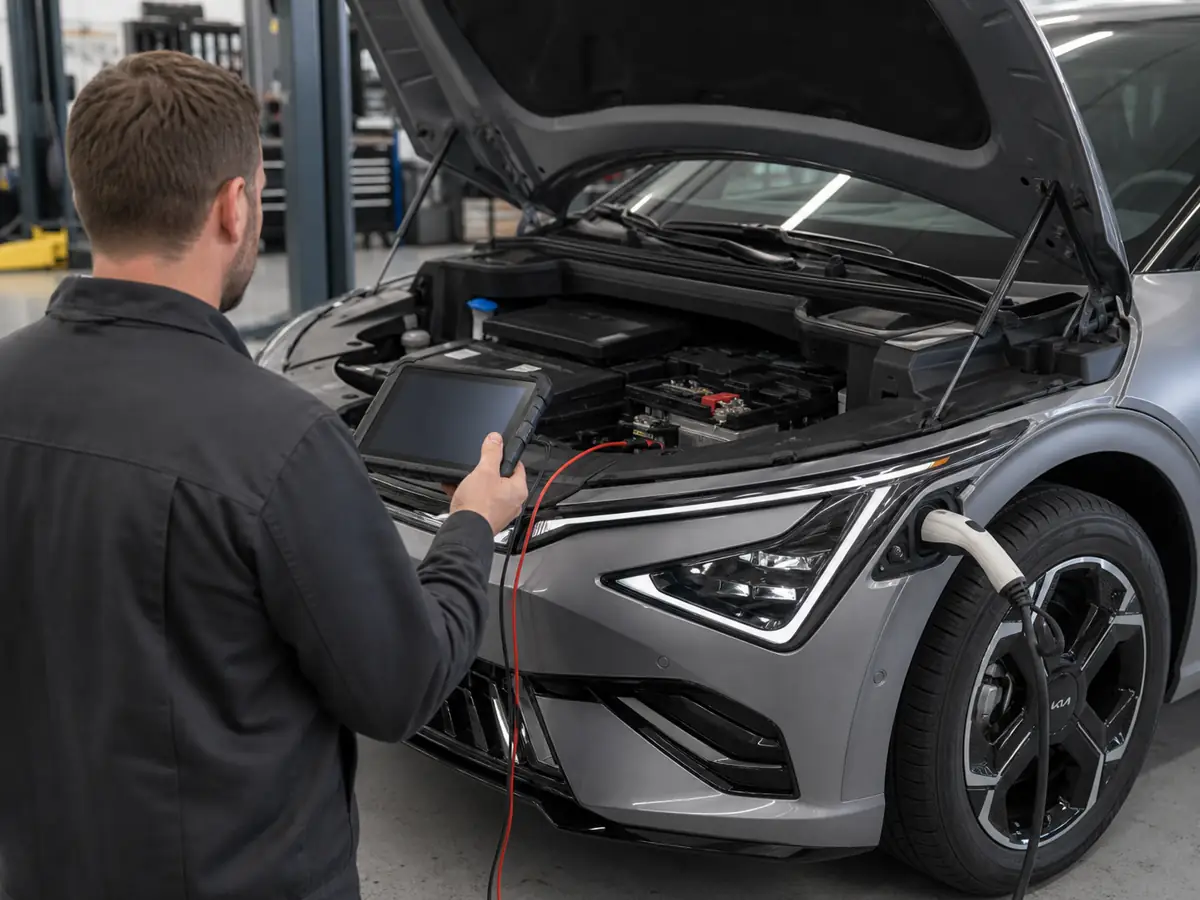
Run the VIN through NHTSA and Kia, then obtain the completed repair order. A sticker, cleared warning, or seller assurance does not show which inspection, software, fuse, or unit was involved.
Ask whether the car had a 12-volt failure before or after the campaign and review any towing or no-start invoices.
Test the 12-volt battery itself because recall completion does not restore an aged or damaged battery automatically. Scan all modules, check charging history, and repeat the scan after a long road test and charge session.
Any active ICCU, high-voltage, isolation, or low-voltage fault needs diagnosis by a qualified technician.
- Save the VIN lookup and repair order
- Check the 12-volt battery date and test result
- Complete AC and DC charge sessions
- Scan before and after the road test
- Resolve every propulsion or charging warning
A used EV6 should not be purchased until the VIN remedy and the current charging system both pass independent checks.
The road test should expose tire, brake, and software condition
Begin cold when possible and check that warning lights complete their normal startup cycle. Move through parking-lot speeds, hold a steady suburban pace, merge onto a highway, and repeat low-speed maneuvers after the car is warm.
Test each regenerative setting and make normal friction-brake stops on a safe road.
Strong regeneration can reduce brake use, leaving rotor corrosion or sticky components in wet climates.
Inspect all rotor faces and test the parking brake. Check tire age, specification, tread depth, sidewall damage, wheel rash, and inner-edge wear.
Uneven wear can indicate alignment or suspension problems and is costly on larger sizes.
Use every screen, camera, sensor, key, phone connection, seat control, window, lock, charge-door function, heat setting, and air-conditioning mode.
Confirm battery preconditioning behavior through the navigation process described by Kia. A missing menu may reflect trim, software, or conditions rather than one simple fault.
EV6 used-road-test route
- Cold start
- Warning check and low-speed noise
- Broken pavement
- Ride, rattles, and wheel condition
- Highway
- Wind noise, tracking, and driver aids
- Parking
- Cameras, sensors, and visibility
- Charging
- AC plus DC session when practical
- Warm finish
- Rescan and fluid or coolant inspection
The new versus used car guide covers records and title evidence. A clean road test joins mechanical condition, software function, and charging behavior instead of testing acceleration alone.
IIHS results improved in some areas but remain mixed
IIHS gives the 2025 EV6 Good results in the small-overlap front and updated side tests.
Its updated moderate-overlap result is Marginal. The tested headlights and vehicle-to-vehicle front crash prevention are Acceptable, while pedestrian crash prevention is Good.
Kia made structural changes beginning with 2025 models, so earlier results should not be transferred without checking the test applicability.
Treat each result as separate evidence. The Marginal updated moderate-overlap rating deserves attention for rear-passenger protection, while the Good pedestrian result addresses a different crash-avoidance task.
A used car also needs structural and calibration inspection after any body or windshield repair.
| Area | Rating | Buyer action |
|---|---|---|
| Small-overlap front | Good | Confirm repair history |
| Updated moderate overlap | Marginal | Read rear-passenger details |
| Updated side | Good | Inspect side structure after collision |
| Vehicle AEB | Acceptable | Test normal warnings and stay attentive |
| Pedestrian prevention | Good | Keep sensors and windshield clear |
Install the actual child restraints and inspect belt webbing, buckles, head restraints, and LATCH access.
Test headlights on a dark road and confirm every camera and warning starts normally.
Driver assistance does not remove the need for following distance or attention.
The safety source policy explains how IIHS ratings and NHTSA campaigns answer different questions. Describe the 2025 EV6 with its individual ratings rather than turning mixed evidence into one broad safety claim.
Insurance and tires can outweigh charging savings
Create a five-year estimate with purchase price, tax, total finance interest, insurance, registration, home charger, electrical work, electricity, tires, alignment, scheduled service, repairs, and resale. Use the exact trim and VIN because a GT, AWD GT-Line, and long-range RWD car create very different numbers.
| Cost | Main driver | Before-buying check |
|---|---|---|
| Electricity | Home rate and public trips | Calculate route energy plus losses |
| Insurance | Trim, driver, and repair market | Quote the VIN |
| Tires | Wheel size and output | Price a complete set |
| Charging setup | Panel and cable route | Get a written electrical quote |
| Depreciation | Transaction price and term | Compare total paid, not payment |
| Repairs | Warranty and condition | Keep cash after purchase |
Kia's new-vehicle coverage includes a five-year or 60,000-mile basic warranty and ten-year or 100,000-mile powertrain coverage under stated terms.
Used buyers must confirm the in-service date, transfer rules, high-voltage battery terms, exclusions, and remaining mileage in writing.
Do not assume every warranty line transfers unchanged.
GT acceleration can increase tire and insurance cost even when driven gently.
Large wheels may reduce range and make pothole damage more expensive. Long-range RWD with modest wheels usually produces the cleanest cost case.
Use the premium-price vehicle hub to compare total costs rather than badges. The lease versus buy framework helps when incentives make a new lease compete with a used purchase.
Protect the EV6 savings by choosing the smallest wheel and least output that still solve the weekly use.
Choose EV6 around road-trip frequency and seating position
Long-range RWD is the broad recommendation because it combines the longest published range, strong charging, and sufficient power.
AWD earns its premium where traction or stronger passing response is used repeatedly. GT belongs to drivers who accept shorter range, higher tire demand, and greater insurance cost for its performance.
A 2024 car may be the value choice when CCS charging works on the intended routes and the ICCU remedy is documented.
A 2025 car has the stronger case when the larger battery, refreshed controls, NACS port, or extra range prevents a real inconvenience.
Compare both at the same out-the-door basis.
Test an ID.4 family EV and Tesla Model Y on the same seating and charging route. A Tesla Model 3 is the lower sedan comparison when cargo height and SUV styling are unnecessary.
EV6 wins when fast charging and a low, responsive feel matter. It loses when the buyer wants the tallest cabin or simplest service network in a particular area.
Buy the EV6 when its charging advantage shortens trips you actually take and its low cabin still fits every regular passenger.