Count the trips, not the seats
A seven-seat badge can solve one local carpool and still be the wrong answer for the household.
Review the last twelve months of travel. Count trips with more than five people, note each passenger's size, record the luggage carried, and mark whether a second vehicle was already available.
That history gives the third row a real frequency.
Next, price each solution. Compare daily Sorento ownership with renting a larger vehicle, taking two cars, or buying Telluride.
Include fuel, parking, insurance, tires, roof equipment, and the time spent moving child restraints.
A rare group trip may not justify a larger body every day.
A weekly group trip usually does.
Use the hardest recurring trip as the pass or fail point. Everyone should enter, buckle, sit for the full route, carry the required gear, and exit without removing a restraint.
Repeat in hot or cold weather when climate demand changes comfort. Record the result before a salesperson explains why the cabin should be enough.
The Sorento earns its third row when the household can name the trips it serves and complete them without borrowing cargo space from a passenger.
The smaller body has a job
Sorento's shorter footprint should reduce a repeated daily burden. Measure the home garage, parking space, school pickup lane, work ramp, and narrow street.
Open every door and the hatch within those spaces. Check the turning circle by making the same legal U-turn and parking maneuver in Sorento, Telluride, and one two-row SUV.
| Daily task | Sorento advantage | Warning that more space is needed |
|---|---|---|
| Garage parking | More clearance around doors and hatch | Roof box no longer clears |
| School pickup | Easier lane and curb maneuvering | Child seat blocks row-three access |
| Fuel and tires | Smaller body can reduce use and cost | Specialty trim erases savings |
| Family travel | Flexible extra seats | Bags require blocked vision or trailer |
| Long ownership | Lower starting total | Early trade for space destroys value |
Track row-three use for three months. Record who sat there, trip length, what cargo was left behind, and whether a child restraint had to move.
A weekly record is stronger than a promise that the family might need seven seats someday. If the third row stays folded, compare the Honda CR-V or Subaru Forester and put the purchase difference into maintenance and savings.
Price every workaround. A roof box needs bars, storage, loading effort, garage clearance, and extra fuel.
A hitch carrier uses tongue capacity and can interfere with cameras. A rental for two annual trips may be cheaper than owning more vehicle.
An early trade can lose tax, fees, interest, and depreciation.
Run a difficult-day test. Load school bags, groceries, a stroller, and every passenger, then park at home.
If the Sorento completes that day without moving a restraint or blocking the rear view, the smaller body is doing its job.
If it fails, drive the Toyota Sienna before assuming another SUV is the only answer. Sliding doors and a low floor can remove more work than extra ground clearance.
Get insurance and tire quotes for both sizes. A base Telluride may cost close to a loaded Sorento, while its larger tires and fuel use can remain higher.
Compare complete five-year totals with the same loan term.
Sorento replaces a larger SUV only when its smaller size saves effort more often than the cabin creates a workaround.
Row three sets the limit
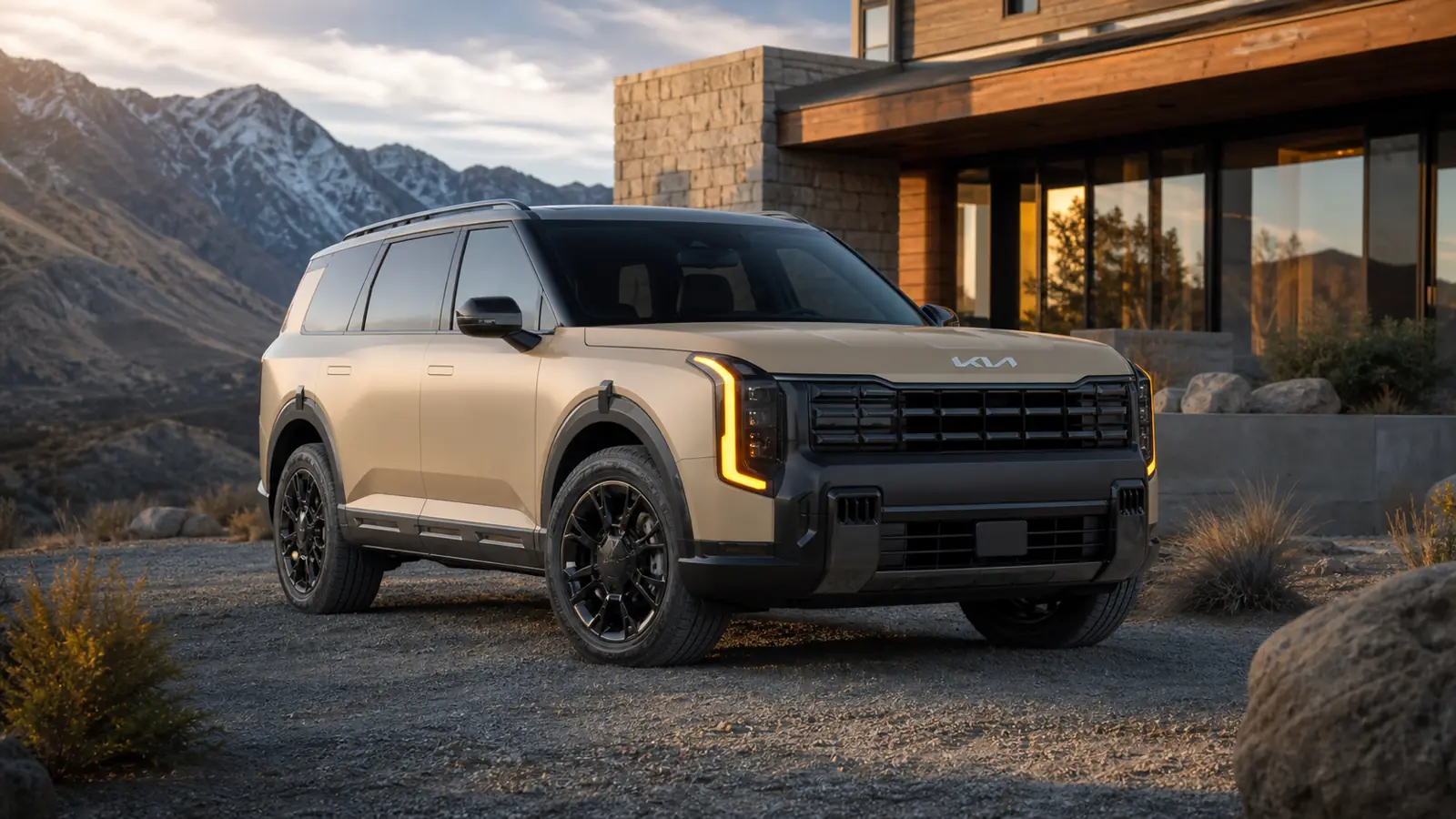
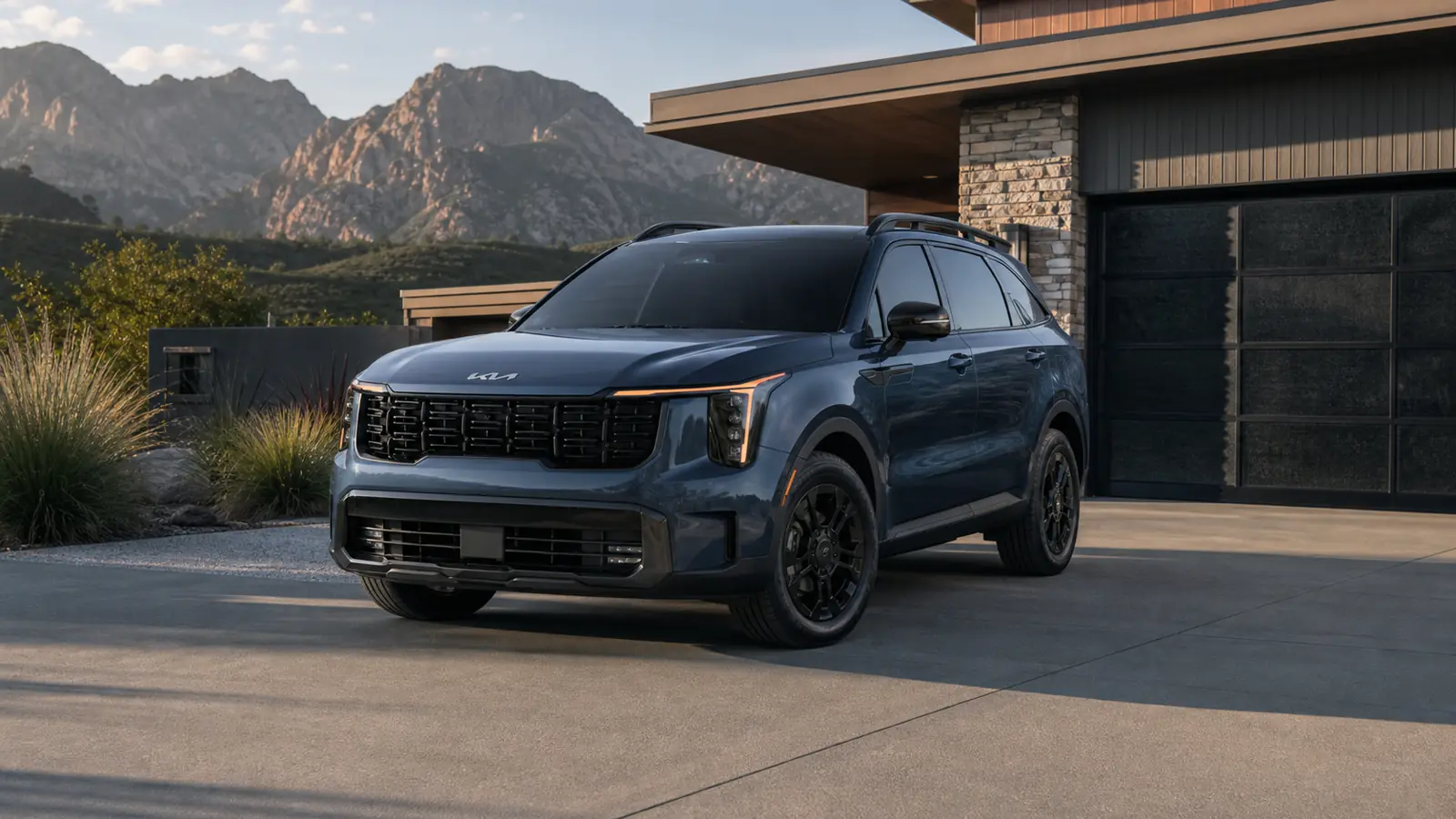
The 2026 Kia Sorento is smaller than the Telluride but still offers three rows. That middle position works when the last row is used occasionally by children or smaller adults.
It stops working when tall passengers sit there every week or when all occupied seats must travel with substantial luggage.
Decide how often row three will be occupied before choosing engine, trim, or color.
Bring every regular passenger. Set the front seats, install child restraints, then move the second row only as far forward as its occupants can accept.
Enter row three and check the step, aisle, foot space, knee angle, head clearance, vents, charging, belt fit, and view out.
Stay seated for fifteen minutes.
A six-seat configuration with captain chairs creates an aisle. A seven-seat bench adds capacity but can complicate access when restraints remain installed.
Test both with the actual seats and boosters. A showroom demonstration that removes a child seat does not represent the school run.
| Use | Likely fit | Required proof |
|---|---|---|
| Five daily passengers | Strong | Child seats and cargo fit |
| One or two occasional guests | Good use of row three | Access and short-trip comfort |
| Weekly adult carpool | Marginal | Every adult completes a route test |
| Seven-person vacation | Difficult | All passengers and bags fit together |
Compare the Kia Telluride and Hyundai Santa Fe on the same day.
Telluride gives the third row more breathing room. Santa Fe offers another compact three-row layout.
The Honda Pilot provides a larger family benchmark.
The smaller Sorento has advantages. It is easier to park, can use less fuel, and may cost less.
Those savings disappear if the household adds a roof box, leaves a passenger behind, or trades early for more space.
Write down row-three use over the last six months rather than buying for an imagined future.
The honest answer may be that the third row is emergency capacity.
That is still useful. It lets the family bring two friends locally without driving a larger vehicle every day.
The vehicle is a poor substitute only when emergency seating becomes the normal plan.
Cargo disappears with seats raised
Sorento maximum cargo figures describe the cabin with seats folded.
A three-row buyer needs the opposite test. Raise every required seat, load the people, and see what remains for a stroller, sports bag, groceries, airport luggage, or mobility equipment.
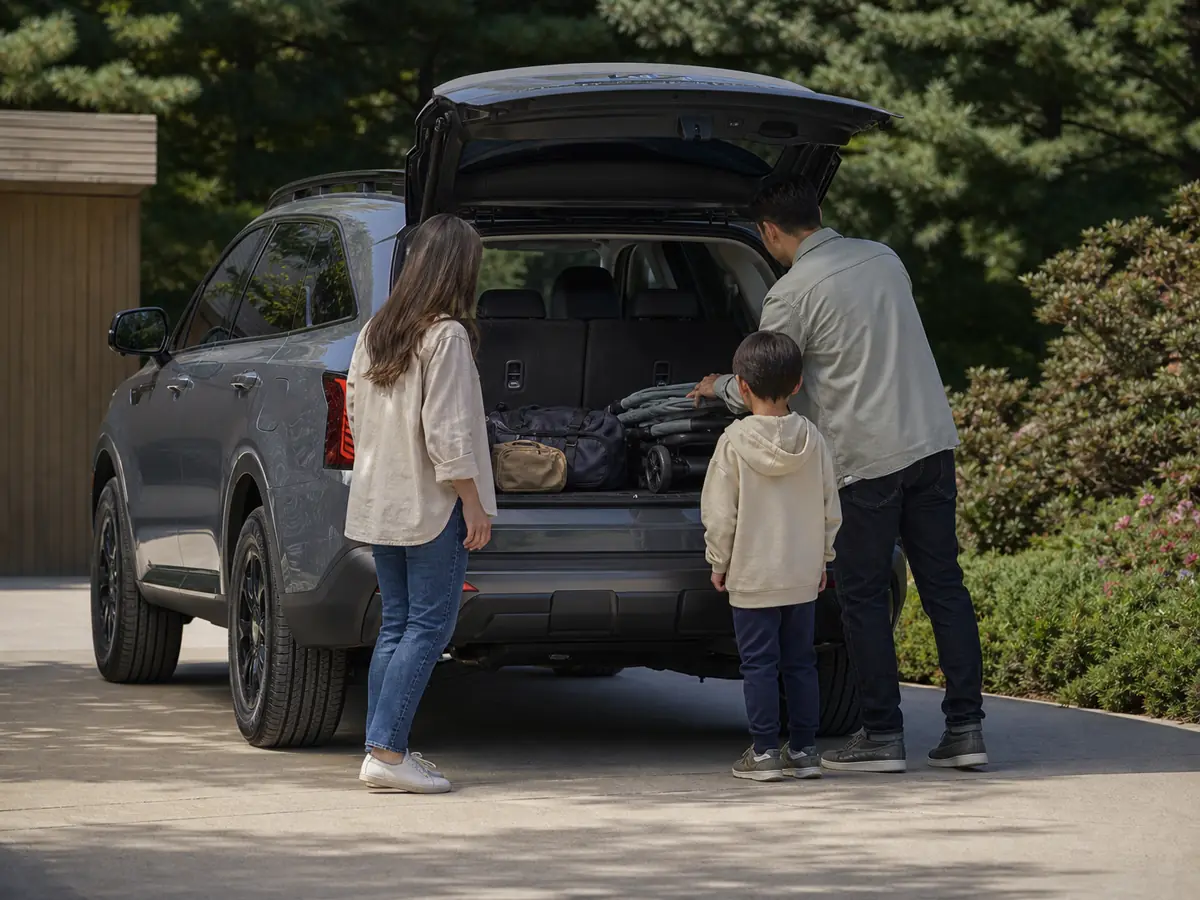
Bring the largest object that travels every week. Load it without pushing the rear glass or blocking the driver's view.
Add one bag for each passenger and close the hatch gently. Check whether the cargo cover can stay, whether emergency gear remains accessible, and whether loose items can be tied down.
The split-fold third row can solve a five or six-person trip by carrying a passenger on one side and long cargo on the other.
It cannot solve a seven-person trip. A roof box adds space but increases total height, wind noise, fuel use, loading effort, and storage needs.
A hitch carrier uses tongue capacity and can affect cameras or liftgate access.
- Raise every needed seat before loading
- Add the stroller or largest routine object first
- Keep rear visibility clear
- Secure cargo below passenger head level
- Check hatch clearance in the home garage
- Repeat with one third-row section folded
Test small-item storage and charging in all rows. Cups, phones, tablets, wipes, headphones, and cables need places that do not block an aisle.
Try the climate vents with a full cabin and check whether rear passengers can control or request airflow without distracting the driver.
Compare the load with the Toyota Highlander and a minivan. Larger does not automatically mean better, but it should remove a clear problem.
If the Sorento carries everything for ninety percent of days and a rental handles one annual group trip, the smaller body may still be the cheaper answer.
Sorento fits the household only when passengers and their objects travel together. Maximum cargo with empty seats is not a family capacity test.
The hybrid is the family default
The 227 hp Sorento Hybrid is the best daily starting point because it combines useful low-speed response with substantially better fuel economy than the gas versions.
Kia rates the EX FWD at 37 mpg city, 36 highway, and 37 combined.
AWD versions are rated at 32 city, 35 highway, and 34 combined.
| Powertrain | Output | Main benefit | Main compromise |
|---|---|---|---|
| Base gas | 191 hp | Lowest entry price | Modest loaded response |
| Turbo gas | 281 hp | Passing and towing power | DCT behavior and fuel cost |
| Hybrid | 227 hp | 37 mpg combined FWD | Purchase premium |
| Plug-in hybrid | 261 hp | 31 electric miles | $48,290 start and charging need |
Drive the hybrid with a full family load. Test electric launch, engine start, steady traffic, a highway merge, a grade, and regenerative braking.
The transition should be predictable. Brake pedal feel may differ from a gas vehicle, but it should not produce warnings, pulling, grinding, or inconsistent stopping.

At 15,000 miles, 37 mpg uses about 405 gallons.
A 24 mpg gas alternative uses about 625. Multiply the 220-gallon difference by a conservative local fuel price, then compare annual savings with the hybrid's actual out-the-door premium, finance interest, insurance, and ownership period.
Use exact ratings for the trim.
Highway-heavy use may reduce the advantage. Short cold trips, fast travel, roof cargo, AWD, tires, climate use, and elevation also change results.
Run a poor-year calculation. The hybrid is still valuable when its stronger low-speed response matters, but fuel savings should not be exaggerated.
Compare hybrid SUVs and the Honda CR-V Hybrid if five seats are enough. Eliminating an unused third row can save purchase price and fuel.
Compare the Hyundai Tucson for another roomy two-row choice.
Hybrid EX is the Sorento to beat for normal family travel. It should win through a measured route, real price, and enough ownership years to use the fuel savings.
Turbo power serves a trailer
The 281 hp turbo gas engine makes 311 lb-ft and gives the Sorento stronger loaded acceleration.
Selected configurations can tow up to 4,500 pounds when properly equipped.
That is the powertrain's clearest purpose. A buyer who does not tow or regularly climb loaded grades may be paying for performance and a dual-clutch transmission that ordinary use does not require.
The wet eight-speed dual-clutch transmission should be tested in the conditions that challenge it. Start cold, select drive and reverse, creep in a parking lot, climb a ramp, sit in stop-and-go traffic, merge, and request a downshift.
Some direct feel is normal. Repeated shudder, harsh engagement, hesitation, overheating messages, or inconsistent response need diagnosis.
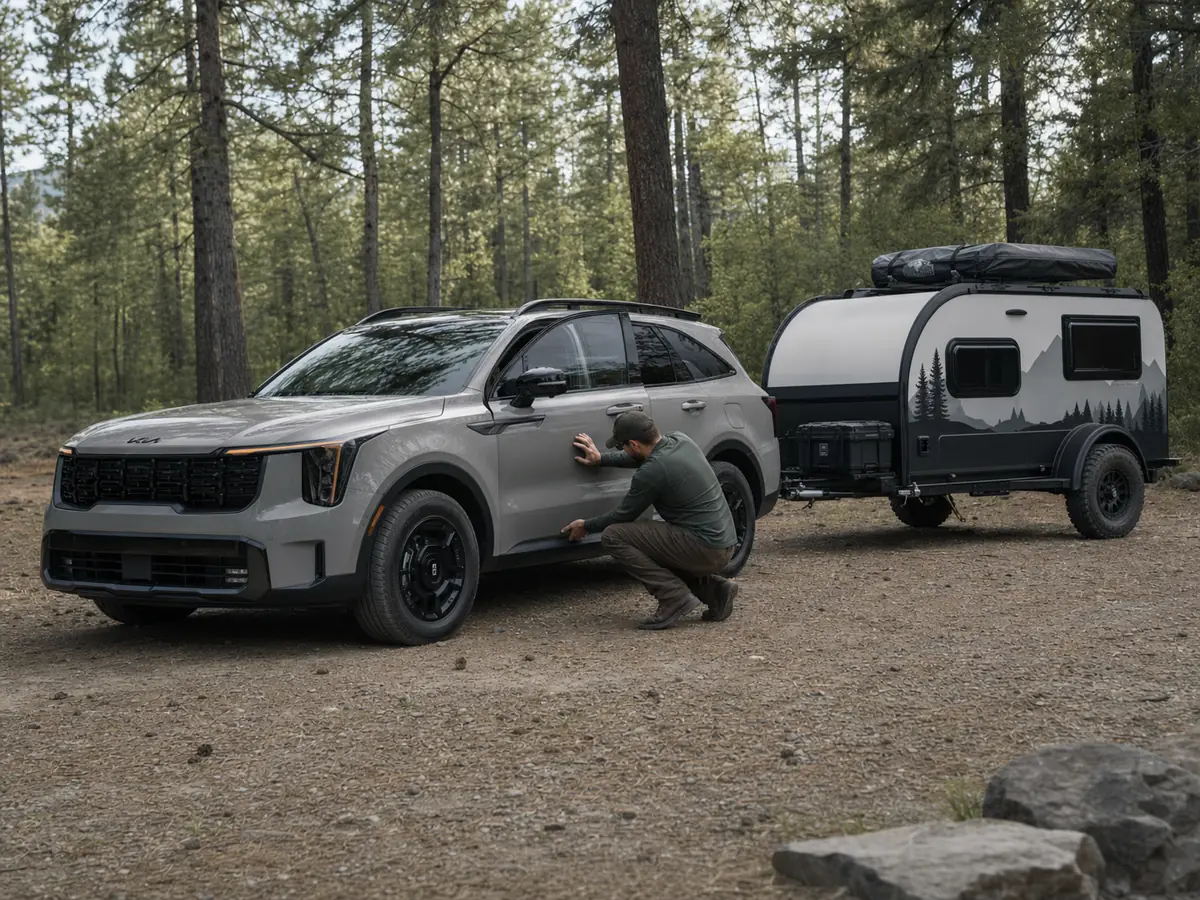
Start trailer math with loaded weight. Add water, fuel, batteries, food, equipment, and personal gear.
Measure tongue weight. Read the payload label on the driver's door and subtract every passenger, cargo item, accessory, and pound on the hitch.
A full cabin can reduce the practical trailer size well below the published maximum.
| Input | Evidence | Reject sign |
|---|---|---|
| Vehicle rating | Manual and exact equipment | Seller quotes a generic maximum |
| Payload | Driver-door label | People plus tongue load exceed it |
| Trailer weight | Certified scale when loaded | Only empty weight is known |
| Hitch and wiring | Rated installed hardware | Improvised wiring or unknown receiver |
| Transmission | Loaded legal road test | Shudder, warning, heat, harsh engagement |
Confirm cooling, wiring, brake controller, tire load index, spare access, and hitch requirements in writing. AWD helps launch on a slippery surface but does not increase braking or payload by itself.
Leave reserve for heat, grades, wind, and family gear.
Compare a Ford Explorer when towing approaches the Sorento ceiling. A larger vehicle may provide more payload and stability.
If the trailer is light and rare, renting a tow vehicle can cost less than buying turbo equipment and fuel every day.
Choose turbo and X-Pro hardware for a measured trailer or repeated loaded-grade need. The hybrid remains the better family engine when towing is only an idea.
The PHEV is a narrow fit
The Sorento Plug-in Hybrid starts at $48,290, makes 261 hp, includes AWD, and carries an EPA-estimated 31 miles of electric range. It can cover many local days with less gasoline, but its price and charging requirement make it a narrow choice.
Begin at the parking space. Confirm a reliable outlet, legal installation, safe cable path, weather protection, and control of the spot.
Renters need written permission. Apartment residents should verify charger availability, price, idle rules, and what happens when every connector is occupied.
Public charging alone rarely creates a dependable nightly routine.
Track a normal week, including school, errands, a second driver, cold weather, and missed charging.
The displayed range changes with temperature, speed, climate use, elevation, and history. Once the engine runs, fuel use depends on route and charge state.
Compare a depleted-battery trip with the regular hybrid.
Inspect a used PHEV through a full charge cycle. Check the port, pins, door, cable, scheduled charging, preconditioning, warning history, battery cooling, and operation after electric range reaches zero.
Request a full-module scan and verify high-voltage coverage by VIN.
A seller's range estimate is not a battery-health certificate.
The plug-in hybrid index shows alternatives with different electric ranges and seating. If five seats are enough, a smaller PHEV may use less energy and cost less.
If seven people travel often, confirm cargo before accepting the Sorento's high purchase price.
The PHEV works when charging is automatic, electric miles cover most weekdays, and the family keeps it long enough to use the premium. Otherwise, choose the regular hybrid.
EX controls the trim budget
The base Sorento starts at $32,390, but a low sticker does not guarantee the right family equipment.
EX is the useful baseline in the hybrid range and a sensible comparison point across drivetrains. The goal is to buy the least expensive trim that solves seat layout, climate, access, parking, and towing needs.
Build three lists. The first contains equipment used weekly, such as the correct second row, power liftgate, heated seats in a cold climate, parking cameras in a tight garage, or a tow package for a real trailer.
The second contains occasional conveniences. The third contains appearance items.
Pay from the first list before touching the third.
| Need | Useful equipment | Cost trap |
|---|---|---|
| Third-row access | Correct bench or captain chairs | Upgrading only for seat trim |
| Parking | Sensors or surround view when space is tight | Larger wheels that worsen clearance |
| Weather | Heated surfaces and AWD when justified | Appearance package without tire plan |
| Towing | Factory-rated equipment | Receiver added without capacity proof |
| Comfort | Features used every commute | Panoramic roof chosen by default |
Large wheels reduce tire sidewall and can increase replacement cost. X-Line or X-Pro tires may add useful traction or clearance, but compare noise, wet braking, fuel use, and price.
A high trim can approach Telluride money without increasing the Sorento's third-row space.
Get exact insurance quotes and tire prices. Ask about panoramic glass, windshield camera calibration, replacement wheels, and original-equipment parts.
Compare 48, 60, and 72-month interest totals rather than selecting from monthly payment.
The Kia vehicle hub makes the size ladder clear. If the desired Sorento trim costs almost as much as a Telluride that fits better, drive both.
If a lower Sorento trim meets every need, keep the smaller purchase and operating cost.
EX controls the budget when it adds functions the family uses and prevents appearance packages from pushing a small three-row into a larger-vehicle price.
Inspect the exact powertrain
A used Sorento inspection must begin with the exact engine, transmission, drivetrain, and model year. The 191 hp base engine, turbo DCT, regular hybrid, and PHEV have different failure points, cooling paths, software, and service needs.
One reliability score cannot replace physical evidence.
Start every engine cold. Check oil and coolant by the manual, watch warning lights, and listen for rattle, smoke, fuel odor, rough idle, or leaks.
Drive at parking speed, in traffic, on a grade, and at highway load.
Scan all modules, not only the engine computer.
| Version | Priority check | Evidence |
|---|---|---|
| Base gas | Cold operation and 8-speed shifts | Records, road test, scan |
| Turbo gas | Low-speed DCT and heat behavior | Long route and stored faults |
| Hybrid | Transitions, brake blending, cooling intake | Scan and hybrid service |
| PHEV | Full charge, port, cable, depleted drive | Charge test and coverage |
| All versions | Seats, roof, screens, cameras, tires | Hands-on test and invoices |
Operate all seat motors and releases, liftgate, windows, locks, climate zones, screens, cameras, phone connection, outlets, driver aids, and roof.
Inspect headliner, carpets, spare area, seals, and odor for water entry. Look underneath for leaks, damaged shields, corrosion, towing stress, and collision repairs.
Four AWD tires should match in size, load rating, model, production date, and similar tread.
Uneven wear can reveal pressure, alignment, suspension, or collision problems. A single new tire beside three worn tires may require more correction than the seller admits.
Verify recalls and software campaigns by VIN. Ask an authorized Kia department for remaining warranty terms based on in-service date, mileage, owner status, title, and market.
A long advertised warranty can change after transfer. Warranty does not make an active warning or bad transmission behavior acceptable.
Use the site's used vehicle checklist to compare the discount with repair risk.
Require an independent inspection even when a dealer calls the vehicle certified.
A used Sorento is ready only when its specific drivetrain operates correctly and every warning, repair, and coverage term is documented.
Small does not always cost less
Sorento can cost less than a larger SUV, but the savings are not automatic. PHEV pricing, turbo trim, X-Pro tires, panoramic glass, insurance, financing, roof storage, and an early trade can make the smaller vehicle more expensive than expected.
| Cost | Controlled pattern | Higher-cost trigger |
|---|---|---|
| Purchase | Hybrid EX or modest gas trim | PHEV or loaded turbo |
| Fuel | Hybrid matched to route | Turbo, AWD, fast travel, roof box |
| Tires | Moderate road wheel | Large wheel or X-Pro set |
| Insurance | Exact VIN quote | High trim value, glass, towing use |
| Cargo | Cabin fits without add-ons | Roof box, hitch carrier, early trade |
| Finance | Short affordable term | Long loan hiding price |
Build a five-year worksheet with purchase, interest, energy, insurance, registration, service, tires, accessories, and a repair reserve.
Use the same annual miles and conservative resale for each option.
Run a poor case with lower MPG and trade value. A choice that works only under perfect conditions is not affordable enough.
Price four tires installed, one windshield with calibration, routine service, brakes, and the insurance deductible.
PHEV buyers should include electrical work. Towing buyers should add hitch, wiring, brake controller, trailer storage, and added fuel.
Families relying on a roof box should add bars and the box.
Compare the final Sorento total with family SUV options and a minivan. A larger vehicle can be cheaper when it avoids accessories and an early replacement.
A compact two-row can be cheaper when row three stays folded for years.
Keep trade, financing, and purchase price separate. Negotiate the out-the-door number first.
A large trade allowance can hide an inflated Sorento price, and a low monthly figure can hide a long term.
The vehicle should still make sense after the original warranty ends while payments may remain.
Sorento saves money when its smaller footprint works without expensive drivetrain upgrades, cargo add-ons, or an early move to a larger vehicle.
Know when to move up
Choose Sorento when five people travel most days, row three is occasional, and normal cargo fits without a workaround. Move up when adults use row three weekly, all seats and bags travel together, or towing consumes too much payload.
Run the final test in order. Assign seats, load luggage, drive the difficult route, choose powertrain, calculate trailer payload if needed, verify safety evidence, complete a powertrain-specific inspection, price insurance and tires, and compare out-the-door totals.
Do not let a rare trip define every commute. Renting a larger vehicle twice a year can cost less than owning extra size.
Do not let a low payment hide a vehicle that cannot handle the first family vacation.
The answer comes from frequency.
A Telluride comparison is mandatory when a high Sorento trim enters the budget. Also drive a minivan when sliding doors and cargo behind row three matter.
The best alternative may look less adventurous but remove more daily work.
Keep enough budget after purchase for correct tires, insurance deductibles, maintenance, and an inspection. A family vehicle that consumes every dollar through a long loan leaves no room to care for the people it carries.
Sorento can replace a larger three-row SUV when the last row is flexible capacity. When it becomes regular seating, choose more space instead of forcing a smaller body to do the wrong job.