Type R can commute every day if its fixed hardware fits your roads
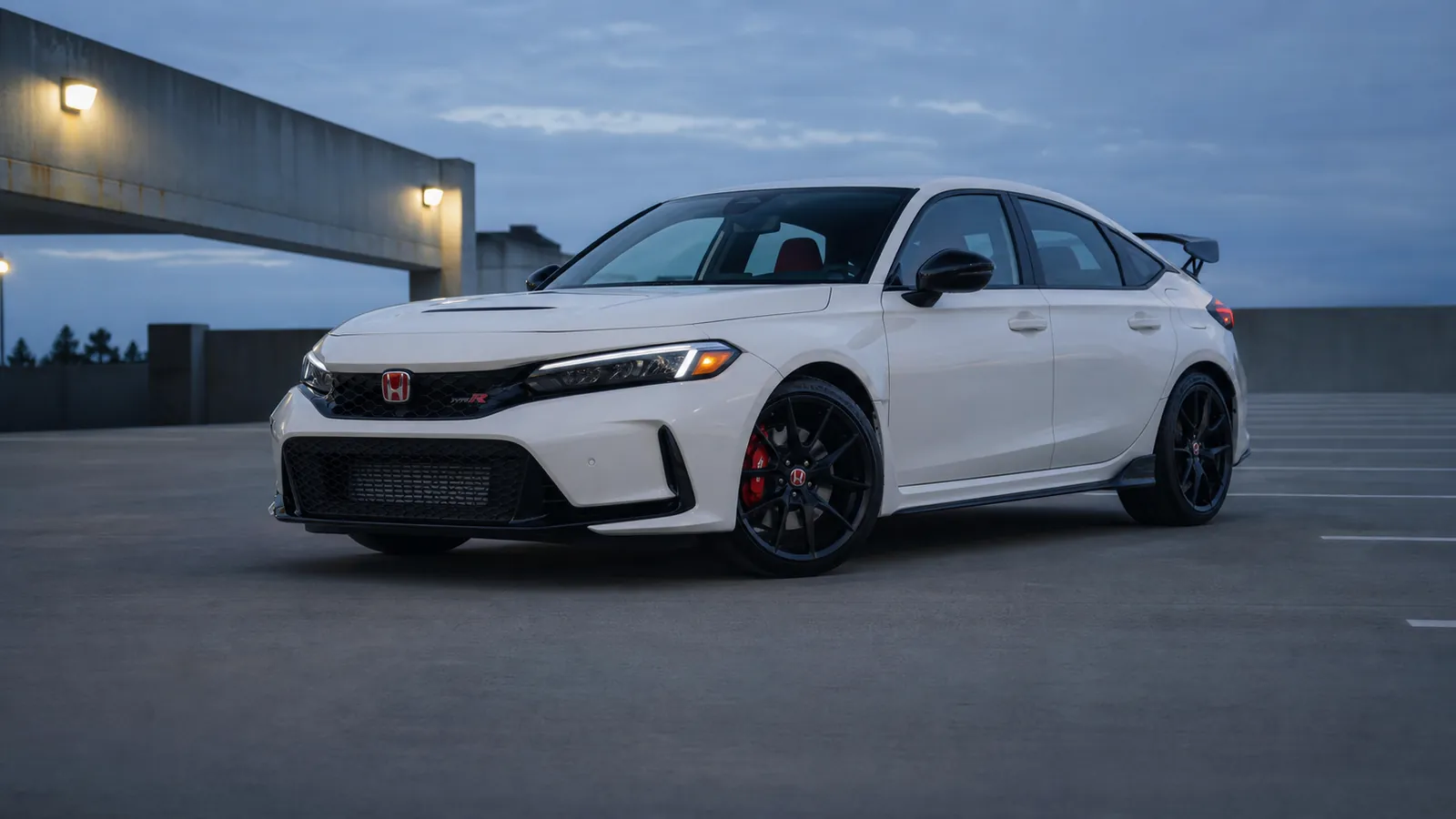
The 2026 Honda Civic Type R is a 315-hp front-wheel-drive hatchback with a six-speed manual, adaptive dampers, 19-inch wheels, and 265/30ZR19 maximum-performance summer tires.
It also has four doors and 24.5 cubic feet of cargo space. The practical body cannot hide the firm, low, and expensive hardware underneath it.
Honda lists a $47,395 starting MSRP before destination, taxes, options, and dealer products.
At that price, the Type R competes with larger or more luxurious cars. It earns the premium through steering, braking, cooling, differential control, and driver involvement rather than cabin isolation.
The daily-use decision starts outside the engine bay. A steep driveway, broken commute, snowy winter, tight garage, sensitive passenger, or two hours of highway tire noise can reject the car before 315 hp matters.
Reproduce those conditions instead of treating a short fast drive as proof.
Comfort mode softens damper response, but it does not change the short tire sidewall, wide tread, low clearance, manual clutch, or exhaust and road noise.
Sport, Individual, and +R adjust responses for different use.
None turns the car into a normal Honda Civic.
Compare its format with the planned Civic Hatchback and a calmer gas hatchback. Type R works daily only when the commute still fits after the excitement, weather, traffic, tire cost, and ride are counted.
The clutch and shifter should be tested in traffic, hills, and parking
Type R offers one transmission, a close-ratio six-speed manual with rev matching and a limited-slip differential.
Buyers do not get an automatic fallback. The manual must remain enjoyable and predictable during the least exciting part of the week.
| Condition | What to assess |
|---|---|
| Cold start | Clutch take-up, idle, gear engagement |
| Parking | Creep control, reverse, steering at full lock |
| Hill start | Take-up consistency without excess slip |
| Traffic | Pedal weight and repeated first-second shifts |
| Highway | Sixth-gear noise and legal passing response |
| Fully warm | Synchros, clutch smell, vibration, warnings |
Start with the car cold. Move through every gear while stationary with the clutch fully depressed, then drive gently until fluids warm.
Check first-to-second engagement at low speed, a normal third-to-fourth shift, reverse selection, hill starts, and smooth low-speed movement.
Grinding, a changing bite point, slip under load, or a persistent clutch smell needs diagnosis.
Rev matching can smooth downshifts, but it should not cover poor technique or mechanical wear.
Test the feature on and off within safe conditions. A used car may have clutch, flywheel, synchronizer, mount, or software changes that alter behavior.
Ask what was changed and require invoices.
Traffic tolerance is personal. Spend at least 20 minutes in stop-and-go movement, then park in the actual garage or a similar tight space.
Check left-leg fatigue, seat position, pedal spacing, rear visibility, door clearance, and whether another household driver can operate the car safely.
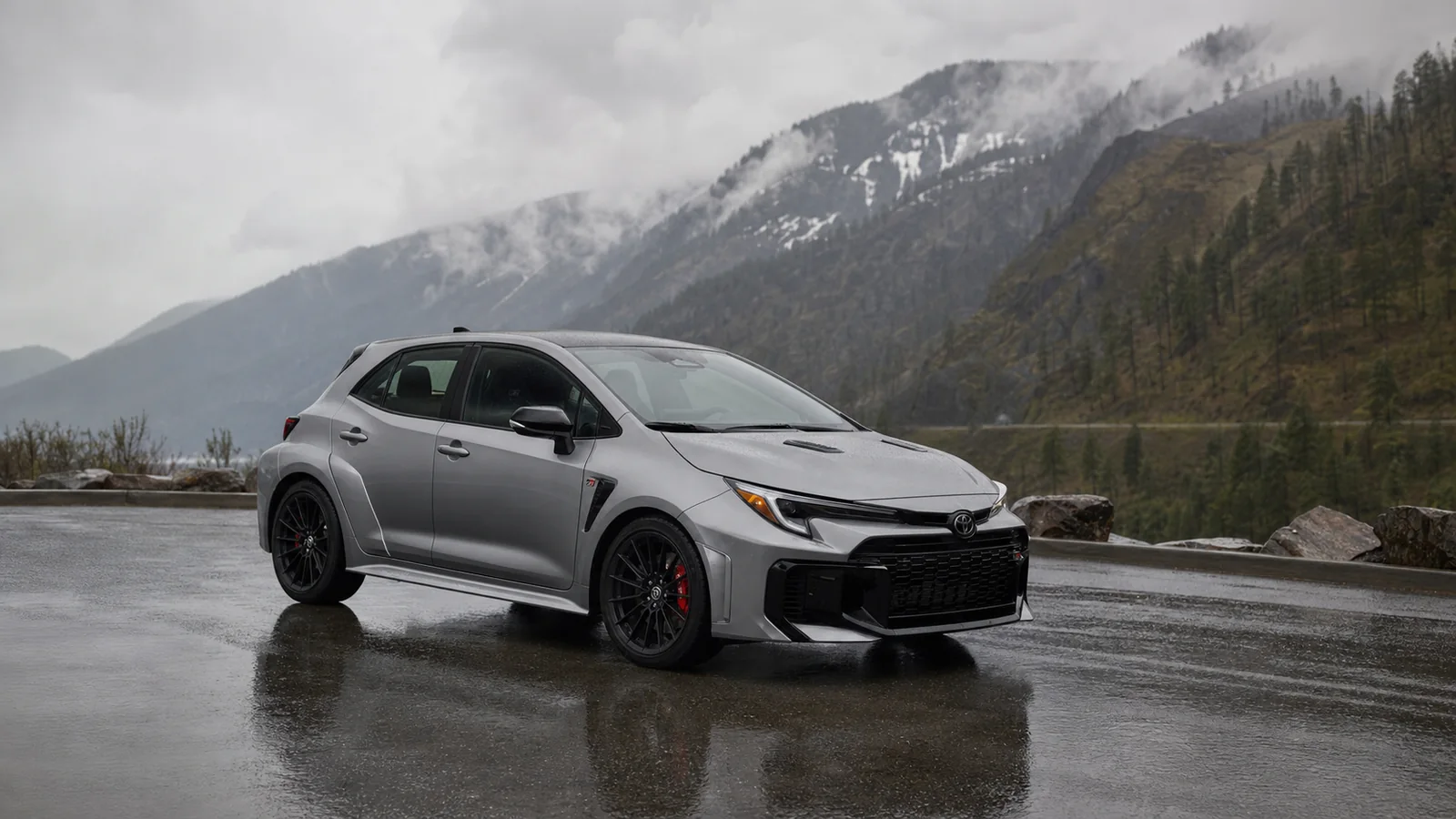
A Toyota GR Corolla offers manual or automatic choices and AWD, while a Toyota GR86 gives rear-wheel-drive balance with less cargo room. Buy Type R only when the manual is part of the daily reward rather than a burden accepted for occasional performance.
Summer tires and 4.8 inches of clearance set hard seasonal limits
Honda fits Michelin Pilot Sport 4S tires in size 265/30ZR19 and labels them maximum-performance summer tires.
The car has 4.8 inches of ground clearance. Those numbers affect cold weather, standing water, potholes, curbs, speed humps, snow, and driveway angles every day.
Inspect the full tread width, sidewalls, bead area, wheels, valve stems, and date codes.
A wide tire can follow grooves and standing water. A short sidewall gives little cushion against a pothole.
Price one tire, one wheel, a complete set, alignment, and road-hazard coverage before purchase.
Use an approved winter or all-season setup when local conditions require it. Keep sizes, load ratings, speed ratings, clearances, and electronic-system compatibility within Honda and tire-maker requirements.
Do not mix tires casually across the axles on a car whose braking and differential behavior depend on consistent grip.
Walk the steepest driveway and parking ramp. Approach slowly and straight where safe, with a spotter when visibility is poor.
Do not normalize scraping. Check the front lip, undertray, exhaust, jack points, wheel faces, and lower cooling areas after any contact.
The front-wheel-drive hub includes cars with less extreme tire demands. An AWD performance car can improve acceleration traction but still needs correct seasonal tires.
A year-round Type R needs a second tire strategy and roads that respect its low body.
Build the seasonal plan before delivery. Record the temperature range specified by the tire maker, identify a compatible cold-weather tire and wheel package, and confirm brake clearance, load rating, speed rating, pressure sensors, storage, and installation cost.
Do not drive summer tires through freezing conditions simply because the road looks dry.
Their compound can lose grip and may be damaged by cold flexing. Check the route for steep ramps, crowned entrances, deep drains, speed humps, snow ridges, and construction plates.
Approach obstacles only when traffic allows and never use an angle that crosses another lane. A front lip that clears the dealer driveway may still contact the home garage when passengers or cargo lower the car.
Keep the factory ride height and wheel dimensions in the inspection notes because springs, spacers, or a different tire diameter can change clearance, steering, speed readings, and driver-assistance calibration.
The hatch is useful, but the rear cabin remains a four-seat compromise
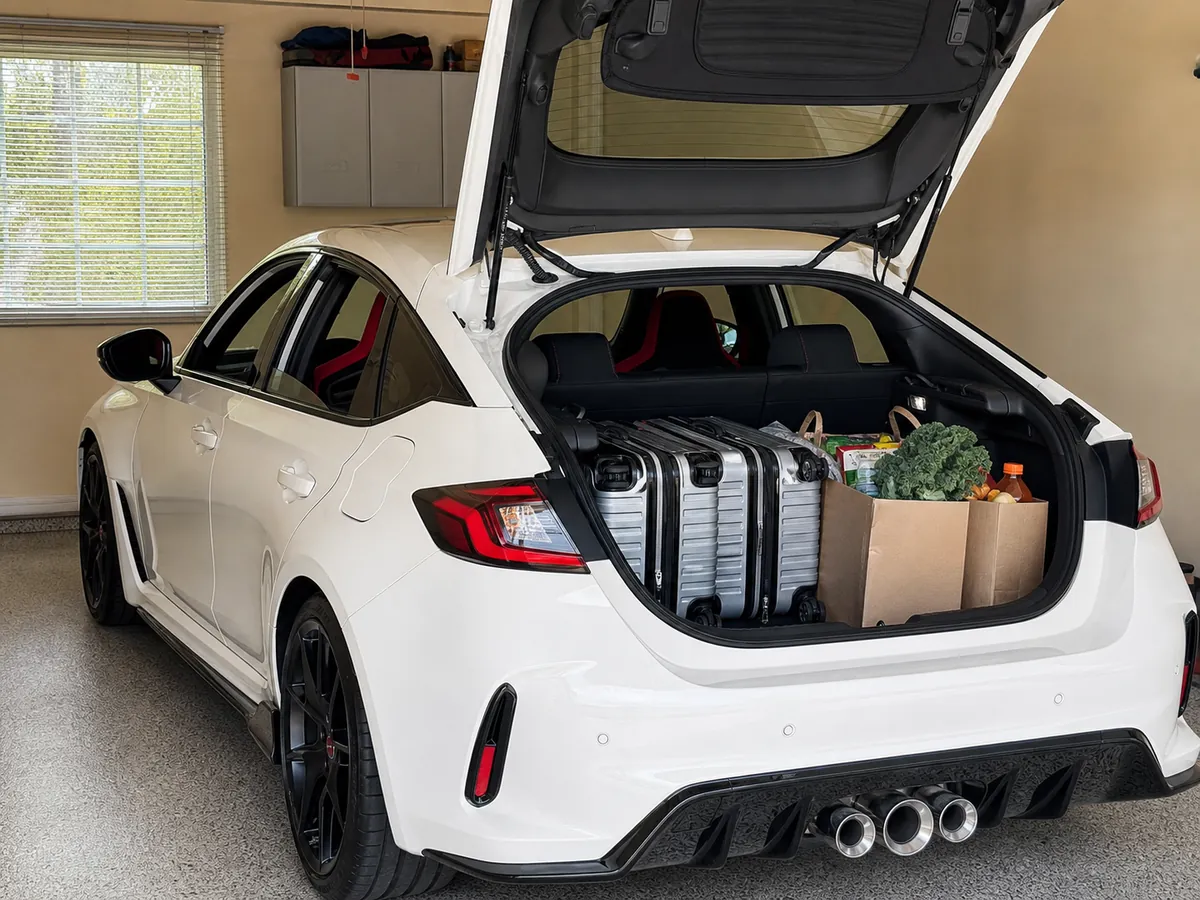
Honda publishes 24.5 cubic feet of cargo volume with the rear seat up, the same headline figure as the normal Civic Hatchback. Type R uses a four-seat layout, and its performance front seats, rear arrangement, and wide exterior need a physical household test.
Set the driver's seat for clutch travel and steering control. Then sit the regular rear passengers behind both front seats.
Check knees, feet, headroom, shoulder space, belt access, door opening, and whether the high-backed front seats affect visibility or comfort.
Install child restraints with Honda and seat-maker instructions.
Load groceries, work bags, a stroller, luggage, sports equipment, or a folded bicycle. The liftgate opening is broad, but hard objects share the cabin and need restraint.
Folding a rear seat increases length while removing a passenger place.
Keep emergency and tire-repair equipment accessible.
The car is 74.4 inches wide and uses wide wheels close to curb edges.
Test the home garage, work parking space, and favorite ramp. Check door clearance, mirror width, turning space, camera view, front-lip approach, and whether passengers can enter without hitting nearby vehicles.
A Honda Accord Hybrid provides more relaxed passenger travel, while a Toyota GR Supra gives up the rear doors entirely. Type R's hatch is genuinely useful when four-seat limits, front-seat position, and the actual load all work together.
Highway noise and a 12.4-gallon tank define the touring limit
Honda rates the 2026 Type R at 22 city, 28 highway, and 24 combined MPG with a 12.4-gallon fuel tank.
Premium fuel is recommended. Real range changes with traffic, temperature, speed, elevation, tire pressure, hard acceleration, and event use.
Track miles and gallons across several normal tanks rather than relying on one dashboard average.
Keep receipts and note highway speed, idling, weather, and performance use. A small tank plus enthusiastic driving can create frequent stops even when the displayed MPG looks acceptable.
Drive for an hour at the speed used most often. Turn the audio down and listen for tire roar, wind noise, exhaust drone, trim rattles, and abnormal bearing sounds.
Cross expansion joints and coarse pavement. Test the seat after enough time for hip, leg, or back pressure to appear.
Comfort mode can improve damper response, but tire construction and cabin sound remain.
Check whether a partner, child, or frequent passenger accepts the ride. A driver who enjoys the feedback may value it differently from a passenger who needs quiet travel.
Plan remote trips around fuel availability and the recommended grade. Do not make the last gallon part of the normal plan.
A Mazda3 hatchback or planned Volkswagen Golf GTI may offer a different balance of speed, comfort, and range.
Type R is a workable tourer when noise, seat comfort, fuel stops, and tire risk remain acceptable after a full highway test.
Track use needs its own insurance and maintenance budget
Type R hardware invites performance driving, but a track entry does not include tires, brake pads, rotors, fluid, fuel, repairs, transport, or insurance. Public roads are not a substitute for a controlled event with qualified instruction and an approved vehicle.
| Item | Question before the event |
|---|---|
| Insurance | Is this event and damage covered? |
| Warranty | Which circumstances or modifications are excluded? |
| Inspection | Do tires, brakes, fluids, and fasteners pass? |
| Consumables | How much life must remain for the drive home? |
| Cooling | Are temperatures, fans, and warnings normal? |
| Transport | What is the tow-home plan after a problem? |
Follow Honda's manual, the organizer's technical rules, the tire maker's limits, and insurer terms. Check oil, coolant, brake fluid, pads, rotors, tires, wheel torque, battery security, loose cabin objects, and warning lights.
Use the required helmet and instruction.
After the event, let the car return to normal temperature and inspect it again. Look at tire shoulders, pressures, wheel fasteners, pads, rotors, fluid levels, leaks, warning memory, and underbody.
Record every symptom before clearing a code. A car that completed the last session may still be unsafe for the commute home.
Do not carry a track alignment, worn tire, thin pad, or overheated fluid into daily rain without review. Event use changes inspection frequency even when the odometer barely moves.
A controlled event with qualified instruction is the proper place to explore the chassis. Treat every event as a separate cost and safety decision, then return the car to a roadworthy setup before daily use.
Set a written stop rule before the event. End the session for a pressure warning, fluid smell, soft brake pedal, rising temperature, new vibration, steering change, or repeated missed shift.
Cooling down for a few laps does not repair a damaged tire or restore boiled fluid.
The tow-home plan should work without driving the car back onto public roads.
Used Type R inspection should look for heat, software, and collision repair
The current FL5 Type R began for 2023, and many examples attract track use, tunes, intake or exhaust changes, suspension work, wheel spacers, and repeated tire changes. A stock appearance cannot prove a stock history.
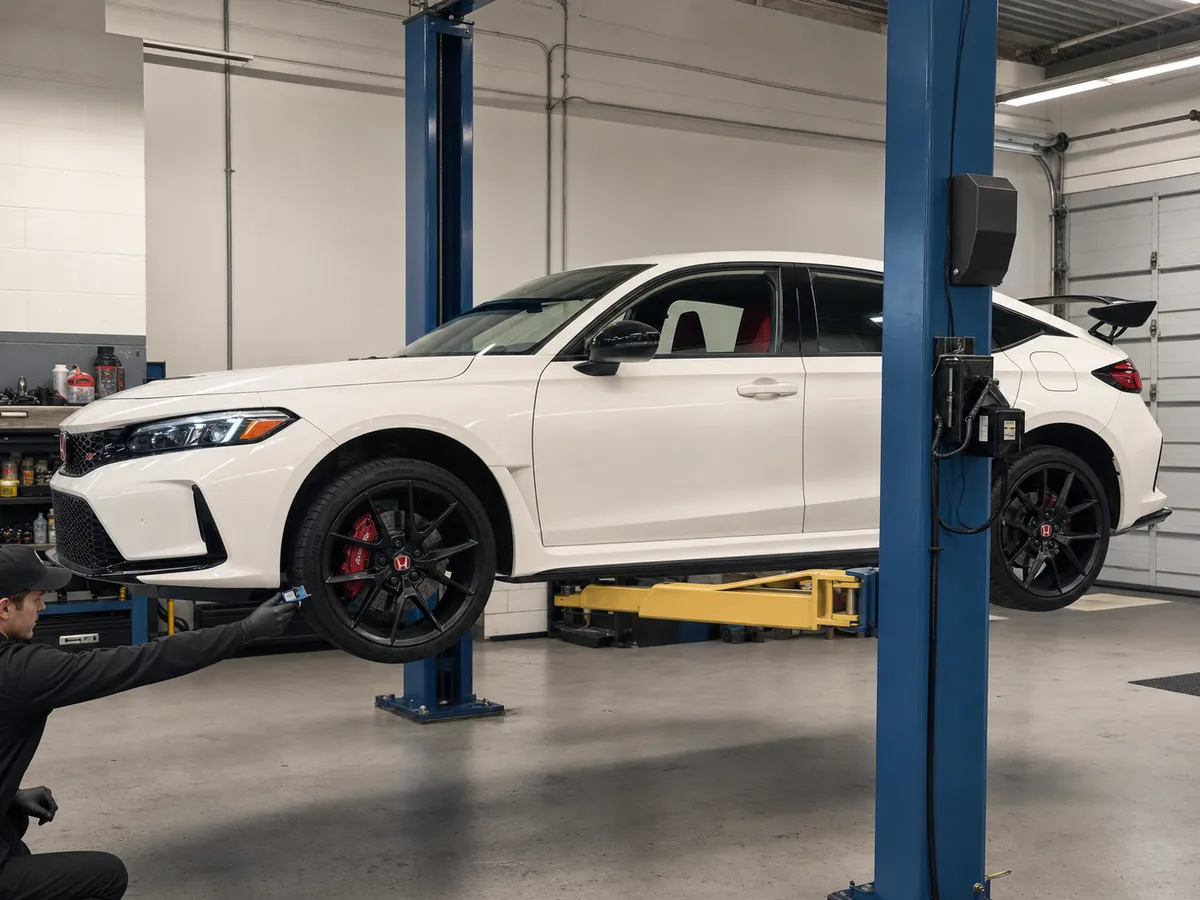
Require a true cold start and scan every module before anyone clears codes. Review stored, pending, and history faults, readiness monitors, oil and coolant records, boost behavior, cooling fans, hoses, mounts, clutch action, synchros, and warning history.
Identify software changes and ask for original parts and invoices.
On a lift, inspect tires, wheels, brakes, bearings, axles, differential areas, suspension, underbody, jack points, cooling surfaces, and exhaust. Melted wheel weights, rubber pickup, discolored components, repeated fastener marks, nonfactory wiring, or missing shields can point to hard use or poor repair.
Measure paint where appropriate and inspect panel gaps, glass dates, restraints, airbag status, alignment, camera and radar mounts, and calibration records.
A clean title does not exclude repaired damage. Walk away when the seller refuses an independent inspection.
A planned Type R reliability history can track year-specific evidence. Used Type R value comes from documented condition and honest use, not low mileage or factory-looking wheels alone.
Ask who installed each part, which calibration was used, and whether the original software can be verified.
A receipt proves that money changed hands, not that the work was correct. Compare boost, fuel trim, knock, temperature, and readiness data with Honda procedures through a qualified technician.
Refuse a test drive that begins after the seller has already warmed the engine.
The 2023 through 2025 steering recall belongs in every used-car check
Honda's bulletin for NHTSA campaign 24V-744 lists 2023 through 2025 Civic Type R vehicles.
Excess friction in the steering gearbox can increase steering effort. Dealers verify eligibility by VIN and perform the specified repair for affected vehicles.
The campaign does not automatically include a 2026 Type R, and it does not prove every earlier car has the defect.
Search the exact VIN at Honda and NHTSA on the purchase day. Require a repair record that names the campaign when the seller says it is complete.
IIHS publishes strong 2026 Civic four-door hatchback results, including Good ratings for small-overlap, updated moderate-overlap, updated side, and headlights.
Confirm how the rating applies to the exact Type R before presenting the hatchback award as a trim-specific result.
Performance tires and braking hardware do not replace crashworthiness evidence.
Inspect belts, airbags, child anchors, tires, brakes, glass, lamps, cameras, radar areas, body structure, and previous calibration. Test driver-assistance features within safe conditions and read their limits.
Official model-year tests and campaign documents should control the safety claim, while anecdotes serve only as inspection prompts. Keep Type R safety claims tied to official model-year evidence, then inspect the exact steering, restraints, sensors, tires, and repair history.
Complete the steering test on smooth pavement and in a parking area at low speed. Hold a steady course, make gentle corrections, turn through both directions, and let the wheel return without forcing it.
Tire pressure, alignment, wheel damage, and suspension changes can also alter effort, so a recall repair record does not replace diagnosis of the actual symptom.
The real five-year bill starts with tires and insurance
A $47,395 starting price is only the entry. Finance interest, insurance, premium fuel, wide summer tires, a winter setup, brakes, alignment, routine service, repair reserve, depreciation, and event use determine whether the car fits the household.
| Cost | What to price |
|---|---|
| Purchase | Car, fees, accessories, dealer products |
| Finance | APR, term, down payment, total interest |
| Insurance | Exact VIN, drivers, mileage, event exclusions |
| Fuel | Premium recommendation and actual annual miles |
| Tires | Summer set plus winter or all-season plan |
| Brakes | Pads, rotors, fluid, labor |
| Service | Oil, filters, inspections, drivetrain fluids |
| Repairs | Deductible and post-warranty reserve |
Get insurance quotes before placing a deposit. Tell the insurer how the car will be used and read exclusions.
Price four correct tires and one damaged wheel. Add seasonal storage or a second wheel set where needed.
Do not assume Civic-branded parts carry ordinary Civic prices.
Finance comparisons should use total interest, not payment alone. A long term can hide the cost of dealer markup, protection products, or accessories.
Remove unwanted products and compare an out-the-door quote with a clean used example after inspection.
Routine commuting still requires oil, filters, brake fluid, tires, alignments, cooling checks, and documentation.
Hard driving can shorten consumable life without adding many miles. Keep a separate event reserve so transportation money is not consumed by recreation.
Compare the whole budget with the Toyota GR Corolla, Toyota GR Supra, and a normal Civic Hatchback. Type R is affordable only when the household can carry performance-car consumables and insurance without depending on resale.
Ask for tire and brake prices at normal street-use intervals and at one demanding event per year. Keep those estimates separate because a track day can consume a large share of a tire or pad set without adding many odometer miles.
Add transport, inspection, and event insurance before deciding that occasional use is cheap. The household should still have ordinary transportation if the Type R waits for parts.
Buy it for the manual and chassis after the daily test passes
Type R combines a precise manual, strong turbo output, a limited-slip differential, powerful brakes, adaptive dampers, rear doors, and a useful hatch. It also brings low clearance, summer tires, road noise, four-seat packaging, modest fuel range, and a serious consumable budget.
Pros
- 315 hp and a rewarding six-speed manual
- Strong braking and front differential control
- Useful 24.5-cu-ft hatch area
- Comfort mode helps on ordinary roads
Cons
- No automatic option
- 4.8 inches of ground clearance
- Summer tires need a seasonal plan
- Tires, brakes, fuel, and insurance cost more
Use the Honda brand hub, hatchback hub, and comparison archive to keep practical and performance alternatives visible. The final decision belongs to the longest test drive, the driveway measurement, the tire quote, and the insurance binder.
The Type R can be a satisfying everyday car when the owner wants its manual and chassis on ordinary days and can pay for the hardware on every day.