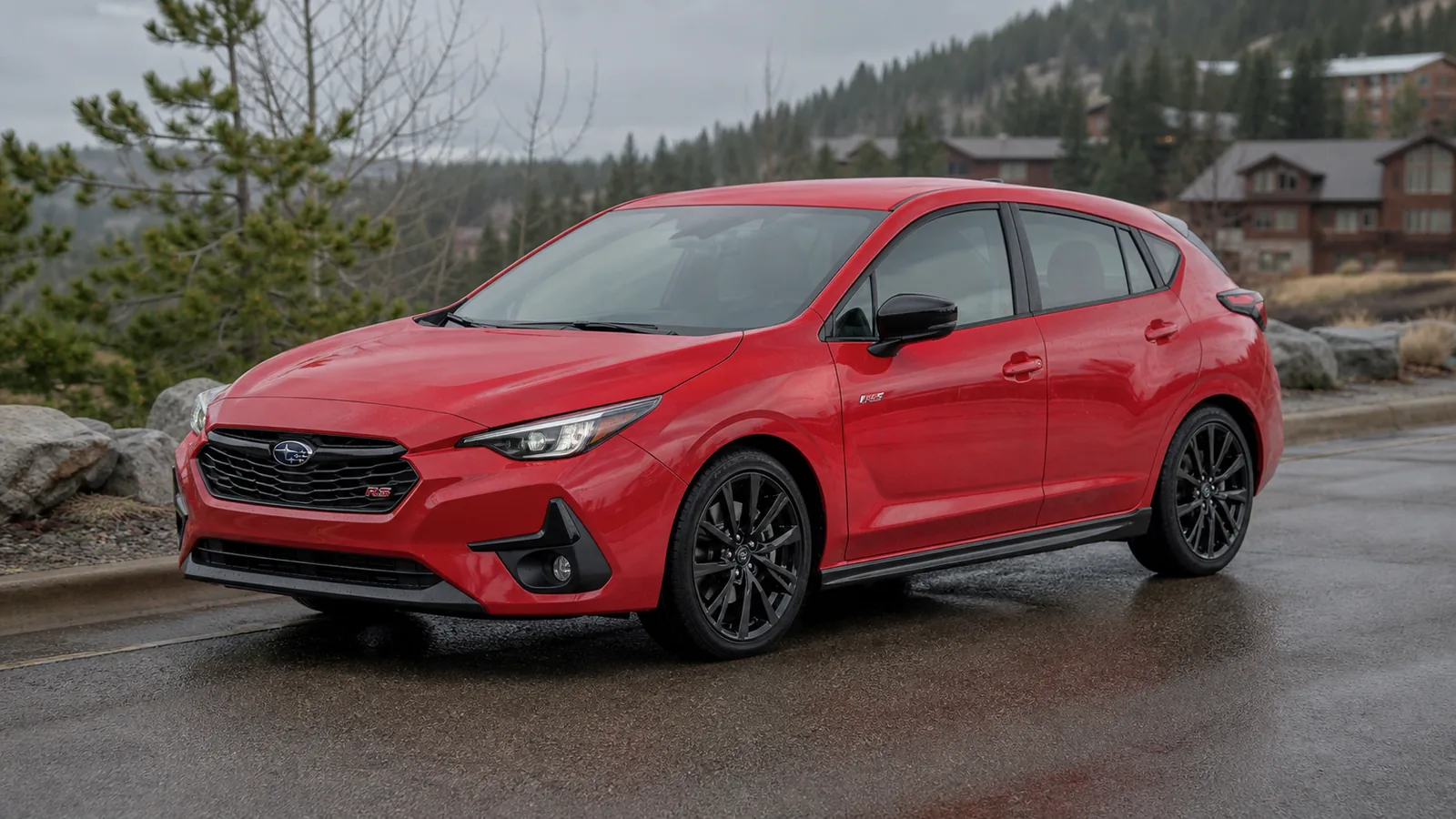
The 2026 Impreza is a two-trim AWD hatchback
The 2026 Subaru Impreza has a simpler lineup than most compact cars. It is hatchback-only, every version has all-wheel drive, and the choices are Sport at $26,595 or RS at $29,495 before destination.
The old base trim is gone.
That change raises the starting price but removes a stripped configuration from the decision. Sport includes an 11.6-inch center display, wireless phone integration, dual-zone climate control, keyless access, 18-inch wheels, steering-responsive LED headlights, and Subaru's EyeSight driver-assistance package.
RS adds the stronger 2.5L engine, heated front seats and mirrors, a windshield-wiper de-icer, blind-spot monitoring, rear cross-traffic alert, rear USB ports, wireless phone charging, and trim details. Its available package adds a power driver's seat, moonroof, and Harman Kardon audio.
Both use a Lineartronic CVT and standard Symmetrical All-Wheel Drive. Neither offers a manual transmission, a front-drive economy version, or the taller stance of a crossover.
This is the answer that should come first.
Buy Sport when standard AWD and hatchback space are the reason you came.
Pay for RS only when its stronger engine and cold-weather equipment fix needs you can feel every week.
The current Impreza belongs in the hatchback category, even though older generations included sedans. Do not let an old listing or generic description send you shopping for a 2026 body style Subaru no longer sells.
A Subaru brand overview also helps explain the lineup. Impreza is the low compact car, Crosstrek is the raised small crossover, and Outback is the larger long-roof family choice.
Start with size and ground clearance before features.
Standard AWD earns its keep in weather, not on the spec sheet
All-wheel drive is the Impreza's clearest advantage over a Civic, Corolla, or front-drive Mazda3. Subaru sends power through all four tires as standard, so there is no trim hunt or large drivetrain package to add.
That traction helps when you pull away on snow, climb a wet grade, or leave a loose gravel parking area.
It does not shorten a stop on ice, and it does not replace winter tires.
Four driven wheels help the car go. Tire grip still decides how it turns and brakes.
| Question | What the Impreza gives | What it does not give |
|---|---|---|
| Snow starts | Standard four-wheel traction | Shorter braking without proper tires |
| Wet roads | Predictable power delivery | Permission to drive faster |
| Fuel economy | Up to 33 mpg highway | Front-drive compact efficiency |
| Ride height | Low car-like center of gravity | Crossover clearance |
| Tire care | Balanced wear with rotations | Tolerance for mismatched tires |
The Impreza has 5.1 inches of ground clearance, which is normal car territory. Deep snow, rutted tracks, and steep trail access can still put the underside close to the surface.
The related Crosstrek sits higher and fits buyers who need clearance rather than road traction alone.
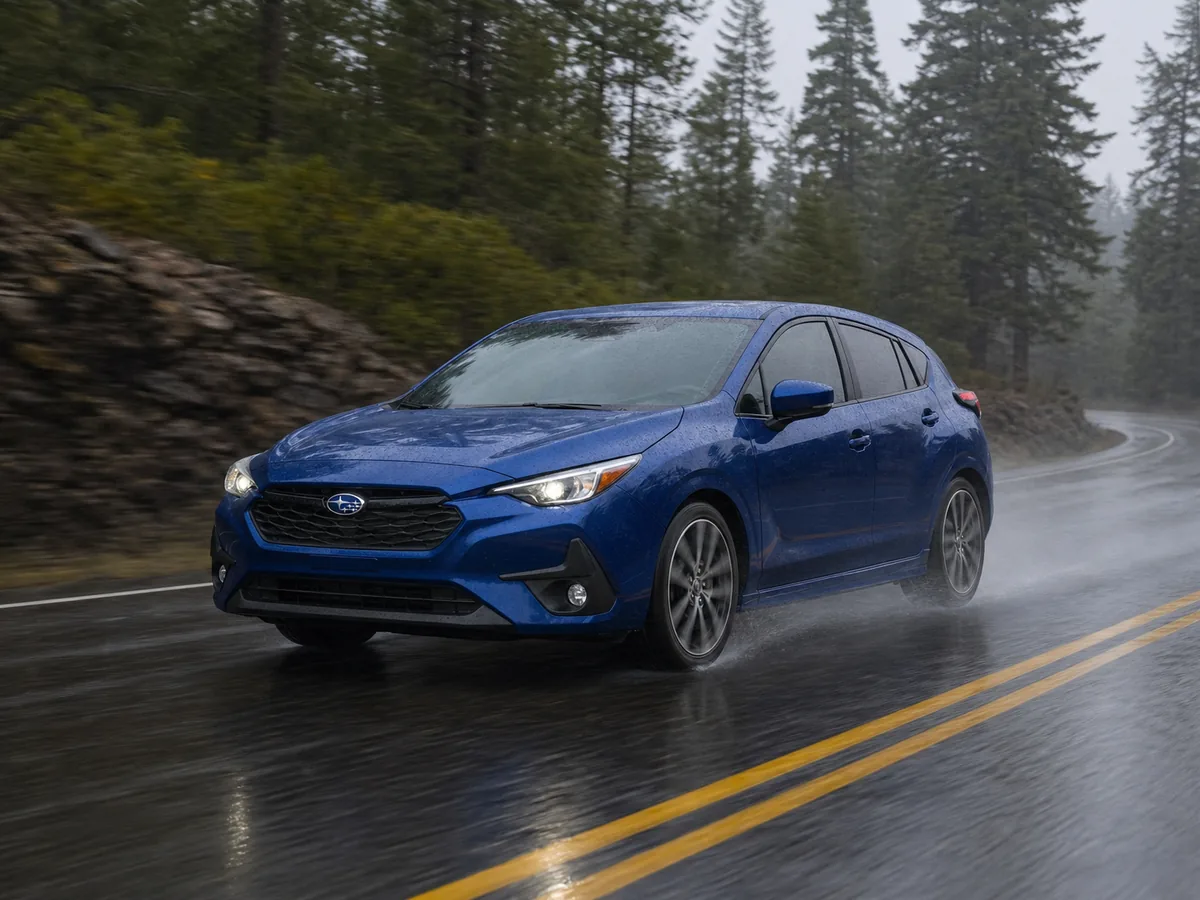
AWD also changes tire ownership. All four tires should match in size, model, and similar tread depth.
Rotate them on schedule and investigate uneven wear early, because a neglected alignment can turn one damaged tire into a four-tire bill.
Browse the AWD car category if you want the traction without crossover height. A Subaru Outback adds space and 8.7 inches of clearance, but it costs more and occupies much more road.
The Impreza is the cleaner answer for plowed winter streets, rain, and paved mountain roads. Choose a Crosstrek when clearance matters, and choose an Impreza when you want AWD behavior in a lower, less expensive car.
Sport or RS depends on one highway pass
The Sport's 2.0L flat-four makes 152 hp and 145 lb-ft of torque. That is enough for errands, school runs, and steady commuting, but acceleration feels deliberate when the car is full or the road climbs.
The RS uses a 2.5L flat-four with 180 hp and 178 lb-ft. The 28 hp increase looks modest, yet the extra 33 lb-ft arrives lower in the rev range and makes merging and passing less strained.
Both engines use direct injection and auto stop-start.
The CVT includes an 8-speed manual mode with steering-wheel paddles. Those programmed steps help on a downhill grade or when you want a quick response, but they do not turn the Impreza into a manual performance car.
Sport versus RS
- Sport
- 152 hp, 145 lb-ft, 27 city / 33 hwy mpg
- RS
- 180 hp, 178 lb-ft, 26 city / 33 hwy mpg
- Price gap
- $2,900 before destination and options
- Shared hardware
- CVT, standard AWD, 18-inch wheels
Drive the Sport first with the climate control on and at least one passenger if possible. Join a fast road, climb the steepest hill in your normal week, and make one safe pass.
If you can plan the acceleration without frustration, the Sport saves $2,900 and almost matches the RS fuel estimate.
The RS is more than an engine upgrade because its heated equipment, blind-spot monitoring, rear cross-traffic alert, and wireless charging are standard.
A snow-belt buyer may value those items even before the power. Still, a loaded RS with its optional package can move beyond the simple-value reason to choose an Impreza.
Fuel economy barely separates the engines on Subaru's published numbers. Sport is rated at 27 mpg city and 33 highway, while RS is 26 city and 33 highway.
The larger engine therefore makes a stronger case than many performance upgrades, but actual cost still depends on annual miles and traffic.
A Mazda3 compact car gives buyers stronger base power and a conventional automatic.
A Honda Civic offers better efficiency and more responsive front-drive choices. The Impreza counters with standard AWD and a practical hatch in every trim.
Pick RS if the Sport feels weak on the road you drive every day. Do not buy it from the horsepower line alone, and do not expect WRX speed from an appearance and response upgrade.
The hatchback works hard without pretending to be a crossover
Subaru gives the Impreza 20.4 cubic feet of cargo space behind the rear seat and 56.0 cubic feet with the seatbacks folded. The low cargo floor and wide liftgate make groceries, folded strollers, and sports gear easy to load.
The rear seat has 36.5 inches of legroom and 38.0 inches of headroom. Those figures make it more welcoming to adults than the dark rear of a Mazda3 hatchback, though the cabin remains compact in width.
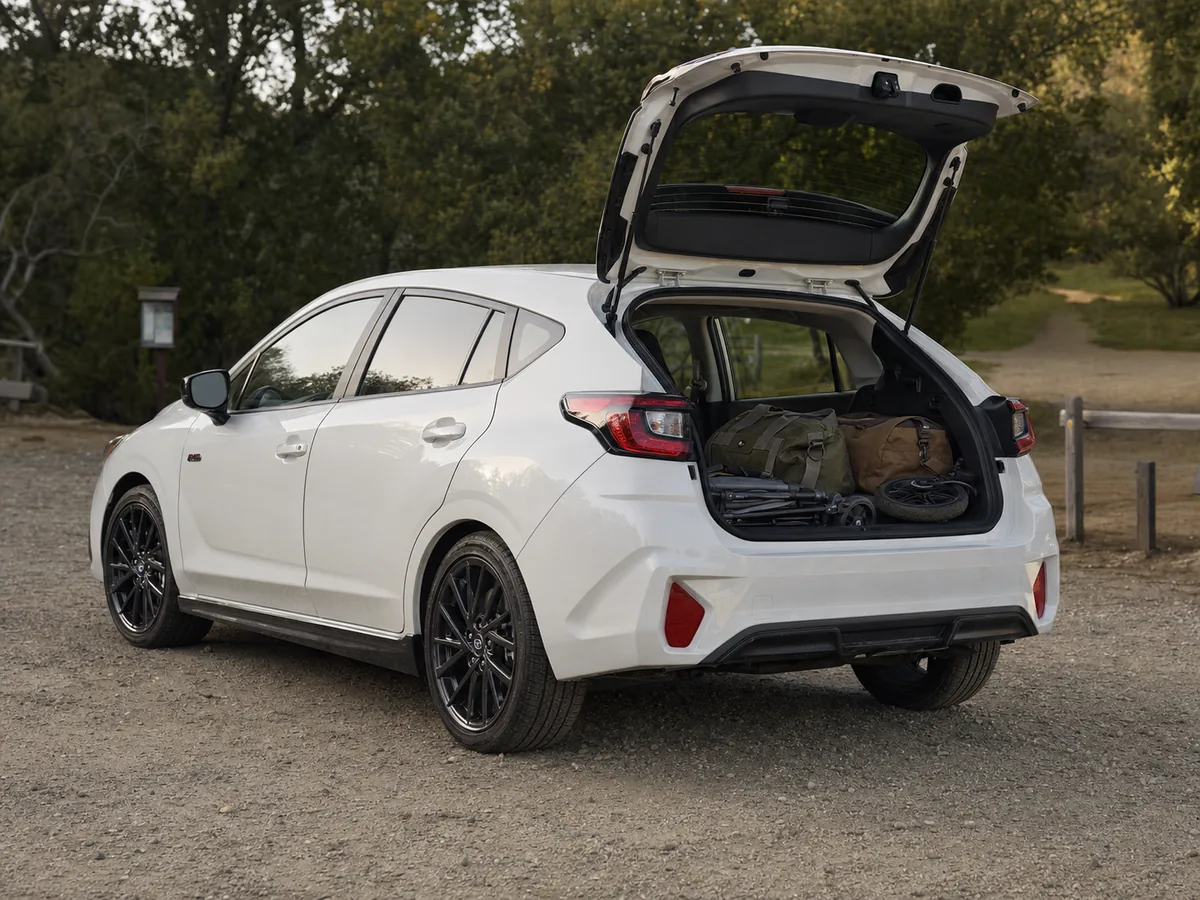
The 60/40 split seatbacks let one passenger ride beside longer cargo. Roof crossbar mounting points add bike, ski, or cargo-box options, and Subaru sells pet and cargo protection accessories that fit the body.
Roof gear adds wind noise and should be counted against the roof-load and accessory instructions.
Run a real fit test before choosing from cubic feet:
- Put the stroller or pet crate through the liftgate
- Fold one rear section and check whether a passenger still fits
- Sit behind the normal driver position
- Check the view through the rear glass with the headrests raised
- Lift the cargo cover and inspect the tire-repair equipment
The Impreza does not include a spare tire in the published 2026 specification. It uses a tire-repair kit, which matters on remote drives or a pothole-heavy commute.
Decide whether roadside assistance and the kit match your risk tolerance.
A Toyota Corolla sedan is more conservative and efficient, but it cannot match the Impreza's standard liftgate utility. The five-seat category offers many larger choices, though more exterior size usually raises price, fuel, and tire cost.
The Impreza is useful because it stays low and compact, not because it copies an SUV. If you need upright seating or repeated travel on rough roads, buy the taller body instead of forcing this car into that job.
EyeSight is standard, but blind-spot equipment is not
Every 2026 Impreza includes Subaru EyeSight with pre-collision braking, throttle management, lane-departure and sway warning, lane-departure prevention, and adaptive cruise control with lane centering. Steering-responsive LED headlights and high-beam assist are standard too.
The important equipment gap sits beside the car. Blind-spot monitoring, lane-change assist, rear cross-traffic alert, emergency lane keeping, and automatic emergency steering are optional on Sport and standard on RS.
A buyer who changes lanes in dense traffic should price the Sport package before comparing it with RS.
IIHS lists the 2026 Impreza with Good ratings in several crash and crash-prevention categories, while its updated moderate-overlap evaluation is Marginal. That mixed result is more useful than a single award badge because it tells you to compare the actual test categories.
The 11.6-inch vertical screen controls audio, phone functions, and several settings. Physical temperature buttons remain, which helps, but you should still pair your phone, use the camera, change the fan, and watch for lag or reboots during the drive.
- Clean the windshield area in front of the EyeSight cameras
- Confirm no camera warning remains after startup
- Test adaptive cruise on a clear road
- Check blind-spot and rear-cross-traffic operation if fitted
- Make sure the rear camera image is clear in shade and sun
Subaru notes that EyeSight performance can vary with weather and road conditions.
That is a limitation, not a reason to dismiss the system. It is a reason to keep the windshield clean and remain responsible for speed, spacing, and steering.
A future Impreza recall history will organize official campaigns by year. For any car you are buying now, search the VIN through NHTSA and have open recall work completed free by a Subaru retailer.
Choose the driver-assist equipment you use, then verify it on the exact car. A long standard-feature list does not guarantee that the Sport on the lot has blind-spot monitoring.
Road-test the CVT, steering, and 18-inch tires as one system
The Impreza feels different from a front-drive compact before the engine matters. Its steering is calm around center, the body stays low, and the AWD system pulls away without the light front-wheel scramble that can appear on a wet hill.
Both 2026 trims use 18-inch wheels with 225/40R18 tires. That is an unusual starting point for a value compact, and it changes the test drive.
The short sidewall can make expansion joints and potholes more obvious, while the wide tread gives the car a planted response on smooth pavement.
Do not judge that trade from a clean dealer road. Use a route that exposes the car:
- Start cold and shift from Park to Reverse, then Drive
- Crawl through a parking lot with light throttle
- Cross patched pavement at 25 to 35 mph
- Accelerate up a hill with the climate system running
- Hold highway speed with the audio off
- Make a safe pass in Sport and RS on the same stretch
- Turn tightly at low speed and listen for tire or driveline noise
A CVT does not copy a normal stepped automatic. Engine speed can rise and hold while road speed catches up, which is expected under a strong throttle request.
Shudder, a long delay into gear, a warning light, or repeated surging is not something to accept because the transmission is different.
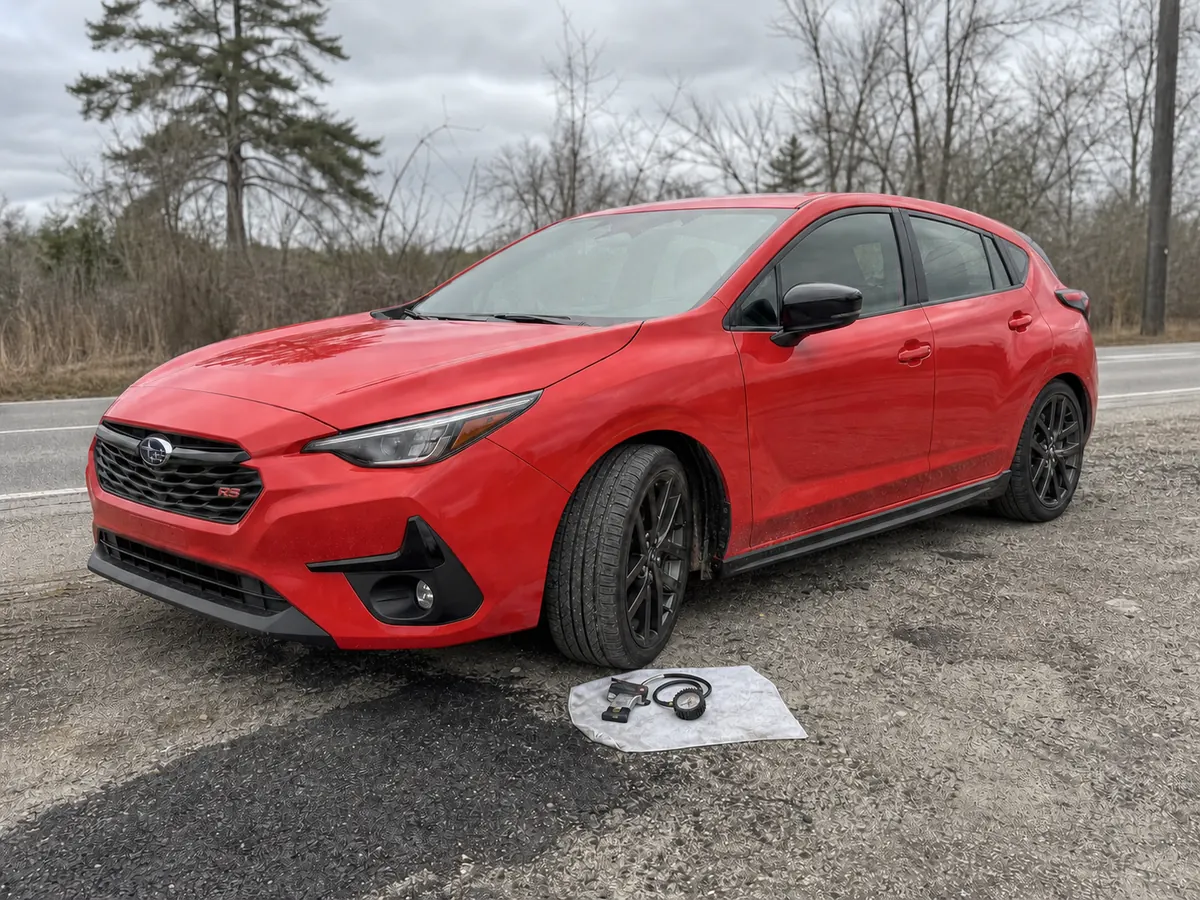
The Sport needs the steepest part of the route. Its 152 hp engine can keep pace, but a short freeway ramp or a full passenger load may force more noise and planning than you want.
The RS should feel easier there, not dramatically fast. If both feel similar in your use, the Sport wins the price decision.
Ride from the rear seat for several minutes. The Impreza's low body controls motion well, but road impact and tire noise can feel different behind the driver.
A car that feels composed from the front can still tire a child or adult passenger on a broken highway.
Check the steering wheel for a centered position on a flat road and look for vibration through 55 to 70 mph.
A pull can come from road crown, tire pressure, alignment, or damage. A vibration can point to wheel balance, a bent wheel, a tire problem, or wear that deserves inspection.
The gas compact category includes quieter and more efficient choices, while the Impreza's reason to win is its standard traction and cargo shape. Make the test route force those strengths and costs into view.
A good Impreza should feel predictable, not exciting. Sport or RS should be decided by hill and passing effort, while the whole model should be decided by ride, tire noise, and AWD behavior.
Reliability depends on separating new and old Imprezas
The current Impreza was redesigned for 2024, so it does not yet have a ten-year record. Its 2.0L and 2.5L flat-four engines, CVT, and AWD layout are familiar Subaru hardware, but long-term conclusions should stay modest until more high-mile cars exist.
- 1993 to 2001First generation offered sedan and wagon bodies
- 2002 to 2007Second generation expanded performance and body choices
- 2008 to 2011Third generation moved toward a roomier hatchback shape
- 2012 to 2016Fourth generation separated WRX from the normal compact story
- 2017 to 2023Fifth generation used sedan and hatchback bodies with a CVT
- 2024 to presentSixth generation became hatchback-only in the U.S.
That generation line matters when people say an Impreza has a certain problem. A 2013 oil-consumption story, a 2021 control-arm recall, and a 2026 shopping question do not describe the same car.
Match every claim to the model year and VIN.
For a current-generation used car, start with service history and four matching tires.
Then test the CVT cold and warm. It should engage Drive and Reverse without a long delay, accelerate without shudder, and settle at highway speed without a warning light or vibration.
Older 2017 to 2023 cars deserve a wheel-bearing listen. A steady hum that grows with road speed and changes as you gently load one side can point to a bearing or tire problem.
Do not diagnose it from the driver's seat alone.
Use a pre-purchase inspection.
Check these items on any used Impreza:
- Four matching tires with even tread depth
- Smooth cold engagement and warm CVT behavior
- Wheel-bearing and tire noise at 40 to 65 mph
- Battery age, screen operation, and camera clarity
- Oil level, coolant condition, leaks, and service records
- VIN recall completion and evidence of crash repair
The planned Impreza reliability report will separate results by generation. The planned Impreza problems report will distinguish owner complaints, service bulletins, and safety recalls.
The safest used choice is a stock car with matched tires and ordinary maintenance records. A newer year does not compensate for a seller who cannot explain its service or warning lights.
AWD tire care matters more than the small MPG gap
The Impreza's cost story begins with standard AWD. You do not pay a separate drivetrain option, but you accept its weight, tire discipline, and slightly lower economy compared with the best front-drive compacts.
At 12,000 miles per year, every 1 mpg difference equals roughly a dozen to fifteen gallons depending on the baseline. The Sport and RS differ by only 1 city mpg in Subaru's estimates, so the $2,900 trim gap matters far more than their fuel difference.
| Cost area | Sport | RS | Best buyer move |
|---|---|---|---|
| Purchase | $26,595 MSRP | $29,495 MSRP | Pay for RS only when power and equipment matter |
| Fuel | 27 city / 33 hwy | 26 city / 33 hwy | Estimate from your annual miles |
| Tires | 225/40 R18 | 225/40 R18 | Rotate and keep all four matched |
| Insurance | Quote by VIN | Quote by VIN | Check before deposit |
| Warranty | 3 yr / 36,000 mi basic | Same | Verify start date on used cars |
| Powertrain warranty | 5 yr / 60,000 mi | Same | Keep service records |
Replacement cost is the reason to price the shared 225/40R18 size before choosing either trim. The low sidewall can be more vulnerable to potholes than a smaller wheel with more rubber, and replacement prices deserve a check before purchase.
A bent wheel or one damaged tire can become a larger AWD expense if tread differences prevent a single-tire replacement.
Routine care is familiar:
- Change engine oil and filters for the driving conditions
- Rotate all four tires and check alignment
- Inspect brake fluid, pads, battery, wipers, and coolant
- Follow Subaru's CVT and differential inspection schedule
- Keep receipts that show the AWD system received matched tires
The planned Impreza maintenance schedule will list exact intervals by mileage. The planned real-world MPG analysis will compare owner fuel logs with Subaru's estimates.
Insurance can overturn the trim decision, especially for a young driver choosing RS.
Quote the exact VIN for both trims. Do the same before assuming a compact hatchback is automatically cheaper than a small crossover.
A simple tire-pressure routine protects fuel economy, steering, braking, and tread life. Check pressure cold and follow the door-jamb placard rather than the maximum printed on the tire.
The Sport is cheaper to own because it costs less to buy, not because it saves much fuel. The RS should earn its price through stronger acceleration and standard equipment you will use.
Buy an Impreza for low AWD utility, not crossover image
The Impreza fits drivers who want standard AWD, a useful liftgate, and compact-car road manners. It is a strong match for snow-belt commuters, apartment dwellers with outdoor gear, and small households that want cargo flexibility without a tall vehicle.
It is weaker for buyers who chase maximum mpg, quick acceleration at the lowest price, or rough-road clearance.
A front-drive Civic or Corolla uses less fuel.
A Mazda3 feels stronger and more polished. A Crosstrek rides higher over broken access roads.
The Sport is our recommendation for most buyers. It keeps the reason to choose an Impreza clear and gives you the same cargo space, AWD layout, screen, climate control, headlights, and basic EyeSight package as RS.
Add its option package only if blind-spot monitoring and cold-weather items are important.
Choose RS when the 2.0L struggles on your hill, on-ramp, or loaded highway pass. Its standard blind-spot equipment and heated features also reduce the effective price gap for winter drivers.
A planned Civic versus Impreza comparison will answer the efficiency-versus-AWD choice in detail. A planned Impreza alternatives list will separate cars that offer more clearance, more power, or lower fuel use.
If you are choosing between a warranty and a discounted used car, apply the new-versus-used checklist before taking the cheaper payment. AWD tires and catch-up service can erase a small discount quickly.
Buy the Impreza when standard AWD and a low hatchback body solve the same problem. If you need only one of those things, a more efficient compact or a taller Subaru may fit better.
Price the Sport package before assuming RS costs $2,900 more
The published $2,900 gap compares a standard Sport with a standard RS. It does not compare two cars equipped for the same winter and traffic needs.
Sport's option package adds heated mirrors and front seats, a windshield-wiper de-icer, moonroof, illuminated vanity mirrors, blind-spot monitoring, rear cross-traffic alert, emergency lane keeping, and automatic emergency steering. Subaru does not publish one permanent national package price on the specifications page, so compare window stickers rather than estimating from the base MSRP.
RS includes most of that cold-weather and side-assist equipment as standard, then adds the 180 hp engine, rear USB ports, wireless charging, and its trim details. Its own option package moves toward audio, a power driver's seat, and a moonroof.
Compare three real inventory cars: an unoptioned Sport, a Sport with the package, and an RS without its package. The middle car may close enough of the price gap that the RS engine becomes inexpensive, or it may preserve enough savings to keep Sport as the clear value.
Do not let a moonroof decide the engine. First choose the driver-assist and cold-weather equipment you need.
Then use the highway pass to decide whether 180 hp improves the car enough.
Window-sticker equipment, not the base-price gap, reveals the honest Sport-versus-RS decision.