The plug-in premium only works when the car charges often
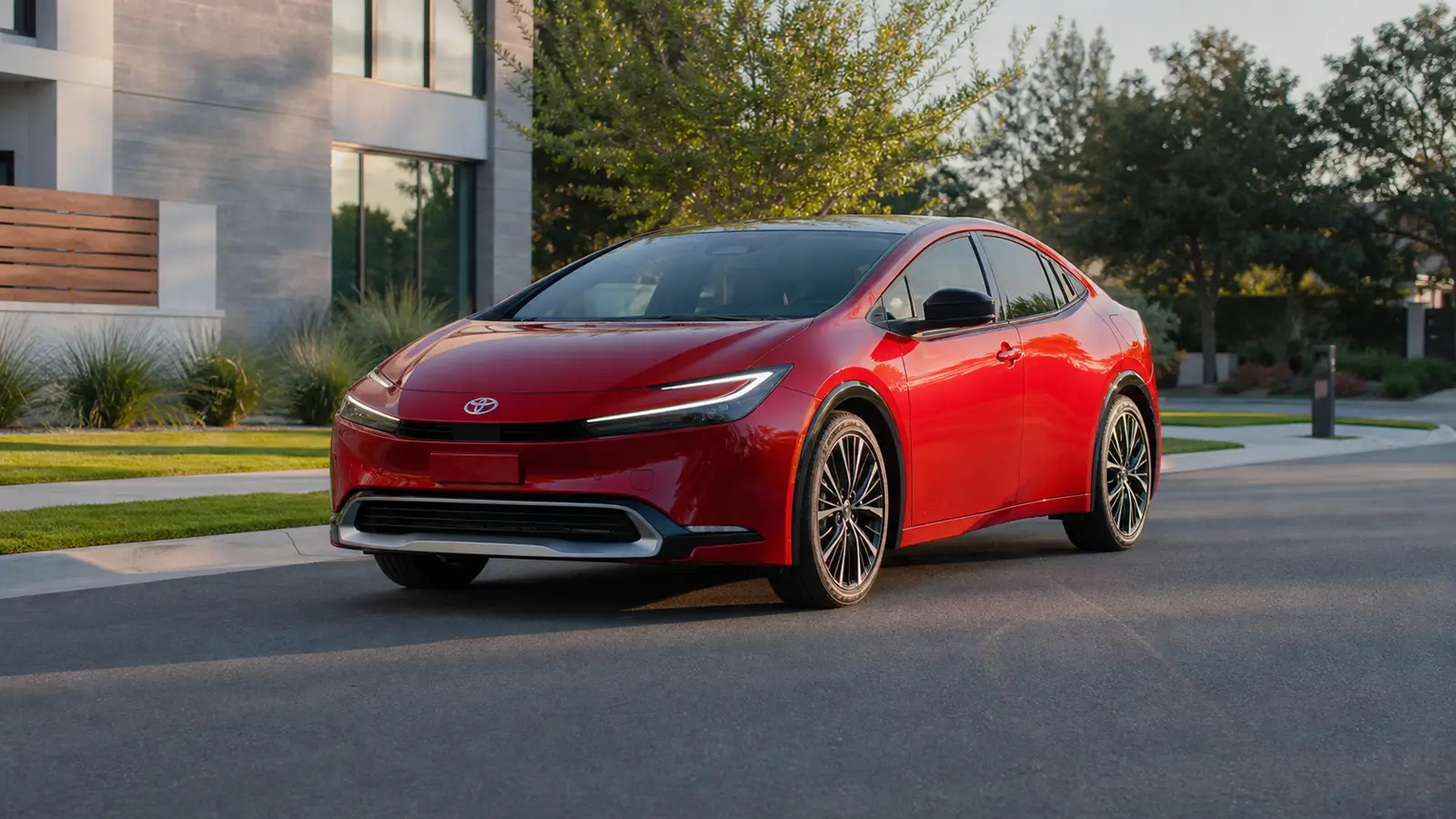
The 2024 Toyota Prius Prime is a 220-hp plug-in hybrid hatchback. SE can travel an EPA-estimated 44 miles on electricity, while XSE and XSE Premium are rated at 39 miles.
When the usable charge is gone, the car continues as a gasoline-electric hybrid instead of stopping for a charger.
The strongest case is a driver who plugs in most nights and completes work, school, shopping, and errands inside the rated range.
A 25-mile day can use little or no gasoline. A 90-mile day still works because the engine takes over, but a large share of the trip will use fuel.
Write down seven normal days and total the miles driven before shopping. Mark where the car can remain connected for at least four hours on Level 2 or overnight at 120 volts.
If charging is uncertain, compare the purchase price with a Toyota Prius and a Toyota Corolla Hybrid.
Both deliver high fuel economy without a plug.
The Prime is not an EV that needs public fast charging to complete a road trip.
It is a hybrid that can cover many local miles electrically.
Pay more for Prime only when dependable charging turns the rated EV range into miles you will use every week.
SE keeps five electric miles that the XSE grades give away
Toyota gives every 2024 grade the same 13.6-kWh battery and 220-hp plug-in system, but wheels and equipment change the efficiency result.
SE is rated for 44 electric miles and up to 52 mpg combined in hybrid mode.
XSE and XSE Premium are rated for 39 electric miles and 48 mpg combined.
| Grade | EV range | Hybrid MPG | Wheel size | Best reason to buy |
|---|---|---|---|---|
| SE | 44 miles | 52 combined | 17 inches | Range, efficiency, lower tire cost |
| XSE | 39 miles | 48 combined | 19 inches | Added comfort and cabin equipment |
| XSE Premium | 39 miles | 48 combined | 19 inches | Premium features after a careful price check |
Five miles sounds small until a 41-mile commute changes from fully electric in SE to a trip that starts the engine in an XSE.
The larger wheel also brings a shorter tire sidewall and a higher replacement price. Get a written quote for one tire and a full set before choosing appearance.
XSE adds equipment that some drivers will use every day. XSE Premium can add features such as a fixed glass roof and more cabin technology.
Build all three with the same destination charge, dealer products, finance term, insurance quote, and trade value.
A longer loan can hide a large trim step.
The hatchback guide shows other practical small cars, while the plug-in hybrid hub frames the broader charging choice. SE is the rational Prime because it keeps the longest range, best hybrid rating, smaller wheels, and lowest starting price.
A normal outlet can work, but the parking arrangement must be safe
Toyota estimates about 11 hours for a full charge from a normal 120-volt outlet and about four hours with compatible 240-volt Level 2 equipment under ideal conditions. That means an overnight 120-volt connection can serve many owners.
Level 2 is useful when the car returns with a low charge and needs to leave again the same day.
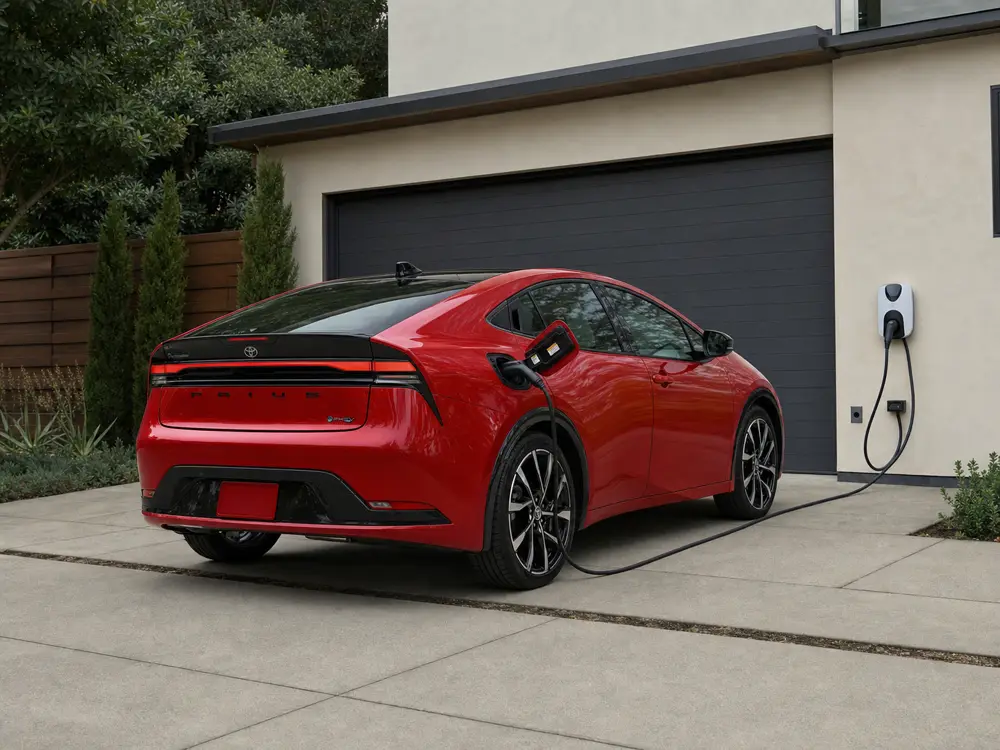
Have a licensed electrician inspect an old, shared, warm, loose, damaged, or extension-fed outlet before regular use.
Follow Toyota's charging instructions and the charging-equipment maker's limits. Keep the control box supported and the cable away from doors, sharp edges, standing water, children, and vehicle tires.
- Confirm the outlet and circuit are suitable for continuous charging
- Check whether other loads share the circuit
- Keep the connector clean and dry
- Lock or secure the cable where theft is possible
- Test the timer before relying on lower overnight rates
- Price any panel, wiring, permit, and equipment work before buying
Apartment and street-parking drivers should get written permission and a real installation quote.
A nearby public Level 2 station can disappear, break, or become expensive. The Prime will still run on gasoline, but that fallback weakens the reason to pay for the battery.
Choose the charging plan before the car because a safe, repeatable home or work connection creates the savings.
The low roof and hatch need a household fit test
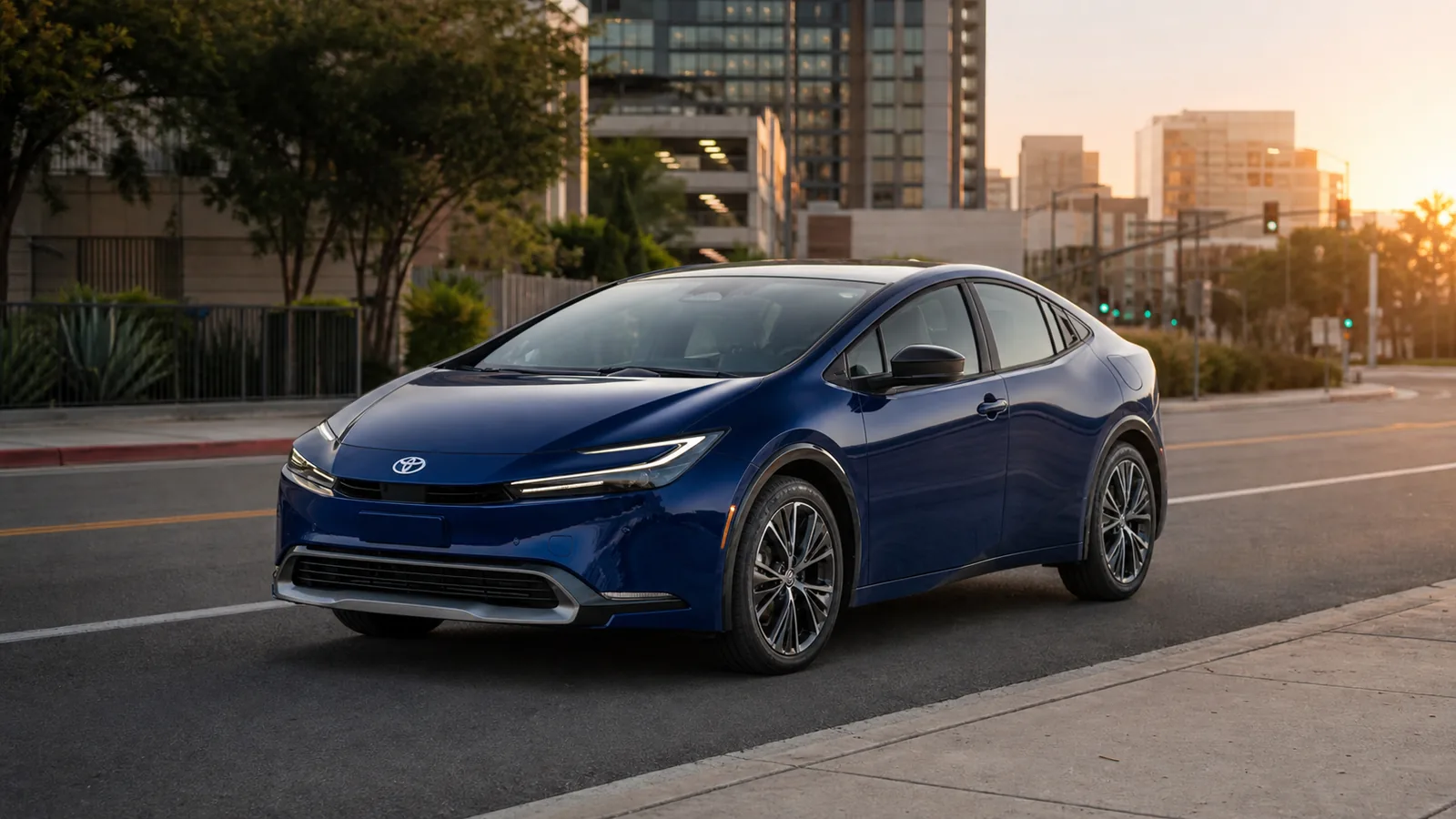
The current Prime looks lower and sleeker than the previous generation. That shape helps aerodynamics and style, but it can make entry, rear head clearance, and tall cargo more difficult.
A specification sheet cannot tell whether a particular driver will bump the roof or whether a rear-facing child seat will force the front passenger forward.
Set the front seats for the regular drivers, then place the tallest passenger behind them. Check head clearance while entering and while seated, knee room, foot space, belt fit, outward view, and the ability to sit for 20 minutes.
Install every child restraint using Toyota and seat-maker instructions.
Do not judge fit from an empty showroom seat.
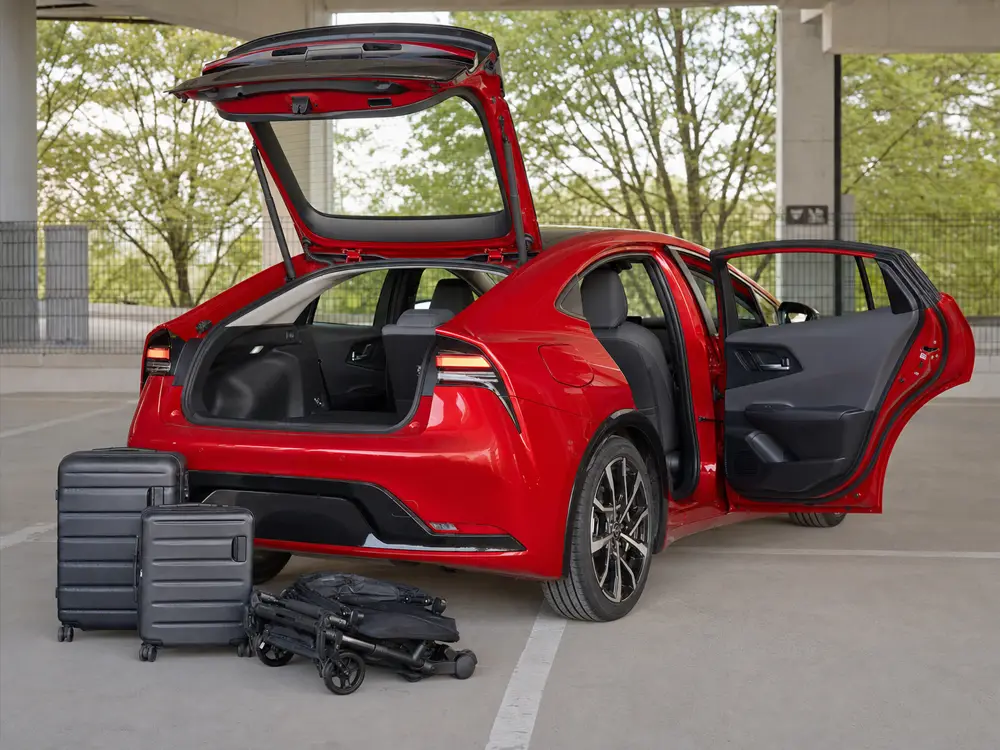
Load the largest weekly object through the hatch. Test a stroller, mobility device, pet crate, suitcase, work case, or sports gear with the rear seats in their normal positions.
The cargo floor, sloping glass, and hatch opening can reject a tall object even when the published volume looks adequate.
A Toyota Corolla Cross gives up some car-like efficiency for easier access and a taller load area.
A Toyota Camry Hybrid offers a roomier sedan comparison.
Prime is practical only after its low roof, rear seat, and hatch accept the people and objects carried every week.
Electric response makes it quick, but front-wheel drive sets the winter limit
The 2.0L plug-in system produces 220 combined hp. Toyota estimates a 6.6-second run to 60 mph, a major change from older Prius models.
Electric torque makes city gaps and short merges easier without requiring the engine to rev immediately. The car remains front-wheel drive, and Toyota does not offer AWD on this generation of Prime.
Quick acceleration is useful, but it also makes front-tire condition important. Inspect both front tires for shoulder wear, measure tread across the width, and check alignment if the steering pulls or the wheel sits off center.
The 19-inch XSE tires cost more and leave less sidewall than the SE setup.
For snow, the correct seasonal tire can matter more than an AWD badge on worn all-season tires.
Price four winter tires and wheels if the route regularly includes packed snow or ice.
Ground clearance, low body panels, and stopping distance remain limits. The front-wheel-drive hub includes alternatives with the same basic traction layout.
Drive the Prime on a rough road and a highway ramp. Check steering tracking, brake blending, tire noise, engine transition, and ride over sharp edges.
Treat the Prime as an efficient front-drive car with strong response, then choose tires for the worst repeated weather rather than expecting the hybrid system to create grip.
The 2024 safety record is strong, but the headlight result still matters
IIHS named the 2024 Prius Prime a Top Safety Pick. Its published page shows Good results in the small-overlap front, original moderate-overlap front, and updated side tests.
The listed headlight result is Acceptable, and the pedestrian front-crash-prevention result is Good.
These ratings describe specific tests and equipment, not every crash.
Toyota Safety Sense 3.0 includes systems such as pre-collision support, lane-departure alert, lane-tracing assistance, road-sign assistance, automatic high beams, and adaptive cruise control.
Blind-spot monitoring and rear cross-traffic alert are standard for 2024.
The driver remains responsible for steering, speed, distance, and observation.
Test the systems on a clear marked road without forcing an intervention. Check warning controls, camera view, cruise following behavior, lane markings, and nighttime glare from the center display.
Confirm that the exact vehicle has the lights and equipment represented by the published rating.
The IIHS-rated vehicle guide can help frame test results across models, while the Toyota brand page keeps model research together. Use the IIHS result as useful evidence, then inspect the exact car's tires, lights, glass, sensors, and repair history.
Recall 26V049 makes the rear-door switch a VIN check
NHTSA recall 26V049 covers certain 2023 and 2024 Prius Prime vehicles. The official report says water can enter the rear-door opener switch and cause a short.
If the affected door is unlocked, it may open while the vehicle is moving or after a crash.
Toyota's free remedy modifies the switch circuit.
Model year alone cannot prove that a car is included. A door that works normally during one test also cannot prove that the repair was completed.
Match the VIN result, dealer record, and vehicle history. If the seller says the work was done but cannot show it, ask a Toyota dealer to confirm.
During the inspection, operate both rear doors from inside and outside, check locks and child-safety settings, look for water or trim disturbance, and confirm that warning lamps clear.
Do not attempt to reproduce the electrical condition with water.
The recall remedy belongs to a dealer.
A recall is a defined safety defect with a specified remedy. It does not prove that every switch or door complaint has the same cause.
Continue checking latches, handles, seals, body alignment, and previous collision work.
Do not close a 2023 or 2024 Prime purchase until the current VIN record and repair paperwork agree on rear-door campaign completion.
A used Prime must prove both its hybrid and charging systems
A normal used-car inspection is only the starting point. The Prime has a gasoline engine, high-voltage battery, traction motors, onboard charger, cooling systems, 12-volt electrical system, and regenerative brakes.
A quiet short drive does not test all of them. Start the car cold and allow enough time to use both EV and hybrid operation.
- Verify the VIN, title, warranty start, service records, and recalls
- Test charging with the included cable and a compatible Level 2 source when possible
- Inspect the inlet, cap, pins, cable, and control box for heat or damage
- Scan all modules before and after the drive
- Check battery-cooling intake and cabin filters
- Test engine start, eCVT response, brake blending, heat, and air conditioning
- Measure all tires and inspect the low front and underbody panels
- Review glass, paint, seams, and calibration invoices
Toyota states that the hybrid battery is covered for 10 years or 150,000 miles and specified hybrid components for eight years or 100,000 miles, subject to its warranty terms. Confirm the in-service date and remaining coverage rather than repeating the headline as a promise for every used car.
Ask how often the owner charged and where the cable was stored.
A missing original cable has a replacement cost. A recent 12-volt battery is useful only with an invoice and correct installation.
The planned Prius Prime reliability guide can separate model-year evidence as it grows.
Buy the individual Prime that charges correctly, completes diagnostics, shows clean cooling paths, and has documented campaign work.
Electric miles save money only after every added cost is counted
The savings calculation begins with the miles that will actually run on electricity. Multiply expected electric miles by the car's measured or rated energy use and the delivered electricity rate, including time-of-use charges.
Price the remaining miles at a conservative hybrid MPG and local gasoline cost.
| Cost | What to enter |
|---|---|
| Purchase | Prime price minus comparable Prius price |
| Charging | Outlet, panel, wiring, permit, equipment |
| Electricity | Delivered rate and expected electric miles |
| Gasoline | Remaining miles at realistic hybrid economy |
| Insurance | Quote by exact VIN and driver |
| Tires | Full-set price for 17- or 19-inch size |
| Finance | Total interest, not monthly payment alone |
| Repairs | Reserve after warranty and for accidental damage |
A driver covering 10,000 local electric miles per year has a stronger case than someone who drives 4,000 miles and rarely plugs in.
Cheap home power helps. Expensive public charging can erase part of the advantage, and a charging installation can take years to recover.
Do not assume a federal or state incentive applies. Eligibility, assembly rules, income limits, lease treatment, and program funding can change.
Compare the total with a hybrid car guide, not only a gasoline car. Keep identical ownership years, insurance limits, finance terms, and resale assumptions.
The Prime earns its premium through many low-cost home-charged miles, not through the plug, acceleration figure, or an incentive that has not been confirmed.
The Prime name ends after 2024, but the car continues
Toyota renamed the model Prius Plug-in Hybrid for 2025. The current-generation shape and basic plug-in idea continued, but model-year equipment and ratings should still be checked separately.
A search result or used listing that says Prime may refer to a 2017 to 2022 car or the very different 2023 to 2024 generation.
- 2017 to 2022First Prius Prime generation in the United States
- 2023New 220-hp generation arrives with up to 44 electric miles
- 2024Final U.S. model year using the Prius Prime name
- 2025 onwardToyota uses the Prius Plug-in Hybrid name
The name change does not turn a 2024 car obsolete. It does make parts searches, insurance quotes, dealer listings, and online comparisons easier to mix up.
Confirm the model year, VIN, battery size, wheel size, range label, charging equipment, and warranty start on every document.
Older 2017 to 2022 models have a different body, battery, performance level, cargo arrangement, and safety evidence. Their lower used price can be attractive, but this 2024 review's 220 hp and 39-to-44-mile range do not apply.
A used hybrid buying guide should be paired with generation-specific records and diagnostics.
Toyota's 2025 naming also brings the U.S. label closer to what many markets already used. Shop the VIN and model year rather than the badge because two Prime generations and the later Plug-in Hybrid name carry different specifications.
Choose SE after the commute, charging, and fit tests all pass
Prius Prime is a precise answer to a specific routine. It can cover a normal commute on electricity, complete a long trip without waiting for a charger, and deliver strong hybrid economy after the charge is used.
It also costs more than a Prius, has no AWD, and gives up range on the better-equipped grades.
Pros
- 44 electric miles and 52 mpg hybrid operation in SE
- Gasoline backup for long trips
- Strong 220-hp response
- Long Toyota hybrid battery warranty under its terms
Cons
- Reliable charging is needed to justify the premium
- XSE grades lose range and use larger tires
- Low roof and hatch need a real fit test
- Front-wheel drive is the only choice
Compare it on the same day with Toyota Prius, Toyota Corolla Hybrid, Toyota Camry Hybrid, and an electric vehicle that fits the longest trip. Use the same passengers, cargo, insurance terms, and five-year period.
Buy the 2024 Prius Prime SE when most routine days fit inside 44 miles, a safe plug is available where it parks, and the cabin passes the household fit test.