Choose the sedan or hatchback before you choose a trim
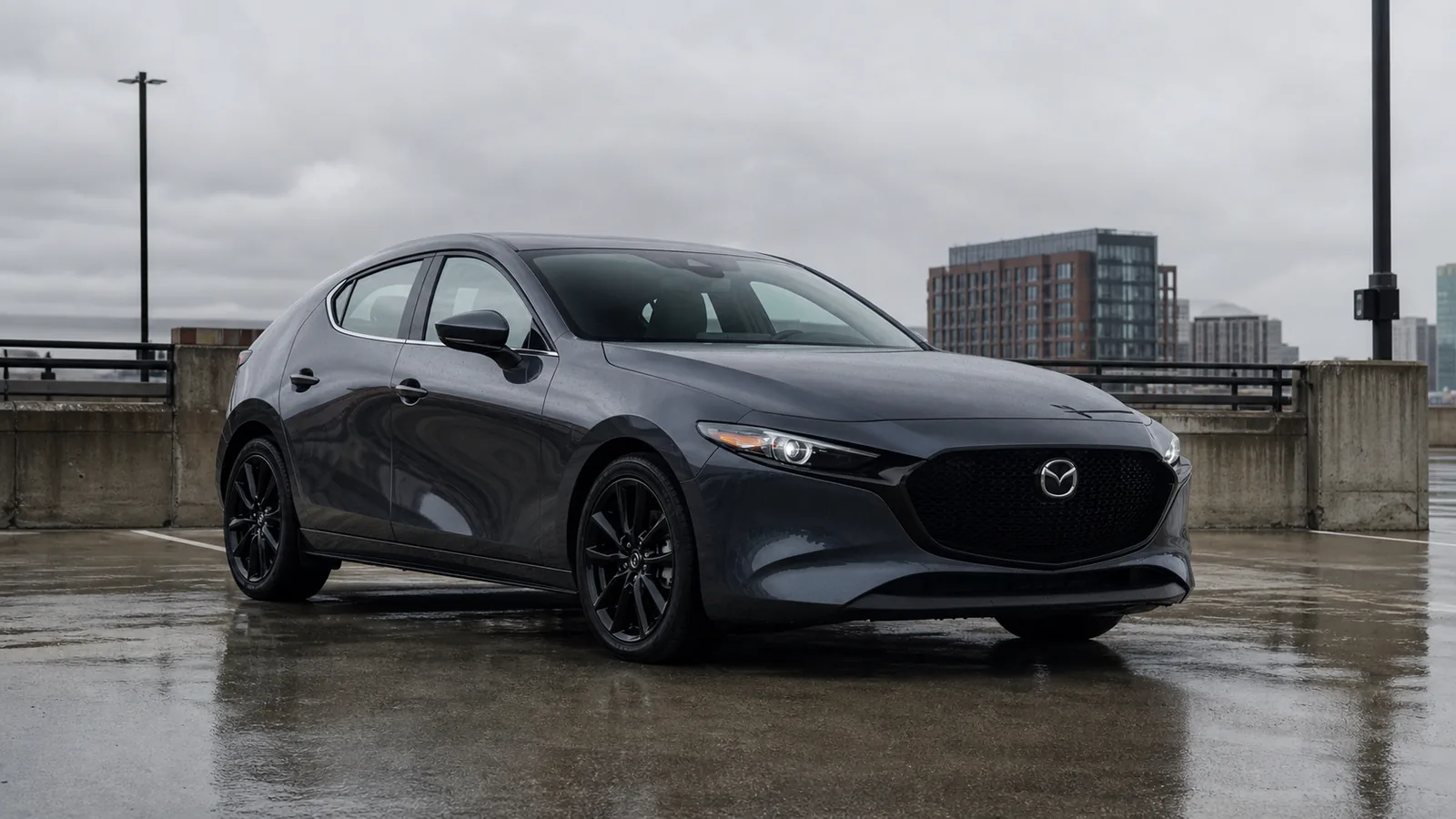
The 2026 Mazda3 comes in two body styles, and that choice changes more than the cargo opening. The sedan starts at $24,650, which is $1,000 below the base hatchback, and its cleaner rear view makes it easier to place in traffic and parking lots.
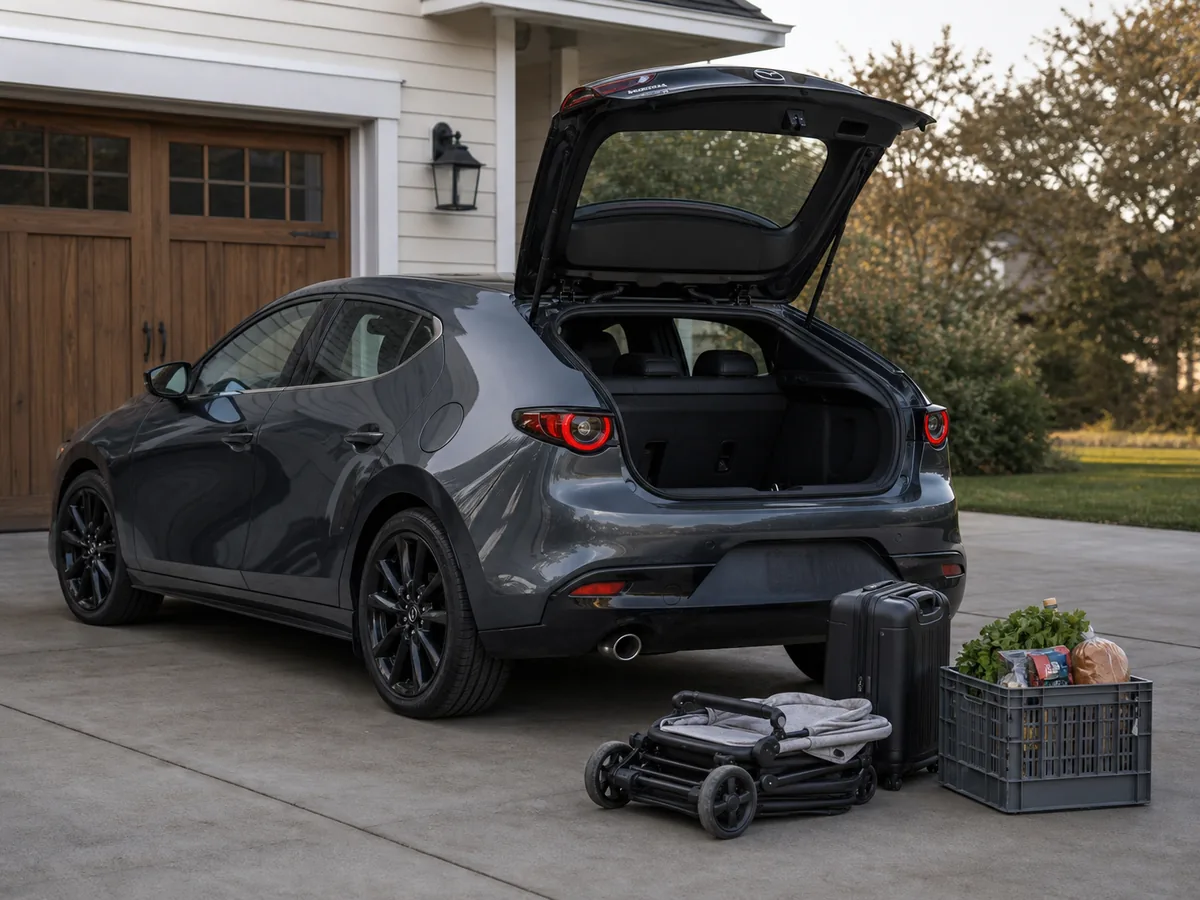
The hatchback starts at $25,650 and gives you a wide liftgate plus 20.1 cubic feet of cargo space behind the rear seat. The sedan has a 13.2 cubic foot trunk, but its longer, enclosed cargo area can still handle normal grocery and suitcase duty.
| Question | Sedan | Hatchback |
|---|---|---|
| Starting MSRP | $24,650 | $25,650 |
| Cargo space | 13.2 cu ft trunk | 20.1 cu ft behind rear seat |
| Best EPA estimate | 27 city / 36 hwy | 26 city / 34 hwy |
| Rear visibility | Clearer view | Thick rear pillars |
| Manual transmission | Not offered | Available on 2.5 S Premium |
| Best fit | Commuting and value | Bulky cargo and driver appeal |
The hatchback's opening is more useful for a bike wheel, a pet crate, or a tall box. Its rounded roof and thick rear pillars also create a large blind area, so you should reverse, merge, and change lanes during the test drive instead of judging visibility from the showroom.
Rear-seat room is tight in both. Mazda lists 35.1 inches of rear legroom, and the sloping roof makes the back feel more enclosed than the numbers suggest.
Put the tallest regular passenger behind the normal driver position before deciding that either body will serve as a family car.
The sedan category contains roomier compact choices, while the hatchback category shows the Mazda3 against other flexible small cars.
A Honda Civic offers more rear room and a larger-feeling cabin. The Mazda answers with better materials and a more intimate driving position.
Choose the sedan if price, fuel economy, and rear visibility lead your list. Choose the hatchback only when its larger opening or available manual solves a real need.
The 2.5L engine and 6-speed automatic make the everyday case
Every 2026 Mazda3 uses a 2.5L four-cylinder, but there are two very different versions.
The naturally aspirated engine makes 186 hp and 186 lb-ft on regular fuel.
It is standard on every trim except Turbo Premium Plus.
That output is generous for a base compact car. You do not have to wait for a small turbo to wake up, and the engine has enough torque for normal merging without sounding strained.
Mazda pairs it with a conventional 6-speed automatic rather than the continuously variable transmission used by most compact rivals.
The automatic shifts through real gears, which gives acceleration a more familiar rhythm than a CVT. It can hesitate before a hard pass because six ratios leave wider gaps than newer 8-speed units, but Sport mode and a firm throttle input usually settle the decision.
The manual is limited to the front-drive hatchback 2.5 S Premium.
That restriction turns it into an enthusiast choice, not the budget gearbox. It costs $31,650 before destination and gives up the sedan body, AWD, and turbo.
Test the clutch in traffic before letting rarity make the choice for you.
The Turbo Premium Plus uses standard AWD and makes up to 250 hp and 320 lb-ft on premium fuel.
Mazda lists lower output on regular fuel, so the car still runs without premium, but you pay for performance you will not fully receive.
The turbo feels effortless on hills and highway passes. It also pushes the price to $36,940 for the sedan and $38,090 for the hatchback.
A gas-powered compact can still be an efficient daily car, but the Mazda3 has no hybrid answer. A Toyota Corolla gives up power and cabin polish in exchange for a hybrid option and easier long-term fuel math.
The 186 hp engine is the better buy for most drivers because it already fixes the slow-base-engine problem common in this class. Buy the turbo for repeated mountain driving or passing power, not for a badge you rarely use.
Build the right 2026 Mazda3 without climbing too far
Mazda spreads useful equipment across six versions, which makes price escalation easy. Start by deciding whether you need heated seats, AWD, a manual, or the turbo.
Those four answers remove most of the trim list.
The base 2.5 S already includes adaptive cruise control with stop-and-go operation on automatic cars, blind-spot monitoring, rear cross-traffic alert, lane support, LED lights, smartphone integration, and an eight-speaker audio system. It is not a stripped commuter.
Select Sport adds dual-zone climate control, rain-sensing wipers, leatherette, keyless entry, and 18-inch wheels.
Preferred adds heated front seats, a moonroof, and a power driver's seat with memory.
Those are comfort upgrades, not changes to the engine or space.
| Trim | Main reason to buy | Main caution |
|---|---|---|
| 2.5 S | Lowest price with strong standard safety | Cloth, 16-inch wheels, fewer comfort items |
| Select Sport | Useful daily convenience | 18-inch tire replacement cost |
| Preferred | Heated seats and power driver seat | Price moves toward larger cars |
| Carbon Edition | Standard AWD and distinctive cabin | AWD is bundled with appearance items |
| 2.5 S Premium | Only manual Mazda3 | Hatchback and FWD only |
| Turbo Premium Plus | Maximum power and driver aids | Near-premium price and running cost |
Carbon Edition is the first AWD answer, and it costs $29,815 as a sedan or $30,965 as a hatchback before destination.
Do not buy it for snow without also budgeting for four suitable, matched tires.
AWD helps the car move, while tires still set braking and cornering grip.
The Turbo Premium Plus adds a 360-degree camera, parking sensors, adaptive front lighting, traffic support, a head-up display, a larger center screen, and the strong engine.
It is complete, but its price overlaps a larger sedan and some entry premium cars. Scan the premium price tier before assuming the loaded compact is the best use of $38,000.
For most buyers, Select Sport or Preferred is the sensible ceiling.
Pick Select Sport if cold seats do not bother you. Pick Preferred if seat heat and driver memory improve every commute.
The Mazda model range also creates internal competition. A similarly priced CX-30 sits higher, while a Mazda CX-5 gives families more rear space.
The best trim is the least expensive one that fixes a daily problem you can name.
Cabin quality is high, but space and visibility set the limit
The Mazda3 cabin feels expensive because the controls sit where your hands expect them, the dash uses soft materials, and the design avoids a wall of bright screens. The driver sits low with the wheel close, which makes the car feel more deliberate than a typical economy compact.
Mazda's rotary controller handles most center-screen functions. It reduces reaching while the car moves, but drivers used to tapping every icon may need a few days to adjust.
The 10.25-inch display on Turbo Premium Plus allows touch input only for supported phone-projection functions, so do not assume the whole interface works like a tablet.
The front seats are supportive and the driving position has a wide adjustment range.
The back seat is the compromise. Adults can fit, but the narrow door opening, modest knee room, and dark hatchback side glass make frequent rear passengers a reason to compare rivals.
- Sit behind your own driving position rather than behind a pushed-forward display seat
- Install the actual child seat and check front-passenger space
- Load the stroller, pet crate, or work case through the chosen body opening
- Reverse into a tight space to test the hatchback's blind areas
- Drive on coarse pavement with the audio off to judge tire noise
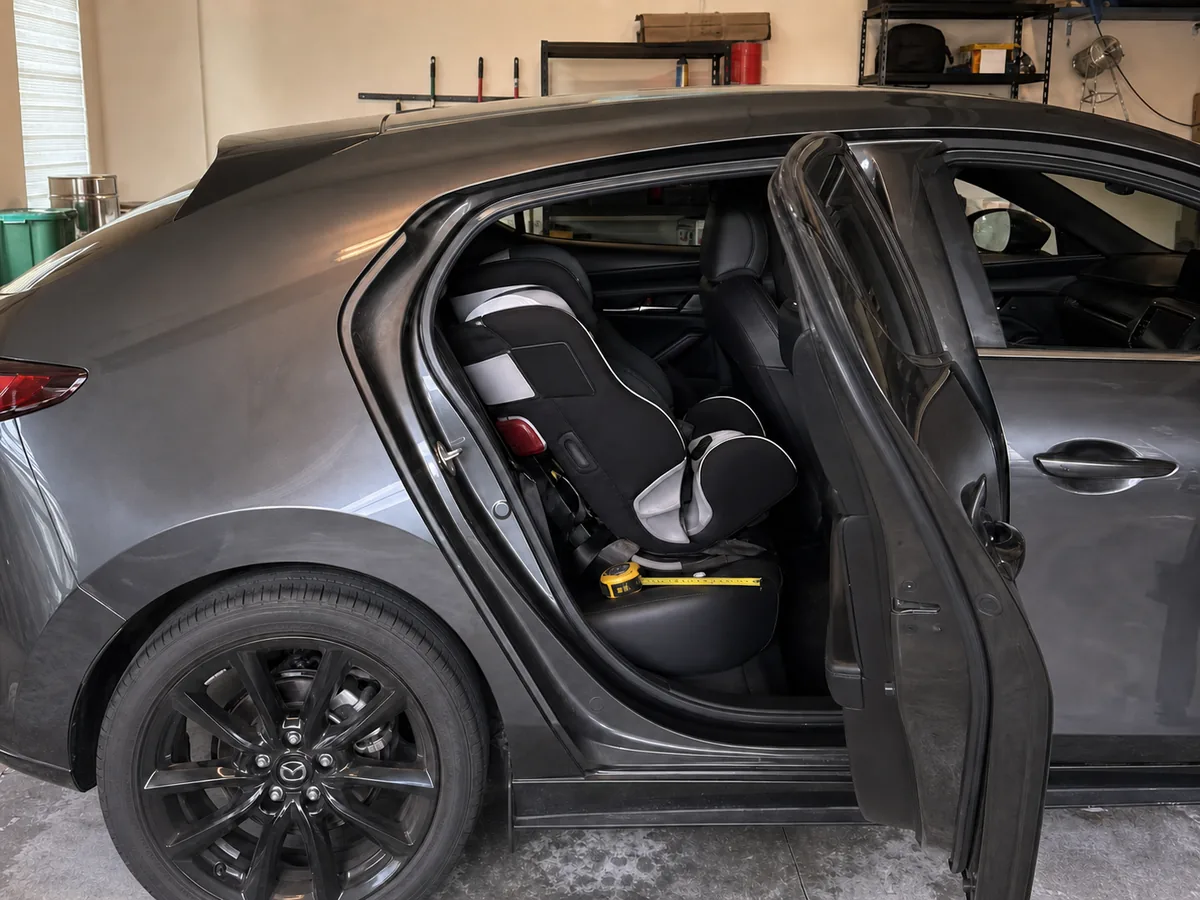
The hatchback cargo floor is useful, but the sloping rear body gives away some boxy volume. The sedan trunk has a smaller published figure and a narrower opening, yet it can be easier to secure luggage out of sight.
Decide with the objects you carry instead of choosing from cubic feet alone.
A planned Mazda3 alternatives list will separate roomier, cheaper, and more efficient substitutes. Today, the clearest test is against the Civic for space and against the Subaru Impreza for AWD hatchback utility.
The Mazda3 feels premium from the front seats, but it remains a small car from the back seat. That is acceptable for one or two people and less convincing for a household that carries adults every week.
Safety equipment is strong, and headlight trim still matters
Mazda gives every 2026 Mazda3 a useful safety baseline. Automatic emergency braking, adaptive cruise on automatic cars, blind-spot monitoring, rear cross-traffic alert, lane-departure warning, lane-keeping support, driver-attention monitoring, and automatic high beams are standard.
The 2026 Mazda3 sedan earned an IIHS Top Safety Pick+ designation. IIHS rates its small-overlap, updated moderate-overlap, and updated side crash performance Good.
The institute also notes that headlight performance varies by trim, which is a reason to test night visibility rather than stopping at the award.
The standard front crash-prevention system received an Acceptable vehicle-to-vehicle rating and a Good pedestrian rating in IIHS testing.
These systems reduce risk, but the driver's view still matters, especially in the hatchback.
Cameras and warning lamps do not turn thick rear pillars into glass.
- Confirm adaptive cruise slows and resumes smoothly on the test drive
- Check that no camera or safety warning remains on after startup
- Test blind-spot alerts from both mirrors
- Compare low-beam reach on an unlit road if night driving is common
A limited group of 2024 Mazda3 vehicles was recalled because an incorrect forward-camera setting could affect high-beam control and some warning functions.
That history does not make every Mazda3 unsafe. It does make a VIN check through NHTSA recall search a required used-car step.
Buy the exact trim and VIN, not the model's award headline. Verify the installed headlights, driver-assist equipment, windshield condition, and completed recall work before paying.
Drive the Mazda3 on rough pavement before the steering sells you
The Mazda3 earns much of its reputation from the driver's seat. The steering builds weight cleanly, the body stays settled in a bend, and the brake pedal is easier to judge than the soft pedals in some economy cars.
Those strengths show up at ordinary speeds, which makes them useful rather than theatrical.
Ride quality depends on the wheel and tire package. The base 16-inch wheels leave more tire sidewall between the cabin and a pothole.
Most higher trims use 18-inch wheels, which sharpen the initial response but send more of a square road edge into the seat.
That is why a showroom loop is not enough. Build a short test route that includes the roads you normally avoid:
- Cross a broken intersection at neighborhood speed
- Hold 45 to 55 mph on coarse pavement with the audio off
- Join a highway and ask the transmission for one decisive downshift
- Take a familiar ramp without rushing it
- Park, reverse, and make a tight turn at full steering lock
- Repeat one section from the rear seat
The current Mazda3 uses a torsion-beam rear suspension rather than the independent rear layout of the previous generation.
The design saves space and can be tuned well, so it is not an automatic flaw. It does make sharp one-wheel impacts and rough mid-corner pavement worth testing, especially on 18-inch tires.
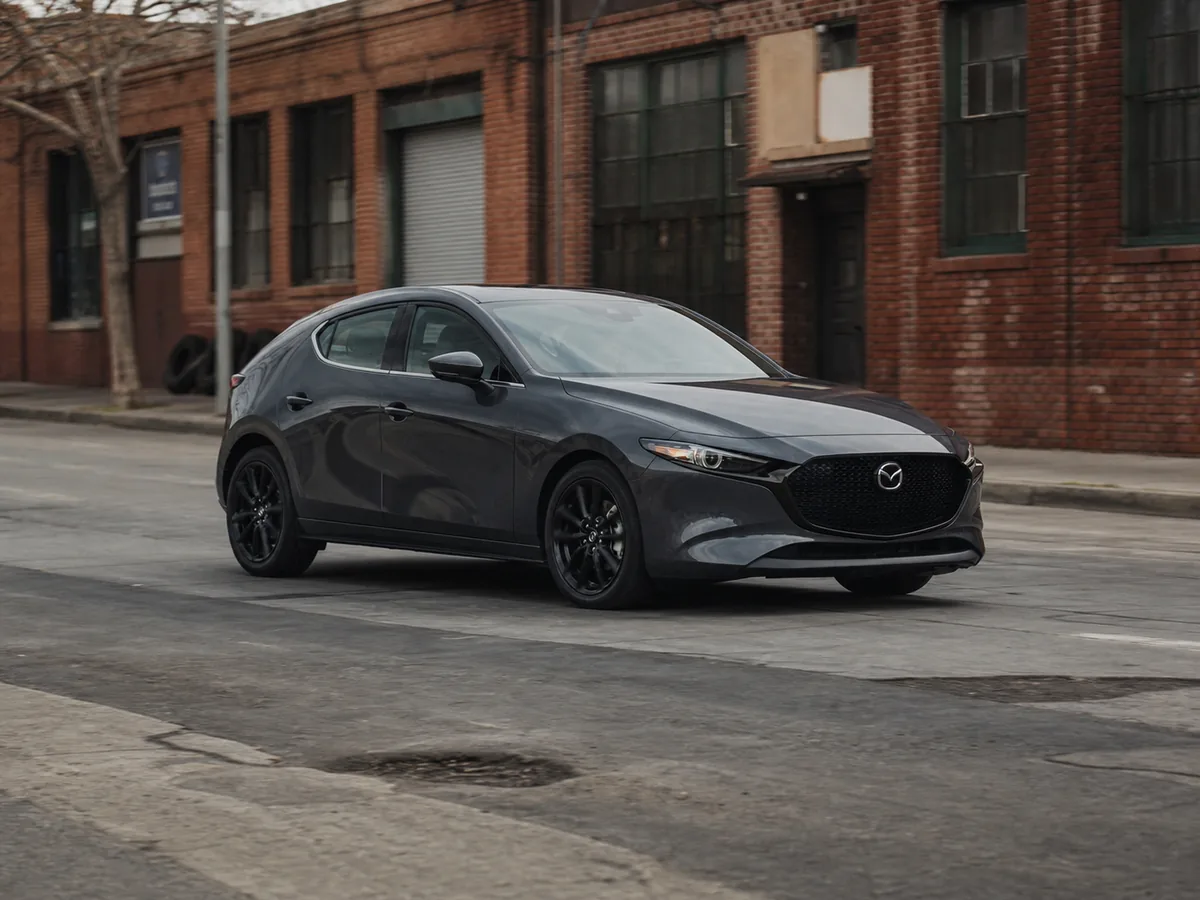
Listen for more than tire noise. A loose trim buzz, wheel-bearing hum, brake vibration, or suspension knock should change a used-car negotiation.
A new car should feel tight and track straight with the wheel centered.
The 6-speed automatic should make one clean downshift when you ask for a highway pass. Repeated hunting, a hard engagement, or a warning light is different from the normal pause of a transmission choosing among six gears.
Manual shoppers should test clutch take-up on an incline and make several second-gear shifts while the car is cold.
The turbo can overwhelm the front-biased character less than a high-output front-drive compact because AWD is standard.
Even so, its heavier nose and stronger acceleration do not make it the most delicate version.
The 186 hp front-drive car feels lighter and asks less of the tires.
Use the front-wheel-drive category to compare simpler compact setups, then drive an AWD Mazda3 on the same road if traction is the reason for upgrading.
The goal is not to find the fastest car. It is to find the wheel, tire, and powertrain combination that stays composed on your commute.
The Mazda3 should feel precise without making your worst regular road tiring. If the 18-inch car feels busy, try a base car before blaming the whole model.
Reliability is promising, but a used Mazda3 still needs five checks
The current Mazda3 generation arrived for 2019 and keeps a relatively conventional mechanical layout. Its naturally aspirated engine and 6-speed automatic avoid the small turbo plus CVT combination common elsewhere.
That simplicity supports a good ownership case, but it does not erase condition or first-year risk.
- 2004 to 2009First generation established the sedan and hatchback formula
- 2010 to 2013Second generation added more space and later Skyactiv technology
- 2014 to 2018Third generation improved efficiency and cabin quality
- 2019 to presentCurrent generation added a richer cabin, available AWD, and turbo power
A current-generation car should start quickly, idle evenly, shift cleanly when cold, and track straight without wheel or tire noise.
Pair a phone, use the camera, test every USB port, and confirm connected functions if the seller includes them in the price.
Mazda has published service information covering connected-service and infotainment complaints across 2019 to 2025 cars, so electronics deserve a real test.
Check the 12-volt battery date and resting condition. A weak battery can create warnings that look more serious than the battery itself, and a car that sat on a dealer lot may need attention even with low miles.
AWD cars add another inspection. All four tires should match in brand, model, size, and similar tread depth.
Listen for hum, whine, or vibration during a steady 40 to 60 mph drive and during tight low-speed turns.
The five checks are simple to remember:
- Cold start and 6-speed automatic or clutch behavior
- Battery age, warning lights, and charging voltage
- Screen, phone pairing, cameras, and connected functions
- Matching tires, alignment, and AWD noise where fitted
- Service history, crash repair, and recall completion
A forthcoming Mazda3 reliability report will go deeper by year, while the planned Mazda3 problems breakdown separates complaints from confirmed defects.
In this profile, the useful answer is condition.
A stock 2.5 S car with boring records is a safer used buy than a loaded turbo with missing history.
If you are comparing warranty against a lower used price, work through the new-versus-used decision before choosing. Mazda's new-car warranty is 3 years or 36,000 miles, with powertrain coverage for 5 years or 60,000 miles.
Fuel, tires, AWD, and turbo power shape the ownership bill
The least expensive Mazda3 to run is the front-drive sedan with the 186 hp engine and smaller wheels.
Mazda estimates 27 mpg city, 36 highway, and 30 combined for that setup. The front-drive automatic hatchback falls to 26 city, 34 highway, and 29 combined because of its body and weight.
AWD costs more in three places. The car costs more to buy, uses more fuel, and needs four closely matched tires.
The system can be valuable in snow and heavy rain, but all-wheel-drive choices should still be paired with tires suited to the weather.
| Choice | What it adds | Cost consequence |
|---|---|---|
| FWD sedan | Best published fuel economy | Lowest fuel and tire burden |
| Hatchback | Larger cargo opening | Higher price and slightly lower mpg |
| 18-inch wheels | Sharper appearance | More expensive tires and firmer impacts |
| AWD | Better power delivery in poor weather | More fuel and tire matching |
| Turbo | Strong passing power | Higher price, insurance, and fuel use |
| Manual | Driver involvement | Clutch wear and limited trim choice |
The turbo deserves a fuel note. It produces its highest rating on 93-octane premium and less power on regular.
If you plan to feed it regular all the time, question whether the price and insurance premium are buying enough benefit.
Tires may create a larger surprise than scheduled service. Base 16-inch sizes are cheaper and better protected from potholes than the 18-inch tires fitted to most higher trims.
Price a complete replacement set before choosing wheels from a photo.
Routine service remains normal compact-car work:
- Engine oil and filter at the interval for your use
- Tire rotations, pressure checks, and alignment
- Brake fluid, engine and cabin filters, wipers, and battery
- Coolant and spark plugs at the manufacturer schedule
- Extra attention to four matching tires on AWD cars
The planned Mazda3 maintenance schedule will list the exact mileage points. The planned real-world MPG report will compare owner logs with the EPA estimates.
Insurance varies enough that the Turbo Premium Plus should be quoted by VIN before a deposit.
The same rule applies to a young driver choosing a hatchback with 18-inch wheels.
A low repair-risk reputation does not guarantee a low premium.
A front-drive 2.5 S or Select Sport keeps the Mazda3's ownership case strongest. AWD and turbo power are useful upgrades only when their benefit appears in your real week.
Who should buy a Mazda3, and the version we recommend
Buy a Mazda3 if you want a compact car that feels composed and well finished from the driver's seat. It works best for one or two adults, a small household that rarely fills the rear seat, or a commuter who wants a traditional automatic instead of a CVT.
The car also suits buyers who want choices the class rarely combines. You can get a sedan or hatchback, FWD or AWD, a manual or automatic, and normal or turbo power.
The catch is that no single trim combines all of them.
A Civic is the better all-round compact for passenger space and efficiency.
A Corolla is the conservative fuel and resale choice. An Impreza is the simpler AWD hatchback decision, while a Mazda MX-5 Miata is the focused answer when driving fun matters more than doors and cargo.
A planned Civic versus Mazda3 comparison will make the room and driving trade clearer. For now, drive both over the same rough road, sit in both back seats, and load the same cargo.
Our recommendation is a front-drive Select Sport sedan for buyers who want the most useful convenience equipment without paying for AWD or turbo complexity. Preferred is worth the step when heated seats and driver memory matter every day.
Choose the hatchback instead if you have proved the opening solves a cargo problem.
Choose Carbon Edition when AWD is required and you like its bundled equipment. Choose the manual or turbo only after a long test drive confirms that the special powertrain is the reason you want the car.
The Mazda3 is at its best when it stays a polished, reasonably priced compact. Once the trim bill becomes the main event, its tight back seat becomes harder to excuse.
Compare the final price with a larger car before signing
A Mazda3 can move from a $24,650 compact to a $38,090 hatchback before destination, tax, registration, accessories, or finance cost. The car does not gain rear legroom as the trim rises, so the out-the-door number needs a size check as well as an equipment check.
Ask the seller for a written price that separates vehicle price, destination, dealer fees, add-ons, tax, and financing. Compare that total with a roomier compact and one midsize sedan equipped with the features you actually use.
A higher trim can still be the right answer. Carbon Edition may bundle AWD at a price below a separate winter car.
Turbo Premium Plus may replace a used premium sedan for a driver who values compact size and strong passing power.
The comparison simply makes those reasons visible.
The mainstream price category is the useful boundary for the normal 2.5 S trims. Once the Mazda enters premium pricing, the buyer should demand a clear benefit from AWD, manual control, or turbo power.
Keep the Mazda3 when its final price still buys a better daily fit, not merely a longer feature list.