Pickup or SUV: which Hummer EV body solves your actual load?
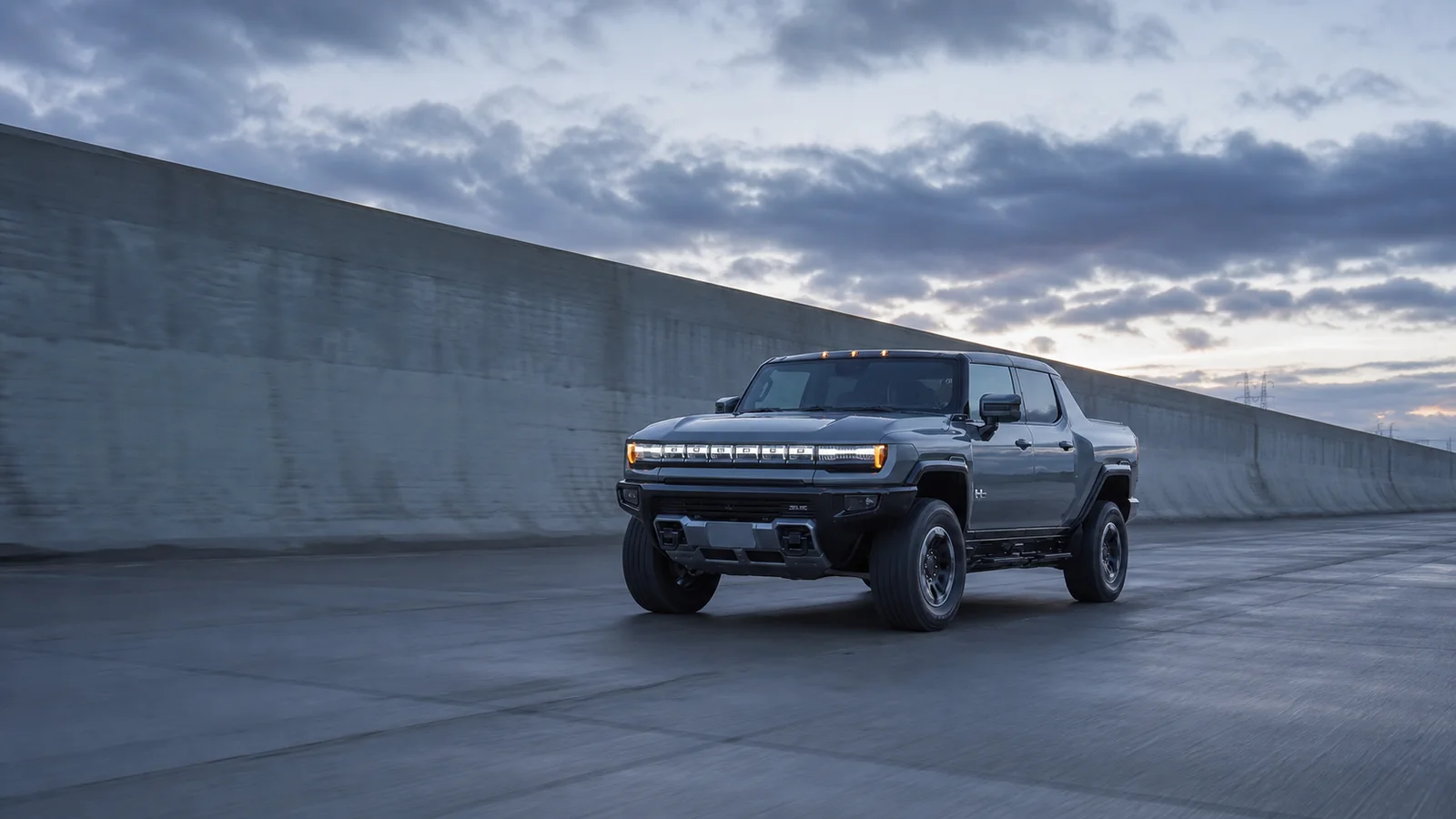
Choose the Hummer EV SUV when enclosed cargo and a shorter body matter more than an open bed. Choose the Pickup when you regularly carry dirty, tall, or awkward equipment and can park a vehicle that is 216.8 inches long.
Both versions seat five and share an 11.3-cubic-foot front trunk. Their cabins feel related, but the space behind the passengers changes how each vehicle works every week.
The Pickup has a 60.1-inch bed with 36.7 cubic feet of published volume. A hard cover can protect gear, although the bed still separates luggage from the climate-controlled cabin.
The SUV measures 206.7 inches with its rear-mounted spare, which makes it 10.1 inches shorter than the Pickup. GMC previously published 35.9 cubic feet behind the second row and 81.8 cubic feet with it folded, so groceries, luggage, and pets stay enclosed.
| Measure | Pickup | SUV | Buyer consequence |
|---|---|---|---|
| Overall length | 216.8 in | 206.7 in with spare | SUV needs 10.1 fewer inches of garage or curb space |
| Passenger capacity | 5 | 5 | Body choice does not add a third row |
| Primary rear storage | 60.1-in bed, 36.7 cu ft | 35.9 cu ft behind row two in prior published specs | Pickup separates cargo, SUV encloses it |
| Maximum enclosed rear cargo | Cab only | 81.8 cu ft with rear seats folded in prior published specs | SUV handles large weather-protected loads |
| Front trunk | 11.3 cu ft | 11.3 cu ft | Both offer secure storage away from the rear load area |
| Maximum listed DC rate | Up to 350 kW | Up to 300 kW | Pickup has the higher published peak in applicable configurations |
Four-wheel steering reduces the turning circle and makes both bodies easier to place than their length suggests. It cannot create garage clearance, narrow the 86.5-inch body, or protect the Pickup bed from weather.
Take the recurring load to the dealership and place it where it will actually travel. Check the closed garage door, walking clearance, charging-cable reach, liftgate or tailgate movement, and the path through the driveway.
The Ford F-150 Lightning offers a more conventional full-size pickup layout and road manners when the open bed matters more than extreme trail hardware.
The Rivian R1T is the more compact premium electric pickup, which can suit a buyer who wants strong performance and outdoor utility without Hummer width.
Pick the SUV for enclosed family cargo and the Pickup for recurring open-bed work. If neither body passes the parking test, the steering technology does not fix the mismatch.
Can your home electrical service refill a Hummer EV overnight?
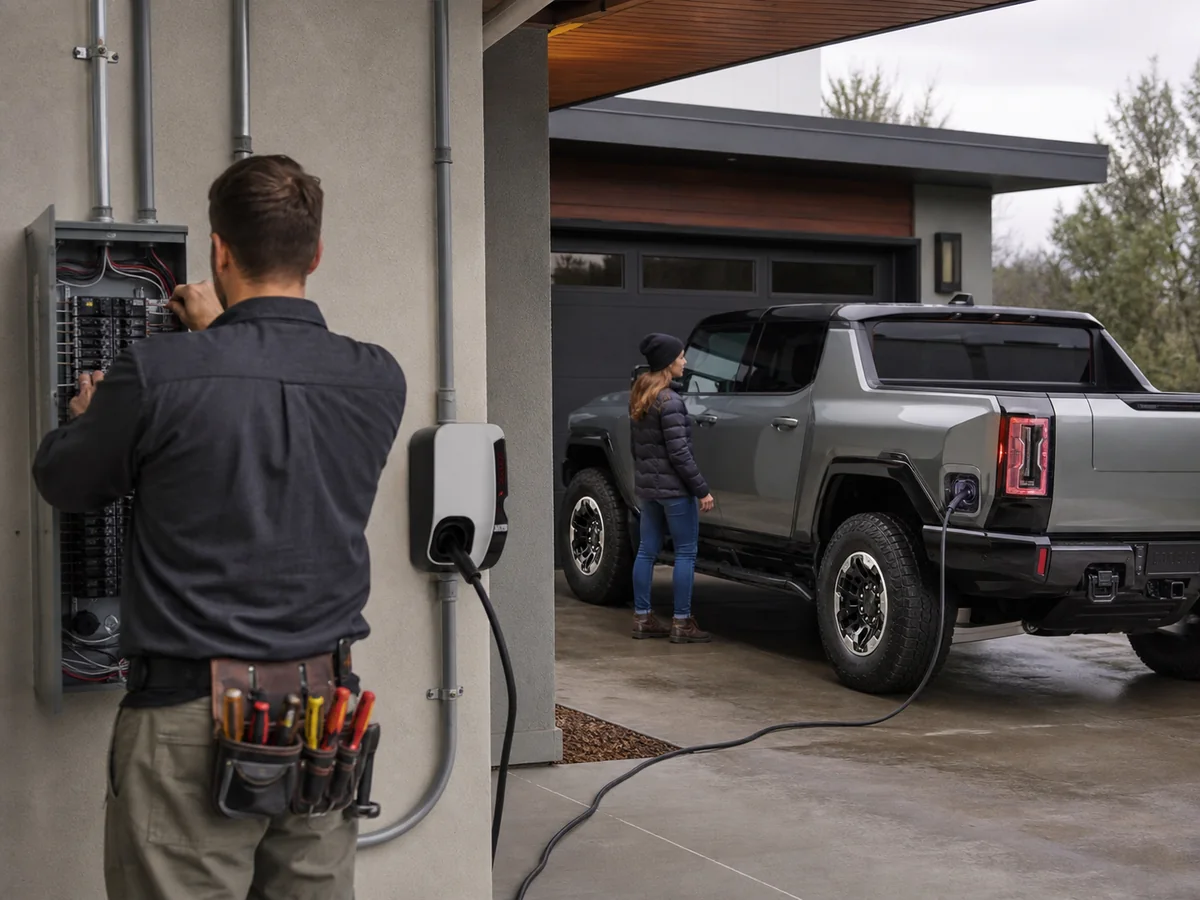
Confirm home charging before placing an order. A large battery magnifies every limitation in outlet power, electrical service, cable reach, and the hours the vehicle remains parked.
A normal 120-volt outlet can add energy, but it is not a practical primary solution for a Hummer that travels meaningful daily miles. The vehicle may consume more energy during the day than the outlet can replace overnight.
Applicable configurations can accept up to 19.2 kW on Level 2 equipment, but the vehicle's ceiling does not mean a house can supply it. The available rate depends on the installed charger, circuit, service capacity, temperature, and onboard equipment in the exact vehicle.
A licensed electrician should perform a load calculation and inspect the panel, meter, grounding, cable route, and parking location. An 80-amp charging installation has different service demands and hardware from a more common 40- or 48-amp setup.
The Pickup lists up to 350-kW DC charging and the SUV up to 300 kW, yet those are peak acceptance figures. Charger output, battery temperature, starting charge, site sharing, and the charging curve determine the actual session.
Car and Driver needed 128 minutes to move its tested SUV from 10 to 90 percent in one session, with a 78-kW average. One result does not define every charger, but it shows why a high peak cannot predict total stop time.
Vehicle-to-home and vehicle-to-vehicle capability expands for 2026, subject to compatible equipment and installation. Price that equipment separately because the charge port alone does not power a house during an outage.
Obtain the electrical quote before choosing the trim. A dependable moderate-rate home setup creates more daily value than a theoretical peak the property cannot deliver.
Why the 2X is the rational Hummer EV before you consider 3X
The 2X is the sensible starting point because it delivers the signature four-wheel steering, removable roof panels, and strong electric performance without making maximum output the reason to buy. GMC lists both 2026 2X bodies from $97,200 before destination.
Standard 2X output is 570 hp with a 20-module battery. GMC estimates 316 miles for the Pickup and 319 miles for the SUV before an Extreme Off-Road configuration changes the tires and range.
The SUV 3X raises output to 830 hp and carries a 310-mile estimate in standard form. Its claimed 3.5-second run to 60 mph is already far beyond what a tall, wide road vehicle needs for merging.
The Pickup 3X creates a more complicated decision because GMC offers 20- and 24-module versions. The larger battery brings an estimated 363 miles and a claimed 1,160 hp, while the 20-module version is rated at 312 miles and 830 hp.
Extreme Off-Road equipment adds 35-inch mud-terrain tires, underbody cameras, rock protection, and locking hardware. Those parts make sense for repeated trail use, but the tires reduce estimated range and can raise noise and replacement cost.
The important exception is range. A buyer who repeatedly drives a long route may justify the larger Pickup battery even without needing the extra power, although that body must still fit daily parking.
Pricing must include destination, the chosen package, installation for home charging, insurance, and a set of correct load-rated tires. The difference between trims is only one part of the first-year cash requirement.
Buy the 2X unless a named route, obstacle, or performance need proves that 3X changes the outcome. That rule keeps the Hummer's spectacle from setting the budget.
What 300-plus miles of range means in an inefficient EV
A 300-mile rating does not make the Hummer EV efficient. Its large battery creates useful reach, while its mass, frontal area, and tires require far more energy per mile than a smaller electric vehicle.
GMC's 2026 numbers are manufacturer estimates for current configurations. The latest complete EPA set available during this review covers 2025 vehicles, so those figures help explain consumption rather than certify every 2026 trim.
Published 2025 EPA data ranges from about 63.9 kWh per 100 miles for standard-tire versions to roughly 71.7 kWh per 100 miles for one mud-terrain configuration. Lower consumption is better, which means the tire package can consume about 12 percent more energy over the same distance.
Car and Driver recorded 250 miles in a 75-mph highway test of its SUV. That result does not invalidate the rating because steady high speed, test temperature, wheel choice, and usable reserve differ from a mixed-cycle laboratory test.
Cold weather adds cabin heating and reduces battery performance. A trailer adds aerodynamic drag, while roof panels removed or cargo placed above the cab can also increase resistance.
Build a travel plan from the least favorable repeated condition, not the largest published number. A cold highway towing trip needs a larger buffer than an urban commute with overnight charging.
Fast-charger spacing matters because a Hummer may arrive with enough indicated range to reach one station but too little reserve to reach the next if that unit is unavailable. Check recent station status and identify a backup before entering a sparse corridor.
A Tesla Model Y is easier to park and uses much less energy, although it does not provide the Hummer's bed, four-wheel steering, or rugged hardware.
The Hyundai Ioniq 5 combines a smaller footprint with rapid charging and a flexible cabin for buyers whose real need is an electric daily vehicle.
Treat 300 miles as a planning ceiling, then subtract for speed, weather, tires, elevation, and towing. The correct configuration is the one that completes the recurring trip with a useful reserve.
What does 8,700 pounds feel like from the driver's seat?
The Hummer EV combines startling acceleration with the reactions of an unusually heavy, wide vehicle. It feels effortless in a straight-line launch, but the driver still manages its mass through every corner, stop, lane change, and parking maneuver.
Car and Driver weighed its tested SUV at 8,660 pounds, while MotorTrend recorded 8,673 pounds for another SUV. Configuration changes the exact number, but both results put the vehicle near 4.3 tons before people or cargo.
MotorTrend measured 3.4 seconds to 60 mph, yet its figure-eight test exposed understeer and overheated brakes. The same vehicle stopped from 60 mph in 142 feet, while Car and Driver recorded 199 feet from 70 mph, so speed and test method matter when comparing the numbers.
The brake pedal deserves more attention than the acceleration figure during a test drive. MotorTrend found the pedal numb and the vehicle unsettled under anti-lock braking, while Edmunds reported predictable modulation in ordinary stops in a 2024 Pickup.
Strong regenerative braking makes one-pedal driving useful in routine traffic and reduces how often the friction brakes work. It does not erase heat or grip limits during repeated hard stops, slippery conditions, or moments when battery state reduces regeneration.
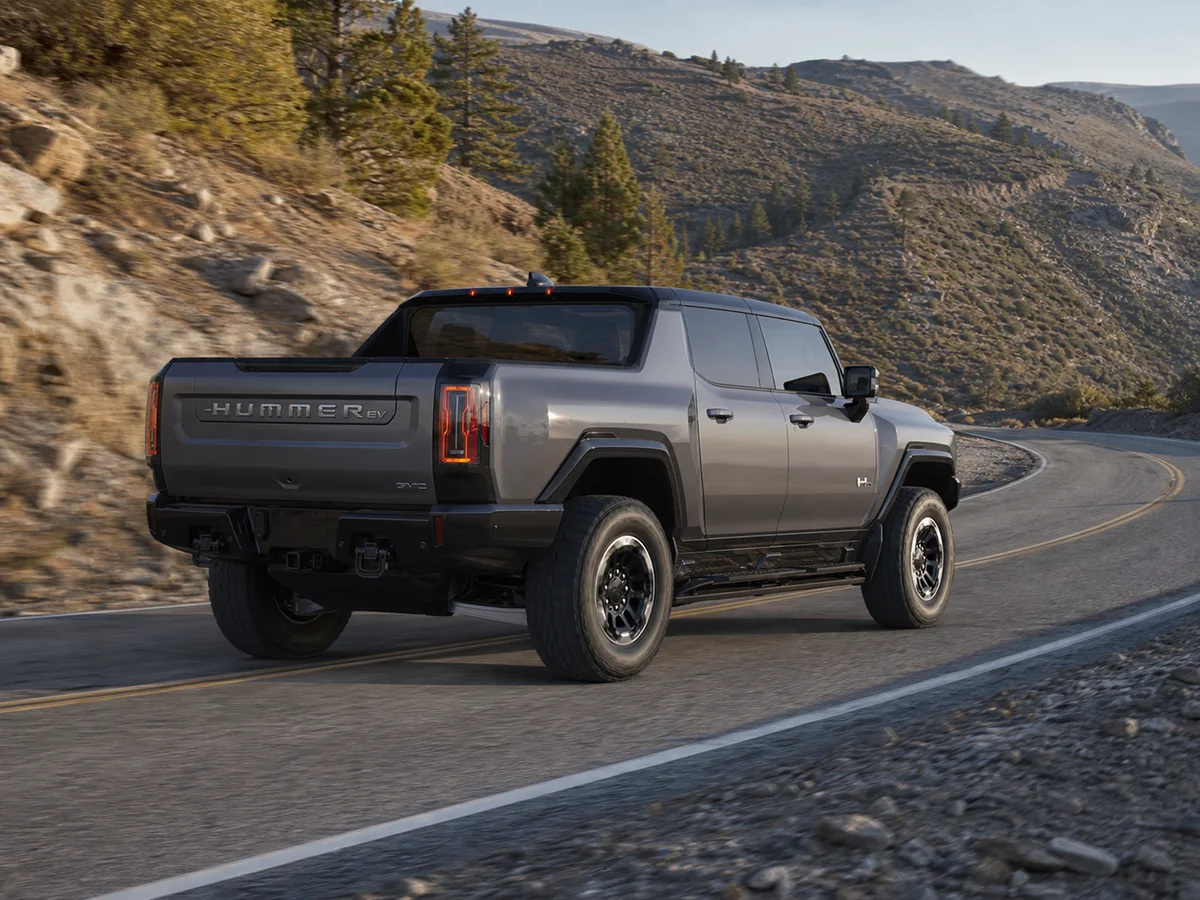
Ride comfort is better than the size and off-road tires suggest because the air suspension absorbs broken pavement and large impacts well. Body motion is still noticeable, and four-wheel steering can make the vehicle feel as if it pivots around the driver during a tight turn rather than tracing the arc of a conventional truck.
Steering effort is manageable, but Edmunds found that its Pickup needed careful lane placement and did not always communicate the straight-ahead position clearly. The 86.5-inch body width remains the daily constraint even when the rear wheels shorten the turning circle.
Highway refinement depends on the exact roof and tire package. Edmunds heard wind around the removable roof panels, all-terrain-tire hum, and electric-motor whine in its test vehicle, while Super Cruise can reduce workload on compatible divided roads without changing those physical characteristics.
The square windows and high seating position provide a broad forward view, and the available camera system helps reveal obstacles close to the body. Small mirrors and the vehicle's width still create blind-area and lane-placement work that cameras cannot remove.
Large load-rated tires cost more than ordinary crossover tires and can turn alignment wear into a large bill. Check tread depth across the full width, sidewall condition, production dates, load specification, and local replacement availability before buying used.
Drive a tight parking structure, rough street, highway merge, and several normal stops before deciding. Any steering pull, vibration, brake pulsation, or abnormal tire noise needs inspection rather than an explanation that every heavy EV behaves that way.
Judge the Hummer by its ride, steering, braking, visibility, and lane fit after the acceleration novelty fades. A buyer who cannot relax behind its width and mass will not solve that mismatch with more horsepower.
Which off-road hardware is useful beyond the demonstration?
Pay for off-road hardware when a repeated obstacle requires it. A branded mode has little value if the vehicle spends every week on pavement and well-graded access roads.
CrabWalk turns all four wheels in the same direction at low speed, allowing diagonal movement around an obstacle. King Crab turns the rear wheels faster than the fronts during its maneuver, which can rotate the vehicle more aggressively in tight terrain.
Air suspension changes clearance by mode. Prior published specifications listed about 10.2 inches in Normal, 12 inches in Terrain, and 16 inches in Extract Mode, with Extract raising the vehicle roughly six inches.
Trail hardware and its real use
- Four-wheel steering
- Tight turns and diagonal placement around obstacles
- Extract Mode
- Temporary additional clearance when the underbody would otherwise contact terrain
- Front and rear lockers
- Low-speed traction when a wheel can lift or slip
- Underbody cameras
- Wheel and obstacle placement where the hood blocks the view
- 35-inch mud-terrain tires
- Soft surfaces and rocks, with range, noise, and replacement-cost penalties
Extreme Off-Road adds 35-inch mud-terrain tires, underbody protection, camera coverage, and locking hardware. Those parts can prevent damage and maintain movement on a real trail, but they do not raise the vehicle's legal road limits.
Water-fording claims depend on the selected mode, depth, current, bottom condition, and the instructions in the owner manual. Do not use a marketing maximum as permission to enter moving or unknown water.
The Pickup's longer rear body changes breakover and departure behavior compared with the SUV. The SUV is usually the easier shape for a tight trail, while the Pickup's bed may be better for dirty recovery equipment.
A buyer should name the trail, access road, job site, or seasonal condition that needs each option. If no recurring obstacle appears, standard tires preserve more range and generally suit road use better.
The useful package is the one that prevents a known traction or clearance failure. Equipment bought for one demonstration creates a permanent cost in range, noise, and tires.
How towing and payload shrink once people and gear are aboard
Use the labels on the exact vehicle, not one universal Hummer EV tow number. Battery size, body, trim, tires, equipment, and option weight can change both trailer and payload limits.
The Tire and Loading Information label states how much occupant and cargo weight the vehicle can carry. Start with that number, then subtract every person, bag, accessory, recovery tool, bed item, and other load placed in or on the vehicle.
The trailering label supplies configuration-specific limits. The 2026 towing supplement also makes clear that trailer tongue weight counts against vehicle capacity, so a high trailer rating can become unusable when little payload remains.
Prior published SUV specifications illustrate the variation. A 2024 2X was listed at up to 10,000 pounds of towing and 1,460 pounds of payload, while a 3X configuration was listed at 7,500 pounds and 1,190 pounds.
| Item | Example weight | Remaining from a 1,460-lb placard |
|---|---|---|
| Starting placard capacity | 1,460 lb | 1,460 lb |
| Driver and three passengers | 650 lb | 810 lb |
| Cargo and installed accessories | 250 lb | 560 lb |
| Measured trailer tongue weight | 600 lb | Exceeds example capacity by 40 lb |
The table is arithmetic, not a rating for another vehicle. A different VIN can begin with less payload, and actual people, cargo, hitch hardware, and tongue weight must replace every example figure.
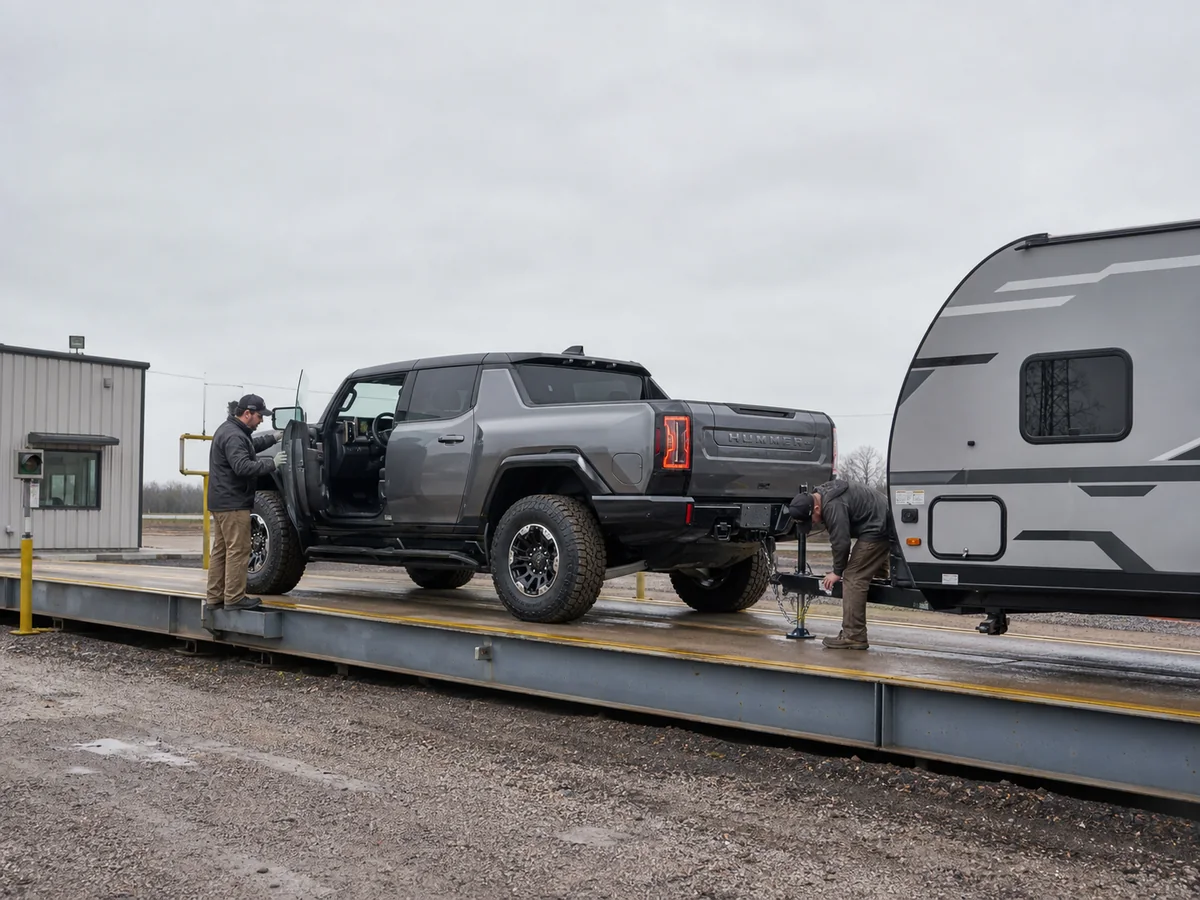
Trailer aerodynamics can reduce electric range more severely than trailer weight alone suggests. A tall enclosed trailer exposes a large wall to highway air, which increases energy use and shortens the distance between charging stops.
Charging with a trailer also needs planning because many stations require the driver to unhitch or block a lane. Review satellite views and recent station photographs before depending on a site along the route.
A public scale can verify axle and combined weights after the trailer is loaded as it will travel. Repeat the measurement when passengers, equipment, or tongue weight changes materially.
A GMC Sierra 1500 makes more sense when long-distance trailer work and fast gasoline refueling outweigh electric operation.
If the loaded arithmetic exceeds a label, choose a lighter trailer, remove load, or choose another vehicle. Horsepower cannot restore legal capacity.
Cabin and cargo: impressive space, mixed material value
The cabin provides real width, a commanding view, and useful physical controls. It also contains surfaces that can feel ordinary beside a six-figure transaction price.
Five adults have generous shoulder room, although the rear floor and seating position should be tested over a long drive. There is no third row, so the exterior size does not translate into seven-passenger capacity.
A 13.4-inch center screen and 12.3-inch driver display carry navigation, vehicle settings, camera views, and off-road information. Hard buttons retain direct access to frequent climate and vehicle functions, which helps on a rough surface or while wearing gloves.
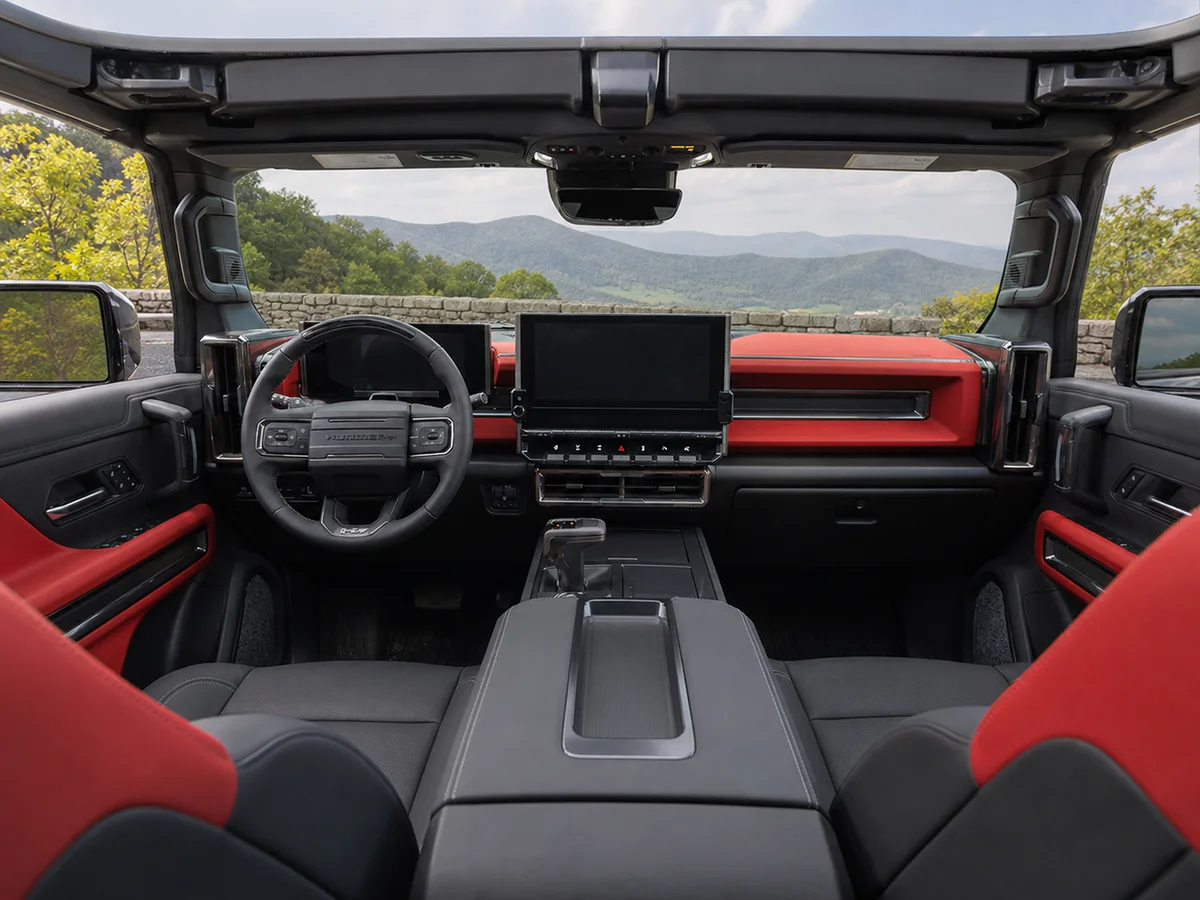
The removable Infinity Roof panels create the experience many buyers expect from a Hummer. Removing, storing, and reinstalling them takes space and planning, while wind, sun, temperature, and security determine how often the feature is genuinely useful.
The SUV offers a broad enclosed cargo floor and foldable rear seat, but independent reviewers note that the load floor is high. Lift a suitcase, dog crate, mobility device, or cooler to that height before assuming the published volume is easy to use.
Pros
- Physical controls remain available for frequent functions
- Removable roof panels create a distinctive open-air cabin
- Front trunk separates charging equipment or valuables from rear cargo
- SUV provides substantial enclosed volume with the rear seat folded
Cons
- Five seats only despite the large exterior
- High SUV load floor makes heavy items harder to lift
- Wide body complicates narrow parking and drive-through lanes
- Some lower-cabin materials do not match the transaction price
The Pickup bed is low enough to reach from the open tailgate, but its sides and tonneau arrangement determine access from the ground. Bring the largest recurring item and test tie-down placement rather than relying on cubic volume.
Super Cruise can reduce workload on compatible divided roads when its operating conditions are satisfied. It does not make the vehicle smaller, and the driver remains responsible for attention and control.
A GMC Yukon carries more people and enclosed luggage when family road-trip space matters more than an open bed or removable roof.
The Chevrolet Blazer EV provides enclosed five-seat electric transport at a much lower entry price, without pretending to match the Hummer's trail equipment.
The Chevrolet Equinox EV places efficiency and purchase value ahead of acceleration, towing, and off-road clearance.
The cabin earns its price through space, controls, roof design, and character rather than flawless luxury materials. Inspect the exact trim in daylight because a screen-heavy demonstration can hide the surfaces touched every day.
What can the short safety and reliability record actually prove?
There is not enough mature fleet history to call every Hummer EV reliable or unreliable. The Pickup began with the 2022 model year and the SUV followed for 2024, so age, build date, software, and completed campaigns matter.
NHTSA campaign 22V141 addressed tail-lamp software on some 2022 vehicles. Campaign 22V771 covered battery-enclosure sealing where water could enter, and campaign 23V367 addressed high-voltage connections that could cause a loss of propulsion.
A later campaign, 25V769, covered 354 model-year 2026 vehicles because an improperly crimped passenger-airbag harness connection could prevent deployment. The filing lists 245 SUVs and 109 Pickups in the affected population.
- 2022Tail-lamp software campaign 22V141
- 2022Battery-enclosure sealing campaign 22V771
- 2023High-voltage connection campaign 23V367
- 2025 filing for 2026 vehiclesPassenger-airbag harness campaign 25V769
Enter the VIN in the NHTSA lookup and ask a GMC dealer for completed campaign records. A clean dashboard does not prove that every remedy was performed, while the presence of a recall does not prove that an updated vehicle still has the defect.
The 2026 warranty manual lists three years or 36,000 miles of bumper-to-bumper coverage. Covered electric propulsion components receive eight years or 100,000 miles, and the manual describes battery-capacity coverage if dealer testing finds capacity below 75 percent of the original level during that period.
Read the transfer language carefully when shopping used. The manual states a Hummer EV coverage restriction tied to a transfer within the first six months after original delivery, so obtain written confirmation of the in-service date, ownership history, and remaining coverage.
No public crash score should be inferred when NHTSA or IIHS has not published one for the exact model and year. Driver-assistance hardware and a heavy structure are not substitutes for an independent crash rating.
During inspection, test AC and DC charging, every roof panel and seal, four-wheel steering, air suspension, cameras, locks, climate control, and all warning messages. Check underbody shields, wheel damage, uneven tire wear, water marks, and evidence of off-road impact.
A strong used candidate has completed recall records, confirmed warranty status, clean diagnostics, and consistent charging. A general reputation cannot replace those four pieces of evidence.
Five-year cost makes a used 2X more compelling than a new 3X
The Hummer EV can cost less to service than a complex gasoline off-roader and still be expensive to own. Depreciation, insurance, financing, charging equipment, electricity, and tires are large enough to dominate routine maintenance savings.
At 12,000 miles, an EPA consumption figure of 63.9 kWh per 100 miles requires about 7,668 kWh before charging losses. At the EIA's 18.2-cent 2026 residential estimate, that is roughly $1,396 per year or $6,980 over five years.
A 71.7-kWh figure raises the same calculation to about $1,566 per year. Actual bills depend on the utility tariff, charging losses, weather, driving, and the share of energy bought away from home.
Public charging can change the result sharply. At an illustrative 45 cents per kWh, 7,668 kWh costs about $3,451, which is why reliable home charging belongs in the purchase decision rather than the accessories list.
CarEdge models five-year depreciation of $55,198 from its stated average new price of $104,108, leaving an estimated value of $48,910. That is a forecast with assumptions, but it demonstrates why a lightly used vehicle can move far more money than an annual electricity estimate.
The same model uses $3,290 per year for insurance under its assumptions. Obtain quotes for the exact VIN, drivers, address, deductibles, annual mileage, lender requirements, and glass coverage because a generic estimate cannot price an individual policy.
Large load-rated tires can cost thousands per set, and aggressive tread may wear faster or reduce range. Request installed prices for the exact tire before purchase, then inspect alignment and wear so an immediate replacement does not arrive after delivery.
Financing amplifies depreciation when interest is paid on a rapidly falling balance. Compare total interest, cash down, taxes, fees, warranty status, and the likely resale value rather than choosing from monthly payment alone.
A used 2X with completed recalls and meaningful warranty remaining can preserve the Hummer's steering, roof, presence, and capability after the first owner absorbs part of the value loss. It remains a specialty purchase, so inspection and an insurance quote matter more than the apparent discount.
The GMC Hummer EV is a compelling luxury electric off-roader and a poor value commuter. Buyers who want efficient transport, easy parking, or predictable low costs should choose a lighter EV, while buyers who accept the expense should still let measurements and quotes set the configuration.