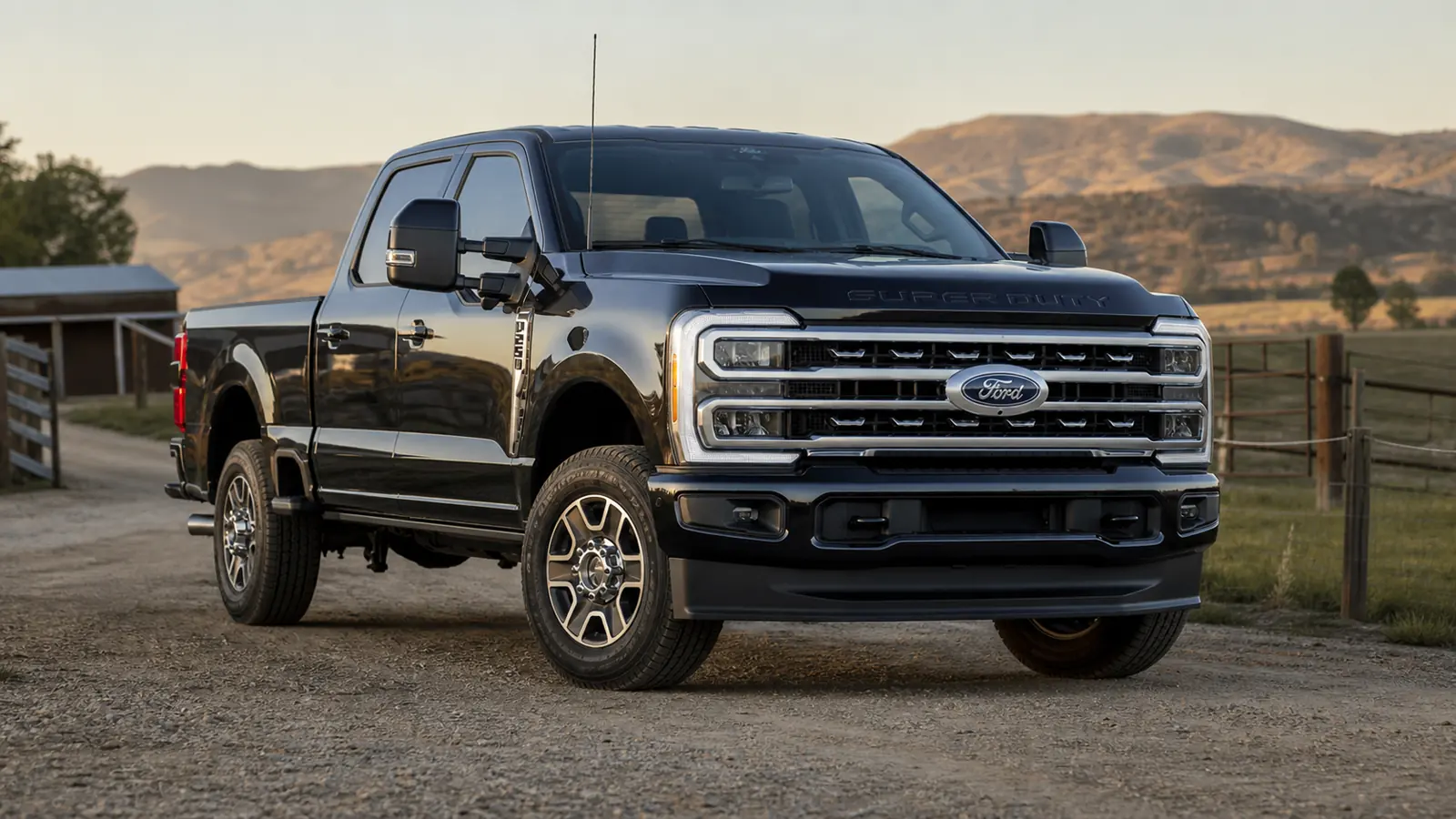
Start With the Door Label, Not the Super Duty Badge
The Ford F-250 Super Duty is the entry point to Ford's heavy-duty pickup range, but even an F-250 can be far more truck than a household needs.
Its value begins when an F-150 runs out of payload, rear-axle capacity, cooling reserve, or trailer stability.
A heavier badge alone does not make daily errands, parking, fuel stops, or tire replacement easier.
A 2026 F-250 can be ordered as a Regular Cab, SuperCab, or Crew Cab with a 6.75-foot or 8-foot bed, depending on cab.
Rear-wheel drive and four-wheel drive are available. Gross vehicle weight ratings and payload change with engine, cab, bed, axle, tires, options, and equipment.
Ford's technical chart shows F-250 maximum payload figures from roughly the mid-3,000-pound range to more than 5,000 pounds in specialized configurations.
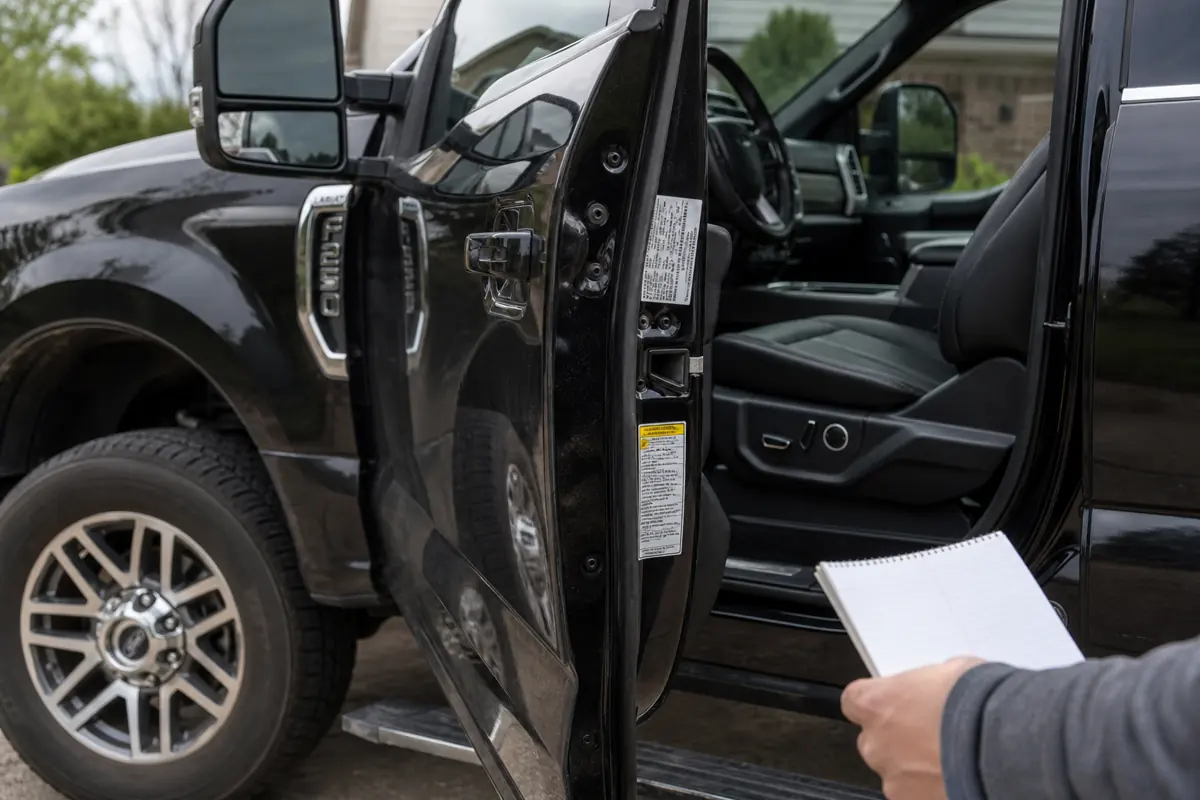
The yellow label on the truck being purchased is the useful number.
Buy the smallest truck whose vehicle-specific ratings cover the heaviest normal day, not the largest truck a brochure can advertise.
A family towing an 8,000-pound travel trailer may need an F-250 because tongue weight, people, and bed cargo exceed a half-ton's label.
A driver towing a 4,000-pound boat alone may get no useful return from the extra mass.
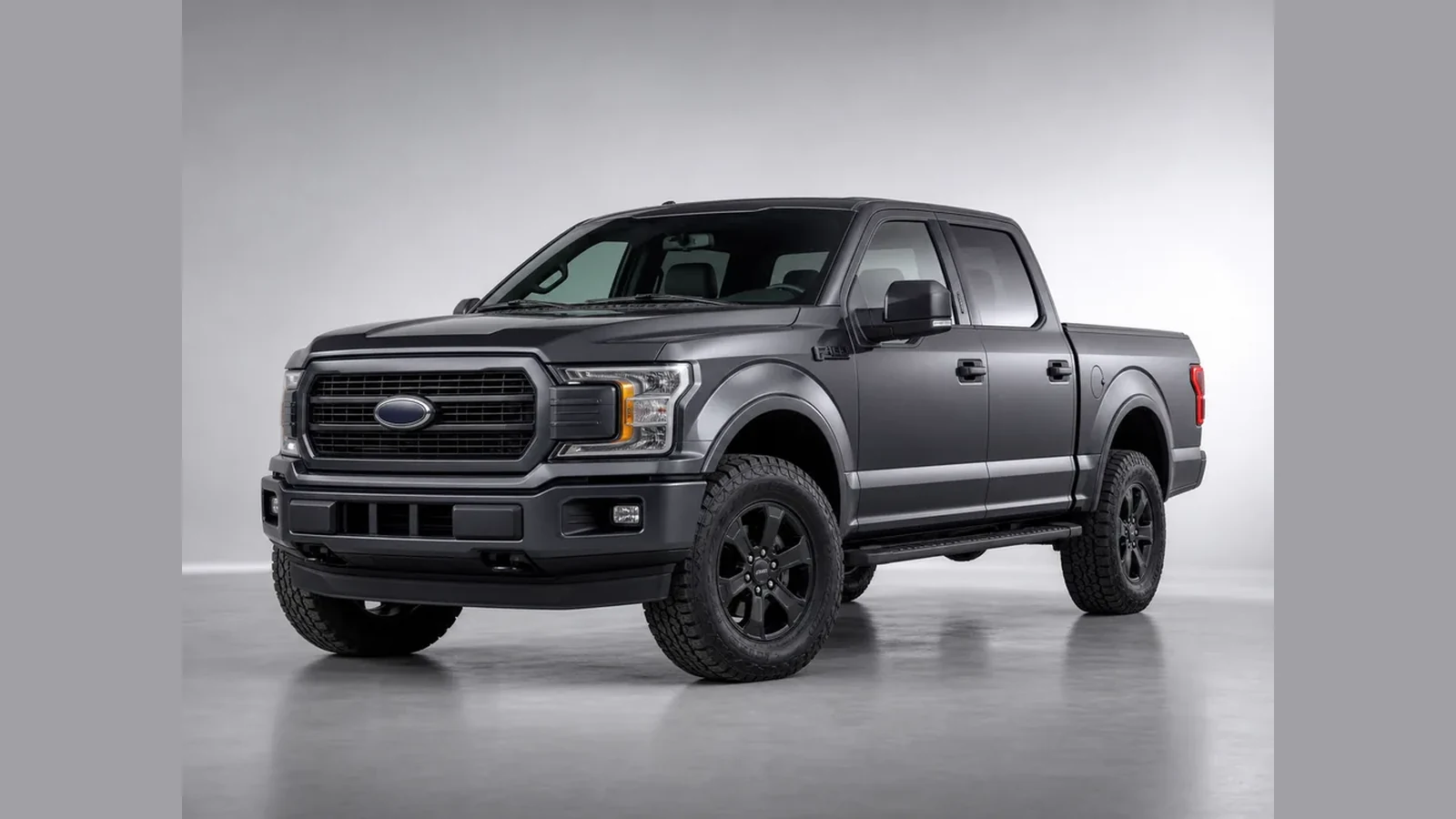
The Ford F-150 is the first comparison for lighter work.
A direct F-150 versus F-250 comparison shows where payload and hitch weight force the move to Super Duty.
The F-250 reliability record addresses long-term questions separately.
This is the lightest truck in the heavy-duty pickup class, which is why it catches households that a one-ton truck would not. This profile focuses on choosing the current truck, its engine, cab, bed, and certified capacity.
The 7.3-Liter Gas V8 Is the Sensible Middle Engine
Ford offers four 2026 Super Duty engine outputs. The standard 6.8-liter gas V8 makes 405 hp and 445 lb-ft.
The 7.3-liter gas V8 makes 430 hp and 485 lb-ft. The 6.7-liter Power Stroke diesel produces 475 hp and 1,050 lb-ft, while the high-output diesel reaches 500 hp and 1,200 lb-ft.
Every engine uses a ten-speed automatic.
The 6.8 works for local fleets, snowplow duty within its limits, and owners who value a lower purchase price.
The 7.3 adds useful torque without diesel emissions hardware, diesel fuel requirements, or the diesel option price. It is the broad recommendation for a privately owned truck that tows regularly but does not spend most days near maximum combined weight.
Engine decision
- 6.8L gas V8
- 405 hp and 445 lb-ft
- 7.3L gas V8
- 430 hp and 485 lb-ft
- 6.7L diesel V8
- 475 hp and 1,050 lb-ft
- High-output 6.7L diesel
- 500 hp and 1,200 lb-ft
- Transmission
- 10-speed automatic
Diesel earns its cost through low-rpm pulling force, engine braking, and reduced effort on long grades. It also adds weight over the front axle, often reducing payload compared with the same cab and bed using gas power.
Short trips and long idle periods are poor use patterns for a modern diesel particulate filter. Owners should expect diesel exhaust fluid, two batteries, larger oil capacity, fuel-filter service, and expensive emissions components outside warranty.
The high-output engine is not automatically the best tow engine. It provides the strongest published torque, but Ford's rating tables still vary by axle, wheelbase, hitch type, and configuration.
A standard-output diesel can be the better value when it already holds speed on the intended grade.
Choose diesel for repeated heavy miles and grade control, not for the idea that every F-250 should have one.
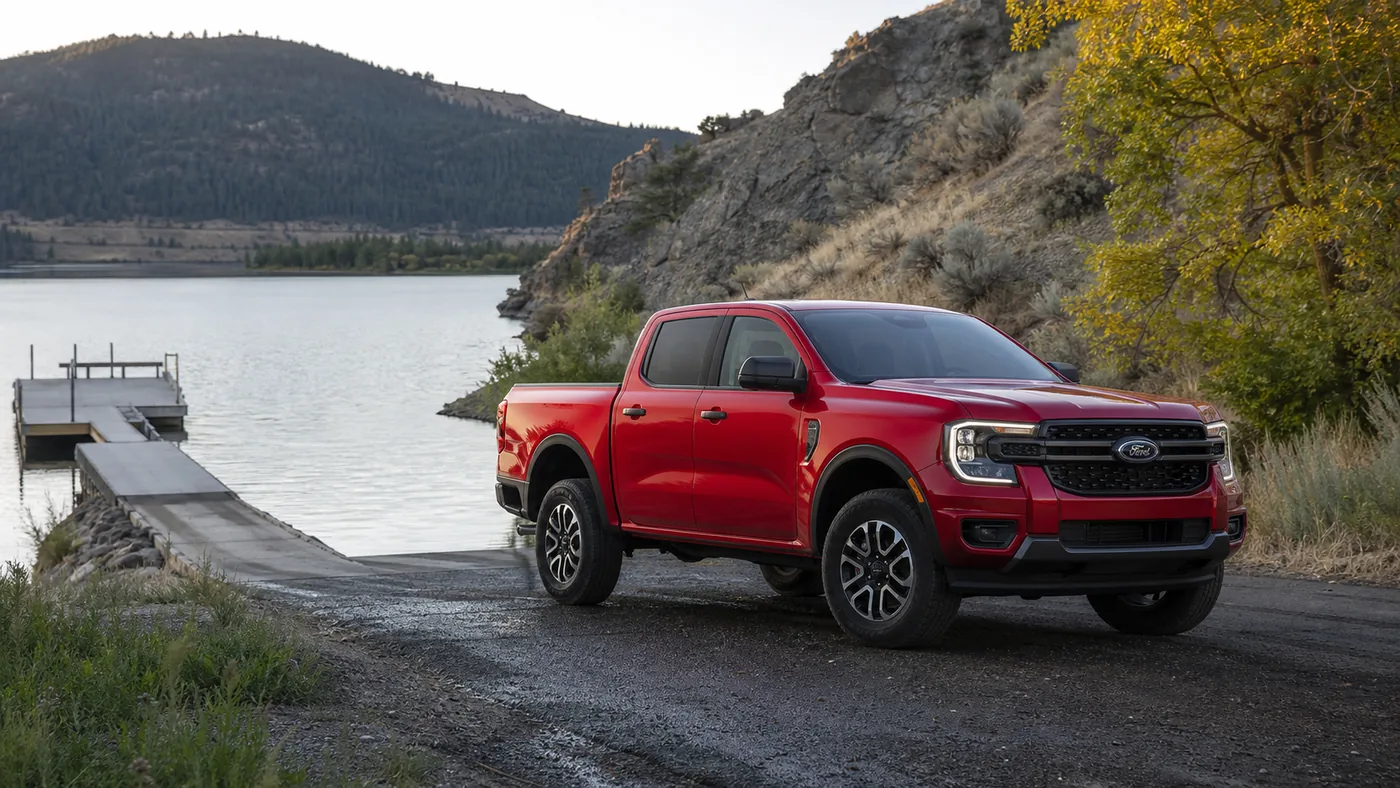
Buyers who need less truck can compare the more maneuverable Ford Ranger. It does not replace Super Duty capacity, but it exposes how much daily cost comes with unused heavy-duty hardware.
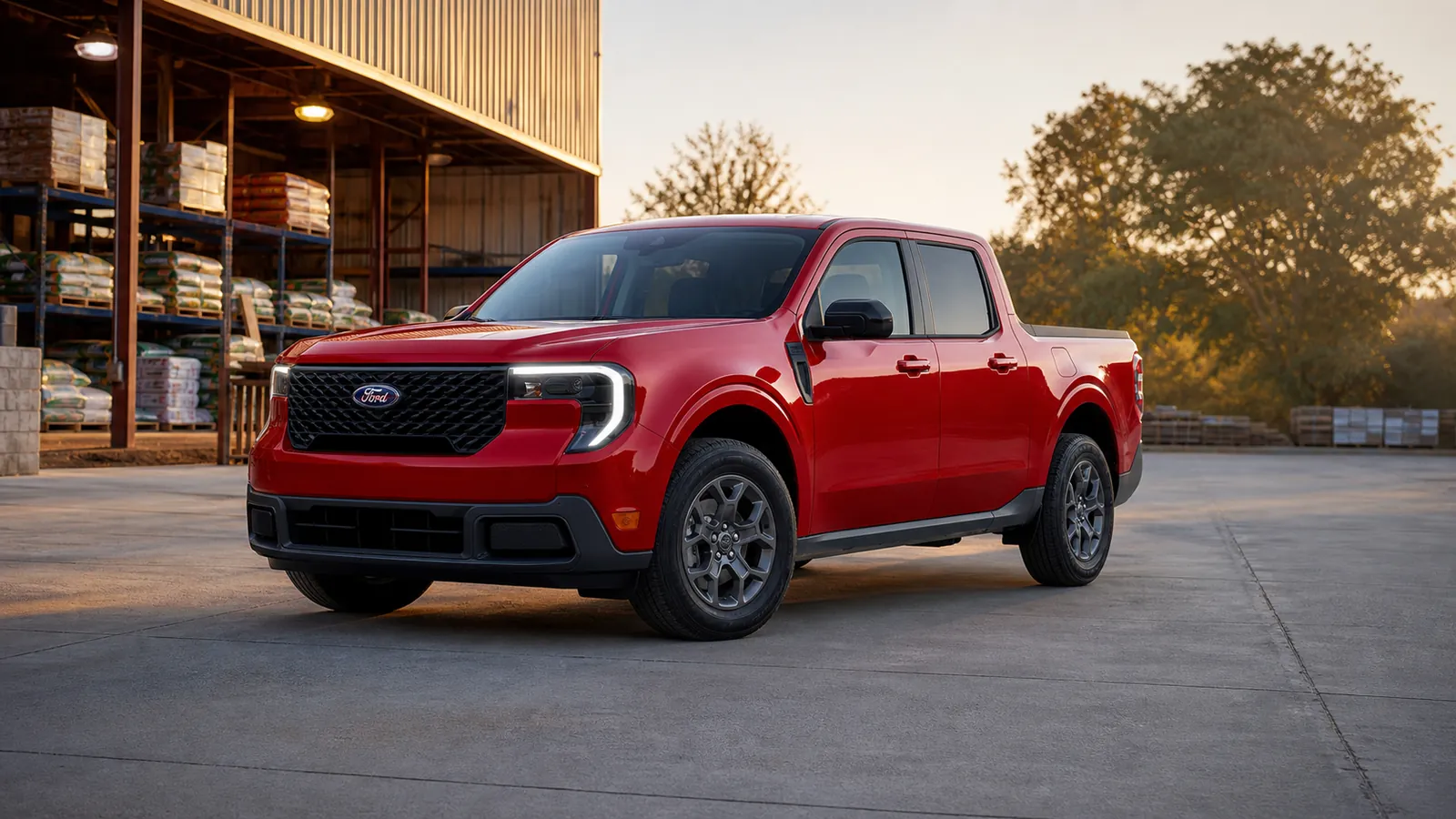
For light household hauling the contrast is sharper still against the Maverick, which is a different tool entirely.
A gas engine avoids the fuel filters, exhaust fluid and oil capacity that come with the diesel, which is most of the service difference.
Trailer Weight Is Only Half of the F-250 Calculation
A properly configured 2026 F-250 can reach 22,000 pounds of conventional towing in Ford's published guide.
That maximum describes a specific truck and test condition. It does not mean every F-250 can pull 22,000 pounds, and it does not reserve payload for a family, a toolbox, or the trailer's hitch load.
Conventional trailer tongue weight is commonly around 10 to 15 percent of loaded trailer weight. A 12,000-pound travel trailer could place 1,200 to 1,800 pounds on the hitch before the passengers, bed cover, auxiliary tank, tools, and firewood enter the calculation.
Fifth-wheel and gooseneck trailers can place still more pin weight in the bed.
That load counts against payload and rear-axle limits.
| Number | What it controls | Where to get it |
|---|---|---|
| Payload | People, cargo, hitch, and accessories | Yellow door-jamb label on the exact truck |
| GVWR | Maximum loaded truck weight | Certification label and manual |
| Rear GAWR | Weight carried by the rear axle | Certification label |
| GCWR | Loaded truck and trailer combination | Ford towing guide for the configuration |
| Trailer rating | Maximum loaded trailer | Ford guide, matched to engine, axle, cab, and drive |
| Actual weights | Whether the setup stays within every limit | Certified public scale |
A weight-distributing hitch can improve axle load distribution on a conventional trailer, but it does not create payload or raise GVWR.
Air springs may level the body, yet they also do not change the certified ratings. The correct fix for an overloaded F-250 is less load or a truck with more capacity, not a suspension accessory.
The Silverado and F-250 comparison applies the same payload test to a light-duty alternative.
Ford directs owners to the vehicle information and towing documents for the exact configuration.
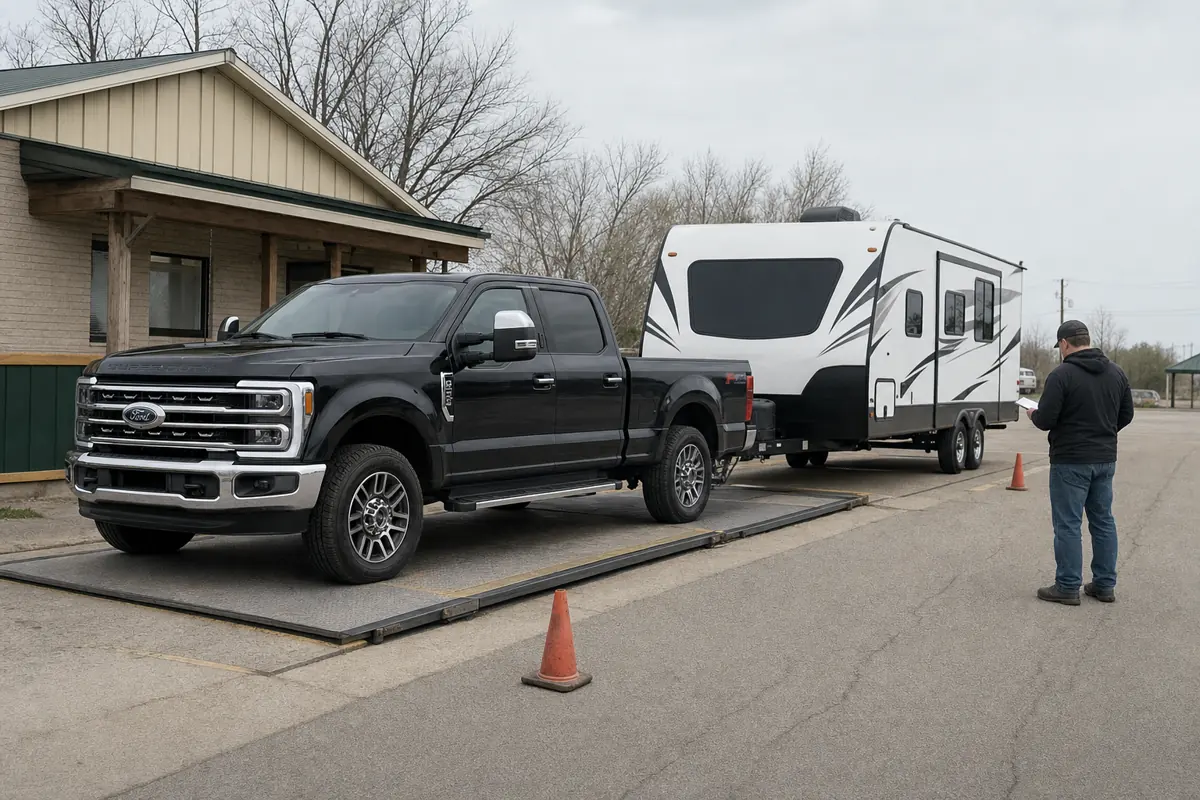
Weigh the truck with passengers, fuel, normal bed equipment, and hitch installed.
Then weigh the connected combination and each axle group. The towing-capacity reference can organize those checks, while the owner's manual remains the authority for hitch setup and operating instructions.
If the loaded rear axle or payload has no practical margin, step up to the right configuration before buying the trailer. Engine torque cannot protect an overloaded tire, axle, hitch, or truck.
Cab and Bed Choice Changes the Truck More Than Luxury Trim
Regular Cab with an 8-foot bed is the compact work configuration within the Super Duty range.
SuperCab adds occasional rear seating and rear-hinged access doors. Crew Cab provides the family-size rear compartment most retail buyers expect, but it adds weight and length.
The 6.75-foot bed keeps a Crew Cab manageable, while the 8-foot bed is better for long material and certain in-bed hitches.
The combination decides the truck's footprint more than any trim does.
What each cab and bed combination costs and buys
- Crew Cab, 8-foot bed
- wheelbase around 176 in, and the largest turning space of the range
- What the 8-foot bed buys
- a full sheet of building material with the tailgate closed, and room ahead of a fifth-wheel hitch
- What the 6.75-foot bed buys
- more than a foot off overall length, which decides a residential garage, fuel island or jobsite gate
- The catch on a short bed
- a sliding fifth-wheel hitch may be needed to protect cab clearance
Sliding fifth-wheel hitches may be needed to protect cab clearance in some short-bed combinations.
The rest of Ford's truck range only becomes comparable once the cab and bed geometry is fixed, because that geometry is what a class is really made of. The F-250 alternatives only become useful after cab and bed choice.
XL is a work-focused base, XLT adds common comfort and convenience equipment, and Lariat moves toward leather and larger screens.
King Ranch and Platinum add expensive materials and technology.
Tremor changes off-road hardware and ride height. Luxury features add curb weight, which can reduce payload on the label.
A bed-mounted toolbox, spray-in liner, cap, winch, steps, and larger tires all consume part of the truck's capacity.
Estimate those additions before ordering. A factory fifth-wheel prep package can be cleaner than drilling and wiring after delivery.
Snowplow users must match the plow package, front gross axle rating, and engine restrictions rather than treating four-wheel drive as approval.
A four-wheel-drive truck moves off more surely on a loose surface, and it does not shorten a stop on ice by a single foot.
Choose it for launch ramps, mud, snow, or off-pavement access. Rear-wheel drive preserves cost and often payload when the truck stays on paved work routes.
An Empty F-250 Rides Like the Load Is Missing
Super Duty uses a solid rear axle and heavy springs because it must carry and control weight.
Unloaded, the rear can move sharply over broken pavement and expansion joints. Adding a modest secured load may settle the ride, but carrying unnecessary ballast wastes payload and fuel.
The test drive should include the truck empty and, when practical, with a representative load.
Steering effort is manageable, and the high seating position gives a clear view ahead.
The long hood, wide mirrors, and large turning circle still demand attention. Cameras help place the front tires and hitch, but a camera cannot see an unmarked roof beam or create room between two parked cars.
Measure garage height, door width, driveway slope, and overall length.
These are editorial assessments, not Ford or government ratings. They show the trade: the qualities that make an F-250 stable under load also make it tiring where a lighter pickup would work.
Large all-terrain tires can add noise, steering weight, and replacement cost. A Tremor should be driven on the same highway used each week, not only across a dealer's smooth lot.
Heavy-duty pickups above EPA light-duty weight thresholds do not carry the same consumer fuel-economy label as an F-150.
Any dealer or owner MPG figure depends on cab, axle, tires, speed, weather, load, and regeneration behavior.
Record hand-calculated fuel use over several tanks if buying used. Do not copy a forum number into a five-year budget.
Use the F-250 real-world MPG method to log comparable tanks and duty cycles.
A driver who needs three rows instead of a bed should compare the Ford Expedition.
It offers family packaging and strong towing with a more compliant rear suspension. The F-250 is the better tool when bed payload, hitch load, or commercial durability is the reason for the purchase.
Recall Checks Must Match the Model Year and VIN
NHTSA's recall database listed several campaigns for certain 2025 F-250 trucks when checked in July 2026. They included a steering-column shifter weld, a diesel fuel-return connection, a brake-booster pushrod retention issue, instrument-cluster software, integrated trailer-module software, and certain driveshafts.
Each campaign covers a defined production population. It is inaccurate to say every 2025 truck has every defect.
One campaign instructed owners of affected trucks not to drive until a brake-pedal assembly inspection and repair were complete.
Another addressed trailer-module communication that could interrupt trailer lights or braking functions. These are serious operating issues for the exact VINs involved, and completion should be documented before towing or purchase.
The F-250 is not evaluated in the same IIHS consumer crash-test program as common passenger cars and crossovers.
The absence of an IIHS grade is not proof of superior or inferior crash protection. Buyers should examine standard and optional driver aids, tire ratings, visibility, braking distance under load, and correct trailer equipment instead of inventing a safety score.
Modern camera, blind-spot, and trailer-assistance systems depend on calibration and compatible trailer wiring.
Test every view, sensor, trailer-light circuit, brake-controller command, and warning message. Modified bumpers, mirrors, suspension, wheels, or wiring can change how those systems work.
The F-250 recall tracker should be used with the VIN result, not as a substitute for it.
Used Diesels Need Evidence of Their Work History
A used F-250 can look clean after years of heavy towing, idling, plowing, or dusty jobsite use.
Start with service records and engine hours, not polished paint.
Compare idle hours with total engine hours. High idle time matters because the odometer may understate engine operation, and extended idling can complicate diesel aftertreatment use.
Cold-start the truck after it has sat overnight. Watch for persistent smoke, abnormal knock, warning lights, fuel or coolant leaks, and slow oil-pressure response.
Drive through every gear at light and heavy throttle, then coast and reapply power.
Test four-wheel drive only on a suitable surface and follow the manual. Check steering play, brake pedal feel, wheel-bearing noise, driveline vibration, and the parking brake.
| Area | Evidence to collect | Deal-stopping result |
|---|---|---|
| Payload and modifications | Original label, tire rating, suspension and hitch receipts | Missing label or parts that obscure certified limits |
| Diesel system | Scan data, regeneration history, DEF warnings, fuel-filter records | Active derate, tampered emissions hardware, or repeated faults |
| Cooling and fluids | Pressure test, oil sample where justified, clean reservoirs | Cross-contamination, active leak, or overheating history |
| Transmission and driveline | Full road test under representative load | Slip, harsh engagement, vibration, or metal in fluid |
| Frame and hitch | Lift inspection around mounts and crossmembers | Cracks, bent structure, poor welds, or severe corrosion |
| Recalls | NHTSA and Ford VIN printouts | Open safety campaign without a repair plan |
Avoid deleted or tuned diesel emissions systems. Apart from legal and inspection risk, unknown calibration can raise exhaust temperature, transmission load, and diagnostic uncertainty.
Oversize tires change effective gearing and may strain steering and brakes.
A lift can reduce trailer stability and complicate hitch height.
Stock, documented trucks are easier to evaluate.
A professional pre-purchase inspection should scan every module, inspect the frame on a lift, test both batteries, and verify tire age and load range.
Year selection matters less here than most used-truck advice suggests. The deciding evidence is condition, capacity, and a work history that matches the price.
Walk away when modifications or missing records make the truck's limits impossible to verify.
Fuel Is Only One Line in the Five-Year Work Budget
The five-year cost begins with purchase price and depreciation, then adds fuel, insurance, registration, tires, brakes, scheduled service, repairs, and downtime.
Diesel may use less fuel while towing, but its option price and service costs need enough heavy mileage to pay back.
A gas truck that uses more fuel can still cost less overall for low annual mileage and occasional towing.
There is no EPA label for this class, so the fuel budget has to be built rather than looked up.
Building a fuel budget without a label
- Split the milesInto unloaded commuting, towing, and idling, using last year's real annual mileage rather than an estimate.
- Assume conservativelyApply a hand-calculated mpg figure to each case, lower than anything an owner forum quotes.
- MultiplyEach case separately, because a towing mile and a commuting mile do not cost the same.
- Stress-test the priceRun the total again at a fuel price well above today's.
- Check the cushionIf the budget only works on an optimistic number, it has no cushion and the truck is the wrong one.
Diesel service includes greater oil capacity, fuel filters, diesel exhaust fluid, and two batteries. The F-250 maintenance schedule should be matched to severe use rather than a light commuter cycle.
Gas service is simpler, but heavy towing still shortens fluid and wear-item intervals. The correct load-rated F-250 tires can cost well into four figures as a set.
Alignments, steering parts, brakes, and wheel bearings also work harder on a heavy truck.
Insurance should be quoted using the VIN and declared use. Commercial operation, business tools, snowplowing, and a high-value trailer may need coverage beyond a personal auto policy.
Factory warranties do not pay for normal wear, overloaded components, poor maintenance, or lost business time.
Keep a reserve that covers a deductible, a tire set, and an unexpected repair.
The F-250 cost-to-own analysis can hold a detailed scenario. At purchase, compare the 7.3 gas and 6.7 diesel using the same cab, bed, axle, insurance quote, and annual workload.
The cheapest engine is the one that completes the real work with the lowest total cost, not the one with the lowest fuel bill.
Most Private Buyers Should Begin With an XLT and the 7.3 Gas V8
For a household or small business, an XLT with the 7.3-liter gas V8 is the clean starting configuration.
It adds useful cabin equipment over XL, keeps the powertrain simpler than a diesel, and has enough output for substantial conventional towing when the ratings match.
Crew Cab short bed is easier to live with, while an 8-foot bed earns its length for material, a fifth-wheel hitch, or a specific upfit.
Pros
- Broad cab, bed, engine, axle, and trim choice
- Up to 22,000 pounds of properly configured conventional towing
- Strong diesel engine braking and low-rpm torque
- Higher payload headroom than many half-ton configurations
Cons
- Unloaded ride and parking demand compromise
- Diesel price and emissions hardware can raise ownership cost
- Luxury equipment can consume payload without adding work capacity
- Heavy-duty pickups lack a consumer EPA MPG label
Choose the 6.8 gas V8 for price-sensitive local work with a verified load. Choose the diesel when frequent heavy towing, mountain grades, and annual mileage make its torque and engine braking useful every month.
Move to F-350 when the selected F-250's payload or rear axle has little margin after hitch weight and passengers.
Other trucks provide useful context, but the window sticker, door labels, towing guide, and scale ticket must select the individual truck.
A fitted F-250 battery still has to match engine, climate, and factory specifications.
The F-250 is worth buying when a lighter truck cannot carry the real hitch, passengers, and bed load with margin.
If the calculation fits an F-150, keep the easier ride and lower running cost.
If the calculation exceeds the chosen F-250, do not force the purchase.
Select the Super Duty configuration that actually owns the load.