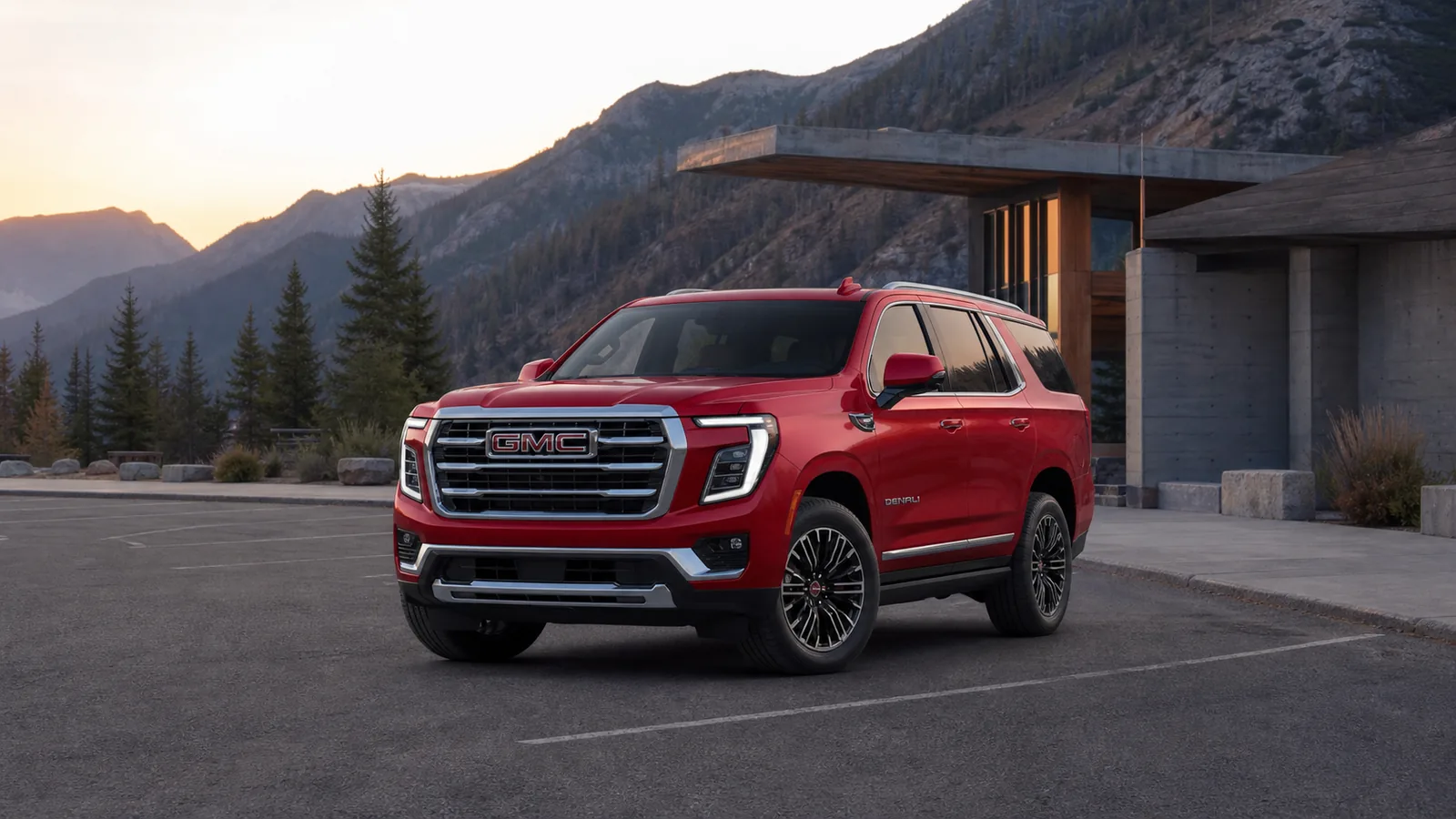
Should your family buy a Yukon or the longer Yukon XL?
Choose the standard Yukon when 25.5 cubic feet behind the third row is enough and the shorter body fits daily parking.
Choose the Yukon XL when eight people regularly travel with large luggage, a stroller, sports gear, or a dog crate. The XL adds 16.0 cubic feet behind row three, but it also adds 15.1 inches of body length.
The standard Yukon is already large at 210.1 inches long.
Yukon XL stretches to 225.2 inches, almost 18.8 feet. Both use the same basic width and full-size body-on-frame layout, so the wheelbase choice changes length and cargo more than passenger shoulder room.
| Measure | Yukon | Yukon XL | What it changes |
|---|---|---|---|
| Overall length | 210.1 in | 225.2 in | XL needs 15.1 more inches in a garage or curb space |
| Cargo behind row three | 25.5 cu ft | 41.5 cu ft | XL carries far more luggage with every seat in use |
| Cargo behind row two | 72.5 cu ft | 93.6 cu ft | XL provides a larger five-seat travel area |
| Maximum cargo | 122.8 cu ft | 144.5 cu ft | Both are large, while XL handles longer bulky loads |
| Fuel tank | 24 gal | 28 gal | XL can travel farther between fills but costs more to fill from empty |
Twenty-five and a half cubic feet is useful, but eight passengers can bring more luggage than the standard cargo floor accepts.
Soft bags fit around wheel housings better than rigid suitcases. A stroller, cooler, or mobility device can consume most of the usable depth before personal bags are added.
XL solves that exact problem. Its 41.5 cubic feet behind row three is closer to the cargo area of a compact SUV while keeping all three seating rows available.
The advantage is strongest on airport trips, road vacations, team travel, or any trip where passenger and luggage count peak together.
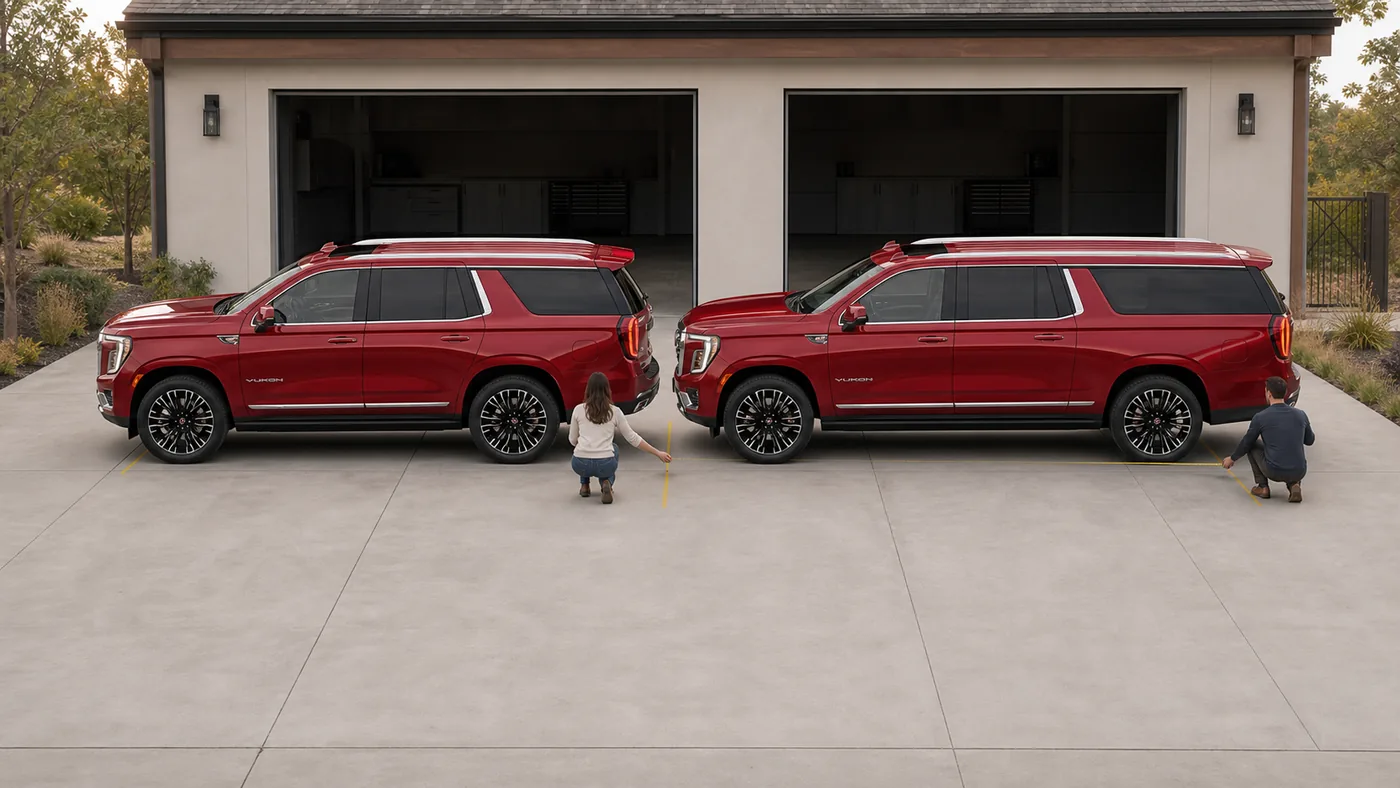
The standard body is easier to maneuver. It needs less curb length, leaves more garage clearance, and carries less body behind the rear axle.
A family that normally travels with four or five people can fold row three and gain 72.5 cubic feet behind row two without accepting XL length.
The garage test should include the door closed, shelving, bicycles, chargers, and space to walk around the vehicle. Open the liftgate and confirm ceiling clearance.
Check whether passengers can enter through every door without hitting a wall or the other parked vehicle.
Curb parking adds another measurement. XL may extend beyond short spaces and can make a narrow driveway turn harder.
Cameras and parking sensors help the driver see clearance. They do not change the turning path or physical length.
A 28-gallon tank in XL increases driving range, especially with the diesel. It does not improve fuel economy.
Filling from nearly empty also costs more at one stop, while the heavier or longer configuration may use slightly more fuel depending on engine and drivetrain.
Buy Yukon XL when full-cabin luggage proves that 25.5 cubic feet is insufficient. Buy the standard Yukon when it passes that load test because fifteen fewer inches will improve parking on every trip.
Which Yukon engine fits your mileage, trailer, and fuel budget?
The 5.3-liter V8 is the sensible Yukon engine for moderate annual mileage and ordinary family use.
The 6.2-liter V8 serves buyers who want stronger acceleration and tow frequently. The 3.0-liter Duramax diesel suits high-mile drivers or regular towing when its fuel savings survive a personal cost calculation.
GMC's 5.3-liter V8 produces 355 hp and 383 lb-ft of torque. It has enough output for a full passenger load and provides familiar V8 response without the 6.2-liter engine's purchase and fuel demands.
Buyers should still test it in the selected wheelbase and drivetrain because a heavy XL with passengers asks more of the engine.
The 6.2-liter V8 raises output to 420 hp and 460 lb-ft. It accelerates the Yukon with less effort and can feel calmer when joining fast traffic with a load.
Premium-fuel recommendations, lower economy, and a higher purchase price can make that performance expensive over many miles.
The 3.0-liter inline-six diesel produces about 305 hp and 495 lb-ft.
Its torque arrives at lower engine speed, which suits steady towing and highway travel. It also returns the strongest official fuel economy in the lineup, with the best configurations reaching roughly 23 mpg combined.
| Engine | Output | Approximate combined MPG | Best use | Main tradeoff |
|---|---|---|---|---|
| 5.3L V8 | 355 hp / 383 lb-ft | About 17 mpg | Moderate miles, family travel, lighter towing | Less reserve than the larger V8 |
| 6.2L V8 | 420 hp / 460 lb-ft | About 16 mpg | Strong passing, heavier use, frequent high load | Highest gasoline use and premium purchase cost |
| 3.0L diesel | About 305 hp / 495 lb-ft | Up to about 23 mpg | High annual miles and steady towing | Added emissions, fuel, and service considerations |
All three engines use a 10-speed automatic. The broad ratio spread helps a heavy SUV leave from a stop, climb, and settle into a tall highway gear.
Test for smooth engagement when cold, consistent shifts when warm, and sensible gear selection on the grades the Yukon will travel.
Fuel arithmetic can change the verdict. At 15,000 miles, a vehicle returning 17 mpg uses about 882 gallons.
At 23 mpg it uses about 652 gallons, a difference of roughly 230 gallons. Multiply each figure by the correct local fuel price, then add the engine option cost and expected service.
Towing capacity does not come from engine output alone.
Wheelbase, drivetrain, axle, cooling, hitch equipment, options, payload, and the trailering package all affect the exact rating. A 6.2-liter engine cannot restore payload consumed by passengers or luxury equipment.
The right engine also depends on trip length.
A diesel used for sustained highway work can make sense. Repeated very short trips may not keep its exhaust aftertreatment at the temperatures it needs, and the fuel savings may never cover the option.
Choose the engine from annual miles, loaded performance, and verified fuel cost. The 5.3-liter V8 is the default answer, while the 6.2 and diesel need a clear performance or mileage reason.
When does the 3.0L Duramax diesel earn its added complexity?
The 3.0-liter Duramax diesel earns its place when a Yukon travels many highway miles, tows regularly, and saves enough fuel to cover its purchase and maintenance differences. Low annual mileage or mostly short urban trips weakens the case even though the diesel produces the lineup's highest torque.
About 495 lb-ft arrives at low engine speed.
That helps the Yukon move away with a trailer and hold speed on grades without chasing high revs. The response feels different from the 6.2-liter gasoline engine, which produces more horsepower and stronger acceleration at higher speed.
The fuel calculation must use local prices.
If regular gasoline costs $3.50 and diesel costs $3.90, the 17-mpg gasoline Yukon uses about $3,087 over 15,000 miles, while the 23-mpg diesel uses about $2,543. The difference is around $544 before option price, maintenance, or financing.
A lower annual mileage stretches payback. At 7,500 miles, the same assumptions save about $272 per year.
A buyer who keeps the Yukon four years may not recover several thousand dollars of added purchase cost from fuel alone.
Diesel ownership adds diesel exhaust fluid, a fuel filter, and emissions aftertreatment. These are normal parts of the system, but they require correct service and suitable operation.
Warning lights should be diagnosed promptly because ignoring an emissions fault can restrict performance.
Short trips can be a poor use pattern.
The exhaust system may need sustained heat to manage collected soot. A vehicle that repeatedly starts cold, travels a few miles, and shuts down may spend more time trying to complete its cleaning process.
Towing can improve the diesel case because load uses the low-speed torque and raises fuel consumption in every engine. Compare expected towing economy cautiously because trailer height, speed, wind, grade, and weight create large changes that a brochure cannot predict.
Resale value may return part of the option price, but it should not be guaranteed. Diesel demand, fuel prices, mileage, emissions-system condition, and regional preferences change the used market.
Keep complete fuel and service records.
Choose the diesel when high annual mileage or regular towing creates a calculation that works before resale is assumed. Choose a V8 when trips are short, miles are low, or simpler gasoline ownership matters more than the efficiency gain.
Can eight people and their luggage actually fit in a Yukon?
A Yukon can seat up to eight, but Yukon XL is the easier eight-person travel vehicle because it provides 41.5 cubic feet behind row three. The standard Yukon provides 25.5 cubic feet.
Both can carry eight bodies. The luggage decides which wheelbase completes the trip.
Eight-seat models use a second-row bench. Seven-seat models use captain's chairs, which create an aisle and give each passenger a separate seat.
Captain's chairs improve movement to row three but permanently remove one seating position.
Third-row room is credible for adults in the current Yukon, especially compared with smaller crossovers.
The floor remains high because the vehicle uses a truck-based chassis, so knee angle and thigh support should be tested. Set the front and middle rows for their regular occupants before checking the rear.
Child seats complicate access.
An installed restraint may prevent the second row from tilting or sliding as expected. Bring every seat and booster, follow both manuals, and confirm that buckles remain reachable.
Do not rely on a salesperson's empty-cabin demonstration.
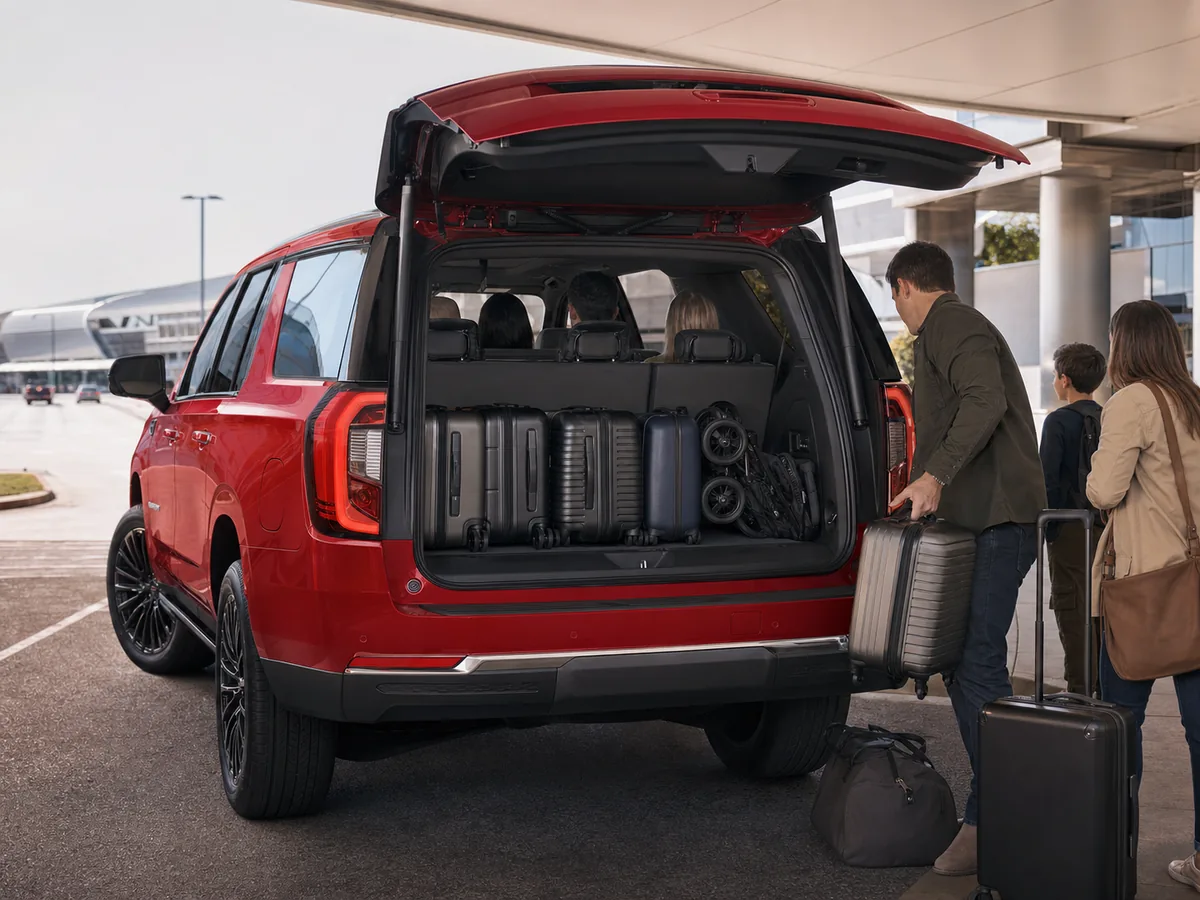
The standard Yukon can carry several carry-ons behind row three, especially when soft bags fill irregular spaces.
A large stroller, cooler, or rigid suitcase may consume the floor quickly. One split third-row section can fold for a longer item, but that removes passenger capacity.
XL adds enough depth to load more suitcases upright or keep bulky family equipment aboard. The extra volume also reduces the temptation to stack items above the seatbacks.
Heavy cargo should remain low and secured so it does not move toward passengers during a sudden stop.
Maximum cargo figures of 122.8 and 144.5 cubic feet describe a different use. They require folding rear seats and do not show family capacity.
A household that sees only the maximum number can buy the standard body and discover that vacation luggage does not fit when every person has a seat.
Payload still applies. Eight passengers can consume a large share of the door-label allowance before bags, accessories, hitch hardware, or trailer tongue weight are added.
Read the label on the exact Yukon and estimate actual occupant weights.
Entry height also matters.
Children and passengers with limited mobility should climb into each row without a showroom step being placed for them. Running boards can help, while powered boards add mechanical complexity and need clearance in snow or near curbs.
Eight people fit best in a Yukon XL when their luggage travels inside the vehicle. Choose the standard body only after loading the hardest occupied trip and confirming that payload, visibility, and hatch closure remain safe.
How much can a loaded Yukon tow after passengers are aboard?
A properly equipped Yukon can tow up to 8,400 pounds, but the usable number usually becomes lower after passengers, cargo, hitch hardware, options, and trailer tongue weight consume payload. The door label and trailering guide for the exact vehicle control the decision.
Trailer tongue weight commonly falls around 10 to 15 percent of loaded trailer weight. An 8,000-pound travel trailer could place 800 to 1,200 pounds on the hitch.
That load sits on the SUV before a family or cargo is counted.
Six occupants might add 900 pounds.
A 100-pound hitch and 150 pounds of luggage raise the total to 1,150 pounds before tongue weight. Adding even 900 pounds of tongue weight produces 2,050 pounds against the exact payload allowance.
Yukon loaded towing check
- Lineup maximum
- Up to 8,400 lb when properly equipped
- Tongue weight
- Commonly 10 to 15 percent of loaded trailer weight
- Payload consumers
- Passengers, luggage, accessories, hitch hardware, and tongue load
- Vehicle authority
- Driver-door labels and the exact trailering guide
- Final evidence
- Occupied vehicle and loaded trailer weighed by axle
Luxury equipment can reduce payload because every powered step, large wheel, seat motor, audio component, and trim item adds mass.
Four-wheel drive and the longer XL body can also change the label. Two visually identical Yukons may therefore carry different allowances.
Start with the yellow Tire and Loading Information label.
Add the real people, cargo, accessories, and hitch hardware. Obtain the trailer's loaded weight and tongue weight rather than using dry weight.
Keep a margin for water, food, batteries, propane, and equipment added after purchase.
Confirm the receiver, hitch ball, weight-distribution system, tires, axles, cooling, and trailer brakes.
A component with a lower rating becomes the limit. Follow GMC instructions because a weight-distribution hitch or trailering package may be required above a threshold.
A public scale provides stronger evidence than arithmetic alone.
Weigh the occupied Yukon and loaded trailer, then record steer, drive, and trailer axle loads. Compare them with every gross vehicle, axle, combination, tire, and hitch rating.
Engine power does not shorten the trailer's stopping distance. Leave more room, reduce speed for weather, and account for crosswinds and long downhill grades.
Test the brake controller and mirrors before joining fast traffic.
Choose the Yukon configuration from occupied payload before relying on the 8,400-pound headline. A smaller trailer with generous margin is a better match than a maximum trailer that leaves no room for the people the SUV was purchased to carry.
Which Yukon trim spends money on equipment you will use?
Start with Yukon Elevation, then move upward only when another trim solves a repeated road, towing, or comfort need. GMC lists 2026 Elevation from $69,600 before destination.
AT4 starts around $76,600, Denali around $80,400, top-trim AT4 around $97,900, and top-trim Denali around $103,900.
Elevation contains the full-size body, three engine choices depending on specification, large screens, core driver aids, and the seating flexibility that defines the Yukon. It is the strongest value when towing, passenger space, and cargo matter more than luxury materials.
AT4 directs spending toward poor-road and off-pavement use. Its equipment can help on snow, rough access roads, and campsites.
The buyer should confirm ground clearance, tires, protection, and suspension on the exact build rather than assuming the badge includes every advertised feature.
Denali directs spending toward the cabin and exterior presentation.
It can make long trips more comfortable through seating, materials, audio, cameras, and convenience. The engine, wheelbase, and payload decision still need to be made separately.
Top versions combine expensive appearance, technology, seating, audio, and chassis features.
Their six-figure prices overlap luxury-brand SUVs. They can be satisfying, but every powered or electronic addition creates another item to insure, repair, or replace after warranty.
Wheel size can alter the ownership experience. Large wheels emphasize appearance and may sharpen steering, while shorter sidewalls can increase pothole risk and tire price.
Test a lower trim on the same damaged road before accepting the largest wheel.
Super Cruise, powered running boards, advanced cameras, premium audio, and air suspension can be valuable.
Verify standard versus optional status, service terms, and what happens when a subscription expires. A feature in a national advertisement may not be installed on the local vehicle.
Compare out-the-door prices and VIN-based insurance quotes. Financing a $20,000 trim jump can add thousands in interest, while depreciation acts on the larger purchase amount.
The higher trim should improve enough trips to justify both costs.
Elevation is the best starting point because it preserves the Yukon's space and capability. AT4, Denali, and top trims make sense only when their defining equipment changes a repeated use rather than the showroom impression.
A Yukon can ride well, but its size never disappears in town
A Yukon can provide a calm highway ride and a commanding view, but full-size dimensions remain present in parking garages, school lanes, narrow streets, and drive-throughs. The standard body is over 17.5 feet long, while Yukon XL is nearly 18.8 feet.
Body-on-frame construction and a long wheelbase give the Yukon a substantial feel. It can settle into a steady cruise with passengers and luggage aboard.
Broken pavement may produce more body movement than a lower crossover, especially with large wheels and low-profile tires.
Suspension equipment changes by trim and option.
Adaptive dampers or air suspension can control motion and adjust height in some configurations. They add useful capability and complexity.
Test the exact hardware rather than using one trim's ride to judge the complete range.
Steering cannot hide the wheelbase.
A tight turn needs space for the front to swing and the rear wheel to cut inside the path. Watch both ends when leaving a garage column, fuel pump, or curb.
Cameras provide an overhead view and close images around the bumpers. They are valuable because the driver cannot see low objects near the body.
Rain, mud, snow, glare, and lens damage can reduce the image, so use mirrors and a physical walk-around as well.
Pros
- Long wheelbase and substantial mass support calm highway travel
- High seating position provides a broad traffic view
- Camera views help place the body and hitch at low speed
Cons
- Standard Yukon is 210.1 inches long
- Yukon XL stretches to 225.2 inches
- Large wheels raise tire cost and can sharpen impacts
- Cameras cannot create physical clearance in a narrow space
Measure the home garage and driveway before the test drive. Include door thickness, shelves, tools, chargers, bicycles, and space to open the hatch.
Check ceiling clearance with the suspension at different heights if the vehicle can adjust itself.
Drive the narrowest regular route.
Use a grocery space, curb pickup, highway ramp, rough street, and U-turn.
Bring the person who will park it most often. A confident salesperson in an empty lot does not answer whether another household driver can manage the same body every day.
Tires affect the result. A smaller wheel with more sidewall can absorb sharp edges better and may cost less to replace.
An aggressive all-terrain tire can add noise and rolling resistance. Correct pressure matters for load, wear, and response.
The Yukon drives best when its space and towing benefits outweigh the effort required to place it. A smaller three-row crossover is the better daily vehicle when full-size capacity remains unused.
Super Cruise and cameras help, while the driver still owns the gap
Available Super Cruise and camera systems can reduce workload in a Yukon, but the driver remains responsible for road conditions, clearance, following distance, trailer behavior, and safe intervention. Assistance does not increase tire grip, payload, or physical room.
Super Cruise can provide hands-free driving on compatible roads in suitable conditions when the system is active and the driver remains attentive. Road coverage, markings, weather, sensor condition, subscription status, and system updates can affect availability.
The driver-facing attention system is part of the operation.
Looking away, blocking the sensor, or ignoring prompts can cause warnings and disengagement. Learn the handoff sequence before relying on the feature during a long trip.
Camera views help with parking, hitch alignment, trailer observation, and blind areas close to the body.
An overhead composition can make the Yukon easier to center in a space. A transparent-trailer view may depend on compatible equipment and correct setup.
Towing creates longer stopping distances and wider lane-change needs.
A camera can show part of the trailer, but it cannot measure every closing speed or crosswind. Extend following distance and use properly adjusted mirrors.
Automatic braking and lane support also have limits. A system may not identify every stationary object, motorcycle, pedestrian, construction pattern, or faded lane.
Read the manual and keep sensors clean.
Test every feature on the exact vehicle.
Confirm camera resolution in daylight and darkness, pair the connected account, review subscription terms, and ask what functions remain after a trial period ends. An inactive service should not be counted as permanent equipment.
Software updates can change behavior, but they do not replace mechanical inspection. Tires, brakes, steering, suspension, lights, mirrors, and trailer connections still determine whether the vehicle can execute a warning safely.
Use Super Cruise to reduce workload on compatible roads and cameras to expose blind areas at low speed. Keep enough distance and attention to control the complete Yukon when either system becomes unavailable.
What does a Yukon cost to fuel, tire, insure, and keep after warranty?
Yukon ownership cost depends more on engine, wheelbase, trim, wheels, and annual miles than on one model-wide estimate. A 5.3-liter Elevation and a top-trim Denali diesel can differ by more than $30,000 at purchase and by hundreds of gallons over several years.
Fuel is the easiest cost to calculate.
Divide annual miles by the exact configuration's expected mpg, then multiply by the correct fuel price. At 15,000 miles, 16 mpg uses about 938 gallons, 17 mpg uses about 882, and 23 mpg uses about 652.
A 24- or 28-gallon tank changes range and the price of one fill. It does not change efficiency.
At $3.50 per gallon, filling 24 gallons costs $84, while 28 gallons costs $98. A larger tank can reduce stops on a trip while making each stop look more expensive.
Tires can be a major wear item. Large 22- or 24-inch tires may cost substantially more than smaller sizes, and one damaged wheel can add another bill.
Ask for installed prices, availability, tread-life expectations, and whether the exact drivetrain needs closely matched tread depth.
Brakes carry a heavy SUV and may work harder with towing or city traffic.
Trailer brakes reduce part of the load only when adjusted and functioning correctly. Fluid, pads, rotors, tires, and alignment should be inspected before a long tow.
Insurance follows the VIN, driver, location, use, and replacement value. Obtain quotes before choosing a top trim or 6.2-liter engine.
Glass, lamps, cameras, sensors, and powered equipment can affect collision repair cost.
- At purchaseTax, destination, financing, insurance, accessories, and the trim price establish the largest cost
- Every yearFuel, registration, insurance, service, and subscription choices repeat
- During wear cyclesTires, brakes, battery, fluids, and alignment arrive according to use and load
- After warrantySuspension, cameras, screens, powered steps, seats, audio, and engine systems become owner exposure
- At saleCondition, mileage, records, configuration, fuel prices, and demand determine depreciation
Upper trims add cameras, displays, powered running boards, premium audio, advanced suspension, large wheels, and more powered cabin equipment.
These features can be worth maintaining when they improve every trip. They can also create expensive diagnoses after warranty.
Diesel service includes its fuel and emissions systems. V8 ownership carries its own fuel and mechanical considerations.
Follow the exact manual, use specified fluids, keep receipts, and inspect before factory coverage expires.
Depreciation acts on dollars.
A six-figure Yukon can lose more cash than an Elevation even if both retain a similar percentage. A large discount may reduce the starting amount but can also signal changing demand.
Build the Yukon budget from the VIN and your annual miles before selecting the trim. The least expensive configuration that fits passengers, cargo, and trailer usually leaves the most money for fuel, tires, travel, and repairs.
Who needs a Yukon, and who should choose a smaller three-row SUV?
Buy a Yukon when the household repeatedly needs full-size passenger room, cargo behind an occupied third row, body-on-frame towing, or the engine choices a crossover cannot provide. The vehicle should solve a measured limitation, because its price, fuel use, tires, and parking effort continue after the rare big trip.
Choose the standard body when 25.5 cubic feet behind row three fits the hardest load and the shorter length improves daily parking. Choose XL when 41.5 cubic feet prevents unsafe stacking, a roof box, or a second vehicle on frequent full-cabin trips.
The 5.3-liter V8 is the sensible default.
Choose the 6.2-liter V8 for performance that is used often enough to cover its fuel and purchase cost.
Choose the diesel after an annual-mile or towing calculation shows a credible benefit.
Elevation protects value. AT4 suits repeated poor-road access.
Denali suits buyers who use its cabin comfort, while top trims need a strong reason because their prices exceed $97,000 before destination and options.
Choose an Acadia when a crossover can carry the same passengers and trailer. It will be easier to park and generally less expensive to fuel.
Choose an even smaller SUV when the third row stays empty most of the year.
A minivan may carry people and luggage more efficiently when towing and rough-road use are unimportant. Its lower floor, sliding doors, and family storage can outperform a taller SUV during school and travel use.
The final test should include the home garage, every regular passenger, installed child seats, the largest luggage load, the trailer calculation, a VIN insurance quote, and a complete route. A camera or luxury package cannot repair a body that does not fit.
Buy a Yukon for capability you use, not capacity you admire. If a smaller three-row vehicle completes the same weekly trips, it will usually be the easier and less expensive choice.