SV is the comfort sweet spot
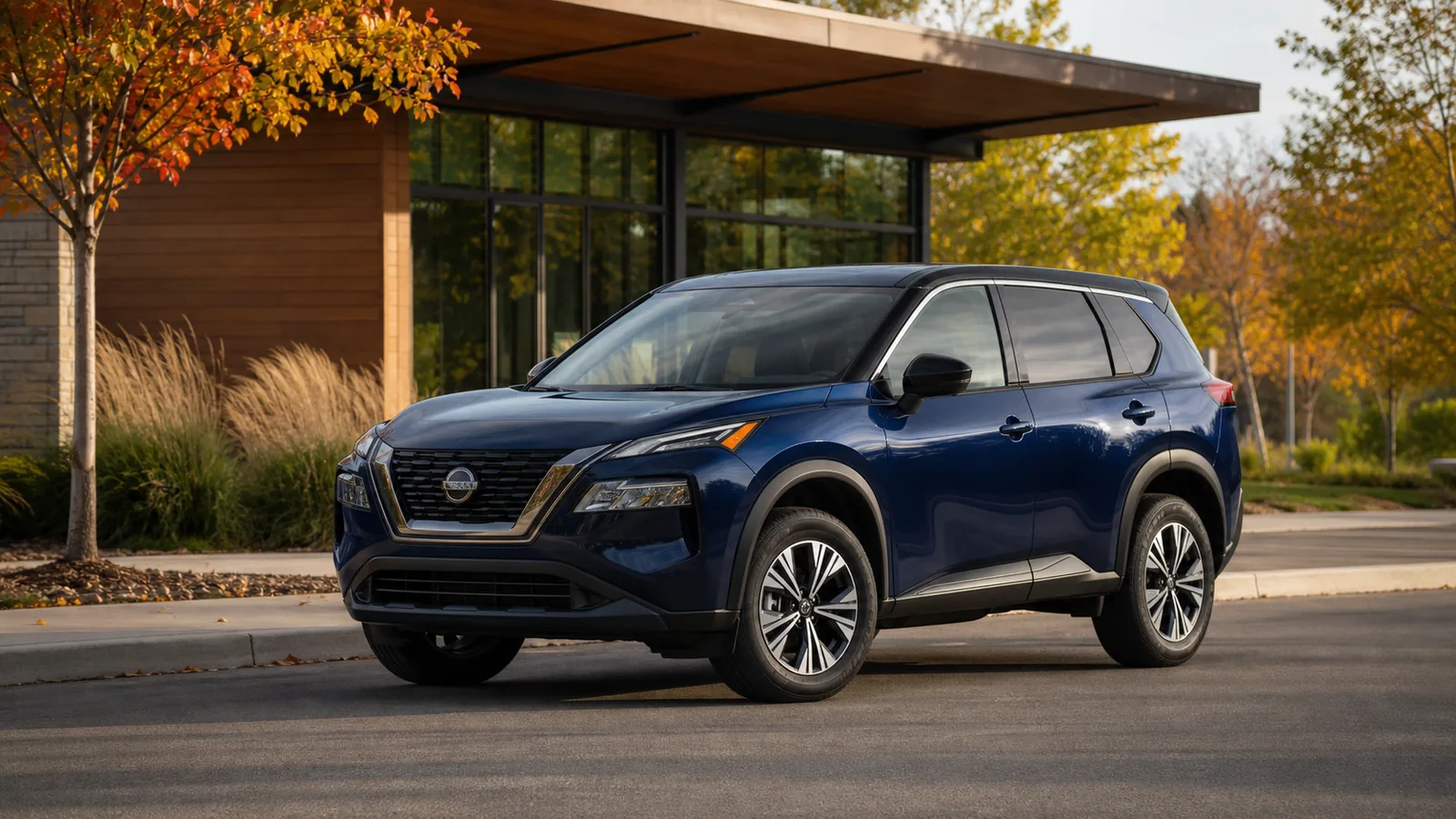
The 2026.5 Nissan Rogue SV is the useful center of the range. It adds the comfort and driver-assistance equipment many families notice every week without climbing to the price and wheel costs of Platinum.
The base S can work when its quote is clearly lower, while SL and Platinum need to solve a repeated need rather than make the test vehicle look complete.
Seat comfort is the Rogue's first advantage. Spend at least 20 minutes in the driver's seat before discussing screens or trim.
Adjust the cushion, backrest, steering wheel, and head restraint. Check whether the seat supports the thighs without pressing behind the knees and whether the right knee rests against hard trim.
A comfortable five-minute showroom position can create pressure after an hour.
SV also keeps the decision grounded. ProPILOT Assist can reduce workload on a well-marked highway, but it remains a supervised assistance system.
A power liftgate can help when both hands are full.
Those functions change a weekly routine. Quilted upholstery, larger wheels, or decorative lighting may not.
Compare the quote with other mainstream SUVs and the wider Nissan lineup.
Match drivetrain, safety equipment, seat functions, wheel size, and dealer products.
Record MSRP, discount, fees, finance rate, and trade allowance separately. The payment is not a clean comparison when the loan term changes.
Rock Creek and Platinum serve narrower buyers. Rock Creek adds an outdoors-focused look, AWD, and all-terrain tires.
Platinum adds luxury equipment and a higher replacement value. Neither changes the five-seat body or creates a hybrid powertrain.
Check the passenger seat with the same care. Some households alternate drivers, and a seat that lacks the driver's adjustments can be the weaker position.
Sit in row two behind both front-seat settings, then drive over a broken road.
Listen for headrest vibration, cargo-cover rattle, and tire noise. Comfort is a cabin result, not only a soft cushion, and the quietest trim may be the one with the least aggressive tire.
The best Rogue trim is the least expensive one that preserves the seat comfort, access, and driver aids the household will use.
The VC-Turbo needs a long drive
The Rogue uses a 1.5L variable-compression turbo three-cylinder rated at 201 hp and 225 lb-ft.
Its design can vary compression to balance response and efficiency.
It works with an Xtronic continuously variable transmission. The technology is more complex than the output number suggests, so a careful drive matters more than a quick acceleration claim.
Start cold. The engine should fire, settle, and idle without persistent knocking, heavy vibration, blue smoke, fuel odor, warning messages, or a seller-cleared dashboard.
A three-cylinder can have a distinct sound, but the vehicle should not shake through the seat or hesitate repeatedly.
Watch temperature and warning displays during the full drive.
| Stage | Normal task | Diagnose before purchase |
|---|---|---|
| Cold start | Clean start and stable idle | Smoke, strong odor, warning or heavy shake |
| Low speed | Smooth creep and takeoff | Delay, shudder, surge or clunk |
| 40 to 70 mph | Predictable passing response | Flare without speed or reduced power |
| Long grade | Stable temperature and output | Warning, overheating or repeated stumble |
| Return idle | Calm restart and no fresh alerts | New code, leak or rough idle |
A CVT may hold engine speed while the vehicle accelerates.
That is not the same as a slipping transmission. The concern is a repeatable mismatch between throttle, engine speed, and road speed, especially with shudder, delayed engagement, or stored codes.
Test Reverse, parking-lot creeping, a gentle launch, a firm merge, and a rolling pass.
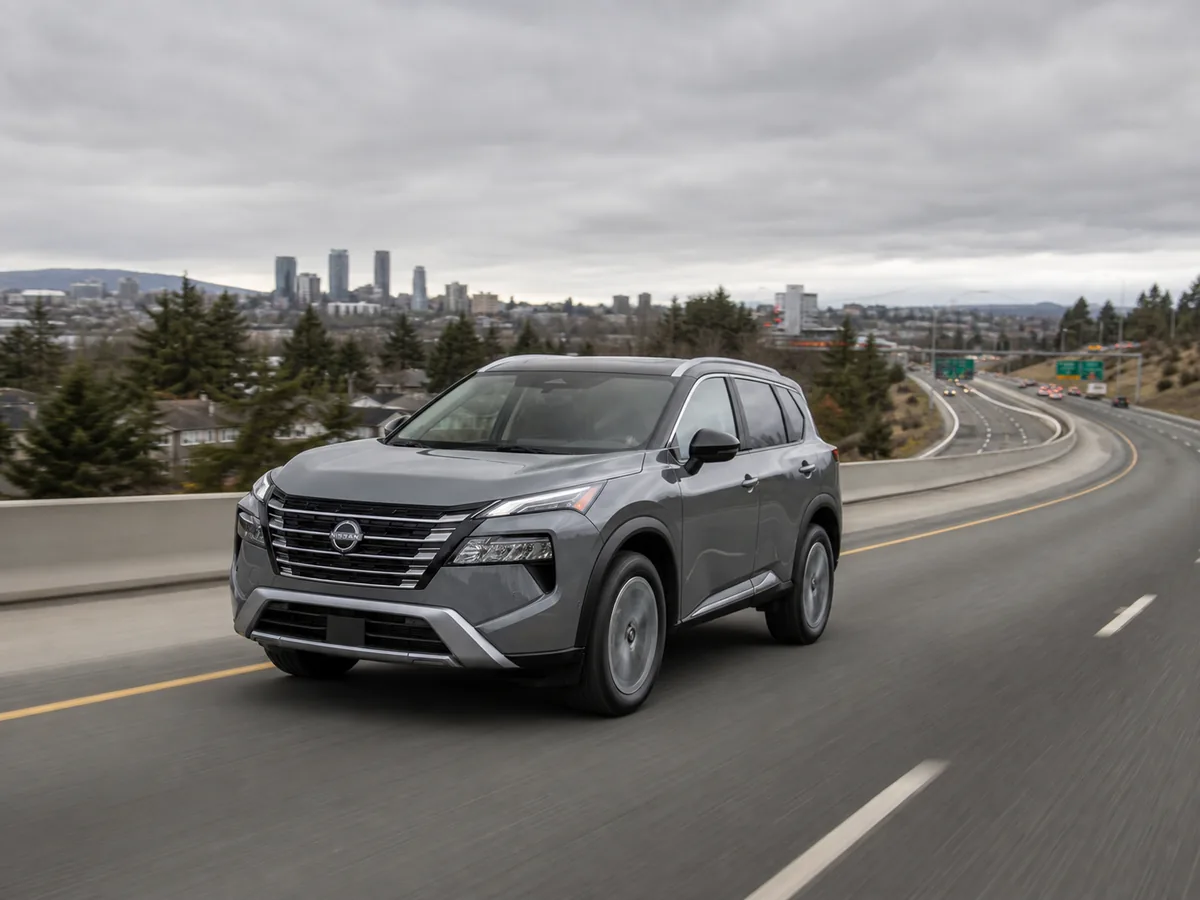
Compare the same loop in the Honda CR-V, Toyota RAV4, and Subaru Forester.
The Rogue may win on seat comfort and cabin quietness. A rival may feel more direct or offer a hybrid.
The point is not to punish a different transmission feel. It is to find the response the driver can predict.
Ask for service records and scan results before accepting any explanation.
After the highway section, stop for five minutes and restart. Recheck idle, warning history, fluid smell, and the ground under the vehicle.
Repeat a low-speed turn and Reverse engagement while the powertrain is hot. Some problems appear only cold, while others arrive after temperature and pressure build.
A complete test includes both states and enough time for a scan tool to see current and pending data.
Use a second driver if possible. One person should hold steady throttle while the other watches engine speed, road speed, and warning displays from the passenger seat.
Repeat the same 25-to-45 mph acceleration three times.
Normal CVT behavior should be repeatable. A single bump over rough pavement can feel like a drivetrain event, while a shudder that returns on smooth pavement at the same load deserves diagnosis.
Do not approve a software reset as the final answer without a clean repeat drive.
The Rogue powertrain passes only when it starts cleanly, responds smoothly through a long mixed route, and carries records that match its mileage.
What does 36 highway MPG require?
Nissan lists up to 29 mpg city and 36 mpg highway for the Rogue.
Those are useful comparison points, not a promise for every trim and route. Front-wheel drive, moderate speed, warm weather, correct tire pressure, and steady highway travel create the strongest case.
AWD, all-terrain tires, short cold trips, roof cargo, and fast cruising reduce it.
Turn the rating into gallons. At 15,000 annual miles and 33 mpg, the Rogue uses about 455 gallons.
At 28 mpg, it uses about 536. The 81-gallon difference can be multiplied by the local fuel price.
This shows why a small MPG change matters more to a high-mile driver than to someone who travels 6,000 miles a year.
Reset the trip display only after the engine is warm. Drive the normal congested section, a steady highway stretch, and the repeated grade.
Keep the test long enough for one hard acceleration or dealer idle period to stop dominating the average.
Record speed, weather, passengers, and tire type so another vehicle can be tested fairly.
Front-wheel drive usually controls purchase and fuel cost. Review front-drive models when snow and rough access are rare.
AWD may earn its price for a steep driveway or repeated winter travel, but it still needs four suitable tires.
Rock Creek's all-terrain tires solve a different problem and can add rolling resistance.
A high-mile city household should also compare hybrid SUVs and the Toyota RAV4 Hybrid. The Rogue can still cost less when its transaction price is lower, but the calculation must include recurring gallons and the planned ownership period.
Keep roof bars, cargo boxes, and tire pressure in the calculation. Bars left in place can add wind noise and drag, while a roof box changes both.
Short winter trips may spend most of their time warming the engine and cabin. A commuter who parks outside should use a colder estimate than a long-distance driver leaving a garage.
The budget should survive the difficult season, not only a summer highway run.
Use 36 highway mpg as a best-case reference, then budget from the exact trim on the roads, tires, speeds, and weather the owner will repeat.
Rear access is the family advantage
The Rogue's family case is easier to understand with doors open. Rear access, seat height, a comfortable bench, and a useful cargo opening can remove friction from school runs and travel.
Those benefits are more important than a maximum cargo number when the rear seats remain occupied most days.
Set the front seats for the usual adults. Install the real rear-facing seat, forward-facing seat, or booster according to its instructions.
Find the lower anchors and top tethers, tighten at the belt path, and check whether another passenger can buckle without twisting.
A wide restraint can make the center position unusable even when the specification says five seats.
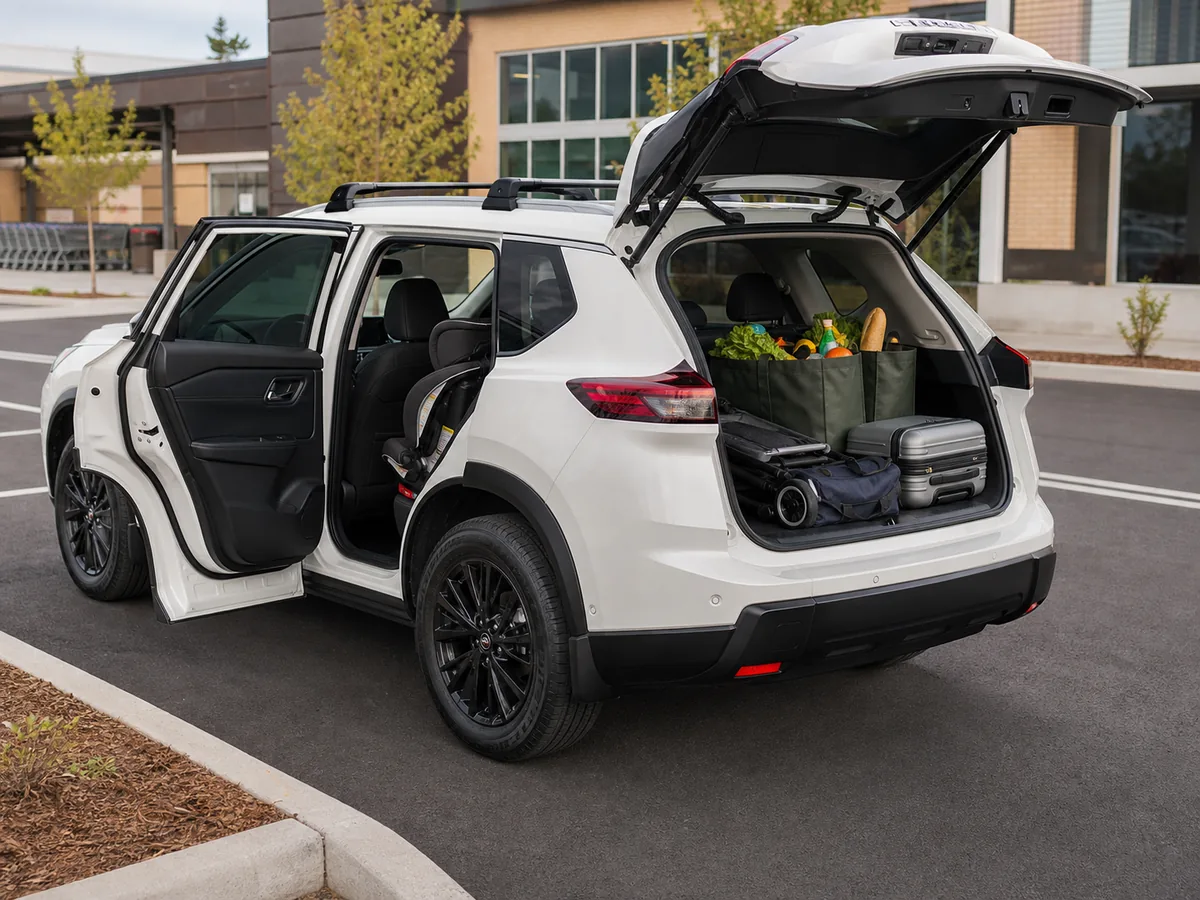
Load the stroller, grocery bins, sports bag, pet crate, work case, or airport luggage behind the occupied bench.
Close the hatch without pressing against the glass. Check floor height, privacy-cover clearance, wheel-well width, and storage below the floor.
Fold only one seat section to see whether a passenger can remain beside a long item.
- Open the rear door in a narrow parking space
- Lift the child seat through the normal angle
- Reach every buckle and tether
- Load the stroller without folding the bench
- Check rear visibility over the usual cargo
- Test the power liftgate under the home garage door
Compare the same load in the Honda HR-V and Mazda CX-5. A smaller vehicle may park more easily, while another roofline may accept taller cargo.
The Rogue should win through fewer awkward motions, not through a brochure total measured with every seat folded.
Older passengers should test step-in height, grab handles, door-sill clearance, and head restraint position.
A comfortable cushion is not enough when entry requires a painful twist.
The Rogue earns family duty when passengers can enter, buckle, and load their normal gear without rearranging the cabin each trip.
Rock Creek changes tires, not space
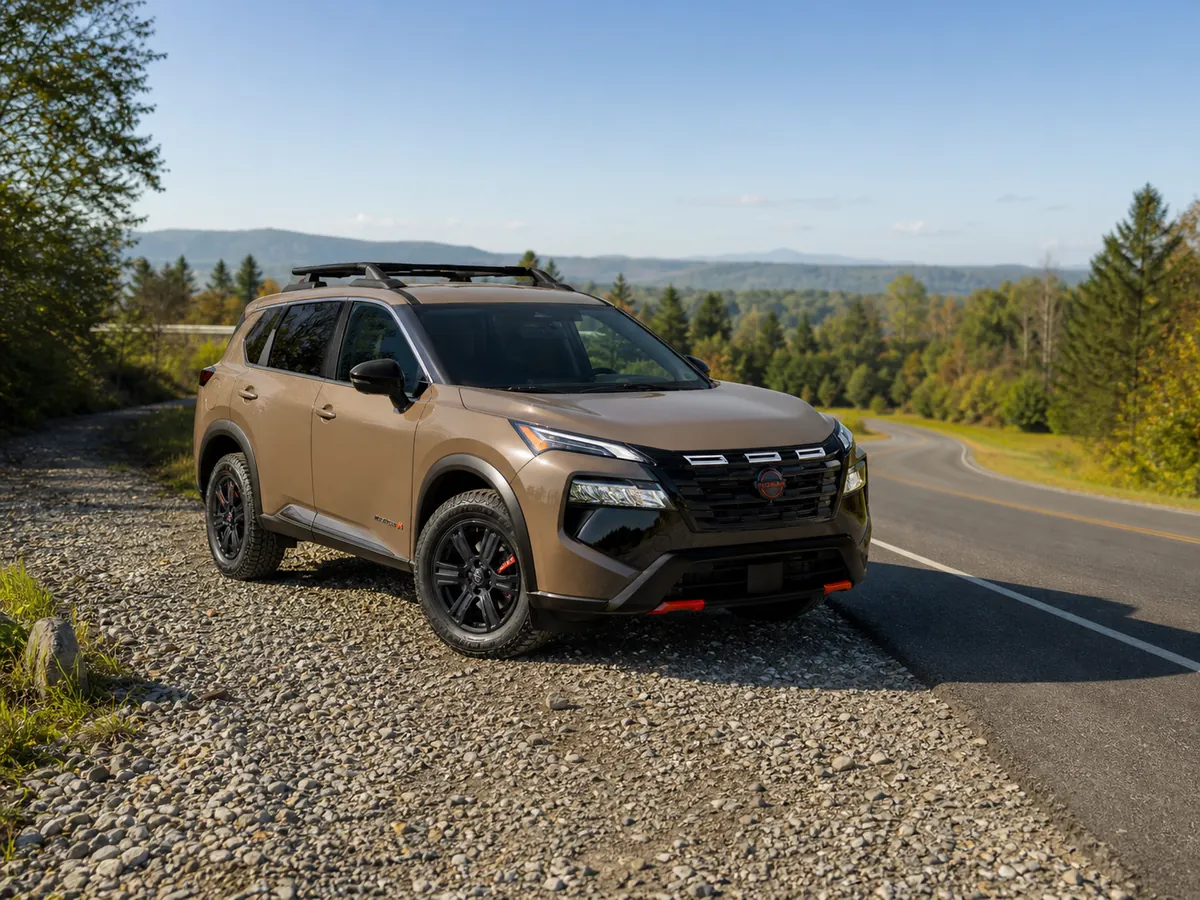
Rogue Rock Creek is easy to buy for its look. It combines AWD, all-terrain tires, exterior details, and an outdoors-focused presentation.
Those changes can suit gravel roads, trailhead parking, snow, and rough access. They do not create more passenger room, a larger cargo opening, or a different engine.
The tire is the most important physical change. An all-terrain pattern can improve grip and damage resistance on loose surfaces, but it may add hum, rolling resistance, steering weight, and replacement cost on pavement.
Test Rock Creek at 30, 55, and 70 mph on the roads used every week.
Listen from the rear seat as well as the driver's position.
| Need | Rock Creek helps | Standard Rogue may fit better |
|---|---|---|
| Gravel access | Tire and AWD package | Paved access only |
| Snow traction | Suitable tread plus AWD | Winter tires still decide grip |
| Highway quiet | Tire may add noise | Road tire usually calmer |
| Cargo space | No meaningful increase | Same five-seat body |
| Fuel use | Possible penalty | FWD gives the best estimate |
Inspect the replacement price for four correct tires before choosing the trim. Ask how often they should rotate and whether a matching spare is provided.
AWD systems work best with closely matched rolling circumference, so one damaged tire can become a multi-tire decision when the remaining tread is worn.
Rock Creek is not a substitute for a purpose-built off-road vehicle. Ground clearance, approach angles, cooling, underbody protection, water depth, and recovery points still set limits.
Drivers who regularly travel rougher terrain should compare a Jeep Wrangler or Toyota 4Runner while accepting their fuel, ride, and cost tradeoffs.
Rock Creek makes sense when its tires and AWD solve repeated access problems, not when the household mainly wants the image in a paved parking lot.
2026 airbags improved the side test
The 2026 Rogue has an important model-year-specific safety change. IIHS reports that Nissan changed the side-curtain airbags, and the 2026 vehicle earns a Good result in the updated side test.
That improvement should not be carried backward to every Rogue from the same generation without checking the exact test applicability.
- 2021Current Rogue generation begins
- 20221.5L VC-Turbo becomes the main engine
- 2026Side-curtain airbags change for updated side protection
- 2026.5Current S, SV, Dark Armor, Rock Creek, SL, and Platinum range
Read the certification label and VIN before comparing a used vehicle. A registration year, sale listing, and production date can describe different things.
Open the current IIHS vehicle page and the NHTSA recall lookup while standing beside the Rogue.
Save the results with the purchase records. KnowMotors explains its evidence standards on the source methods page.
A Good side rating does not install a child seat. Locate lower anchors and top tethers, tighten the restraint at the belt path, and check whether adjacent buckles remain usable.
Make sure an adult can reach the rear position without stepping on a restraint or twisting the belt.
Head restraints need to meet the occupant correctly.
Driver assistance is supportive, not autonomous. Test blind-zone alerts, lane support, automatic braking warnings, adaptive cruise, and camera views on a legal route.
Learn alert sensitivity and cancellation controls while parked. Rain, road salt, dirty sensors, faded markings, and unusual traffic can reduce performance.
Headlights and tires finish the physical check. Drive after dark if possible, inspect beam coverage on curves, and confirm automatic high-beam behavior.
Four suitable tires determine stopping and turning grip.
Ask whether the chosen vehicle received any software, sensor, camera, seat, or restraint work after collision repair.
Airbags and pretensioners have service requirements that a cosmetic repair cannot prove. Inspect warning lights during the bulb check, read scan data, and review invoices.
A vehicle with a clean exterior can still need specialized inspection when the history shows side or roof damage.
When comparing listings, write the VIN, build month, model year, and first registration date in four separate fields.
Ask IIHS or the manufacturer when an applicability note is unclear. A late sale does not turn an earlier vehicle into the improved version.
This discipline matters most when two otherwise similar Rogues have different safety evidence and only a small price gap.
The 2026 airbag change is meaningful evidence, then the buyer must verify the exact year, recalls, restraints, lights, tires, and driver-aid behavior.
Used Rogues need oil and scans
The current Rogue generation arrived for 2021, and the 1.5L VC-Turbo became the main engine during the run.
A used buyer must identify the exact engine, drivetrain, model year, and equipment before applying any inspection advice. Online complaints can point to systems worth checking, but they do not establish the probability that one vehicle will fail.
Oil history matters. Ask for invoices showing dates, mileage, and correct service rather than accepting a reminder sticker.
Check the level and condition only by the owner's-manual procedure. Look for long gaps, repeated low-oil notes, cooling work, engine warnings, CVT complaints, and unexplained module replacement.
A clean history report cannot show every repair paid without insurance.
| Area | Cold test | Records and scan |
|---|---|---|
| VC-Turbo | Start, idle, oil, boost response | Oil intervals, engine codes, repairs |
| CVT | Reverse, creep, merge, grade | Fluid work, complaints, stored codes |
| AWD | Tight turn, wet incline, tire match | AWD warnings and tire invoices |
| Electronics | Screen, cameras, driver aids | Software updates and module history |
| Body | Seals, glass, underbody, paint | Collision invoices and water repairs |
Drive before the seller warms the vehicle. Test both keys, remote functions, climate, heated seats, phone connection, screen, cameras, liftgate, windows, roof equipment, outlets, and every assistance feature fitted.
A weak 12-volt battery can trigger warnings, but replacing it should not be used to dismiss stored faults without a scan.
Inspect four matching tires for size, date, tread depth, damage, and uneven wear. Rock Creek tires are expensive to correct, and AWD increases the importance of similar rolling circumference.
Look underneath for leaks, impact damage, loose shields, tow-hitch wear, and fresh coating that hides repairs.
Use the new versus used guide to compare remaining warranty with the discount.
Order an independent pre-purchase inspection and full-module scan.
Verify recall completion by VIN.
Confirm title status, in-service date, and warranty eligibility in writing. Prior rental, commercial, branded-title, or imported use can change value and coverage.
The seller should provide the VIN before the appointment so recall, service, and insurance checks can begin early. If the VIN changes when the buyer arrives, restart the research rather than assuming the replacement vehicle has the same history.
A good used Rogue starts cold, holds clean oil records, drives smoothly through a long route, and explains every warning or repair with evidence.
Trim upgrades change ownership cost
Rogue cost goes beyond the payment. Drivetrain, tire type, wheel size, glass, cameras, insurance value, fuel use, finance interest, and trade timing all change the bill.
SV with front-wheel drive is the controlled baseline because it combines useful equipment with the best published fuel figures and ordinary road tires.
| Cost | Controlled pattern | Higher-cost trigger |
|---|---|---|
| Purchase | SV FWD at a clean total | Platinum or loaded package |
| Fuel | FWD and moderate highway speed | AWD, Rock Creek tires, short cold trips |
| Tires | Common road-tire size | All-terrain or large-wheel package |
| Insurance | Exact SV VIN quote | High replacement value and glass |
| Repairs | Warranty plus records | Complex options and ignored warnings |
| Depreciation | Mid trim kept longer | Loaded trim traded early |
Get insurance quotes for exact VINs before choosing Platinum or Rock Creek. Price a complete set of correct tires with mounting, balancing, disposal, and alignment.
Ask about windshield replacement and camera calibration. One cracked glass panel can cost more than a year of small fuel savings.
Fuel cost should use annual miles and a conservative test-drive result. Divide miles by MPG, multiply by the local price, and compare with a hybrid rival.
Include finance interest on the price difference. An efficient vehicle does not save money when the buyer overpays and trades before recurring savings accumulate.
Compare out-the-door totals rather than MSRP. Dealer accessories, protection products, taxes, fees, trade manipulation, and loan term can erase a discount.
The lease versus buy guide helps separate a lower payment from a lower total cost.
Ask a Nissan service department for current prices on routine oil service, filters, brakes, one wheel, one tire, and windshield calibration.
These are not predictions, but they show scale. Keep a reserve during warranty because tires, glass deductibles, collision damage, and routine service remain the owner's responsibility.
Create a five-year worksheet with one row for purchase and interest, then one row each for fuel, insurance, tires, scheduled service, registration, and expected accessories.
Use the same mileage and resale assumption for every trim. The worksheet will not predict every repair, but it exposes when a Platinum payment or Rock Creek tire package costs more than the household expected to spend for comfort and access.
A sensibly equipped Rogue kept for years protects the comfort value better than a loaded one traded while the loan is still young.
Who should shortlist the Rogue?
The Rogue belongs on a family shortlist when seat comfort, rear access, cargo loading, highway fuel economy, and available driver assistance matter more than sporty steering. It suits households that will test the VC-Turbo and CVT carefully and maintain the vehicle from records rather than assumptions.
Compare it within the compact SUV field and the best family SUVs using one fixed route and load. Rankings can suggest candidates, but they cannot measure a driver's back after an hour or show whether the stroller fits behind an installed child seat.
Run the final decision in order. Sit for 20 minutes, test the vehicle cold, drive low speed and highway, load the rear area, read exact-year safety evidence, price tires and insurance, scan a used example, then compare out-the-door totals.
Negotiate only after the Rogue passes the tests a discount cannot repair.
A buyer who wants a regular hybrid, simple powertrain, or performance feel should keep shopping. A buyer who values comfortable travel and receives a clean SV quote may find the right answer.
Set a walk-away total before entering finance. Include destination, tax, registration, unavoidable fees, and only the products deliberately chosen.
Keep the trade and loan rate separate until the vehicle price is clear. A high trade allowance or long term can make an ordinary Rogue deal appear generous.
Comfort can justify choosing the model, but it cannot justify unclear math.
The Rogue is comfortable enough for family duty when its powertrain proves smooth and documented, and when the household confirms that access matters more than trim decoration.