Nissan stopped selling the Ariya, so what can you actually buy?
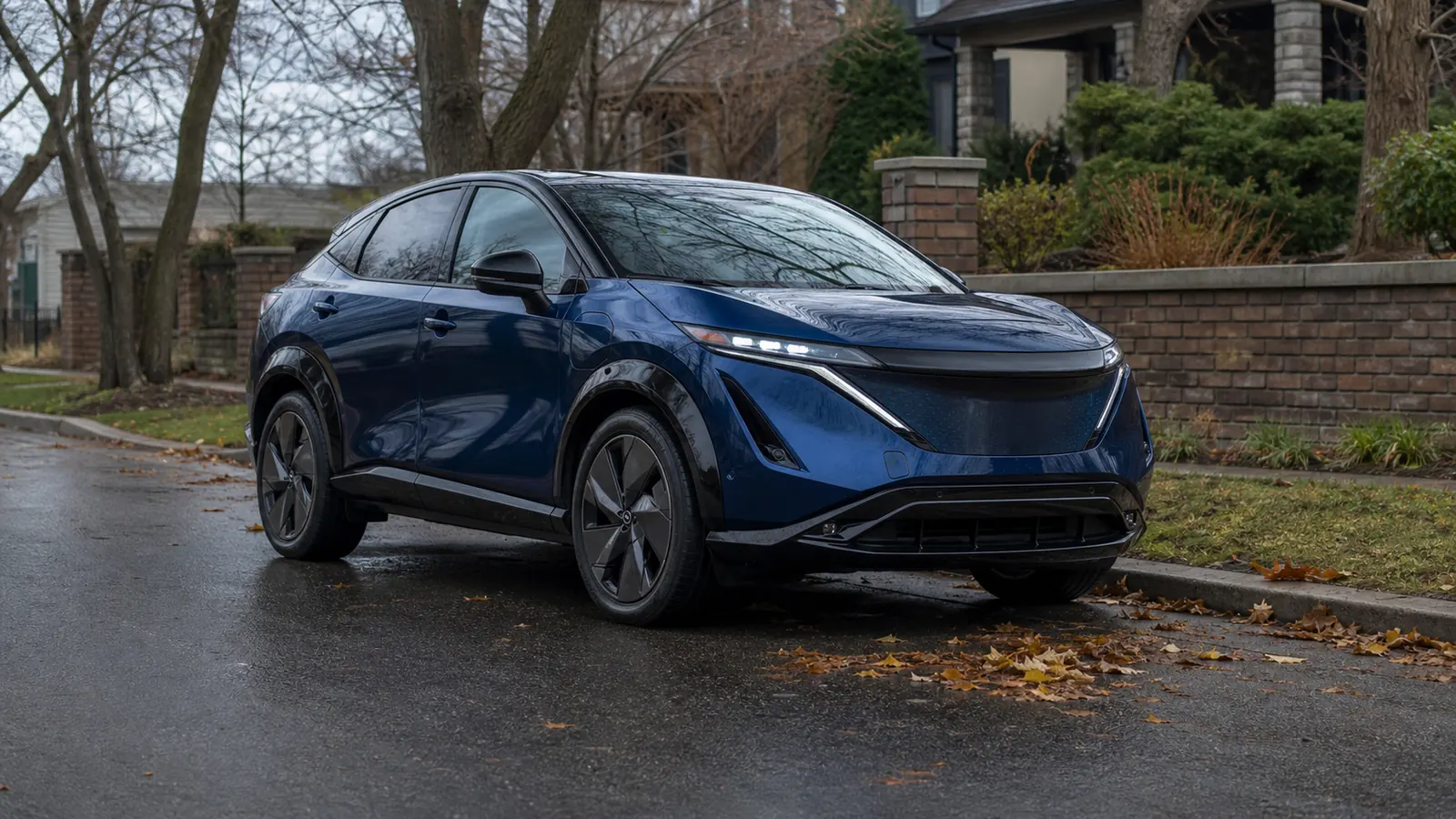
The Nissan Ariya is a five-seat electric crossover, built in Japan and sold in the United States since 2023. It was aimed at the Tesla Model Y and the Volkswagen ID.4, priced above the Leaf, and built for buyers who wanted a quiet family EV more than a quick one.
In September 2025 Nissan told its dealers that no 2026 Ariya would be built for this market. The 2025 cars are the last ones, and Nissan now serves the model from the discontinued-vehicles part of its own website.
The reasons were commercial. A 15 percent tariff applies to the Japan-built car, the federal purchase credit that once softened its price has ended, and Nissan moved the budget to a redesigned Leaf that starts at $29,990.
Sales were not the trigger. US deliveries reached 7,471 in the first half of 2025, up 43 percent year on year, although heavy discounting did much of that work.
Two Ariyas are left to shop. Dealers still hold leftover 2025 stock at new-car prices, and the used market carries 2023, 2024 and 2025 cars at figures their first owners would not recognise.
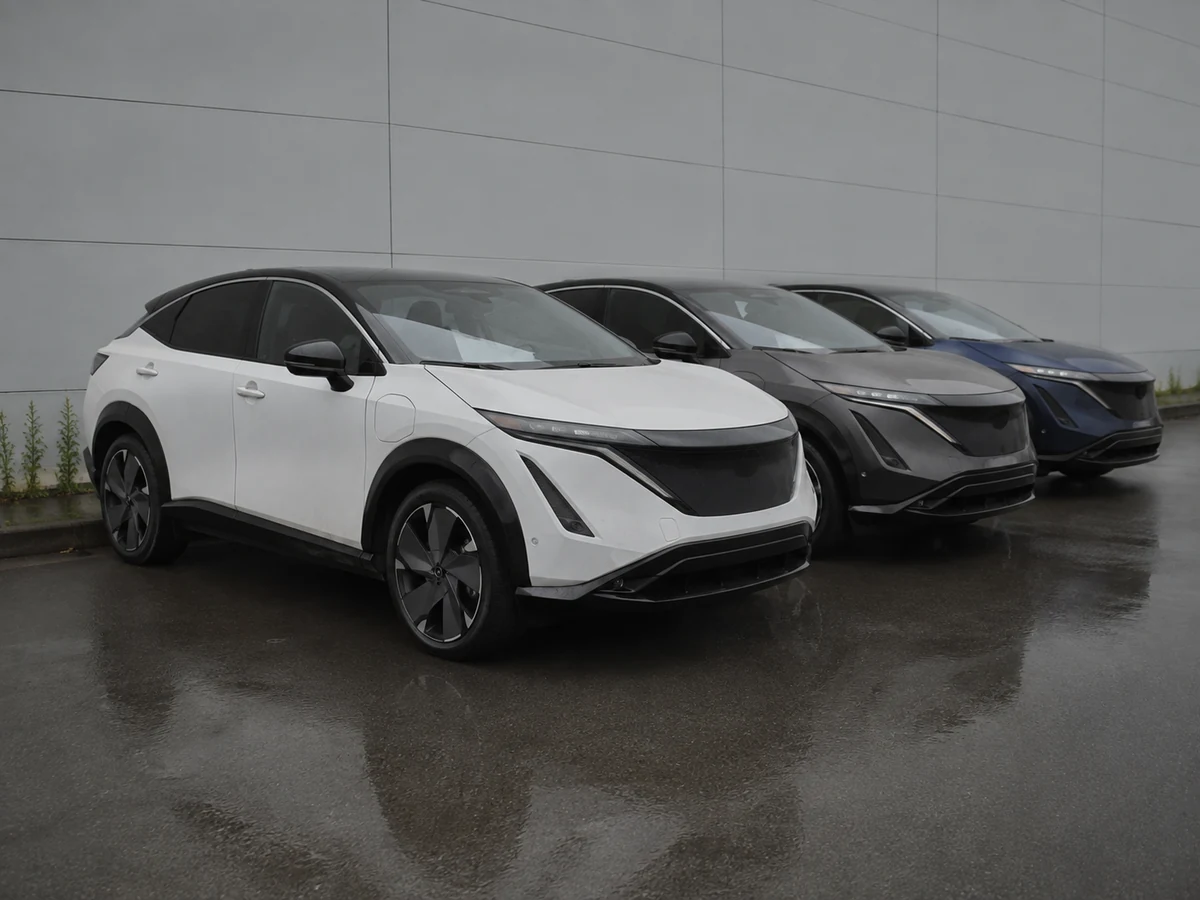
Nissan has promised continuing support for existing owners and has left the door open to bringing the car back later. Treat both as background rather than as reasons to pay more, because today's asking prices are set by a market that has already assumed the Ariya is gone.
The 2023 Ariya has lost 56 percent of its value in three years
Kelley Blue Book values a 2023 Ariya that cost $44,525 new at $19,550 today, with a trade-in figure of $14,800. The car has given up $24,975 and holds 44 percent of what it was worth three years ago.
Almost all of that happened immediately. Year one took $18,251 of the loss, while years two and three took $3,364 and $3,360.
KBB places the car in the top quarter of 2023 SUVs for depreciation. Discounting, fleet sales and a manufacturer exit arriving within three years of each other will do that to any nameplate.
Sequence is what makes this interesting to a second buyer. The first owner absorbed roughly three quarters of the three-year loss, so anyone buying now steps in after the steep part instead of ahead of it.
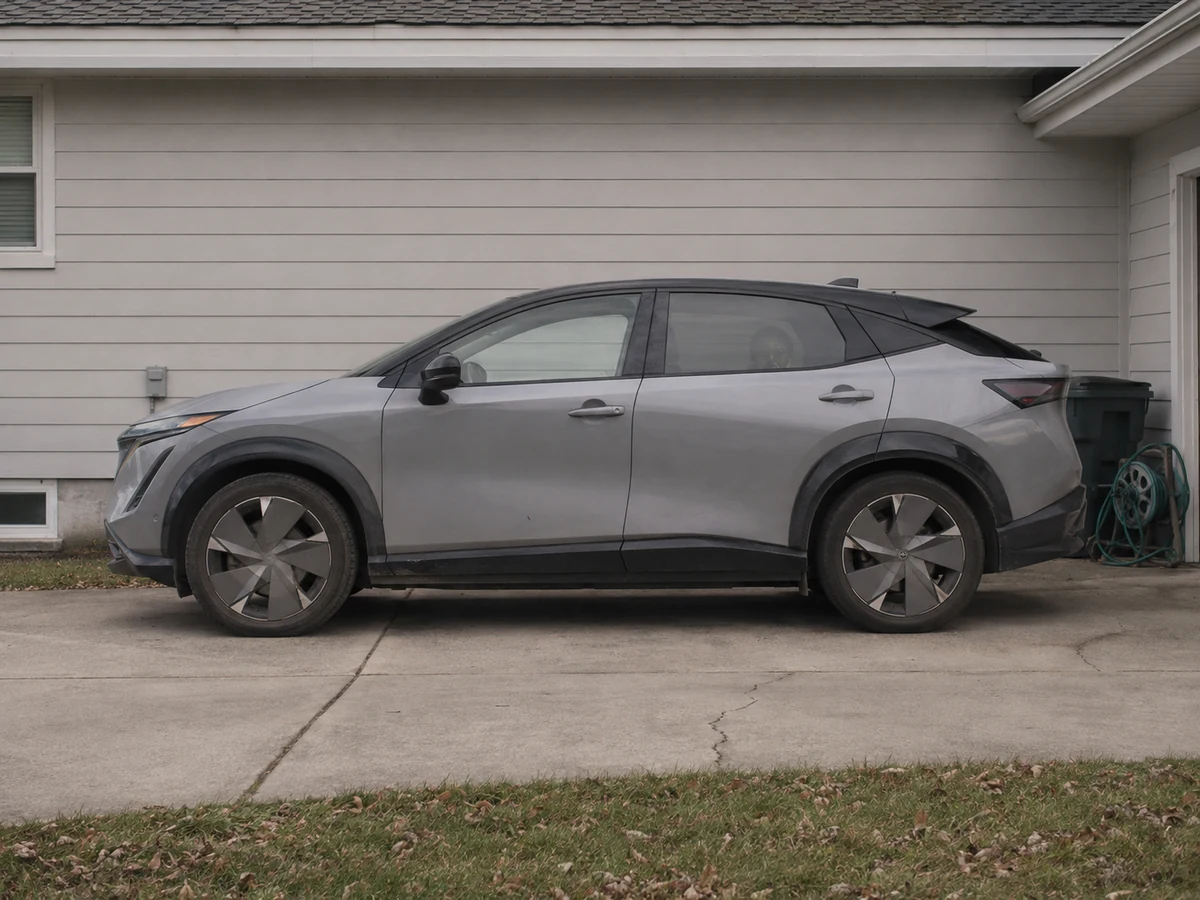
One subsidy that would have covered part of the gap is gone. The federal used clean vehicle credit paid 30 percent of the price up to $4,000 on a used EV selling under $25,000, which describes this car exactly, and it stopped applying to any vehicle acquired after 30 September 2025.
A buyer today pays the whole asking price. Someone who bought the same car a year earlier could take up to $4,000 of it back at tax time, so a listing that looks flat against last year is really more expensive.
A leftover 2025 listed at $39,770 before its $1,495 destination charge is a different purchase from a 2023 at less than half that money. The used Ariya's case rests on buying a car that has already taken its worst hit, which is exactly why the model year underneath the price matters more than the price.
Every Ariya recall campaign belongs to the 2023 car
NHTSA lists four recall campaigns for the Ariya. All four cover 2023 vehicles, and the same query run against the 2024 and 2025 model years returns nothing at all.
Three of the four end in the same place. Two separate inverter software faults and one damaged set of front traction motor O-rings can each shut the drive system down while the car is moving.
- February 202323V131, a steering wheel bolt that may be loose or missing, replaced after inspection
- September 202323V657, inverter software that shuts down the EV system after reading a short circuit
- June 202424V391, front traction motor O-rings damaged in assembly, remedied by replacing the motor
- July 202424V560, a second inverter software fault, this time a misdiagnosed error
The dates are the part a used buyer needs. Two of the campaigns arrived more than a year after these cars were delivered, so a service history that looked complete in 2023 can be missing two remedies today.
The complaint record points the same way. The 2023 car holds 40 filings, the 2024 holds 6 and the 2025 holds 7, counted as unique filings across every label NHTSA files the car under.
Inside those 40, twenty-four name the electrical system somewhere in their component field. Six describe losing drive power, six mention the brakes, and three describe a car that would not start.
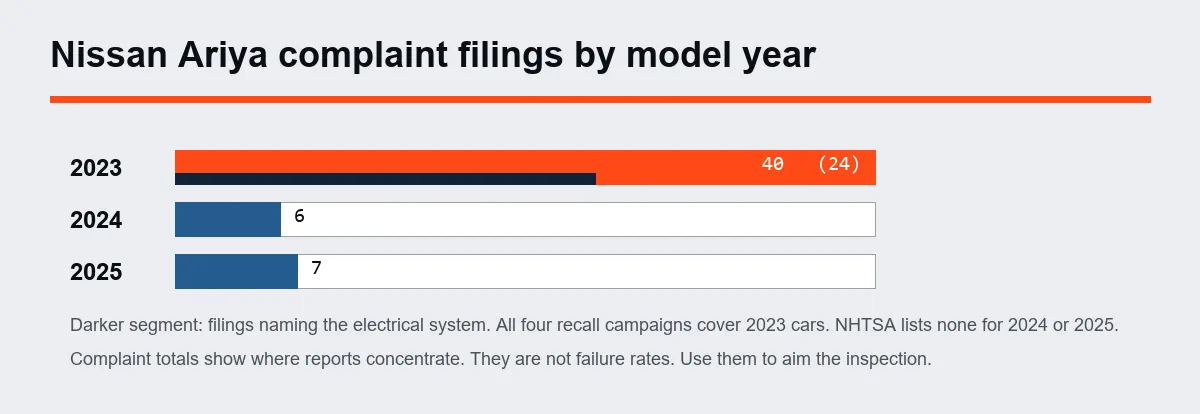
Fifty-three filings across three model years is a small record. It cannot tell you how likely any of this is, and it was never meant to, but it does tell you where to aim an inspection.
There is a reading of all this that favours the buyer. Nissan fixed the launch-year faults under campaign, and the two model years that followed have so far produced neither a campaign nor a pattern.
Run the VIN against all four campaigns before you talk about price on a 2023, because a car with open remedies is worth less than one without, and a private seller often has no idea which they are holding.
63 or 87 kWh, front-drive or e-4ORCE: what each version gives you
Two battery sizes were offered, and the numbers that matter are the usable ones. The 66 kWh pack delivers 63 kWh to the motors and the 91 kWh pack delivers 87 kWh.
Front-drive cars use one motor, making 214 hp in Engage form and 238 hp in Evolve+, both with 221 lb-ft. Adding e-4ORCE puts a second motor on the rear axle for 335 hp and 413 lb-ft, or 389 hp and 442 lb-ft in the two most expensive grades.
Traction costs range. The second motor takes 11 EPA miles off the small-battery car and 17 off the large one, because it adds weight and drag that no amount of torque splitting recovers.
Wheels cost range too. A Platinum+ on 20-inch wheels is rated at 257 miles where the identical car on 19s is rated at 267.
| Version | Usable battery | EPA range | Output | List price |
|---|---|---|---|---|
| Engage FWD | 63 kWh | 216 miles | 214 hp | $39,770 |
| Engage e-4ORCE | 63 kWh | 205 miles | 335 hp | $43,770 |
| Evolve+ FWD | 87 kWh | 289 miles | 238 hp | $44,370 |
| Engage+ e-4ORCE | 87 kWh | 272 miles | 335 hp | $45,370 |
| Evolve+ e-4ORCE | 87 kWh | 272 miles | 389 hp | $48,370 |
| Platinum+ e-4ORCE 19-inch | 87 kWh | 267 miles | 389 hp | $54,370 |
| Platinum+ e-4ORCE 20-inch | 87 kWh | 257 miles | 389 hp | $54,370 |
Those prices all exclude a $1,495 destination charge. The lineup spans 84 miles of rated range and $14,600 of list price, so searching by trim name puts a buyer at real risk of paying more and travelling less.
Safety and driver-assistance kit does not climb with the price. Nissan Safety Shield 360 and ProPILOT Assist with Navi-link are standard on every grade, as are the dual 12.3-inch displays, so a $39,770 Engage is not a stripped car with the equipment held back for the $54,370 one.
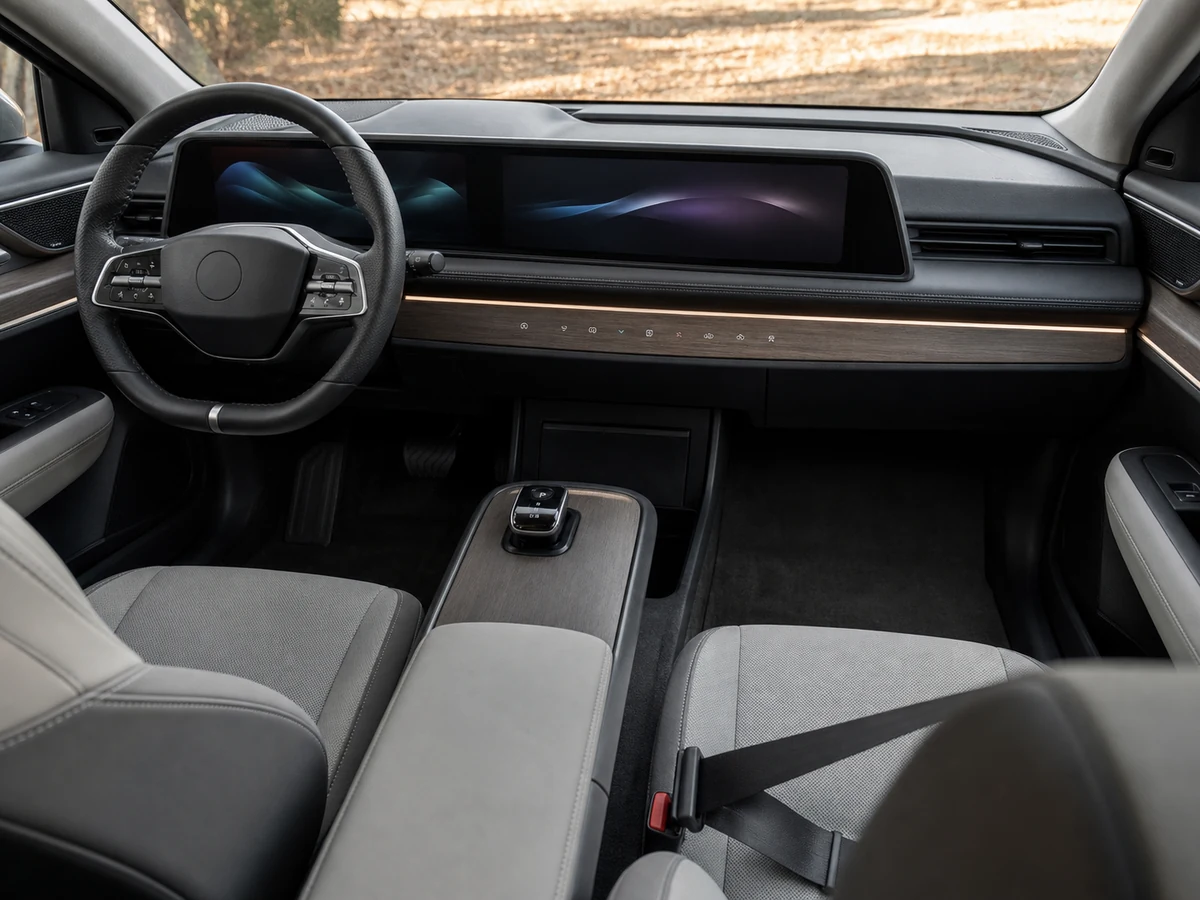
What the extra money buys is comfort and highway assistance. Nappa leather, a nine-speaker Bose system and ProPILOT Assist 2.0 are reserved for Platinum+, so the top of the range is sold on cabin materials and a hands-off highway mode rather than on anything structural.
There is one equipment change worth knowing between years. Wireless phone charging became standard across the range for 2025, which is a small thing on its own and a useful tiebreak between two otherwise similar listings.
One listing deserves particular care. A Venture+ front-drive rated at 304 miles was sold for 2023 and 2024 only, which makes it the longest-range Ariya ever offered here and a car no 2025 badge can match.
The 289-mile Evolve+ front-drive is the range choice, and e-4ORCE earns its money only when you genuinely need traction, not when you like the sound of 389 hp.
What 130 kW on a CCS plug means for a real road trip
Nissan rates the Ariya at a 130 kW DC peak and quotes 35 minutes to 80 percent on the 63 kWh car, 40 minutes on the 87 kWh car. At a 50 kW station those same windows stretch to 65 and 90 minutes.
A long-term test of a Platinum+ found the quoted peak hard to reach. Sessions typically ran at 70 to 91 kW, fell to 37 kW at one 50 kW station, and touched 130 kW exactly once, near freezing, after about twenty minutes of deliberate battery warming.
That warming has to be requested. Preconditioning sits several menus deep in the vehicle settings and cannot be triggered from a navigation app, so a driver who has never gone looking for it will arrive at every charger cold.
The inlet itself is CCS Standard. Tesla Superchargers are reachable through a NACS adapter rather than a native socket, and the car's 130 kW ceiling still applies once the cable is in.
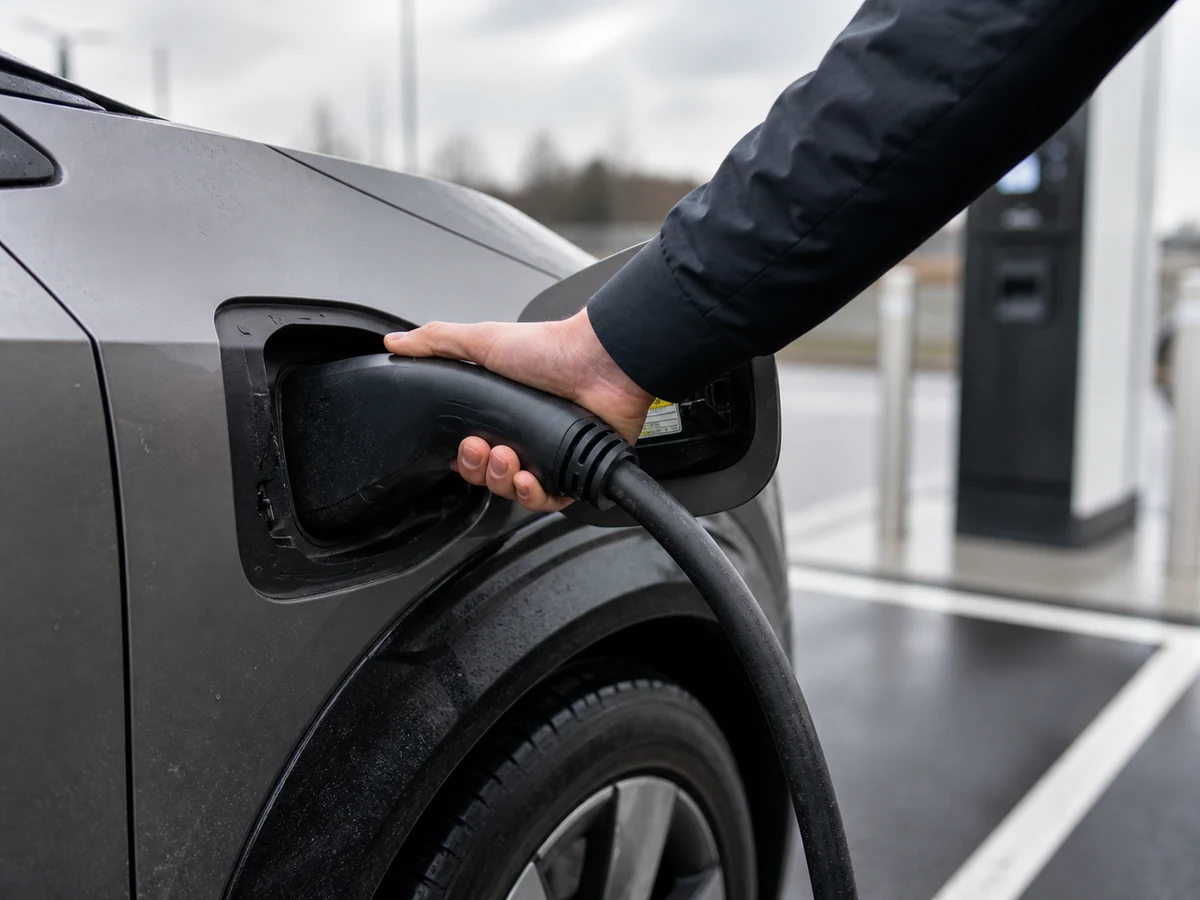
Home charging is the figure most owners actually live with. The 7.2 kW onboard charger fills the small pack in 10.5 hours and the large one in 14, which clears an overnight either way.
Ariya charging inputs
- Inlet
- CCS Standard, Superchargers by adapter
- DC peak
- 130 kW
- To 80 percent at 130 kW
- 35 minutes on 63 kWh, 40 on 87 kWh
- To 80 percent at 50 kW
- 65 minutes on 63 kWh, 90 on 87 kWh
- Home charging
- 7.2 kW onboard, 10.5 or 14 hours to full
The gap to the quickest rivals is wide and worth naming. A Hyundai Ioniq 5 or Kia EV6 on an 800-volt system finishes the same 10 to 80 percent window in 18 to 20 minutes, roughly half the Ariya's best case and a third of a poor one.
There is a second cost that does not show up in kilowatts. The car's built-in charger database has drawn complaints for listing stations that no longer work, and its navigation shows connector types without showing power ratings, so trip planning belongs on a phone app.
Charging speed only bills you at the frequency you use it, so the Ariya suits a household that plugs in at home and takes long trips a few times a year, not one that fast-charges on the road most weeks.
How the Ariya drives, and the range to plan around
The Ariya drives quietly and softly, which is what Nissan built it to do. Its e-4ORCE system varies torque between the axles and brakes individual wheels to steady the body, so it stays composed through a corner without ever feeling eager.
Mass is why it never feels light. A front-drive Engage carries 4,323 pounds and a Platinum+ e-4ORCE carries 5,057, and that difference shows up in how the car settles over a crest rather than in how it turns in.
Efficiency drops as you climb the price list. EPA rates the front-drive Engage at 101 MPGe combined and the 20-inch Platinum+ at 87, which is the same penalty that costs the expensive car its rated miles.
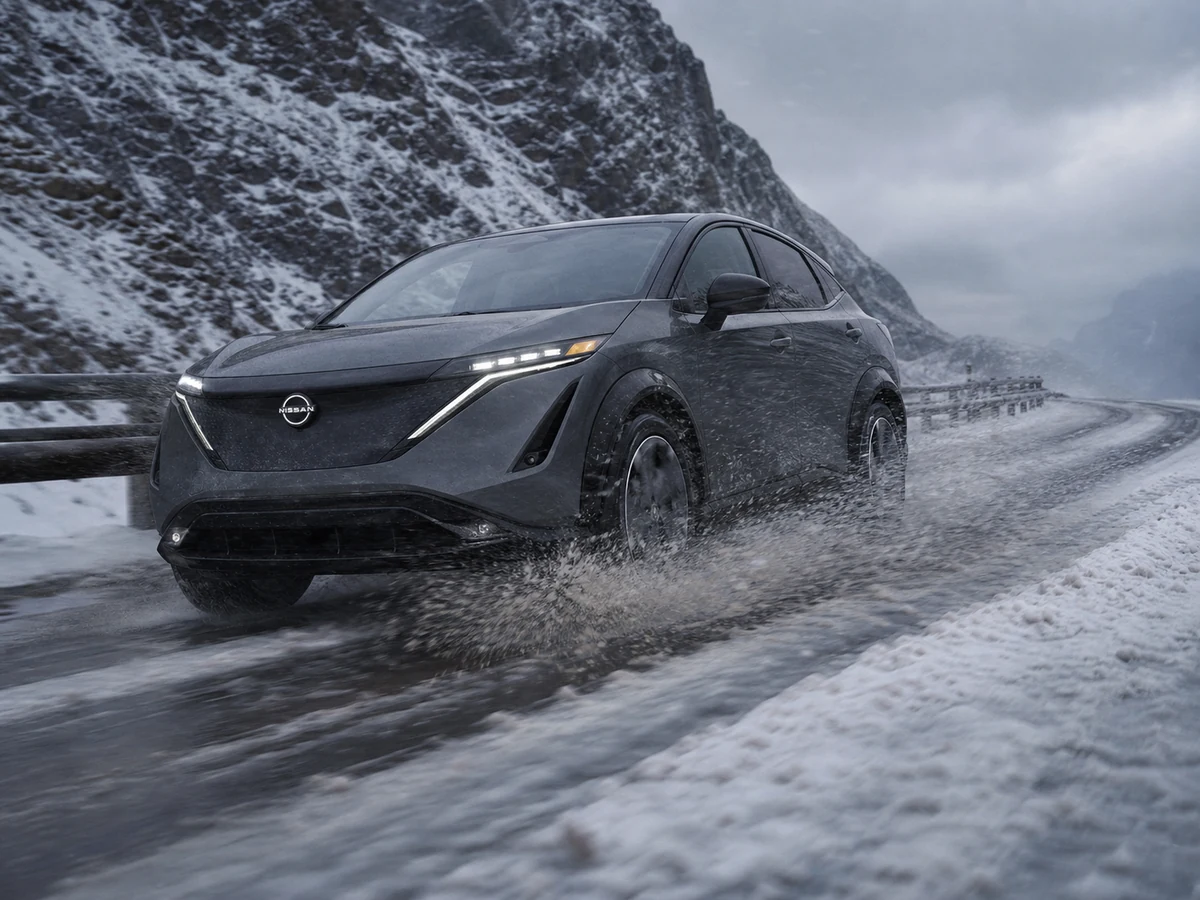
The window sticker is not what owners see. A long-term Platinum+ rated at 267 miles returned between 196 and 233 miles on a full charge, and about 180 miles when charged to 80 percent.
Cold accounts for most of that gap. A battery heater is standard on every grade, but warming the pack and the cabin in winter spends energy that would otherwise have moved the car down the road.
Size a commute against 196 to 233 miles instead of the sticker figure, and treat an 80 percent daily charge on a Platinum+ as roughly 180 usable miles.
The IIHS award does not cover the Ariya most buyers want
The Insurance Institute for Highway Safety names the Ariya a Top Safety Pick under its 2024 criteria. Small overlap front and the updated side test both rate Good, pedestrian front crash prevention rates Good, and the headlights rate Acceptable.
One result sits well below the others. The updated moderate overlap front test returns Marginal, and IIHS recorded it on a 2025 Ariya Engage+ four-door all-wheel drive.
The coverage note is the part to read twice. IIHS states that the small overlap and side results do not apply to the all-wheel drive extended range battery variant, and Nissan's own 2025 material says the award covers Ariya models with the 66 kWh battery.
Both statements point at the same car. The long-range e-4ORCE, which is the version most shoppers want and the one most used listings carry, is not the version those strongest results were recorded on.
Federal testing is more straightforward. NHTSA gives the 2025 all-wheel drive car five stars overall, five for side impact and five for rollover at a 9.9 percent rollover possibility, with four stars in the frontal test for both front occupants.
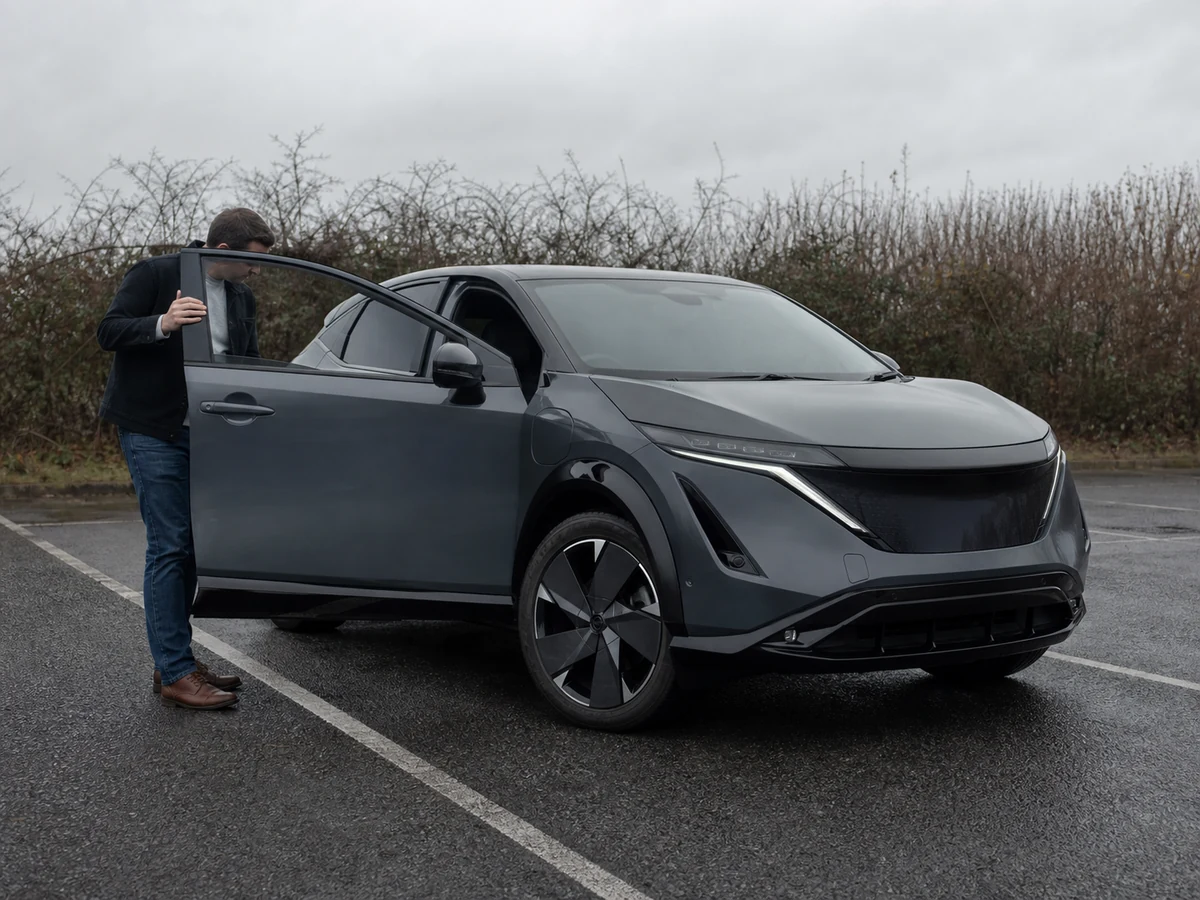
A safety badge summarises the tests that were run, not the car in front of you, so read the coverage note before it quietly changes your shortlist.
Cargo, towing, and the fit checks a flat floor does not settle
The Ariya holds 27.9 cubic feet behind its second row and 59.7 with that row folded, measured on a car without the moonroof. Passenger volume is 101.2 cubic feet without the glass roof and 96.3 with it.
The glass costs 4.9 cubic feet of cabin, and headroom is where it goes. An adult sitting behind another adult on a long drive is the test that finds it.
Towing is decided by drive layout. e-4ORCE cars are rated for 1,500 pounds and front-drive cars carry no rating at all, so a small trailer or a tongue-loaded bike rack rules out half the lineup before you start.
Nothing lives under the hood. The charging cable travels in the cargo area, which quietly removes part of that 27.9 cubic feet on every trip where you bring it.
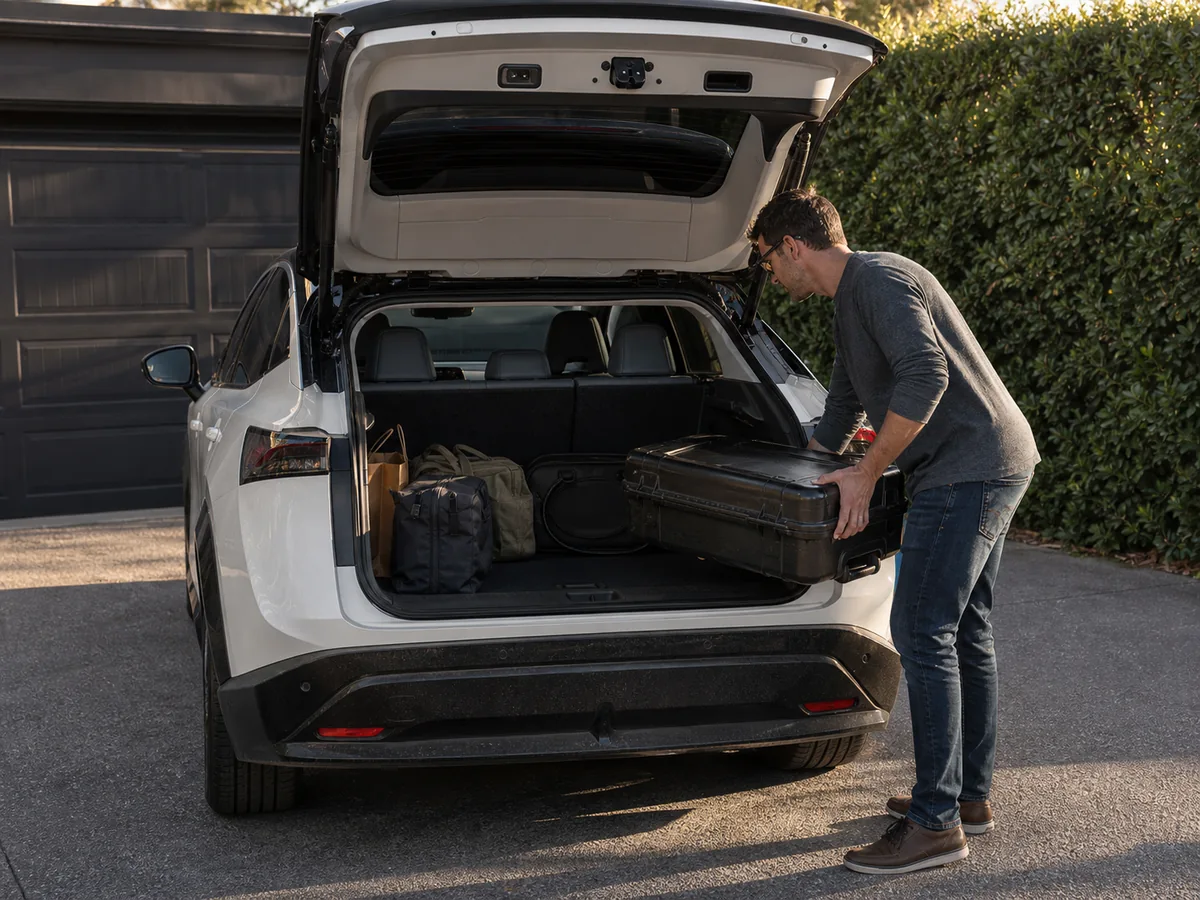
There is no spare wheel either. Nissan supplies a repair kit in the cargo area, which handles a nail but not a kerbed sidewall, and that difference is a tow rather than a roadside change.
The flat floor is real and it is useful. Battery packaging leaves no transmission tunnel, so the middle rear seat is a genuine seat, and the available sliding centre console moves the armrest to suit whichever row needs it.
Child seats have a head start here. IIHS rates the Ariya's LATCH hardware Good for ease of use, which means the anchors are reachable and correctly spaced, though it says nothing about whether your particular seat leaves the driver anywhere to sit.
Load test before you agree a price
- Install every child seat you own, then check how far the front seats still travel
- Load a full weekly shop with the second row upright rather than folded
- Lift your heaviest regular item over the load lip without leaning on the bumper
- Open the hatch fully inside your own garage, not the dealer's forecourt
- Stow the charging cable and see what floor space is actually left
- Sit behind your own driving position in the exact car, moonroof included
Run that load test on the car you are buying rather than on a showroom example, because two of the three limits here are options someone chose in 2023 instead of properties of the Ariya.
What it costs to run a car the manufacturer stopped importing
EPA puts annual energy cost at $750 for a front-drive Ariya, $800 for the 87 kWh e-4ORCE and $850 for a Platinum+. Those figures assume average mileage and average electricity prices, so a household on a cheap overnight rate beats them and one leaning on paid fast charging will not.
Warranty cover is unusually simple to state. Basic cover runs three years or 36,000 miles, powertrain cover runs five years or 60,000, and the lithium-ion battery, the EV system and battery capacity carry eight years or 100,000 miles.
Every one of those clocks starts at the in-service date. A leftover 2025 registered this year and a used 2023 registered three years ago wear the same badge and carry very different amounts of remaining cover.
The capacity clause is the one that protects a used buyer, and it is written against a gauge anyone can see. Nissan warrants the pack against falling below nine of the twelve segments on the dashboard capacity gauge, for the same eight years or 100,000 miles.
Read that gauge on the test drive, because it is the measure the warranty itself uses. A car sitting at nine segments is already at the line, while one at eleven has room left before anyone owes anything.
The remedy is a floor rather than a restoration. Nissan writes that a repair under this clause may not return the battery to an as-new twelve segments, only to nine or more, so a successful claim buys back the minimum and not the car you thought you were getting.
Then check the number against the road. Compare the miles the car predicts on a full charge with the 205 to 289 mile rating for that exact configuration, and treat a large gap as a question for the seller rather than a fault you have proved.
What actually decides the five-year bill
Energy
Your overnight electricity rate, and what share of your charging happens at home rather than at a public DC station
Insurance
A VIN-specific quote, because EV collision work and battery-area procedures move premiums more than the sticker price suggests
Tires
Installed prices for the fitted size, 235/55R19 on the nineteen-inch cars, on a car weighing between 4,323 and 5,057 pounds
Remaining warranty
Years and miles left on the eight-year battery and EV system cover, counted from the in-service date and not from the model year
The costs specific to a withdrawn model are the ones nobody can quote you. Nissan promised continuing support for current owners, which covers parts supply and warranty work, but no promise covers how fast a dealer can source an inverter or how many local technicians will still be trained on this car in five years.
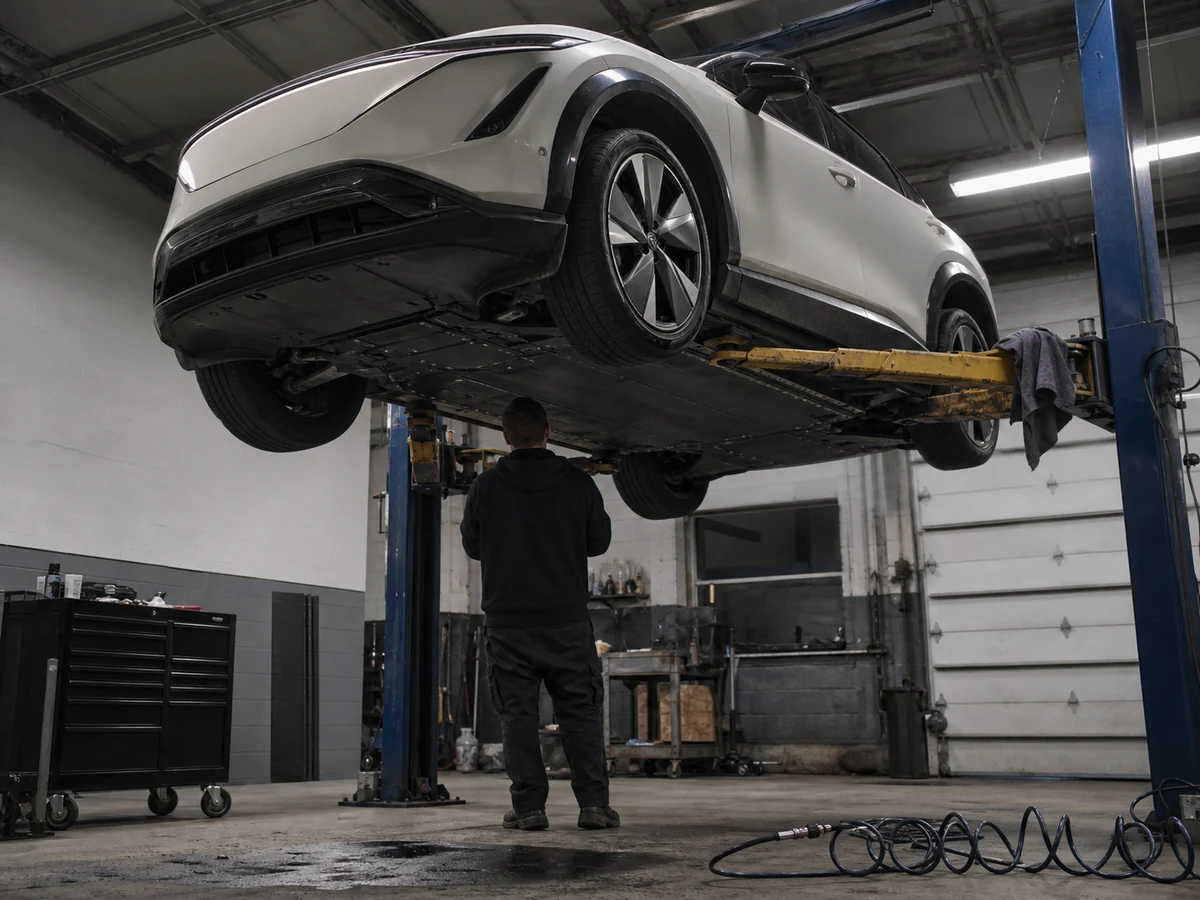
Software is the other open question. The car accepts firmware updates over the air, which is how a manufacturer fixes things after launch, and nobody has said how long those will keep arriving for a model Nissan no longer builds.
Ask those questions before you buy instead of after. A dealer that has sold and serviced Ariyas in your area is worth more to you than one that has not, and finding out which you are dealing with costs a phone call.
Compare a leftover 2025 against a used 2023 on remaining warranty as well as on price, because the years left on the eight-year battery cover are often worth more than the gap between the two stickers.
Which Ariya to hunt for, and how to close the deal
The evidence points at a 2024 or 2025 car bought by a household that charges at home. Those two years carry no recall campaigns between them, hold 13 complaint filings in total, and still sell for far less than their original stickers.
A 2023 is worth buying at the right price. It needs all four campaigns confirmed closed against its VIN, and it needs a discount that reflects what it is, which is the launch year of a car nobody is building any more.
Two buyers should look elsewhere. Anyone fast-charging on the road most weeks will spend real time waiting, and anyone who mainly wants a cheap electric car can buy a redesigned Leaf from $29,990 with up to 303 EPA miles.
The order of the checks decides what you end up paying. Campaign status and battery condition both change what the car is worth, so they belong in front of the negotiation instead of after it.
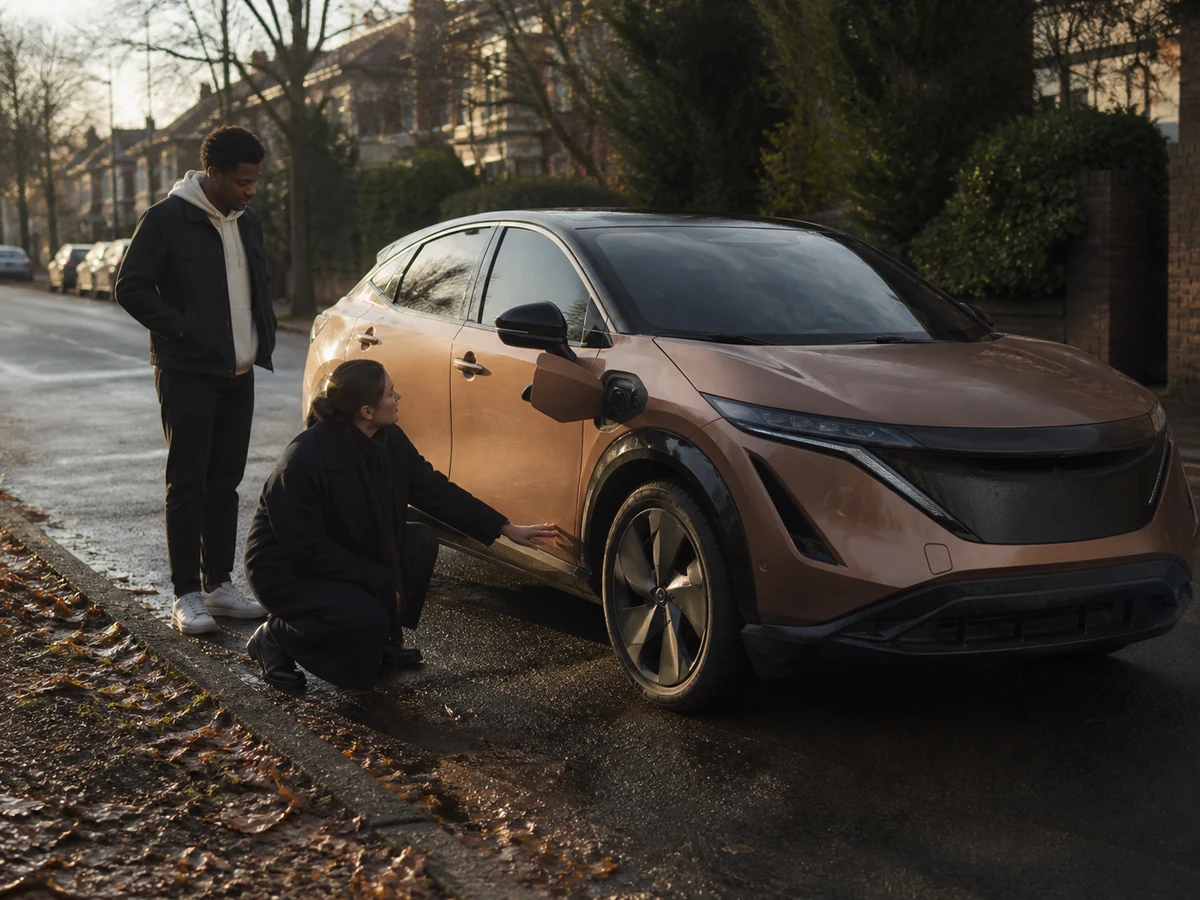
How to close on a used Ariya
- Check the VINRun it against campaigns 23V131, 23V657, 24V391 and 24V560, and get the remedy dates in writing
- Read the batteryCount the segments on the dashboard capacity gauge, the measure the warranty uses, then ask the dealer for a state-of-health readout to check it against
- Test your own routeDrive the real commute in the weather you actually get, and compare miles used against miles shown
- Then price itSet your offer against the remaining battery cover and against any campaign still open
Buy an Ariya for what it now is, a quiet and well-equipped electric crossover selling well under what it cost to build, and let the model year rather than the trim badge decide what you offer.