
Which Nissan Rogue years should you avoid?
The clearest older years to avoid are 2014 to 2016, particularly when the CVT record is incomplete or a full-temperature drive produces judder, flare, delayed response, or stored transmission codes. Earlier 2008 to 2012 Rogues need a different heat-and-load check because Nissan documented CVT temperature-protection behavior for that generation.
The recent answer changed in February 2026. NHTSA campaign 26V-080 covers certain 2023 to 2025 Rogues with the 1.5-liter VC-Turbo engine because bearing damage can cause loss of power and, in some cases, release hot oil.
This does not make 2021 and 2022 Rogues part of the same engine recall, and it does not prove that every 2014 to 2018 CVT will fail. The useful decision comes from matching the vehicle's exact powertrain to the right official evidence and test conditions.
The Rogue name hides three different powertrain eras
First-generation Rogues sold from 2008 through 2013 used a 2.5-liter four-cylinder and CVT, with the Rogue Select carrying the older design into later calendar years. Age, corrosion, fluid history, and accumulated wear now matter as much as the badge on those vehicles.
The second-generation T32 arrived for 2014 and retained a 2.5-liter four-cylinder with a CVT. That is the family covered by Nissan's best-documented judder bulletin and the broad 2014 to 2018 warranty extension.
The current generation arrived for 2021, then shifted broadly to a 1.5-liter three-cylinder VC-Turbo for 2022. The 2023 to 2025 recall concerns that engine's internal bearings, which is a different purchase question from an older transmission judder.
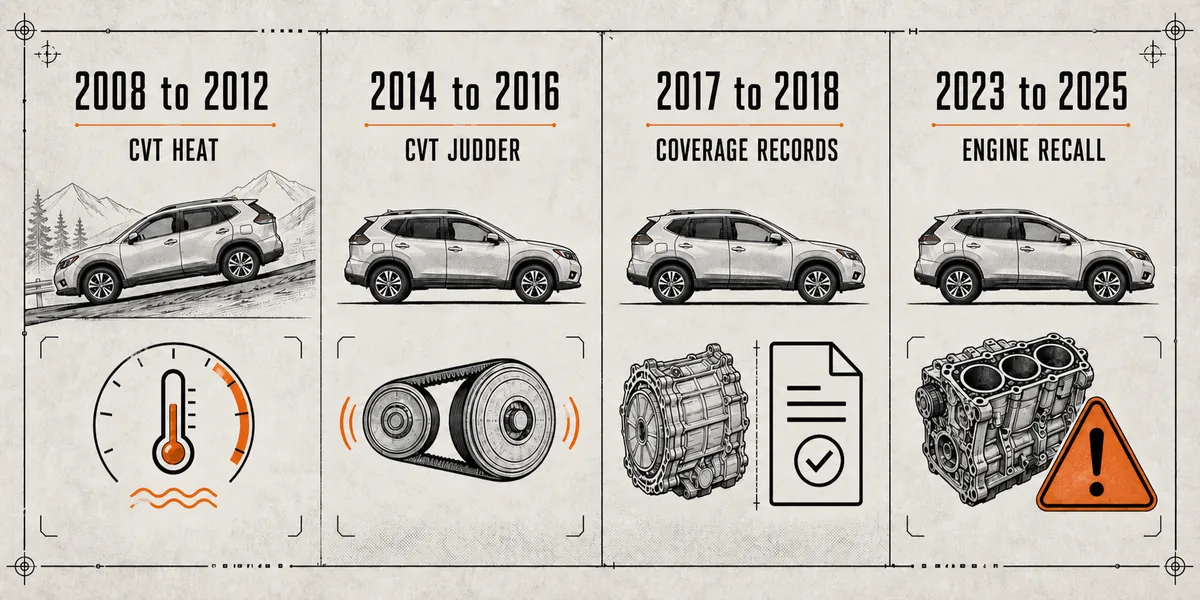
- 2008 to 2012First-generation CVT can enter temperature protection under sustained heat or load
- 2013Final first-generation year, still judged by CVT behavior, age, and service evidence
- 2014 to 2016T32 CVT judder bulletin defines the primary road-test and scan question
- 2017 to 2018Included in the later CVT coverage program, still condition-led rather than an automatic rejection
- 2021 to 2022Current body generation begins, but these years are outside NHTSA 26V-080
- 2023 to 2025Certain VC-Turbo engines require the 2026 bearing-failure recall remedy
Identify the engine label, transmission, drivetrain, and production date before using a year list. A dealer advertisement that says only "Rogue AWD" does not tell you whether the relevant uncertainty is CVT condition, current engine campaign status, or ordinary high-mileage wear.
Why can a 2008 to 2012 Rogue lose power on a long hot drive?
Nissan bulletin NTB12-057 explains that a CVT can reduce engine performance when fluid temperature crosses its protection threshold. The driver may experience this as low power, but the bulletin first directs technicians to check fluid level, the required NS-2 fluid, and coolant mixture rather than assume internal transmission failure.
A later bulletin, NTB14-002b, applies to 2008 to 2012 Rogues without the tow-package cooler. Nissan lists sustained driving at 65 mph or above for roughly 1 to 1.5 hours, ambient temperatures of 96 degrees or higher, and steep or extended grades of 6 miles or more among the conditions that can precede reduced speed.
| Condition | What the driver may notice | Evidence to request | Buying response |
|---|---|---|---|
| Long highway run | Reduced speed after sustained load | Diagnostic history, correct fluid record, and cooler-kit status | Reproduce only on a safe normal trip |
| Hot weather | Low power as CVT temperature rises | Cooling-system condition and correct fluid level | Reject unexplained repeat events |
| Extended grade | Whine or rattle followed by reduced performance | Dealer diagnosis and applicable cooler repair | Do not accept a short flat drive as proof |
| Past fail-safe claim | Seller says the car only needed to cool down | Repair order naming cause, DTCs, fluid, and parts | Treat missing detail as unresolved |
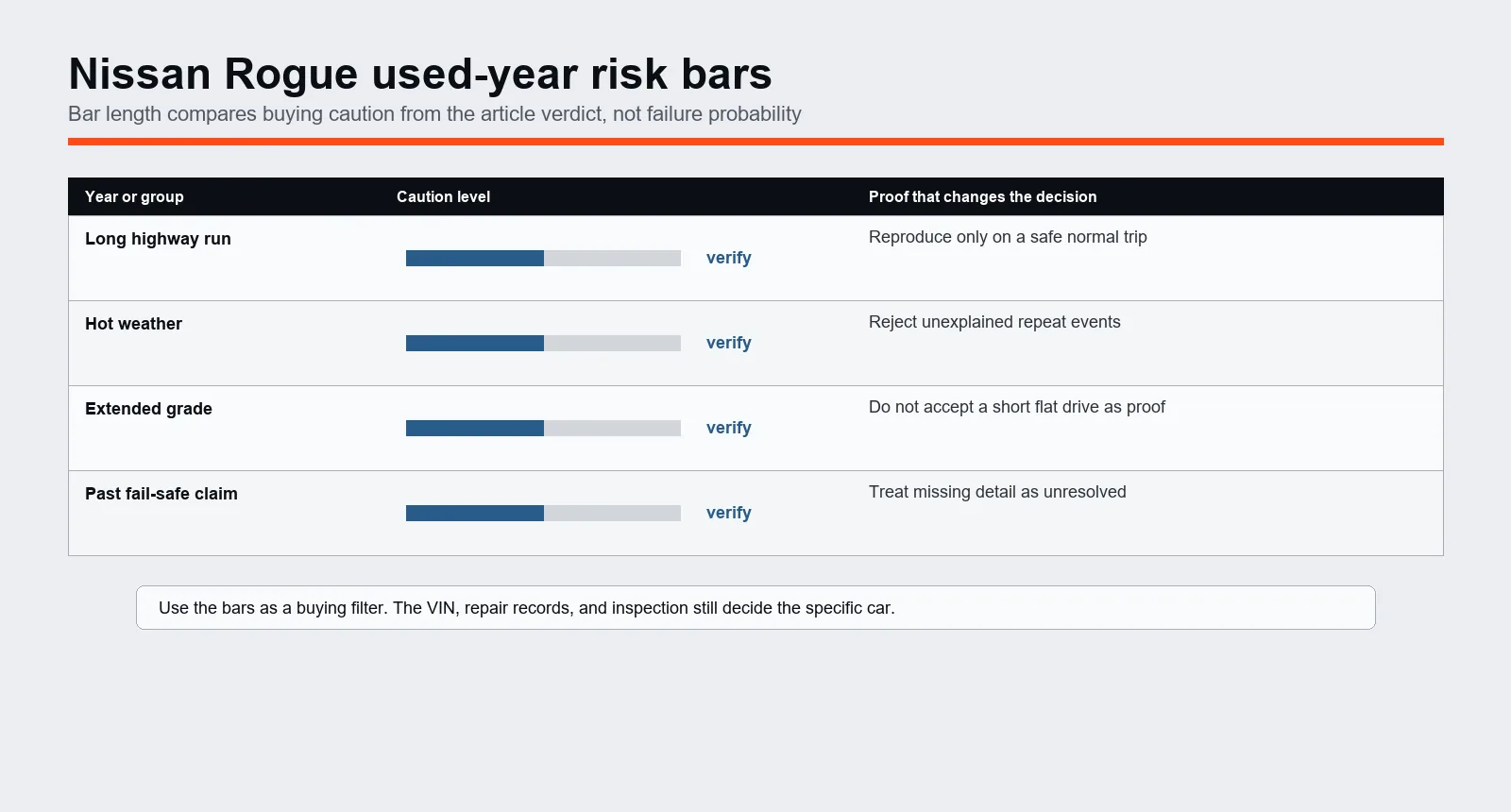
This is different from the P17F0 or P17F1 judder path on 2014 to 2016 Rogues. Temperature protection describes the control response to heat, while repeatable judder points technicians toward a separate internal inspection process.
A private-sale test should not attempt 90 minutes at high speed merely to provoke a fault. Review prior long-trip behavior, drive the vehicle fully warm on a normal grade, scan it before and after, and let a transmission specialist decide whether cooler, fluid, cooling, or internal evidence needs more testing.
Reject an early Rogue that has repeat reduced-power history without a documented diagnosis, because a short smooth drive cannot resolve a heat-load problem.
Why are 2014 to 2016 the weakest CVT years?
Nissan bulletin NTB15-084b applies to 2014 to 2016 T32 Rogues when the driver reports judder and the transmission controller stores P17F0 or P17F1. Nissan describes judder as shaking, shuddering, one or more bumps, or vibration.
The bulletin matters because it creates a defined diagnostic path rather than a rumor about all CVTs. It directs trained technicians through code confirmation and internal inspection that can lead to valve-body work or a complete CVT decision, depending on the evidence.
| Year group | Main concern | Evidence that matters | Starting verdict |
|---|---|---|---|
| 2008 to 2013 | Age plus first-generation CVT condition | Cold engagement, fluid history, scan, corrosion | Consider only when condition and price justify age |
| 2014 to 2016 | Documented CVT judder path | P17F0 or P17F1 history, repair order, full-load road test | Avoid unresolved examples |
| 2017 to 2018 | Included in extended CVT coverage population | Service history, current behavior, past claim | Inspect rather than reject by year alone |
| 2021 to 2022 | New-generation evidence still maturing | Engine oil history, electronics, CVT and AWD behavior | Evaluate by condition and VIN |
| 2023 to 2025 | VC-Turbo bearing recall | Live VIN status and completed 26V-080 remedy | Hold affected purchases until complete |
A useful road test starts cold, includes repeated low-speed acceleration, then holds moderate throttle on a safe grade or highway merge until the transmission is fully warm. A five-minute loop may never create the temperature and load that expose a repeatable judder.

Scan before and after the drive, including history and pending codes. Reject a Rogue that reproduces judder, enters fail-safe mode, shows relevant codes, or arrives with recently reset monitors and no credible explanation.
Are 2017 and 2018 Rogues safer than 2014 to 2016?
The 2017 and 2018 Rogues move beyond Nissan's 2014 to 2016 judder bulletin, so they can be better T32 starting points when condition and history are comparable. They still sit inside the broader warranty-extension population, which prevents a model-year shortcut from replacing the road test.
Nissan program 22N2299RRB extended CVT coverage on certain 2014 to 2018 T32 Rogues from 60 months or 60,000 miles to 84 months or 84,000 miles. Covered items included internal CVT parts, gaskets and seals, the control valve body, torque converter, an applicable cooler kit, and control-module reprogramming.
The document proves that Nissan created additional coverage for a defined population, but it does not show that every covered vehicle received a new transmission. Time, mileage, ownership, and settlement boundaries also mean an old eligibility statement cannot establish coverage today.
Ask for the original dealer repair order, parts description, mileage, and date. A line that names a valve body, control valve, CVT assembly, software action, or diagnostic code is more useful than a generic receipt for "transmission service."
Fluid service can support longevity when the correct procedure and fluid were used, but it cannot prove that an existing internal judder was repaired. Current cold and hot behavior must still agree with the paperwork.
Treat an extended warranty as evidence that Nissan recognized a defined concern, not as evidence that the particular Rogue is sound today. A documented 2017 or 2018 with consistent cold and hot behavior is preferable to an unresolved 2014 to 2016, but the year alone cannot certify the CVT.
The 2023 to 2025 engine recall changes the recent-year answer
NHTSA campaign 26V-080 covers 323,917 potentially affected 2023 to 2025 Rogues with the 1.5-liter VC-Turbo engine. Nissan reported that higher temperatures can break down engine oil, allow bearing damage or seizure, and lead to engine failure.
Loss of drive power raises crash risk, while a breached engine block can release hot oil and increase fire risk. These consequences make an unresolved campaign a purchase hold rather than a negotiating point.
The filed remedy includes ECM reprogramming, a diagnostic-code inspection, and a road test. Some vehicles also require an oil-pan inspection for specified metal debris, with engine replacement when Nissan's procedure calls for it.
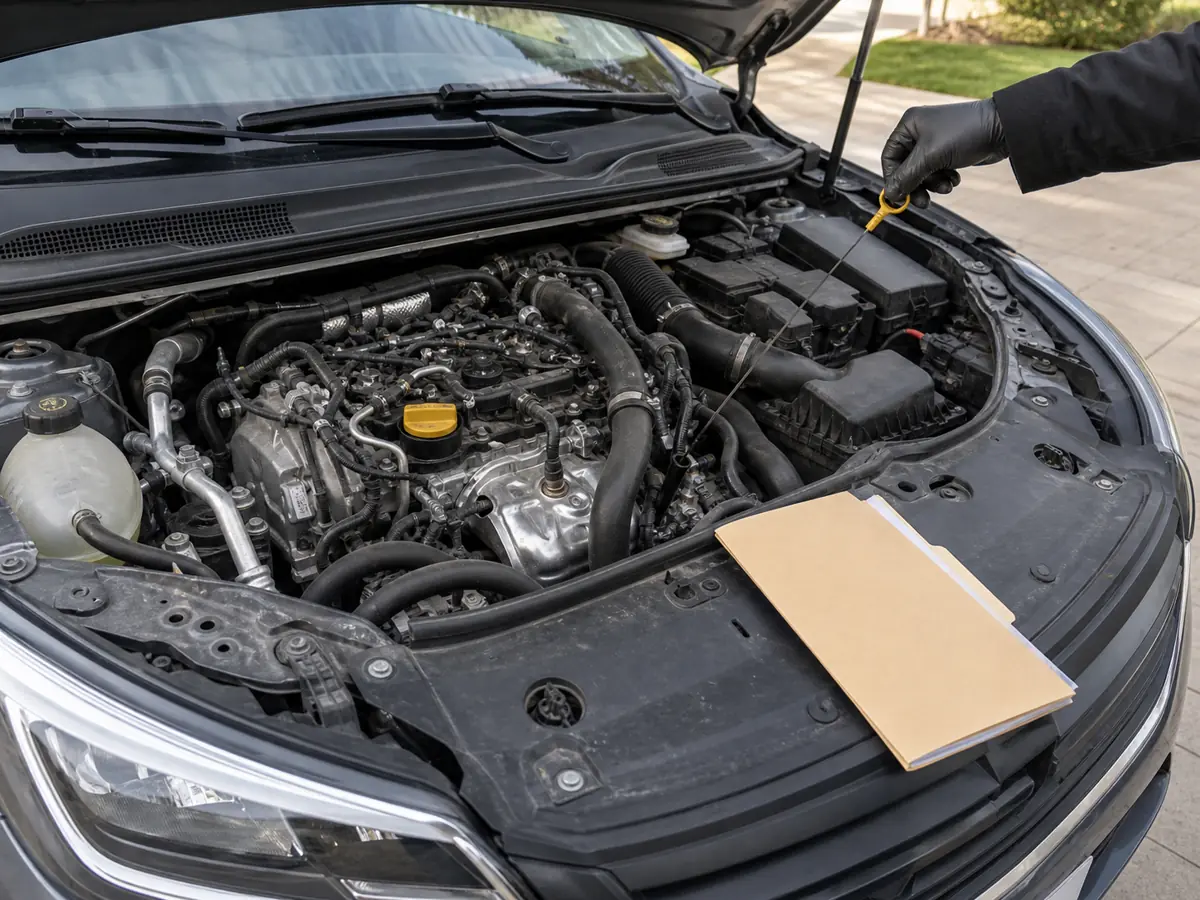
Check oil level before startup and inspect maintenance dates for gaps, incorrect viscosity, unexplained top-ups, or repeated low-oil notes. Do not open an oil filter, drop the pan, or attempt bearing diagnosis during a private sale.
An affected 2023 to 2025 Rogue should move forward only after Nissan completes the VIN-specific remedy and an independent inspection finds no contradictory engine evidence.
How should you road-test a used Rogue?
Arrange the first startup of the day and confirm that the seller has not pre-warmed the vehicle. Note delayed Drive or Reverse engagement, warning messages, unstable idle, smoke, sharp mechanical noise, or a need to restart before the car moves normally.
Use light throttle through neighborhood speeds, then repeat acceleration after the powertrain warms. A CVT should change engine speed smoothly with demand, without a repeatable shake, sudden flare, heavy bump, loss of response, or fail-safe behavior.
Rogue road-test phases
- Cold selection
- Measure engagement delay and note warning messages
- City driving
- Check creep, low-speed response, and repeated starts
- Sustained load
- Hold a safe grade or highway speed to expose heat-related judder
- After heat soak
- Rescan modules and recheck oil, leaks, odor, and warning status
On AWD vehicles, verify that all four tires match closely in size and wear. Make a slow tight turn on dry pavement and investigate binding, hopping, or driveline noise rather than assuming the AWD system needs to feel that way.
Review readiness monitors and code-clearing history where the scan tool supports them. A battery disconnect or recent code clear does not prove concealment, but it reduces the amount of verified evidence and justifies a repeat visit after normal drive cycles.
The test should answer the question tied to the powertrain. Older Rogues need consistent CVT behavior across temperature and load, while affected recent Rogues need completed engine-campaign evidence before the test can support a purchase.
When is a used Rogue still worth buying?
A 2014 to 2018 Rogue can be worth buying when its CVT is quiet and consistent cold and hot, scan data is clean, and any past repair has a detailed invoice. A replacement transmission is useful evidence only when the reason, part, mileage, installer, and remaining coverage are known.
A 2023 to 2025 can return to consideration after the live VIN status shows the campaign is complete and the dealer order states whether the engine passed inspection or was replaced. Allow an independent shop to confirm current oil condition, leaks, codes, cooling behavior, and drivability.
The right used Rogue is not simply the newest or cheapest one. It is the vehicle whose powertrain history can be verified without asking you to absorb an unknown transmission or engine bill.
Buy only when the VIN, repair orders, scan, fluids, and full-temperature drive support the same conclusion.