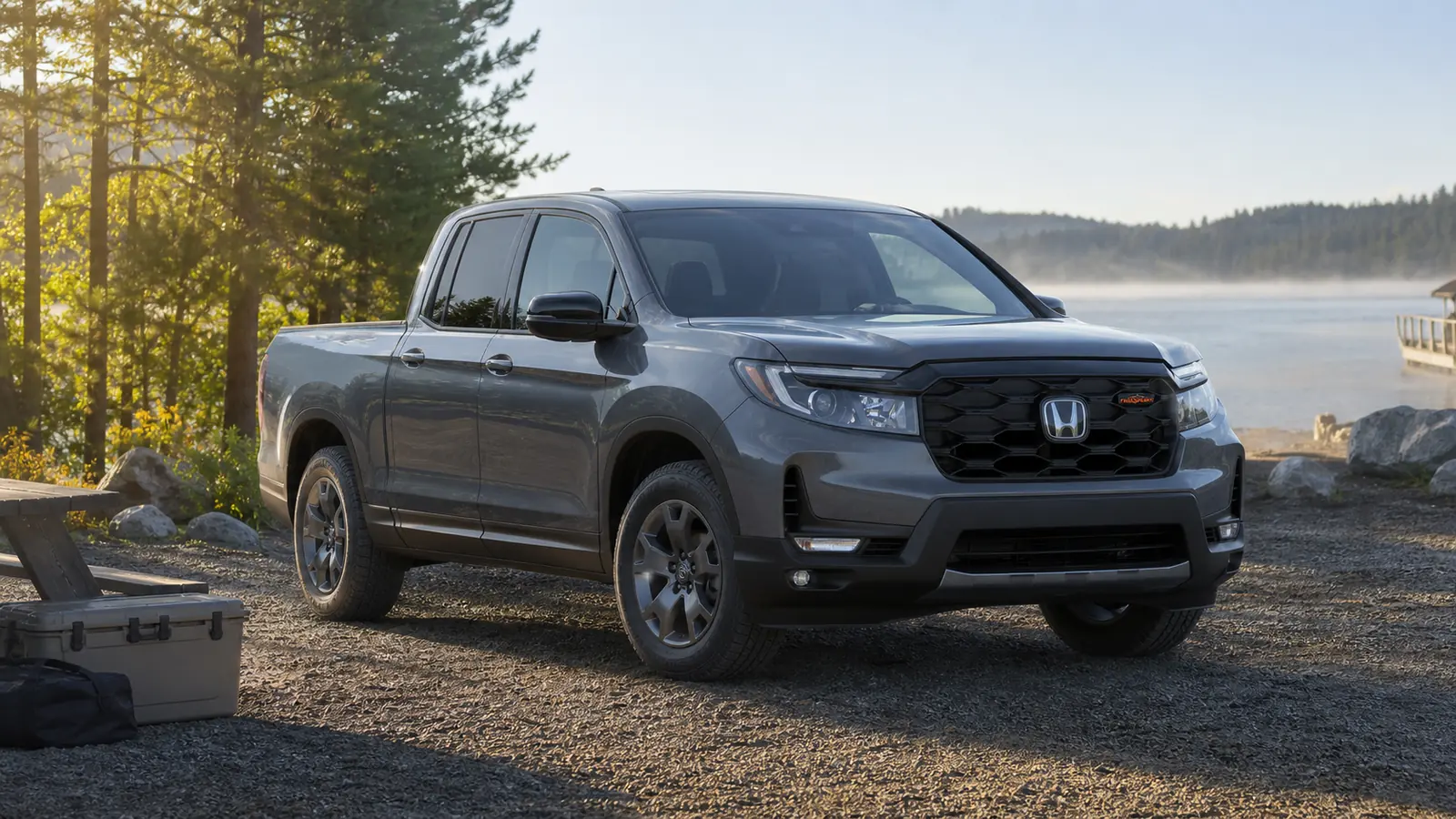
Ridgeline is the smarter truck when daily miles matter most
Ridgeline's independent suspension gives it crossover-like ride and steering, while its 5,000-pound tow ceiling and one crew-cab, short-bed format set the work limits.
Honda lists Sport at $40,795, RTL at $43,595, TrailSport at $45,995, and Black Edition at $47,395 before destination and other charges.
All use the same V6, nine-speed automatic, AWD, cab, and basic bed concept.
The trim ladder changes equipment and appearance more than core capability.
Compare Ridgeline with the pickup hub and a Honda SUV. Buyers who use the bed weekly but commute every day may benefit from its comfort.
Drivers who tow heavier trailers, need a longer bed, or cross severe terrain should choose a truck designed for that job.
Ridgeline is a strong daily pickup when its measured load and 5,000-pound trailer ceiling cover the real work with margin.
Payload math decides more jobs than the truck argument
Whether Ridgeline has a frame separate from its body does not answer whether it can carry the load. The driver-door payload label, axle limits, tire limits, bed loading, passengers, accessories, and tongue weight answer that question for the exact truck.
| Input | Evidence |
|---|---|
| Available payload | Driver-door certification label |
| People | Actual ready-to-travel weight |
| Cabin cargo | Bags, pets, child seats, tools |
| Bed cargo | Loaded scale or measured item weights |
| Accessories | Rack, cover, step, hitch, protection |
| Trailer tongue | Measured loaded value |
| Total | Keep below every applicable limit with margin |
Start with the label. Subtract every occupant and item carried in or on the truck.
Add the hitch and measured tongue weight when towing. A 5,000-pound trailer maximum does not create more payload, and dry trailer weight excludes common cargo, water, propane, batteries, options, and food.
Place dense cargo low and secure it to suitable points.
Follow Honda's loading instructions. Do not put a heavy item behind the tailgate or above the sidewalls without checking support, restraint, visibility, and legal requirements.
Recheck tire pressure for the load using the label and manuals.
A midsize truck comparison should use the same passengers, accessories, trailer, and bed cargo. Ridgeline can do useful truck work when the exact label and measured load pass, while an online maximum cannot approve one vehicle or trip.
The bed, trunk, and tailgate are the strongest ownership reasons
Ridgeline's composite bed includes a lockable, drainable trunk below the floor. The tailgate can drop conventionally or swing sideways, which can improve access to the trunk and make loading easier.
Those features are useful only when the owner's cargo fits around their dimensions and drainage needs.
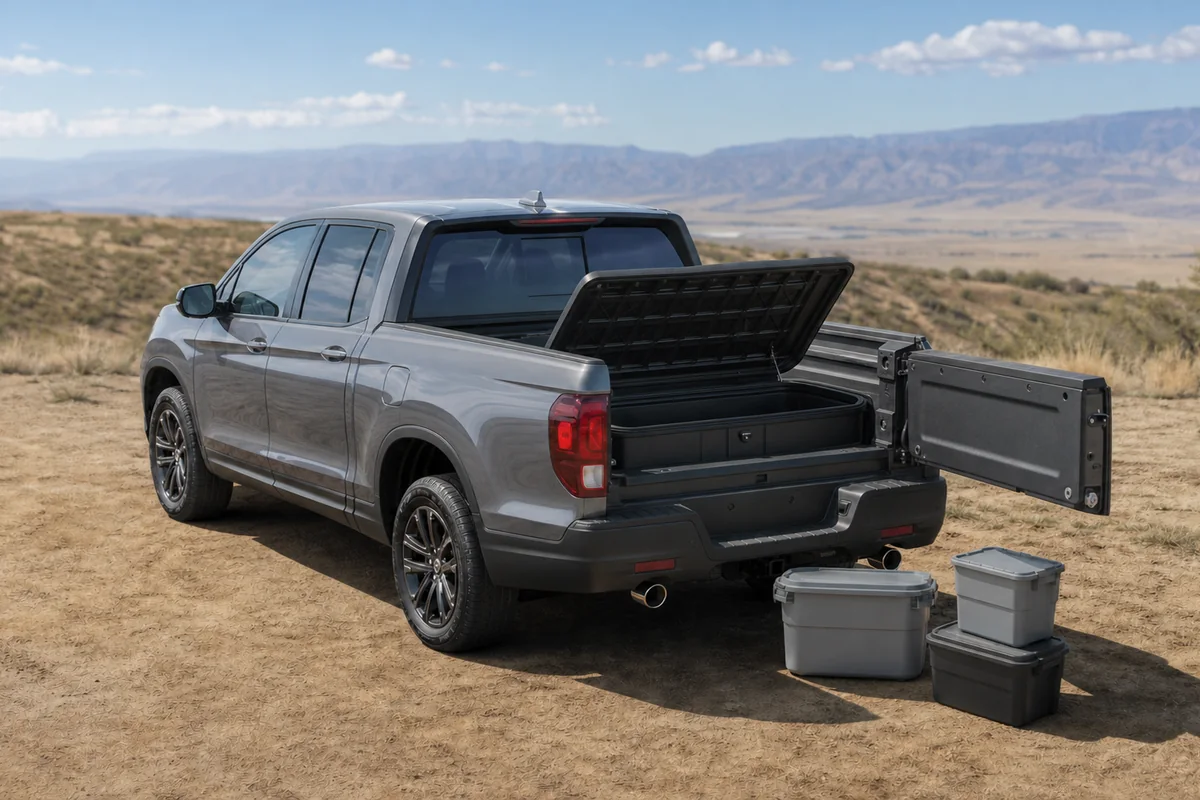
Bring the regular items. Test coolers, tools, bins, bicycles, camping gear, yard supplies, or sports equipment.
Check whether opening the trunk requires unloading the bed. A tonneau cover can improve security but may affect tall cargo and access.
A rack can carry long items but adds weight, wind noise, and height.
Inspect the trunk seal, drains, hinges, latch, spare-tire access, lights, outlet where equipped, and water management. The trunk is drainable, but that does not mean every stored item can tolerate water or cleaning chemicals.
Secure cargo separately from passengers.
A Honda Passport keeps cargo inside and weather protected. Ridgeline wins when dirty, bulky, wet, or separate cargo use happens often.
The bed design justifies Ridgeline when the in-bed trunk and two-way tailgate save work every week, not when the owner only likes the idea of a pickup.
The cabin must carry five without turning the bed into luggage overflow
Every Ridgeline is a crew cab with five seating positions. The rear seat can handle passengers and interior cargo, but a child restraint, tall driver, and long trip need a physical fit test.
Exterior bed cargo is not a substitute for secure, weather-protected luggage.
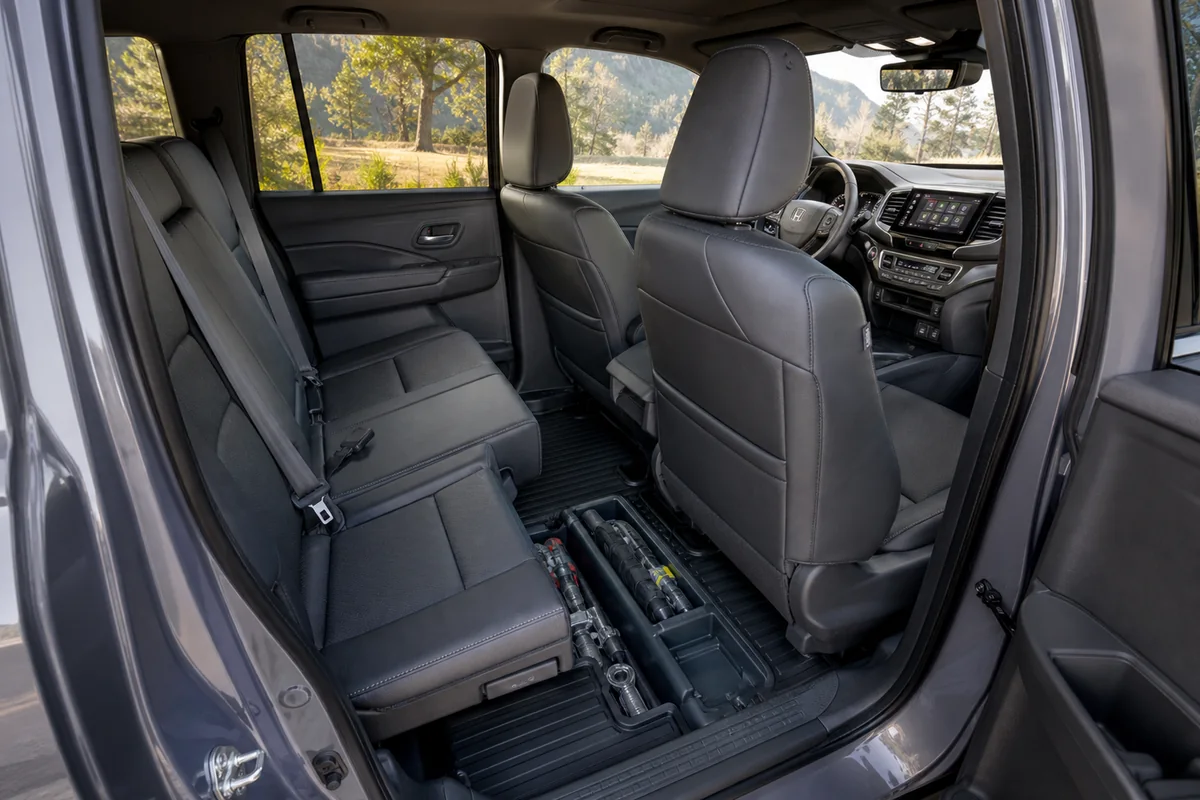
Set the front seats for the real occupants. Sit rear passengers together and check knees, feet, headroom, shoulder space, belt access, vents, ports, and center-seat comfort.
Install child restraints with Honda and seat-maker instructions.
Confirm the front seats remain safe and comfortable.
Fold and raise the rear seat as designed, then test work bags, groceries, pet equipment, or valuable items.
Secure heavy objects so they cannot move during braking. Check door opening, floor shape, underseat hardware, and whether the arrangement removes a needed passenger position.
Compare the cabin with the five-seat hub and a seven-seat SUV. Ridgeline works as family transport only when five occupants and protected luggage fit without using an open bed for items that must stay dry or secure.
Five thousand pounds of towing still needs a full trailer calculation
Honda rates the 2026 Ridgeline to tow up to 5,000 pounds. That is useful for moderate boats, utility trailers, and campers when properly equipped.
It is not permission to select a trailer from empty weight or to ignore the vehicle's payload label.
Start with the trailer's loaded scale weight.
Measure tongue weight in travel condition. Subtract people, cabin cargo, bed cargo, accessories, hitch equipment, and tongue weight from available payload.
Confirm the hitch, wiring, brake controller, trailer brakes, mirrors, tire pressures, cooling, and speed requirements in the manuals.
- Use loaded trailer weight instead of brochure dry weight
- Measure tongue weight after water and cargo are aboard
- Keep below vehicle, axle, tire, hitch, and trailer limits
- Inspect lights, tires, bearings, brakes, coupler, and chains
- Leave capacity for heat, wind, grades, and emergency braking
- Weigh the combination again after changing cargo
Test the setup in a safe controlled area before the trip. If the normal trailer approaches the maximum after passengers and cargo are counted, a larger truck gives more margin and flexibility.
The towing guide can organize the worksheet, but labels and manuals control.
Ridgeline's tow rating fits moderate trailers only after loaded scale weight, measured tongue weight, payload, and equipment all pass together.
TrailSport improves rough-road confidence without changing the basic geometry
TrailSport adds all-terrain tires, underbody protection, suspension tuning, and appearance details for drivers who regularly use unpaved roads.
Ridgeline still has long bodywork, independent suspension, and road-focused packaging. It is not a substitute for low-range gearing, greater clearance, or more aggressive approach and departure angles.
Walk obstacles before driving. Check ruts, rocks, water, side slope, soft ground, turnaround room, and recovery access.
Keep speed low enough to protect tires, wheels, suspension, exhaust, and passengers. Do not enter water when depth, current, bottom, or exit is uncertain.
Inspect tires for cuts, age, pressure, and full-width tread. Look under the truck after a trip for bent shields, packed debris, leaks, scraped exhaust, damaged fasteners, and impacts around suspension mounts.
Protection reduces damage risk but cannot make a hard strike harmless.
A Toyota Tacoma or Ford Ranger offers different body-on-frame capability, bed and towing choices, while Ridgeline provides better empty-road comfort for many drivers.
TrailSport is the Ridgeline for regular rough access roads, while buyers who need hard-trail geometry should change trucks instead of adding accessories.
IIHS shows a mixed result that needs detail
The IIHS page covering 2025 and 2026 Ridgeline models does not support a simple best or worst label. It shows Acceptable in the small-overlap front evaluation, Poor in the updated moderate-overlap front test, Good in the updated side test, Marginal headlights, and Acceptable LATCH ease.
In the updated moderate-overlap test, IIHS reports concerns for the rear passenger, including Poor head and neck protection and Marginal chest protection.
Those details matter to buyers who regularly carry rear occupants. They should not be hidden behind standard driver-assistance equipment.
Inspect belts, airbags, head restraints, child anchors, tires, brakes, lamps, cameras, radar areas, glass, and body structure.
Require calibration records after windshield, bumper, steering, suspension, or collision work. Test headlight aim and condition rather than assuming LED lamps guarantee a strong rating.
Compare the exact test details with other pickup models. Ridgeline's safety evidence is mixed, with a Good side result but a Poor updated moderate-overlap result that rear-seat households should weigh directly.
Used buyers must separate engine and salt-state subframe recalls
NHTSA recall 23V751 includes certain 2017 and 2019 Ridgeline vehicles because connecting-rod-bearing damage can lead to engine failure. NHTSA recall 26V365 includes certain 2017 through 2023 Ridgelines sold in listed salt states because rear-subframe corrosion can affect suspension mounting areas.
For an engine-recall vehicle, verify manufacturer records and the completed remedy, then inspect cold and hot operation, oil and coolant, stored codes, smoke, noise, leaks, and service history. A normal five-minute drive does not replace documentation or diagnostics.
For a salt-state truck, inspect the rear structure and suspension mounts on a lift.
Look for corrosion, perforation, coating, prior repair, and official remedy evidence. Road salt exposure can also affect brake lines, fasteners, hitch hardware, exhaust, and body seams beyond the campaign area.
Every used Ridgeline also needs nine-speed, AWD, rear-differential, brake, tire, bed, trunk, water, trailer-wiring, collision, and calibration checks. The planned Ridgeline problems page can track evidence by year.
Do not close a used Ridgeline purchase until the VIN result, dealer records, engine condition, and rear-subframe inspection tell the same story.
The V6, nine-speed, and AWD should be tested cold and loaded
Honda rates the 3.5L V6 at 280 hp and 262 lb-ft, paired with a nine-speed automatic and standard i-VTM4 AWD.
Most trims are EPA-rated 18 city, 24 highway, and 21 combined mpg.
TrailSport is rated 18 city, 23 highway, and 20 combined.
Start the truck cold and verify warning lights perform their check. Drive at parking speed, light throttle, highway speed, and under a safe legal load.
Test reverse and drive engagement, shifts after warm-up, passing response, cruise, AWD modes, and low-speed turns in both directions.
Inspect oil, coolant, leaks, mounts, battery condition, air intake, exhaust, and service records.
Review transmission and rear-differential service against Honda's maintenance information. A tow history makes fluid, brake, and cooling evidence more important.
Powertrain facts
- Engine
- 3.5L V6
- Output
- 280 hp
- Torque
- 262 lb-ft
- Transmission
- 9-speed automatic
- Drivetrain
- Standard i-VTM4 AWD
- Best estimate
- 18 city, 24 highway, 21 combined
A gas truck remains sensitive to annual miles and load. The Ridgeline powertrain earns approval after a cold start, hot shift test, AWD check, fluid review, and loaded drive show consistent behavior.
RTL usually balances price, cabin use, and long-distance comfort
Sport is the lowest-price entry. RTL adds comfort and convenience that many commuters and travelers use often.
TrailSport adds rough-road hardware. Black Edition adds premium and appearance features but does not raise towing or engine output.
| Grade | Starting MSRP | Best reason |
|---|---|---|
| Sport | $40,795 | Lowest purchase price |
| RTL | $43,595 | Broad comfort and daily equipment |
| TrailSport | $45,995 | Repeated rough-road travel |
| Black Edition | $47,395 | Premium cabin and appearance |
Sit in every likely trim and list equipment used weekly. Check seat comfort, climate, cameras, audio, outlets, bed features, tire price, and insurance.
Drive Sport or RTL over the same broken road as TrailSport. All-terrain tires can add durability and loose-surface grip while changing noise, cost, and response.
Do not let a monthly payment hide the price step. Compare out-the-door totals, loan terms, accessories, dealer products, and tire replacement.
The mainstream price hub gives a broader baseline.
RTL is the broad value because it improves daily comfort without charging for trail hardware or appearance that leaves capability unchanged.
Five-year cost should be compared with both an SUV and a truck
Ridgeline can replace an SUV and an occasional rental truck for the right owner.
That combined use can justify its purchase. A driver who rarely uses the bed may pay pickup fuel, tire, registration, and purchase costs without receiving the benefit.
| Cost | What to price |
|---|---|
| Purchase | Grade, fees, accessories, dealer products |
| Finance | Rate, term, total interest |
| Insurance | Exact VIN, drivers, use, annual miles |
| Fuel | EPA estimate, actual route, towing miles |
| Tires | Road or all-terrain set and alignment |
| Service | Oil, filters, transmission, AWD, differential |
| Truck gear | Cover, rack, hitch, wiring, controller |
| Repairs | Deductible and post-warranty reserve |
Get insurance quotes for the exact VIN. Price bed covers, racks, hitches, and trailer equipment separately, then add their weight to payload planning.
Towing and rough-road use can accelerate tire, brake, fluid, and underbody inspection needs.
Compare the same five years with a Honda Passport, Toyota Tacoma, or Ford Ranger. Include rental cost for the few large jobs an SUV cannot handle.
Ridgeline costs make sense when its bed replaces regular hauling or a second vehicle need, not when the bed stays empty while the owner pays truck costs every day.
Choose RTL when the label, bed, cabin, and safety tradeoff all fit
Ridgeline provides comfortable independent suspension, standard AWD, a flexible bed, useful in-bed trunk, and an easy crew-cab cabin. It gives up heavier towing, multiple bed and cab choices, hard-trail geometry, and strong results in every IIHS category.
Pros
- Comfortable daily ride and handling
- Dual-action tailgate and in-bed trunk
- Standard AWD and five-seat crew cab
- Useful 5,000-lb towing for moderate trailers
Cons
- Tow ceiling below harder-working midsize trucks
- One basic cab and bed configuration
- Limited hard-trail geometry
- Poor updated moderate-overlap IIHS result
Use the Honda hub, pickup hub, AWD hub, and comparison archive to keep alternatives visible.
RTL is the smartest Ridgeline when its door-label payload, measured trailer, rear-seat needs, bed workflow, and mixed IIHS evidence all fit the owner without excuses.
A month of real truck use proves whether Ridgeline is enough
Many buyers can name one large job that favors a bigger truck. The better question is what the vehicle carries during a normal month.
Record passenger trips, bed loads, trailer weights, parking constraints, fuel use, and the days when another vehicle or rental was still needed.
That record separates an actual capability gap from an identity preference.
| Trip | Record |
|---|---|
| Commute | People, parking, fuel, ride comfort |
| Family travel | Rear-seat fit, protected luggage, bed use |
| Home project | Item dimensions, weight, restraint, cleanup |
| Recreation | Wet gear, bicycles, boards, camping equipment |
| Trailer | Loaded weight, tongue weight, passengers, route |
| Rough road | Surface, clearance, tire and underbody condition |
For every hauling job, write down the heaviest item and how it was loaded.
Long boards may need a rack and legal marking. Loose mulch may require a liner and careful cleanup.
A motorcycle, appliance, or landscaping machine needs ramps, suitable tie-downs, enough payload, and a loading procedure that does not exceed tailgate or ramp limits.
When the bed is too short or the payload label is too low, another truck is the correct answer.
Track how often the in-bed trunk solves a problem. It can separate tools, wet gear, groceries, or valuables from the open bed.
Check whether bed cargo blocks its lid and whether a cover or rack interferes.
Keep drains, seals, hinges, and the spare-tire access clean and usable.
Measure parking and garage fit with mirrors, hitch accessories, bikes, and the tailgate in both opening directions. A comfortable pickup that cannot open its trunk or swing its tailgate in the normal parking spot loses one of its best features.
At month's end, price the few jobs Ridgeline could not do. Occasional delivery, trailer rental, or a larger rental truck may cost far less than buying and operating unused heavy-duty capacity every day.
Frequent failures in towing, bed length, payload, or trail access point toward a different truck.
Ridgeline is enough when its label, bed, trunk, cabin, parking size, and tow limit cover the repeated month, while rare oversized jobs have a cheaper safe alternative.
Water management and underside condition reveal how the truck was used
A pickup carries wet, dirty, and abrasive material that an SUV keeps outside. Ridgeline's composite bed and drainable trunk are useful, but seals, drains, hinges, seams, fasteners, and the underside still need inspection.
A clean upper bed can hide salt, mud, or impact below.
Open the trunk and remove loose items. Inspect the seal, hinge, latch, drain plugs, moisture, odor, staining, tools, spare access, and any evidence of standing water.
Operate the tailgate in both directions and check alignment, cables or supports, hinges, latches, camera, lock, and nearby body gaps.
Follow Honda instructions for cleaning and drainage.
| Area | Look for |
|---|---|
| Bed | Cuts, heavy impact, chemical residue, loose hardware |
| Trunk | Seal damage, blocked drains, water, odor, missing tools |
| Tailgate | Both opening actions, alignment, latch, lock, camera |
| Hitch | Corrosion, deformation, wiring repair, excess play |
| Underside | Salt, mud, leaks, bent shields, damaged mounts |
| Cab seams | Water entry, poor paint, collision repair |
Inspect the truck on a lift. Check rear structure, suspension mounts, brake and fuel lines, exhaust, hitch attachment, spare area, shields, seams, and corrosion.
Campaign 26V365 makes official VIN status critical for covered salt-state model years, but the inspection should not stop at the named recall area.
Ask what the bed carried. Fertilizer, pool chemicals, road salt, soil, concrete dust, fuel, and cleaning products create different risks.
Require professional evaluation when residue, corrosion, odor, or staining suggests a hazardous or corrosive load.
A used Ridgeline earns its price when the bed, trunk, two-way tailgate, hitch, drains, rear structure, and underside show documented use without hidden water, chemical, impact, or salt damage.