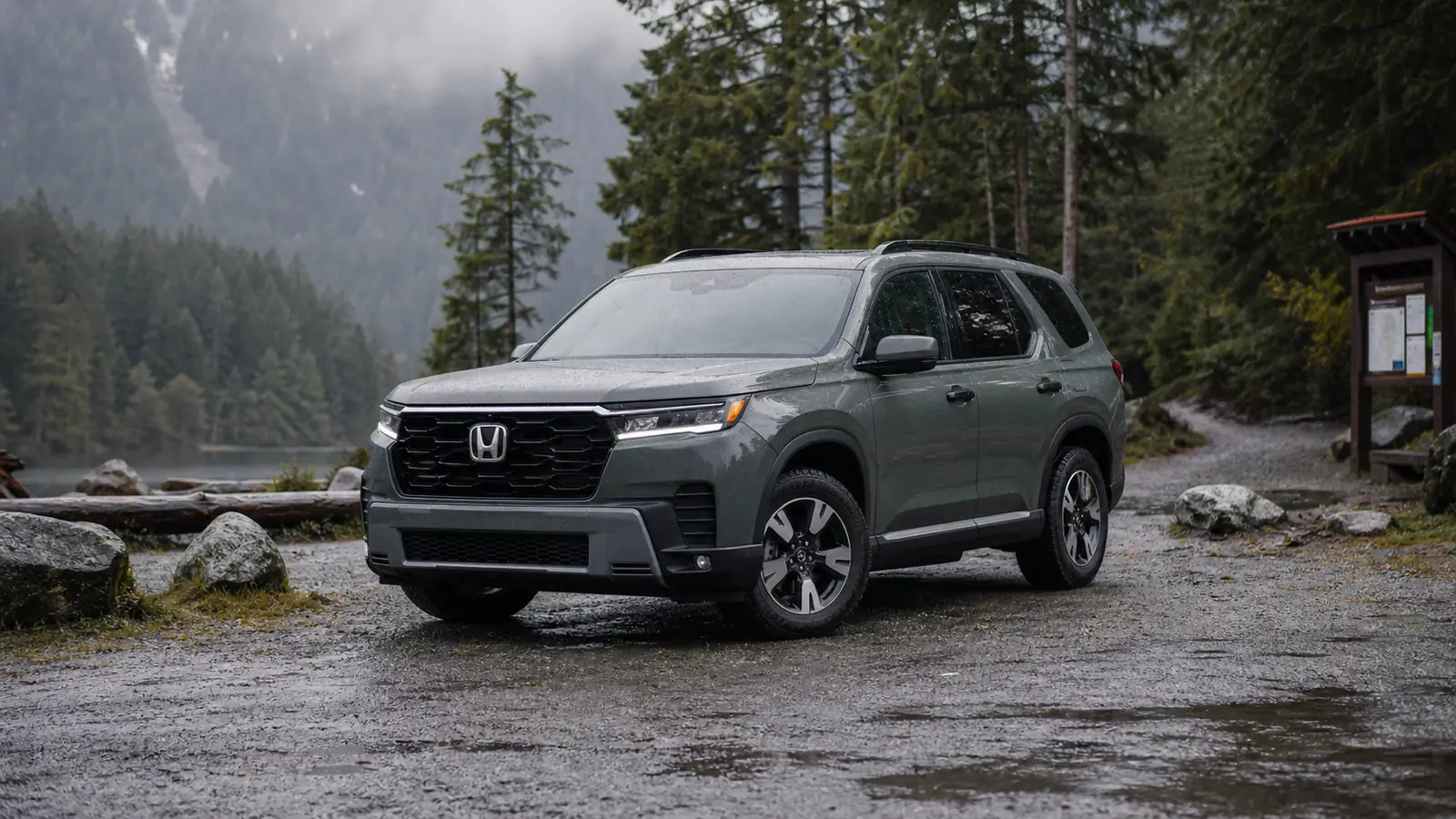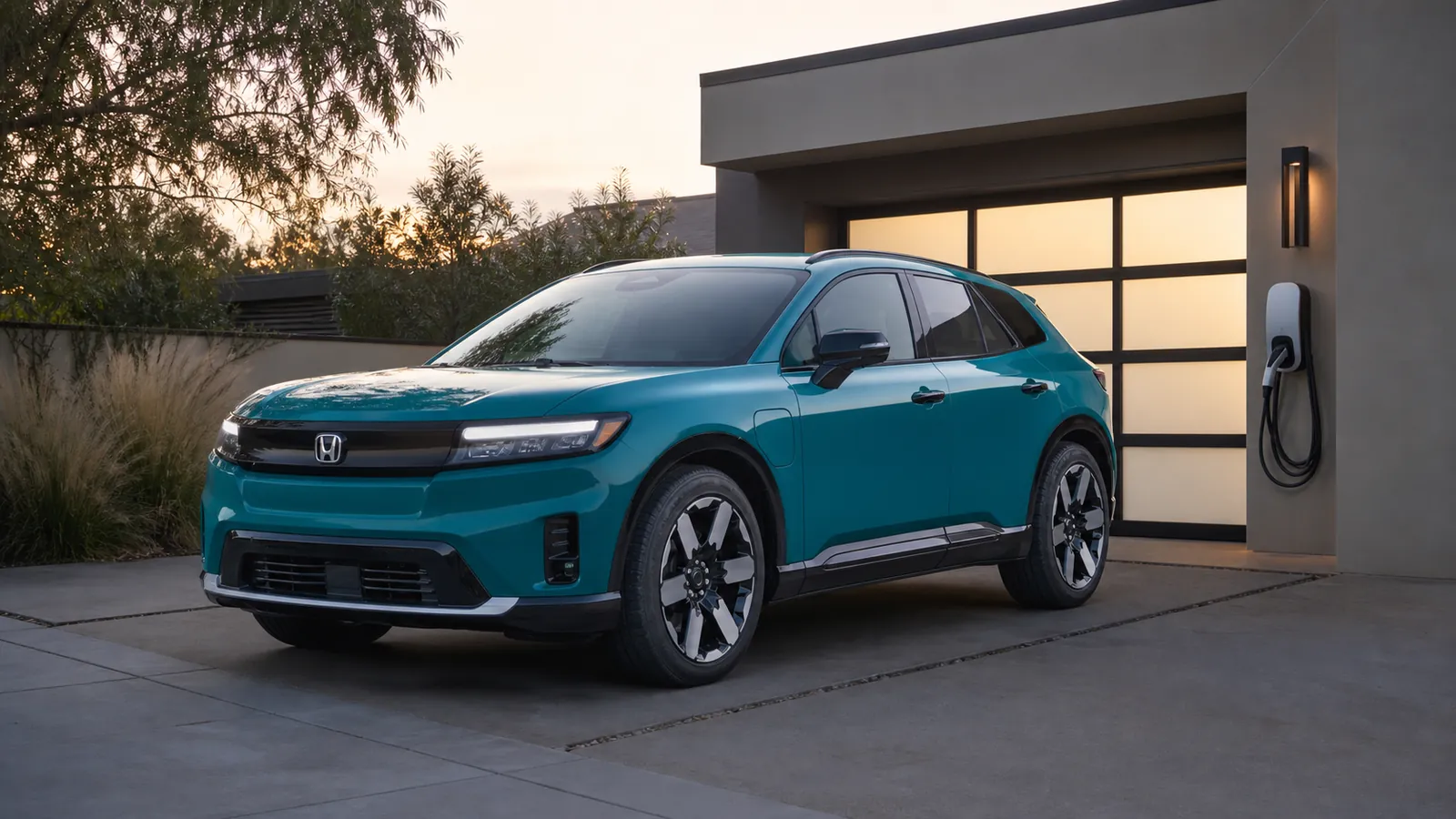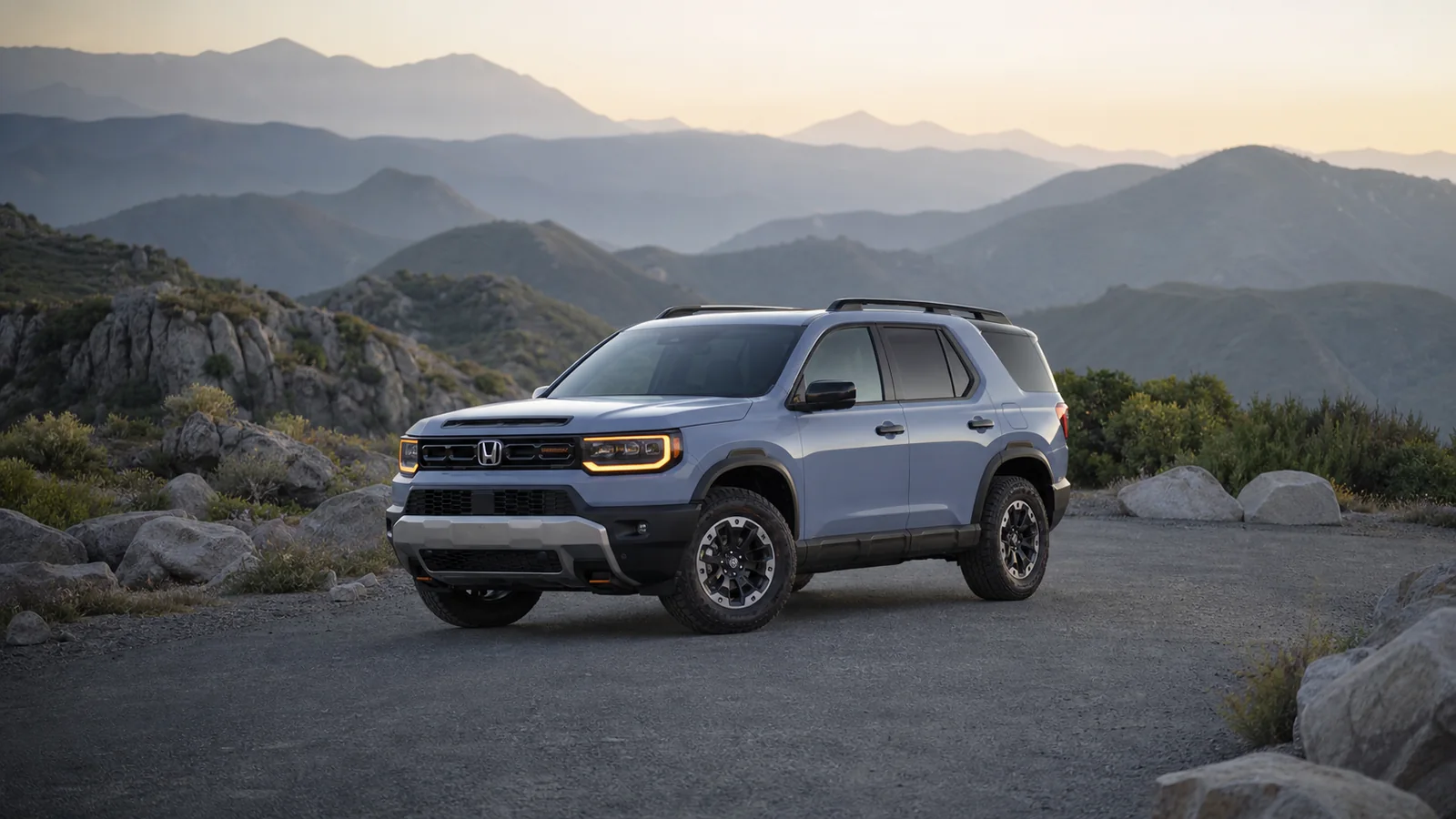
The 2026 Passport makes sense when two rows are enough
The redesigned 2026 Honda Passport is a five-seat midsize SUV with a 285-hp V6, 10-speed automatic, standard i-VTM4 all-wheel drive, and a 5,000-pound maximum tow rating. It gives travelers more cargo focus than a three-row family SUV, but it uses more fuel than a smaller hybrid crossover.
Honda lists RTL at $44,950, TrailSport at $48,650, and TrailSport Elite at $52,650 before destination and other charges. The extra money buys equipment and off-pavement hardware, not more engine output or a higher tow ceiling.
Compare the Passport with a two-row SUV and a seven-seat vehicle.
A Honda Pilot provides a third row. A Honda CR-V Hybrid uses less fuel and may fit a smaller load.
Passport earns its place when five people or fewer need cargo, V6 towing, and AWD.
RTL is the default road-trip pick because it preserves the core V6, AWD, space, and towing hardware without charging for trail equipment the owner may never use.
The new V6, 10-speed, and AWD need a loaded road test
Honda rates the 3.5L DOHC V6 at 285 hp and 262 lb-ft. Every 2026 Passport uses a 10-speed automatic and i-VTM4 torque-vectoring AWD.
Seven drive modes adjust vehicle responses for conditions, but no mode changes tire grip, payload, ground clearance, or driver responsibility.
Test the car with the normal passenger and cargo load when possible. Start cold, drive slowly through a parking area, climb a grade, merge, pass legally, and continue until the powertrain is fully warm.
Check engagement, light-throttle shifts, downshifts, vibration, warning history, cooling, and whether engine noise is acceptable at highway speed.
Drive modes are useful when they match conditions. Snow, Sand, and Trail settings do not make unsuitable tires safe or turn a crossover into a rock crawler.
Leave margins for braking and underbody clearance.
A gas SUV comparison should include annual fuel use. The Passport's strength is predictable V6 response under load, while a hybrid's strength is city efficiency.
Buy the V6 for loaded travel and towing response only after its fuel use and 10-speed behavior fit the normal route.
RTL, TrailSport, and Elite solve three different budgets
RTL carries the core powertrain and road-trip equipment at the lowest price. TrailSport adds hardware and tuning aimed at rougher routes, including all-terrain tires and related protection.
TrailSport Elite adds comfort, camera, audio, and convenience features. It does not raise the 285-hp output or 5,000-pound tow rating.
| Grade | Starting MSRP | Best reason |
|---|---|---|
| RTL | $44,950 | Paved travel, value, V6 and AWD |
| TrailSport | $48,650 | Repeated dirt, snow, and rough-road travel |
| TrailSport Elite | $52,650 | Trail hardware plus premium cabin technology |
Drive RTL and TrailSport over the same broken pavement. All-terrain tires can improve durability and loose-surface traction, while adding noise, cost, or different steering response.
Price a complete replacement set. Check whether the household needs the added cameras, audio, heated or ventilated equipment, and power features often enough to support Elite's cost.
A trim should solve a repeated use, not an imagined vacation. Owners who visit maintained campsites twice a year may be better served by RTL and suitable tires.
Drivers who regularly reach trailheads on rutted roads may use TrailSport hardware every month.
Compare Passport's price with the premium SUV hub and Honda brand hub. Choose RTL unless rough-road frequency proves TrailSport, then choose Elite only when its added visibility and comfort features will be used throughout the year.
Road-trip comfort depends on five real occupants and their luggage
Passport avoids a third row and uses its length for two seating rows and cargo. That is an advantage only when the regular group fits comfortably and the trip luggage stays below the roof and payload limits.
A showroom with empty seats cannot answer either question.
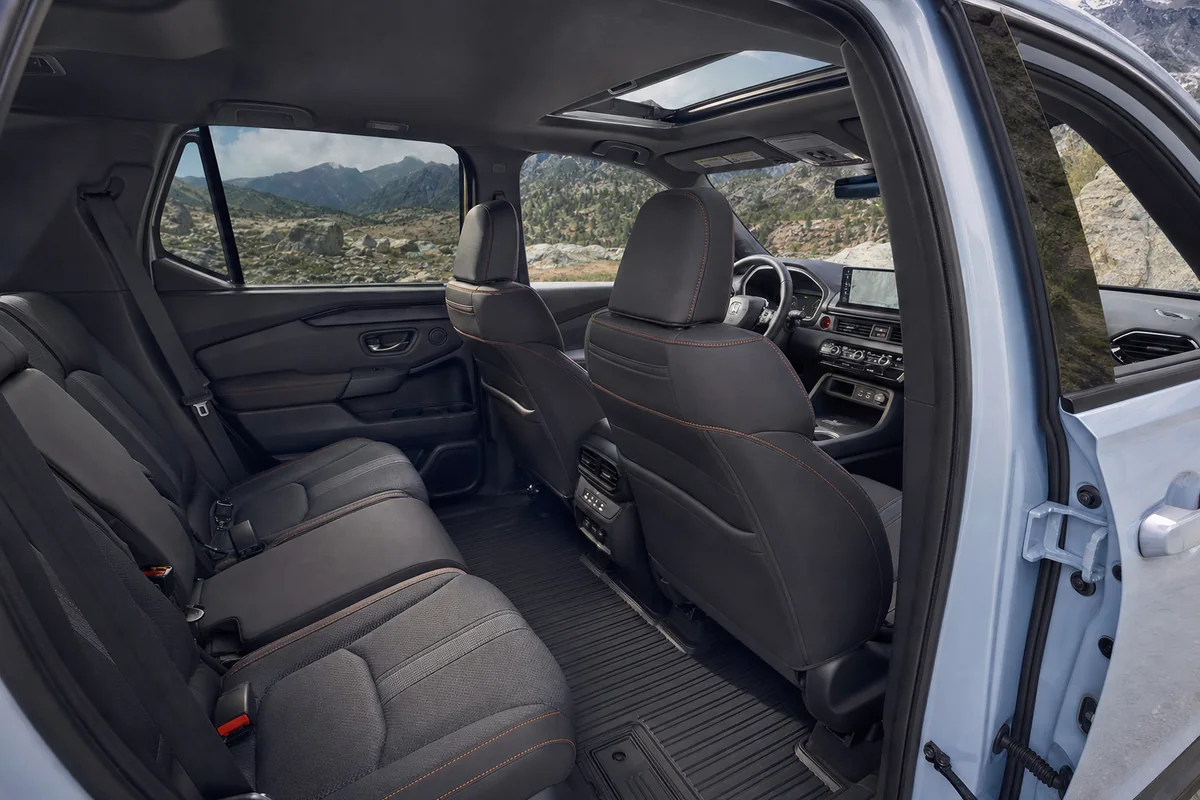
Set the front seats for the real driver and passenger. Then sit rear occupants together and check knees, feet, headroom, shoulder room, center-seat comfort, vents, ports, belt access, and door opening.
Install child restraints using Honda and seat-maker instructions without moving the driver to a false position.
Load suitcases, a cooler, stroller, mobility aid, sports equipment, pet crate, or work gear.
Keep the rear seat in the position required for passengers. Check liftgate clearance, floor height, underfloor storage, rear visibility, tie-down points, and whether a cargo cover interferes with tall items.
A five-seat vehicle can be shorter and cheaper. A three-row SUV can carry extra people in a pinch.
Passport is the right road-trip cabin when five occupants and their normal luggage fit at the same time without using roof storage to repair a poor interior match.
A 5,000-pound tow rating starts the calculation instead of ending it
Honda rates each 2026 Passport trim to tow up to 5,000 pounds when properly equipped.
That figure does not mean every 5,000-pound trailer fits every trip.
Passengers, cargo, accessories, hitch equipment, and trailer tongue weight use vehicle payload.
| Input | Evidence to collect |
|---|---|
| Vehicle payload | Driver-door certification label |
| People | Actual ready-to-travel weight |
| Cabin cargo | Bags, coolers, pets, child seats |
| Accessories | Hitch, rack, steps, protection |
| Trailer | Loaded scale weight, not dry brochure weight |
| Tongue weight | Measured loaded value |
| Equipment | Hitch class, wiring, brake controller, manual requirements |
Start with the vehicle's label, not a website maximum. Subtract people and cargo, then account for hitch and tongue weight using Honda instructions.
Confirm trailer brakes, controller requirements, wiring, cooling, speed limits, tire pressures, and weight distribution in the manuals.
Get a loaded scale ticket.
Test the combination in a controlled setting and inspect tires, brakes, lights, mirrors, hitch fasteners, and fluids before travel.
Leave space below every limit. Crosswinds, heat, grade, altitude, and emergency braking do not care that the brochure number was technically met.
The towing-capacity guide should support the calculation, while the exact labels and manuals control. Use Passport's 5,000-pound rating only after payload, measured tongue weight, equipment, and the fully loaded trailer all fit with margin.
TrailSport hardware helps on rough roads but does not remove geometry limits
TrailSport is aimed at drivers who repeatedly leave pavement. All-terrain tires, suspension tuning, underbody protection, drive modes, cameras on Elite, and standard AWD can make a forest road or snowy access route easier.
Passport remains a large two-row SUV whose wheelbase, overhangs, weight, and clearance set limits.
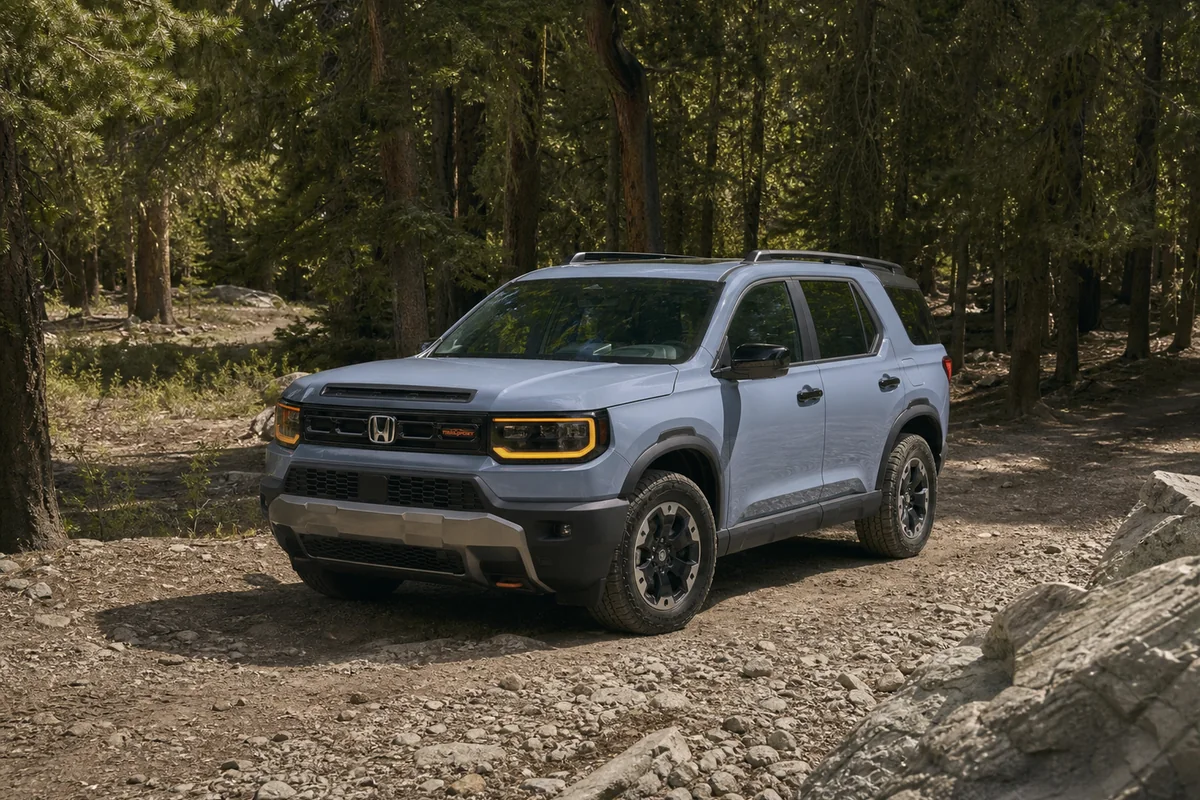
Walk an unfamiliar obstacle. Check approach, breakover, departure, side slope, water depth, surface, turnaround space, and recovery access.
Do not enter water when depth, current, bottom, or hidden damage is uncertain.
Keep speed low enough to protect tires, wheels, suspension, and passengers.
Inspect all-terrain tires for cuts, age, pressure, and full-width tread. Look under the vehicle after a rough trip for bent shields, leaks, packed debris, damaged exhaust, or scraped components.
Protection reduces risk but does not make impacts harmless.
A Toyota Land Cruiser or body-on-frame alternative may offer different trail geometry and recovery options, while costing more or driving less smoothly. TrailSport is worthwhile for repeated rough-road travel that uses its tires and protection, not for appearance during an entirely paved ownership.
IIHS gives the 2026 Passport a strong and specific result
IIHS names the 2026 Passport a Top Safety Pick+. Its page shows Good ratings in the listed small-overlap front, updated moderate-overlap front, and updated side evaluations, plus Good headlights, Good vehicle-to-vehicle and pedestrian front-crash-prevention results, and Good+ LATCH ease.
Some ratings are assigned from the structurally related Honda Pilot, while the updated moderate-overlap evaluation used a 2026 Passport.
Those details belong with the result. The award does not mean crashes are harmless or that every child restraint installs easily in every seating position.
Inspect belts, airbags, head restraints, child anchors, tires, brakes, glass, lamps, cameras, radar areas, and body structure.
Require calibration invoices after windshield, bumper, steering, suspension, or collision repair. Test each driver aid within safe conditions and read system limits.
The safety source guide explains why an award should be tied to year and test details. Passport's 2026 IIHS result is a genuine strength, provided buyers state the published categories accurately and still inspect the exact vehicle.
Do not transfer old-generation recalls to the redesigned 2026 model
The 2026 Passport begins a new generation. Problems, complaints, and campaigns from 2019 through 2025 can guide questions about an older used Passport, but they cannot be presented as proven defects of the redesigned vehicle without official evidence.
NHTSA recall 26V365 covers certain 2019 through 2023 Passport vehicles sold in listed salt states because rear-subframe corrosion at suspension mounting areas can create a safety risk.
That is an exact old-generation, model-year, and region condition.
It does not include the 2026 Passport.
For an older vehicle, inspect the rear structure on a lift and require official remedy documentation when applicable. For a 2026, inspect current campaign status, software, cold and hot powertrain behavior, 10-speed shifts, AWD, brakes, tires, cameras, water entry, body repair, and stored codes.
A planned Passport problems guide can separate older evidence from the new generation. The honest 2026 reliability conclusion is limited history plus a disciplined inspection, not a borrowed reputation from a different Passport.
Fuel, tires, towing, and trim price shape the five-year cost
Passport's V6 and standard AWD support travel and towing, but they also use fuel. Honda lists 18 city, 23 highway, and 20 combined mpg for the 2026 lineup.
Annual miles, loaded travel, idling, towing, weather, tires, and driving style change the result.
| Cost | What to price |
|---|---|
| Purchase | Trim, fees, accessories, dealer products |
| Finance | Rate, term, down payment, total interest |
| Fuel | 20-mpg estimate and actual annual miles |
| Insurance | Exact VIN, drivers, towing use |
| Tires | Road or all-terrain set and alignment |
| Towing | Hitch, wiring, brake controller, maintenance |
| Service | Oil, filters, transmission and AWD needs |
| Repairs | Deductible and post-warranty reserve |
TrailSport tires may cost more and affect noise or efficiency.
Elite raises the amount financed. Towing can accelerate tire, brake, and fluid needs.
Price the vehicle both with and without dealer accessories, and do not roll unwanted products into a long loan.
Compare the same period with a Honda CR-V, hybrid SUV, and three-row SUV. Passport ownership makes sense when its V6, cargo room, and towing replace another vehicle need, not when one person pays 20-mpg costs for unused space and hardware.
RTL is the best road-trip value after passenger and trailer checks
Passport combines a strong naturally aspirated V6, standard torque-vectoring AWD, a focused two-row cabin, useful towing, and excellent 2026 IIHS results. It gives up hybrid fuel economy, a third row, and years of evidence for the redesigned generation.
Pros
- 285-hp V6 and standard AWD
- 5,000-lb maximum tow rating
- Two-row cargo-focused layout
- 2026 IIHS Top Safety Pick+
Cons
- 20-mpg combined estimate
- No third row or hybrid choice
- TrailSport hardware raises price and tire cost
- New generation has limited long-term history
Use the Honda brand hub, SUV hub, AWD hub, and comparison archive before signing.
Choose RTL when five people, their luggage, and any trailer fit at the same time, then pay for TrailSport or Elite only when their hardware solves a repeated trip.
A road-trip departure check should match the exact passengers and route
Passport's appeal is long-distance travel, so the final evaluation should happen with the vehicle prepared as it will leave home. Five people, luggage, a pet, roof equipment, a hitch accessory, and all-terrain tires can change visibility, payload, noise, fuel use, braking, and emergency access at the same time.
Start with the driver-door label and Honda's loading instructions.
Weigh or estimate every person and item honestly.
Heavy cargo belongs low and secured. Keep rear visibility, emergency equipment, and the spare-tire or repair tools accessible.
A roof box adds height and wind load, while a hitch carrier adds rear weight and can affect camera or liftgate use.
Confirm every accessory's limits and the vehicle's remaining capacity.
| Area | Check before leaving |
|---|---|
| People | Seating position, belts, child restraints, comfort |
| Cargo | Weight, restraint, visibility, emergency access |
| Tires | Cold pressure, tread, damage, correct seasonal type |
| Fluids | Oil, coolant, washer fluid, visible leaks |
| Brakes | Pedal, warnings, pad and rotor condition when due |
| Technology | Cameras, lights, phone connection, navigation |
| Route | Weather, fuel stops, closures, legal restrictions |
| Towing | Hitch, wiring, brakes, chains, tongue and payload |
Set the navigation and audio before moving. Pair the main phone, download offline maps where coverage is weak, and place charging cables so they do not cross pedals or become loose objects.
Choose a passenger to manage route changes when possible. Driver-assistance systems support attention, but they do not make fatigue safe.
Plan fuel around distance, weather, traffic, elevation, towing, and station availability. Do not use the last gallons as a normal operating target.
On remote routes, stop while there is enough fuel to reach a second station. Keep the correct fuel requirement in view and save receipts when investigating a consumption change.
Stop at regular intervals for the driver and passengers. Check tires visually, look for leaks or loose cargo, and confirm trailer connections where applicable.
A new vibration, warning, smell, pull, brake change, temperature concern, or tire-pressure alert deserves a safe stop and diagnosis.
Continuing to protect a schedule can turn a small concern into a breakdown.
For unpaved travel, check current route rules, fire restrictions, weather, water crossings, communications, and recovery access.
Tell someone the route and return time. Carry clothing, water, medication, and emergency supplies appropriate to the location rather than copying a generic off-road list.
Do not rely on mobile coverage.
- Keep the heaviest cargo low and restrained
- Preserve access to emergency and tire equipment
- Recheck accessory and payload weight together
- Stop when fatigue reduces attention
- Investigate warnings instead of clearing them for the trip
- Leave enough fuel and time for a closed road or missed stop
A road-trip vehicle earns trust through boring preparation. Passport is ready when every passenger, bag, tire, fluid, accessory, route, fuel stop, and trailer item has a place in the departure check, not when the cargo door merely closes.
Used 2019 to 2025 Passports need a different inspection from 2026
A used Passport can cost far less than the redesigned 2026 model, but the two generations should not share one reliability summary.
The 2019 to 2025 vehicle uses older body, cabin, transmission, suspension, and electronic details.
The 2026 vehicle introduces new design and hardware with little long-term history.
Price and inspect each on its own evidence.
For an older Passport, begin with VIN campaigns, complete maintenance records, cold V6 operation, transmission behavior, AWD and rear-differential service, idle-stop behavior where equipped, brakes, tires, steering, suspension, cameras, infotainment, liftgate, water entry, body repair, and corrosion. In salt states, official rear-subframe campaign status and a lift inspection are essential for covered years.
For a 2026, focus on build quality and early-life evidence. Scan every module, review software and campaign history, test the 10-speed cold and fully warm, operate every drive mode within safe conditions, inspect all-terrain tires where fitted, verify camera views, and check accessory installation.
A new design deserves careful observation without inventing a pattern from a few reports.
| Question | 2019 to 2025 | 2026 |
|---|---|---|
| VIN campaigns | Older-generation campaigns by exact year | Current VIN search only |
| Transmission | Earlier design and service history | New 10-speed behavior and software |
| Trail hardware | Earlier TrailSport package where applicable | Redesigned TrailSport structure and equipment |
| Safety | Use the exact older IIHS page | 2026 Top Safety Pick+ details |
| Reliability | More years of condition evidence | Limited long-term evidence |
| Value | Used price and repair reserve | Warranty, new price, financing, depreciation |
Do not assume older means unreliable or new means trouble free. A clean older SUV with documented service and completed campaigns may be the better value.
A new 2026 gives warranty coverage, the latest packaging, stronger published safety evidence, and current equipment, while asking the buyer to accept a higher price and limited long-term history.
Drive both on the same route. Compare seat comfort, visibility, rear space, cargo loading, ride, noise, transmission response, fuel use, tire price, insurance, and finance cost.
Include immediate maintenance or tire needs in the used quote. Include dealer products and total interest in the new quote.
- Keep recall claims with the years listed in official documents
- Require a lift inspection for an older salt-state vehicle
- Scan every module on either generation
- Compare five-year cost rather than payment alone
- Test passenger and cargo fit again because packaging changed
- Treat early 2026 complaints as inspection prompts, not population proof
Choose the older Passport for documented condition and a large price advantage, or the 2026 for its redesigned space, hardware, warranty, and IIHS result after the higher total cost is justified.
Delivery inspection should include every camera and accessory
Passport can leave the dealer with racks, steps, protection, hitch equipment, cargo systems, and electronic accessories.
Inspect installation before accepting the vehicle. Confirm fasteners, clearances, wiring, seals, camera views, liftgate movement, tire pressure, payload effect, and written warranty for each item.
Operate every key, lock, window, seat, climate zone, screen, camera, light, outlet, driver aid, drive mode, and liftgate function.
Match the VIN, trim, odometer, tire size, accessories, manuals, and contract.
Photograph condition and save the signed correction list.
- Check that racks and steps do not contact paint or seals
- Confirm hitch wiring and camera views operate together
- Verify liftgate clearance with every installed cargo item
- Record tire pressure and accessory weight before loading
- Save part numbers and warranty terms on the signed paperwork
Accept delivery only when the exact Passport, installed accessories, cameras, body condition, tire setup, and written repair promises match the transaction.