Which Honda Passport years should you avoid?
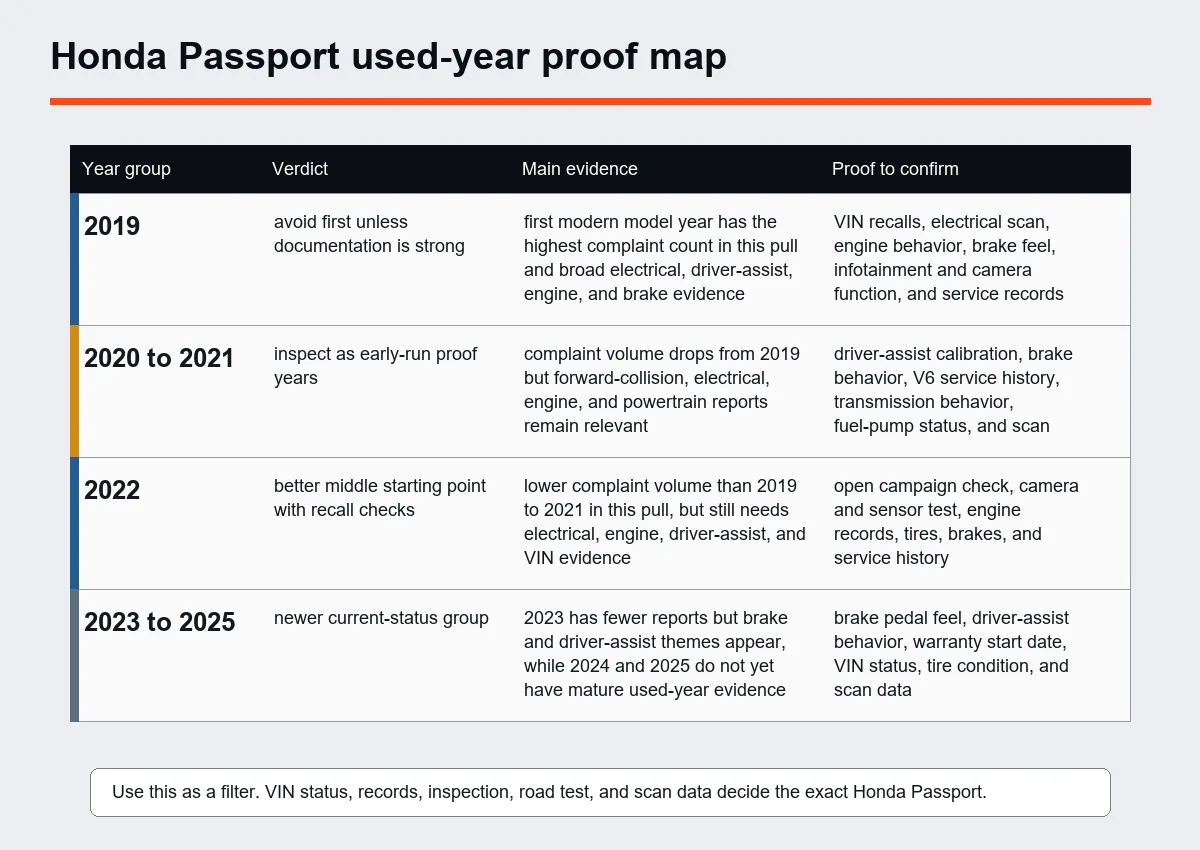
On the modern car there is one answer, and it is the 2019 launch year. Every model year after it sits far below it in the federal complaint record.
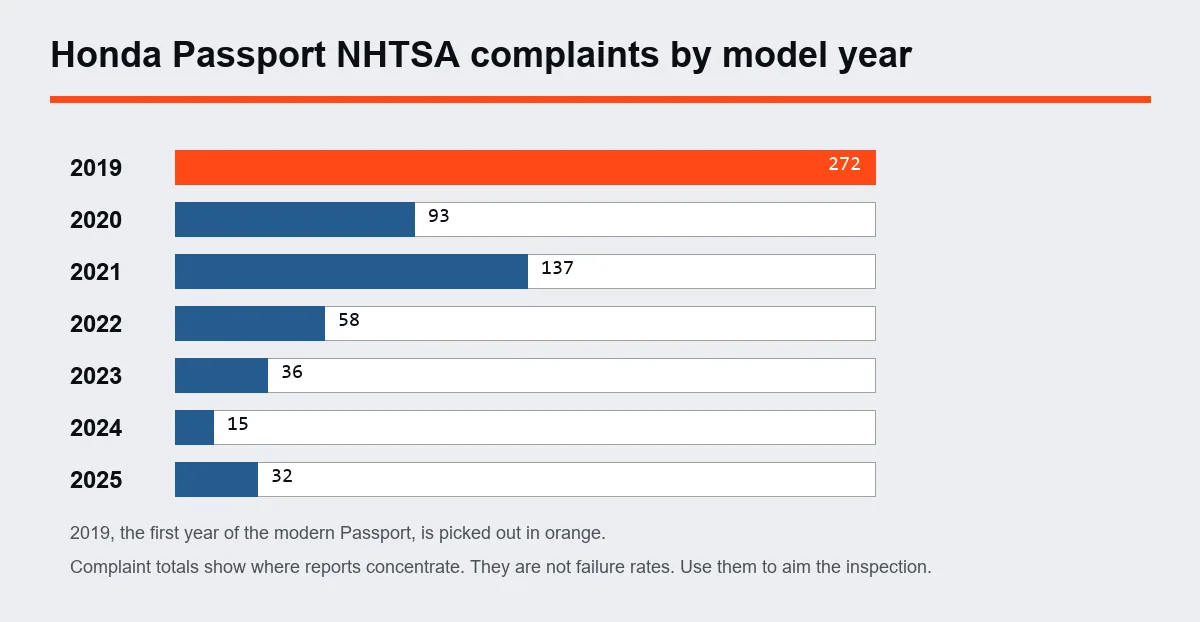
The gap does the arguing. The 2019 car holds more filings than the 2020, 2022, 2023, 2024 and 2025 cars put together.
A single weak launch year is a normal outcome for a new platform. What is not normal is how quickly the record settles afterwards, with no second spike anywhere in the following six years.
That is the whole modern answer. The rest of the year lists you will find belong to a different vehicle, which is worth separating properly before you read any further advice.
There are two unrelated Hondas called Passport
Honda has used this name twice, and the two vehicles have nothing in common beyond the badge on the tailgate.
The first was a rebadged Isuzu Rodeo sold from 1994 to 2002. Body-on-frame, built by Isuzu in Indiana, and engineered entirely outside Honda.
The second arrived in 2019 as a two-row unibody crossover sharing its platform with the Honda Pilot. Different construction, different factory, different engineering, seventeen years apart.
The gap is what breaks the year lists. Ranking sites build per-year tables from a single nameplate record, so a 1997 Isuzu and a 2023 Honda end up scored on the same axis as though one led to the other.
Their complaint records say the same thing. The older vehicle accumulated 1,033 filings across nine model years, led by service brakes, suspension and structural corrosion.
| Passport era | Construction | Complaints | Leading categories |
|---|---|---|---|
| 1994 to 2002 | Body-on-frame, built by Isuzu | 1,033 across nine years | Service brakes, suspension, structure |
| 2019 to 2025 | Unibody, shared with the Pilot | 643 across seven years | Electrical, driver assistance, fuel system |
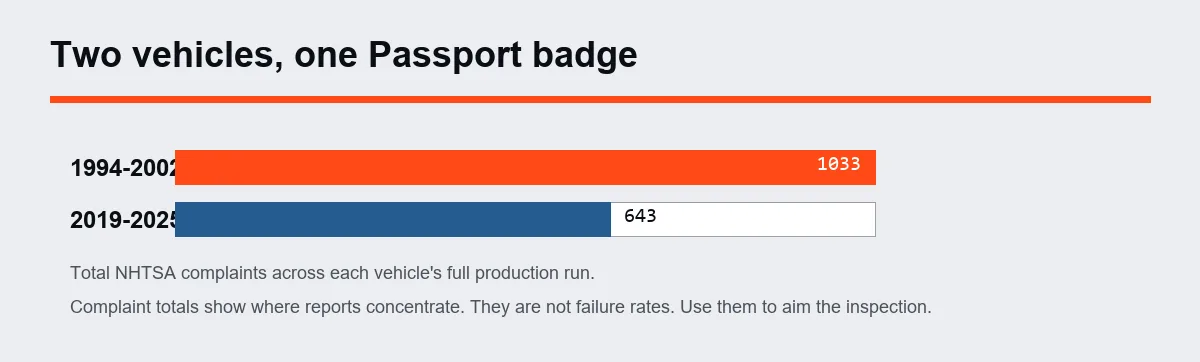
Nothing crosses between those rows. The old vehicle's worst years were 1998 and 1999, at 270 and 247 filings, and its 2001 record is dominated by structural complaints that a unibody crossover cannot physically reproduce.
So discard it all when you are shopping a modern car. Frame rust, transfer case failure and head gasket advice describe an Isuzu, and none of it tells you anything about the vehicle in front of you.
The modern Passport's record is genuinely small
Seven model years of a high-volume family SUV have produced about 643 complaints in total.
Put that beside the older vehicle and the comparison is unflattering to the one people are usually warned about. A 1990s SUV that sold in far smaller numbers generated 60 percent more complaints than its modern namesake has managed.
The trend inside the modern run matters as much as the total. Volume falls from 272 to 93 in one year, ticks back up to 137 in 2021, then drops to 58 and stays low.
That 2021 bump is not a mechanical story. It is driver assistance, which gets its own section below because it is the one issue no inspection will find.
One caveat keeps this honest. The 2024 and 2025 cars have had far less time on the road, so their 15 and 32 filings are partly a function of age rather than quality.
Even allowing for that, the shape is clear. This is a quiet vehicle by the numbers, which makes the next section genuinely surprising.
What actually happened in 2019
The launch year's 272 filings do not concentrate anywhere. Electrical accounts for 29, the fuel system for 20, and the largest single group of 35 is filed under no specific component at all.
A spread like that describes a platform settling rather than one defective part. When a single component fails at scale it shows up as a category with triple-digit counts, and nothing here comes close.
The 35 filings with no component assigned are worth a moment. That category collects reports the database could not classify, which usually means the owner described a symptom rather than named a part.
A launch year is exactly when that happens most. Owners have no shared vocabulary for a car nobody has owned long enough to develop one.
The more useful evidence on a 2019 car is structural, and most buyers would never think to look for it. Campaign 19V784 covers the front frame left and right side upper members on 2019 Passport and Pilot models.
Two more campaigns from 2020 cover the rearview camera display, reached through different software faults in the instrument panel and the central network unit. A third, 21V932, covers the hood latch striker on 2019 cars.
What clears a 2019 car
- Frame upper members (19V784)
- Dealer inspection recorded against the VIN, not an owner's visual check
- Rearview camera software (20V439, 20V440)
- Reverse the car and confirm the display comes up every time
- Hood latch striker (21V932)
- Open and close the bonnet, then confirm the campaign is closed
- Fuel pump (21V215, 23V858)
- Two separate campaigns, so check both by VIN
Then the record falls to 93 the following year. A launch year that spreads wide and recovers immediately is a very different risk from one that concentrates and persists.
The system most likely to annoy you is not mechanical
On both the 2020 and 2021 cars the leading complaint category is forward collision avoidance. That is unusual, because on almost every vehicle the top category is something that physically breaks.
These filings do not describe a part failing. They describe the collision mitigation system intervening when nothing is in the way, warning or braking on overhead signs, shadows, cresting hills and cars turning out of the lane ahead.
That distinction matters more than it sounds, because a system that works too eagerly passes every inspection a mechanic can run. There is no fault code to pull, no worn component to measure and no warning light to find.
The only way to assess it is to drive the car properly. Take it onto a road with overhead gantries and a mix of light and shade, keep enough space ahead to make a false brake safe, and cover twenty minutes rather than five.
Powertrain sits second on the 2021 car at 17 filings, largely describing how the nine-speed automatic behaves at low speed. That one shows itself on the same drive, in stop-start traffic and pulling away from junctions.
Neither is a reason to rule a model year out by itself. Both are a reason to make the test drive long enough to find them, which a loop around the dealership will not do.
A quiet record with sixteen campaigns behind it
Here is the part that does not fit the low complaint volume. Sixteen separate safety campaigns cover the 2019 to 2025 Passport.
They are not trivial ones either. The list runs to a brake master cylinder on 2021 to 2023 cars (23V458), a steering gearbox inner ball joint housing on 2023 cars (24V184), a fuel filler pipe on 2023 and 2024 cars (24V900), tyres on 2019 and 2020 cars (21V165), and mirror heating pads on 2020 to 2022 cars (23V174).
The newest entry is the one no year list has caught up with. Campaign 26V365 covers a rear subframe that may corrode at the suspension mounting points on 2019 to 2023 Passports, alongside Pilot, Ridgeline and Acura MDX models built on the same architecture.
Honda gives failure of rear suspension components, such as the control arm, as the consequence, with a loss of handling and control.
So the two signals genuinely point in opposite directions, and the resolution is not complicated. A manufacturer filing campaigns before owners file complaints is acting early, which is a better pattern than the reverse.
But it changes what the low complaint count means. It is evidence that problems were caught, not evidence that there was nothing to catch.
Which makes the VIN search non-negotiable on this vehicle specifically. Run it yourself on the day rather than accepting a printout, because the newest campaign here was filed this year and any report older than that will not show it.
Which Passport years are worth shortlisting
Four model years share the quiet end of the record. The 2022 car holds 58 filings, 2023 holds 36, 2025 holds 32 and 2024 holds 15.
Two of those come with an asterisk. A 2024 or 2025 car has had a fraction of the road time of a 2022 one, so its low count is partly just youth.
Strip the age discount out and 2022 is the strongest position. It is far enough past the launch year for the platform to have settled, and it has enough years behind it for 58 filings to be a real result rather than an incomplete one.
The contrast with the year before it is sharp. The 2021 car holds 137 filings, more than double the 2022, with driver assistance and powertrain leading.
None of this removes the campaign check. A 2022 car still falls inside the 2019 to 2023 frame campaign and inside the 2021 to 2023 brake master cylinder campaign.
The 2023 car is the runner-up and the trade is worth stating. It holds fewer filings at 36, but it carries two campaigns the 2022 does not, covering the steering gearbox ball joint and the fuel filler pipe.
So the choice is between a newer car with a shorter complaint record and a longer campaign list, or a slightly older one with the reverse. Both are defensible and neither is a year to avoid.
That is a better answer than most used SUVs allow. One year to avoid, one year to target, and a short list of campaign numbers that turns the rest into a five minute check.
Sources
- NHTSA 2019 Honda Passport complaints
- NHTSA 2020 Honda Passport complaints
- NHTSA 2021 Honda Passport complaints
- NHTSA 2022 Honda Passport complaints
- NHTSA 2023 Honda Passport complaints
- NHTSA 2024 Honda Passport complaints
- NHTSA 2025 Honda Passport complaints
- NHTSA 2019 Honda Passport recalls
- NHTSA 2020 Honda Passport recalls
- NHTSA 2021 Honda Passport recalls
- NHTSA 2022 Honda Passport recalls
- NHTSA Passport automatic-emergency-braking investigation
- NHTSA 1998 Honda Passport complaints
- NHTSA 1999 Honda Passport complaints
- NHTSA 2001 Honda Passport complaints
- NHTSA Honda Passport recalls