Which Honda Ridgeline years should you avoid?
Three groups. If you have only read the popular lists, the first will be unfamiliar.
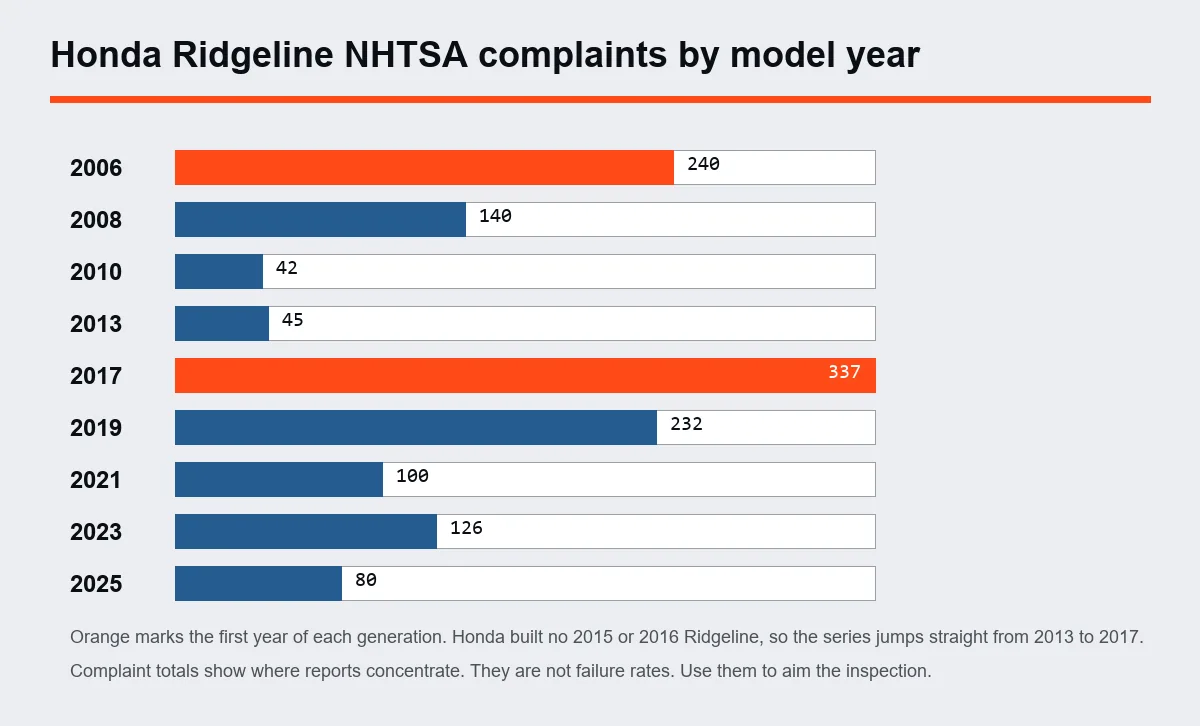
That first entry is the surprise. The 2017 Honda Ridgeline carries more filings than any truck from the first generation, despite being eleven years newer and having far less time on the road.
Age normally works the other way. An older truck accumulates filings for longer, so a newer year outscoring every older one is a genuine signal rather than an artefact.
Two generations, two different problems
There was no 2015 Ridgeline and no 2016 Ridgeline. Honda ended the first generation in 2014 and brought the nameplate back for 2017 on a new platform.
That gap makes a cleaner boundary than an ordinary redesign, because nothing carried across it quietly.
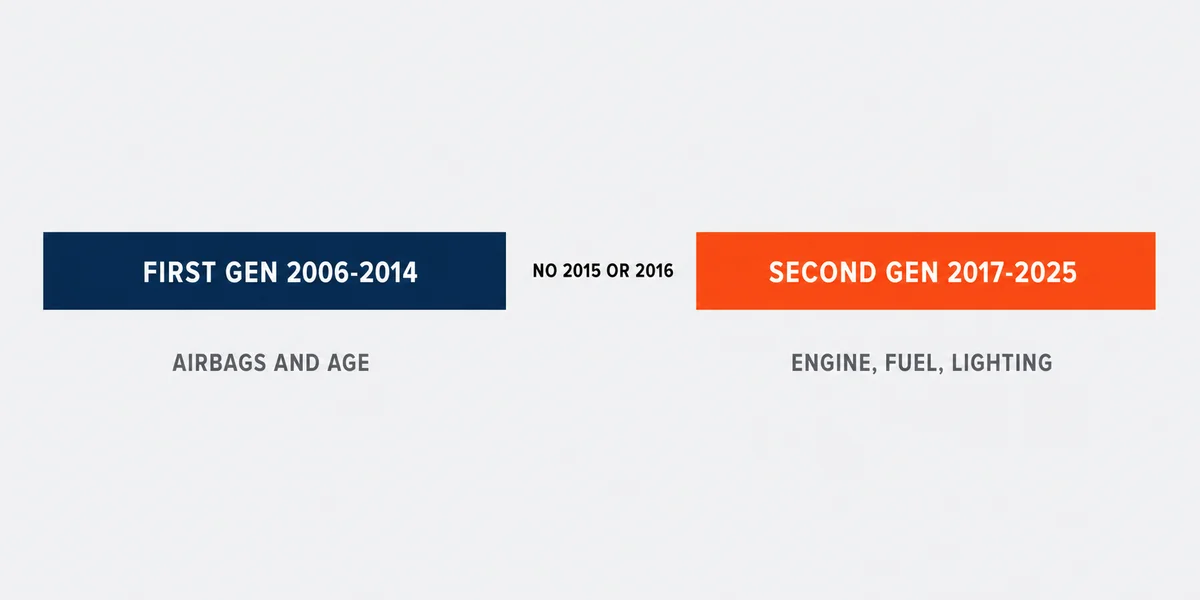
The leading categories change completely across it. Airbags lead almost every first-generation year from 2006 through 2014, while the second generation opens on electrical and engine.
That is not two versions of the same problem getting better or worse. It is two different vehicles with two different failure patterns sharing a badge.
For a buyer the consequence is simple. Half of everything written about this truck does not apply to the one you are looking at, and the gap in the model years tells you which half.
The 2017 launch year is the second generation's worst
The 2017 truck holds 337 complaints. Electrical leads at 58 filings, engine follows at 55, and fuel and propulsion items account for 31.
No single component dominates, which is the point. A launch year that spreads across three unrelated systems is a new platform being debugged rather than one bad part.
The electrical filings describe the truck behaving oddly rather than failing outright. Owners report the alarm triggering on its own, dashboard lights flickering with clicking from behind the dash, and in some cases the engine starting without the key fob.
The engine filings are more serious and more specific. Owners describe shuddering and vibration under way, knocking from the engine bay, and in the worst cases a failure that dumps oil and coolant and stops the truck.
Those descriptions matter because they line up with a campaign. Knocking followed by seizure is what a worn connecting rod bearing produces, and 2017 trucks fall under exactly that campaign.
| Model year | Complaints | Leading category |
|---|---|---|
| 2017 | 337 | Electrical at 58, with engine at 55 |
| 2018 | 158 | Electrical at 34 |
| 2019 | 232 | Fuel system at 35, with power train at 26 |
| 2020 | 167 | General items, with electrical at 24 |
The recovery is real but incomplete.
The 2018 truck more than halves the volume. Then 2019 rises again on a different category entirely.
That makes 2019 a separate question rather than a continuation of the launch problem, which is where the campaigns come in.
The fuel pump recall that car wash soap can trigger
Campaign 19V053 covers 2017 to 2019 Ridgeline trucks. Its stated trigger is unusual enough to be worth reading twice.
Honda states that exposure to acids, such as from car wash soaps, can cause the fuel pump feed port to crack.
A cracked feed port allows pressurised fuel to leak out, and Honda gives fire as the risk.
It is easy to dismiss precisely because the trigger sounds trivial. A campaign that names car wash soap does not read like a fire risk until you notice that Honda classified it as one.
Three campaigns cover the engine and fuel system on early second-generation trucks
The fuel pump feed port is not the only campaign on that window. Three more overlap with it.
Campaign 19V298 covers 2019 trucks where the timing belt teeth may separate from the belt, which can stall the engine. Campaign 23V751 covers 2017 and 2019 trucks where a connecting rod bearing may wear and seize.
Campaign 23V858 covers 2017 to 2020 trucks under the wider low-pressure fuel pump programme, where pump failure can stall the engine while driving.
What clears each campaign on a 2017 to 2019 truck
- 19V053, fuel pump feed port
- Dealer repair order naming the operation, not just a closed status line
- 19V298, timing belt
- Repair record for 2019 trucks, plus any belt service already carried out
- 23V751, connecting rod bearing
- Inspection or engine repair record, and a cold start with no knock under load
- 23V858, low-pressure fuel pump
- Confirmation the pump work is closed, separately from 19V053
Four separate campaigns on the engine and fuel system of a three-year window is a real concentration. A history report showing one clear line does not tell you the other three were done.
The lighting complaints nobody writes about
Here is the part of the record that no competing article covers, because it is recent enough that the year lists have not been rewritten since it appeared.
Exterior lighting is the leading complaint category on the 2022, 2023, 2024 and 2025 trucks. Four consecutive model years, all led by the same thing.
The category grows before it peaks. It runs 10 filings on the 2020 truck, 13 on the 2021, then 29 and 38 on the two years after that.
Read the filings and one behaviour dominates the rest. Thirty-one of the 38 on the 2023 truck name the automatic high beam system, and 24 of the 29 on the 2022 truck do the same.
Owners report it flickering, reacting to road signs and reflective markers, and failing to dim for oncoming traffic. Several describe switching the system off permanently and leaving it off.
That share holds as the counts fall. Sixteen of the 18 filings on the 2025 truck name the same system, so this is not a single bad production run working its way out.
Water is the smaller behaviour and worth separating from it. Four of the 2023 filings and one each on the 2021, 2022 and 2025 trucks describe headlight assemblies filling with condensation or standing water.
No recall campaign covers either behaviour.
These are owner reports rather than a confirmed defect. In absolute terms the counts stay modest.
What makes them worth your attention is the consistency. A category leading four consecutive model years is a pattern, and checking it costs nothing.
On any 2022-onward truck, view it after dark. Drive a stretch with oncoming traffic to watch the automatic high beam behave, then look into both headlight housings for moisture.
The first generation is now an airbag and age question
The old trucks look worse in the raw totals than they deserve. Airbags account for most of the difference.
Airbags lead the 2006, 2007, 2008, 2009, 2010, 2011, 2012, 2013 and 2014 model years without interruption. Nine consecutive years led by the same component.
When one category leads nine straight years of a relatively low-volume truck, the explanation is usually outside the vehicle. In this period it is the industry-wide airbag inflator replacement programme, which swept up millions of vehicles across many manufacturers.
Counting an industry-wide programme as a Ridgeline design fault is how these trucks end up looking worse than they are.
What genuinely belongs to them is smaller. Campaign 07V097 covers a 2006 fuel pump relay coil wire that can break and stall the engine, and the rest of the first-generation record is unremarkable.
At more than ten years old even for the newest of them, these trucks are bought on corrosion, service history and bed condition rather than on which of the nine years they happen to be.
The bed is worth its own minute on this truck specifically.
The in-bed trunk is a sealed well with its own drain. A blocked drain or a failed seal puts water somewhere no conventional pickup has a cavity.
Open it, look for standing water and staining, and check that the drain is clear. It is the one inspection point unique to a Ridgeline and the one a general used-truck checklist will not mention.
Which Ridgelines to shortlist, and what to check
The second generation has a narrow sweet spot, defined by what sits on either side of it.
The 2021 truck holds 100 filings, the lowest of any Ridgeline with real time on the road. The 2020 truck holds 167.
The 2024 truck holds 50, which looks better still and means considerably less, because it has had about two years in which anyone could file anything.
What makes 2021 the pick is its position. It sits after the engine and fuel campaign window that covers 2017 to 2020, and before exterior lighting establishes itself as the leading category from 2022.
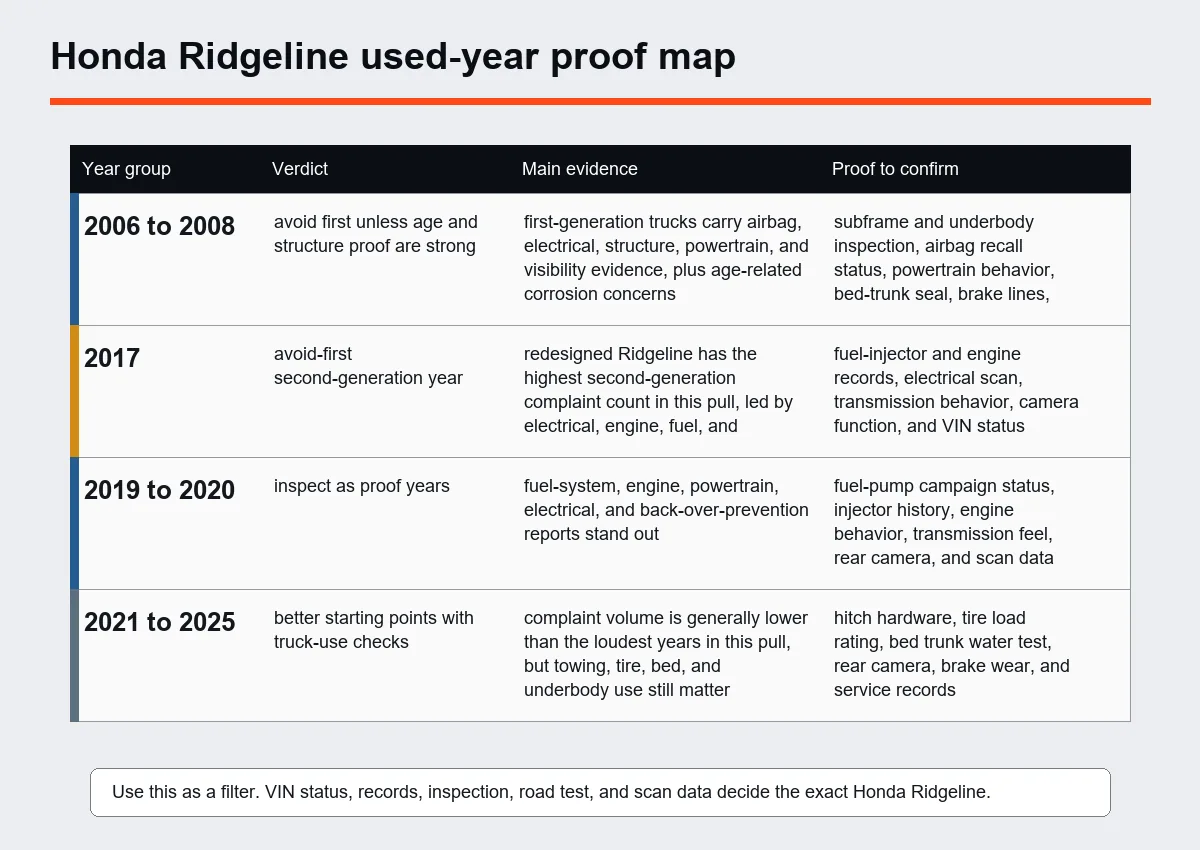
Whichever year you settle on, the checks divide cleanly. A 2017 to 2020 truck is settled on paperwork, a 2022-onward truck is settled after dark, and a first-generation truck is settled underneath and in the bed.
Run the VIN yourself on the day rather than trusting a printout, because campaign status changes as manufacturers file. On this truck there are four separate entries to look for on the early second-generation years alone.
One recent entry reaches further than most lists show. Campaign 26V365 covers a rear subframe that may corrode at the suspension mounting points on 2017 to 2023 Ridgelines, though only on trucks originally sold in 23 salt-belt states.
Honda gives failure of rear suspension components as the consequence, with a loss of handling and control.
The same campaign covers the Honda Passport across 2019 to 2023 and the Pilot across 2016 to 2022, so a cross-shopper carries it between all three.
What separates them is the span. The Ridgeline is covered from 2017, which is a year earlier than the second generation's engine and fuel campaigns begin.
So on a salt-belt truck the subframe entry can apply to a model year that looks clear on every other list.