Which Honda Pilot years should you avoid first?
Put 2003, 2005, 2016, and 2019 to 2020 at the back of the list first. The early years carry old transmission and airbag proof, 2016 has the largest current complaint spike in this review, and 2019 to 2020 combine fuel, camera, engine, and structural campaign questions.
The 2023 to 2025 Pilot does not belong in the same bucket. It has a short history, so the buyer should focus on open recalls, software, fuel-system proof, brake-pedal proof, seat hardware, and third-row belt operation rather than pretending there is a decade of durability evidence.
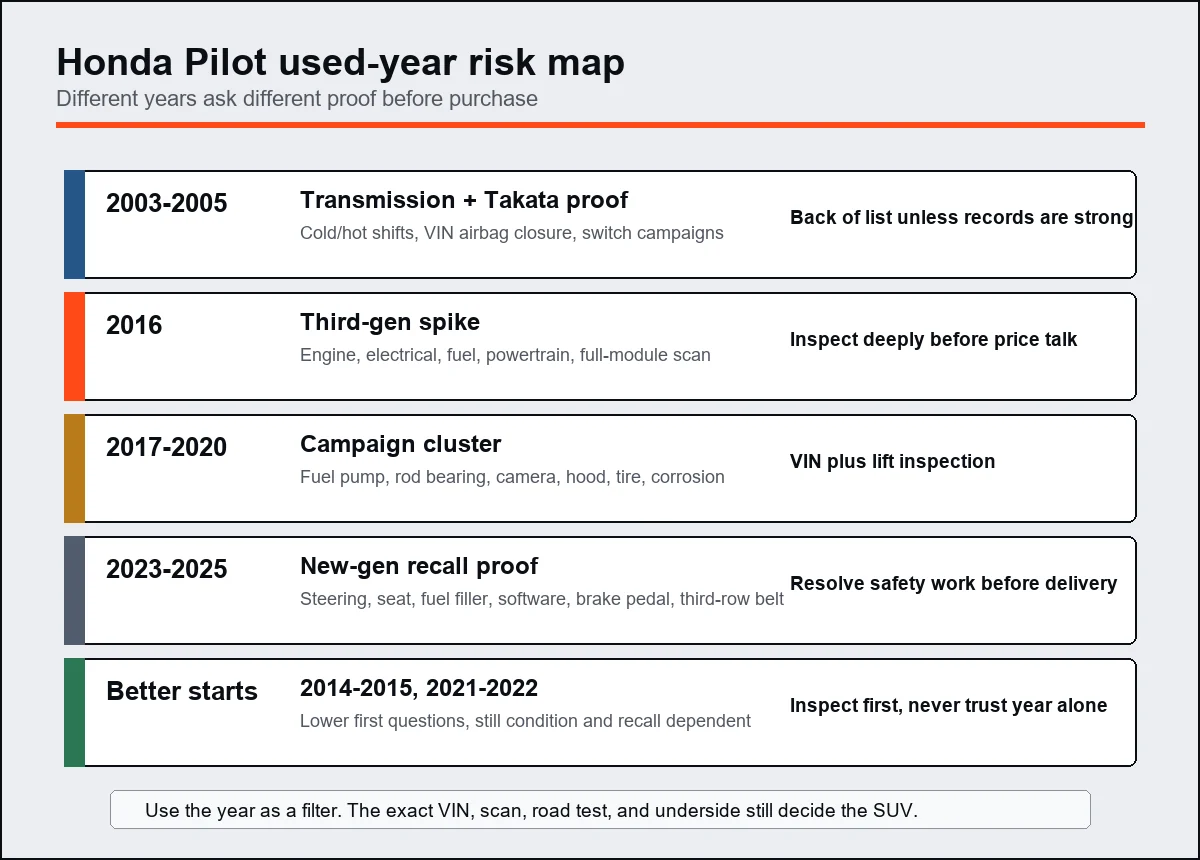
Use those years as screening flags, not failure odds. NHTSA complaint counts show where reports concentrate, but they do not adjust for sales volume, mileage, climate, owner behavior, repair completion, or how long the vehicle has been on the road.
A better year is not automatically safe either. A clean-looking Pilot with mismatched tires, cleared codes, towing wear, rust, open campaigns, or no transmission records can be worse than a risky-year example with boring paperwork and a calm road test.
Early 2003 to 2005 Pilots need transmission and airbag proof
The first-generation warning is mainly a transmission and safety-campaign question. Current NHTSA data returns 746 complaints and 14 recalls for 2003, 544 complaints and 13 recalls for 2004, and 679 complaints and 15 recalls for 2005.
The component mix explains why a cheap early Pilot needs more than a short drive around the block. In 2003, power train leads the complaint categories with 182 reports, followed by air bags and electrical system reports.
| Concern | Evidence to request | Present check | Buying response |
|---|---|---|---|
| Automatic transmission | Repair invoices, fluid history, campaign or rebuild records | Cold engagement, warm shifts, flare, shudder, harsh downshift, scan data | Reject slipping or delayed engagement without diagnosis |
| Takata and airbag history | VIN recall printout and completed repair orders | Airbag light, crash history, steering wheel and passenger dash condition | Do not buy around unresolved airbag evidence |
| Ignition and headlight switches | VIN status for switch campaigns and related repairs | Key removal, shift interlock behavior, headlight switch heat or flicker | Treat missing proof as an electrical risk |
| Age and structure | Rust photos, lift inspection, suspension and brake records | Subframe, brake lines, mounts, tires, leaks, cooling system | Price only documented wear, not unknown deterioration |
NHTSA campaign 04V176 covered certain Honda and Acura automatic transmissions because heat buildup between gears could lead to chipping or breakage. That campaign is not a complete history of every old Pilot transmission, but it tells you why shift behavior and records matter.
Airbag proof matters just as much. Early Pilots appear in multiple Takata-related campaigns, and a seller's statement that the recall was handled is weaker than a VIN printout plus repair orders that name the date, mileage, and completed inflator work.
The road test should start cold. Check engagement into Drive and Reverse, drive gently through low-speed shifts, get the transmission fully warm, then repeat the same maneuvers before scanning for stored and pending codes.
Walk away when the transmission bangs, flares, slips, delays engagement, or shows a warning the seller cannot document. An early Pilot is old enough that a cheap price can hide several overdue jobs arriving at once.
The 2016 Pilot is the strongest third-generation warning year
The 2016 Pilot is the clearest modern caution year in the current NHTSA query. It returns 1,678 complaints, far above the 2017 count of 904 and the 2018 count of 433.
The complaint categories also shift away from the early transmission story. For 2016, NHTSA grouping returns 431 engine complaints, 272 electrical system complaints, 113 combined electrical and engine complaints, 86 power train complaints, and 77 fuel or propulsion complaints.
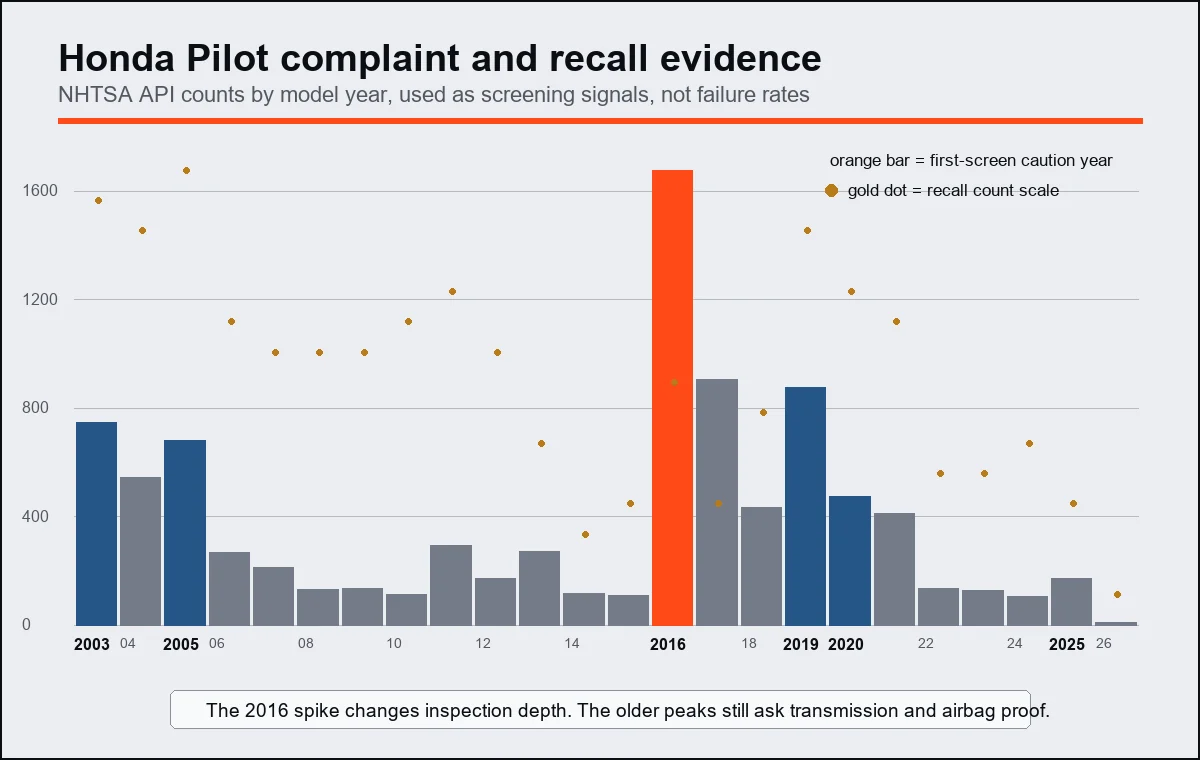
That does not prove every 2016 Pilot will fail. It means a 2016 listing needs a deeper scan and road test than a quieter year, especially if the seller has recently replaced the battery, cleared codes, or cannot explain warning history.
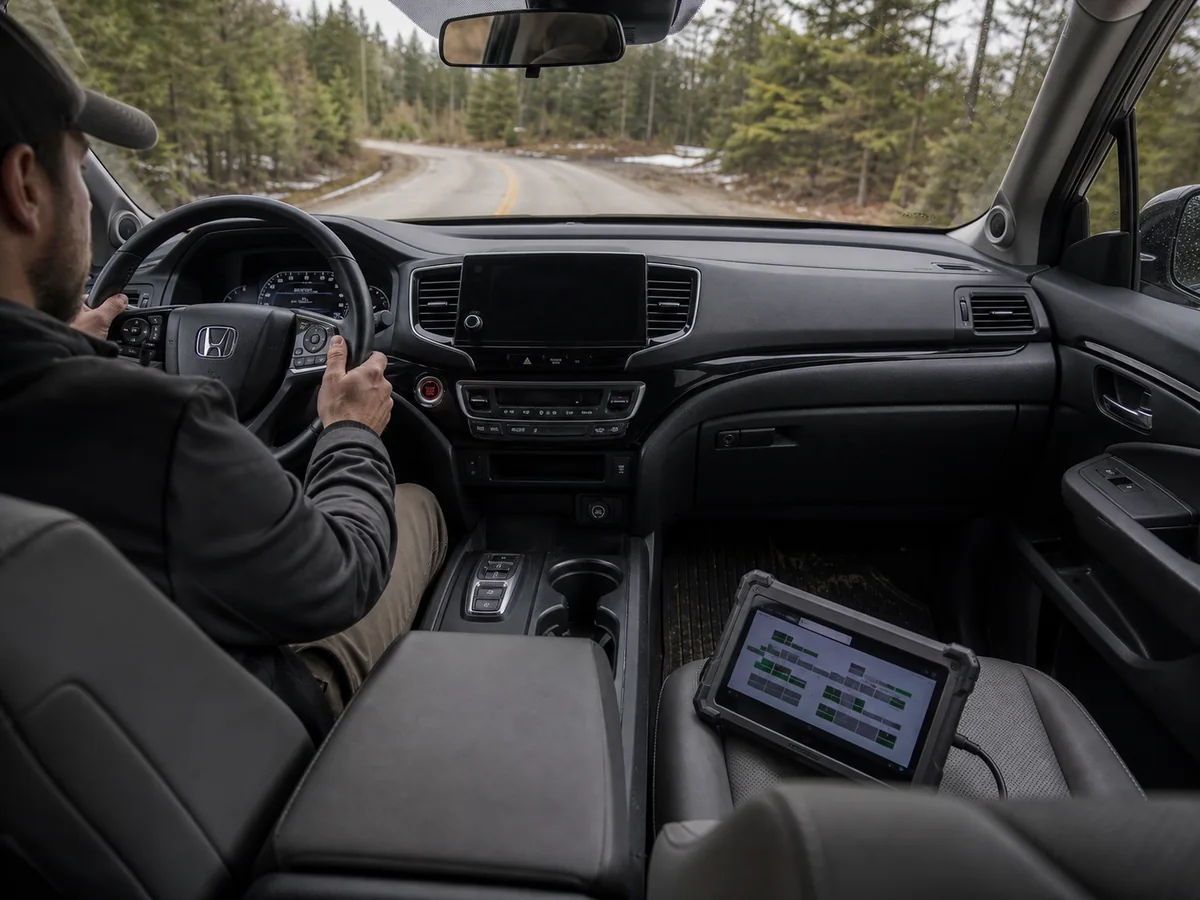
Drive it from cold to fully warm and include stop-and-go traffic, light-throttle suburban speeds, a highway merge, and several parking-speed shifts. A five-minute test drive can miss hesitation, misfire, idle-stop issues, harsh shifts, or warnings that appear only after heat and load.
The scan should include every module, not only the engine computer. Electrical complaints can involve infotainment, warnings, charging behavior, camera or sensor messages, and network faults that a basic code reader may not capture.
Ask whether the vehicle has received software updates, injector or fuel-system work, engine diagnosis, or repeated battery replacement. Those records matter because several symptoms can look like a weak battery during a short test but return when the SUV is hot, loaded, or restarted after a drive.
The transmission check still belongs here, even though 2016 is not the old five-speed story. Confirm smooth engagement from a stop, steady light-throttle shifts, and no repeated hunting between gears after the fluid is warm.
The 2016 can still be a good family SUV when records and current behavior line up. It becomes a poor gamble when the seller asks you to trust Honda's reputation instead of showing diagnosis, repairs, and clean hot-road-test evidence.
2017 to 2020 Pilots need fuel, camera, engine, and rust-region checks
The adjacent third-generation years do not disappear from the risk map after 2016. Current NHTSA data returns 904 complaints for 2017, 433 for 2018, 875 for 2019, and 475 for 2020.
Those years ask more campaign-specific questions. Depending on VIN and year, the proof can include low-pressure fuel pump work, connecting rod bearing exposure, rearview camera and instrument software repairs, hood-latch work, tire recalls, occupant sensor recalls, and rear subframe corrosion checks.
The 2019 and 2020 fuel-system question starts with campaign 21V215, and later campaign 23V858 included certain 2015 to 2020 Pilots in a larger fuel-pump population. A completed recall does not explain a present stall, hesitation, hard start, fuel odor, or stored fuel-system fault.
Campaign 23V751 included certain 2016 and 2018 to 2019 Pilots because a connecting rod bearing may wear and seize. That kind of campaign changes the inspection from a normal drive to a record, oil, noise, scan, and warranty-history review.
Camera and display campaigns matter because a three-row family SUV spends time backing out of driveways, parking lots, and school lanes. NHTSA campaigns 20V439, 20V440, and 23V431 involved rear camera, display, or network faults on certain 2019 to 2022 Pilot populations.
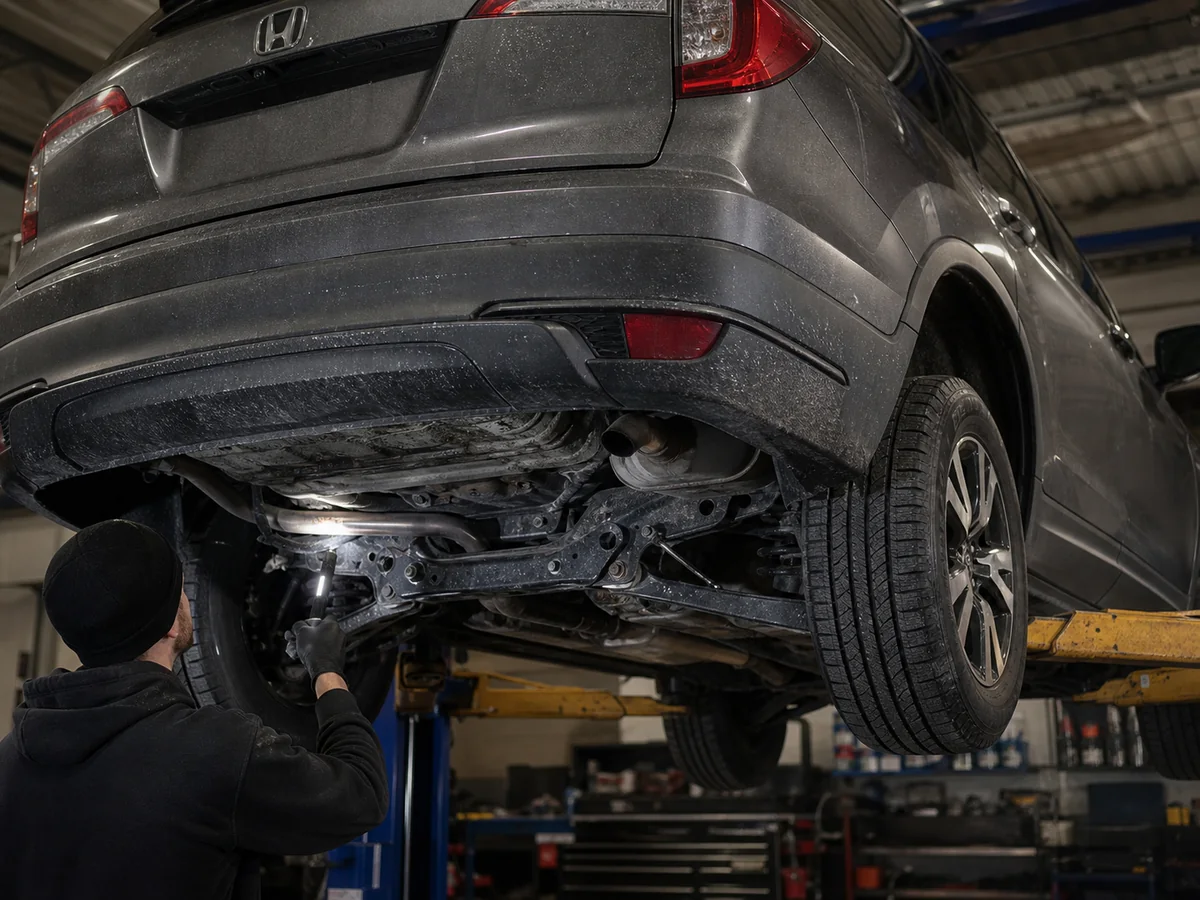
Rust-region proof needs both a VIN and a physical look. Ask whether the Pilot lived in a salt state, then inspect the rear subframe, suspension mounting areas, brake lines, exhaust, fuel lines, and fasteners on a lift.
Buy only when the campaign status, repair orders, scan data, road behavior, and underside condition agree. If the paperwork says repaired but the vehicle still hesitates, loses camera function, shows warning lights, or has structural corrosion, the next step is diagnosis, not negotiation.
New 2023 to 2025 Pilots are recall-proof buys, not proven long-term picks
The fourth-generation Pilot began for 2023, so it has too little age for the same long-term judgment as a 2003 or 2016. That short history does not make it bad, but it does make open campaign status unusually important.
The current recall list includes safety and drivability items a family should not treat as paperwork. NHTSA campaign 23V735 covered certain 2023 to 2024 Pilots for a steering gearbox issue that could result in loss of steering control or steering lock-up.
Campaign 24V900 covered certain 2023 to 2025 Pilots for a fuel filler neck and pipe issue that could allow fuel to leak. Campaign 25V031 covered certain 2023 to 2025 Pilots because fuel-injection ECU software could cause an engine stall or loss of power.
Newer Pilot proof points
- Steering
- VIN status for 23V735 and repair order where applicable
- Fuel system
- Fuel filler and fuel-injection software campaign status
- Seats
- Driver-seat cushion frame campaign status and physical seat movement check
- Third row
- 2025 third-row seat belt routing and function check
- Brake pedal
- Brake pedal pivot-pin campaign status and pedal feel check
Campaign 25V056 covered certain 2025 Pilots because the third-row passenger seat belt assembly may not function due to incorrect routing. That is a real family-use issue, not a minor document mismatch.
The 2025 complaint mix also shows why a new vehicle still needs a real drive. NHTSA grouping currently includes forward collision avoidance, steering, service brake, electrical, powertrain, and engine reports, which are exactly the systems a family uses every day.
The newer Pilot also appears in brake-pedal and seat-frame recall populations. Verify the VIN on the day you are ready to buy because a listing screenshot or old dealer printout can be stale.
Physically test the third row before treating the cabin as ready for children or adults. Buckle every position, tug the belts, fold and raise the seats, and confirm the driver seat does not shift under braking or during entry.
Do not reject a 2023 to 2025 Pilot just because it appears in a recall search. Reject it when the seller cannot prove the required remedy, refuses a full function check, or asks you to take delivery before a safety issue is resolved.
Better Honda Pilot years still need the right use history
Better starting points include carefully documented 2014 to 2015 examples, well-kept 2021 to 2022 examples after recall review, and 2023 or newer Pilots only when current campaigns are closed or scheduled before delivery. These are starting points for inspection, not guaranteed winners.
The complaint counts support that screening logic. Current NHTSA data returns 116 complaints for 2014, 108 for 2015, 412 for 2021, 134 for 2022, 128 for 2023, and 106 for 2024.
A 2014 or 2015 Pilot is old enough that condition still decides the buy. Transmission service, timing belt history, oil leaks, suspension wear, corrosion, tire match, brakes, and accident repairs can outweigh a calmer complaint count.
A 2021 or 2022 Pilot may be a good middle ground when records are complete and campaigns are handled. It still needs fuel-pump, camera, occupant-sensor, and rear subframe review where the VIN and region call for it.
The Pilot is a large gas three-row SUV, so use history matters. Towing, mountain trips, heavy family loads, stop-and-go school duty, and poor tire maintenance can create a different risk profile than the model year suggests.
Start with the calmer years, then let the exact SUV pass or fail on records and inspection. A better year with bad tires, rusty mounting points, active warnings, or no service file should not beat a riskier year with complete proof.
Buy the exact Pilot only when the evidence lines up
A risky-year Pilot can move forward when the documents and current behavior agree. That means live VIN recall status, repair orders naming the work, clean scan data before and after the drive, stable cold-to-hot transmission behavior, and a physical inspection that checks the system the year warned you about.
Ask for records before the test drive. A serious seller can usually show service dates, mileage, repair orders, campaign completion, tire history, and the shop or dealer that performed the work.
Paperwork alone is not enough when the Pilot disagrees. A fuel-pump recall closure does not explain a present stall, and an airbag recall completion does not explain an active airbag warning light.
The reverse is also true. A 2005 or 2016 Pilot with complete records, clean scans, matched tires, closed campaigns, normal transmission behavior, and no structural corrosion can be better than a calmer year with missing history.
Buy the exact Pilot only when the VIN, records, scan, road test, underside, tires, restraint checks, and family-use rehearsal all point in the same direction.