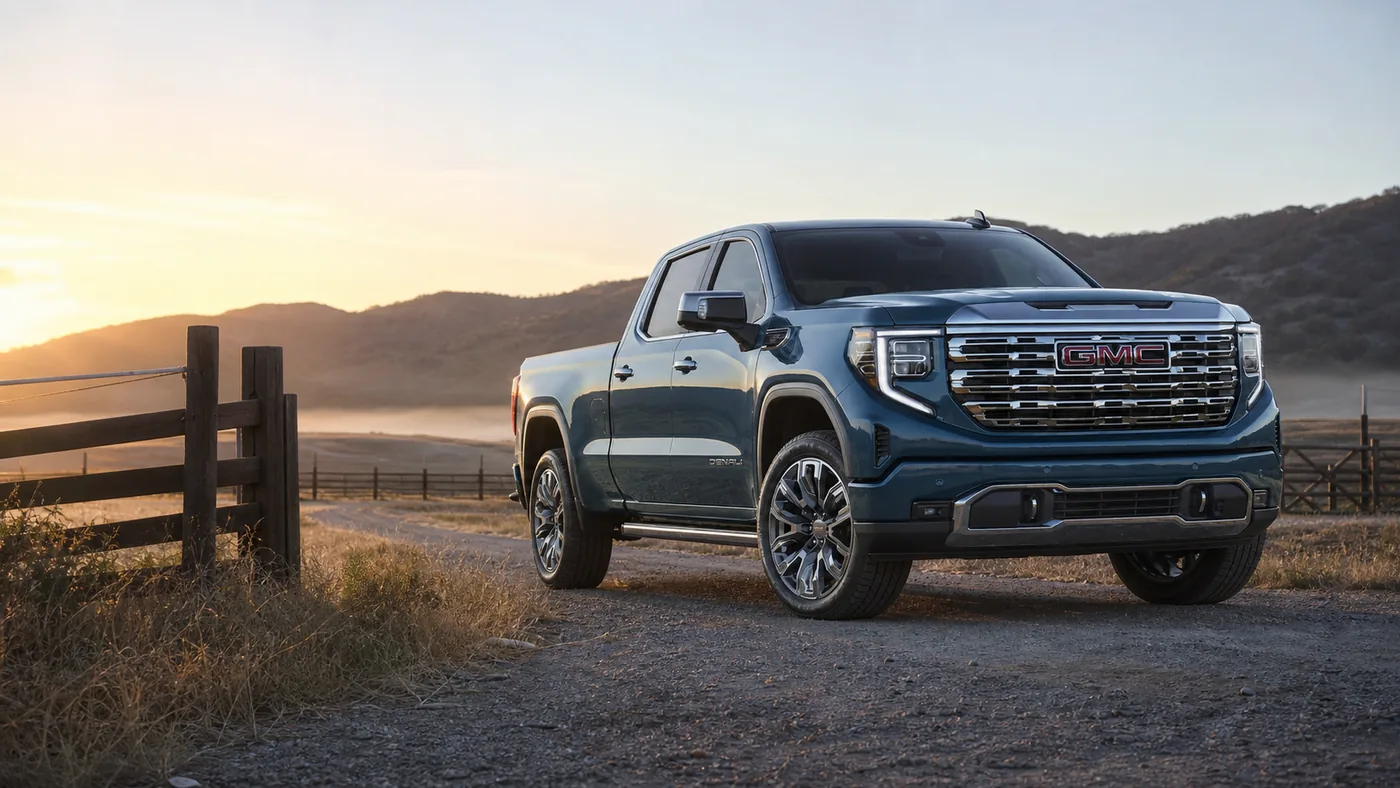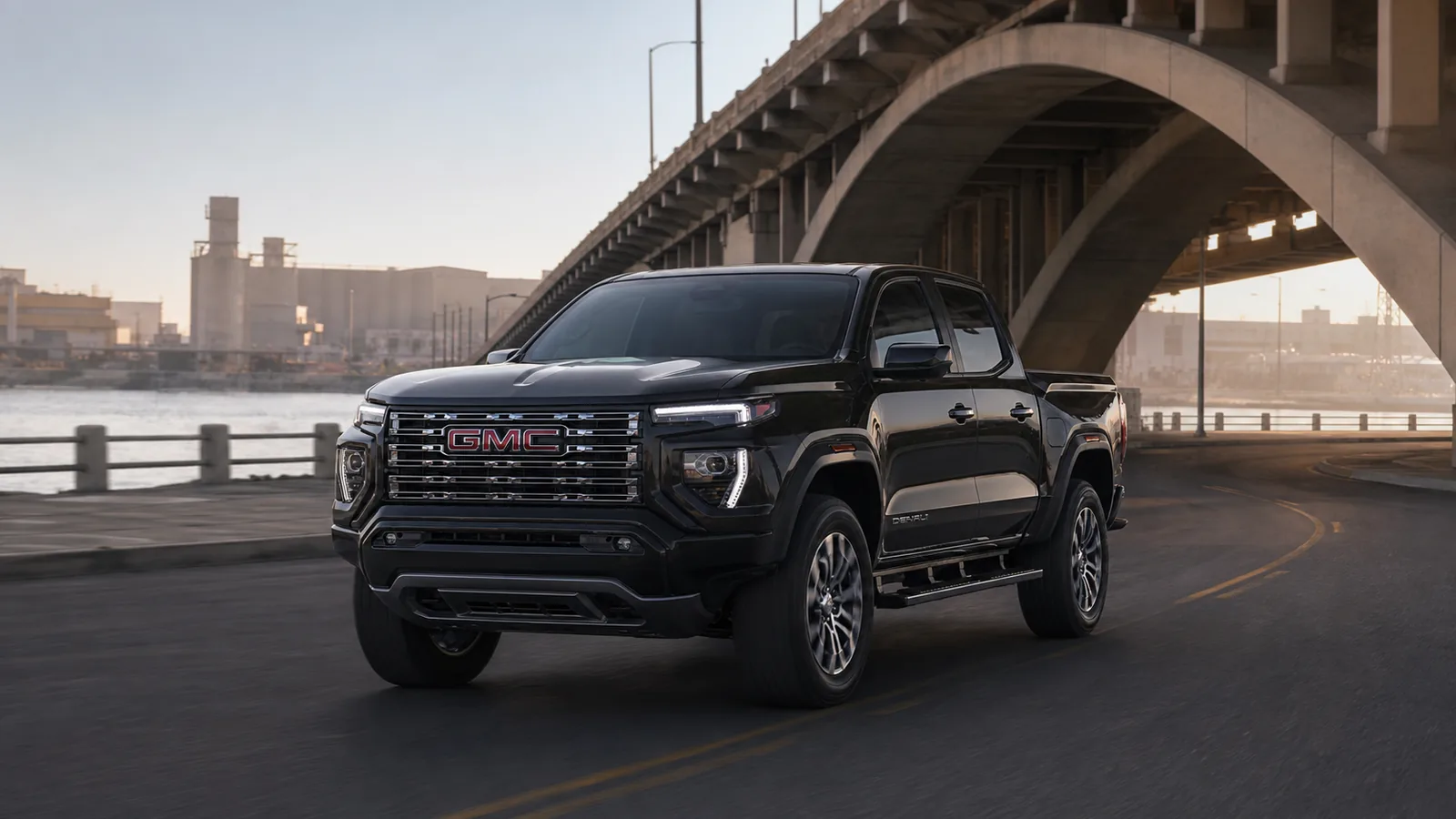
Is the 2026 GMC Canyon worth more than a Chevrolet Colorado?
The 2026 GMC Canyon is worth its higher price when you want a midsize pickup with useful trailering equipment, a taller standard stance, and a richer cabin without building those features through several option packages. The value case weakens when the engine, tow rating, and basic truck hardware matter more than the GMC finish.
GMC lists a $38,900 starting MSRP before destination for the Canyon Elevation. Chevrolet lists the related Colorado from $32,400 before destination.
That $6,500 gap is substantial because both trucks use the same 2.7-liter TurboMax four-cylinder, eight-speed automatic, and rear-drive or four-wheel-drive architecture.
| Factor | 2026 GMC Canyon | 2026 Chevrolet Colorado | What the difference changes |
|---|---|---|---|
| Starting MSRP | $38,900 before destination | $32,400 before destination | Colorado leaves $6,500 for options, fuel, or accessories |
| Engine output | 310 hp and 430 lb-ft | 310 hp and 430 lb-ft | Neither truck buys more output at the entry point |
| Maximum towing | Up to 7,700 lb | Up to 7,700 lb | The exact configuration and payload label decide the usable limit |
| Basic chassis choice | Crew cab, short bed, standard 2-inch lift | Crew cab, short bed, broader work and off-road trim range | Canyon starts taller and more specialized |
| Standard presentation | 18-inch all-terrain tires, trailering tools, 11.3-inch center screen | Lower-cost WT entry with the same screen size and engine | GMC spends the base price on stance and equipment rather than extra power |
The Canyon starts with an 11.3-inch center touchscreen, an 11.0-inch digital driver display, Hitch View, GMC's trailering software, 18-inch all-terrain tires, and a two-inch factory lift with a wider track. Those items can be useful if you tow, drive rutted roads, or want a truck that feels finished before options are added.
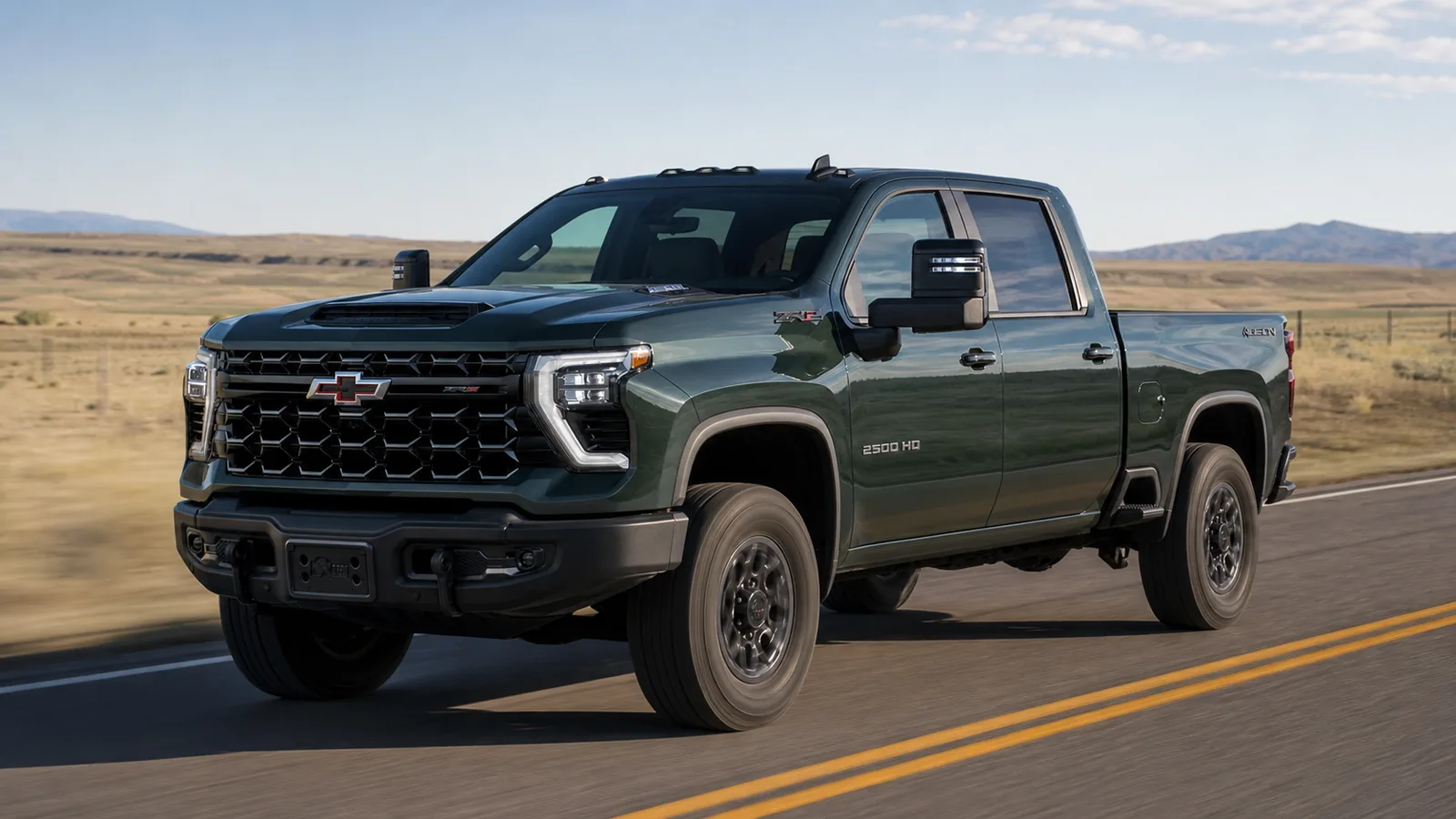
The Colorado reaches much lower because its WT trim is designed as a simpler work entry. It can still be configured with the same engine output and 7,700-pound maximum tow rating.
A buyer who expects vinyl, cloth, or basic cabin materials to get dirty may prefer that lower starting point.
The Canyon's bodywork, grille, interior colors, trim materials, and standard equipment create a distinct truck even though the two share their foundation.
None of those changes increases the engine output. None raises the maximum towing number beyond 7,700 pounds.
That makes the deciding question concrete. Will the lift, trailering interface, all-terrain tires, cabin finish, and GMC design improve something you do every week?
Choose the Canyon when those features replace options you would add anyway.
Choose the Colorado when the shared truck hardware is the reason you are buying.
Which 2026 GMC Canyon trim gives you the most for the money?
The Canyon AT4 is the strongest all-around trim for many buyers. It keeps the 7,700-pound maximum tow rating, carries more published payload than Denali or AT4X, and adds four-wheel-drive hardware that matters on snow, dirt access roads, boat ramps, and uneven campsites.
Elevation is the rational price choice. It is the only Canyon offered with rear-wheel drive, which keeps the entry price and curb weight lower.
Four-wheel drive remains available, and the truck still carries the TurboMax engine, two-inch lift, wide track, large screens, Hitch View, and trailering software.
AT4 makes four-wheel drive standard and adds a two-speed transfer case, hill-descent control, an automatic locking rear differential, a transfer-case shield, all-terrain tires, and drive modes for Terrain, Off-Road, Normal, and Tow/Haul. The hardware suits a buyer who reaches low-traction ground but does not need rock-crawling equipment.
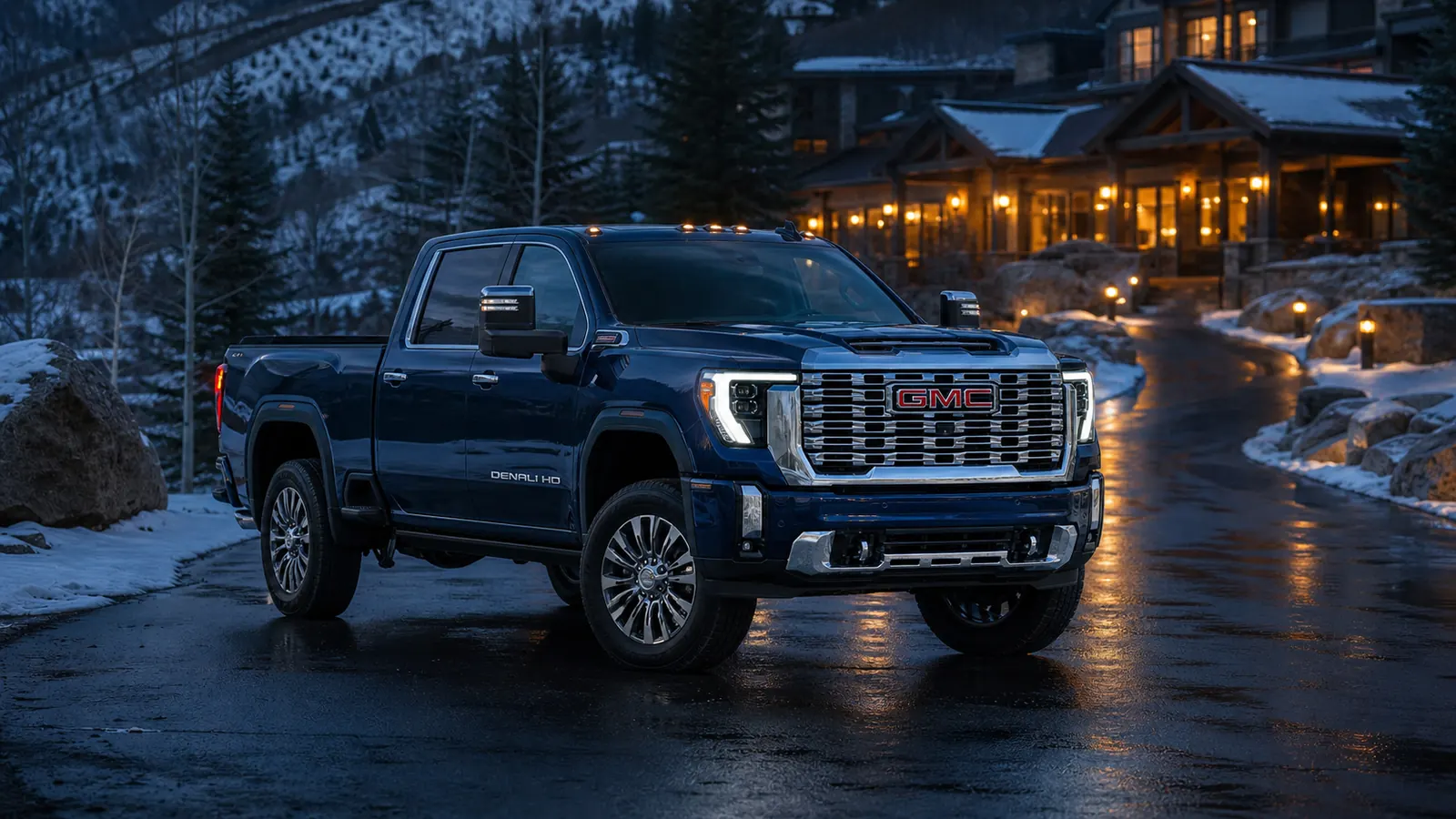
Denali uses its price on the cabin. It adds perforated leather-appointed seating, open-pore wood trim, a 6.3-inch head-up display, Bose audio, HD Surround Vision, chrome assist steps, and 20-inch wheels.
It still tows up to 7,700 pounds, but its published maximum payload is lower than Elevation or AT4 because luxury equipment adds weight.
AT4X changes the chassis.
Multimatic DSSV dampers, front and rear electronic locking differentials, a three-inch lift, rocker protection, underbody cameras, and Baja mode improve control on difficult terrain. They also reduce maximum towing to 6,000 pounds and maximum published payload to 1,260 pounds.
The option sheet can blur these boundaries. An Elevation loaded with convenience and camera packages may approach AT4 money.
An AT4 with premium seating can overlap Denali comfort. Compare two actual window stickers and payload labels rather than assuming the trim name tells the whole story.
AT4 is the best starting point for a four-wheel-drive Canyon because it preserves truck utility while adding hardware that works beyond the showroom. Elevation is the value answer, Denali is the comfort answer, and AT4X is a specialized terrain answer.
The TurboMax engine is strong, but Canyon MPG changes sharply by trim
Every 2026 Canyon uses the same 2.7-liter TurboMax gasoline engine. It produces 310 hp at 5,600 rpm and 430 lb-ft of torque at 3,000 rpm, then sends that output through an eight-speed automatic and a 3.42 axle ratio.
The torque figure matters more than the cylinder count suggests. It arrives low enough to move the 4,410 to 4,960-pound truck without waiting for high engine speed, and it supports the lineup's 7,700-pound maximum tow rating.
Tow/Haul mode changes shift points and uses grade braking to help control speed on descents.
There is no V6, diesel, or hybrid choice.
That keeps the order sheet simple, but it removes an escape for buyers who want the smooth sound of a six-cylinder, the highway efficiency of a diesel, or a hybrid's lower-speed fuel savings. A Ford Ranger, Toyota Tacoma, or full-size truck provides a wider powertrain conversation.
Official fuel estimates show how much the chassis and tire package affect one engine. A rear-wheel-drive Elevation is rated at 19 mpg city, 23 highway, and 20 combined.
Elevation 4WD, AT4, and Denali are rated at 17 city, 22 highway, and 19 combined.
AT4X falls to 17 mpg in both city and highway testing.
The AEV package with 35-inch mud-terrain tires reaches 16 mpg combined. Extra ride height exposes more air underneath, while aggressive tires add rolling resistance and rotating mass.
A 3 mpg combined difference becomes 158 gallons over 10,000 miles when comparing 20 mpg with 17 mpg.
At $3.50 per gallon, that is about $553 each year before the cost of larger replacement tires is considered. The AEV truck uses another 37 gallons over the same distance at 16 mpg.
The engine is not the Canyon's weak point for ordinary work. Its limit is choice.
Buy the trim whose tires, lift, and drivetrain match your use because those parts decide fuel cost after every Canyon leaves the factory with the same output.
How much can a GMC Canyon tow once payload is included?
A Canyon can tow up to 7,700 pounds, but the lineup maximum is only the beginning of the calculation. People, cargo, accessories, hitch hardware, and trailer tongue weight all consume payload on the exact truck.
GMC publishes different maximum payload figures for each trim. Elevation 2WD reaches 1,670 pounds, Elevation 4WD reaches 1,610 pounds, AT4 reaches 1,570 pounds, Denali reaches 1,390 pounds, and AT4X reaches 1,260 pounds.
The label on a truck with options may show less.
| Trim | Maximum towing | Maximum payload | What to check |
|---|---|---|---|
| Elevation 2WD | 7,700 lb | 1,670 lb | Best published margin, but rear drive may not suit every ramp or winter route |
| Elevation 4WD | 7,700 lb | 1,610 lb | Strong towing and payload balance with added traction |
| AT4 | 7,700 lb | 1,570 lb | Keeps the full tow rating with low-range four-wheel drive |
| Denali | 7,700 lb | 1,390 lb | Luxury equipment leaves less room for people and tongue weight |
| AT4X | 6,000 lb | 1,260 lb | Off-road suspension and protection trade away truck utility |
GMC recommends tongue weight around 10 to 15 percent of loaded trailer weight. A 6,000-pound travel trailer could put 600 to 900 pounds on the hitch before a weight-distribution system, passengers, coolers, tools, and bed cargo are added.
Consider a Denali carrying 750 pounds of actual tongue weight. Two adults and two children may add 550 pounds, while a 70-pound hitch and 100 pounds of cargo bring the total to 1,470 pounds.
That exceeds the published 1,390-pound maximum before a lower door-label figure or dealer accessories enter the math.
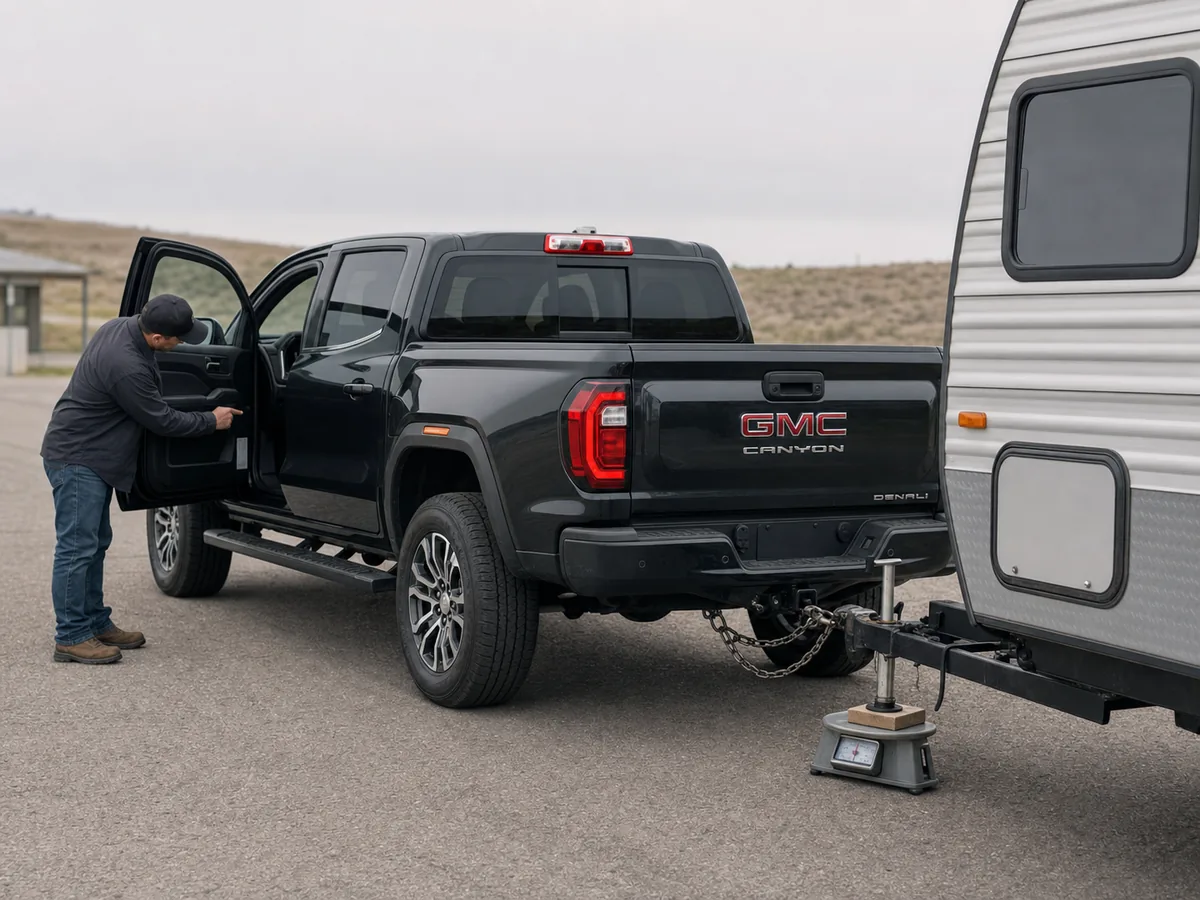
The calculation should follow the actual combination.
- Read the Tire and Loading Information label on the driver door
- Add occupants, cargo, bed cover, steps, recovery gear, and hitch hardware
- Measure loaded trailer weight and tongue weight rather than using the empty brochure figure
- Confirm the receiver, hitch ball, tires, axles, and trailer brakes have suitable ratings
- Weigh the occupied truck and loaded trailer by axle when the combination is close to a limit
AT4X AEV reduces maximum towing again to 5,500 pounds. Its bed-mounted spare, 35-inch tires, steel bumpers, skid plates, and lift improve clearance but add weight and change the combination it can safely carry.
Choose the Canyon trim from occupied payload first, then confirm the trailer weight. Engine torque cannot restore capacity that passengers, tongue weight, or options already consumed.
Can the crew cab and short bed handle daily family use?
The current Canyon has one body arrangement, a crew cab with a short bed. That simplifies shopping, but it also means there is no extended cab, long bed, or smaller work body for buyers who want to trade passenger space for cargo length.
Front-seat room is generous at 45.2 inches of legroom and 40.3 inches of headroom.
Rear legroom measures 34.7 inches. Adults can fit, but a tall driver, rear-facing child seat, or bulky winter clothing can expose the difference between a midsize crew cab and a full-size Sierra 1500.
Bring the child seat and the tallest regular passenger to the test drive. Install the seat behind the person who normally sits in front of it, then check knee room, foot space, head clearance, door opening, and whether the front seat still reaches a comfortable driving position.
The bed floor is 61.7 inches long and volume is 41.9 cubic feet. It handles coolers, tools, mulch, camping bins, bicycles with a wheel removed, and many home-project loads.
Sheet goods, long motorcycles, and construction material need the tailgate position, support, and tie-down plan checked before purchase.
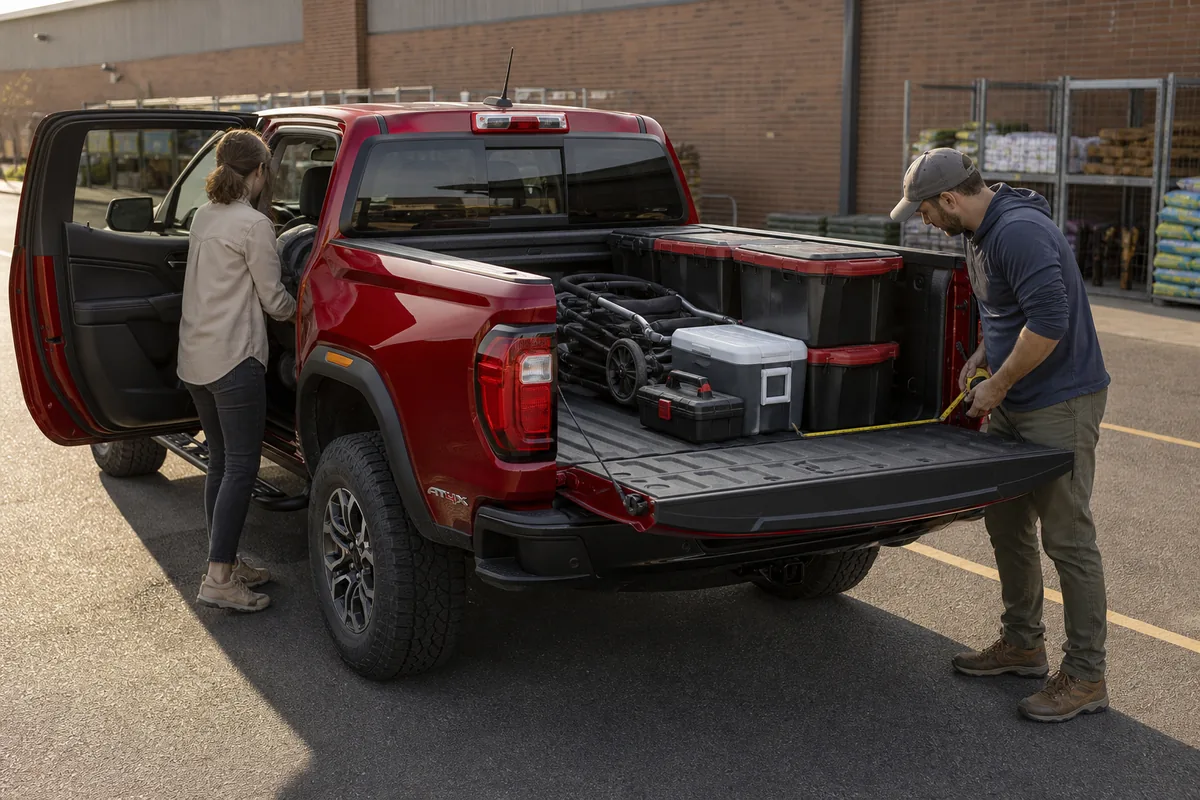
GMC's MultiStow tailgate adds a lockable, drainable compartment for straps, small tools, wet gear, or recovery equipment. It organizes items that would otherwise roll around the cab, but the compartment does not increase payload or make the bed longer.
At about 213.2 inches long on a 131.4-inch wheelbase, the Canyon is easier to place than many full-size crew-cab pickups. Its 72.4-inch width with mirrors folded still demands a real garage and parking test, while the standard lift creates a taller step for children or passengers with limited mobility.
The ride also depends on trim and load.
A body-on-frame pickup can move more sharply over broken pavement when the bed is empty. AT4X dampers can control difficult terrain well, yet its tires and height do not turn the rear seat into a crossover cabin.
Test daily usefulness with the truck loaded as it will be used.
- Park inside the home garage and close the door
- Turn into the narrowest regular parking space or driveway
- Load the stroller, toolbox, dog crate, bicycle, or mobility device
- Reach over the bed side and climb into the cab without using a showroom step
- Check rear visibility with the normal passengers and cargo aboard
The Canyon works as a family truck when four people fit comfortably and the recurring load fits a 61.7-inch bed. Choose a Ridgeline for easier cabin use or a full-size pickup when rear room, bed choice, or cab choice matters more than midsize width.
What does AT4X add, and what capability does it trade away?
AT4X is built for slow, difficult terrain where wheel placement, traction, damping, and protection matter. Its hardware can be useful on rocky access roads, washed-out grades, deep ruts, and trails where an open differential or lower truck would stop progress.
Multimatic DSSV dampers control wheel and body movement through spool valves rather than a simple comfort tune.
Selectable front and rear electronic locking differentials can make both wheels on an axle turn together when one tire loses grip. Rocker protectors and underbody cameras help the driver protect vulnerable areas.
The standard AT4X has a three-inch factory lift and 10.7 inches of ground clearance.
GMC lists a 37.1-degree approach angle, 24.7-degree breakover angle, and 25.1-degree departure angle. Those measurements describe how steep an obstacle the body can meet, cross, and leave before contact.
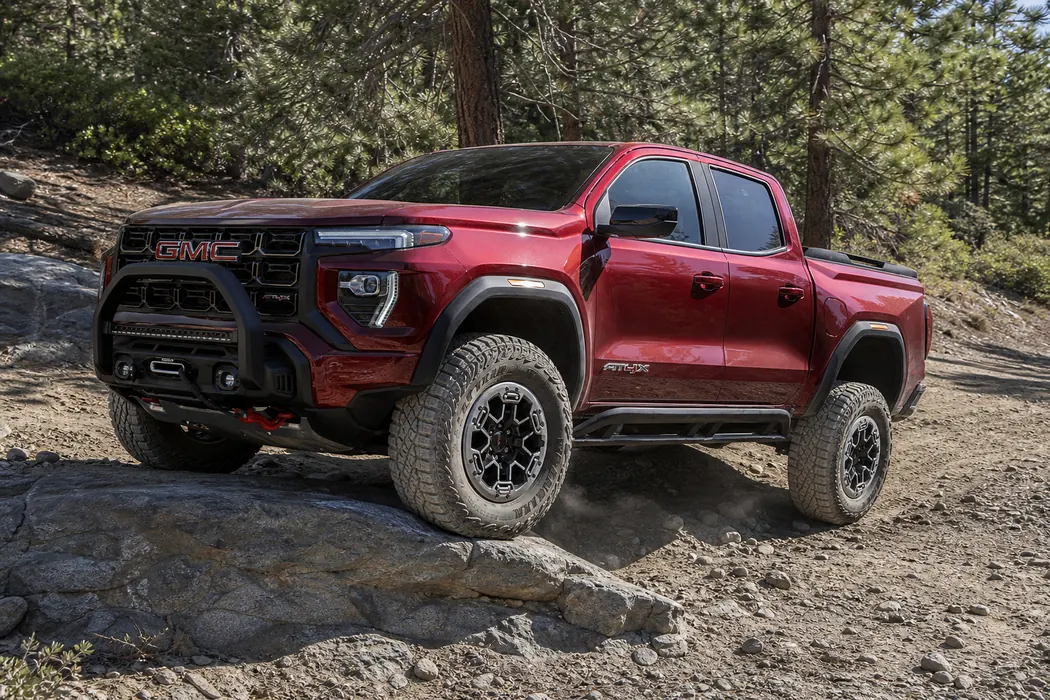
The AEV package takes the idea farther. It adds five hot-stamped boron-steel skid plates, stamped-steel bumpers, 35-inch mud-terrain tires, a bed-mounted vertical spare, winch capability, and a 4.5-inch lift.
Ground clearance reaches 12.2 inches.
Pros
- Front and rear lockers improve traction when a wheel unloads
- DSSV dampers control repeated impacts and body movement
- Underbody cameras help place tires and avoid contact
- Skid plates and rocker protection reduce exposure on rocky trails
Cons
- AT4X maximum towing falls to 6,000 pounds
- Published payload falls to 1,260 pounds before options
- AT4X fuel economy falls to 17 mpg combined
- AEV tires, spare, armor, and lift raise price and reduce towing to 5,500 pounds
The package does not turn the Canyon into a high-speed desert truck. A Ford Ranger Raptor uses a 405-hp twin-turbo V6 and a different performance emphasis.
AT4X uses the same 310-hp engine as every other Canyon and directs its extra cost toward low-speed control and a richer cabin.
Large tires also change ordinary ownership. They cost more to replace, add noise and rolling resistance, and may be harder to find during travel.
The bed-mounted AEV spare consumes cargo space, while the taller body increases step-in height.
A maintained forest road, gravel driveway, or campground rarely demands two lockers and DSSV dampers. AT4 already provides low-range four-wheel drive, an automatic locking rear differential, hill-descent control, and the full 7,700-pound tow rating.
Buy AT4X when difficult terrain repeats often enough to use the lockers, clearance, dampers, and protection. Buy AT4 when access matters but the truck still needs its full towing and payload potential.
The Canyon protects occupants well, but its automatic braking result needs context
The Canyon has strong crashworthiness results and a weaker result for one crash-avoidance test. Those findings measure different things, so compressing them into one safety label would hide the useful part of the evidence.
IIHS rates the driver-side and passenger-side small-overlap tests Good for 2023 through 2026 Canyon crew-cab models. The updated side test is also Good for 2025 and 2026, while the LED projector headlights receive an Acceptable rating.
The standard vehicle-to-vehicle front crash-prevention system receives a Poor rating in the newer IIHS 2.0 evaluation for 2025 and 2026. It avoided some lower-speed collisions and reduced speed in others, but performance was not consistent across the passenger-car, motorcycle, and higher-speed conditions in the test.
Pedestrian front crash prevention is rated Acceptable.
Standard driver aids include automatic emergency braking, front pedestrian and bicyclist braking, lane-keeping assistance, and forward-collision alert. Available blind-zone steering assistance, rear cross-traffic braking, rear pedestrian alert, and surround-view cameras depend on trim or package.
Driver assistance cannot judge payload, see through mud on a camera, or replace a shoulder check and safe following distance. Test every warning and camera on the actual truck, then read the settings because a disabled or poorly understood feature offers no useful protection.
Two current recalls need narrow wording and a VIN check.
The airbag campaign is important for an AT4X AEV buyer, but it does not cover every Canyon. The manual campaign may sound minor, yet the correct manual contains tire, towing, safety, and maintenance instructions that must match the truck.
Ask the dealer to print the VIN recall result before delivery. Confirm that any over-the-air software remedy shows complete, keep the repair record, and check again after ownership because new campaigns can appear later.
Treat the Canyon as a truck with good tested occupant protection and a driver-assistance system that still needs active supervision. A clean VIN result and working cameras do not remove the driver's responsibility.
What should you budget for Canyon reliability and ownership?
The redesigned Canyon has been on sale since the 2023 model year, so the current truck does not yet have a decade of same-design evidence. A careful buyer should use current recalls, service records, warning history, and a complete function test instead of transferring every problem from the 2015 to 2022 generation.
That distinction matters because the earlier truck offered different engines, electronics, and transmission calibrations. A complaint about an older V6 or diesel does not prove that the 2026 TurboMax will develop the same fault.
Current evidence should stay attached to the current design.
For a new truck, verify build date, software updates, recall completion, warranty start date, and any dealer-installed accessories. For a used 2023 to 2026 truck, require a cold start, scan of every control module, warm transmission drive, four-wheel-drive test, camera test, service history, and inspection underneath.
Fuel creates the clearest recurring difference among trims. The 21.4-gallon tank and combined estimates from 16 to 20 mpg mean the same 12,000 annual miles can use roughly 600 gallons in an Elevation 2WD or 750 gallons in an AT4X AEV.
At $3.50 per gallon, that spread is about $525 each year.
Canyon ownership checks
- Powertrain coverage
- GMC states a 5-year or 60,000-mile transferable limited powertrain warranty for 2016 and newer vehicles
- Fuel tank
- Approximately 21.4 gallons
- Combined fuel range
- 16 to 20 mpg depending on drivetrain and off-road equipment
- High-cost trim hardware
- DSSV dampers, lockers, cameras, 20-inch or 35-inch tires, head-up display, and premium audio
- Recall check
- Search the individual VIN at NHTSA before purchase and after new campaigns appear
Tires deserve their own line in the budget. Elevation and AT4 use sizes that are easier to source than the AEV package's 35-inch mud-terrain tires.
Denali's 20-inch wheels can raise tire price and reduce sidewall compared with a smaller wheel, while trail damage can turn one replacement into an urgent purchase.
AT4X adds dampers, locking differentials, underbody cameras, rocker protection, and more complex drive modes.
Denali adds a head-up display, surround-view cameras, Bose audio, powered seating, premium trim, and larger wheels. These features can improve every drive, but each is another item to diagnose or replace after warranty.
Depreciation also acts on dollars, not percentages alone.
A heavily optioned truck can lose more cash than a simpler Elevation even if both retain a similar share of their original price. Insurance and registration may also follow the higher transaction value.
Do not treat the standard powertrain warranty as protection for tires, impact damage, neglected service, or every electronic feature. Read the current warranty booklet and confirm the in-service date on the exact truck.
The safest Canyon ownership plan starts with the simplest trim that performs the repeated job. Pay for AT4X or Denali hardware when its daily benefit is worth both the purchase price and the later replacement exposure.
Who should buy a GMC Canyon, and who should choose another truck?
Buy a Canyon if you want a midsize pickup with strong low-speed torque, up to 7,700 pounds of towing, a standard lifted stance, useful trailering technology, and a cabin that feels richer than a basic work truck. The best buyer uses those advantages often enough to justify the premium over a Chevrolet Colorado.
AT4 is the balanced configuration for a buyer who drives on pavement every day, reaches low-traction ground regularly, and still needs the full lineup tow rating.
Denali fits the buyer who values seats, cameras, a head-up display, audio, and cabin materials across frequent long drives. AT4X fits recurring technical terrain where two lockers and DSSV dampers solve a real access problem.
Choose the Colorado when price matters more than GMC design and standard equipment. It offers the same engine output and maximum towing from a lower entry point, then lets the buyer add only the equipment the job requires.
A Honda Ridgeline is easier to treat like a family vehicle. Its independent rear suspension, wider-use cabin, dual-action tailgate, and in-bed trunk trade some traditional truck capability for everyday convenience, while towing stops at 5,000 pounds.
A Ford Ranger provides a conventional midsize alternative and a 405-hp Raptor for buyers who want high-speed off-road performance.
A Toyota Tacoma adds hybrid availability and several cab or off-road personalities. Both deserve a drive when the Canyon's one-engine lineup feels too narrow.
Move to a GMC Sierra 1500 when you need more rear-seat room, multiple bed lengths, more engine choices, or payload that the occupied Canyon cannot provide. Accept the extra width, length, fuel use, and parking burden before making that move.
The wrong Canyon is easy to identify. Its payload label cannot carry the family and trailer, its rear seat does not fit the child seat, its short bed cannot secure the recurring load, or its expensive trim hardware spends most of the year unused.
Buy the least expensive Canyon that fits the people, payload, trailer, terrain, and parking space you actually have. A premium midsize truck makes sense when its premium features work, not when the badge is the only difference you notice.