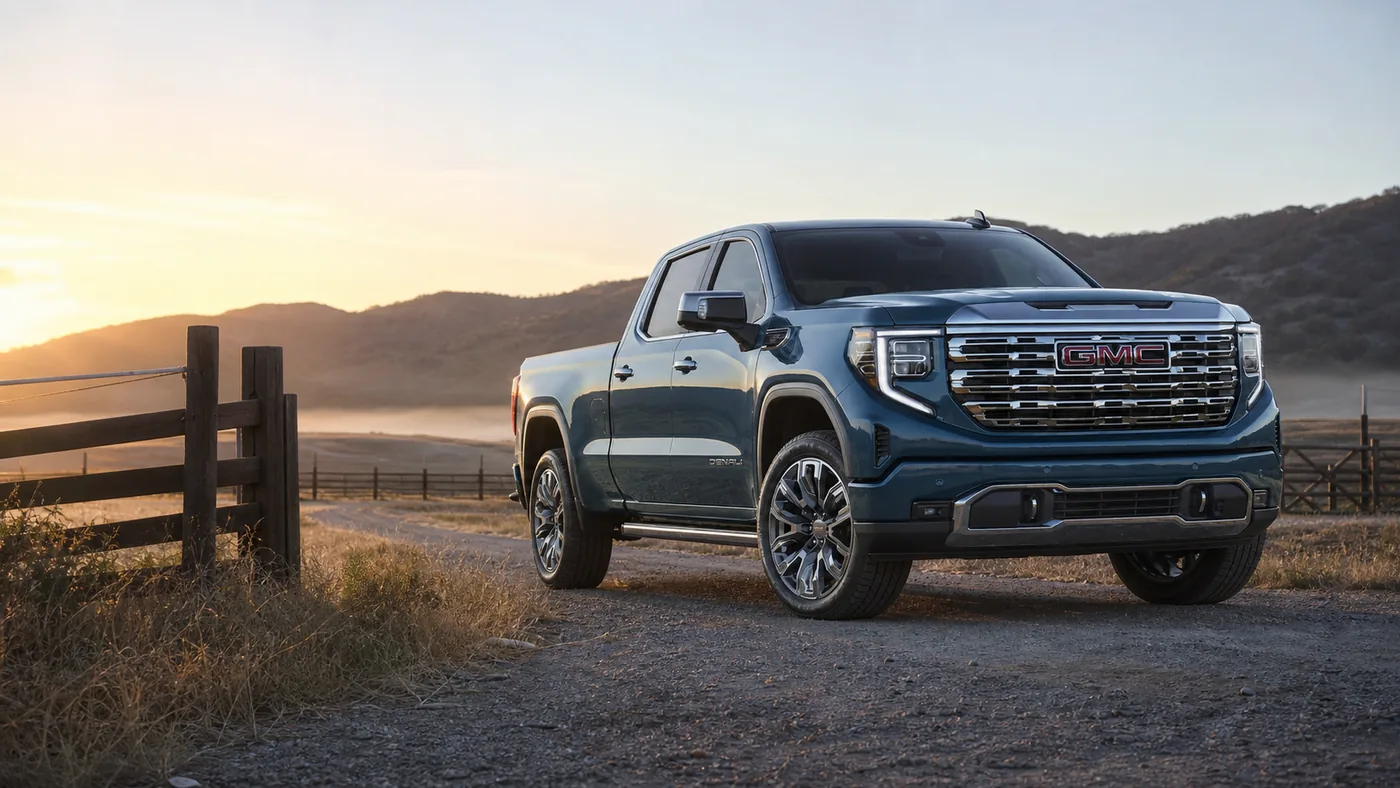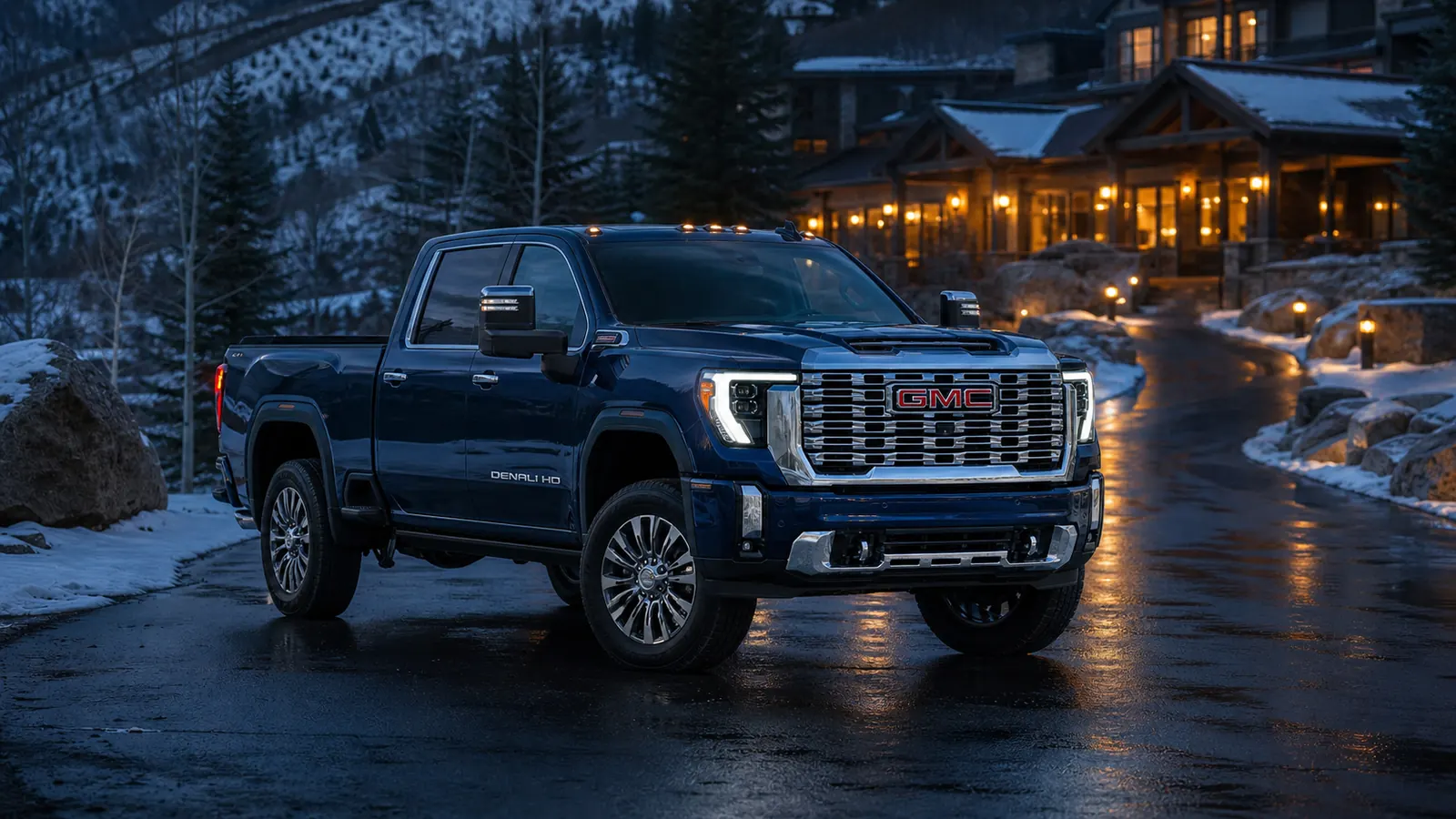
GMC Sierra HD explained: choose 2500 or 3500 before the trim
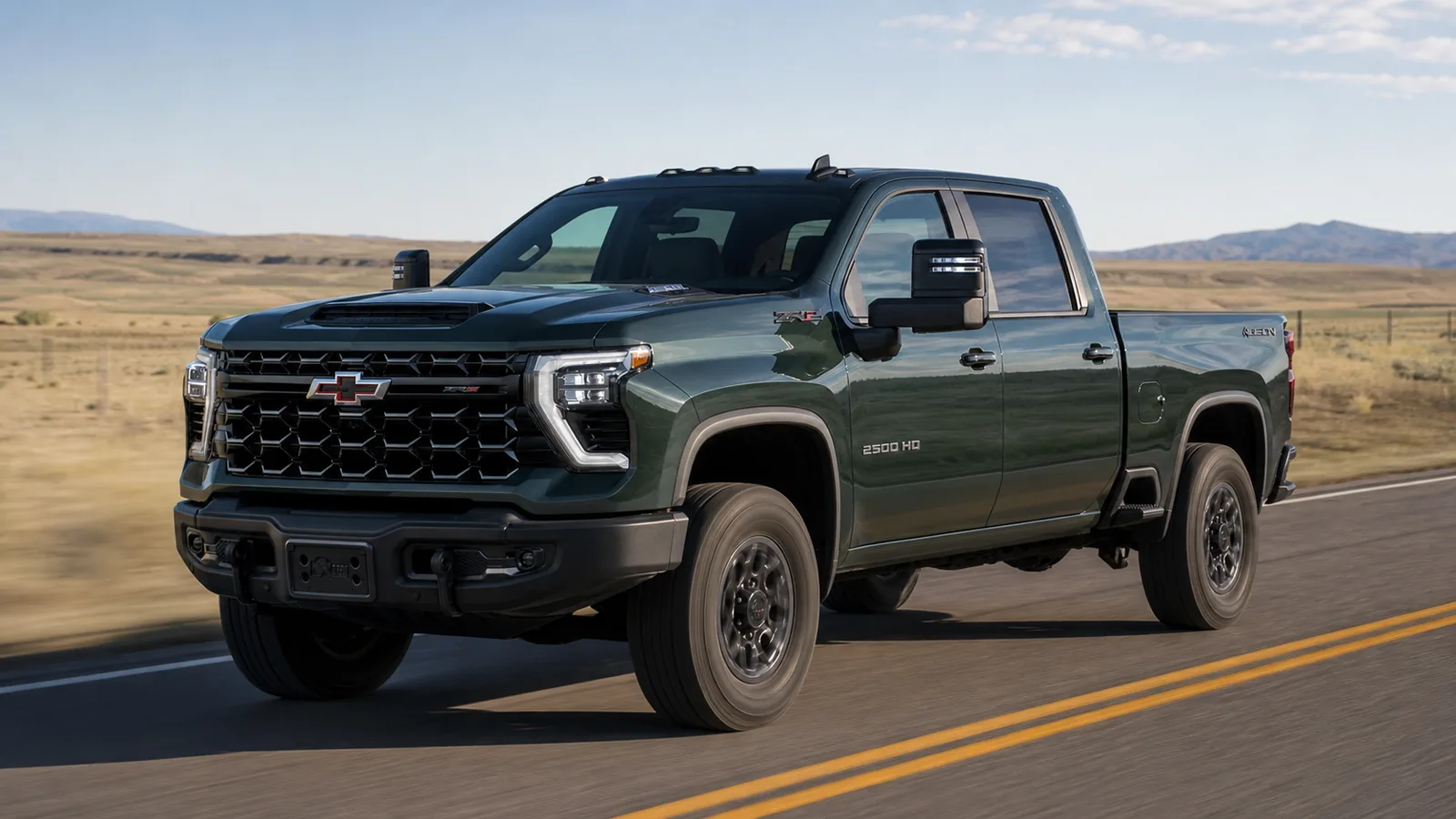
The 2026 GMC Sierra HD is the heavy-duty member of the Sierra family, sold as a three-quarter-ton 2500 HD and a one-ton 3500 HD. It exists for trailers and cargo that push beyond the ratings of a Sierra 1500, while GMC adds comfort and trailering technology above the basic work-truck formula.
Choose the series from weight before comparing upholstery, screens, or wheel designs. The 2500 HD is the sensible starting point for many equipment trailers, horse trailers, large travel trailers, and work bodies because GMC publishes maximum towing of 22,390 pounds and maximum payload of 4,049 pounds for specific configurations.
The 3500 HD is the next step when pin weight, a service body, or recurring bed cargo crowds the 2500. Its lineup maximum reaches 36,000 pounds of towing and 7,290 pounds of payload, with dual rear wheels available when the rear axle and tires need more capacity.
Every maximum belongs to one cab, bed, drivetrain, engine, axle, wheel, and hitch combination. A crew-cab Denali 4WD with the diesel and accessories carries less payload than a lighter work configuration, even though both trucks wear the same 2500 or 3500 badge.
Payload includes more than material in the bed. Add the driver, passengers, personal gear, toolbox, bed cover, auxiliary tank, hitch hardware, and the trailer's actual tongue or pin weight.
A family of four can use 650 pounds before luggage. Add a 200-pound fifth-wheel hitch, 250 pounds of bed gear, and 2,500 pounds of pin weight, and the truck carries 3,600 pounds before dealer accessories are counted.
That arithmetic can fit one 2500 HD label and exceed another.
Check these limits on the exact truck rather than a model summary.
- Tire and Loading Information label for available payload
- Certification label for gross vehicle and axle ratings
- GMC trailering chart for the exact cab, bed, engine, drivetrain, and hitch
- Hitch and tire ratings for the installed equipment
- Loaded axle weights from a certified scale after purchase
A 3500 HD with single rear wheels often adds useful capacity without the width of a dually. Dual rear wheels make sense for the heaviest fifth-wheel, gooseneck, commercial, or slide-in loads, but they add rear width, tire cost, and parking difficulty.
Select 2500 or 3500 from the occupied truck and loaded trailer, then shop for the trim. Leather cannot restore payload that an undersized series never had.
Which GMC Sierra HD trim offers the best value?
SLT is the strongest value in the Sierra HD range for most private buyers. It can combine leather seating, useful trailering technology, all-terrain tires, and a well-equipped cabin without forcing the price of Denali or the top Denali trim.
Edmunds also recommends SLT for this reason. The trim delivers the comfort that separates GMC from a basic fleet truck while leaving room in the budget for the correct engine, hitch, camera package, tires, or bed equipment.
Denali changes the atmosphere more than the basic capability. GMC adds authentic wood, patterned aluminum trim, perforated leather seating, bright exterior details, and heated and ventilated front seats.
Those features can matter on long days. A supportive seat and a clear camera display may reduce fatigue, but a chrome grille and larger wheels do not improve the certification label.
The top Denali trim takes the luxury case farther with full-grain leather, Paldao wood, premium audio, illuminated power steps, and 16-way front seats with massage. GMC shows a top-trim 2026 Sierra 2500 HD at $104,685, more than twice the Pro trim's $47,000 starting price before destination and options.
| Trim | What it adds | Best fit | Main caution |
|---|---|---|---|
| SLT | Leather, strong comfort equipment, useful trailering options | Mixed work, towing, and daily use | Options can still raise price and weight |
| Denali | Richer materials, ventilation, distinctive exterior, more convenience | Frequent long trips where cabin comfort matters | Premium does not increase payload |
| Top Denali trim | Massage seats, full-grain leather, premium audio, power steps | Buyers who want a luxury tow vehicle and have verified capacity | Six-figure examples face steep depreciation exposure |
The 13.4-inch infotainment screen and 12.3-inch driver display available on upper trims make trailering information easier to read. A 15-inch head-up display can keep speed and alerts near the driver's sightline.
Luxury equipment also adds systems that will eventually age. Power running boards, seat motors, cameras, audio hardware, and large wheels increase replacement exposure after warranty, especially on a truck that works in mud, salt, dust, or livestock environments.
A lower trim can be easier to live with on a worksite. Simpler surfaces, smaller wheels, fewer powered exterior parts, and less bright trim reduce the worry attached to boots, tools, brush, and winter grime.
Buy Denali for comfort you will use across many loaded hours, not for an assumption that it is the strongest Sierra HD. SLT leaves more money for capability and usually covers the cabin needs that affect the drive.
GMC Sierra HD engine specifications: gas V8 or Duramax?
Both Sierra HD engines displace 6.6 liters and use an Allison-branded ten-speed automatic, but they suit different schedules. The gasoline V8 makes 401 hp and 464 lb-ft, while the Duramax turbo-diesel V8 produces 470 hp and 975 lb-ft.
The gas engine is the practical choice for lower purchase cost, short local trips, lower annual mileage, snowplow use, and occasional towing within its configuration's ratings. It avoids diesel exhaust fluid and diesel aftertreatment, although it can consume fuel quickly under a heavy load.
Duramax earns its price when the truck repeatedly pulls substantial weight on highways and grades. Its torque arrives with less engine speed, and the exhaust brake helps control speed on descents while reducing how hard the service brakes must work.
Sierra HD powertrains
- Gas V8
- 401 hp, 464 lb-ft, ten-speed automatic
- Duramax diesel
- 470 hp, 975 lb-ft, ten-speed automatic
- Gas advantage
- Lower entry cost and simpler short-trip ownership
- Diesel advantage
- Strong loaded acceleration, exhaust braking, and relaxed grade work
- Fuel evidence
- No official EPA city or highway rating for Sierra HD
Car and Driver recorded 17 mpg on its 75-mph highway test with a diesel Sierra 2500 HD Denali. That is one unloaded test result, not a promise for another cab, tire, axle, speed, climate, or trailer.
Heavy-duty pickups this large do not carry the familiar EPA city and highway estimate used for light-duty trucks. Budget fuel from comparable trucks doing comparable work, and separate unloaded commuting miles from loaded towing miles.
Diesel ownership adds larger oil services, fuel filters, diesel exhaust fluid, emissions hardware, and specialized labor. Short-trip owners may pay for torque while using the engine in a pattern that does not suit its aftertreatment.
Estimate the diesel premium against annual loaded miles, local fuel prices, service access, downtime, and resale. The answer changes for a contractor towing every weekday and a family moving a fifth-wheel six weekends each year.
Duramax is the better tool for repeated heavy highway work. Gas is the better value when the truck needs HD capacity more often than it needs maximum loaded torque.
How useful is the GMC MultiPro tailgate?
GMC's MultiPro tailgate is useful when its inner gate changes a task you perform often. Its six configurations can act as a conventional tailgate, a load stop, a work surface, an inner-gate load stop, an easy-access opening, or a full-width step.
The step is the clearest advantage on a tall HD bed. Dropping the inner section shortens the climb for a worker carrying tools, a rider unloading tack, or an owner reaching a cooler near the cab.
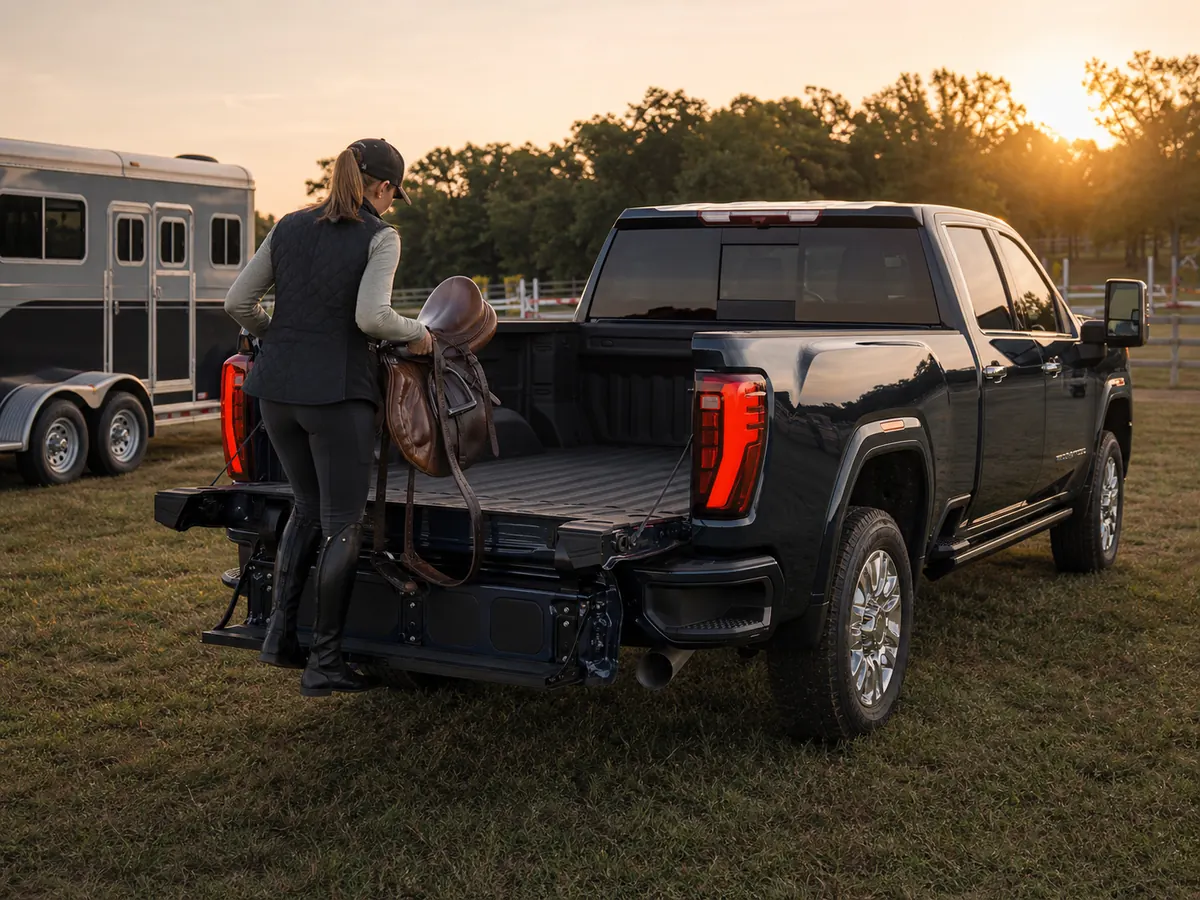
The upper load-stop position can support longer material extending beyond a closed tailgate. With the main gate down, a second stop helps contain cargo near the rear edge, while the work-surface position creates a raised area for plans, a laptop, small tools, or food.
Not every position works with every trailer. A conventional receiver, adjustable ball mount, tongue jack, or coupler can occupy the same space as the dropping inner gate, and contact can damage the tailgate.
A fifth-wheel or gooseneck user has a different conflict. The open gate must clear the trailer during hookup, while bed cargo, the hitch head, and pin-box position can limit how much access the inner gate provides.
GMC lists as much as 83.5 cubic feet of bed volume. A toolbox, auxiliary tank, bed cover, hitch, spare, or cargo divider reduces the clean-box number, so arrange the permanent equipment before judging tailgate usefulness.
Test the six positions with the exact hitch installed or at least measure the likely interference. Confirm that the inner gate releases, latches, and supports a stable step without forcing your body under a raised load.
The available Kicker audio system in the tailgate may suit campsites or outdoor events, but it does not improve cargo handling and adds another exposed electrical component. Treat it as entertainment, not a reason to select the tailgate.
Use MultiPro for recurring bed access, long material, and an outdoor work surface. Skip the assumption that six advertised positions equal six useful positions for your trailer.
- Open the main gate with the receiver and ball mount in place
- Lower the inner gate and check coupler or jack clearance
- Climb the step in work boots while holding typical gear
- Load the bed with the toolbox, hitch, cover, and cargo you expect to carry
- Confirm both gates latch cleanly after dirt or cold-weather use
MultiPro earns its cost when it removes a repeated climb or supports real cargo. Its best mode is the one your hitch and bed layout leave available.
AT4X changes how the Sierra HD drives on-road and off-road
AT4 and AT4X suit buyers who regularly leave maintained pavement, but they are not higher-capacity Sierra HD models. Their tires, suspension, protection, and standard four-wheel drive improve access while adding mass, price, noise, and equipment that may reduce the payload left for people and hitch weight.
AT4 is the more restrained choice. It adds off-road suspension tuning, underbody protection, all-terrain tires, hill-descent control, a two-speed transfer case, and the Kalahari-accented cabin.
AT4X adds Multimatic DSSV dampers, 35-inch all-terrain tires, additional skid plates, and front and rear electronic locking differentials. The available AEV package adds stamped-steel bumpers and more protection for buyers who expect rock contact or difficult remote access.
Car and Driver's diesel 2500 HD AT4X AEV test truck weighed about 8,700 pounds and reached 60 mph in 6.6 seconds. The acceleration is impressive for that mass, but the number also shows how much truck must be stopped, turned, fueled, and supported by its tires.
Pros
- More controlled wheel movement on broken tracks
- Locking differentials improve low-speed traction
- Underbody protection reduces exposure on rocky access roads
- Large tires add clearance and puncture resistance in suitable terrain
Cons
- Added equipment consumes purchase budget and some payload
- Aggressive tires cost more and can add noise or steering response
- Taller step-in and wide body remain difficult in town
- Off-road hardware does not raise towing or axle ratings
Large all-terrain tires can change braking feel, steering precision, replacement cost, and winter behavior. Their load range and pressure must still match the truck's label and actual axle load.
AT4X directs money toward terrain equipment rather than trailering cameras, payload, a stronger series, or a simpler wheel and tire package. That trade is reasonable for ranch tracks, remote construction, hunting access, or heavy snow where the hardware sees repeated use.
A gravel driveway or occasional campground does not normally require locking front and rear differentials. A standard 4WD SLT on appropriate tires may reach the same destination with less cost and easier tire replacement.
Drive the exact trim on pavement and turn tightly at low speed. Check the payload label, spare-tire match, running-board clearance, and local tire availability.
Choose AT4X for difficult access that repeats, not for the appearance of capability. A truck that spends nearly every mile towing on pavement usually benefits more from the right series, axle, cameras, and tires.
A premium cabin does not make a 266.77-inch Sierra HD easy to park
The Sierra HD can be genuinely comfortable on a long highway day, especially in an SLT or Denali with supportive seats, a clear driver display, and a quiet diesel at cruise. That comfort does not reduce the truck's length, step-in height, mirror span, turning space, or firm response over rough pavement when empty.
Cab choices include regular, double, and crew configurations. Regular Cab maximizes simplicity and pairs with a long bed, Double Cab preserves occasional rear seating, and Crew Cab provides the space most families and work crews expect.
Bed choices depend on the cab. Double and Crew Cab trucks offer a standard bed around 6.8 feet or a long bed around 8.1 feet, while Regular Cab uses the long bed.
The smallest 2500 HD configuration is about 236.30 inches long. A Crew Cab Long Bed reaches 266.77 inches, which adds more than 30 inches before a receiver or trailer is attached.
GMC lists the 2500 HD at about 79.8 inches tall. Roof accessories, a raised suspension, snow buildup, a sloped garage approach, and door framing can make a nominally adequate opening too close for comfort.
The long hood and broad tow mirrors require deliberate positioning in tight lots. Up to 14 camera views help, but a dirty lens or missing option returns the driver to mirrors, sightlines, and a careful spotter.
An empty bed allows the heavy rear springs to move sharply over broken pavement. Real cargo can settle the ride, but carrying unnecessary weight to soften the truck reduces braking and wastes fuel.
Measure the places the truck must enter before choosing the cab and bed.
- Garage opening, inside depth, ceiling hardware, and room behind a closed door
- Driveway width and the turn from the street
- Work gates, loading areas, parking structures, and car-wash limits
- Trailer storage approach and space to straighten the combination
- Bed length remaining after a hitch, toolbox, auxiliary tank, and cover
- Passenger step-in with child seats, work clothing, or limited mobility
Seat comfort needs more than a showroom sit. Spend at least 30 minutes in the exact seat, verify thigh and lumbar support, use the mirrors, reach the trailer controls, and test whether the head restraint or console creates pressure.
Power steps make entry easier but introduce motors and hinges close to road salt and mud. Fixed steps sacrifice some ground clearance yet remain simpler in difficult conditions.
A Crew Cab Long Bed is valuable when adults and eight-foot cargo travel together. It becomes wasteful when a standard bed covers the work and every daily destination punishes the extra wheelbase.
Choose the shortest cab and bed combination that handles the recurring people, hitch, and cargo. The best cabin loses its appeal when the truck cannot fit at home or at work.
Sierra HD towing safety and reliability depend on cameras, recalls, and inspection
The Sierra HD's available camera system is one of its strongest reasons to choose GMC equipment above a basic work trim. Up to 14 views can help the driver align a hitch, see inside the bed, monitor the trailer sides, and place a large truck during low-speed maneuvers.
Transparent Trailer View combines compatible trailer-camera information with the truck's rear view to help show traffic behind the trailer. It needs the correct equipment and setup, and it cannot see through a disconnected, damaged, dirty, or poorly positioned camera.
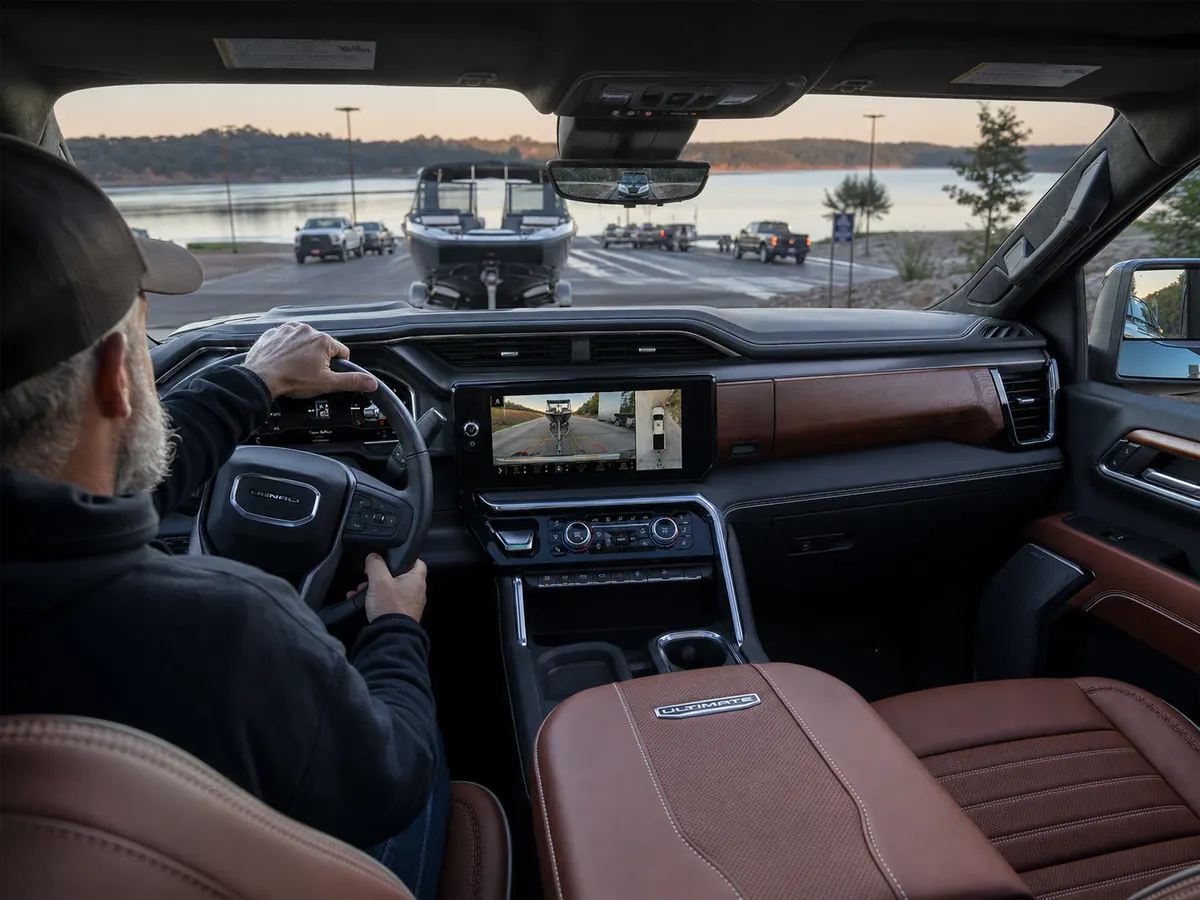
Hitch guidance can reduce repeated exits from the cab, while a bed view helps place a fifth-wheel or gooseneck connection. Side views are valuable at a crowded boat ramp or fuel station where a long trailer cuts inward during a turn.
Available Adaptive Cruise Control with trailering can account for added drag and longer braking needs. It still depends on clear sensors and driver supervision, and it cannot judge whether the truck or trailer is overloaded.
Trailer Side Blind Zone Alert can extend monitoring beside a compatible trailer. A warning system cannot replace adjusted mirrors, a shoulder check where possible, a safe following distance, and slower speed in crosswinds or traffic.
Public crash-test evidence for heavy-duty pickups remains less complete than it is for many passenger vehicles. Do not transfer a Sierra 1500 crash rating to the heavier 2500 or 3500 simply because the cab shape looks related.
The 2026 manual campaign matters because tire, trailering, diesel, safety, and maintenance instructions must match the truck. The dual-tank campaign applies to a defined gas 3500 population rather than every Sierra HD, which is why a VIN search is more accurate than a model-wide claim.
Inspect every exterior lens for cracks, water intrusion, poor repair, or an obstructed view. Put the truck in each supported camera mode, connect a compatible trailer when possible, and check that steering guidelines move correctly.
A used truck also needs a full-module scan. Trailer-brake, camera, parking-sensor, network, emissions, transmission, and four-wheel-drive faults may be stored without an obvious warning during a short test drive.
Examine the receiver, gooseneck or fifth-wheel mounting, bed floor, springs, tires, brakes, frame, wiring, and tailgate for evidence that matches the seller's story. A spotless screen cannot reveal overload damage under the truck.
- Run the VIN through NHTSA and confirm completed remedies with paperwork
- Test cameras in daylight and darkness with clean lenses
- Verify trailer-brake output and connector pins
- Check the certification labels against the planned load
- Pay an independent heavy-duty truck specialist for a lift inspection and scan
Use the cameras to manage blind areas, then use labels, scales, records, and inspection to manage the load. The screen adds information, but it cannot correct an unsafe combination.
Sierra HD ownership costs must justify the GMC premium
GMC lists the 2026 Sierra HD Pro from $47,000 before destination and options. The top Denali example above $104,000 shows how engine, cab, trim, technology, and accessories can turn one truck line into two different ownership decisions.
Financing, sales tax, insurance, registration, depreciation, fuel, tires, brakes, service, and downtime all rise with a larger or more complex configuration.
There is no official EPA city or highway estimate for this truck. Estimate annual fuel by separating empty miles from loaded miles, then use records from the same engine, cab, axle, tires, speed, terrain, and trailer style.
A tall fifth-wheel or enclosed work trailer can matter more to consumption than several hundred pounds of cargo because aerodynamic drag grows rapidly with speed. Slowing down may save more fuel than an expensive efficiency option.
RepairPal rates the Sierra 2500 HD at 3.0 out of 5 across model years and reports an average annual repair and maintenance cost of $912. Its data shows about 0.28 unscheduled shop visits per year and an 18 percent chance that a repair is severe.
Those figures cover many years and uses, not a prediction for a new 2026 truck. A commercial diesel with high idle hours and a lightly used gas model do not share one risk profile.
Duramax adds diesel exhaust fluid, fuel filters, greater fluid capacity, and expensive aftertreatment or fuel-system exposure. Large tires, power steps, massage seats, cameras, and tailgate electronics also bring replacement costs that a simpler truck avoids.
Downtime can exceed the repair invoice for a truck that supports paid work. Check dealer capacity, diesel technicians, parts availability, towing coverage, and whether another vehicle can carry the load while the Sierra waits.
A Sierra 1500 is easier to park, generally rides better empty, and carries an EPA fuel-economy label. The Sierra HD earns its burden only when a recurring trailer, bed load, work body, or remote route uses the extra capacity.
The best new configuration is often a 2500 HD SLT with the engine chosen for real annual work. Move to 3500, Denali, or AT4X only when a measured load, repeated comfort need, or difficult access proves the upgrade.
Buy the least expensive Sierra HD that carries the complete load and makes repeated work easier.