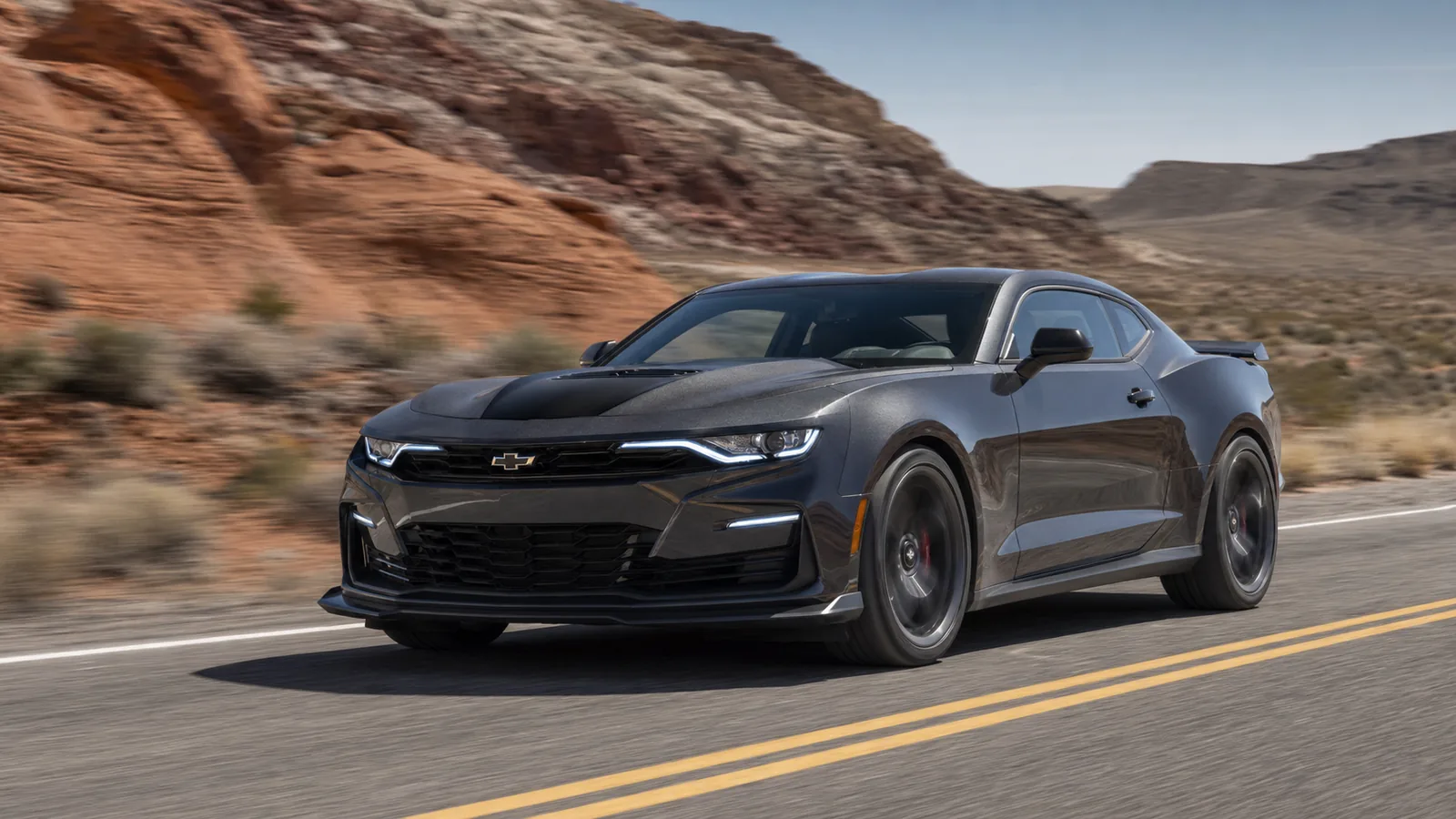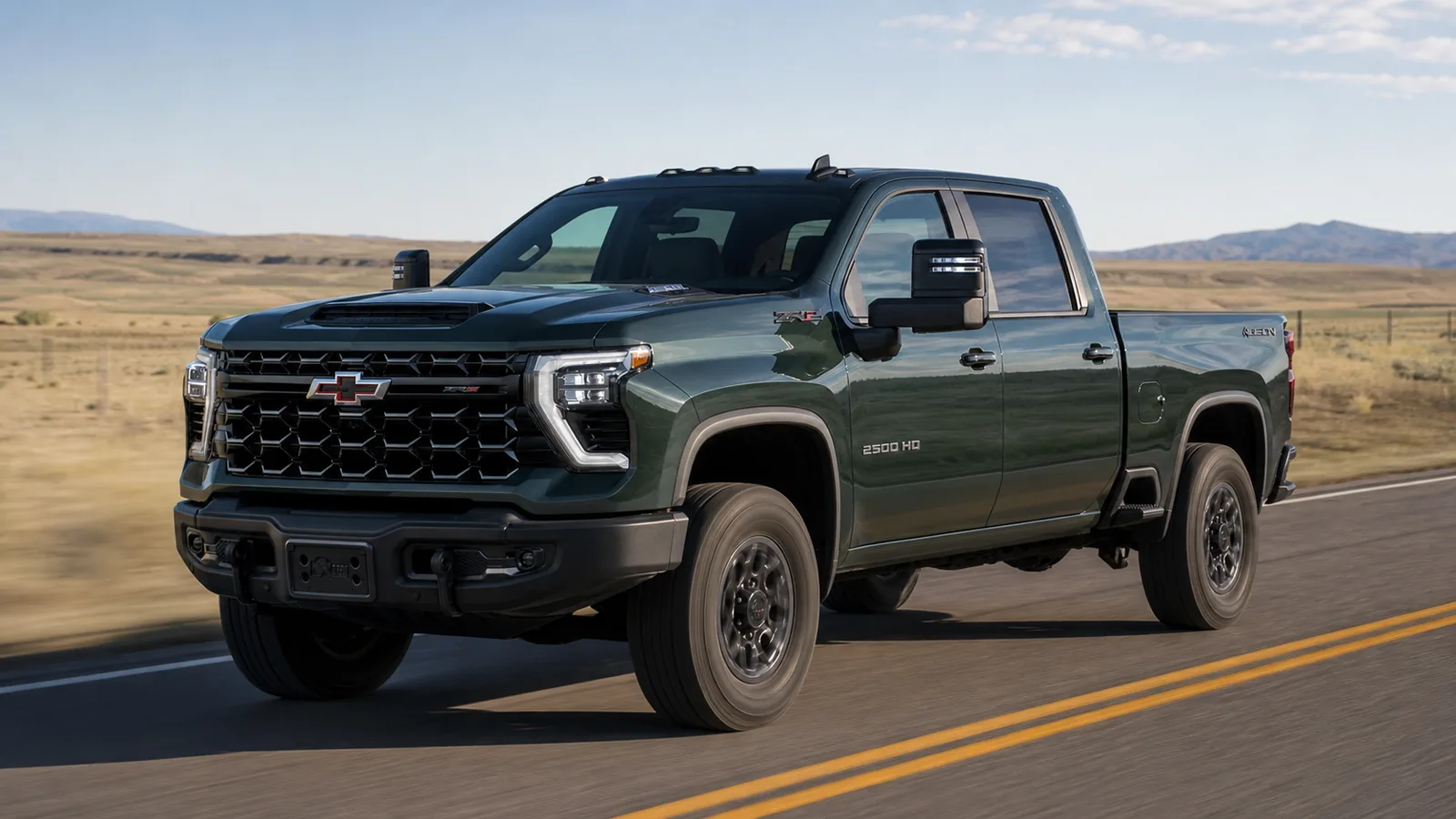
Chevrolet Silverado HD explained: 2500 or 3500, gas or Duramax
The Chevrolet Silverado HD is Chevrolet's heavy-duty pickup line, split into 2500 HD and 3500 HD models for towing, hauling, commercial equipment, and other jobs that exceed a Silverado 1500's ratings. Cab, bed, axle, rear-wheel, and engine choices change its capacity more than the trim badge does.
The 6.6-liter gas V8 is the sensible default for a Silverado HD that tows occasionally, works close to home, or spends long periods without a trailer. It makes 401 hp and 464 lb-ft of torque, uses regular gasoline, and shares Chevrolet's ten-speed Allison-branded automatic with the diesel.
Gas power gives up climbing speed and engine braking under a heavy trailer, but it avoids the diesel's higher purchase price, diesel exhaust fluid, fuel-filter service, and emissions aftertreatment. A landscaping crew that travels 20 miles between jobs can make a stronger business case for gas than a fifth-wheel owner crossing mountain grades every month.
The 6.6-liter Duramax diesel makes 470 hp and 975 lb-ft. That extra 511 lb-ft matters when the truck must start a heavy combination on a grade, hold speed without repeated downshifts, or use its exhaust brake on a long descent.
The ten-speed keeps both engines closer to the useful part of their output range. With the Duramax, the broad torque and close ratios make an 8,000-pound truck feel unexpectedly quick.
Edmunds recorded 0 to 60 mph in 6.8 seconds in its tested diesel 2500 HD, although acceleration without a trailer is not the reason to pay for the engine.
| Decision factor | 6.6L gas V8 | 6.6L Duramax diesel |
|---|---|---|
| Output | 401 hp, 464 lb-ft | 470 hp, 975 lb-ft |
| Best use | Local work, lighter trailers, lower annual loaded miles | Frequent heavy towing, grades, long loaded highway trips |
| Fuel evidence | No EPA rating. Calculate from actual use | No EPA rating. Edmunds observed about 13 mpg combined in a tested 2500 HD |
| Added ownership items | Spark-ignition service and higher fuel use under load | DEF, fuel filters, aftertreatment, higher labor and purchase cost |
| Main advantage | Lower cost and simpler short-trip use | Pulling force, exhaust braking, and sustained-load ease |
Heavy-duty pickups do not carry the familiar EPA city and highway MPG comparison used for light-duty trucks. EPA classifies trucks above 8,500 pounds GVWR as heavy duty, so a dealer claim about highway MPG is not an official window-sticker rating for this truck.
Fuel records from the same engine, axle, tires, speed, terrain, and trailer type are more useful than an isolated owner number. A diesel may return better unloaded mileage, but the savings need to recover its purchase premium and extra service over the miles you will actually drive.
Choose the Duramax when loaded highway work and grade control repeat often enough to pay for it. Choose gas when the truck's capability matters more than covering huge loaded distances.
Chevrolet Silverado HD towing specifications depend on configuration
Chevrolet advertises up to 36,000 pounds of towing for a properly equipped Silverado 3500 HD diesel. The 2500 HD peaks at 22,420 pounds, while the gas powertrain reaches as high as 19,080 pounds in the right truck.
Those numbers describe different combinations. Series, cab, bed, two-wheel or four-wheel drive, single or dual rear wheels, engine, axle rating, wheel size, hitch type, and installed equipment all change the answer.
The 2026 Silverado 2500 HD trailering chart shows GVWR values from 10,000 to 11,900 pounds and several GCWR values from 24,500 to 30,000 pounds. GCWR covers the truck and trailer combination, including people, fuel, options, and cargo, so an empty brochure number cannot replace a loaded calculation.
A conventional travel trailer places part of its loaded weight on the receiver. A fifth-wheel or gooseneck moves a larger pin load into the bed.
The hitch style changes both the published tow limit and how much truck payload remains for occupants and cargo.
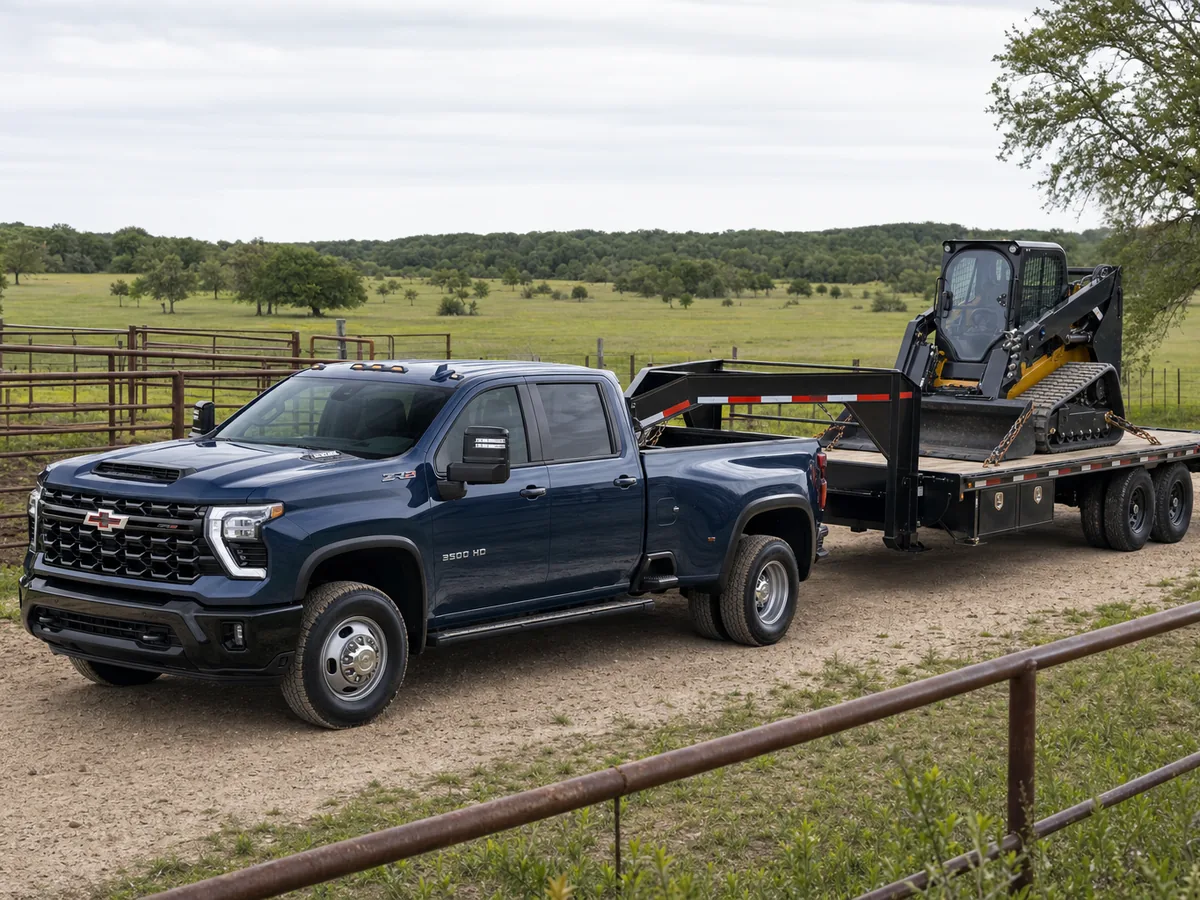
Start with the trailer's expected loaded weight rather than its dry number. Add water, propane, batteries, tools, food, motorcycles, livestock equipment, or job materials, then use the trailer's real tongue or pin weight when possible.
The truck must remain within every applicable limit at the same time. That includes GVWR, front and rear axle ratings, tire ratings, hitch rating, payload, GCWR, and the configuration-specific trailer limit.
A weight-distribution hitch can improve how a compatible conventional trailer shares load, but it does not increase the truck's certified ratings. Air springs can level the body, but they also do not create payload.
Read the trailering chart and labels for the exact VIN before agreeing that a Silverado HD can tow your trailer. A correct engine in the wrong cab, axle, or wheel configuration can carry a lower rating than the truck parked beside it.
How much payload can a Chevrolet Silverado HD carry?
Payload is the Silverado HD limit most likely to surprise a private owner. People, tools, bed accessories, hitch hardware, and trailer tongue or pin weight all consume the allowance printed for that exact truck.
Chevrolet publishes a maximum available payload of 6,602 pounds for the current Silverado HD lineup. Reaching it requires a specific configuration, and a diesel crew cab with four-wheel drive and luxury equipment will not carry that same number.
Consider a crew-cab 2500 HD carrying four adults, 200 pounds of bed cargo, a 200-pound hitch, and a fifth-wheel that places 2,500 pounds in the bed. The truck has already taken on well over 3,300 pounds before optional accessories or extra trailer supplies are counted.
That is why a 2500 HD can have enough engine and trailer rating yet still lack enough payload. A 3500 HD single-rear-wheel truck often restores useful capacity without the width of a dually, while a dual-rear-wheel 3500 HD gives the greatest rear-axle and payload headroom for the heaviest pin loads.
Loaded truck arithmetic
- Occupants
- Driver, passengers, child seats, pets, and personal items
- Truck cargo
- Tools, coolers, generators, bed covers, auxiliary tanks, and accessories
- Hitch equipment
- Receiver hardware, weight-distribution parts, fifth-wheel, or gooseneck hitch
- Trailer load
- Actual tongue or pin weight at travel condition
- Proof
- Door labels plus axle weights from a certified scale
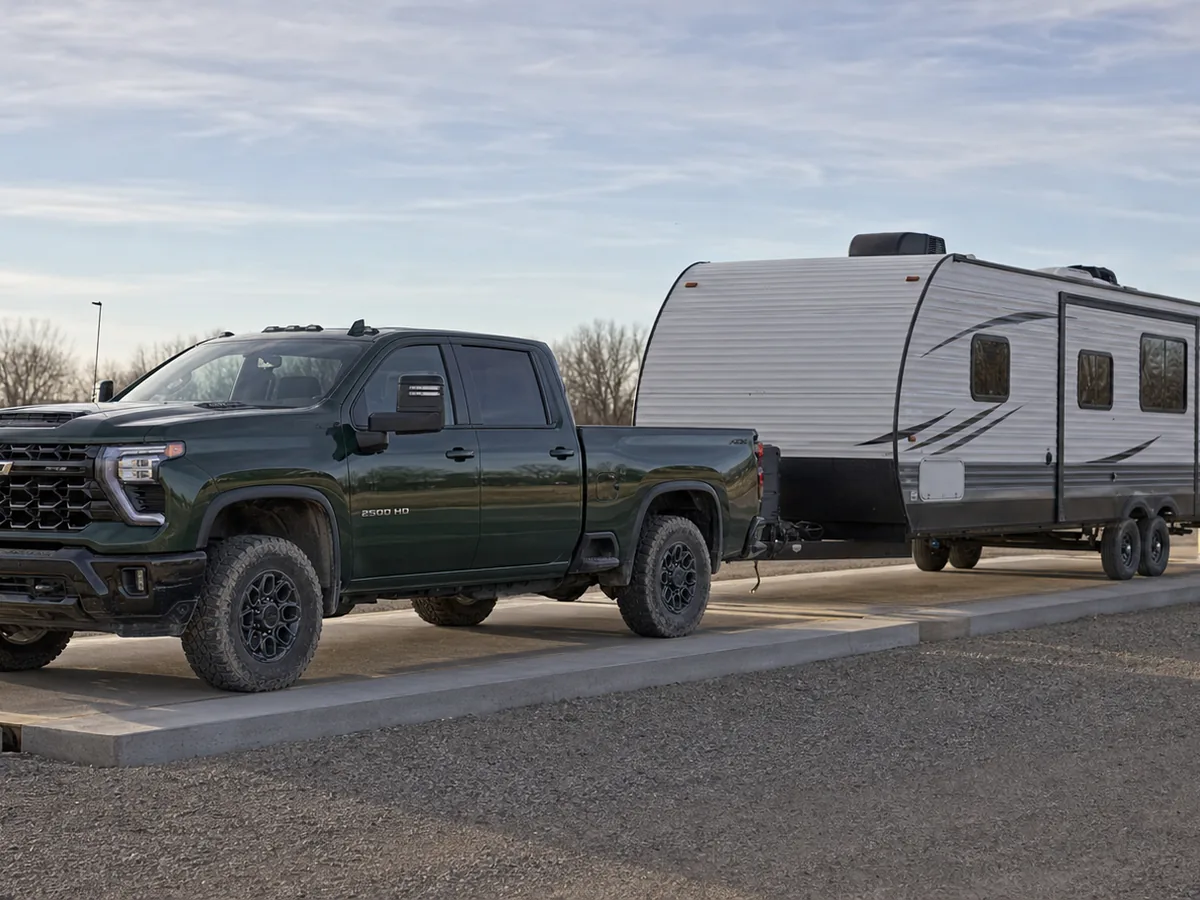
Use a certified scale after the combination is loaded as it will travel. Weigh the truck and trailer together, then follow the scale procedure needed to isolate axle and trailer loads.
Tire pressure must follow the truck and tire requirements for the load. A larger tire or a higher number molded on its sidewall does not raise the axle or vehicle rating established by Chevrolet.
The payload sticker is also why option restraint matters. Power steps, larger wheels, off-road hardware, a sunroof, a bed cap, and a heavy hitch may improve the truck, but their mass leaves less capacity for the job.
Choose 2500 HD when its actual payload covers the occupied truck and trailer load with useful margin. Move to 3500 HD when the same calculation crowds the label, not after suspension modifications make an overloaded truck appear level.
How the Silverado HD drives empty and with a trailer
The Silverado 2500 HD has accurate steering and a calmer highway manner than its size suggests. GM's independent front suspension helps the nose track cleanly, while the diesel's deep torque and ten-speed automatic reduce the drama of merging or passing.
Edmunds found its roughly 8,000-pound diesel test truck easy to place within a lane and smooth in normal traffic. The brake pedal brought the truck down progressively, but no HD pickup can hide its mass when traffic stops suddenly or a trailer begins to sway.
An empty bed exposes the spring rate needed for work. The truck can jostle over broken pavement, and Car and Driver found the Z71 suspension particularly trucklike when unladen.
Adding real load settles some motion, but a softer ride is not a reason to tow or haul weight the truck does not need.
The high hood and large tow mirrors reduce close visibility. Available surround-view cameras, hitch guidance, and trailer views are useful when lining up a coupler or watching the sides of a trailer, but lenses can be dirty, distorted, or unavailable on a lower trim.
Seat comfort deserves a long drive rather than a showroom sit. Edmunds found the High Country seats flat and firm, and it noted that the broad mirrors create some wind noise even though the diesel remains subdued at highway speed.
Drive the exact configuration on a narrow road, rough pavement, a highway merge, a downhill stop, and the parking area you use. A ZR2 on 35-inch tires, a long-bed dually, and a standard-bed LT may share an engine while feeling like different tools.
A loaded test drive is rarely practical before purchase, so pay attention to steering correction, brake vibration, driveline clunk, tire tracking, and transmission behavior when empty. Those small problems become larger distractions when a trailer adds weight and wind area.
The Silverado HD is composed for a heavy truck, but its good road manners do not turn it into a half-ton. Buy it only if its empty ride and low-speed scale remain acceptable during the many miles when nothing is attached.
Which Silverado HD cab and bed fit daily use?
A 2026 Silverado HD ranges from about 235.5 to 266 inches long. The longest crew-cab long-bed configuration adds more than 30 inches beyond the shortest regular-cab truck, and width reaches 105.2 inches with mirrors included.
Chevrolet lists unloaded weights from 6,266 pounds for some 2500 HD configurations to 8,552 pounds for some 3500 HD configurations.
That spread shows why series and options change the payload left on the door label.
A regular cab maximizes simplicity and pairs with the long bed. A double cab preserves occasional rear seating with less cabin length than a crew cab.
The crew cab provides about 43.4 inches of rear legroom and fits adults or child seats more naturally, but it also creates the longest combinations when paired with an eight-foot bed.
The standard bed makes a crew cab easier to park and still provides useful volume. The long bed accepts eight-foot material more readily and gives fifth-wheel or gooseneck users more clearance and placement flexibility.
Chevrolet lists up to 83.5 cubic feet of bed volume and installs 12 standard tie-downs rated at 500 pounds per corner. Volume does not settle fit, because a toolbox, auxiliary tank, hitch, bed cover, spare tire, or slide-in equipment can take away the space shown in a clean cargo box.
Cabin storage is less convincing than the rear-seat room. The rear bench folds up in a 60/40 split, but Edmunds noted that the floor is not completely flat and that several smaller cabin bins trail the cleverer storage found in rivals.
Step-in height affects every stop. Running boards help shorter passengers and workers carrying gear, while the CornerStep bumper and bedside steps make bed access easier without climbing onto a tire.
Before choosing a cab and bed, measure these places with the mirrors and hitch in mind.
- Garage door width, interior depth, and opener clearance
- Driveway turn from the street and room behind a closed garage door
- Worksite gates, loading docks, parking structures, and drive-through lanes
- Trailer storage approach and room to straighten the combination
- Bed space after the hitch, toolbox, cover, and normal cargo are installed
A 28 to 36-gallon fuel tank also changes stop planning according to configuration. The larger tank can extend range but adds more fuel mass when full.
The right cab and bed should solve the weekly passenger and cargo pattern without making every ordinary stop difficult. Measure first because wheelbase and body length cannot be fixed with a trim change.
Silverado HD safety depends on cameras, labels, and load discipline
The Silverado HD's most useful safety technology is closely tied to its size and trailer job. Chevrolet offers eight cameras with up to 14 views, including hitch guidance, a bed view for gooseneck connection, and views intended to help monitor the trailer area.
Trailer Side Blind Zone Alert can extend the monitored area along a compatible trailer. It is an aid, not a measurement system, and it cannot confirm that the trailer is loaded correctly or that the driver has enough space to turn.
Forward Collision Alert, Automatic Emergency Braking, Front Pedestrian Braking, Lane Departure Warning, Following Distance Indicator, and IntelliBeam availability varies by equipment. Verify the window sticker and menus on the exact truck because a large screen or expensive trim does not prove every feature is present.
Current public crash-test evidence is limited for this model. NHTSA's published list of vehicles selected for 2026 five-star testing includes the Silverado 1500 and Ford F-250 Crew Cab, but it does not list Silverado 2500 HD or 3500 HD.
Do not transfer a Silverado 1500 rating to the heavier truck.
A missing manual may sound minor until the truck is used at its limits. Tire pressure, trailering, diesel after-run, emissions-system messages, maintenance, and driver-assistance limitations need the correct instructions.
Mass can protect occupants in some collisions while increasing stopping distance and the harm delivered to a smaller road user. Cameras, mirrors, tires, brakes, speed, following distance, and driver attention all matter more than the assumption that a bigger truck is automatically safer.
Confirm open recalls at NHTSA, test every camera and alert, inspect the windshield area around sensors, and make sure no warning lamp has been hidden or recently cleared. Technology helps the driver manage the truck, but it does not repair an overloaded combination or create visibility where the cameras cannot see.
Silverado HD reliability starts with gas or Duramax service evidence
A used Silverado HD should tell one consistent story through mileage, idle hours, hitch wear, bed damage, service records, tires, and scan data. A clean cabin paired with a worn gooseneck ball and fresh undercoating deserves more questions than the odometer alone can answer.
The Duramax needs evidence of engine-oil, fuel-filter, coolant, transmission, and diesel exhaust fluid care. Repeated short trips and long idle periods can make aftertreatment regeneration harder, while frequent loaded highway work can produce high miles with a healthier operating pattern.
Ask how often the truck requested regeneration, whether emissions warnings appeared, and which parts were replaced. A deleted or tuned emissions system can create inspection, registration, warranty, resale, and diagnostic problems even when the engine feels strong during a short drive.
The gas V8 avoids diesel aftertreatment but still needs records, a cold start, stable oil pressure, clean coolant, smooth shifts, and a scan for stored or pending faults. Gas is simpler for short-trip use, not immune to neglect.
Used Silverado HD inspection
- Engine and cooling
- Cold start, leaks, fluid condition, fan operation, temperatures, service records
- Diesel system
- DEF quality, fuel filters, aftertreatment messages, regeneration history, stock calibration
- Transmission and 4WD
- Cold engagement, warm shifts, transfer-case operation, axle noise, leaks
- Work evidence
- Receiver, gooseneck holes, trailer wiring, brake controller, bed floor, tailgate, frame, springs
- Chassis
- Load-range tires, wheel damage, steering play, brakes, shocks, alignment, rust, underbody repairs
- Electronic evidence
- Full-module scan, camera views, sensors, warning history, open recalls, both keys
Inspect the hitch receiver for elongation, rust movement, cracked paint, poor weld repairs, and damage around safety-chain points. In the bed, check a fifth-wheel or gooseneck installation for proper mounting rather than judging it by a neat cover plate.
Road-test the truck from fully cold to operating temperature. Use light and moderate throttle, verify every forward gear, engage four-wheel drive as the manual permits, and listen for wheel-bearing, axle, driveshaft, and transfer-case noise during acceleration and coast.
NHTSA recall 24V060 covered certain 2020 to 2024 Silverado HD trucks with power-unlatching tailgates that could open unexpectedly. Check the VIN and remedy record, then test that the tailgate closes and latches instead of assuming a completed software action proves the hardware is sound.
A full-module scan can reveal recently cleared monitors, network faults, trailer-brake codes, emissions history, or sensor problems that never light the dashboard during a ten-minute drive. The scan must be interpreted with the truck's equipment and service records.
Pay an independent diesel or GM truck specialist to inspect the truck on a lift. The cleanest purchase is a stock example whose wear matches its stated work and whose owner can document why major services or repairs were performed.
Walk away when calibration history is unknown, emissions equipment is missing, the seller blocks a cold start or scan, structural repairs are unexplained, or the truck's labels do not support the trailer you plan to pull.
Silverado HD ownership costs make sense only with recurring heavy work
The 2026 Silverado 2500 HD starts around $48,195 before configuration and local fees, while the 3500 HD starts around $49,395. Cab, four-wheel drive, the Duramax, trailering hardware, luxury trims, and dealer accessories can move the transaction far beyond those starting points.
Fuel is the most visible operating cost and the easiest one to misuse. Edmunds observed about 13 mpg in combined driving with a diesel 2500 HD, but that is one road-test result rather than an EPA rating or a promise for a loaded truck.
Calculate annual fuel from your unloaded and loaded miles separately. Trailer shape, speed, grade, wind, tires, axle ratio, idle time, temperature, and regeneration all move the result.
Diesel adds DEF, fuel filters, more oil, expensive emissions components, and technicians whose labor rate may exceed a general repair shop. Gas can burn more fuel under heavy load but usually reduces the cost of entry and the complexity of short-trip ownership.
Tires and brakes carry heavy-duty prices because their load ratings and mass matter. Larger wheels and aggressive off-road tires can raise replacement cost, road noise, and stopping distance without improving the trailer job.
Downtime belongs in the calculation for a work truck. A cheaper engine that slows every loaded climb can cost time, while a diesel that waits for a specialized part can also stop revenue.
The better answer depends on how the truck earns its keep and what service exists nearby.
A half-ton is easier to park, usually rides better empty, and carries official EPA fuel-economy estimates. The HD earns its disadvantages only when a recurring trailer, payload, or commercial load exceeds what the lighter truck can handle responsibly.
The best Silverado HD is the least complicated configuration that carries the occupied truck and loaded trailer within every rating. Once that condition is met, spend on the engine, cab, cameras, and comfort equipment that reduce the cost or strain of the work you actually do.