Suburban Is Worth Its Length When Every Seat Travels With Luggage
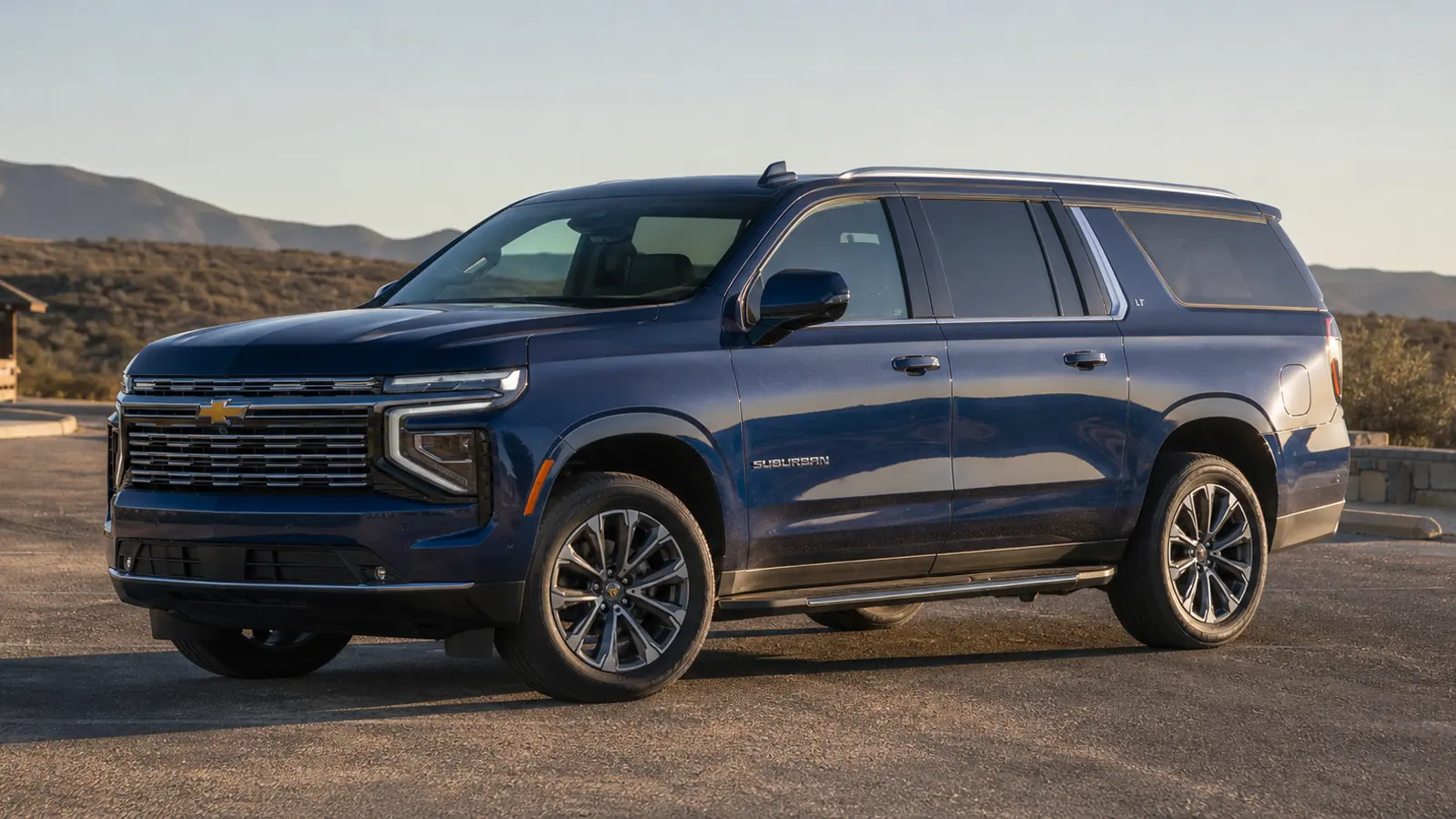
The Chevrolet Suburban is the maximum-space member of Chevrolet's full-size SUV family. It offers 41.5 cubic feet of cargo volume behind row three, 93.8 behind row two, and 144.5 with the rear seats folded.
Seating can range from seven to nine. Its three engines and truck-based chassis largely mirror Tahoe, but the longer wheelbase and rear body change the ownership decision.
A 2026 Suburban is 226.3 inches long and starts at $63,700 before destination and options on Chevrolet's U.S. site.
It is roughly 15 inches longer than Tahoe. Most of the advantage is luggage room behind the third row, not a completely different passenger compartment.
That makes the normal all-seat load the first test.
The extra length earns its cost only when the family uses the 16-cubic-foot cargo gain behind row three.
Loading to the roof is not a solution if bags block the rear view or can move into the cabin.
Bring the real cases, secure them below the seatbacks where possible, and keep emergency supplies accessible.
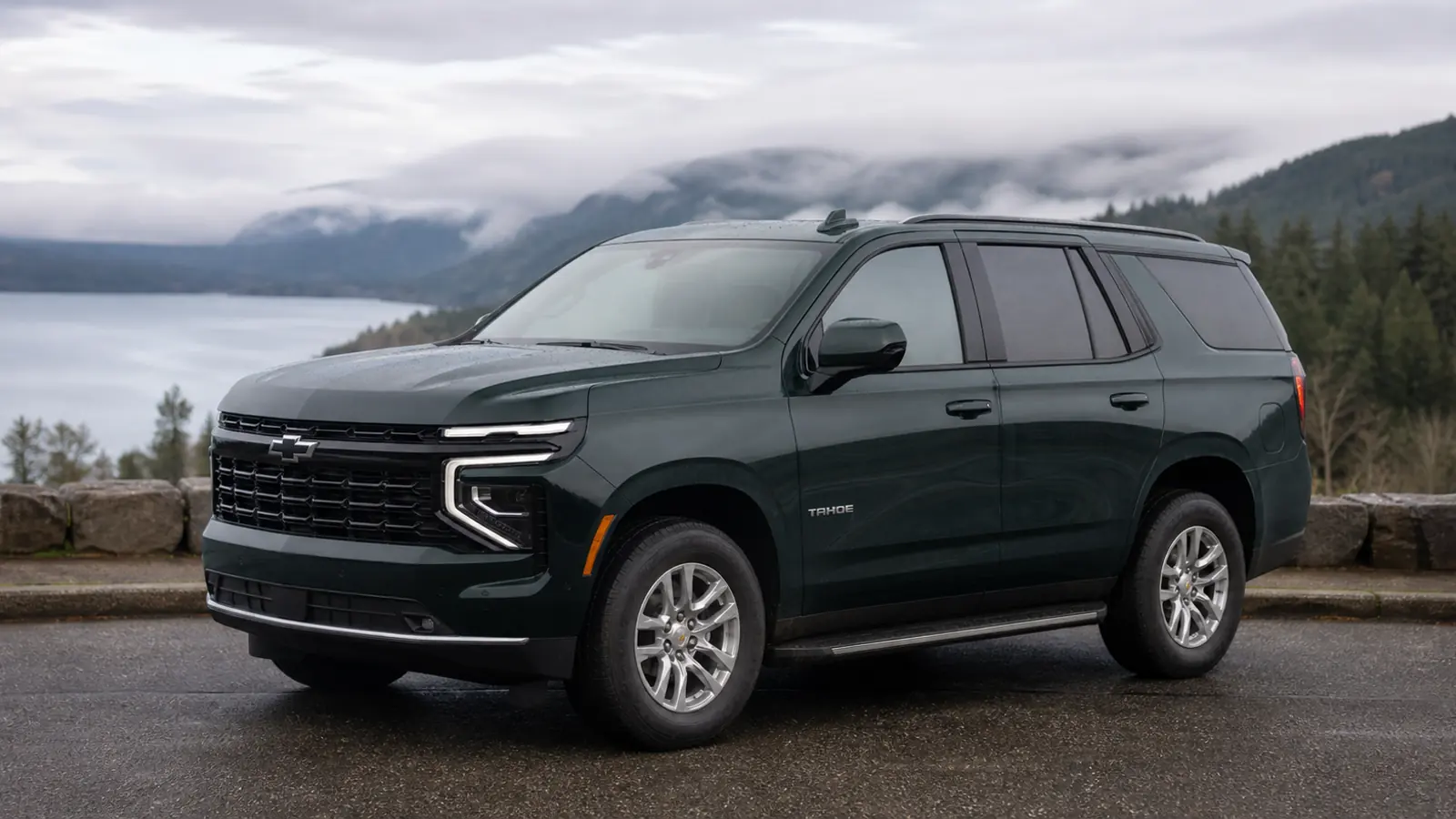
The Chevrolet Tahoe is the closest and most important comparison. The Suburban alternatives list covers other ways to carry the same people and luggage.
The Ford Expedition offers different engine and cargo tradeoffs. The Toyota Sequoia changes the powertrain and towing equation.
Measure 226.3 Inches in the Garage Before the Test Drive
Suburban's long wheelbase helps highway stability and creates the cargo area families seek. It also follows the driver into every parking structure, school lane, ferry, campsite, and fuel stop.
Overall length alone is not enough. Measure the garage door opening, interior depth, workbench clearance, liftgate swing, driveway slope, and room to walk around the vehicle.
At more than 81 inches wide without mirrors, Suburban can leave narrow margins in older garages.
Folding mirrors help at the opening, but passengers still need door space. A roof rack, cargo box, antenna, or suspension mode can change height.
Put the measured driving height where every family driver can see it.
| Place | Measurement | Why it matters |
|---|---|---|
| Garage depth | Bumper to wall plus walking room | 226.3 inches leaves little reserve in a 20-foot bay |
| Door width | Mirrors folded and body clearance | Prevents mirror and rear-quarter damage |
| Liftgate area | Open height and rear swing | Stops contact with ceiling or garage door |
| Driveway break | Approach and departure transition | Long wheelbase can touch on steep changes |
| Parking space | Real local stall and turn aisle | Cameras cannot create turning room |
| Roof clearance | Vehicle plus rack or box | Protects accessories and structures |
Drive both Tahoe and Suburban through the same route. Reverse into a normal space, make a three-point turn, use a drive-through if legal and tall enough, and enter the home driveway at an angle.
Ask every regular driver to repeat the test. A vehicle that one person can place confidently may intimidate another.
Available camera views and parking sensors are valuable, particularly around the front corners and rear overhang.
Keep lenses clean and learn how the views stitch together.
Distortion can make a post appear farther away. The driver must still look outside and account for objects below the camera's view.
The full-size SUV category includes long-wheelbase alternatives. The Chevrolet Traverse is cheaper to buy and run when 5,000 pounds of towing covers the job.
Suburban should be chosen after it passes the building and route measurements, not because maximum cargo sounds useful in isolation.
Forty-One Cubic Feet Behind Row Three Changes Family Travel
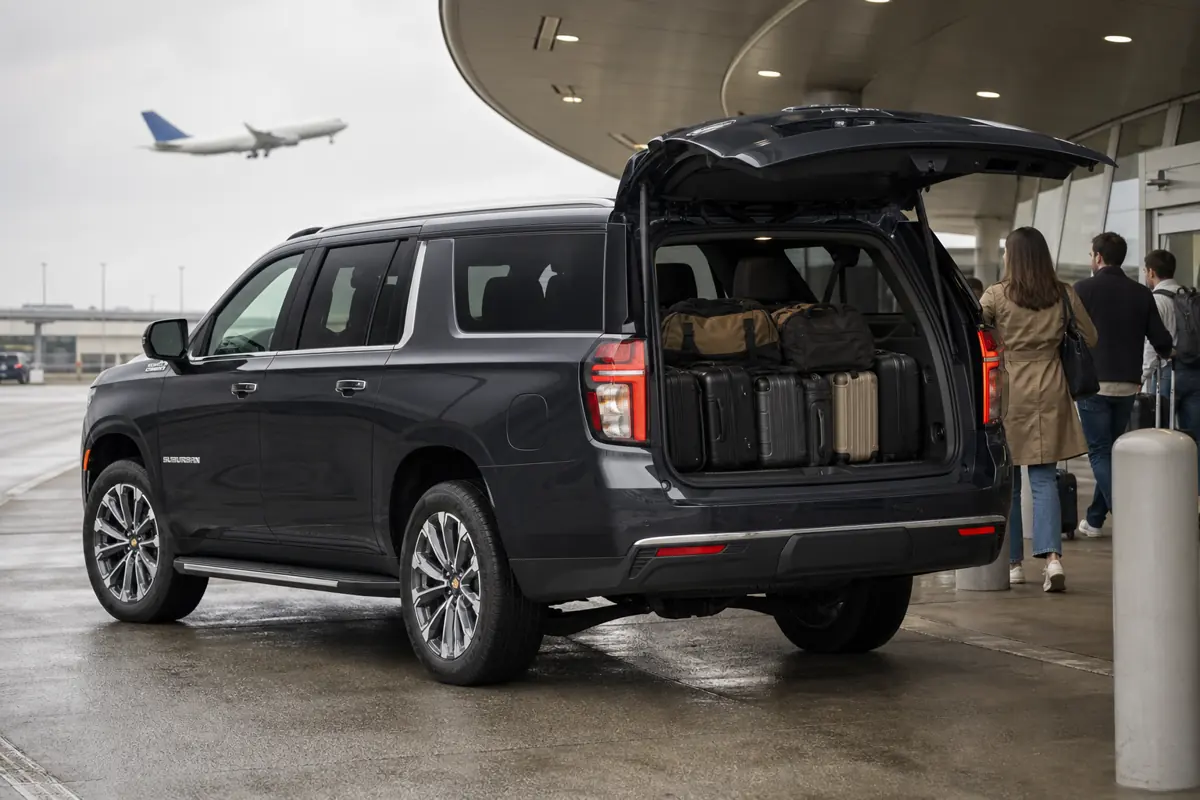
Suburban's 41.5 cubic feet behind row three is its clearest advantage.
Tahoe provides 25.5. Ford Expedition MAX lists 37.4.
The Chevrolet can hold more ordinary luggage without folding a passenger seat, mounting a roof box, or placing bags in the aisle.
That improves visibility and keeps the cabin calmer on long trips.
The second and third rows fold to create 93.8 and 144.5 cubic feet. Those large totals matter for furniture or gear, but a family usually buys Suburban to avoid folding row three.
Test the narrower area between trim panels, the hatch opening, load-floor height, and the space needed for a stroller's wheels or a large cooler.
Choose between a second-row bench and captain's chairs by installing child restraints. A bench can preserve eight seats, while captain's chairs ease the path to row three.
Nine-seat configurations are limited and should be verified on the window sticker. Belt fit, lower anchors, top tethers, buckles, and access matter more than the headline count.
A cargo barrier, tie-downs, or fitted organizer can keep heavy objects below the seatback and away from the liftgate.
Do not rely on a loose parcel cover to restrain a cooler or toolbox.
Follow Chevrolet's load and roof limits. Place dense items low, forward, and secured.
The seven-seat listings include easier-to-park models. The Chrysler Pacifica uses sliding doors and a lower floor for frequent passenger loading.
Suburban answers a narrower need: many people, their luggage, and substantial towing capability in one vehicle.
The Diesel Extends Highway Range, but the 5.3 V8 Keeps Ownership Simpler
The 2026 Suburban offers a 355-hp 5.3-liter V8, a 420-hp 6.2-liter V8, and a 305-hp 3.0-liter Duramax turbo-diesel inline-six.
The diesel makes 495 lb-ft of torque, while the 6.2 makes 460 and the 5.3 makes 383.
All use a ten-speed automatic. Rear-wheel drive and four-wheel drive depend on trim and configuration.
The 5.3 is the default engine. It uses regular fuel and has enough power for normal family load and moderate towing.
The 6.2 provides stronger acceleration but recommends premium fuel and was included in a recall covering defined earlier model years.
Choose it only when performance or required trim content justifies the added cost.
Engine and fuel
- 5.3L V8
- 355 hp, 383 lb-ft, regular gasoline
- 6.2L V8
- 420 hp, 460 lb-ft, premium gasoline recommended
- 3.0L diesel
- 305 hp, 495 lb-ft, diesel and DEF
- Transmission
- 10-speed automatic
- Drive choices
- Rear-wheel drive or four-wheel drive
- Fuel tank
- 28 gallons
EPA lists a 2025 rear-wheel-drive Suburban with the 5.3 at 15 mpg city, 20 highway, and 17 combined.
The rear-wheel-drive diesel is rated at 21 city, 26 highway, and 23 combined. Chevrolet promotes up to 728 miles of highway range for the diesel under its assumptions.
Use the exact window sticker and treat range as a planning estimate, not a promise.
Diesel can reward high annual highway mileage, long legs between fuel stops, and steady trailer use. It also needs diesel exhaust fluid, fuel-filter service, and proper operating conditions for its emissions system.
Short cold trips and long idle periods weaken the case.
Compare diesel price along the routes actually traveled.
The Suburban real-world MPG report can separate configurations. The Suburban oil specification must match the selected engine and service duty.
The 5.3 is safer for a mixed-use budget, while diesel should win a written mileage calculation before purchase.
Suburban Trades a Little Tow Rating for Cargo Behind the Axle
Chevrolet's 2026 guide lists a maximum of 8,200 pounds for a rear-wheel-drive 5.3-liter Suburban with the Max Trailering Package.
The comparable four-wheel-drive figure is 8,000.
Other engine and drive combinations range lower. Tahoe can reach 8,400 in its best listed setup, so the longer body does not increase the maximum.
Trailer tongue weight, people, cargo, accessories, and the hitch all count against payload. Suburban's larger cargo area makes it easy to add bags without noticing how much weight enters the rear of the vehicle.
The door label on the exact SUV is the capacity authority. Luxury equipment and four-wheel drive can reduce the remaining number.
| Item | Verify before departure | Consequence if missed |
|---|---|---|
| Trailer | Fully loaded scale weight | Brochure dry weight understates the load |
| Tongue | Measured loaded value | Rear axle and payload can be exceeded |
| Passengers | Real occupant weight | Every seat adds to vehicle load |
| Cargo | Bags, cooler, pets, roof box, accessories | Large volume encourages hidden weight |
| Tires | Pressure, condition, load rating | Heat and overload can cause failure |
| Hitch and brakes | Correct setup and controller operation | Stability and stopping are compromised |
A weight-distributing hitch and sway control are required above the thresholds in Chevrolet's guide. Set trailer brakes according to the manual, test lights, confirm safety-chain crossing, and secure the breakaway cable independently.
Weigh each axle group with the normal travel load.
Do not use air suspension to justify extra cargo. Leveling changes stance, not certified GVWR, axle, tire, hitch, or payload limits.
A roof box also adds aerodynamic drag and raises the center of gravity.
Keep its load within the roof and crossbar ratings.
The Suburban towing-capacity reference can organize exact combinations.
Choose Suburban for interior volume, then prove that the loaded family and trailer still fit its labels.
Buyers carrying dense bed-style cargo may need a pickup such as the Chevrolet Silverado 1500 instead.
LS and LT Preserve the Space Value Better Than 24-Inch Wheels
Suburban uses the familiar LS, LT, RST, Z71, Premier, and High Country trim ladder. LS delivers maximum space at the lowest entry price and can offer the highest seating count in the right configuration.
LT adds everyday cabin comfort.
RST changes street appearance. Z71 adds off-road-oriented hardware.
Premier and High Country add luxury equipment and cost.
The vehicle's practical advantage is cargo volume, so LT with the 5.3 V8 is the broad recommendation.
It keeps the useful body and comfort without forcing the richest materials or largest wheels.
Rear-wheel drive is suitable for mild paved routes. Four-wheel drive earns its cost on snow, ramps, loose access roads, and recurrent off-pavement travel.
Large wheels use short tire sidewalls that transmit sharper impacts and leave less protection against road damage.
The Suburban replacement tire cost can be substantial. A 2026 recall covered certain Tahoe and Suburban vehicles with 24-inch wheels for potentially incorrect front hub bolts, which also reinforces the need for a VIN check rather than a visual assumption.
Available air suspension and magnetic damping can improve body control and access height. They also add compressors, sensors, dampers, and lines to the long-term service list.
Drive a conventional-suspension LT before assuming the more complex setup is required.
The Chevrolet model lineup includes less expensive SUVs with similar screens and driver aids.
Pay for Suburban's structure and space first. Technology packages should come after garage fit, seating, payload, trailer equipment, and tire choice are settled.
The Highway Is Suburban's Natural Setting
A long wheelbase and independent rear suspension give Suburban a settled highway ride. The cabin remains composed over broad pavement waves, and the engine can hold a relaxed speed with the ten-speed automatic.
Diesel adds low-rpm torque and long range, while the V8s provide familiar response.
The driver and passengers benefit most on long travel days.
The same wheelbase slows direction changes and expands the turning path. A narrow mountain-town street, older hotel garage, and crowded trailhead can reveal compromises that a freeway test hides.
Reverse into a space and watch the front corners swing.
Practice with the camera views before adding a trailer.
These scores are editorial assessments, not Chevrolet or government ratings. They show why Suburban can be excellent and excessive at the same time.
A vehicle that reduces luggage stress on a 1,000-mile family trip may create parking stress during the other 50 weeks.
Annual use decides which side matters more.
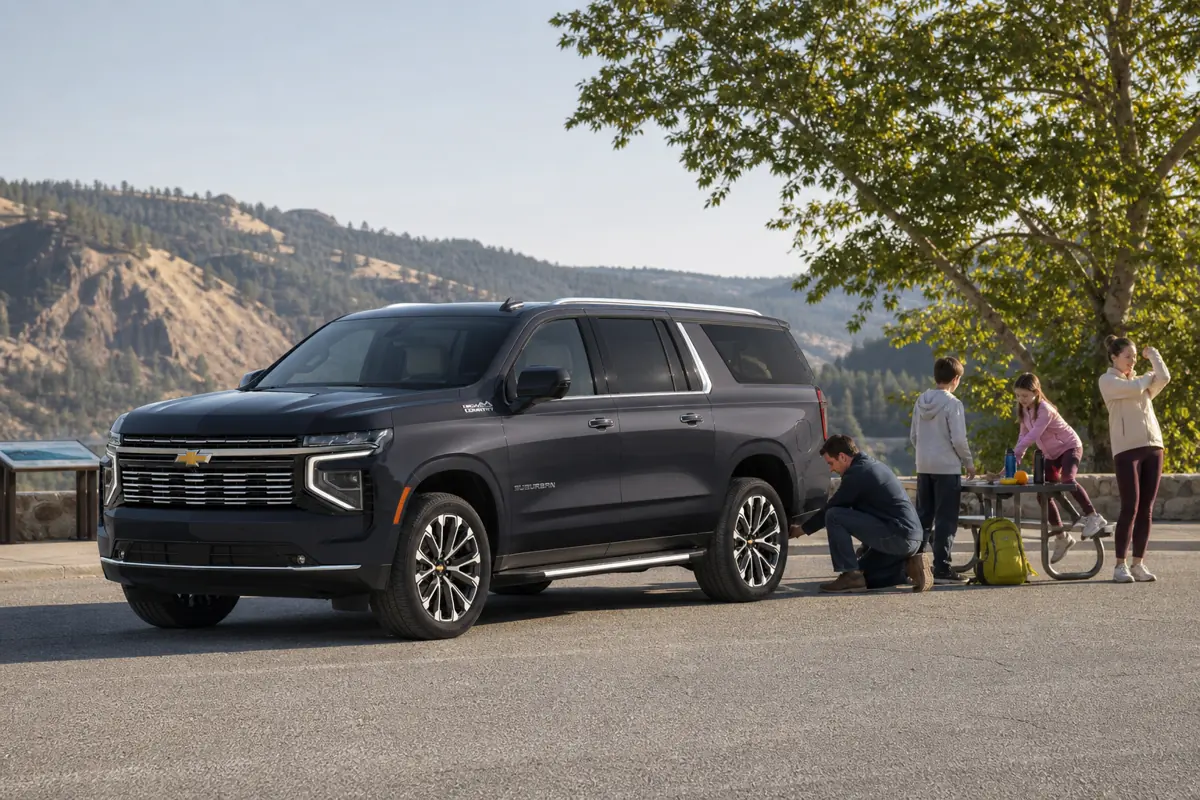
Test the exact wheel and suspension combination on broken pavement. Listen for tire noise and cabin boom with the cargo area empty.
Sit in row three for at least 20 minutes and check climate airflow, charging access, belt fit, and window view.
The driver should test common screen, camera, and climate tasks without coaching.
A diesel vehicle comparison can frame route and service needs. Suburban is strongest as a long-distance carrier, not a status purchase for short solo errands.
Safety Research Requires More Than Borrowing the Tahoe Result
IIHS publishes current crash-test details under the Tahoe listing, but a buyer should not silently transfer every Tahoe result to Suburban unless the Institute explicitly says the rating applies.
The current Suburban page was not available in the same form during this review.
Shared architecture is useful context, not permission to invent a Suburban grade.
Chevrolet lists automatic emergency braking, blind-zone assistance, lane support, rear cross-traffic braking, camera views, and other driver aids across the full-size SUV family, with equipment varying by trim.
Confirm the window sticker and read operating limits in the 2026 Tahoe/Suburban vehicle information and owner documentation.
A Suburban battery fitment also matters because low voltage can trigger multiple warnings.
A long, heavy SUV needs more space to stop and can present a greater risk to people outside it.
Automatic braking may reduce some collisions but cannot see through blocked sensors or overcome worn tires. Keep cameras and radar areas clean, secure cabin loads, and leave a longer following gap when full or towing.
Recent campaigns show why model year and VIN matter. Certain 2021-2024 Suburbans with the 6.2-liter V8 were included in an engine-component recall.
Certain 2023-2024 models were included in a brake-fluid warning software recall. Certain 2025-2026 examples with 24-inch wheels were included in a front hub-bolt recall.
The Suburban recall tracker can explain campaign scope. The used Suburban guide applies those campaigns to year selection.
It must not replace the live government result.
When a current crash grade is unavailable for the exact model, say so and rely on verified equipment, recall, restraint, tire, and driving evidence.
Used Suburbans Reveal Their History Under the Rear Floor
A used Suburban may have carried trailers, large families, fleet passengers, or heavy cargo for years.
Inspect the area that delivered that value. Look below the rear floor, around hitch mounts, under the bumper, at suspension links, and along the frame for corrosion, impact, poor wiring, and overloaded wear.
Check rear climate, seat mechanisms, liftgate, glass, and every charging point.
Cold-start the engine after an overnight rest. Listen through warm-up and watch oil pressure, coolant temperature, warning lights, and exhaust.
On a 6.2-liter 2021-2024 example, confirm whether the VIN falls under NHTSA campaign 25V274 and collect the inspection or repair invoice.
Do not rely on a seller's memory.
| System | Test | Evidence that should pause the deal |
|---|---|---|
| Engine | Cold start, full scan, oil and coolant inspection | Knock, pressure warning, metal, active campaign |
| Transmission | Low-speed shifts, highway pass, coast and reverse | Slip, delayed engagement, repeatable harsh shift |
| Rear suspension | Inspect links, dampers, air components if fitted | Lean, leaks, compressor overuse, uneven tire wear |
| Trailer area | Check receiver, wiring, brake controller, frame | Bent mount, corrosion, poor splice, overload damage |
| Cabin systems | Operate every seat, climate zone, screen, camera | Repeated fault or water intrusion |
| History | Review title, service, fleet use, and recalls | Structural damage or missing maintenance evidence |
Scan all modules. Camera, restraint, suspension, trailer, seat, climate, and infotainment faults may not light the engine warning.
Test both batteries where diesel or equipment requires them, and check tire date codes and load ratings.
A set of large full-size-SUV tires changes the economics of a used deal.
Separate model-year research can compare years. For the individual vehicle, a documented stock example with completed recalls and clean inspection is safer than a cheaper modified SUV with uncertain history.
No open engine or brake campaign, persistent warning, structural repair, or unexplained fluid loss should be accepted without a verified remedy. A pre-purchase lift inspection is inexpensive beside the cost of a drivetrain or suspension repair.
A 5.3-Liter LT Makes Sense Only When the Cargo Volume Stays Busy
Suburban's five-year cost includes depreciation on a high purchase price, fuel, insurance, registration, tires, brakes, service, repairs, finance charges, and parking damage risk.
Its maximum cargo volume does not reduce any of those bills. The expense is justified when the family would otherwise need a second vehicle, trailer, roof box, or repeated seat folding.
At 15,000 miles per year and 17 mpg combined, the 5.3 rear-wheel-drive assumption uses about 882 gallons.
At $3.50 per gallon, fuel is roughly $3,087 annually. A 23-mpg crossover uses about 652 gallons and $2,283, around $804 less.
Diesel changes the volume and price, but its option cost, DEF, filters, and use pattern remain part of the comparison.
Pros
- 41.5 cu ft behind row three and 144.5 cu ft maximum
- Adult-usable third row with up to nine seats
- Three engines and up to 8,200 lb of towing
- Stable highway ride and long fuel range with diesel
Cons
- 226.3-inch length limits garages and parking
- High fuel, tire, insurance, and depreciation cost
- Maximum towing is slightly lower than Tahoe
- Recent 6.2-engine and wheel-hub recalls require VIN checks
A 5.3-liter LT on the smallest suitable factory wheels is the broad recommendation.
Add four-wheel drive only for recurring traction needs. Choose diesel after annual highway miles and local fuel prices show a return.
Choose 6.2 only when stronger performance matters enough to accept premium fuel and careful recall review.
The Suburban cost-to-own breakdown can model the household. The Suburban maintenance schedule should be priced for the same engine, wheels, and annual mileage.
Suburban is worth its size when 41.5 cubic feet behind a live third row prevents a weekly compromise.
If Tahoe passes the same cargo test, buy the shorter SUV.