Set a walk-away total
Set one five-year spending limit before driving Sport, Hybrid, or Wilderness. Include purchase, interest, fuel, insurance, four tires, service, accessories, and a repair reserve.
Then subtract the cost of equipment the route does not use.
The limit should survive a lower resale value and one expensive tire event. If Hybrid or Wilderness fits only after extending the loan, return to Sport or a different vehicle.
A version is affordable when its repeated job fits inside the total without optimistic fuel, trade, or repair assumptions.
Three versions solve different jobs
The gas Sport, Hybrid, and Wilderness should not be ranked on one ladder. Sport is the value baseline for ordinary commuting, weather, and maintained dirt roads.
Hybrid must earn its premium through annual miles. Wilderness must earn its fuel and tire cost through measured clearance or trailer needs.
Choose the use case first, then compare trims only inside the version that solves it.
| Version | Repeated job | Proof before buying |
|---|---|---|
| Sport | Daily AWD travel at a controlled price | Loaded grade and tire quote |
| Hybrid | High annual mileage and traffic | Personal hybrid break-even date |
| Wilderness | Rough access or trailer above 1,500 lb | Measured obstacle and loaded trailer |
| Larger SUV | More width, height, or payload | Passenger and cargo rehearsal |
Put the hybrid break-even date on a calendar. Divide the complete Hybrid premium, including finance and insurance differences, by annual fuel savings.
If the result reaches year six but the owner normally trades after four, the fuel case fails. Repeat with lower gasoline prices, three fewer MPG than the rating, and a tire replacement during ownership.
Wilderness needs a similar test. Compare annual gallons at its 24 city and 29 highway ratings with Sport.
Add all-terrain tire replacement, insurance, and any towing equipment. Then divide that cost by the number of trips that actually need 9.3 inches of clearance or more than 1,500 pounds of capacity.
A specialty trim used twice a year can be replaced by a rental or a different route.
Sport still needs proof. Load the household, climb the difficult road, price four winter or all-season tires, and confirm cargo.
A lower purchase price is false economy when the cabin forces an early trade. Compare the Subaru Outback when long cargo and highway comfort matter, and the Jeep Wrangler only when low range and trail articulation are real requirements.
Write one sentence for the vehicle's job and one number for the maximum five-year cost.
If a feature does not support that sentence, leave it off the contract. This prevents Hybrid economy, Wilderness styling, or Limited equipment from changing the mission after the decision is made.
Sport is the value baseline
The 2026 Subaru Crosstrek now uses a 180 hp 2.5L engine across the gas range, which removes the old reason to climb trims just for adequate power.
Sport is the best starting point because it combines that engine, standard AWD, and useful equipment without the cost and specialized hardware of Hybrid or Wilderness.
Price Sport first, then make efficiency or trail capability prove the extra money.
Get written out-the-door totals for Premium, Sport, and the next trim that contains a must-have feature.
Include destination, dealer accessories, tax, interest, insurance, and the first tire set. A small monthly difference can become several thousand dollars when the term changes.
Drive Sport with passengers and cargo. Test parking speed, a highway merge, a grade, and a safe pass.
The 2.5L does not need to feel quick, but it should respond consistently without forcing the driver to avoid normal gaps.
Listen to engine speed through the CVT and decide whether its sound and response remain acceptable on the hardest weekly road.
The standard 8.7 inches of ground clearance already handles snow, maintained dirt roads, and many trailhead approaches.
Measure the actual obstacle that causes concern before paying for 9.3-inch Wilderness clearance. More ride height does not protect the exhaust, bumper, or rocker from careless line choice.
Compare the Subaru Forester when rear-seat width, cargo height, or visibility feels tight. Compare the Mazda CX-50 when road feel matters more than the Crosstrek's smaller footprint.
The AWD vehicle index shows alternatives that may use different systems and tires.
Sport is not automatically the cheapest lifetime choice. High annual mileage can support Hybrid, and regular rough-road towing can support Wilderness.
The key is to name the repeated task. A trim selected for an annual camping photo is less defensible than one selected for 200 winter commutes.
Can the hybrid repay itself?
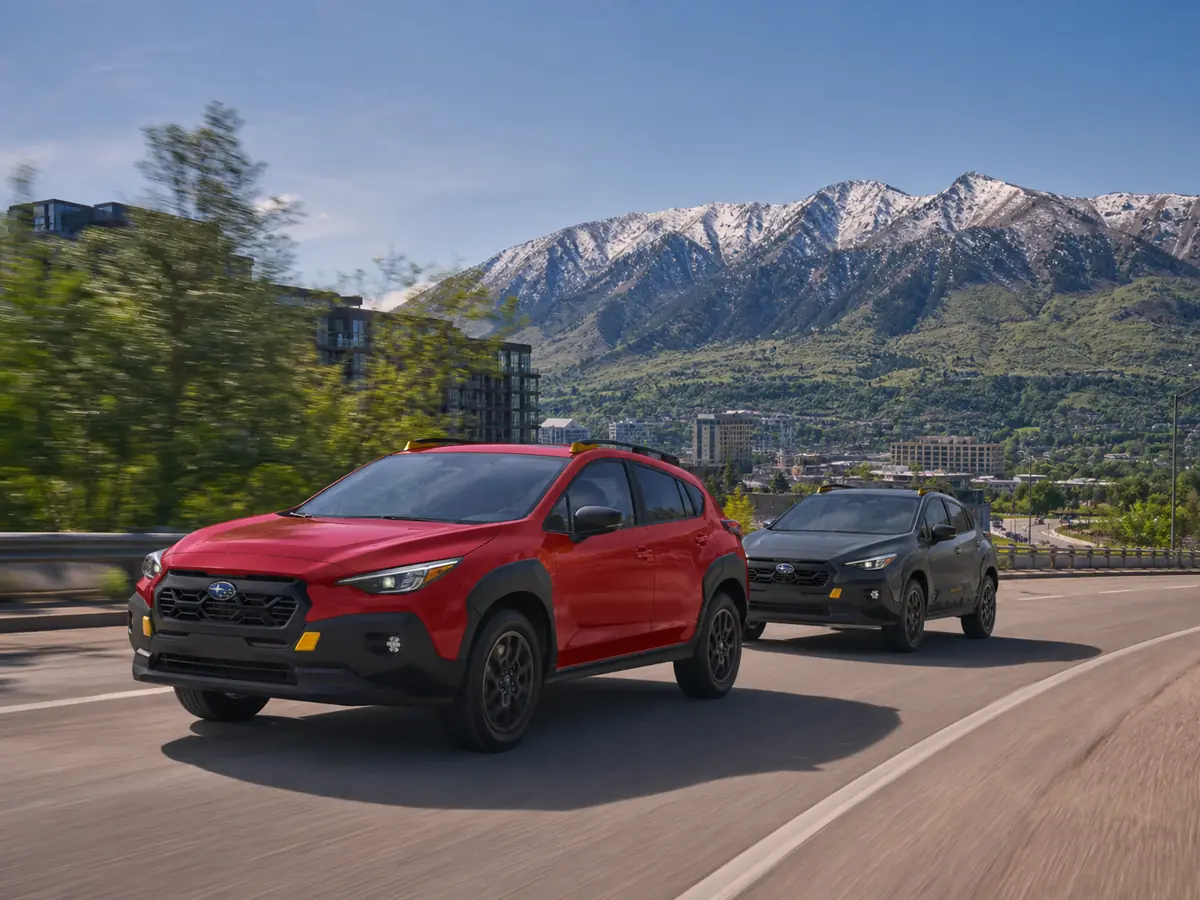
The 2026 Crosstrek Hybrid makes 194 hp and carries a 36 mpg city, highway, and combined rating.
It can reduce fuel use, especially for drivers covering many mixed miles. It also costs more and provides 50.6 cubic feet of maximum cargo instead of about 54.7 in the regular gas version.
| Measure | Gas Crosstrek | Crosstrek Hybrid |
|---|---|---|
| Output | 180 hp | 194 hp |
| Fuel economy | Up to 26 city and 33 highway | 36 city, highway, and combined |
| Maximum cargo | About 54.7 cu ft | 50.6 cu ft |
| Charging | None | None, it is a regular hybrid |
| Best use | Lower price and normal miles | High miles and traffic |
Calculate annual gallons using exact trim ratings. At 15,000 miles, 36 mpg uses about 417 gallons.
A 29 mpg gas average uses about 517. Multiply the 100-gallon difference by a conservative local fuel price.
Compare annual savings with the actual price gap, added interest, insurance, and expected ownership period.
City share matters. A driver covering low-speed traffic can use the hybrid's regenerative braking more often than someone cruising at high speed.
Cold weather, short trips, roof cargo, tire choice, elevation, and cabin heat can reduce results. Run a poor-year estimate so the purchase does not depend on the full rating.
Drive both on the same day. Test low-speed response, engine start, a highway merge, a grade, brake blending, and steady noise.
The hybrid may feel stronger without behaving like a performance model. Its value includes response and quiet operation as well as gasoline saved.
Give those benefits a dollar limit rather than forcing them into fuel math.
Load the exact cargo that travels. The 4.1-cubic-foot difference may be irrelevant for two backpacks but decisive for a dog crate or stroller.
Check floor height, spare or repair equipment, rear-seat folding, and secure storage.
Use the hybrid vehicle hub to compare the Honda CR-V Hybrid if a larger body is acceptable. Choose Hybrid when miles, route, and ownership length repay the premium without making its smaller cargo area a daily compromise.
Wilderness needs rough ground
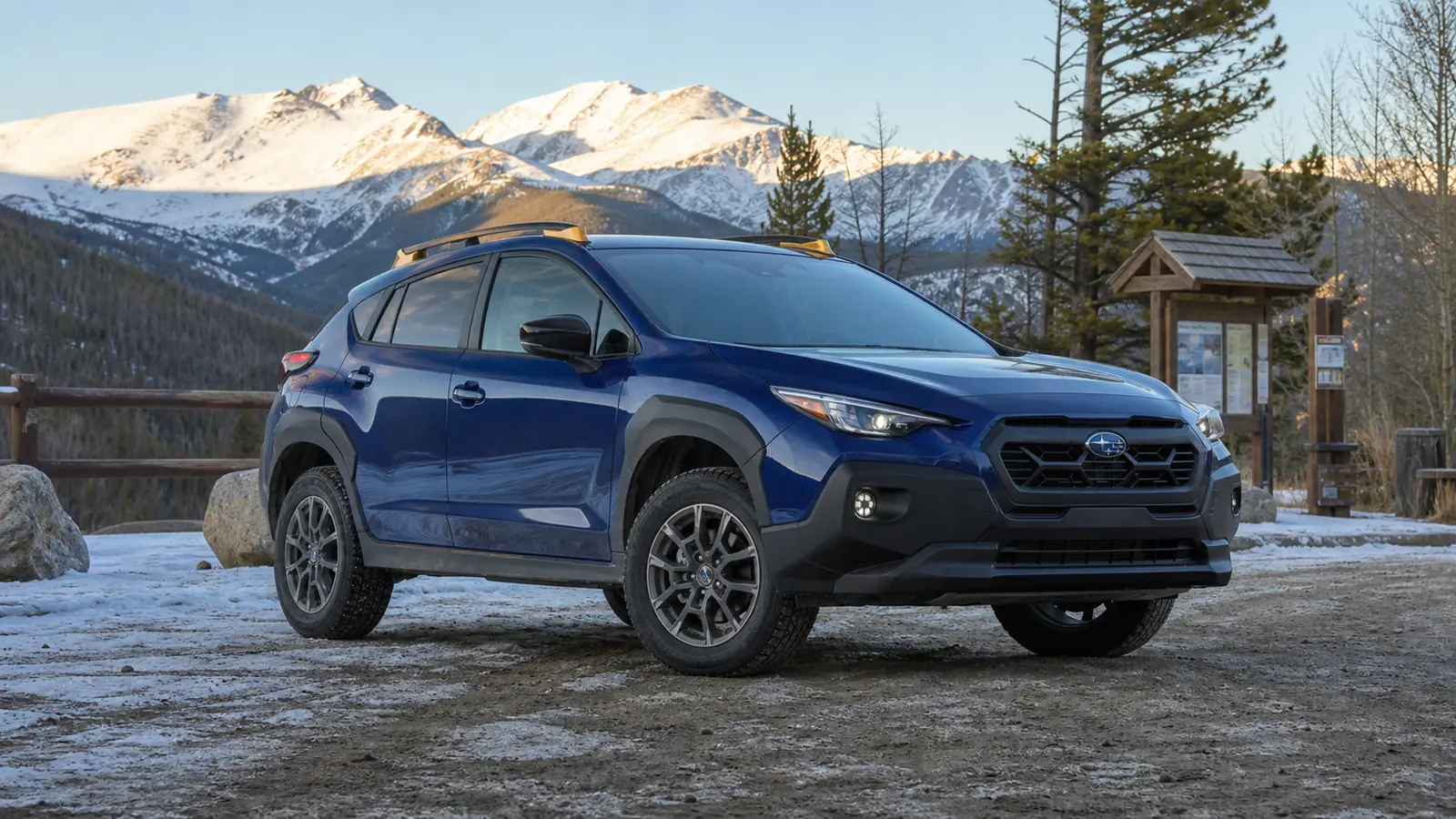
Crosstrek Wilderness adds 9.3 inches of ground clearance, all-terrain tires, revised gearing and suspension, and up to 3,500 pounds of towing capacity.
Other trims generally tow up to 1,500 pounds. The hardware is meaningful when the owner regularly uses rough approaches or a measured trailer.
It is expensive decoration when pavement covers nearly every mile.
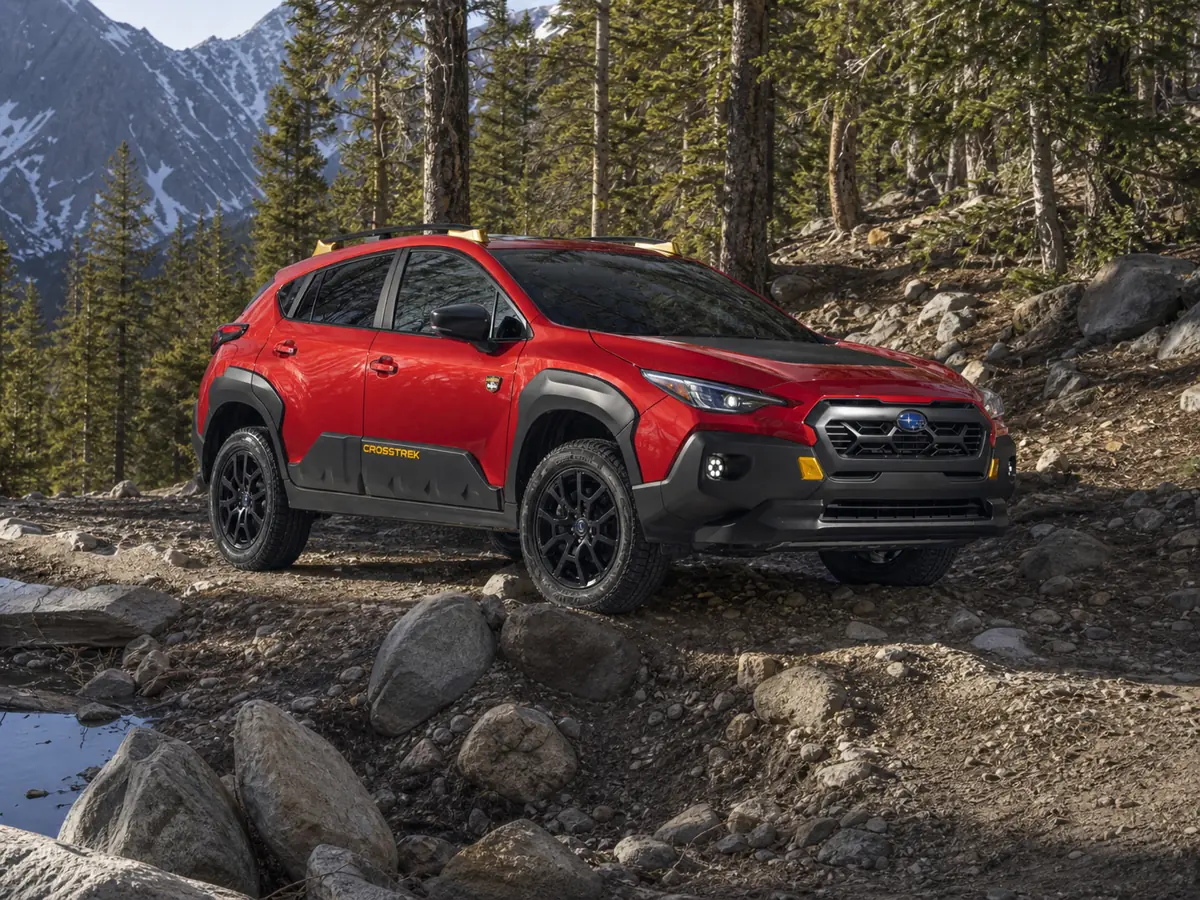
Visit the actual dirt road or reproduce its steepest legal grade, washout, and loose surface.
Measure the obstacle that causes scraping. Check approach and departure angles, not only ground clearance at one point.
Inspect the front bumper, exhaust, center underbody, rear differential area, and rocker protection after the test.
The all-terrain tires may improve loose-surface grip but can add road noise, rolling resistance, and replacement cost.
Subaru rates Wilderness at 24 city and 29 highway, below the standard gas figures. Drive at 65 to 75 mph on the pavement used most and listen on both smooth and coarse surfaces.
Test wet braking where safe.
| Hardware | Useful when | Cost when unused |
|---|---|---|
| 9.3-inch clearance | Repeated ruts, snow, rocks | Fuel and handling tradeoff |
| All-terrain tires | Loose surfaces occur often | Noise, wear, replacement price |
| 3,500-lb towing | Loaded trailer exceeds 1,500 lb | More fuel and equipment cost |
| Revised gearing | Slow climbs and loaded launch | Higher engine speed |
| Body protection | Careful trail travel | Cannot prevent all impact damage |
Trailer math begins with the door-label payload. Subtract people, cargo, accessories, and measured tongue weight.
Use loaded trailer weight, including water, batteries, fuel, and gear. Confirm hitch, wiring, brakes, tire load index, cooling, and manual instructions for the exact vehicle.
Compare a larger Subaru SUV when the trailer or cargo approaches the Crosstrek limits.
More wheelbase, payload, and cabin volume can be worth added size. If the rough road appears twice a year, renting a more capable vehicle may cost less than Wilderness fuel and tires every day.
Choose Wilderness when its clearance, tires, or towing rating solves a repeated measured problem. Sport remains better for ordinary roads and seasonal weather.
The cabin is hatchback narrow
Crosstrek is easy to park because it is closer to a lifted compact hatchback than a wide family SUV.
That size creates the main cabin limit. Five seats exist, but three adults, wide child restraints, a large dog crate, or bulky winter gear can expose width and cargo-height constraints.
Install every child seat and booster. Check lower anchors, top tethers, buckle access, front-seat clearance, and whether an adult can sit beside the restraint.
A rear-facing seat may reduce front passenger space. Three-across fit depends on exact restraint models and should never be assumed from the seat count.
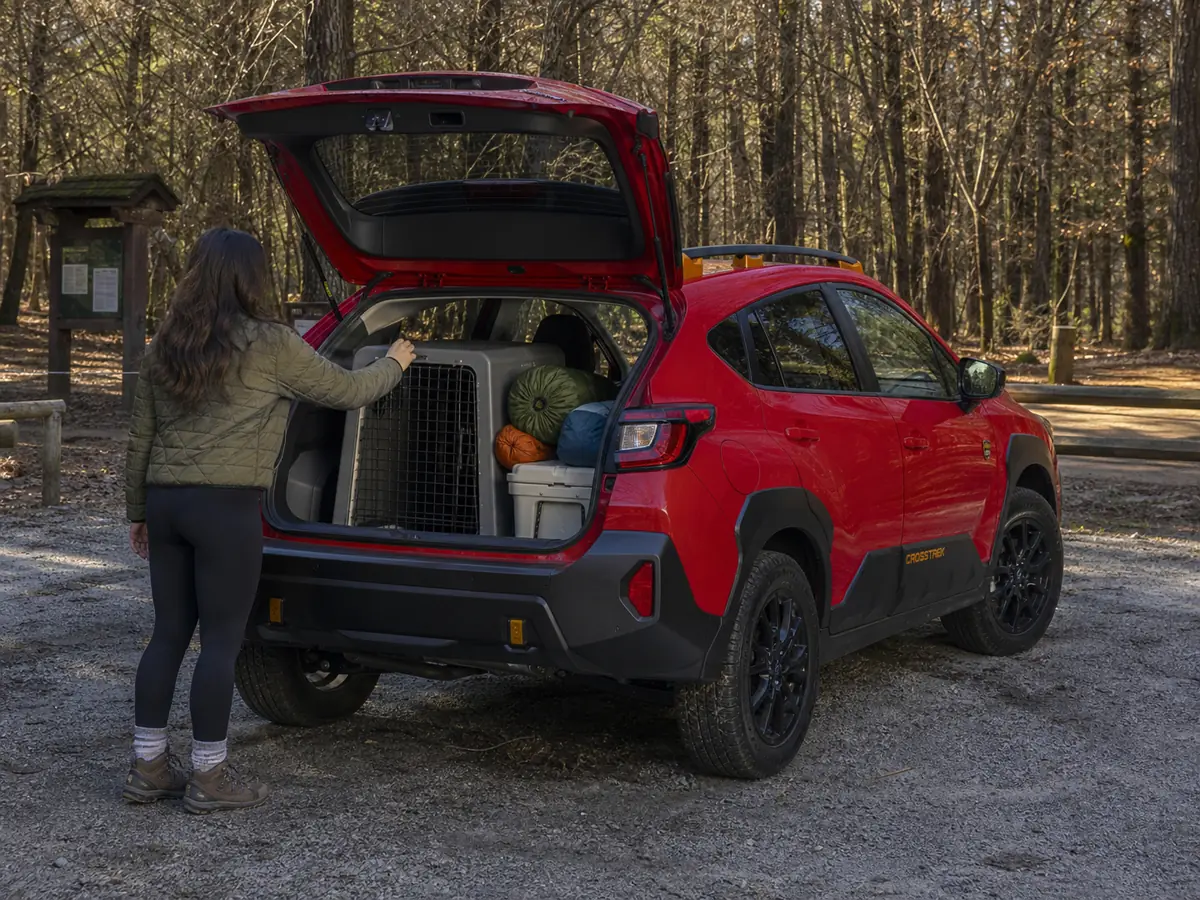
Load the largest weekly object without folding a required seat. Try the stroller, crate, cooler, tool case, skis, or bicycle.
Check hatch opening width, floor height, roof slope, tie-downs, cover clearance, and rear view.
Fold only one seat to see whether a passenger can remain beside long gear.
- Install the real child restraints
- Load the widest rigid object first
- Close the hatch without touching glass
- Keep rear visibility clear
- Test roof-rack loading height
- Reach the spare or repair kit with cargo aboard
Roof rails can carry long equipment, but roof load raises the center of gravity and total height.
Confirm dynamic load limits, crossbar compatibility, garage clearance, and secure attachment. A roof box reduces fuel economy and creates storage work when removed.
Compare the compact SUV category with the Honda HR-V and Forester. HR-V may suit urban use, while Forester gives a taller and wider cabin.
Crosstrek should win because its smaller shape is easier daily and still carries the actual load.
Small-item storage also matters. Test phones, bottles, gloves, sunglasses, charging cords, and trail maps.
A narrow console can become cluttered quickly.
Crosstrek space is enough when the household proves width, height, and rear-seat fit with its own objects, not when maximum cargo looks competitive on paper.
Standard AWD still needs tires
Every Crosstrek includes AWD, but the system can distribute only the grip available at four contact patches.
It cannot shorten braking on worn tires, correct excessive speed, or create traction on ice.
Tire condition and type remain the main winter purchase after the vehicle.
Inspect all four tires for size, model, load and speed rating, production date, tread depth, pressure, damage, and uneven wear.
Subaru drivetrains need closely matched rolling circumference. A single new tire beside three worn ones may require measured shaving or replacement of more than one tire according to approved procedures.
Choose tires from the roads used most. A driver on cleared city streets may prefer quiet all-seasons plus cautious snow travel.
A mountain commuter may need dedicated winter tires. Wilderness all-terrains serve loose surfaces but are not automatically the best tire for ice or wet pavement.
Read independent tests for the exact tire.
Test the vehicle in rain or snow only when legal and safe. Feel how gently the system launches, how the steering communicates grip, and how ABS responds.
Avoid demonstrations that encourage sudden maneuvers on public roads. Ground clearance helps avoid deep snow contact, but it does not prevent a slide.
Price a complete set with mounting, balancing, disposal, alignment, seasonal storage, and sensors when applicable.
Include a replacement plan for one damaged tire. Tire costs can erase part of the value of an expensive trim, especially when a specialty size has fewer choices.
The winter driving guide should inform the plan if available, while the front-wheel-drive index offers alternatives that may perform well on correct winter tires. Do not buy more drivetrain than the route needs while neglecting the tires it depends on.
Standard AWD is valuable when the owner maintains four correct tires and drives for conditions. It is not a substitute for braking distance, judgment, or winter preparation.
Drive the CVT on a grade
The 180 hp 2.5L engine and CVT are adequate for most Crosstrek use, but the test must include the hardest weekly road. An empty loop on flat streets cannot reveal behavior with passengers, cargo, air conditioning, altitude, or a sustained grade.
Load the vehicle normally. Start cold, engage reverse and drive, crawl in traffic, accelerate onto the highway, climb a grade, and make a safe pass.
The CVT may raise engine speed and hold it while speed builds. Decide whether that sound and response are acceptable, but separate normal operation from shudder, delay, flare, warning lights, or inconsistent power.
| Segment | What it reveals | Reject sign |
|---|---|---|
| Cold parking | Engagement and low-speed control | Delay, thump, repeated surge |
| Highway merge | Loaded acceleration | Inconsistent response or warning |
| Long grade | Heat and sustained engine speed | Overheat message or loss of power |
| Descent | Engine braking and brake feel | Pulling, vibration, poor control |
| Rough pavement | Tire noise and suspension | Clunk, steering wander, harsh impact |
At elevation, naturally aspirated engines lose power as air density falls. A buyer living in the mountains should test there with the normal load.
Wilderness gearing can change response, while Hybrid adds output and electric assistance. The version that feels strongest on a short flat drive may not be the best on a long climb.
Use manual or paddle modes only after understanding the owner's manual. They simulate ratios for control but do not turn the CVT into a conventional stepped transmission.
On a descent, select an appropriate mode early and keep brake application controlled.
Stop if there is odor, vibration, or a warning.
Test steering center, crosswind correction, brake pedal, lane support, and visibility. A wheel alignment, tire pressure, roof load, or accident repair can change how one example feels.
Ask the seller to set correct tire pressure before comparing vehicles.
The 2.5L Crosstrek is strong enough when it merges, climbs, and descends predictably with the household's real load. Reject a trim decision made on an empty flat loop.
EyeSight depends on clear vision
Crosstrek driver assistance uses cameras that need a clear, correctly installed windshield and proper calibration after relevant work.
Match safety evidence to the exact model year and trim. Crash tests, headlights, software, and equipment can change within a generation.
Read the individual IIHS tests and use the VIN in the NHTSA recall lookup.
Save the build month and headlight type. A broad award does not tell the buyer whether a specific lamp performed well or whether a repaired windshield camera was calibrated.
Inspect the windshield for chips, distortion, haze, scratches, tint near cameras, and nonstandard accessories.
Watch startup indicators and confirm that EyeSight becomes available. Test adaptive cruise, lane support, warnings, cameras, and automatic braking alerts without creating a dangerous situation.
Learn how weather, glare, dirt, and faded markings limit operation.
Install child restraints in the intended positions. Locate anchors and top tethers, tighten each seat, and check adjacent buckle access.
Test adult belt fit and head restraints. Secure outdoor equipment so a cooler, tool, or bottle cannot strike a rear passenger during hard braking.
Headlights should be checked after dark on the route used most. Confirm low and high beams, aim, automatic functions, and visibility in rain.
Tires, speed, and driver attention remain important regardless of assistance.
KnowMotors explains its use of independent safety sources and provides a buying disclaimer. Use current evidence to compare vehicles, not as a guarantee of a future crash.
EyeSight adds value when the cameras can see clearly, calibration is documented, warnings are understood, and the driver still controls speed, following distance, and attention.
Inspect weather and trail wear
A used Crosstrek may have spent years in snow, salt, dirt, roof-rack use, or trailhead parking.
Those uses are not defects. Neglected fluid, mismatched tires, underbody impacts, wheel-bearing noise, water entry, or undocumented modifications are the concern.
Start cold and check oil and coolant by the manual. Listen for abnormal rattle, smoke, rough idle, or bearing hum.
Test CVT engagement, parking speed, highway load, a grade, and a tight turn.
Scan every module for current, pending, and history codes.
| Area | Inspect | Evidence |
|---|---|---|
| CVT | Engagement, shudder, heat behavior | Long road test and scan |
| AWD | Four matched tires and tight-turn behavior | Measurements and service records |
| Bearings | Speed-related hum that changes with load | Lift and road inspection |
| Underbody | Shields, exhaust, suspension, leaks, corrosion | Lift inspection |
| EyeSight | Glass, cameras, warnings, calibration | Invoice and scan |
| Hybrid | Cooling intake, transitions, warning history | Hybrid inspection and coverage |
Inspect underbody panels, exhaust, suspension mounts, wheel wells, rocker edges, and recovery points.
Fresh coating can protect or conceal. Ask what was applied and inspect beneath accessible areas.
Modifications to suspension, wheels, tires, lighting, or wiring need receipts and a return-to-stock cost.
Operate the hatch, windows, locks, screens, cameras, climate, heated equipment, outlets, roof accessories, and driver aids.
Check the spare area, carpet, headliner, seals, and odor for water. Roof racks can damage paint or create leaks when installed incorrectly.
Verify recalls, service, and warranty by VIN. A seller's statement that Subarus are durable is not evidence about this car.
Use the new and used comparison to decide whether the discount pays for shorter coverage and inspection risk.
A used Crosstrek is a good candidate when its trail and weather use is visible, documented, and matched by maintenance. Hidden impacts, tire mismatch, or warning history belong in the price or end the deal.
Pick the version that works
Choose Sport when standard AWD, 180 hp, and 8.7 inches of clearance cover the route at a controlled price.
Choose Hybrid when high annual mileage and traffic repay the premium without making its smaller cargo area a problem.
Choose Wilderness when 9.3 inches, all-terrain tires, or 3,500-pound towing are used regularly.
Run the decision in order. Measure passengers and cargo, drive the 2.5L on a grade, calculate hybrid fuel value, measure Wilderness obstacles and trailer load, inspect tires, verify safety evidence, complete a used inspection, then compare out-the-door prices and insurance.
A discount should not create a use case. Cheap Wilderness inventory still costs more to fuel and re-tire.
A high Hybrid trade estimate should not justify a premium that takes longer than the planned ownership to recover.
A Sport with the right tires can be the most capable answer for ordinary winter life.
Keep enough money after purchase for a tire set, maintenance, insurance deductible, and emergency repair. A long loan on a specialty trim can leave the owner paying for hardware that no longer matches the route.
The Crosstrek succeeds because it puts useful AWD and clearance in a small body. Do not force it to become a family cargo SUV or a heavy tow vehicle.
Choose a larger platform when those are regular tasks.
Sport is the default recommendation. Hybrid and Wilderness are better only when annual miles, cargo, rough ground, or trailer weight can show exactly how their extra cost returns value.