Write the truck task before choosing a trim
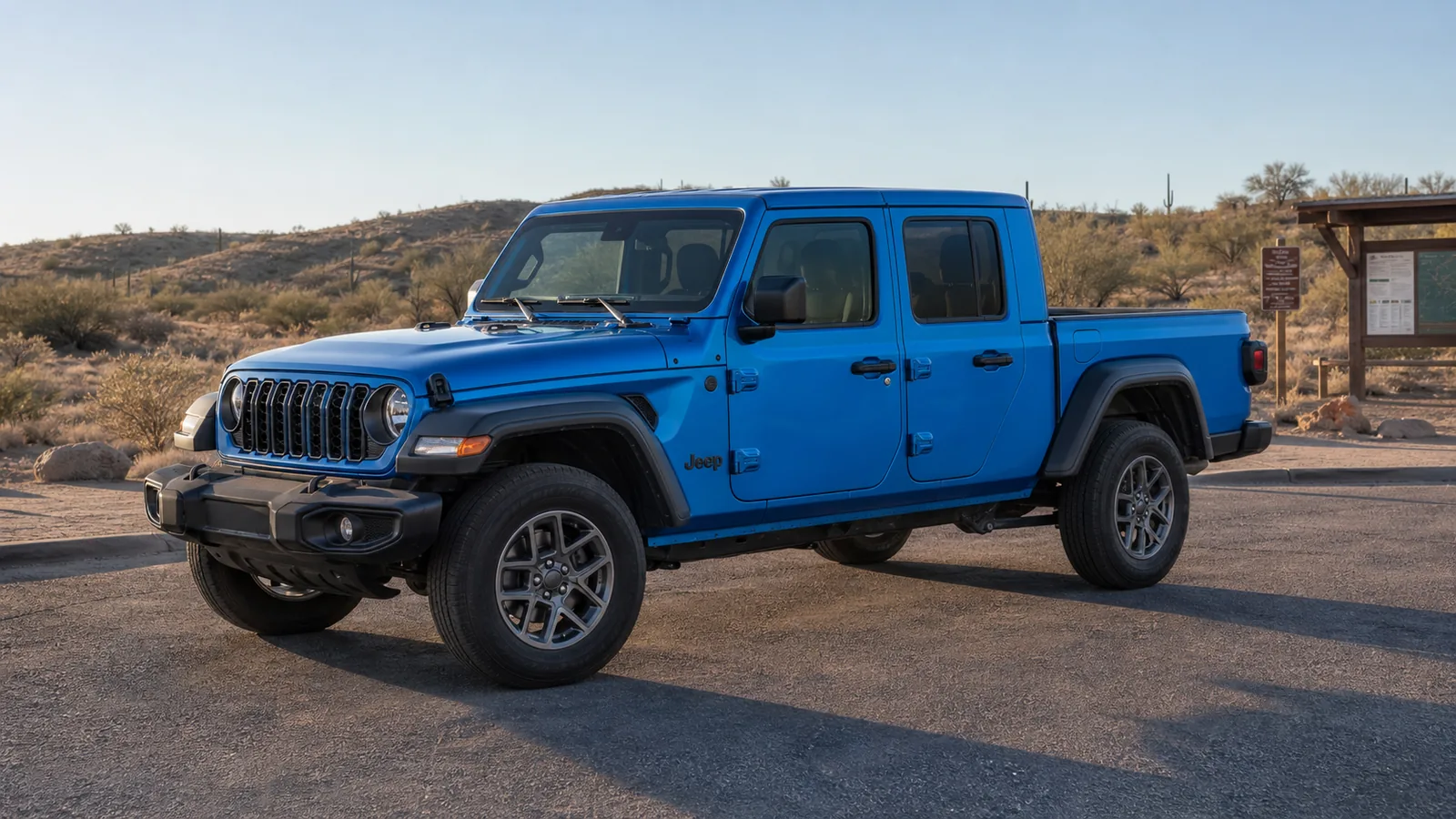
The 2026 Jeep Gladiator is a five-seat crew-cab pickup with a five-foot bed, standard part-time four-wheel drive, and removable roof and doors. Its value depends on doing two jobs often enough: carrying a real truck load and delivering the open-air or trail experience that a conventional midsize pickup cannot.
Write down the passengers, bed cargo, hitch equipment, loaded trailer, repeated route, parking space, and roof-panel storage available during a normal week. A trim should leave the list only when one of those measurements or routines requires its equipment.
The Gladiator measures 218.0 inches long on a 137.3-inch wheelbase, so its truck bed and four-door cabin bring a different parking and breakover problem than a Wrangler. Measure the garage, driveway turn, trail access, and worksite before treating its familiar Jeep face as proof of fit.
Keep evaluating only when both the pickup function and removable-body experience solve repeated needs. A buyer who needs only one half can usually find a quieter truck or a shorter open-air vehicle with fewer compromises.
One V6 simplifies the choice but not the daily tradeoff
Every regular 2026 Gladiator uses a 3.6-liter Pentastar V6 rated at 285 hp and 260 lb-ft. It pairs with the 850RE eight-speed automatic and part-time four-wheel drive, leaving no current engine ladder to resolve.
The EPA label is 17 mpg city, 22 highway, and 19 combined for the applicable 2026 configuration. Those laboratory figures provide a comparison baseline, while tires, gearing, load, temperature, speed, and four-wheel-drive use can change fuel consumption on the buyer's route.
Use two-wheel-drive high range on dry pavement and reserve four-wheel-drive modes for suitable surfaces and conditions described in the owner's material. During the test drive, check low-speed throttle response, automatic shifts on a grade, and whether the engine needs frequent downshifts at highway speed.
One powertrain makes the specification sheet simpler, but it also means the buyer cannot purchase a quieter, torquier, or more efficient factory engine alternative within this model. The exact tires and axle hardware still change how that fixed baseline feels.
The five-foot bed needs a concrete loading test
A wide tool case, folded ladder, or long household item exposes the five-foot bed more clearly than its volume figure. Closed-bed length, wheel-well width, and tailgate position decide whether that real object can travel securely.
Available Trail Rail cleats and lockable storage can improve organization, but they cannot change the bed envelope or replace secure tie-down practice. The bed is 60.3 inches long with the tailgate closed and 81.3 inches with it open.
It measures 56.8 inches across, 44.8 inches between the wheel wells, 17.5 inches deep, and 35.5 cubic feet in volume.
Those numbers answer different questions. The wheel-well gap controls whether a wide case lies flat, closed length decides whether the load stays inside the bed, and depth affects stacking, cover clearance, and how easily a shorter person can reach gear.
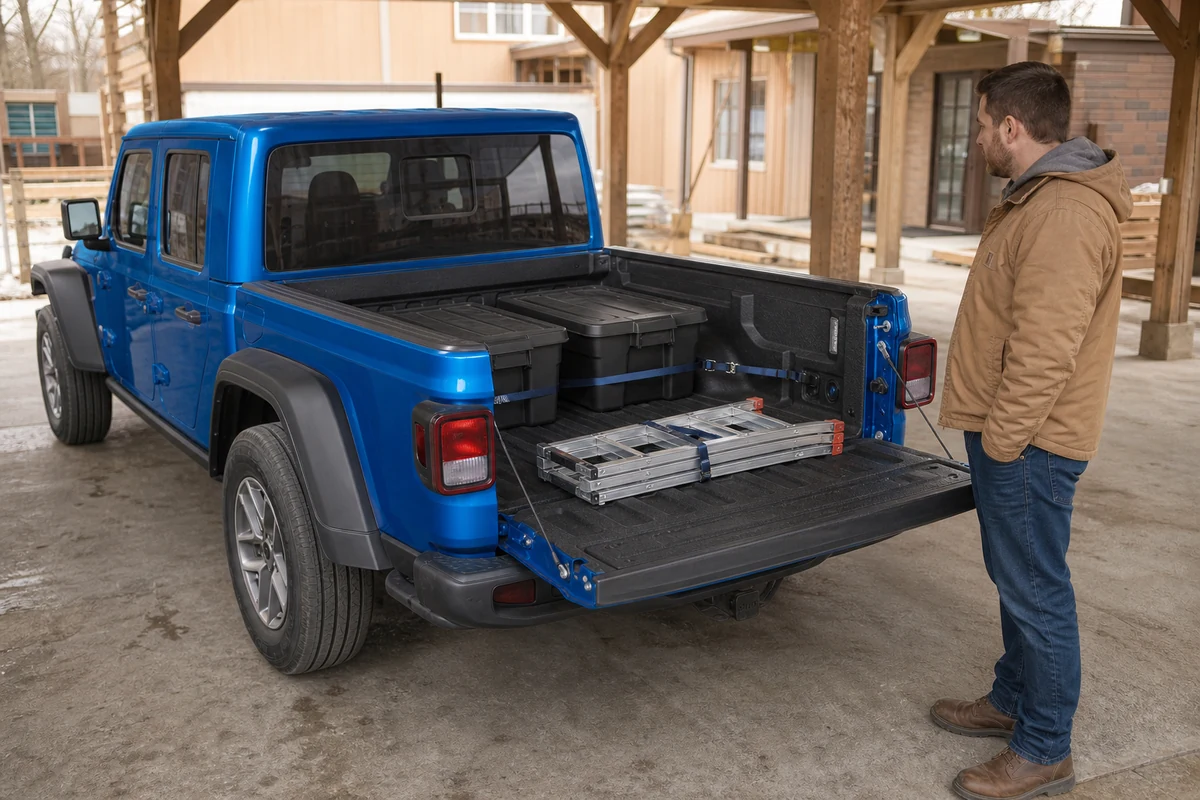
Keep all five passenger positions available during the decisive trial. Load the repeated totes, tools, sports equipment, or household item, secure it at the real tie-down points, then confirm the tailgate position, rearward view, weather plan, and passenger comfort.
Payload counts people, and most buyers forget that
Maximum payload is 1,720 pounds on a qualifying configuration. That number is everything the truck carries, and passengers are part of everything.
Five seats of adults is roughly 850 pounds before anything reaches the bed. On a truck at the lower end of the payload range, that is most of the budget spent before you load a single item.
Doing the payload arithmetic honestly
- Start from
- the payload on this truck's own door label, not the brochure maximum
- Subtract
- every passenger who normally travels
- Subtract
- fuel, tools, recovery gear and anything that lives in the truck
- Subtract
- the tongue weight of a trailer, which lands on the rear axle
- What remains
- is the actual bed capacity for this truck on this trip
Tongue weight is the item people miss most often. A trailer within the 7,700-pound towing figure still presses down on the hitch, and that weight comes out of payload rather than out of the towing number.
The five-foot bed compounds it. A short bed fills by volume before it fills by weight for light cargo, and reaches its weight limit surprisingly early for dense cargo such as gravel or paving.
Read the yellow label on the driver's door jamb of the exact truck. Options add weight and every option fitted comes straight out of the payload figure printed there, which is why two Gladiators on the same lot do not carry the same load.
Max Tow works only when the exact labels agree
A 6,500-pound trailer at 12 percent tongue weight places about 780 pounds on the truck before the driver, passengers, bed cargo, accessories, and hitch hardware consume payload. A truck can remain below its trailer maximum while exceeding the payload printed on its own label.
Jeep lists a maximum 7,700-pound tow rating for a qualifying 2026 Gladiator Sport S with Max Tow. The 1,720-pound maximum payload belongs to qualifying Sport or Sport S Max Trailer Tow configurations, and neither headline applies to every Gladiator.
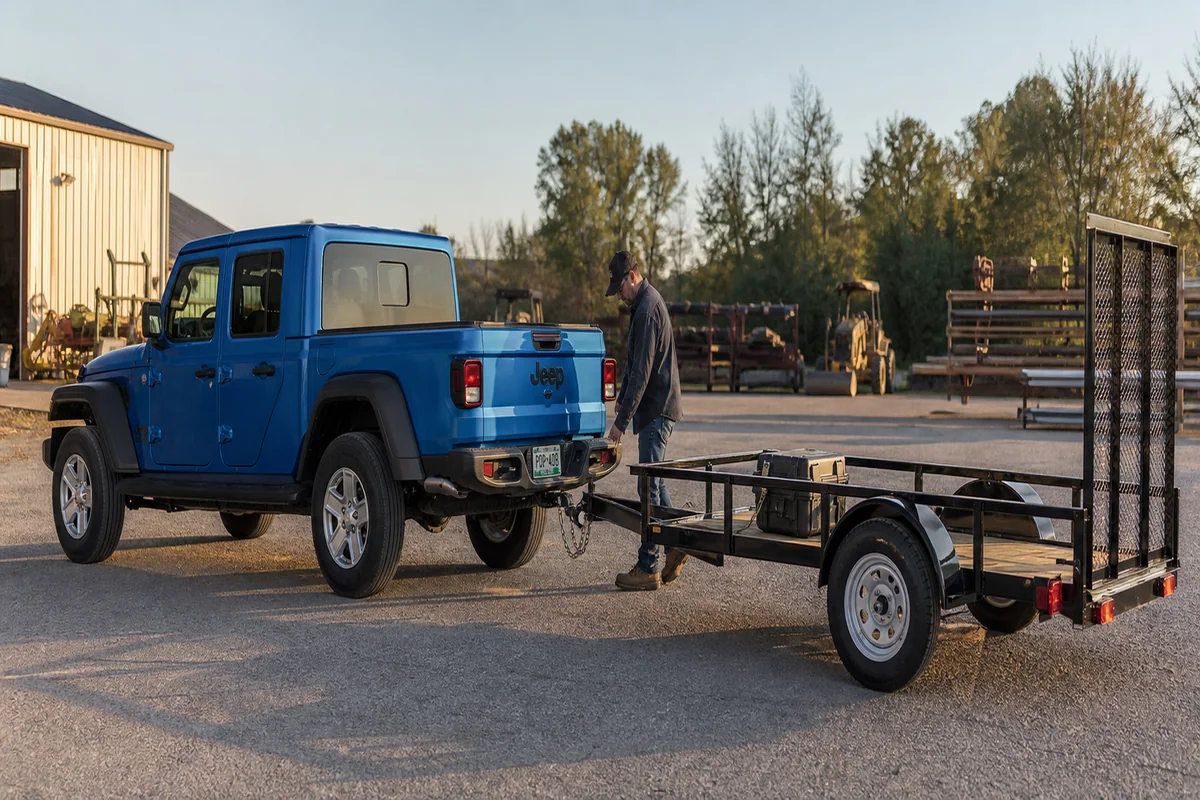
Capacity proof
- Match the VIN and window sticker to the required Max Tow equipment
- Read the certification and tire-loading labels on the exact truck
- Add every occupant, accessory, cargo item, and hitch component
- Use measured loaded trailer and tongue weights
- Confirm hitch, tires, brakes, and cooling equipment meet their own limits
A camera, controller, or heavy-duty axle can reduce workload or qualify a package, but no convenience feature raises a printed rating. Use a scale when the loaded combination is close enough that estimates leave no useful margin.
The lowest verified limit controls the trip. Reject the truck when the payload label, hitch, tire, axle, or trailer rating fails, even if the brochure's largest number looks sufficient.
Which Gladiator earns its price, and which one you are being sold
Displayed 2026 pricing runs from $40,015 to $61,210, and the destination treatment needs checking on any individual quote. That is a spread of more than twenty thousand dollars for one truck with one engine.
Every Gladiator uses the same 3.6-liter V6 making 285 hp and 260 lb-ft through the same eight-speed automatic. Nothing in that spread buys speed.
What it buys is hardware and trim, and the two are worth very different amounts depending on what you do. The maximum towing figure of 7,700 pounds belongs to a qualifying Sport S with the Max Tow package, which is near the bottom of the range rather than the top.
Sorting capability from decoration
- Write your real towing and payload figures down before a salesperson names a trim
- Check whether the truck in front of you carries the tow package or merely the badge
- Treat locking differentials and a disconnecting sway bar as trail equipment, not as luxury
- Price leather, screens and audio separately in your head from anything mechanical
- Confirm the tire size, because it changes both the ride and the effective gearing
The uncomfortable finding is that the cheapest useful configuration is often near the bottom of the range. A tow-equipped Sport S does the work that the price leaders at the top mostly decorate.
That is not an argument against the expensive trims. It is an argument for knowing which half of the money is buying capability and which half is buying comfort, before the two get sold to you as one thing.
Drive the repeated road before valuing the trail hardware
Road tests describe steering that needs frequent correction, noticeable crosswind sensitivity, and a busy ride on broken pavement. The Gladiator's solid front and rear axles support articulation and durable trail hardware, but they also explain part of that pavement behavior.
The 137.3-inch wheelbase adds stability and cabin-bed space while increasing the length that must clear parking turns and uneven terrain.
Begin on the pavement used every week, then let the ordered trial expose whether the exact tires and trim remain acceptable with a safe representative load.
Road and terrain trial
- Parking and visibilityCheck the long wheelbase, rear corners, mirrors, and camera views
- Broken pavementNote steering correction, impact motion, and cabin shake
- HighwayJudge tracking, wind and tire noise, shifts, and passing response
- Grade and brakingTest speed control and pedal confidence with representative legal load
- Permitted terrainEngage four-wheel drive only on an appropriate surface and use a bypass when unsure
Rubicon targets slower technical terrain with low-range and crawling hardware, while Mojave is tuned for faster rough-surface control, while Willys offers a different traction and tire balance. Keep each claim attached to the exact trim and choose the least expensive hardware that clears terrain the owner will actually drive.
Trail capability earns its cost only when the terrain calls for it more often than the road compromises irritate the owner. A buyer who spends nearly every mile on pavement should give highway noise, ride, steering, braking, and fuel use more weight than an unused axle feature.
What the off-road hardware costs you on the commute
The Gladiator is good at the things it is built for because of decisions that are unusual on a modern truck. Those same decisions are with you every day.
Solid axles at both ends, a part-time four-wheel-drive system and a removable roof are the reason it works on a trail. They are also the reason it does not drive like a crew-cab pickup built on a car-derived layout.
Three things a test drive should settle
Steering feel
A solid front axle steers differently, and it needs more small corrections at highway speed than most drivers expect. Decide whether that reads as character or as work.
Noise
A removable roof has more joints than a fixed one, and joints make noise. Hold a steady highway speed for several minutes rather than judging it around town.
Ride over joints
Concrete expansion joints are where solid axles announce themselves. Find some before you decide.
The fuel figure is the other daily cost. A rated 17 city and 22 highway gives 19 combined, which is what a tall, heavy, boxy truck costs to move.
Turn 19 mpg and your real mileage into a yearly bill
None of this is a fault, and pretending otherwise would be dishonest in the other direction. It is the price of the hardware, and it is only worth paying if the hardware gets used.
The question to answer before buying is simple and uncomfortable. Count the days last year you would have needed the low range or the roof off, and decide whether that number justifies every other day.
If the honest count is near zero, a conventional midsize pickup such as the Ford Ranger carries more and rides better for similar money.
Open-air use succeeds or fails in the storage routine
Remove the exact panels without sales assistance, inspect and protect the seals, place the pieces into intended storage, then refit them and check for wind or water intrusion. Confirm local mirror requirements before removing doors, because jurisdiction rules and the chosen replacement mirrors affect whether the routine is legal.
If the doors will come off, verify legal mirror requirements, safe lifting, protected storage, electrical-connector handling, and a dry place where the pieces cannot fall or be damaged.
A removable roof and doors give the Gladiator an experience that a normal pickup cannot copy. They also create lifting, storage, weather, visibility, and security work that a catalog photograph leaves out.
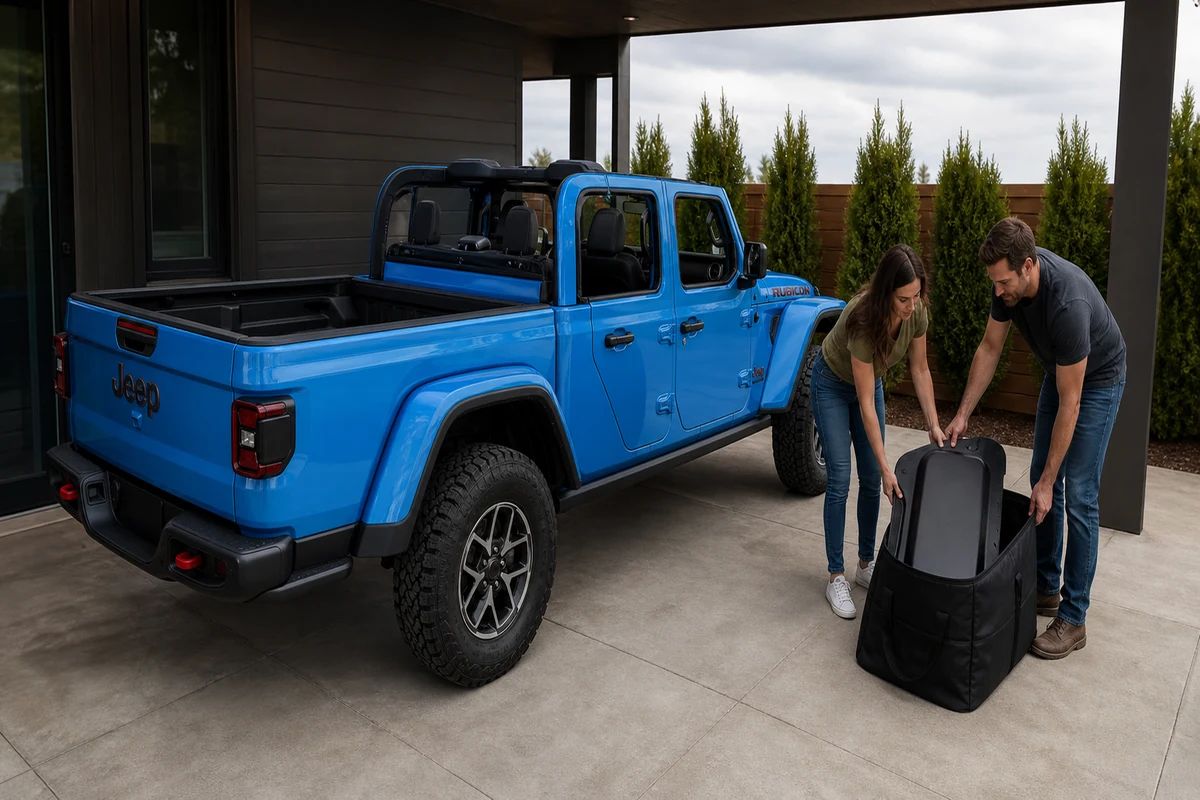
The official open-air reference shows a Rubicon, so its visible trim hardware should not be generalized to every Gladiator. Roof and door choices also differ in effort, noise, security, and storage needs, making the exact configuration more important than the shared open-body idea.
The feature earns money only when the owner can complete the whole routine repeatedly. Panels that remain installed because storage is awkward provide little return for the compromises designed around their removal.
Safety evidence changes with test, build date, and equipment
NHTSA vehicle 20924 has no overall rating and no side rating for the exact 2026 Jeep Gladiator 4WD. It lists four stars for frontal crash, three stars for rollover, a 26.7 percent rollover risk, and no tip in the dynamic maneuver.
| Evidence | Exact result | Buyer check |
|---|---|---|
| NHTSA overall / side | Not rated | Do not invent or average a score |
| NHTSA frontal | 4 stars | Keep it separate from missing categories |
| NHTSA rollover | 3 stars, 26.7% risk, no tip | Respect the high-body handling limit |
| IIHS small overlap | Acceptable for trucks built after October 2025 | Verify the build date |
| IIHS updated moderate / side | Good for stated 2024 to 2026 applicability | Confirm exact crew-cab applicability |
| IIHS headlights | LED Marginal, Sport halogen Poor | Inspect lamps and drive at night |
| IIHS pedestrian prevention / belts / LATCH | Poor or unavailable / Marginal / Acceptable | Verify installed equipment and child-seat fit |
IIHS small-overlap applicability changes after the October 2025 build boundary, and headlight results differ between LED and halogen equipment.
Recall 26V456 applies only to certain 2026 Gladiators with affected steel wheels.
Query the exact VIN and require remedy documentation rather than treating the campaign as universal or converting one recall into a failure-rate verdict.
Jeep's written coverage provides three years or 36,000 miles of basic warranty and five years or 60,000 miles of powertrain coverage and roadside assistance, subject to the booklet's terms. Confirm the original in-service date, mileage, exclusions, and transfer conditions on the exact vehicle.
The safety conclusion is conditional rather than one score. Build date, headlamp type, VIN campaign status, and the categories that remain untested all belong in the purchase check.
Steering leads the record, and a campaign in 2026 says it is not finished
Seven model years of the Gladiator are on the road, and the filings against them point in one direction more than any other.
Owners filed 980 complaints across 2020 to 2026. Steering leads every category at 327, ahead of electrical systems at 285.
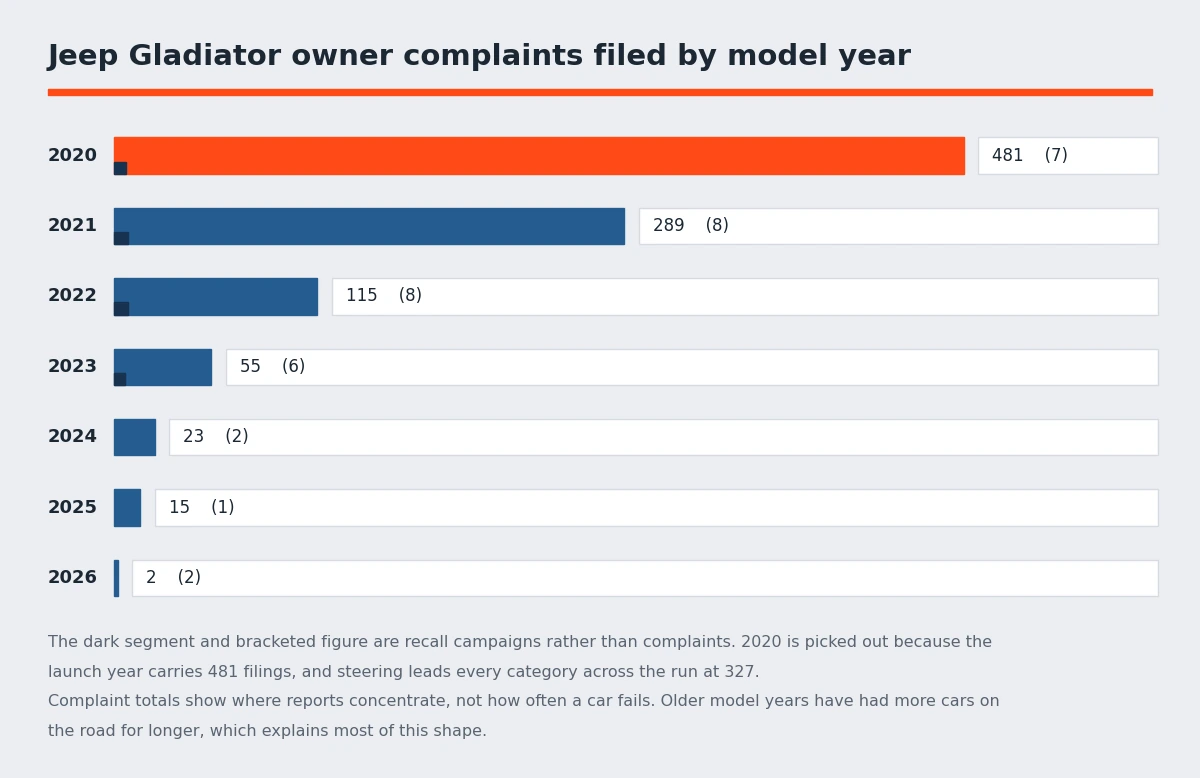
The 2020 launch year carries 481 of those filings on its own. The fall after it is steep and partly ordinary, because later years have had fewer trucks on the road for less time.
What is not ordinary is that the steering theme did not stop. Eighteen distinct campaigns touch the run, and one opened against the 2026 truck names the hydraulic power-assist pump.
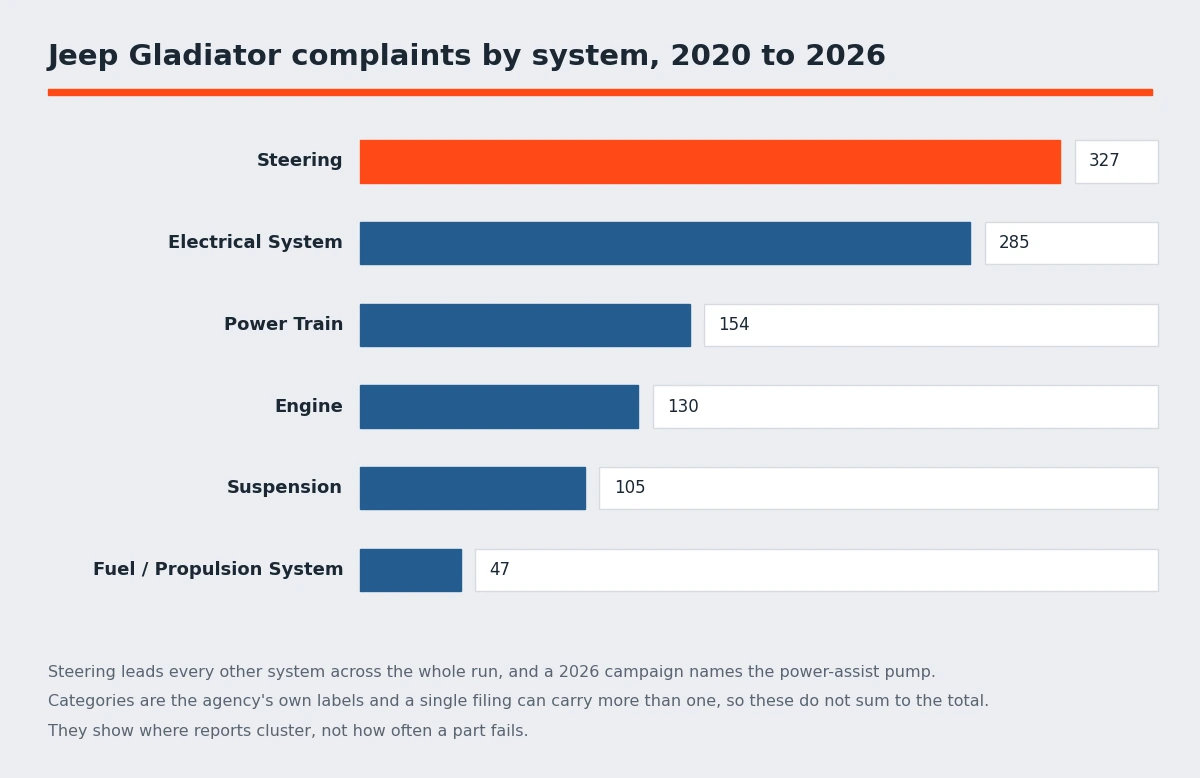
That makes one test-drive item non-negotiable on any Gladiator. Take it to a highway speed on a surface with joints or ruts and hold the wheel loosely, because a steering system that is going to feel wrong will feel wrong there and nowhere else.
Then confirm the campaign history against the exact vehicle identification number. A solid-axle truck rides differently from a car by design, and the paperwork is what separates that from a fault.
Buy the Gladiator only when both halves earn their cost
The purchase case exists only after the same truck passes its bed load, payload calculation, trailer check, repeated-road drive, and open-air storage rehearsal. A failure in the truck task points toward a conventional midsize pickup, while a failed bed requirement but successful open-air routine points toward a Wrangler.
A truck that fails both belongs on neither shortlist.
Jeep displayed 2026 MSRPs of $40,015 for Sport, $43,015 for Sport S, $46,445 for Willys, $48,115 for Sahara, $53,215 for Rubicon or Mojave, and $61,210 for the X trims when this review was researched. Treat them as dated displayed prices, not proof that destination, options, incentives, or dealer charges are included.
A written quote should identify the VIN, trim, Max Tow equipment when required, options, destination treatment, discounts, taxes, and fees. Compare that total only after the same truck passes the bed load, payload calculation, trailer check, repeated-road drive, open-air rehearsal, safety review, and recall lookup.
Buy the exact Gladiator only when both its truck function and its open-air function earn their cost. Character cannot rescue a failed payload label, unusable bed, tiring highway drive, unsafe storage routine, or unresolved evidence gap.