A final-year V8 needs a specific reason to win
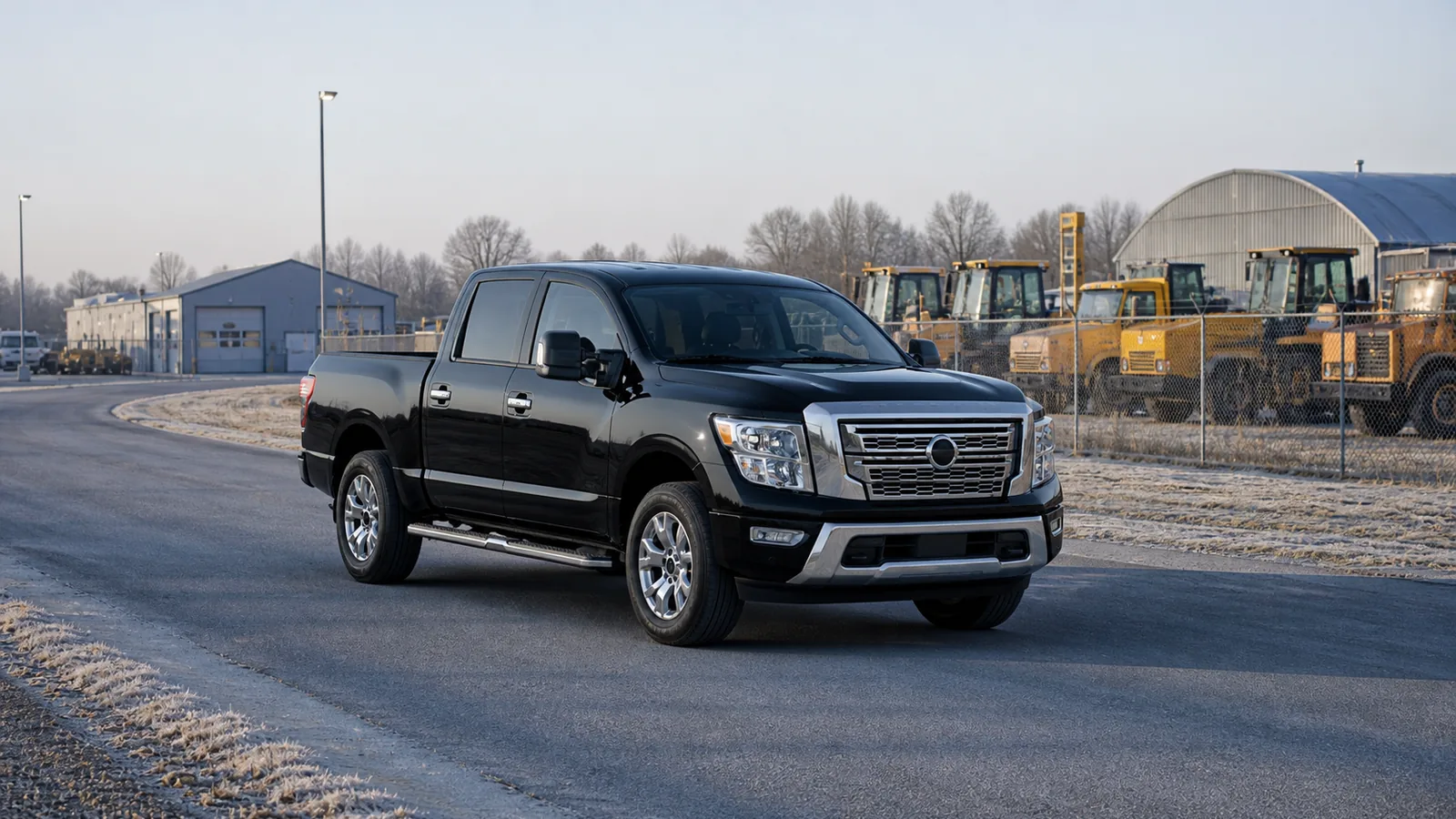
A buyer who regularly carries a family, a bed load, or a moderate trailer may still find a clear use for the 2024 Nissan Titan.
The 2024 truck closed the model's U.S. production run, and its naturally aspirated V8 delivers power without forcing the buyer through an engine menu. It remains a full-size pickup bought from remaining stock or the used market rather than a current factory order.
That simplicity has value only when the truck solves the repeated job at the right used price. High fuel use, a discontinued platform, and the wrong cab or rating can each erase the appeal before condition even enters the discussion.
Keep the Titan on the list only when its V8, configuration, and price solve a need that a newer rival does not solve better. A buyer seeking low fuel expense, current-generation refinement, or a fresh full warranty can stop here.
One V8 simplifies the choice but not the fuel bill
The owner's manual recommends 91 AKI fuel, while permitting 87 AKI with reduced performance. A 16 or 17 mpg combined EPA estimate turn annual mileage into the first powertrain decision.
The regular Titan gives every buyer the same 5.6-liter naturally aspirated V8, rated at 400 hp and 413 lb-ft through a nine-speed automatic.
Regular SV and Platinum Reserve configurations carry 15 mpg city, 21 highway, and 17 combined EPA figures. PRO-4X is rated at 14 city, 20 highway, and 16 combined, while Titan XD requires separate fuel evidence.
The V8 responds without waiting for turbo boost, which can make merging and moderate towing feel straightforward. Use the published baseline to calculate from your own annual mileage, because a buyer covering 18,000 miles faces a different value equation from one driving 6,000.
What 17 mpg means in gallons, not adjectives
A rated 15 city and 21 highway gives 17 combined on the configurations that carry a figure. Calling that thirsty is easy and tells a reader nothing they can plan around.
So do the division. Twelve thousand miles a year at 17 mpg is about 706 gallons.
Fifteen thousand miles takes it to roughly 882 gallons. Multiply either by whatever you actually pay at the pump and the annual figure appears.
Gallons a year at 17 mpg combined
- 10,000 miles
- about 588 gallons
- 12,000 miles
- about 706 gallons
- 15,000 miles
- about 882 gallons
- 20,000 miles
- about 1,176 gallons
That total is the honest cost of a naturally aspirated V8 with no smaller engine offered beneath it. There is no configuration on this truck that avoids it.
Set it against what the truck does rather than against a rival's brochure. Up to 9,290 pounds of towing and 1,710 pounds of payload is the return on that fuel, and a truck that never tows is paying the bill for nothing.
Towing changes the sum again, and not gently. Expect real-world economy well below the rated figure with a heavy trailer, which is worth budgeting for if towing is the reason you are here.
Crew Cab or King Cab changes the useful truck
A Crew Cab suits the buyer who regularly fills the rear seat. Its 38.5 inches of rear legroom leaves adults usable space, while the 67-inch-long, 63.8-inch-wide bed asks whether the routine cargo can give up length.
King Cab answers the opposite problem with 172-degree rear doors, a 78.7-inch bed, and only 24.8 inches of rear legroom. That rear area works better for occasional passengers or secured interior storage than for adults who travel every week.
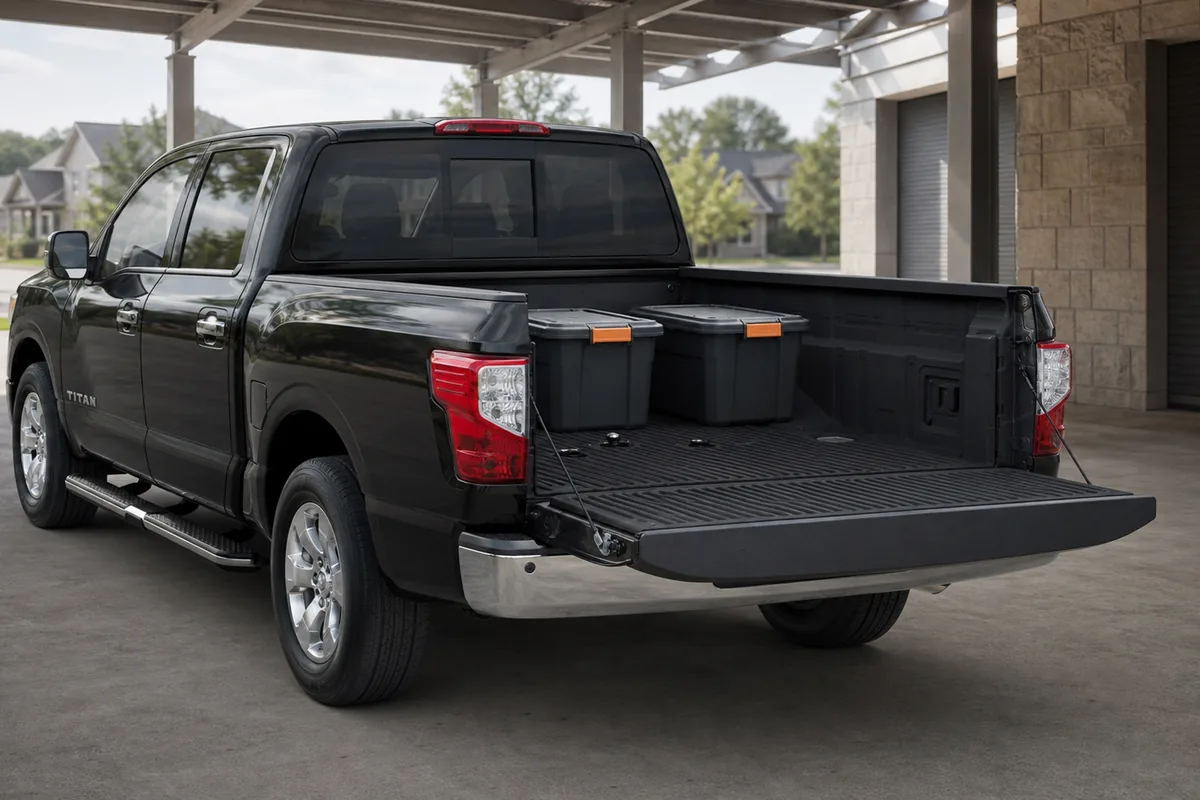
The bed narrows to roughly 50 inches between its wheel wells, so a wide load can fail even when overall bed width looks sufficient. The decisive rehearsal uses people and cargo together.
Load the Crew Cab with occupied rear seats, or enter the King Cab rear area before assuming its longer bed makes it more useful.
Overall length also matters in the same decision. Crew Cab measures 228.2 inches in SV form or 229.5 inches in upper configurations, so the chosen passenger advantage still has to clear the buyer's garage and parking routine.
Payload and tow labels choose the passing configuration
An 8,000-pound trailer at a representative 12 percent tongue weight places about 960 pounds on the truck before four occupants, bed cargo, and hitch hardware are counted. That combined load can exhaust payload before the trailer reaches the number printed in an advertisement.
A properly equipped regular Crew Cab can tow up to 9,290 pounds with 4x2 or 9,130 with 4x4. King Cab reaches 9,210 pounds, while payload maxima are 1,600 pounds for Crew Cab 4x2, 1,650 for Crew Cab 4x4, and 1,710 for the qualifying King Cab.
| Configuration | Maximum towing | Maximum payload |
|---|---|---|
| Crew Cab 4x2 | 9,290 lb | 1,600 lb |
| Crew Cab 4x4 | 9,130 lb | 1,650 lb |
| King Cab | 9,210 lb | 1,710 lb |
Subtract passengers, cargo, accessories, hitch hardware, and tongue weight from the certification-label payload. A truck that runs out of payload fails the job even when its advertised tow ceiling still has room.
The road test exposes both V8 ease and an older feel
The Titan's strongest road impression comes from easy V8 response and supportive front seats. Edmunds also found a smooth ride on even pavement, while Consumer Reports noted energetic acceleration, but also measured pronounced cabin noise and found the integrated brake controller, tow mirrors, and camera views useful when trailering.
The older feel appears when the route becomes less forgiving. Edmunds cited wind and cabin noise, blind spots, and less rear room than some rivals, while Car and Driver found competitive performance and stopping but less refined steering and handling.
MotorTrend's 7.3-second run to 60 mph belongs to a tested PRO-4X rather than every Titan. The useful lesson is that straight-line pace can arrive alongside visibility and control tradeoffs.
Reproduce both sides on one drive: cold start, broken pavement, merge, grade, tight parking, and a firm straight stop. Buyers who enjoy the response but remain uncomfortable placing or braking the truck will not grow out of that conflict after purchase.
Titan XD is a narrow capacity fork
Titan XD matters only after the regular truck's door label fails a measured payload or trailer requirement. Its extensively reinforced frame stretches to a 151.6-inch wheelbase, uses a 6.5-foot bed, and comes with 4x4.
XD boundary
- Wheelbase
- 151.6 in
- Bed
- 6.5 ft
- Receiver tow
- Up to 10,900 lb
- Gooseneck tow
- Up to 11,050 lb
- Payload
- Up to 2,360 lb
The qualifying XD configurations reach 10,900 pounds with a receiver hitch, 11,050 with a gooseneck, and 2,360 pounds of payload. Those gains can rescue a job that is slightly beyond a regular Titan, but they also add length and mass to every unloaded trip.
Parking, ride, purchase price, tires, and component costs all change with that larger package, and regular Titan EPA figures do not transfer. The discontinued pre-2020 XD engine belongs to a different used-truck decision and is not a 2024 powertrain choice.
The used problem is supply, not price
Every Titan for sale is a used truck. Nissan built its last one for the 2024 model year, and there is no successor.
That normally means leverage for a buyer. On this truck it mostly means scarcity.
The Titan never sold in the volumes its rivals did, so the pool you are searching is small to begin with. Narrow it by cab, bed, drivetrain and trim and it gets very small very quickly.
Searching a thin market without settling
- Decide the cab and bed first, because those cannot be changed later at any price
- Treat the drivetrain as the second fixed requirement, not a preference
- Widen the search radius before you widen the specification
- Expect to travel, and price the travel into the deal rather than compromising
- Have a mechanic you trust ready before you find the truck, not after
If the search runs out before the right cab and bed appear, the Ford F-150 offers comparable capability from a used pool many times deeper.
The 5.6-liter V8 and its nine-speed automatic are the same across the range, so there is no engine decision to agonise over. What varies is configuration, and configuration is what a thin market makes hard.
Fuel is the running cost that will not negotiate. At 15 city and 21 highway, a combined 17 mpg is what this truck does, and no trim changes it.
Set that against the capability before deciding. Up to 9,290 pounds of towing and 1,710 pounds of payload is a real working figure, and it is what the fuel bill is buying you.
What warranty is left, and why the listing will not tell you
Nissan made an unusual promise when the second-generation truck arrived. The 2017 Titan and Titan XD were sold with five years or 100,000 miles of bumper-to-bumper coverage, which was longer than anything else in the class.
That coverage transfers to a second owner. It also carries a condition most listings never mention.
If the first owner did not keep the truck for at least six months, the five-year term is void. A truck that went through an early trade or a fleet disposal may therefore have far less protection than its model year suggests.
Ask for that before the price conversation rather than after it. A truck with real coverage remaining and a truck without it are worth different money, and the difference is larger than most sellers will volunteer.
Two questions settle it. When did the truck first go into service, and did its first owner hold it past six months.
The answer changes what the rest of this review is worth to you. Remaining coverage makes an early high-complaint model year a far more reasonable risk, and its absence pushes you toward the quieter later years and a longer inspection.
Mixed safety evidence and tiny recalls require exact checks
Safety evidence gives the 2024 Crew Cab neither a single clean score nor a reason for panic. NHTSA rates the 2024 Crew Cab four stars overall and frontal, with five stars in the side test, while rollover results change between 4x2 and 4x4 listings.
These results do not establish a King Cab or XD rating.
IIHS measures different outcomes for the regular gasoline Crew Cab. It reports Acceptable in the small-overlap test, Good in the original moderate-overlap test, Poor headlights, and Superior pedestrian crash prevention, without automatically extending those results to King Cab or XD.
The two exact 2024 recall checks are narrow. Campaign 24V154 involved a small cross-model passenger-airbag inflator population.
Campaign 24V580 covered only three model-year 2024 Titans plus certain vehicles previously repaired with the affected part.
The original basic and powertrain warranty ran five years or 100,000 miles, but a used buyer receives only the valid remainder under the written terms. Coverage depends on required maintenance and can be restricted for salvage or total-loss history.
VIN and coverage checks
- Match the NHTSA result to Crew Cab and the exact drivetrain
- Confirm whether 24V154 or 24V580 applies to the VIN
- Obtain proof of any completed remedy
- Verify the original in-service date, mileage, and remaining written coverage
These checks describe the individual truck's evidence. They do not establish a broad reliability verdict.
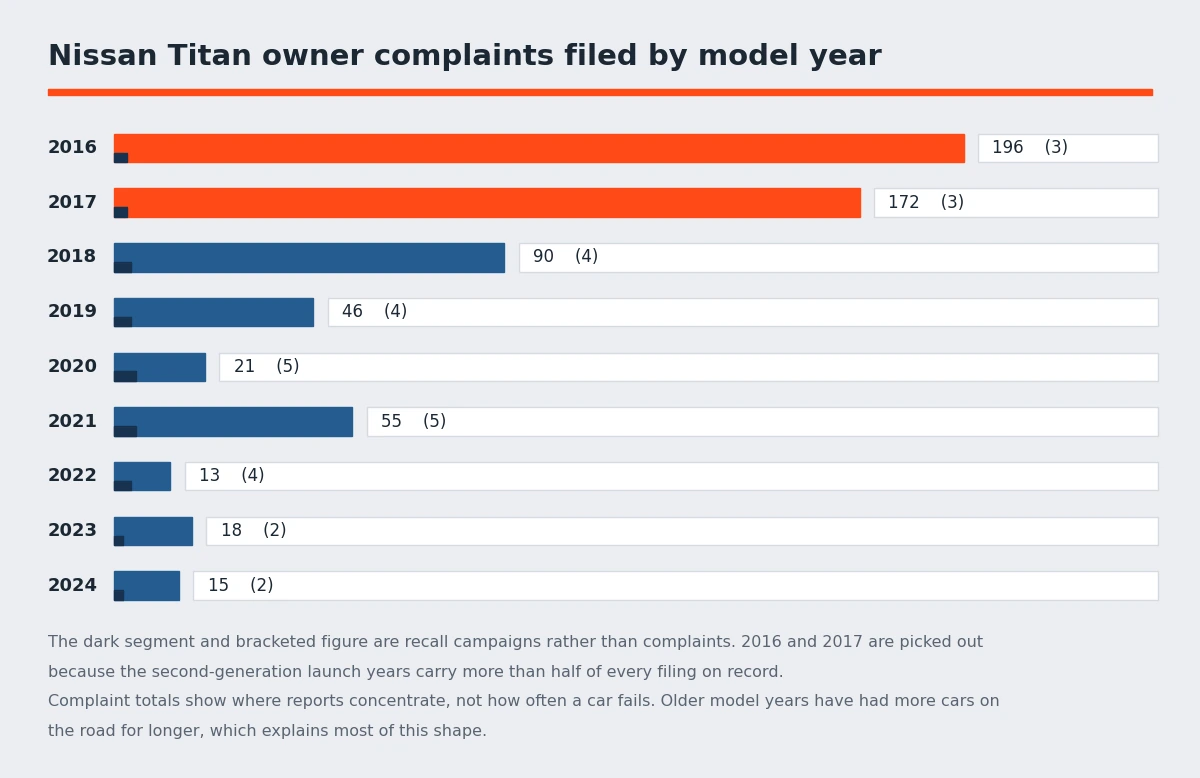
Nine model years of filings point at the launch, and at the engine
A truck that is out of production has one advantage over a current one. Its record is finished, so it can be read rather than guessed at.
Owners filed 626 complaints against Titan model years 2016 through 2024. The first two years of the second generation carry 368 of them.
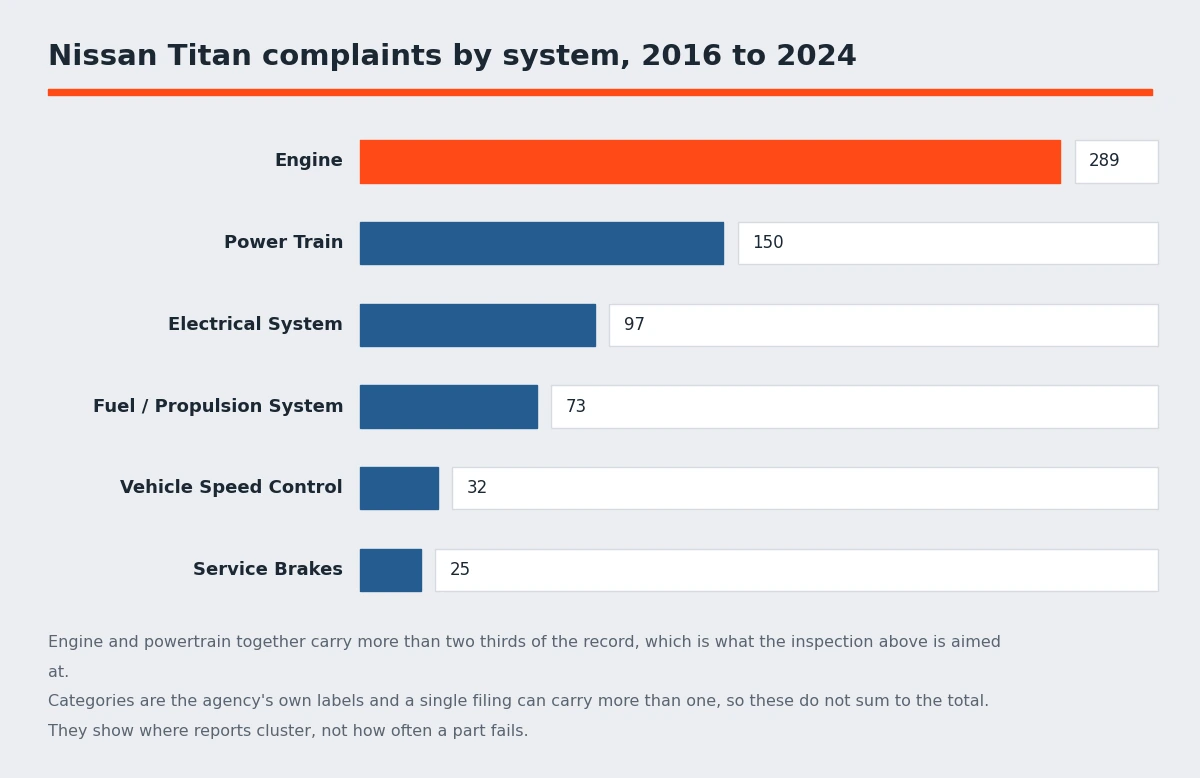
One category dominates. Engine leads at 289 filings, with the powertrain second at 150 and electrical systems third at 97.
Sixteen distinct recall campaigns touch the run, between two and five per model year. The components named most often are tires, the automatic transmission and a set of equipment labels.
For a used buyer that is a starting point rather than a verdict. A 2020 or later truck sits in the quiet part of the record, and a 2016 needs a service history that shows the engine complaints were somebody else's.
Turning an engine-heavy record into a pre-purchase inspection
Engine filings lead every other category on this truck at 289, and powertrain sits second at 150. Between them they account for more than two thirds of the record.
That is not a reason to walk away. It is a set of instructions for the hour before you agree a price.
The inspection this record argues for
- Start it coldBe there for the first start of the day, not a truck the seller warmed up. Cold starts expose noises that disappear in ninety seconds.
- Listen at idleStand at the front with the hood up and listen for anything irregular from the valvetrain before touching the throttle.
- Watch the transmission through the rangeThe nine-speed should find its gears without hunting. Drive it in traffic, not only on an empty road.
- Load itAsk to tow or carry something if you can, because a drivetrain complaint usually appears under load rather than empty.
- Read the service recordsAn engine-heavy record makes a documented maintenance history worth more on this truck than on most.
Ask specifically what oil-change interval the truck lived on. A naturally aspirated V8 is not fragile, but 400 hp and 413 lb-ft of towing duty rewards a strict schedule and punishes a loose one.
The categories after the top two thin out quickly. Electrical systems sit at 97 and fuel and propulsion at 73, which is a normal spread for a truck of this age rather than a pattern.
None of this replaces a mechanic. It tells you what to point one at, which is the only thing a complaint record is genuinely good for.
Inspect the truck that exists, not the reputation
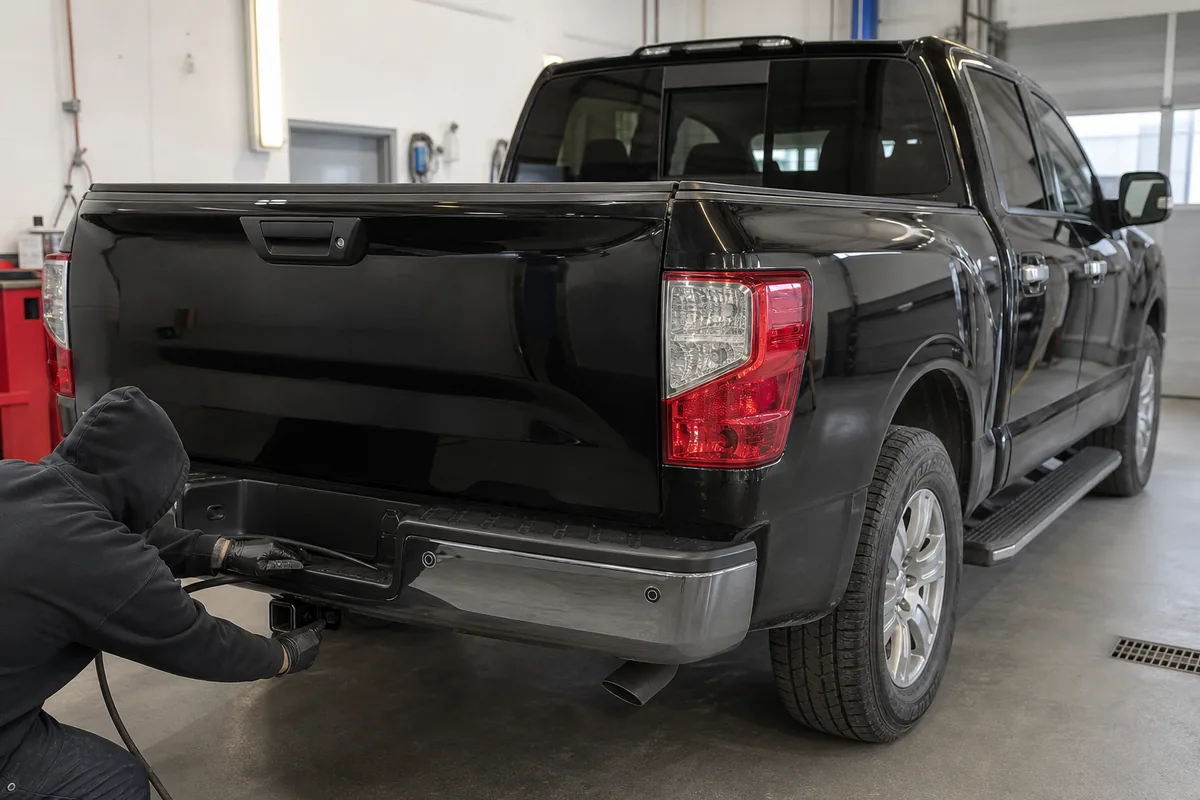
Inspect the truck cold before the seller starts or moves it, then begin with what it shows. Uneven tire wear, damaged receiver hardware, poor wiring repairs, bed deformation, fluid seepage, or underbody impact can contradict a clean exterior and an attractive asking price.
Then compare service records, VIN history, cold-start behavior, fluid condition, tire age, and matching load ratings with the seller's account. The tire age and matching load ratings matter especially when the truck has carried or towed near its limits.
A road test should confirm consistent tracking and braking, normal nine-speed shifts, and working cameras and tow aids without warnings. Missing records or unexplained behavior justify an independent inspection rather than a reputation-based guess.
A final 2024 Titan makes sense when the individual truck proves its value through configuration and condition. Buyers who prioritize fuel economy, modern road manners, larger rear space, or a fresh full warranty should choose a newer rival.