Buying a used car is the best value in cars and the easiest place to get burned.
Screen the VIN history, inspect the car cold, pay a mechanic $100 to $200 for a pre-purchase inspection, and never pay before the signed title is in your hand.
Do the steps in order and the risk drops sharply.
Start with a budget that covers more than the sticker
The most expensive used-car mistake happens before you look at a single listing: spending your whole budget on the purchase price. The sticker is only part of what a used car costs to buy and own, so build the real number first.
Tax, title, and registration add several hundred to a couple of thousand dollars depending on your state and the price. On a $15,000 car, sales tax alone can be $900 to $1,500 before you have driven anywhere, and that money has to come from somewhere other than the seller's asking price.
- Set aside tax, title, and registration on top of the purchase price
- Keep a repair reserve of at least $500 to $1,000 for a used car's first surprises
- Price insurance on the exact model before you buy, because an older sporty car can still cost a lot to cover
- Leave room for the first service, since you do not know how the last owner treated it
Work out the ownership picture before the purchase, not after. If you are still setting the top-line number, how much car you can afford gives you a method that starts from income rather than from the car you fell for, and the affordability calculator turns that method into a number.
A useful rule is to keep the purchase price low enough that the extras do not break you. If your total out-the-door budget is $12,000, shopping cars priced around $10,000 leaves room for tax, a set of tires, and the first repair without a second loan.
Buyers who spend the entire budget on the car itself are the ones who end up putting a $700 repair on a credit card three weeks later.
Depreciation is the reason a used car is the smart buy in the first place.
A new car loses roughly 20 percent of its value in the first year and about half within five, so a three-year-old car lets someone else absorb the steepest drop while the car still has most of its life ahead.
That is the value you are capturing, and it is why the used market rewards patience over the newest possible car.
The sweet spot for most buyers is a car two to four years old with documented maintenance. It is past the steepest depreciation, still has years of reliable service left, and often carries some of the original warranty.
Chasing a much older car to save a little more usually trades that saving for higher repair risk, which is a bad deal on anything but a proven, well-kept model.
Set a firm ceiling and hold it. Listings are designed to pull you a little higher, and a car $2,000 over budget feels affordable in the moment and painful for the next three years.
Knowing your number before you shop, and treating it as a wall rather than a suggestion, is what keeps a good deal from quietly becoming a stretch you regret.
Dealer, private seller, or online: where the risks change
Where you buy shapes the price, the risk, and how much recourse you have if something goes wrong. There is no single best source, only the one that fits how much risk you are willing to carry.
| Source | Typical price | Risk and protection |
|---|---|---|
| Private seller | Lowest | No warranty, no recourse, cash deal, most inspection responsibility on you |
| Independent dealer | Middle | Some handle paperwork; quality varies widely by lot |
| Franchise dealer | Highest | Paperwork handled, often certified options, easiest recourse |
| Online retailer | Middle to high | Return window and delivery, but you buy mostly sight unseen |
A private sale is where the money is, because you cut out the dealer's margin, but you also give up every protection and take on all the inspection responsibility yourself. A franchise dealer costs more and handles the title work, and it is where you find certified cars if that coverage matters to you, which is what certified pre-owned coverage is for.
Online retailers sit in between: they add a return window and home delivery, but you are trusting photos and a description instead of your own eyes. Whichever source you choose, the steps that follow still apply, because a bad car is a bad car no matter who is selling it.
Independent used-car lots are the wild card. The best are honest local businesses that stand behind their cars; the worst buy auction rejects and flip them fast.
The difference shows in whether they let you take the car for an independent inspection and whether their prices track the market.
Treat an independent dealer like a private seller who happens to have a lot: do every check, and trust the car, not the salesperson.
No-haggle online retailers deserve a specific note, because their return window is the real product. A seven-day, money-back return period lets you do at delivery what you could not do before buying: drive the car on your roads and take it to your own mechanic.
Use that window fully rather than treating it as a formality, because it is the one protection that a private sale can never offer.
Screen the VIN history before you visit
Every car worth seeing survives a remote screen first. A few minutes on your phone removes the worst cars before you waste an afternoon driving to them.
- Run the VIN through a vehicle history report for title status, past accidents, and odometer readings
- Check for open safety recalls by entering the VIN on the manufacturer's site or the NHTSA database
- Read the service history in the report; regular maintenance is a good sign, long gaps are not
- Compare the report's mileage records against the number in the listing
A branded, salvage, or rebuilt title should end most purchases before you leave home. It means the car was once declared a total loss, and while some rebuilt cars are fine, they are worth far less and much harder to insure and resell.
If the history is clean and the recalls are addressed or minor, the car has earned an in-person look.
Book a mechanic for a pre-purchase inspection before you agree a price.
History reports are not perfect, so treat them as a filter rather than a guarantee. An accident that was never reported to insurance will not appear, and a clean report does not prove a clean car.
What the report does reliably catch is a branded title, a major reported collision, and odometer readings that do not add up, and any one of those is worth the small cost of running it before you spend gas and an afternoon.
A single history report costs about $25 to $40, and some sellers and dealers provide a recent one for free.
If you are shopping several cars, a multi-report subscription can be cheaper per car, but do not let a report the seller hands you replace one you pull yourself, since a motivated seller can show you only the version that helps them.
Pull your own from the VIN and compare it against the seller's story.
If the report and the seller disagree, believe the report. A seller who calls a car accident-free while the history shows a reported collision has either forgotten or is hoping you will not check, and neither builds trust in the rest of the pitch.
The report is the neutral record, so where it conflicts with the story, the story is the part that is wrong.
What to inspect when you see the car in person
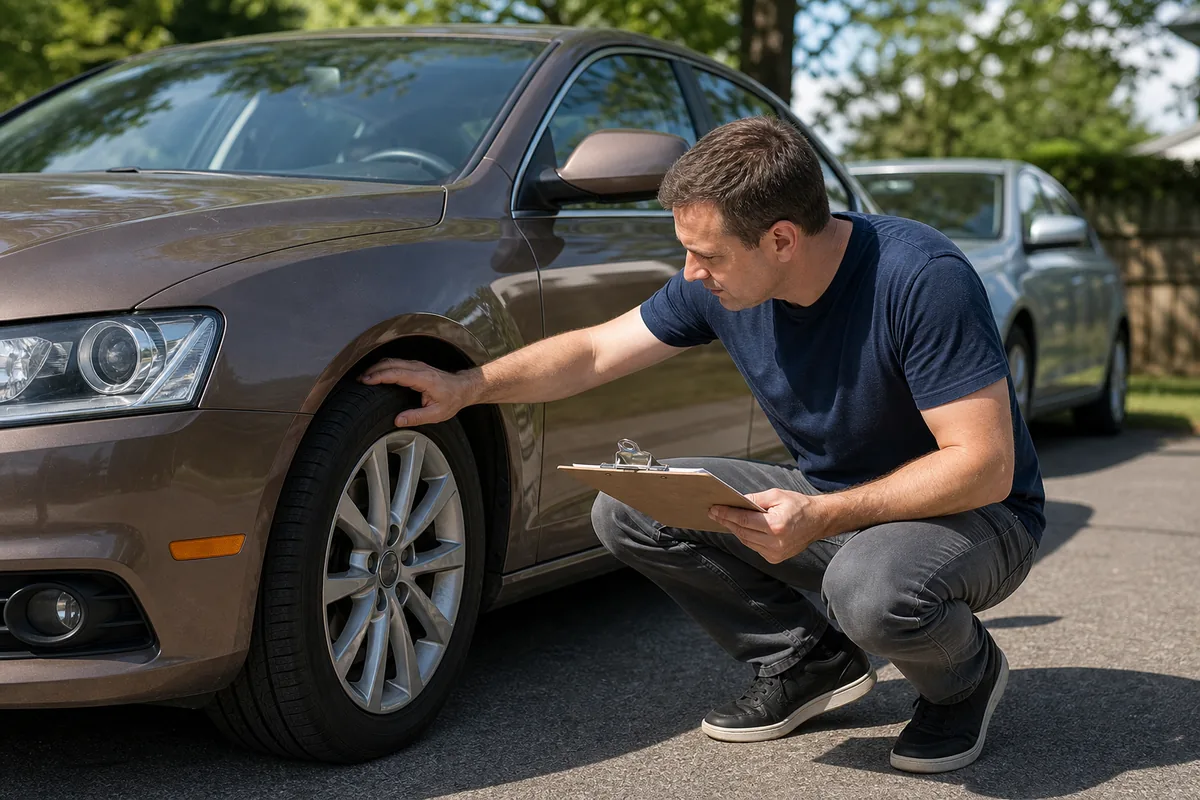
Once a car passes the remote screen, inspect it in a fixed order so you do not miss anything under sales pressure. Do this in daylight, on dry ground, with the engine cold.
A 15-minute in-person inspection
- Body and paint
- Check panel gaps and color mismatches for past collision repair
- Tires
- Uneven wear points to alignment or suspension problems, and new tires cost $600 or more
- Under the hood
- Look for leaks, corroded terminals, and milky oil on the dipstick
- Interior
- Test every window, the AC, the infotainment, and all the warning lights
- Cold start
- Start it cold; many faults hide once the engine warms up
The cold start is the single most revealing test, because a warm engine masks hard starting, rough idle, and smoke that a cold one reveals. Ask the seller not to start the car before you arrive, and be suspicious if the hood is already warm when you get there.
Drive the car on a real route, not a loop around the block. Get it to highway speed, brake firmly once from speed, and turn hard both ways in an empty lot to feel the steering and suspension.
Note anything that pulls, shakes, or clunks, because those are the findings that either end the deal or lower the price when you negotiate the car price.
Run the test drive beyond the dealer's loop
Pay attention to what the car does at the moments most owners never test. Brake hard once from highway speed and feel for a pulsing pedal or a pull, which points to warped rotors or a caliper problem.
Let go of the wheel briefly on a straight, flat road to see if the car tracks straight or drifts.
Turn the wheel to full lock in a parking lot and listen for the clicking that signals a worn CV joint on a front-wheel-drive car.
Bring a magnet and a flashlight, two tools that cost almost nothing and reveal a lot.
A magnet that will not stick to a body panel means thick filler under the paint from a repair, and a flashlight in the wheel wells and along the frame rails shows rust and past welding that a quick glance misses.
Neither replaces a mechanic, but both help you decide whether the car is even worth paying one to inspect.
Is a pre-purchase inspection worth it?
Yes, on almost any private-party or independent-dealer used car, a pre-purchase inspection is the best money you will spend. For about $100 to $200, a trusted mechanic puts the car on a lift and sees what a parking-lot check cannot.
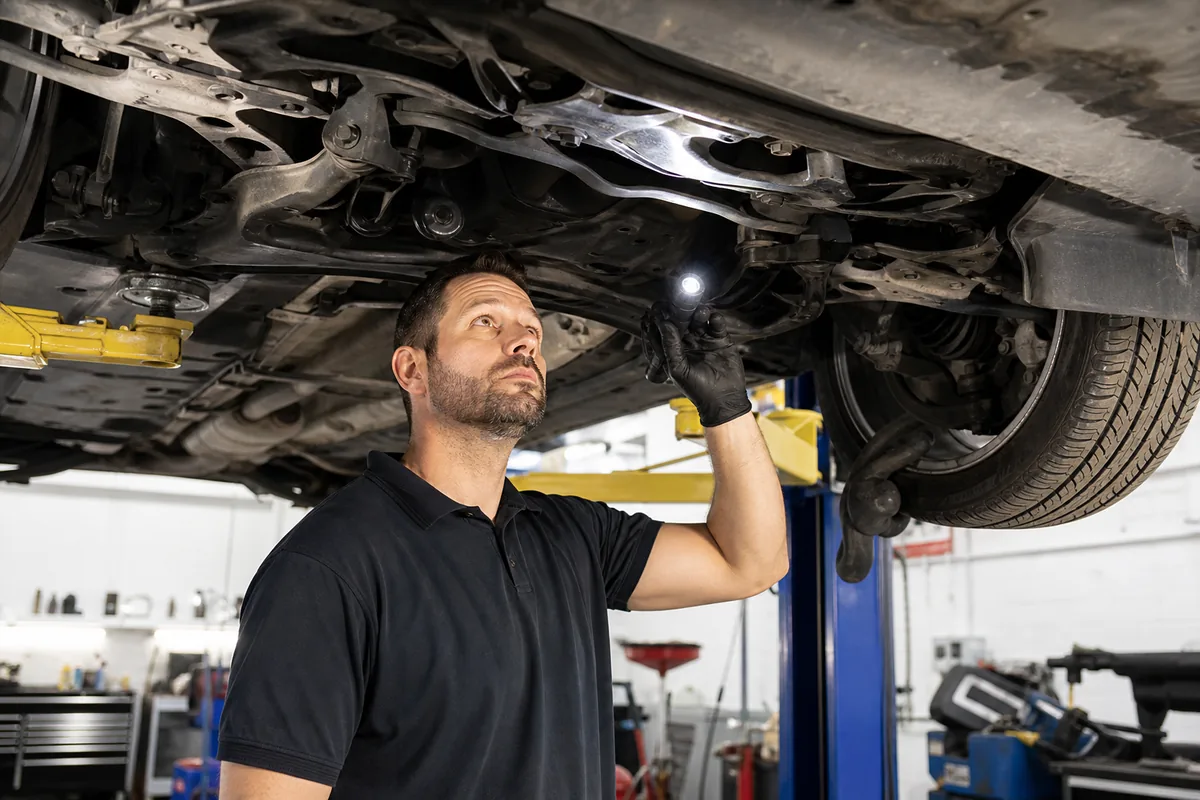
A mechanic on a lift checks the frame for past collision or rust damage, spots fluid leaks you would never see, and measures brake and suspension wear against real limits.
They can also scan for stored fault codes that are not yet showing a dashboard light.
None of that is visible in a driveway.
A seller who refuses to let you take the car for an independent inspection is telling you something, and it is rarely good. On a certified car from a franchise dealer the inspection is already done, but on any other used car, treat a refusal as a reason to walk.
If you cannot get to a shop, a mobile inspection service will come to the car for a similar fee, which removes the seller's excuse that the car cannot be moved.
The inspection report also becomes a negotiating tool: a documented list of needed repairs, with rough costs, is far more persuasive than a buyer's vague sense that the price is too high.
Bring that list to the price conversation and let the findings do the arguing.
Ask the mechanic what the next two years look like
The inspection also tells you what kind of used car you are dealing with over the long run.
A mechanic can flag whether the model has a known weak point at this mileage, whether the maintenance that is due is routine or expensive, and whether the car has been cared for or merely cleaned up for sale.
That context is worth as much as the specific findings, because it shapes what the next few years of ownership will cost.
Walk away from title, flood, and seller red flags
Some findings are not negotiating points, they are reasons to leave. Learn the stop-list so no amount of sales pressure talks you past a deal-breaker.
- A price far below the market for that model, which hides a problem rather than a bargain
- A seller who will only meet in a parking lot and will not show a home address or a dealer lot
- A title that is not in the seller's name, or names that do not match their ID
- Fresh undercoating or heavy air freshener, which can mask rust, leaks, or flood damage
- Pressure to decide immediately or to pay a deposit before you have seen the car
A price that looks too good is the most common trap, because it exploits a buyer's hope of a deal.
If a car is thousands below every comparable listing, assume there is a reason and make the seller prove otherwise.
Water stains, a musty smell, or corrosion in odd places can point to flood damage, which is a hard stop no matter how clean the car looks on top.
Trust the small inconsistencies, because scams live in the details.
A seller who dodges questions about why they are selling, who cannot produce a maintenance record for a car they claim to have loved, or who pushes hard to close before you have finished looking, is showing you how the rest of the deal will go.
None of those alone is proof of a bad car, but two or three together are a reason to walk and find another listing.
Flood damage deserves its own paragraph because it is common after major storms and easy to hide.
Check under the carpet and in the spare-tire well for water lines, silt, or rust, smell the cabin for a musty odor that air freshener is trying to cover, and look for corrosion on the metal under the dashboard where a detailer never reaches.
A flood car can run fine for months and then fail electrically in ways no one can economically fix.
Match the title, seller, VIN, and payment
The car is only yours if the paperwork is right, and this is where a private sale most often goes wrong. Verify each document before any money moves.
| Document | What to check |
|---|---|
| Title | Signed by the person named on it, with no active liens and a matching VIN |
| Bill of sale | Records the VIN, agreed price, date, and both parties' names |
| Odometer disclosure | Federally required on the transfer; the mileage must match the car |
| Seller's ID | Matches the name printed on the title exactly |
Never hand over full payment before the signed title is in your hand. If the seller still owes money on the car, the lender holds the title, and you need to complete the sale at the lender or with a clear payoff process, not on a promise to mail it later.
Check for a lien on the title before you pay. A car with an unpaid loan can be repossessed even after you buy it, leaving you out both the car and the money.
This paperwork is separate from any financing you arrange, which is your loan, not the seller's.
State rules vary, so know yours before you meet. Some states require a notarized title transfer, some need a separate release-of-liability form the seller files to end their responsibility for the car, and a few use electronic titles that never exist on paper.
Spending ten minutes on your state DMV site before the sale tells you exactly which documents to demand, so you are not standing in a parking lot discovering a missing form with cash in hand.
The temporary tag and drive-home plan matter too. In a private sale the car often has no valid registration you can use, so find out whether your state issues a temporary permit that lets you drive it home and to the DMV legally.
Arranging that before the sale keeps your first act of ownership from being an illegal drive on someone else's expired plates.
How to avoid the most common used-car scams
A handful of scams target used-car buyers, and each has one check that defeats it. Know them by name so you recognize the setup before you are in it.
Title washing hides a salvage brand by re-titling the car across state lines until the brand drops off the paperwork.
The history report is what exposes it, because it records the brand from the state that first applied it.
Odometer rollback shows up as service or inspection records with mileage higher than the number now on the dash, which is why the history report's mileage entries matter.
The safest defenses are boring and reliable: buy from a seller whose name is on the title, run the VIN history, and get the independent inspection. A scammer's whole plan depends on you skipping one of those three steps, so skip none of them.
Pay in a way that leaves a record and protects both sides.
A cashier's check or a documented bank transfer is safer than a stack of cash, and meeting at the seller's bank to complete the payment and hand over the title at the same time removes most of the risk for both of you.
Be wary of any seller who insists on a wire transfer, a payment app, or gift cards, because those are the payment methods scammers choose precisely because they cannot be reversed.
Match the VIN in three places
VIN cloning is the scam that catches careful buyers, because the paperwork looks perfect.
A thief copies the VIN from a legally registered car of the same model and puts it on a stolen one, so the history report comes back clean for a car that is not the one in front of you.
The defense is to confirm the VIN matches on the dash, the door jamb, and the title all three, and to be suspicious of a price that is good on a car whose seller is oddly eager.
What to do in the first week after you buy
The deal is not finished when you drive away. A few immediate steps lock in the purchase and protect you from the last owner's unknowns.
- Add insurance before you drive the car home, not after; a gap of even one trip is a real risk
- Transfer the title and register the car within your state's deadline, often 10 to 30 days, to avoid late penalties
- Change the oil and check every fluid soon, because you do not know the previous owner's maintenance habits
- Get two keys made if the car came with only one, since a replacement smart key can cost $200 to $500 later
Registering promptly matters because many states fine you for a late transfer, and driving on the seller's plates or an expired temporary tag invites a ticket. Insurance is the one step that cannot wait, since an accident on the drive home with no coverage can erase the savings that made a used car worth buying in the first place.
Treat the first service as a reset. Fresh oil, a new air filter, and a fluid check give you a known starting point and often surface a small issue while it is still cheap.
From there you own a used car you understand, which is the whole point of doing the steps in order.
Do the steps in order and the odds shift firmly in your favor. None of them is hard on its own, and together they turn a used-car purchase from a gamble into a managed decision.
The buyers who get burned are almost always the ones who skipped a step because they were rushed or afraid to seem difficult, and a patient buyer who runs the full process will pass on more cars than they buy.
That willingness to walk from a bad one is exactly what lands a good one.