How the model years compare
The reports cluster around the fifth-generation launch. CarComplaints model-year data currently lists 38 owner complaints for 2019 and 25 for 2020.
The same source lists 18 for 2016, 10 for 2018, 7 for 2021, and 4 for 2022. These are submitted reports, so they show concentration rather than the chance that one vehicle will fail.
| Model year | Starting verdict | Evidence that changes the choice | Required check |
|---|---|---|---|
| 2016 | Inspect | 18 submitted complaints | Water intrusion, brake feel, warning lights, and 12-volt battery |
| 2017 | Consider | 5 submitted complaints, with one costly air-conditioning drain report | Carpet and condensate drain |
| 2018 | Target for value | 10 submitted complaints and the last fourth-generation year | Age, service history, and hybrid inspection |
| 2019 | Avoid without complete repairs | 38 submitted complaints, fuel-fill fault, cable exposure, and three NHTSA campaigns | Fuel-tank order, cable condition, and every VIN campaign |
| 2020 | Inspect closely | 25 submitted complaints, fuel and electrical reports, cable exposure, and five NHTSA campaigns | Same checks as 2019 plus production-specific campaigns |
| 2021-2022 | Consider with records | Lower complaint totals, but covered cable exposure remains | Cable inspection, LSC status, and recall completion |
| 2023-2024 | Inspect by VIN | Added to Toyota cable program 22TE09 in 2025 | Production date, cable condition, and LSC 25TD01 |
| 2025 | Consider, data still maturing | Outside the published production period ending in February 2024 | VIN lookup, current recalls, and full pre-purchase inspection |
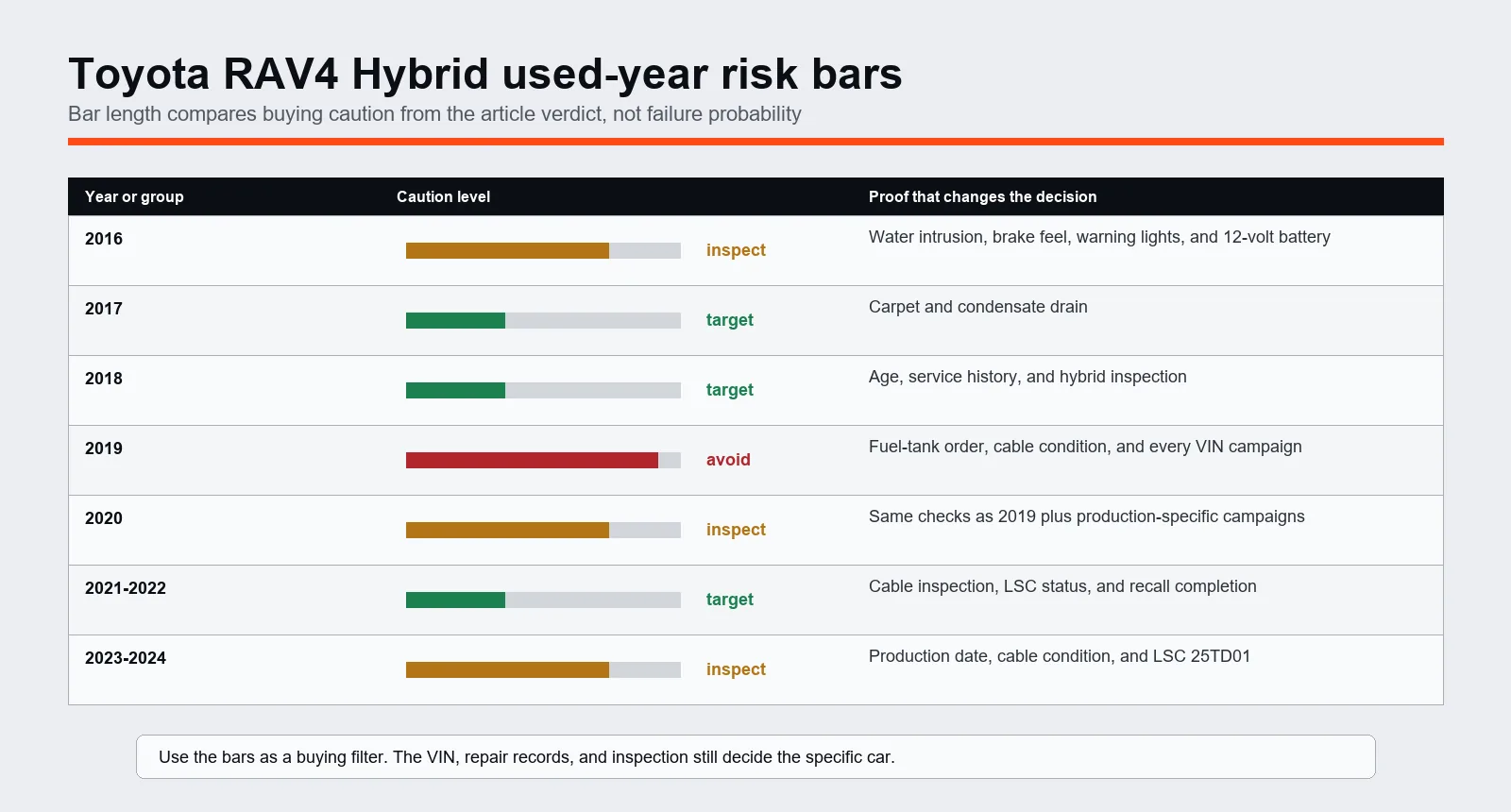
The table is a starting filter. A completed repair order can move one vehicle into consideration, while corrosion or an open campaign can remove another vehicle from the list.
That distinction matters. CarComplaints tracks the hybrid separately from the gas Toyota RAV4, whose engine and transmission history does not transfer cleanly to the hybrid.
Use complaint totals to decide where to investigate. The research method explains why repair records and primary documents carry more weight in the final buying decision.
The timeline shows where the buying checks change.
- 2016First RAV4 Hybrid year, with more submitted reports than 2017 or 2018
- 2017-2018Mature fourth-generation hybrids, with 2018 the stronger early target
- 2019Fifth-generation launch, refueling fault, and three NHTSA campaigns
- 2020Refueling coverage, five NHTSA campaigns, and cable exposure
- 2021-2022Fewer reports, but the cable program still applies to covered vehicles
- 2023-2024Added to cable program 22TE09 in Toyota's September 2025 update
- 2025Outside the program's published production period, with a shorter ownership record
The data puts 2019 first on the inspection list, with 2020 close behind. The separate RAV4 year history covers conventional models and should stay out of this hybrid verdict.
Why 2019 needs the closest look
The 2019 RAV4 Hybrid has the highest complaint total in the hybrid's run on CarComplaints. Nineteen reports in that site's fuel-system category concern this model year.
Owners described a 14.5-gallon tank that could make the pump click off after accepting roughly 9 to 10 gallons. The car still drove, but its practical range and distance-to-empty display became less useful.
Toyota documented the condition. Customer Support Program 20TE04 covers certain 2019 and 2020 RAV4 Hybrids for eight years from first use or 100,000 miles.
When a dealer verifies the fault, the program calls for a new fuel tank and fuel sender gauge unit. A later Toyota service bulletin includes some 2021 vehicles and identifies updated parts.
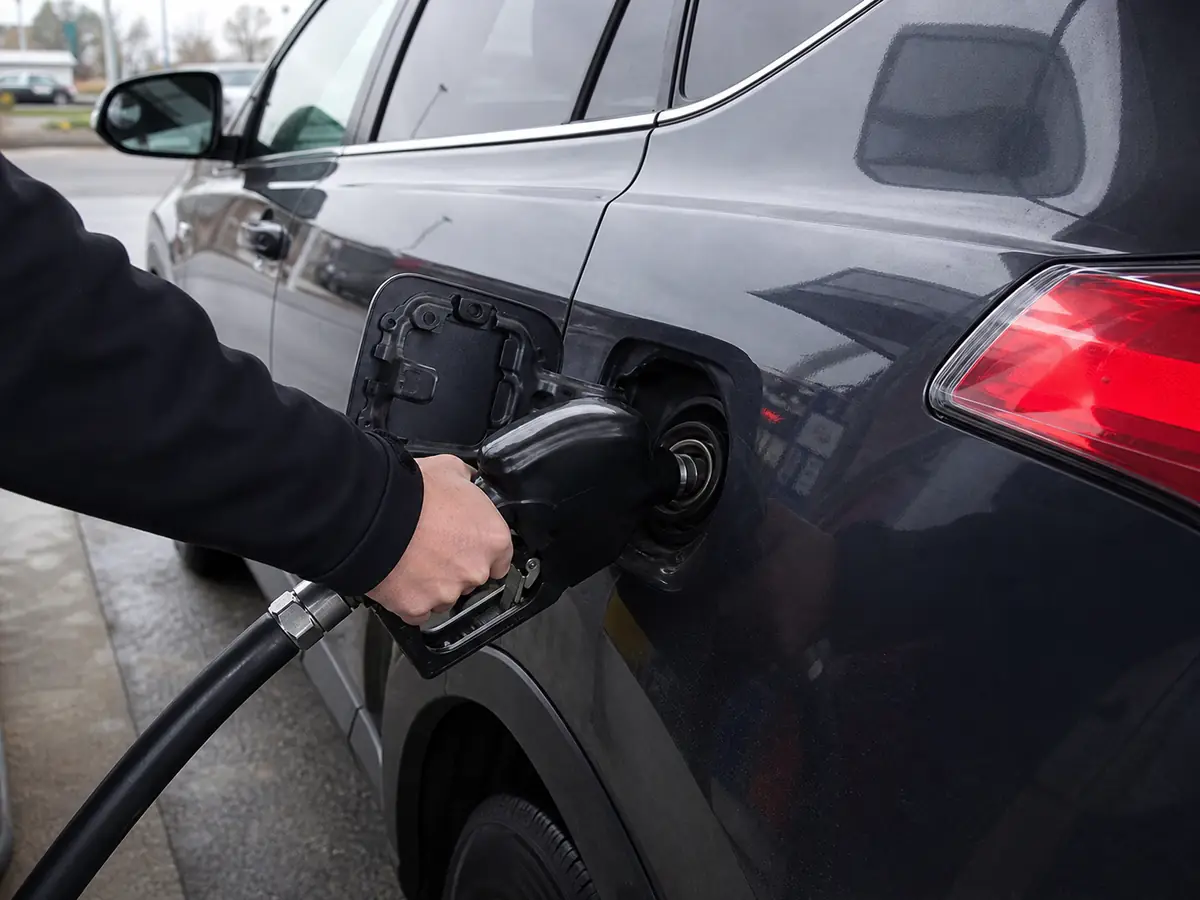
Do not accept early pump shutoff as normal reserve capacity. Ask for the repair order, then test a normal fill from a low indicated fuel level.
Stop when the nozzle clicks. Repeated topping off can damage the evaporative-emissions system and proves nothing about the repair.
The 2019 also carries three campaigns in the NHTSA recall record. Campaign 19V544 covers a brake-booster pump that may remove braking assist.
Campaign 20V064 covers a limited group with porous engine castings that can leak coolant or oil. Campaign 20V286 covers front lower suspension arms that may crack and separate.
These campaigns apply to specific production groups. A VIN can have all, some, or none of them.
A recall remedy also differs from a support-program repair. Safety recalls remain free for an included VIN, while support programs add time, mileage, condition, and inspection limits.
Ask for the Toyota dealer service printout before paying for a separate inspection. Match its VIN to the dashboard and title, then look for campaign numbers and completion dates.
Road salt changes the cable risk
The fuel-tank repair does not address the rear high-voltage cable. That part sits under the vehicle, where moisture and road salt collect.
A clean dashboard offers little proof. The connector needs a physical inspection.
Toyota's technical guidance links the condition to trouble codes P0AA649 and P1C8049. Static on AM radio, a hybrid warning, or lost all-wheel-drive operation can appear when the connection deteriorates.
Visible green or white deposits deserve the same attention. Clearing a stored code does not repair corroded metal.
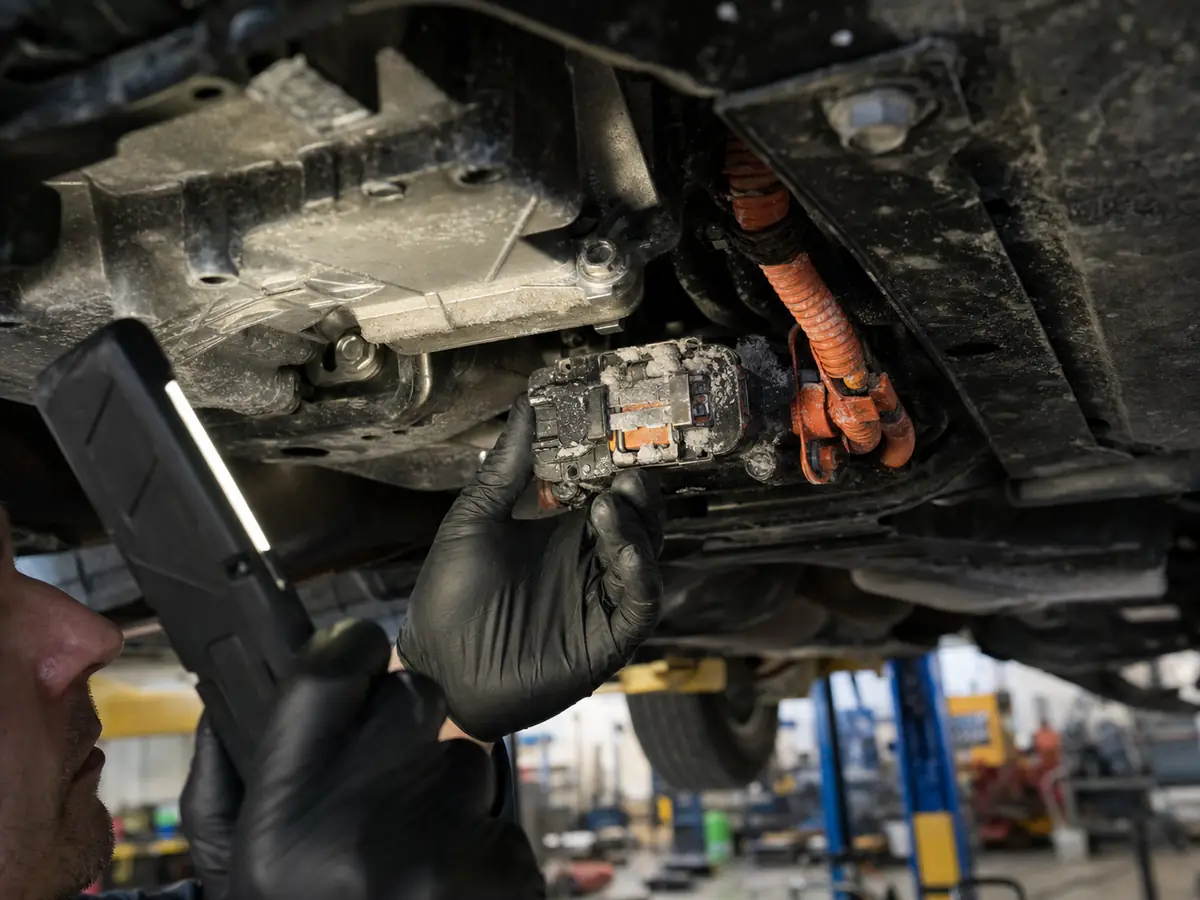
Inspect every 2019 through 2024 salt-state vehicle on a lift, even when no warning light is on. Ask a Toyota dealer to confirm program eligibility by VIN and record whether LSC 25TD01 or a harness and cable replacement was completed.
Check the original in-service date too. An early 2019 without LSC 25TD01 may be close to the original eight-year limit even when the odometer remains below 100,000 miles.
When a 2020 to 2022 model can work
The 2020 RAV4 Hybrid combines several separate checks. CarComplaints lists 25 owner reports, including eight in the fuel-system category and six in the electrical category.
NHTSA lists five campaigns for the model year. They cover the engine casting, front suspension, electric power steering, steering column, and passenger occupant sensor.
Five campaigns do not make every 2020 defective. They create five chances for an incomplete repair record.
A 2020 can work when the fuel tank accepts a normal fill, every applicable recall shows complete, and the rear cable is clean or replaced. The sale price should reflect the extra verification.
Build date matters inside the same model year. Two 2020 vehicles can have different recall lists because Toyota often defines campaigns by plant and production period.
Read the month and year on the door-jamb label. Then let the VIN confirm exact eligibility.
The Toyota model range can help with the broader choice, but brand reputation cannot close an open campaign. Vehicle records come first.
The 2021 and 2022 models have far fewer submitted complaints. Calling both bad years would overstate the available evidence.
Their main hybrid-specific concern is continued inclusion in the cable program. A dry-climate 2021 with complete records presents a different risk from one that spent four winters on salted roads.
For 2021, make sure the gauge reaches full and the distance-to-empty figure rises normally after refueling. For 2022, verify the stability-control software and passenger-seat occupant-sensor campaigns by VIN.
What 2016 to 2018 get right
The 2016-2018 RAV4 Hybrids avoid the later fuel-tank and rear-cable pattern. They still need age-based checks, but the inspection starts from a shorter list.
CarComplaints labels 2017 its worst year because one reported air-conditioning drain repair carried a high stated cost. The site lists only five total owner complaints for that year.
One costly report should trigger a carpet and condensate-drain inspection. It does not justify rejecting every 2017.
The 2016 has 18 submitted reports, so it deserves a closer look than the two years that follow. Check for water intrusion, warning lights, smooth brake blending, and a healthy 12-volt battery.
The 2018 has 10 reports and closes the fourth generation. For a lower purchase price, 2018 is the strongest early target.
Its mechanical layout gives a specialist a familiar baseline. Toyota pairs a 2.5-liter hybrid system with an electronic continuously variable transmission and a separate rear motor for all-wheel drive.
During the test drive, engine starts should feel clean. The brake pedal should also blend regenerative and friction braking without a sudden change in effort.
Compare its older cabin and cargo tradeoffs with the current family SUV picks. A low price loses its appeal when deferred repairs consume the difference.
How to approach 2023 through 2025
A 2023 or 2024 RAV4 Hybrid AWD no longer belongs in an automatic low-risk group. Toyota added certain vehicles from both years to cable program 22TE09 in September 2025.
These years still avoid the early fifth-generation fuel-tank campaign. Their cable, build date, and LSC 25TD01 record now need the same VIN-level attention as earlier AWD models.
A 2025 falls outside Toyota's published cable-program production period, which ends in mid-February 2024. That narrows one check, but its complaint and long-term repair record is less mature than the 2018 record.
Within the SUV body-type field, a newer model leaves more time before age-related work enters the budget. The 12-volt battery, coolant, and worn tires arrive sooner on an older bargain.
Compare that premium with a repaired 2021. The hybrid car field shows whether another no-plug SUV offers a better price with fewer unresolved checks.
Choose by VIN and repair history, not by assuming every 2023 or 2024 escaped the cable program. A documented 2021 can still beat a newer car with an unresolved campaign.
What to check before paying
Start with the VIN. Run it through NHTSA and Toyota's campaign lookup, then save the completed-repair printout.
Follow the paper trail with physical checks. The two need to agree.
- Start with a low fuel level and confirm the tank accepts a normal fill
- Inspect the rear high-voltage connector for corrosion, dirt, or updated parts
- Scan the hybrid, brake, steering, airbag, and isolation-control modules
- Check the age and test result of the 12-volt battery
- Review dealer records for 20TE04 fuel-tank work, 22TE09 cable work, and LSC 25TD01
- Test regenerative braking, engine restarts, all-wheel drive, and the fuel gauge
Missing paperwork leaves the condition unresolved. It does not prove that a repair was unnecessary.
A useful invoice identifies the VIN, campaign number, parts installed, mileage, and completion date. A one-line service entry gives you too little evidence.
A Toyota or hybrid specialist should inspect the vehicle before purchase. The mechanic can compare dealer history with the parts on the car and separate an old stored code from an active fault.
Use the RAV4 Hybrid and Honda CR-V comparison for the model decision. The used-car buying checklist covers title, finance, and seller records.
The right year for each budget
The choice comes down to purchase price and tolerance for unresolved history. The 2018 and 2023 sit on opposite sides of that tradeoff.
Mileage helps price the vehicle. It cannot replace campaign records or an underbody inspection.
The final yes should come from three things. The VIN is clear, the repairs are documented, and the vehicle passes a specialist's inspection.