
The hybrid system is durable, but its surrounding hardware sets the risk
The Toyota RAV4 Hybrid pairs a gasoline engine with Toyota's power-split hybrid transaxle and an electric rear motor for AWD. This architecture avoids a conventional stepped automatic and has a long service history across Toyota models.
The largest used-buying concerns are outside the core transaxle. Some 2019 cars had incomplete refueling, while salted-climate fifth-generation vehicles deserve close inspection of the high-voltage cable connection at the rear motor.
A 12-volt battery can also create warnings or no-start behavior without indicating a failed traction battery. Separating these systems prevents a cheap conventional-battery fault from being confused with an expensive hybrid diagnosis.
The hybrid system deserves confidence, but a salted-climate car must prove that its rear motor cable is healthy.
The 2019 fuel-tank problem changes range, not battery health
Some 2019 owners reported that the pump shut off before the tank accepted its expected volume. The result was reduced distance between fill-ups even when the fuel gauge and hybrid battery otherwise behaved normally.
Toyota bulletin T-SB-0109-20 applies to some 2019 and 2020 RAV4 Hybrids that stop accepting fuel before the gauge reaches full or show less distance to empty than expected. Toyota developed an updated tank and fuel sender, so the useful invoice identifies which part was replaced and the post-repair fill confirms the result.
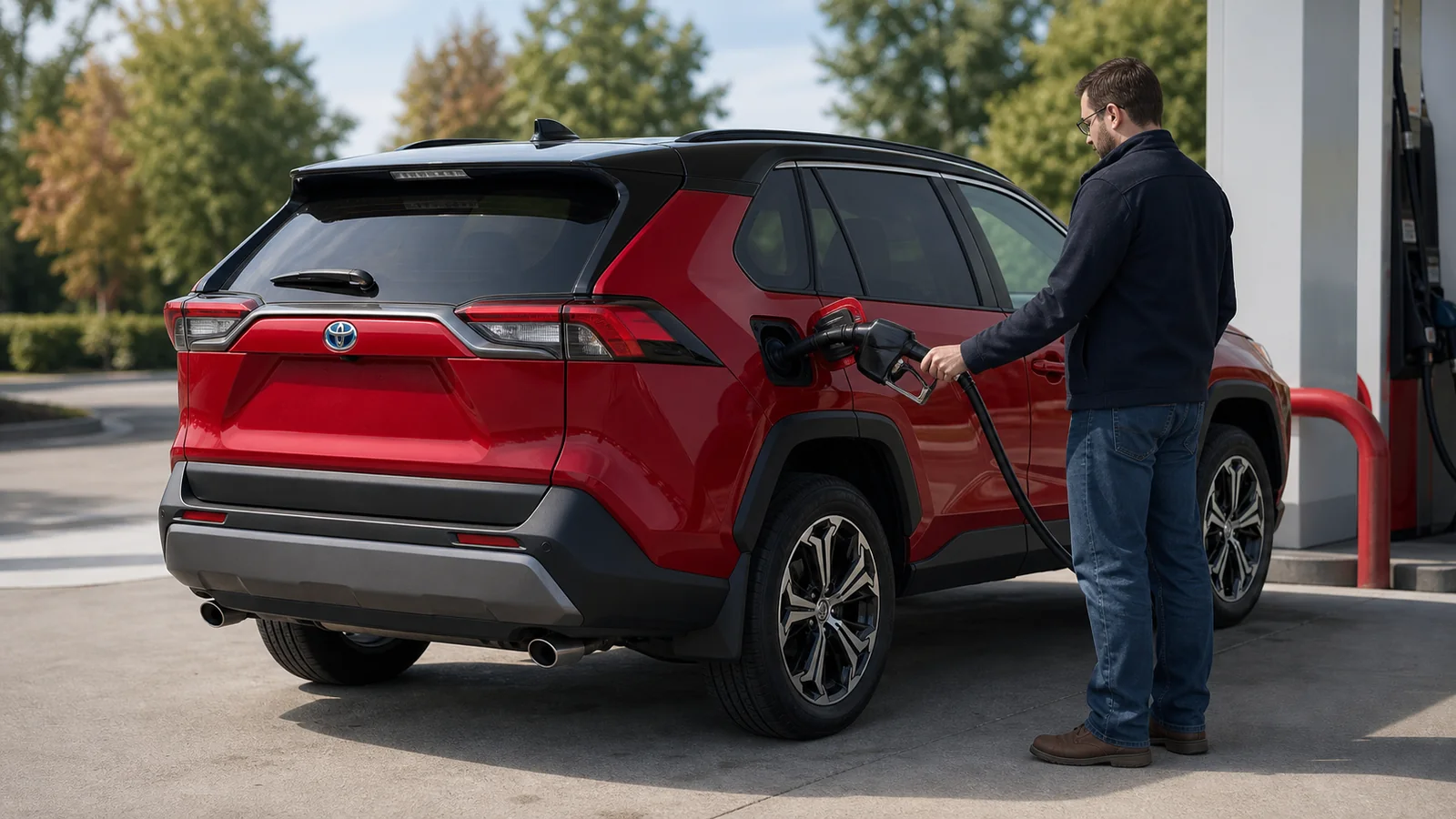
Ask for invoices by VIN, then test whether the vehicle accepts fuel normally instead of relying on a dashboard range estimate.
- 2019 launchIncomplete refueling complaints emerge
- 2020 service informationDiagnostic and repair procedures develop
- Completed repairTank acceptance and gauge behavior should be verified
- Current purchaseConfirm work by VIN and an actual fill
This fault belongs to the gasoline storage system. It does not measure traction-battery capacity, motor condition, or electric-drive durability.
A repaired 2019 can be a sound purchase when the invoice names the completed parts and the tank now fills consistently. A seller who says every RAV4 does this without evidence is asking you to inherit the uncertainty.
Road salt makes the rear motor cable the decisive inspection
The AWD hybrid sends high-voltage power to a rear motor through an orange cable and connector mounted under the vehicle. Road spray containing salt can reach that area, and corrosion at the connection can eventually cause hybrid warnings, isolation faults, loss of AWD assistance, or an expensive cable repair.
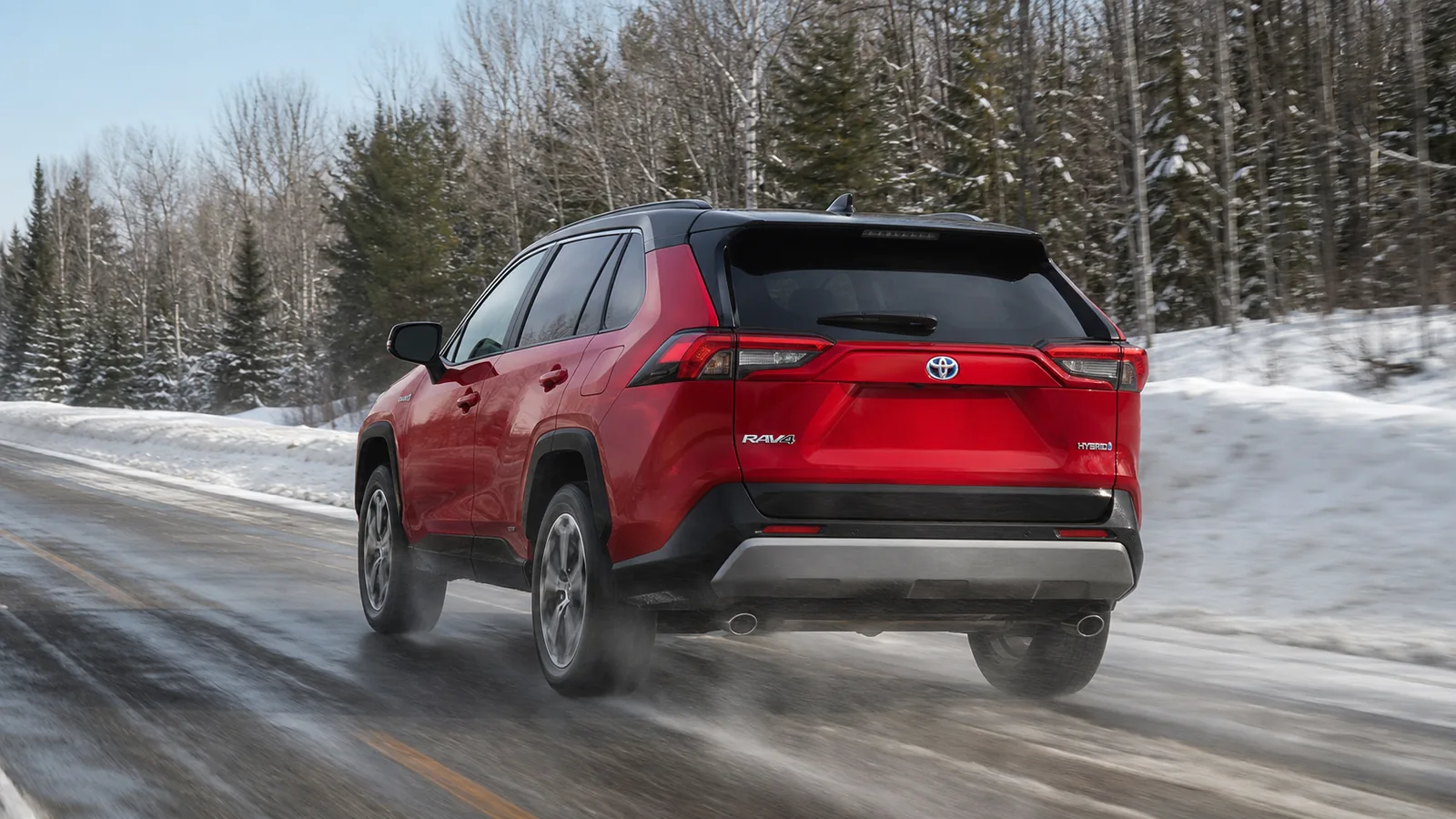
Registration history matters because a dry-climate vehicle does not have the same exposure as one driven through several northern winters. Undercoating and frequent washing may help, but neither replaces a direct view of the connector and a scan of hybrid control modules.
Toyota's Customer Support Program 22TE09 identified certain AWD 2019 to 2022 RAV4 Hybrids and offered coverage for verified rear motor cable corrosion for eight years or 100,000 miles. Verify eligibility and diagnosis for the exact VIN because the program does not make every underbody condition automatically covered.
Toyota revised parts and coverage responses over time, so verify the terms that apply to the exact VIN and region. An internet report about another model year cannot guarantee assistance for the car in front of you.
Hybrid battery life, the 12-volt battery, and the cable are three different systems
The traction battery stores energy for propulsion, the 12-volt battery wakes computers and accessories, and the rear cable carries high voltage to the electric motor. Each produces different symptoms and requires different tests.
| System | Job | Useful evidence |
|---|---|---|
| Traction battery | Stores propulsion energy | Module data, state-of-charge behavior, cooling path |
| 12-volt battery | Starts computers and closes relays | Load test, age, terminal condition |
| Rear motor cable | Carries high voltage to rear drive unit | Visual connector inspection and isolation-code scan |
| Fuel tank | Stores gasoline for the engine | Fill volume, gauge behavior, repair invoice |
A weak 12-volt battery can trigger a cluster of warnings because control modules see low voltage during startup. Test it before assuming several expensive hybrid components failed at once.
Traction-battery condition should be read with proper diagnostic data. Age and mileage provide context, but temperature history, cooling airflow, cell balance, and actual codes provide evidence.
Toyota extended the hybrid battery warranty for model-year 2020 and newer hybrids to 10 years or 150,000 miles, whichever comes first, and made it transferable to later owners. Earlier vehicles use the coverage stated in their own warranty booklet, so confirm the in-service date instead of applying the newer term backward.
Clean the cabin battery-cooling intake and keep cargo from blocking it. Stable temperatures help the pack, while a clogged intake can force higher fan speed and increase heat.
Early 2016 to 2018 and later 2023 or newer models solve different budgets
The 2016 to 2018 fourth-generation hybrid offers a lower purchase price and predates the fifth-generation cable layout at the center of current corrosion concern. Its age raises ordinary questions about batteries, suspension, brakes, cooling service, and accident repairs.
The 2019 to 2022 group offers newer safety and cabin technology but requires fuel-tank and cable evidence. This range can still be excellent when the relevant work is documented and the underbody condition is clean.
Era tradeoffs
- 2016-2018
- Lower price, older components, simpler cable decision
- 2019-2022
- New platform, verify tank and salted-climate cable history
- 2023-newer
- Later revisions and higher price, less long-term age data
A later vehicle buys warranty and design maturity, while an early vehicle can leave more money for a repair reserve. Choose the budget structure you can support rather than assuming the newest odometer always creates the lowest total cost.
The separate years-to-avoid question focuses on model-year clustering. This reliability decision instead asks whether the individual vehicle has passed the system checks relevant to its era.
A winter-history inspection matters more than an odometer shortcut
Begin with registration geography and winter use, then put the vehicle on a lift for direct access to the rear cable connection and surrounding underbody. Surface dirt is expected, while green corrosion, damaged seals, swelling, or stored isolation codes require specialist judgment.
Scan every hybrid module, not only the engine computer. Confirm no warnings were recently cleared and compare freeze-frame data with the seller's account.
- Inspect the rear high-voltage connector and protective hardware
- Verify fuel-tank work on affected 2019 vehicles
- Load-test the 12-volt battery
- Check traction-battery cooling intake and fan operation
- Confirm four matching tires and even tread for AWD
- Verify all recalls and service campaigns by VIN
Mileage cannot reveal road-salt concentration or whether warning codes were erased. A higher-mile dry-climate vehicle with clean diagnostic data can be safer than a lower-mile northern car with an unreadable connector.
Use a Toyota-qualified hybrid technician for this inspection. General mechanical condition still matters, but high-voltage evidence requires the correct access, scan tools, and safety procedures.
The right RAV4 Hybrid is the one with cable evidence and complete campaigns
Buy when the hybrid scan is clean, the cable inspection matches the climate history, the fuel system behaves normally, and maintenance records are continuous. Normal brakes, tires, suspension, and 12-volt battery wear can be priced like ordinary used-car work.
Leave when the seller refuses an underbody inspection, hybrid codes have no diagnosis, or a 2019 fuel complaint remains unresolved. A discount is useful only when a qualified estimate makes the risk finite.
Do not reject a good hybrid because its 12-volt battery is old, and do not accept a corroded cable because the traction battery tests well. Each system must answer its own question.
The dependable RAV4 Hybrid is the one whose winter history, cable condition, fuel-system work, and diagnostic scan agree.
Regenerative brakes, tires, and coolant still need ordinary service

Conventional service evidence
- Friction brakes
- Clean rotor faces, free caliper slides, controlled stops
- Tires
- Matching size and load rating with even tread
- Engine cooling
- Correct level, clean fluid, no dried residue
- Inverter cooling
- Stable temperature and no pump warnings
Brake wear can look unusual to buyers coming from a gas vehicle because regenerative braking reduces use of the friction brakes during normal deceleration. Low pad wear is expected, while rusted rotors, sticking calipers, vibration, or contaminated fluid still require normal mechanical attention.
Tires also influence the hybrid experience because rolling resistance, pressure, tread mismatch, and alignment affect efficiency and AWD operation. Four suitable tires cost more than correcting one weak 12-volt battery, so measure them before using fuel economy as the condition test.
Cooling-system records should cover the gasoline engine and hybrid electronics at the specified intervals. Clean coolant, stable temperatures, and no pump or inverter warnings provide better evidence than a seller's claim that hybrids need no maintenance.
Collision and underbody history affect more than the battery
| Repair area | Evidence to request | Why it matters |
|---|---|---|
| Rear floor | Photos, seams, cable routing, shields | Protects high-voltage hardware and sealing |
| Windshield | Camera calibration invoice | Supports lane and braking functions |
| Bumpers | Radar calibration and scan | Confirms driver-assistance alignment |
| Underbody | Correct fasteners and undamaged covers | Keeps cable protection intact |
Collision history matters near high-voltage components and sensors. Ask whether repairs involved the rear floor, underbody, battery enclosure, cable routing, windshield camera, or bumpers, then require calibration and safety documentation where relevant.
A full hybrid inspection therefore combines ordinary brakes, tires, fluids, structure, and body work with the cable and diagnostic checks. Focusing only on the traction battery can miss both the cheaper faults and the more urgent safety evidence.
Underbody collision work can disturb cable routing, shields, fasteners, and sealing even when the traction battery remains undamaged. Require photographs or invoices for repairs near the rear floor and confirm that protective hardware matches the factory layout.
Windshield and bumper repairs also affect camera and radar calibration. A clean hybrid scan does not verify those driver-assistance systems, so test their startup checks and request calibration records separately.
Confirm that underbody shields and orange-cable fasteners are present and undamaged after any repair near the rear axle.
Fuel economy is evidence only when trip conditions match
Efficiency can provide a useful clue only after the variables are controlled. Compare several trips with similar temperature, speed, tire pressure, cabin heat, and route because winter weather or short drives can lower displayed fuel economy without a component failure.
Unexpected engine running can also be normal when the cabin needs heat, the traction battery is cold, or the system is protecting charge. Persistent roughness, warning messages, large charge swings, or behavior that differs sharply from another healthy example deserves diagnostic data.
Listen for wheel-bearing noise and inspect suspension wear because hybrid quietness can make road-speed sounds more noticeable. These are conventional vehicle repairs, yet ignoring them can make a buyer blame the electric drivetrain for a mechanical noise at one corner.
Confirm both cooling loops have the correct level and clean fluid, then inspect for dried residue around pumps, hoses, and reservoirs. The engine and power electronics depend on temperature control even though their circuits do different work.
Fuel savings matter only after condition and coverage are clear
Ownership math should include insurance, tires, brake service, and the price difference from a gas RAV4. Fuel savings are valuable when the driving pattern earns them, but they should not justify buying a car with unresolved cable corrosion or incomplete fuel-system work.
Regenerative braking can leave the friction brakes underused, especially on a gently driven urban vehicle. Inspect rotor faces on both sides, confirm the caliper slides move freely, and perform several controlled stops to separate normal regeneration from vibration or pulling.
Brake fluid still absorbs moisture, and steel friction surfaces can corrode even when regenerative braking limits pad wear. A road test should include several firm controlled stops after checking that the rotors are safe, which helps expose vibration, pulling, or a sticking caliper.
Measure all four tread depths and confirm matching size and load rating before interpreting displayed efficiency. Alignment error and low pressure raise rolling resistance while also shortening tire life, so the correction benefits both operating cost and road behavior.
The engine and inverter cooling circuits have separate jobs and service information. Confirm correct fluid levels, clean reservoirs, stable temperatures, and no dried residue around pumps or hose connections before treating the hybrid system as maintenance-free.
Fuel economy is most useful as a trend across comparable trips. Tire pressure, cabin heat, speed, short-trip length, roof accessories, and winter fuel can all lower the display without proving battery deterioration.
Coverage also changes the purchase math by model year and in-service date. A cable program or battery warranty is valuable only when the exact VIN, diagnosis, mileage, and time limit fit the written terms.
Ask the technician to save hybrid-health data and photographs of the rear cable connection with the inspection report. That baseline makes later changes visible and prevents a vague statement such as looks fine from carrying the whole decision.
The gas engine still needs its own oil, coolant, ignition, and emissions history. Hybrid durability does not protect an engine that overheated, ran low on oil, or accumulated unresolved misfire codes.
Record the original in-service date because both battery and cable coverage expire by time as well as mileage.
A seller who welcomes a hybrid scan and underbody inspection is providing more useful confidence than one who repeats Toyota's general reputation. The individual car still has to show that normal maintenance and model-specific work were completed.
Sources
- Toyota fuel-system information in service bulletin T-SB-0109-20.
- Toyota cable-corrosion coverage in Customer Support Program 22TE09.
- Toyota hybrid battery terms in its 2020 warranty announcement.
- Model-year complaints from CarComplaints.
- Recalls and complaints should be checked by VIN at NHTSA.