The whole modern run is smaller than one rival year
Before flagging any year, it is worth knowing what a busy year looks like on this vehicle.
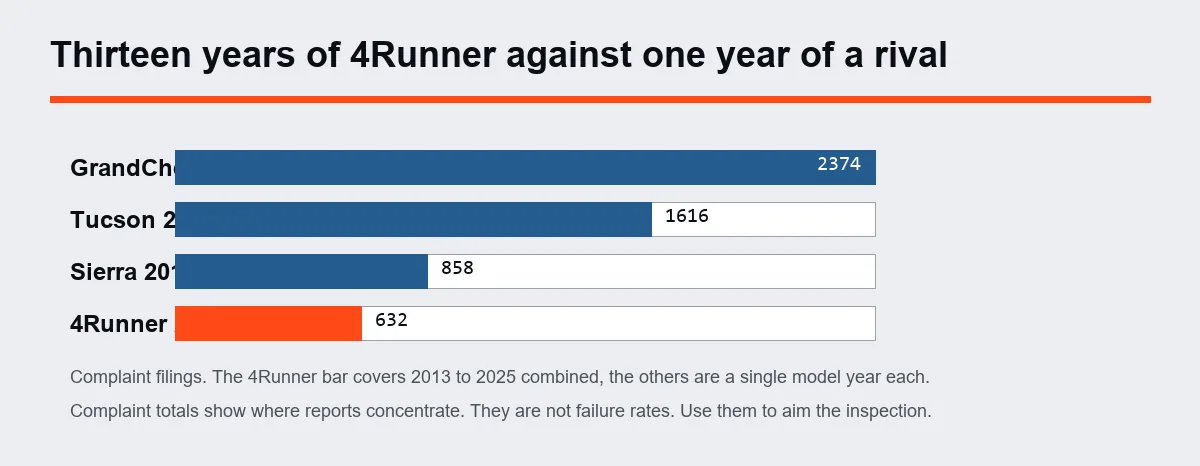
From 2013 to 2025 the Toyota 4Runner holds 632 filings across all thirteen model years. No single year in that run exceeds 85.
Set that against the vehicles in the same buying decision. A single 2016 Hyundai Tucson model year holds 1,616 filings, and a single 2014 Jeep Grand Cherokee holds 2,374.
The categories inside those years are smaller still. The largest single category in any fifth-generation year is 19 filings, electrical on the 2014 truck, followed by 12 for air bags on the 2015 and 10 for electrical on the 2016.
Six of the thirteen years are led by the database's own catch-all label. A record whose most common heading is unknown or other is one with no dominant fault to name.
The quietest years are quieter still. The 2024 truck holds eight filings, the smallest model-year record of any vehicle covered on this site.
None of that makes the flagged years disappear. Read every figure below at this scale rather than at the scale of a troubled vehicle.
The airbag years belong to the industry, not the vehicle
The 2010 to 2012 trucks are on every avoid list, and their records are genuinely led by air bags.
The 2011 truck holds 109 airbag filings, the 2010 truck 89 and the 2012 truck 70. On totals of 163, 145 and 96 that is most of each year.
Read what those filings actually say and the picture changes completely.
| Model year | Air bag filings | Naming an inflator or the recall |
|---|---|---|
| 2010 | 89 | 87 |
| 2011 | 109 | 102 |
| 2012 | 70 | 68 |
Almost every one of them is an owner reporting the inflator campaign rather than a failure. Five separate passenger frontal inflator entries cover 4Runner model years through 2016.
That programme covered vehicles from many manufacturers, not this one. Filings generated by owners chasing a recall measure the recall's reach, not the vehicle's quality.
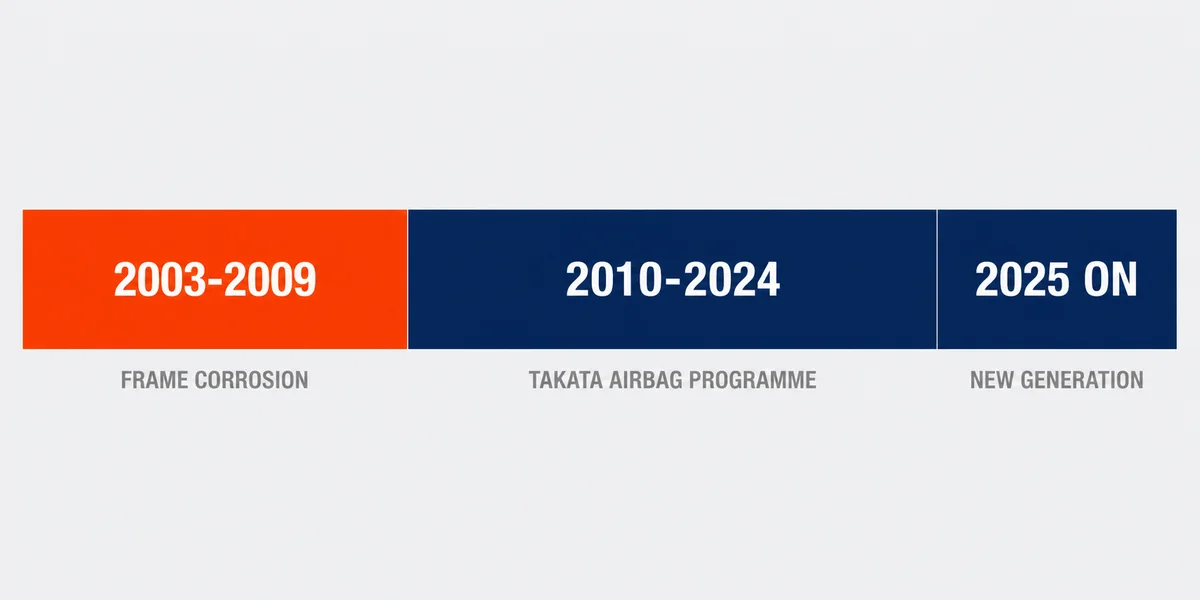
So the check on those years is simply whether the inflator work is closed on the VIN. It is not a reason to avoid the model year.
Frame corrosion is the one era that is really its own
Strip out the airbag programme and one era remains. It is a genuine Toyota design problem.
The 2003 truck holds 285 structural filings and the 2004 truck 310. Read them and 260 and 272 of those name rust, corrosion or the frame directly.
What owners describe is not surface rust. One filing records two holes through the frame rails just behind the front wheels and two more at the ends of the rear crossmember.
That wording repeats across the era. Seventy-eight of the 2003 filings and 93 of the 2004 ones describe holes, perforation or metal that has rusted through.
The consequences owners report are not cosmetic. Fifty-six of the 2003 filings and 50 of the 2004 ones describe the truck being called unsafe, condemned or sent for scrap.
Many of those judgements came from a franchise rather than the owner. Sixty-four of the 2003 filings and 69 of the 2004 ones involve a dealer, in several cases refusing to work on the vehicle.
One owner records a dealership declining to align new tyres because the rear frame had rusted through. Another reports being told the frame needed replacing at 78,000 miles.
Mileage is not what decides this. Time and salt are.
Several filings describe trucks under 100,000 miles with structural rust. An odometer reading settles nothing here.
The era tapers instead of stopping cleanly. The 2005 truck carries 185 structural filings with 170 matching, the 2006 truck 143 with 137, and the 2007 truck only 40 with 22.
Where to look on a fourth-generation truck
- Frame rails behind the front wheels
- Holes rather than scale, often from the inside face outward
- Rear crossmember ends
- The other location owners name most often
- Spring and shock mounts
- Check the metal around them, not just the fasteners
- Any fresh underseal
- Treat a recently coated frame as a reason to look harder, not less
The same corrosion story reaches the Toyota Tacoma of the same era, so a cross-shopper carries the identical inspection between them.
Age matters more than the model year now. A 2003 truck kept out of the salt belt can be sound while a 2006 truck from Ohio is not, which makes this an inspection and not a year filter.
No campaign covers the frame
The rust era holds the largest cluster in this record and the shortest paperwork trail.
Seven campaigns reach the 2003 to 2006 trucks in total. They cover wheels, a fuel system, two label corrections, an accelerator pedal, side air bags and a seat heater.
What a VIN check returns on a fourth-generation truck
- 02V339 for wheels and 03V146 for the fuel system, on the 2003 truck only
- 11V113 for the accelerator pedal, which reaches all four model years
- 16V065 for side air bags and 16V396 for a seat heater
- 10V035 and 10V036, which are label corrections and not repairs
- Nothing at all for the frame, the rails, the crossmember or corrosion
Two hundred and sixty of the 2003 truck's 285 structural filings name rust, and no campaign answers any of them. A clean VIN report and holes in the frame are both true at once.
The contrast with the Toyota Tacoma is worth drawing, because that truck did receive suspension campaigns in the same period. Campaign 05V225 covers lower ball joints on 2003 and 2004 trucks, and 14V604 covers rear leaf springs across 2005 to 2011.
The inspection is not a second opinion on a recall here. It is the only source of information there is.
The middle of the fifth generation is almost empty
Between the inflator years and the newest trucks there is a long stretch that no year list discusses, because there is nothing in it to discuss.
The 2014 truck holds 77 filings, the 2015 truck 85 and the 2016 truck 78. Those are the busiest years of the whole fifth generation.
Even then the leading categories are small and scattered. Electrical leads the 2014 record at 19 filings and the 2016 record at 10, which are counts most vehicles reach in a single quarter.
From 2017 the numbers fall again and stay down. The 2017 truck holds 36 filings, the 2020 truck 32 and the 2023 truck 30.
Eleven consecutive model years without a single leading category reaching triple figures is the clearest statement this record makes. It is also why the two flagged eras stand out so sharply in any ranking that does not adjust for scale.
The campaign list says the same thing. The 2020 truck carries one campaign and the 2023 truck one, and both are label corrections rather than repairs.
For a buyer that means the fifth generation is chosen on mileage, service history and condition. The complaint record simply does not separate one year from another.
The new generation opens on brakes
The sixth-generation truck arrived for 2025 and its record so far is small enough to read in full.
Service brakes lead at 18 of the 54. Read those 18 and the split is stark.
Fourteen of them describe a noise, squealing, squeaking or grinding, in some cases from the first week of ownership. Exactly one says anything about how the truck stops.
A launch year whose leading category is almost entirely a noise is a different proposition from one whose leading category is a failure. That distinction is what a raw category ranking throws away.
Owners describe it as loud, constant and present in all weather. Several report a dealer confirming the noise and calling it normal for the pad material.
On a record this small it would be wrong to draw much from it either way. A truck a few months into production has not had time to show what it does at eighty thousand miles.
One campaign has been issued so far. Campaign 25V595 covers the instrument cluster, which is a display fault and not a mechanical one.
Seven of the 54 filings name the cluster or the display, so that campaign has a visible constituency in the record. It is still the least consequential thing on this page.
The eight filings on the 2024 truck are the more remarkable number. A final model year that quiet is unusual for any vehicle.
Three of those eight are structural. Nothing in the group repeats often enough to be called a pattern.
Which 4Runner to look for
This is the one vehicle in this silo where the model year is close to irrelevant.
The 2020 to 2024 trucks hold 32, 35, 39, 30 and eight filings. No fifth-generation year exceeds 85, so there is no year to steer around.
Nothing inside those years concentrates either. Their leading categories run at six, five, six, six and three filings, which is the level at which a category name stops meaning anything.
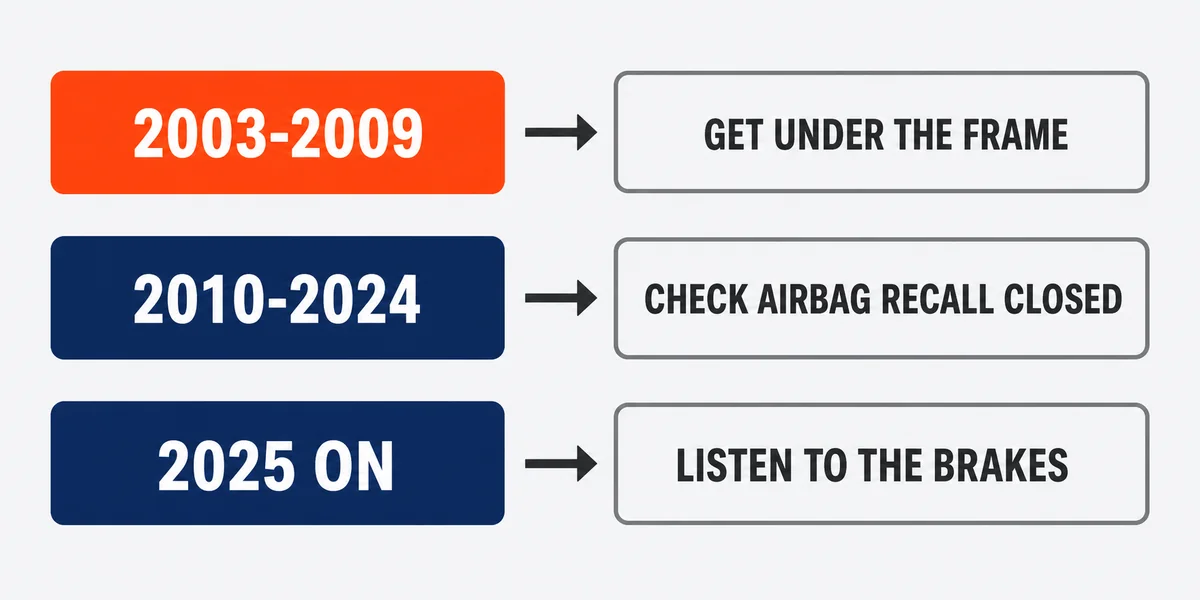
What replaces year selection is a single check per era. Only one of them is any effort.
On most vehicles the useful advice is which year to avoid. On this one it is which underside to inspect.
That is an unusual position for a twenty-year-old nameplate to be in, and it is what the numbers show.