Two peaks, seventeen years apart
Laid out by model year, the complaint record does not have one problem in it. It has two, with a long quiet run between them.
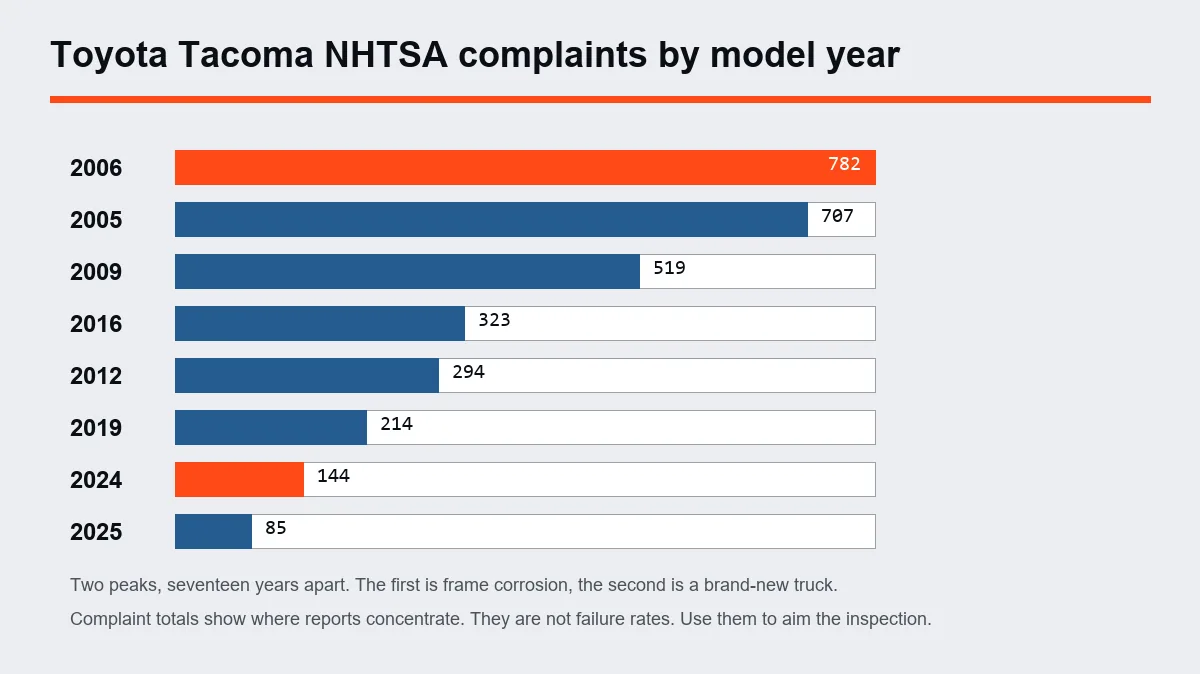
The first peak is the famous one. The 2006 Toyota Tacoma holds 782 filings and the 2005 truck 707, which are the two largest totals anywhere in the nameplate.
Then it settles for more than a decade. The 2022 and 2023 trucks hold 57 and 52 filings, the quietest years the Tacoma has ever recorded.
The second peak is new. The 2024 truck already holds 144 filings and the 2025 truck 85, on vehicles that have barely had time to accumulate anything.
A record shaped like that cannot be summarised by its older half. Every existing year list does exactly that, which is why the current truck goes unreported.
The frame era is closed, and its numbers say why
The early trucks earn their reputation on the numbers rather than on repetition.
Structure leads the 2005 record at 193 filings and the 2006 record at 177. That is the corrosion story, the largest single concentration in the first half of the record.
What happens next is less well known. Suspension takes over as the leading category for 2007, 2008 and 2009, at 83, 97 and 101 filings.
| Model year | Filings | Leading component |
|---|---|---|
| 2005 | 707 | Structure at 193 |
| 2006 | 782 | Structure at 177 |
| 2007 | 540 | Suspension at 83 |
| 2008 | 445 | Suspension at 97 |
| 2009 | 519 | Suspension at 101 |
The newest truck anywhere in that run is a 2009, which makes it old enough that the model year has stopped being the useful filter. Two trucks from the same year can now be in completely different condition.
So the old warning still applies, but it applies as an inspection rather than as a shopping rule. Get underneath any truck of this era, check the frame rails and the leaf spring mounts, and judge that example rather than its year.
The 2016 truck is a drivetrain question
The middle of the record has one genuine concentration. It arrives with the third generation.
The 2016 truck holds 323 filings. Powertrain accounts for 136 of them, which is more than two fifths of everything filed against that model year.
Nothing else in the middle years comes close to that share. The 2017 truck falls to 238 filings and the concentration eases with it.
Two campaigns cover the same window and both are worth checking by VIN rather than assuming.
What clears a 2016 or 2017 truck
- 17V285, rear differential
- Repair order naming the operation, not a closed status line
- 17V356, engine
- Dealer record confirming the work was carried out
- Shift quality
- A drive from cold to fully warm, with repeated pull-aways from a stop
- Service history
- Evidence the automatic has had fluid work, which many have not
The useful thing here is that the fault reports behaviour rather than breakage. Drive a third-generation truck long enough to reach operating temperature and pay attention to how it selects gears at low speed.
The 2009 headlights melt
One category in the first peak has nothing to do with corrosion, and no year list covers it.
Exterior lighting holds 105 filings against the 2009 truck. Read them and 99 of those 105 describe melting or overheating, mostly of the amber lenses inside the headlight unit.
Owners report the amber sections deforming and clouding on both sides, which obscures the light output. It is a heat problem inside a sealed assembly rather than anything a bulb change fixes.
That makes it the one fault on an old Tacoma you can check in daylight without tools. Look into both headlight units from the front and compare the amber sections for distortion or a milky finish.
No campaign covers it, so a VIN search will not raise it. On a truck of this age it is a cost question rather than a safety one, but replacement units are not cheap.
The 2012 and 2019 trucks each carry one system
Between the two peaks sit two smaller years worth knowing about. Each is about a single system rather than a general decline.
The 2012 truck holds 294 filings with 80 of them against the engine. Owners describe the truck losing power and refusing to exceed about 45 mph, with the check engine and traction lights coming on together.
The 2018 and 2019 trucks are a fuel and brake story instead.
Fuel items lead both years. Brakes sit immediately behind at 27 and 32 filings.
What the late second-generation and mid third-generation years need
2012 engine
80 of 294 filings. Drive it under load on a gradient and watch for a power ceiling with warning lights
2018 fuel pump
Two separate campaigns cover the same defect, so confirm both by VIN rather than one
2019 fuel pump
Same pair of campaigns. Toyota states the consequence as the engine stalling while driving
2018 to 2019 brakes
Campaign 18V888 covers reduced braking performance, which is separate from the fuel work
The fuel pump pair is the detail most easily missed. Toyota recalled the same fuel pump defect twice on these trucks, so a history report showing one closed campaign does not tell you the second was done.
Neither year belongs on an avoid list on this evidence. Both simply have a named question that a VIN search and one drive can answer.
The 2024 truck fails young
Here is the part of the record no year list has caught up with.
The 2024 truck holds 144 filings and 52 of them are filed against the powertrain. Thirty-five of those 52 name the transmission directly.
The failures are not one behaviour. Eleven describe hard, rough or slamming shifts, eight an outright transmission failure, eight a loss of drive power and seven the gearbox dropping into neutral.
What ties them together is when they arrive. Five of the 52 give a mileage figure alongside a transmission failure, and not one of those trucks had reached 4,000 miles.
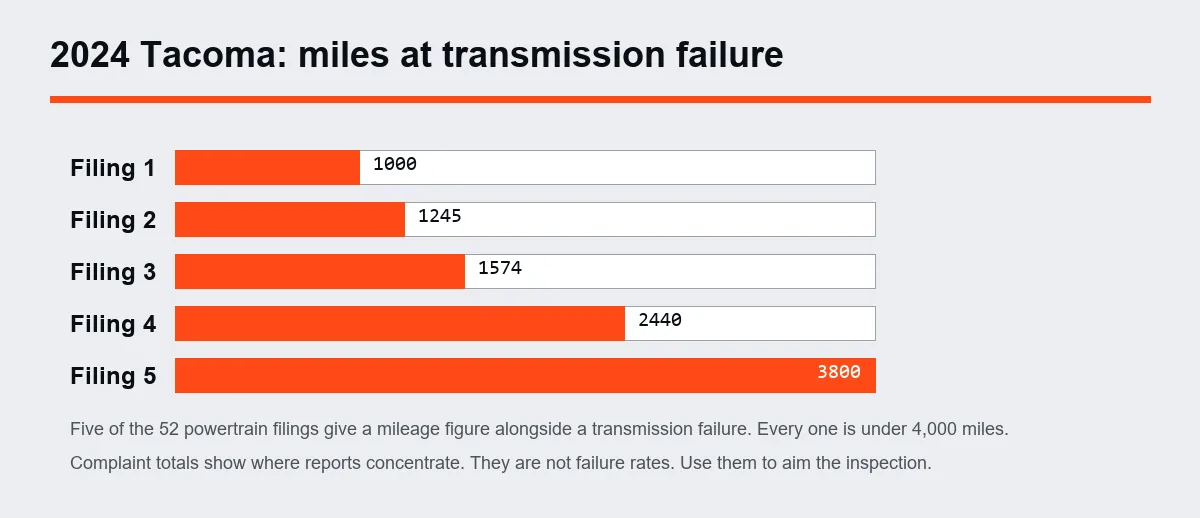
Two of those owners had barely finished the drive home. One records a failure fifteen days after purchase at just over 1,000 miles, another at 1,245 miles after about a month.
The failures themselves are not gentle. One truck lost most propulsion climbing a mountain highway at 2,440 miles, and another dropped into limp mode at 3,800 after the gearbox revved as though in neutral.
Thirty-three of the 52 end in a dealer visit, a replacement or a tow. For a vehicle this new that is a high proportion.
Two campaigns sit alongside it on the same trucks.
Campaign 25V058 covers brakes on 2024 and 2025 four-cylinder models. Campaign 26V514 covers rear shock absorbers on the 2024 Tacoma Hybrid.
A door handle is breaking on the 2025 trucks
The newest truck's leading category is structure, which sounds alarming until you read what the filings actually describe.
They are not about the frame. They are about the handle you pull to get out.
Owners describe the handle fracturing during normal use, in one case while the truck was parked, leaving it flopping loose. Several report the door then opening from neither the inside nor the outside.
Roughly one in three filings against a truck barely a year old naming a single interior part is a manufacturing problem, not wear. No campaign covers it, so nothing will show up in a recall search.
That makes it the cheapest check on this page. Sit in both front seats and work each interior handle properly before you talk about price.
A driveshaft recall owners report they cannot close
Toyota issued campaign 25V656 covering the driveshaft on 2025 Tacoma models. Nine filings in that year's record name the campaign by number.
Seven of those nine say the same thing, which is not about the driveshaft at all.
The contact received notification of NHTSA Campaign Number: 25V656000 (Power Train); however, the part to do the recall repair was not yet available. The vehicle was taken to the dealer, where it remained since October 2025, while the contact drove a rental vehicle.
Another owner records the remedy as pending for more than seven months. On this campaign an open status is at least as likely to mean the part is on backorder as that the seller ignored the letter.
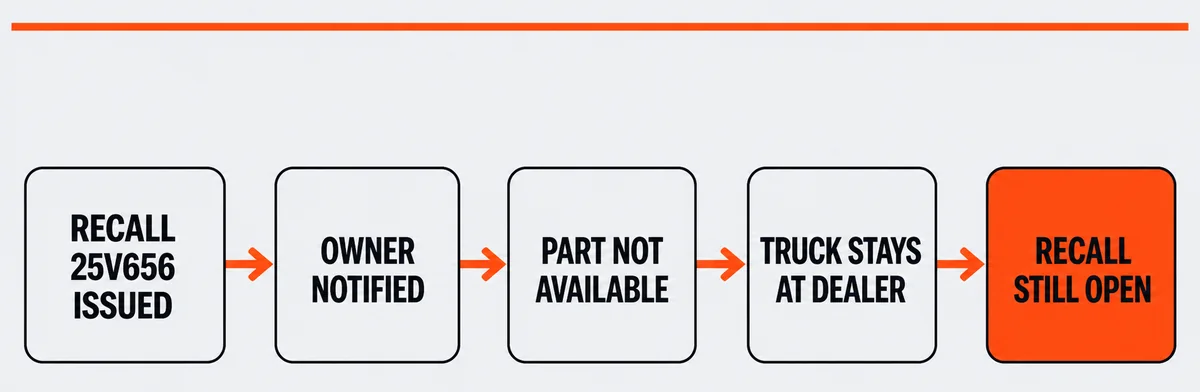
So the question changes for the newest trucks. Ask the dealer whether the part is actually in stock and how long their current wait is, rather than asking only whether the recall is closed.
Which Tacoma to search for
The quiet window is not where most buyers look, because it is the end of a generation rather than the start of one.
The 2022 and 2023 trucks hold 57 and 52 filings.
The 2021 truck holds 78. The 2024 truck holds nearly three times the 2023 total.
Those late third-generation trucks sit after the drivetrain complaints that define 2016 and before the redesign that defines 2024. One campaign still reaches them, covering child seat anchors on 2022 and 2023 models.
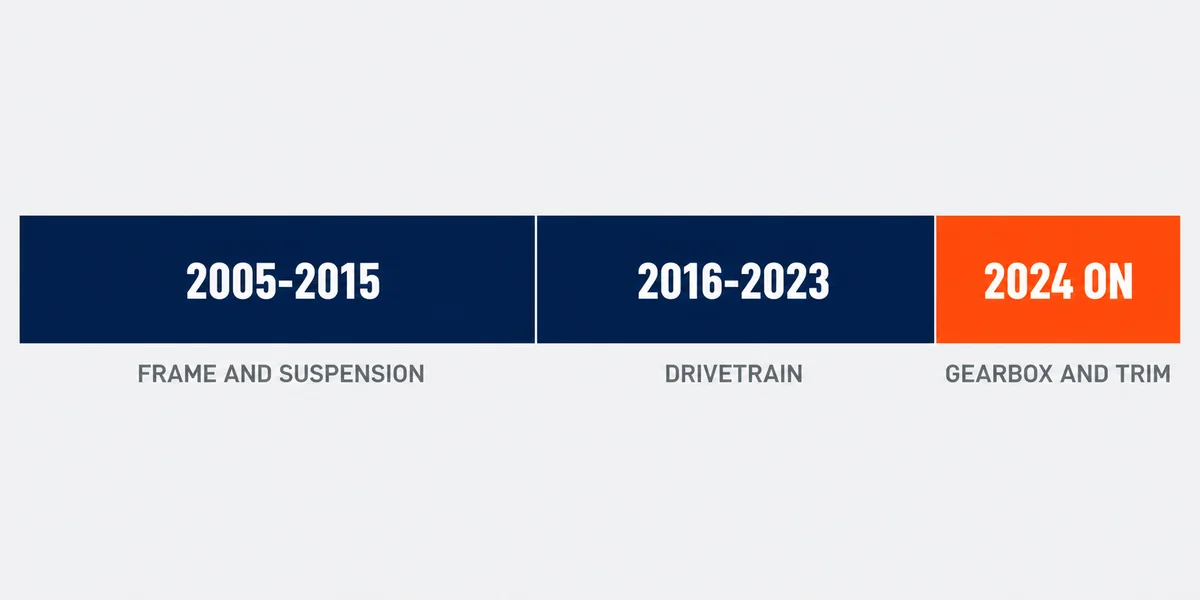
The Tacoma is still a straightforward truck to buy, provided you stop reading the twenty-year-old warning as though it were the current one. One drive settles the middle years, a service history settles the newest, and a parts question settles the rest.
The three eras also cost different amounts to keep. A frame-era truck is cheap to buy and expensive to inspect while a third-generation truck is the reverse, which is the comparison the Toyota Tacoma reliability record sets out.