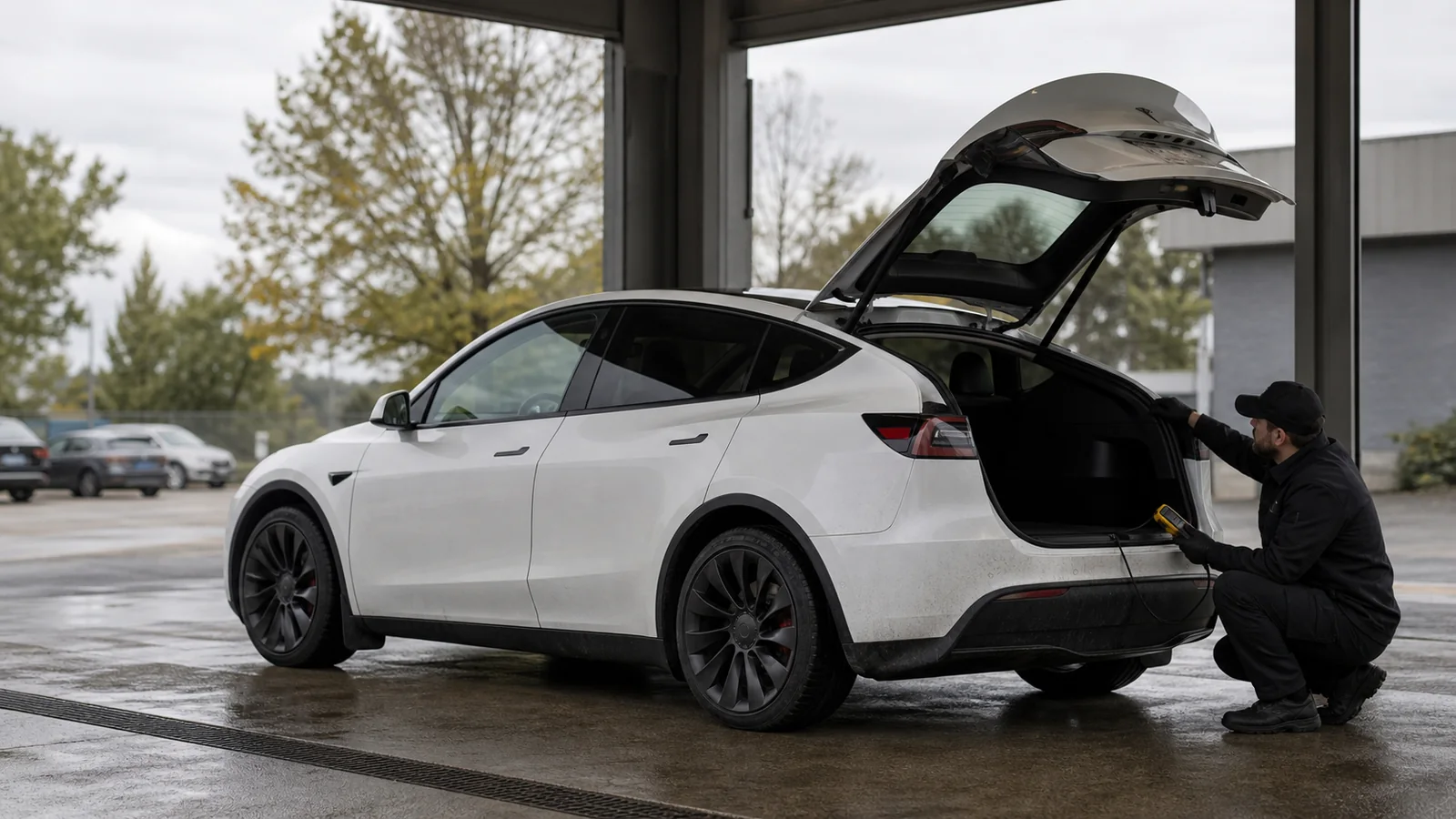
The first two years carry the longest inspection list
The Model Y launched for 2020 and shares major systems with the Model 3, but its taller body, larger tires, hatch, rear structure, seats, and suspension loads create a different used-car inspection. Build plant and date also matter as production expanded.
CarComplaints names 2021 its worst Model Y year, yet the site lists only four submissions on the current year page.
That is not enough to calculate reliability. Two entries concern premature 12-volt battery failure, which makes low-voltage history worth checking without turning four reports into a year-wide verdict.
| Model year | Starting verdict | Evidence that changes the choice | Required check |
|---|---|---|---|
| 2020 | Inspect closely | Launch year plus heat-pump and suspension campaign exposure | Build repairs, HVAC, knuckles, tires, hatch, and charging |
| 2021 | Inspect most closely | Highest small complaint sample plus seat-belt, heat-pump, and suspension checks | VIN campaigns, cold heat, low-voltage battery, and seat hardware |
| 2022 | Consider by VIN | Suspension-knuckle campaign can include certain cars | Campaign status, alignment, tires, cameras, and charging |
| 2023 | Target by condition | Later production with fewer launch-period questions | Battery, tires, body repair, HVAC, and current recalls |
| 2024 | Consider | Mature original body, but long-term history remains shorter | Exact build, repair file, insurance, and charging |
| 2025-newer | Consider, data still maturing | Refreshed design and controls | New hardware, tire cost, parts history, and VIN campaigns |
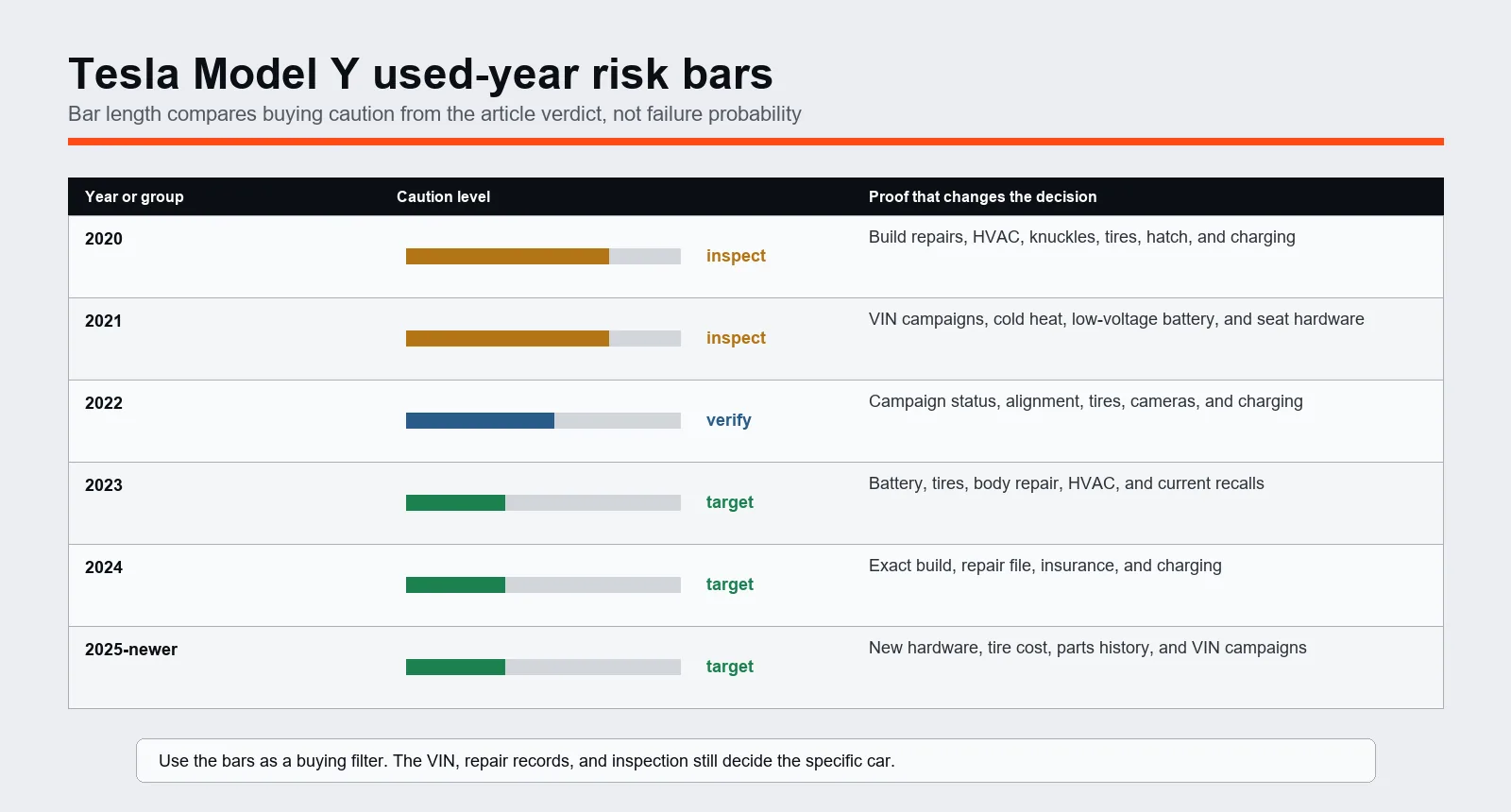
A campaign population may include several Tesla models, so it cannot be treated as a Model Y failure count. The VIN and completed remedy are the only reliable way to close a recall question.
Suspension knuckles and tire wear need one combined check
Tesla recall bulletin SB-21-31-004 describes inspection of suspension knuckles on certain 2020 through 2022 Model Y vehicles.
The procedure checks knuckle hardness and replaces affected parts.
Applicability comes from the VIN record.
A normal short drive can miss loose or damaged suspension. Use slow turns, driveway angles, broken pavement, steady highway tracking, and moderate braking.
Listen for clunks or creaks, then inspect joints, fasteners, wheels, and all four tires.
Inner-edge tire wear deserves a lift or a mirror because the outer tread can look healthy. Mismatched tire models, different tread depths, bent wheels, or repeated alignment invoices may point to pothole damage or unresolved geometry.
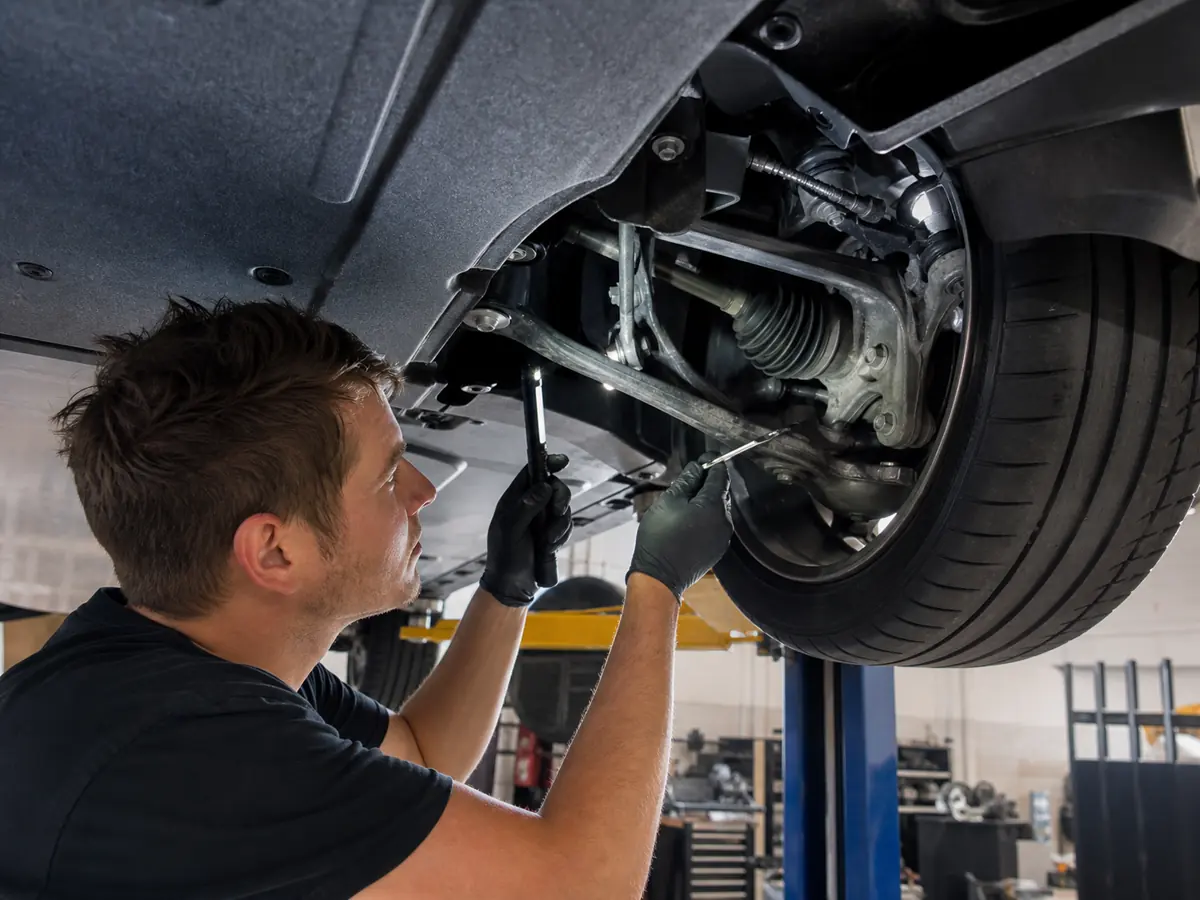
The tire-pressure procedure should use the exact door-label value. Large wheels can raise replacement cost and reduce impact protection, so price a complete matching set before choosing a trim.
Walk away from unexplained geometry changes or repeated rapid tire wear.
Cold cabin heat exposes the 2020 and 2021 sensor issue
Tesla service bulletin SB-21-18-002 covers certain 2020 and 2021 Model 3 and Model Y heat-pump vehicles whose refrigerant pressure and temperature sensors can fault over time. The listed correction replaces all three sensors.
This is a campaign bulletin for a non-safety condition, not proof that every heat pump will fail. It creates a defined service-history question for applicable cars.
Test from a cold, unplugged start. Request cabin heat, note outlet temperature and time, then change the set point and fan speed.
Scan the thermal system for stored faults and ask whether the sensors, compressor, supermanifold, or refrigerant circuit received work.
Preconditioning can hide weak performance during a sales demonstration. Repeat the test after the car sits, and compare energy use during similar conditions.
HVAC evidence
- Cold-start output
- Warm air arrives consistently without repeated warnings
- Sensor campaign
- Applicability and completed Tesla service entry
- Stored faults
- No unresolved thermal-management codes
- Repair history
- Named part, date, mileage, and symptom
The EV charging guide helps separate winter energy use from a hardware fault. Buy a 2020 or 2021 heat-pump car only when cold operation and repair history agree.
Seat-belt campaigns make a physical cabin inspection necessary
NHTSA recall 21V-388 concerns second-row seat-belt retractor attachments on certain 2021 Model Y vehicles. The manufacturer report describes a retractor that may not have been secured correctly.
A separate campaign, 21V-389, covers certain front shoulder-belt top-loop attachments. The NHTSA report explains that an incorrectly secured fastener can keep the belt system from performing as designed in a crash.
Verify both by VIN rather than recall name alone.
Then inspect every seating position. Pull each belt sharply to confirm locking, inspect webbing and anchors, buckle and release every latch, and check that second-row seats lock securely after folding.
A repaired collision can disturb belt anchors, trim, pretensioners, seats, and air-bag wiring. Scan the restraint system and compare trim fasteners, carpet, seat mounts, and pillar covers for disturbance.
Use this cabin sequence:
- Match the VIN to both seat-belt campaign records
- Test every buckle, retractor, and adjustable shoulder loop
- Fold and relatch the rear seatbacks
- Scan restraints and air bags for current or stored faults
- Inspect pillars, floor anchors, and seat mounts for repair evidence
A clear touchscreen does not prove that a mechanical belt attachment is secure.
Low-voltage battery and wake behavior can stop a charged car
The traction battery can hold plenty of energy while the car fails to wake because the low-voltage system is weak.
CarComplaints' 2021 page includes two low-voltage battery submissions, one with a reported $100 repair. The sample is tiny, but the symptom is easy to test and document.
Ask when the low-voltage battery was replaced and which chemistry is fitted. Review warning history, sleep behavior, door and hatch operation, and any repeated jump or service calls.
A replacement should have a dated service entry, not only a seller statement.
The car should wake consistently from the key, phone, and screen. Cameras, locks, windows, powered hatch, charge port, climate control, and seats should work after the vehicle has been asleep.
Software connectivity and low-voltage faults can feel similar to the owner. A technician needs voltage history, alerts, and logs to separate them.
Repeated wake failures need diagnosis before purchase, even when the high-voltage battery shows a full charge.
Battery, charging, and underbody evidence decide the expensive risk
A Model Y battery assessment uses more than displayed range. Wheel size, temperature, recent energy use, software calibration, and state of charge all move the number.
Confirm the exact battery and drive configuration, warranty start date, high-voltage repair history, and charging behavior.
Test AC charging and a DC fast-charge session when practical. The connector should lock, charging should begin cleanly, and alerts should remain absent.
Inspect the battery enclosure, aero shields, lift points, rocker panels, and cooling area.
Scraped shields are common. A dented enclosure, fresh sealant, missing fasteners, damaged lift point, or underbody collision needs an EV-qualified review.
Record these facts:
- Battery and motor configuration
- Warranty start date and remaining coverage
- High-voltage and low-voltage repairs
- AC and DC charging results
- Underbody impact or lift damage
- Tire size, tread depth, and alignment evidence
The electric powertrain field gives context for range and charging differences. Compare the Model Y with the Ford Mustang Mach-E and Hyundai Ioniq 5 when service access, ride, and charging behavior matter.
Do not buy through unexplained battery damage or repeat charging faults.
Hatch, glass, and body repairs reveal how the crossover lived
The Model Y's hatch and cargo opening make it useful, but they also create more seals, hinges, trim, glass, and rear-body structure to inspect.
Open the hatch from the screen, exterior control, and phone. Confirm that it rises smoothly, stays open, closes without hitting trim, and latches on the first attempt.
Inspect the cargo well, side bins, rear seatbacks, headliner, hatch seal, roof edges, and lamp pockets for water marks. A musty smell, fogged lamp, lifted carpet, or corroded connector needs a source.
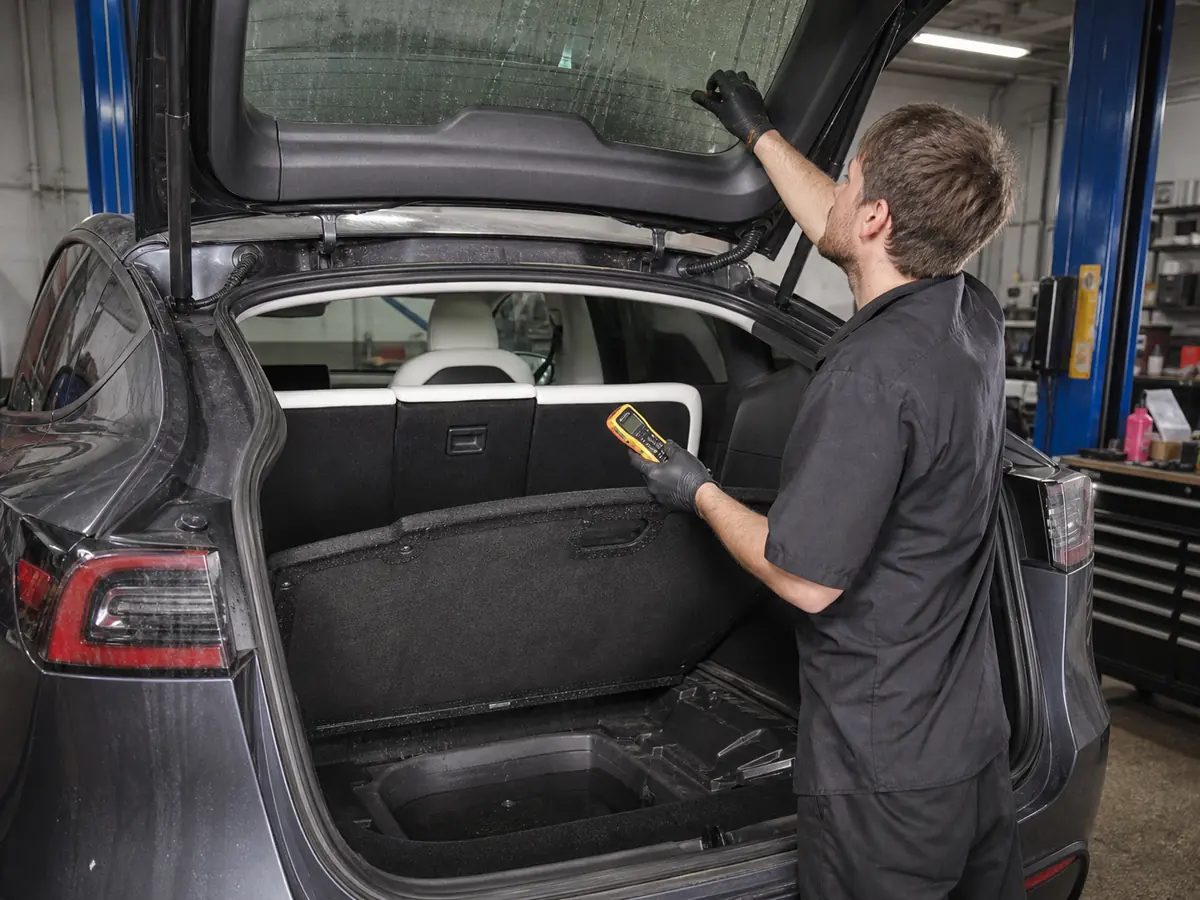
Check paint texture and panel gaps under even light. Compare glass markings, bolts, seam sealer, lamps, and camera alignment.
A repaired rear impact can affect the hatch, charging hardware, parking cameras, and water sealing at once.
The SUV field helps price the space against non-EV alternatives. The Tesla brand range separates Model Y cargo value from the lower Model 3 sedan.
Build configuration and family-use wear change the same model year
Two Model Y vehicles from the same year can have different factories, wheels, seat counts, low-voltage systems, processors, suspension revisions, and service histories.
Photograph the certification label and VIN, then confirm the exact configuration in the vehicle and account. A listing that says only Long Range or Performance leaves out details that change tires, ride, cargo use, and repair cost.
Wheel size is the easiest difference to price. Larger wheels use lower-profile tires that cost more and provide less impact protection.
Check all four wheels for bends and repairs, inspect inner tread, and compare the installed tire specification with the door label.
A mixed set can affect noise, grip, range, and all-wheel-drive behavior.
Seven-seat cars add moving second-row hardware and a compact third row. Operate every latch and track, fold and raise each seat, inspect belt routing, and confirm that floor anchors and trim remain secure.
Bring the child seat or passenger who will use the space because a functioning mechanism can still be a poor fit.
Five-seat cars have fewer seat mechanisms, but the cargo floor and underfloor bins often show how the vehicle lived.
Look for pet damage, liquid spills, crushed trim, loose tie-down points, and repairs around the rear structure.
A detailed cabin can hide moisture below the removable floor.
Family use also appears at the door edges, seat bolsters, rear climate outlets, USB ports, window switches, and powered hatch.
Test these parts after the car wakes from sleep, then repeat key functions after the road test. Intermittent faults deserve more weight than cosmetic marks because they can involve wiring, low-voltage power, or damaged connectors.
Build and service evidence should answer these questions:
- Which factory and month built the car?
- Which wheels, seats, battery, and motors are installed?
- Does every tire match the required size and load rating?
- Were suspension, seat-belt, HVAC, or low-voltage campaigns completed?
- Did any collision or glass repair require camera calibration?
- Can the seller complete account transfer with every key card present?
Account access is part of the handover. Confirm that the seller can remove the vehicle from the old Tesla account and that the transfer process is ready.
Test phone and card keys, remote wake, locks, hatch, charging controls, and climate access. Do not leave payment or delivery to a promise that account access will be fixed later.
Review repeated service visits by symptom. Several invoices for cabin heat, suspension noise, water entry, or wake failure require a final repair that explains why the condition stopped.
An invoice that says inspected or updated does not name a failed part or prove the issue stayed gone.
A pre-purchase scan should preserve active and historical evidence. Do not clear alerts before an EV-qualified technician reads them.
Mechanical faults, restraint attachments, collision repairs, and water damage cannot be approved from a clear center screen alone.
Value the Model Y by its installed configuration and evidence, not by the cleanest version of the year in an online listing. The right year can still be the wrong car when wheels, seats, repairs, or account ownership do not match the advertisement.
A family-use road test must include load, noise, and braking
The Model Y often carries passengers and cargo, so an empty solo drive is incomplete. Bring the child seat, stroller, mobility aid, luggage, or pet barrier that defines the purchase.
Confirm door opening, seat access, belt fit, hatch clearance, and cargo-floor strength before judging acceleration or screen features.
Drive first with the cabin quiet. Listen over broken pavement for hatch rattle, seat movement, suspension clunks, and trim noise.
Some noise is cosmetic, but a sound that changes with steering, braking, or wheel speed needs mechanical inspection.
Test the friction brakes at low speed and during moderate stops.
Regenerative braking reduces pad use and can allow rotor corrosion. The pedal should stay firm, the car should stop straight, and no wheel should drag or heat abnormally.
Regeneration changes with battery charge, temperature, and settings. Record those conditions before deciding that reduced deceleration is a fault.
A warning or abrupt change deserves diagnostic evidence.
On the highway, check straight tracking, crosswind behavior, wheel vibration, camera availability, climate output, and wind noise around glass.
Repeat the route after the tires warm. A bent wheel or tire defect may become clearer at speed.
After the drive, reopen the hatch, fold the seats, and inspect the cargo well.
Vibration can move loose trim or reveal water beneath the floor. Recheck tire temperatures safely and look for one wheel that differs from the rest.
A loaded family car also needs payload awareness. Use the door label and count passengers, child seats, cargo, and accessories.
Roof boxes and hitch carriers change wind noise, range, and rear-axle load even when they are empty.
The right Model Y must carry the real household load without belt, hatch, tire, brake, suspension, or climate problems.
Why 2023 is the cleaner starting point
A 2023 Model Y sits after the first three production years and before the later refresh. It avoids the launch year and is outside the model-year descriptions in the 2020 through 2022 knuckle bulletin.
That does not make it immune to recalls, tire wear, collision damage, charging issues, glass damage, or software campaigns. Its long-term record is also shorter than a 2020 car's record.
The benefit is a narrower starting checklist. Confirm current campaigns, then focus on the battery, charging, tires, HVAC, underbody, hatch, cameras, and repair history rather than assuming the year itself earns approval.
CarComplaints currently lists only two submitted complaints for 2023 and none for 2022 or 2024. Those tiny counts show why absence of reports is not proof of reliability.
The new versus used checklist covers title, lien, and seller records. Keep copies of the VIN campaigns, scan, battery evidence, charging notes, tire measurements, and repair invoices.