The Ram years split into three different checks
Ram became a stand-alone brand for the 2012 model year, so older Dodge Ram complaint totals should not be mixed into this decision.
The truck sold as the Ram 1500 from 2012 through 2018 belongs to the DS generation. The redesigned DT truck arrived for 2019, while the older body continued as the separately named 1500 Classic.
That overlap makes a listing title unreliable. A 2019 Ram 1500 and a 2019 Ram 1500 Classic have different body structures, electronics, and campaign histories even though sellers may shorten both names to Ram 1500.
CarComplaints identifies 2014 as the worst Ram model year and lists the 2013, 2016, 2019, and 2015 1500 among the brand's other worst models. Those reports help locate trouble, but they do not show the chance that one truck will fail.
| Model year or group | Starting verdict | Evidence that changes the choice | Required check |
|---|---|---|---|
| 2012-2013 | Inspect very carefully | Early Ram-branded trucks carry concentrated engine and steering reports | Cold engine, full scan, steering effort, and recall history |
| 2014 | Avoid without exceptional proof | CarComplaints names it the worst year, with 387 complaints and 17 recalls listed | EPS, eight-speed operation, air suspension, Park engagement, and every VIN campaign |
| 2015-2016 | Inspect very carefully | Engine, fuel, steering, and powered-tailgate records need separation by build | Cold and hot drive, tailgate latch, shifter type, and campaign receipts |
| 2017 | Consider by configuration | Later DS year, but column-shifter and powered-tailgate recalls can still apply | Shifter design, recall completion, engine noise, and work history |
| 2018 | Target for a late DS truck | Mature generation with fewer owner-submitted problem entries than 2014 | Fuel system, tailgate, axle noise, and open recalls |
| 2019 | Inspect very carefully | First DT year, with 27 recalls listed on the model-year record | Confirm DT versus Classic, then check electronics, steering, leaks, and campaigns |
| 2020 | Consider with records | Second DT year, but early-generation electronics and leak checks remain | Full-module scan, rear window, exhaust, and recall status |
| 2021 | Target as a DT starting point | CarComplaints lists 23 submitted complaints, well below earlier problem years | Rear window, eTorque behavior, air suspension, and current VIN results |
| 2022-newer | Inspect by VIN | Shorter ownership history and continuing campaign updates | Current recall lookup, service file, software, and exact engine |
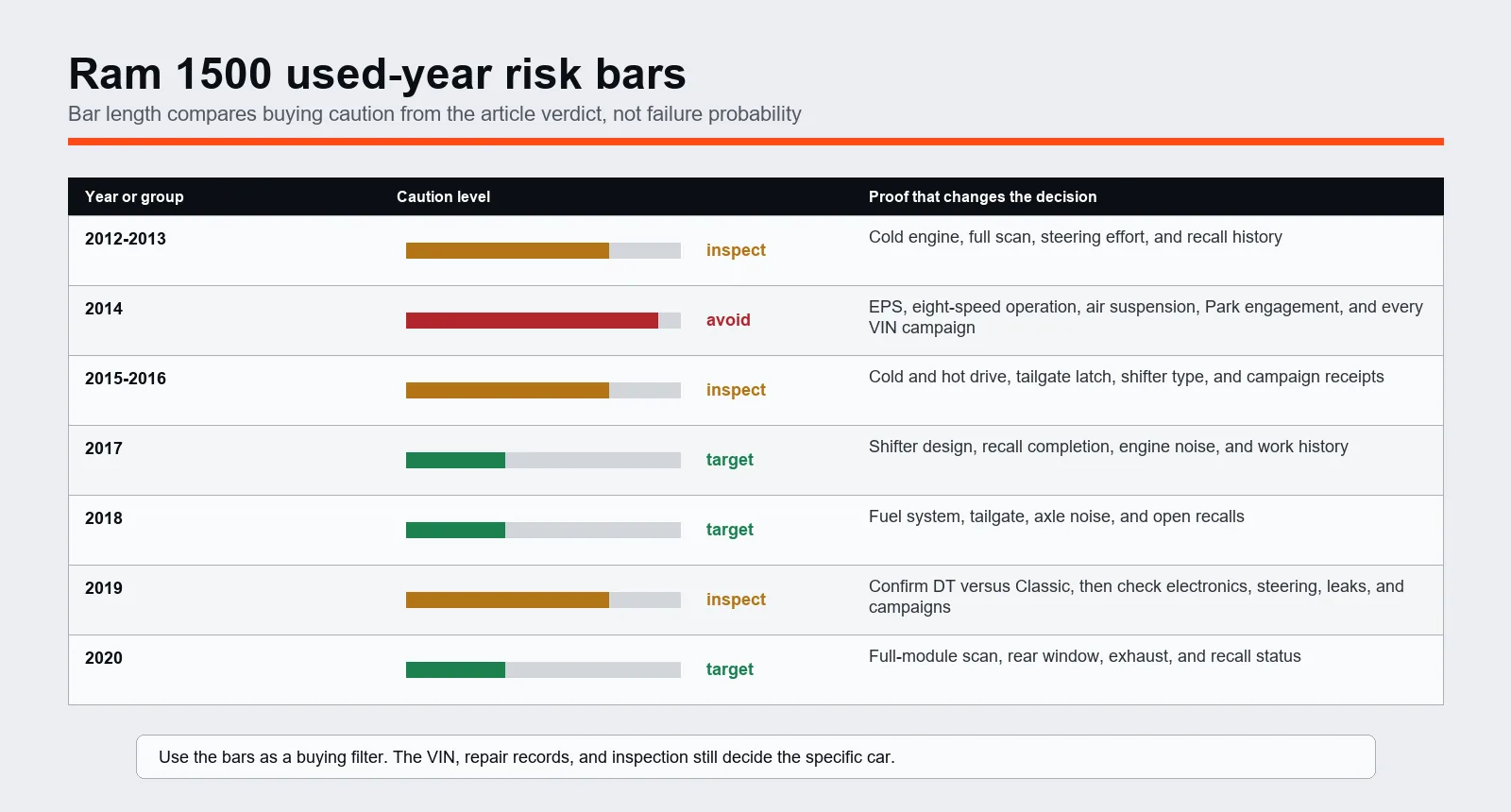
The table is a filter, not a guarantee. A completed recall does not erase poor maintenance, and a clean complaint chart does not prove a specific truck is healthy.
Use the full-size pickup field to compare the Ram with trucks that carry different failure patterns. Keep this year screen separate from the broader Ram 1500 profile, which covers engines, payload, and daily use across the whole range.
Why 2014 is the clearest year to avoid
The 2014 Ram 1500 combines several expensive systems in one model year.
Its CarComplaints model-year record lists 387 complaints and 17 recalls. The largest submitted categories are transmission with 58 reports, interior accessories with 54, engine with 52, steering with 45, and electrical with 40.
CarComplaints lists power steering failure as the year's worst reported problem, with an average reported repair cost of $3,100 at 82,000 miles.
The site also lists air-suspension trouble at an average reported $2,000 and 56,000 miles.
These are owner-submitted averages, not shop quotes for every truck.
The steering check needs more than turning the wheel in a parking space. Drive from cold, make repeated low-speed turns, hold a straight line on a crowned road, and watch for an EPS warning or a sudden change in assistance.
A full scan should include the steering module even when the dashboard is clear.
A limited group of 2014 four-wheel-drive trucks with the eight-speed automatic was covered by NHTSA recall 14V-161. An improperly machined transmission case could prevent the park pawl from engaging, which could let the truck roll.
The VIN decides whether that campaign applies.
Air suspension adds a separate cost path. Let the truck sit before the appointment, compare all four corners, cycle every height setting, and listen for a compressor that runs too long.
The combined steering and Park test should be recorded with the scan result so the shop can name the fault instead of guessing from one symptom.
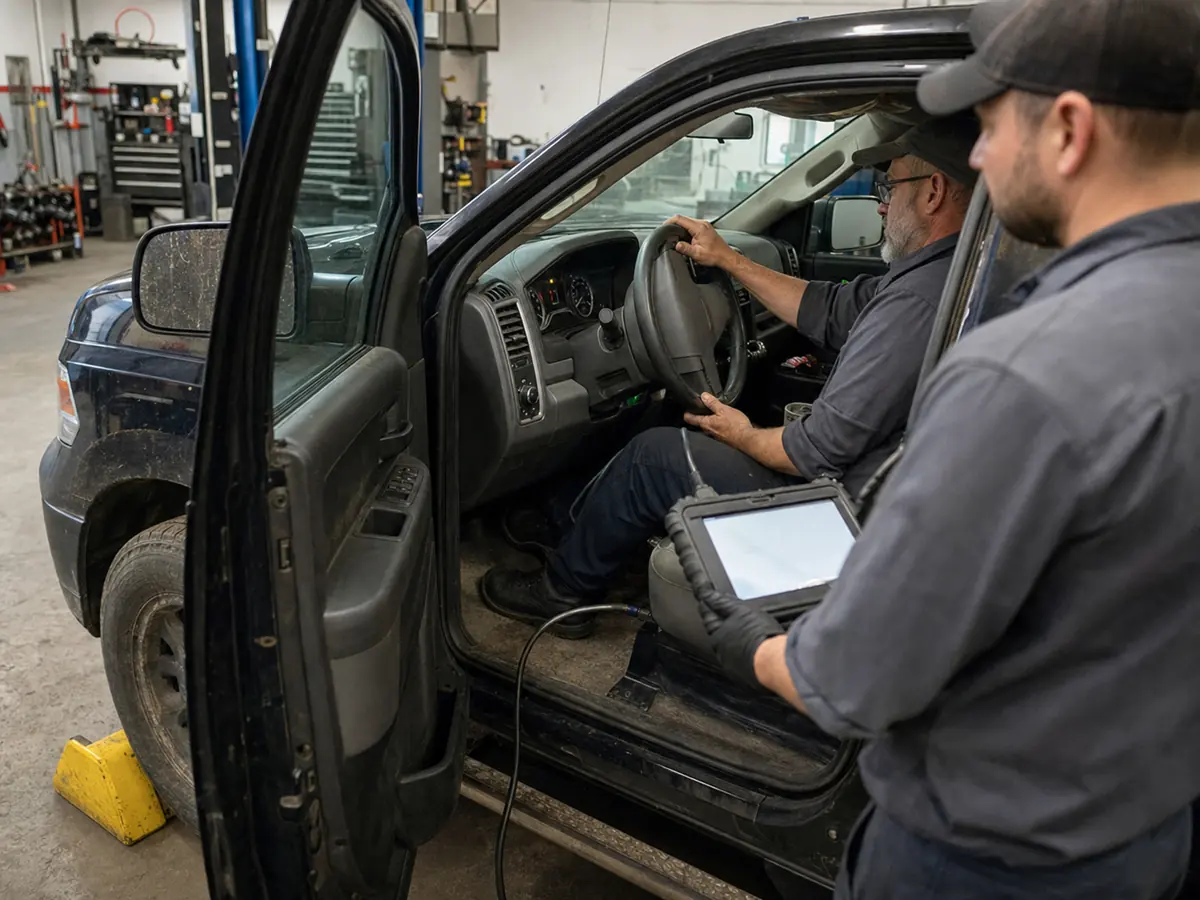
Walk away when steering assistance changes, Park does not hold, or the body settles unevenly after sitting.
Engine noise means different things on 2012 through 2016 trucks
A tick from a 5.7-liter Hemi needs diagnosis before price negotiation. A cold exhaust leak can sound sharp and fade as the manifold warms.
A valvetrain problem may remain warm, follow engine speed, add a misfire, or leave metal in the oil filter.
Treating every tick as a broken manifold can hide a much larger engine bill.
The 2012 Ram 1500 record lists 199 complaints, including 62 submitted engine problems. Its leading submitted problem is camshaft and lifter lockup, with a $5,200 average reported repair cost at 119,000 miles.
The same page lists engine knock and valve noise at a lower average mileage, which makes a cold start essential.
The 2013 page carries a different warning mix. CarComplaints lists 478 NHTSA steering complaints and 159 NHTSA engine complaints in its category display, alongside 24 submitted steering reports and 39 submitted engine reports.
One complaint can be assigned to more than one component, so these category totals should not be added into a failure rate.
A useful cold-start check has a fixed order:
- Confirm the engine is cold by touching the upper radiator hose before startup
- Start with the hood open and record the first 60 seconds of sound
- Listen at both exhaust manifolds, then at the valve covers
- Scan for current, pending, and permanent misfire codes
- Cut open the oil filter when service history or persistent noise justifies it
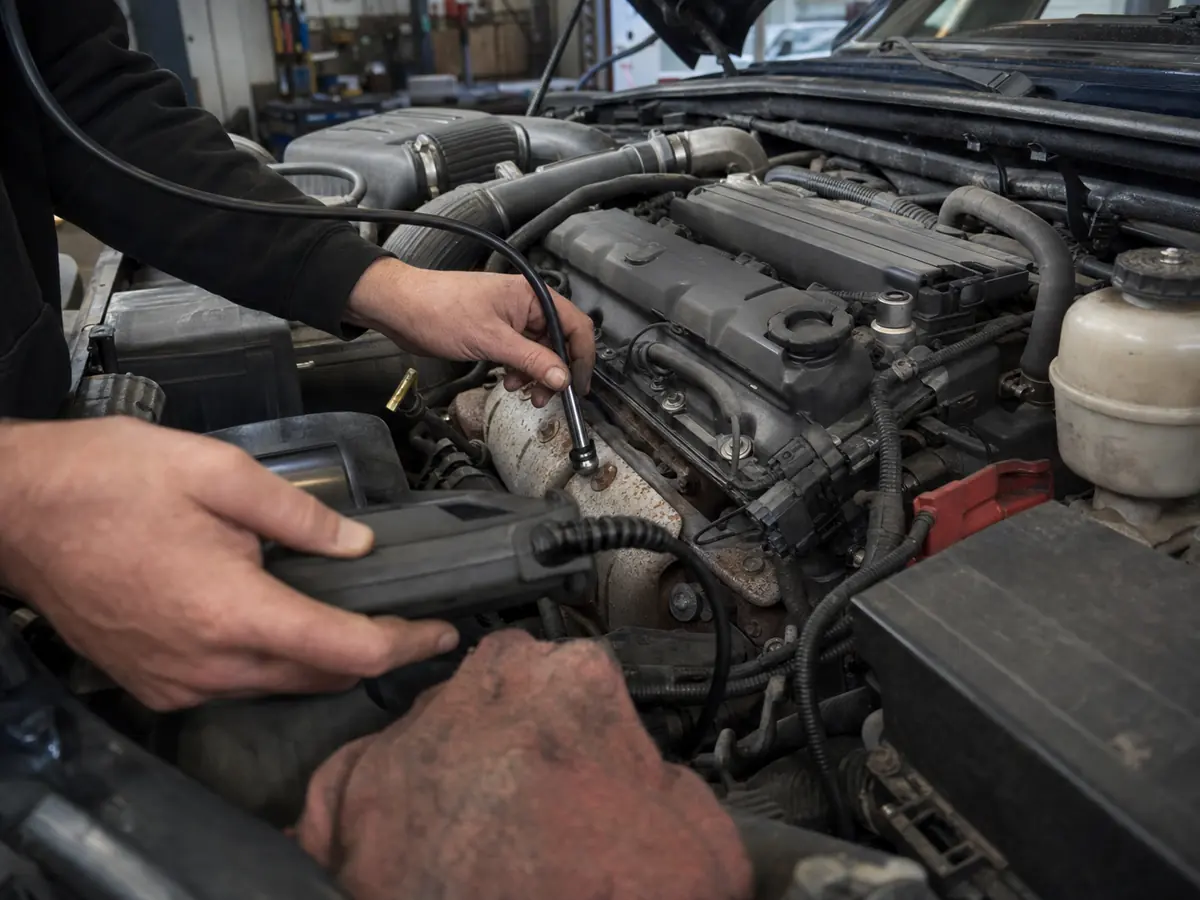
Do not authorize a camshaft or lifter repair from sound alone. Ask the shop to identify the bank and cylinder, check misfire counts, inspect oil condition, and explain whether the noise disappears as the exhaust expands.
Persistent warm tick plus a misfire deserves a written diagnosis before purchase.
The gas powertrain group gives context for simpler naturally aspirated alternatives. The Ram still needs an engine-specific check because V6, Hemi, EcoDiesel, and later Hurricane trucks do not share one repair list.
2015 and 2016 require a recall and configuration audit
The 2015 and 2016 trucks sit inside several overlapping concern groups. CarComplaints lists 33 submitted engine problems for 2015 and 36 for 2016.
Its 2016 overview also puts engine failure and a severe stop-related transmission complaint among the Ram brand's costliest submitted problems.
A small production group of 2015 and 2016 DS trucks was covered by NHTSA recall 16V-167 for contamination in the electric power-steering circuit board. The campaign involved about 440 vehicles, which shows why a broad statement that every truck has the defect would be wrong.
Column-shift trucks need another check. NHTSA recall 17V-821 covered 2009 through 2017 Ram 1500 trucks equipped with a column shifter.
The brake-transmission shift-interlock pin could stick open and allow a shift out of Park without the brake pedal or key conditions being met.
Rotary, floor, and manual shifters were excluded.
Powered tailgates add a cargo-safety question. FCA's 19V-347 recall report explains that a fractured actuator limiter tab could let the tailgate open while driving and release unsecured cargo.
The earlier U74 action covered certain 2015 through 2017 Ram pickups, and the later action expanded the population.
Verify these items by configuration:
- Column shifter: confirm T79 or 17V-821 completion when the VIN is included
- Powered tailgate: pull firmly on both corners after locking it
- Electric steering: scan the EPS module and inspect recall history
- Air suspension: cycle heights and recheck the truck after it sits
- Hemi engine: compare cold noise with warm noise and misfire data
Evidence by Ram system
- Hemi V8
- Cold and warm sound, misfire data, oil history, and filter inspection
- Column shifter
- VIN inclusion and T79 repair record
- Eight-speed automatic
- Park hold, engagement, fluid leaks, and hot shift quality
- Air suspension
- Level after sitting, height changes, compressor run time, and stored codes
- Powered tailgate
- Recall status, both latches, lock operation, and cargo history
The correct VIN, shifter, engine, and suspension must be identified before a model-year verdict means anything. Compare the truck's label and equipment with the Ram model range instead of trusting a seller's trim description.
EcoDiesel trucks carry a separate fire-recall check
The 3.0-liter EcoDiesel changes the inspection again. Its strong low-speed torque and highway range appeal to owners who tow or cover long distances, but diesel emissions hardware, coolant history, and recall work matter more than the Hemi noise check.
NHTSA recall 19V-757 covered certain 2014 through 2019 Ram 1500 and 1500 Classic pickups with the 3.0-liter EcoDiesel.
The EGR cooler could crack from thermal fatigue, allowing heated vaporized coolant into the EGR system.
The mixture could combust in the intake manifold and increase fire risk.
The recall population was 107,979 vehicles, but the VIN still decides inclusion. A coolant top-up receipt does not prove the EGR cooler was replaced, and an EGR repair does not explain every case of coolant loss.
Start the diesel inspection cold. Record the expansion-tank level, look for dried coolant around the engine and underbody, scan the engine and emissions modules, and compare any EGR-cooler invoice with the VIN campaign history.
After the drive, recheck the level and inspect for fresh residue or odor.
Diesel ownership also needs evidence that the truck regularly reached operating temperature. Repeated short trips can make emissions-system operation harder, while towing or long highway use puts different demands on cooling, oil, and fuel systems.
The service file should fit the way the seller says the truck was used.
Ask the diesel shop to record five findings:
- Whether recall VB1 or 19V-757 applies and shows complete
- Whether coolant level and pressure remain stable
- Whether stored emissions codes return after a complete drive cycle
- Whether oil and fuel-filter service match time and mileage
- Whether the truck has unsupported emissions modifications
An emissions delete is a stop sign for a normal road purchase. It can create registration, inspection, resale, and diagnostic problems, and it removes the factory configuration used for safety and emissions work.
Buy an EcoDiesel only when the recall file, coolant evidence, emissions equipment, and diesel-specialist inspection agree.
The first DT year makes 2019 a conditional buy
The redesigned 2019 DT truck is quieter and more comfortable than the outgoing DS, but first-year hardware and software add inspection work. Its CarComplaints record lists 27 recalls, 26 submitted electrical problems, 22 submitted steering problems, 20 submitted transmission problems, and 19 submitted engine problems.
The same page displays much larger NHTSA category totals. Those totals can include reports assigned to several components, so they are useful for finding systems to inspect, not for estimating how many trucks fail.
NHTSA campaign V61, recall 19V-407, covered certain 2019 DT trucks whose occupant-restraint controller software could disable air bags and belt pretensioners.
Dealer instructions call for reprogramming the module. A clear VIN result matters more than whether the air-bag lamp happens to be off during a short drive.
Some replacement electric steering gears for 2013 through 2019 DS trucks were covered by equipment recall 19E-077.
This matters most when a truck has a replacement steering assembly. The part history and VIN report need to explain what is installed.
Check a 2019 in this order:
- Confirm whether it is the new DT truck or the older 1500 Classic
- Run the VIN through the current NHTSA recall lookup
- Scan every module before the seller clears or disconnects the battery
- Test steering, transmission, cameras, parking brake, and trailer controls
- Inspect the rear window, roof edge, headliner, and carpet for water entry
A dry cabin at the appointment is not enough. Look for water marks, lifted carpet edges, musty odor, and corrosion at connectors.
Buy a 2019 only when the generation, recall file, scan, and leak inspection all agree.
Why 2018 and 2021 are better starting points
A 2018 Ram 1500 is the last regular model year of the DS generation before the DT launch.
That does not make it trouble-free. CarComplaints lists 14 recalls, while its submitted categories include 14 interior-accessory reports, 13 fuel-system reports, and seven engine reports.
The value is maturity. Independent shops know the Hemi, eight-speed, air suspension, and DS electronics well.
Parts and diagnostic history are established. A steel-spring V8 truck with clean records is easier to judge than a feature-heavy first-year redesign.
A 2021 Ram 1500 is the stronger DT starting point. CarComplaints currently lists 23 submitted complaints, including five for interior accessories and four for windows or windshield.
It still needs a VIN check and rear-window inspection, but it avoids the first model year's broad complaint concentration.
Mileage cannot choose between them. A 70,000-mile work truck with idle hours, towing wear, and air-suspension faults can be a worse buy than a 110,000-mile coil-spring truck with complete service.
The Ford F-150 and Chevrolet Silverado offer useful price checks because both have different engine and transmission risk periods. A safer Ram year still has to beat the condition and records of the actual rival truck.
Inspect the truck for work, water, and suspension history
A pickup can age hard without adding many miles.
Long idle time wears engine hours. Towing heats the transmission and axle.
Bed loads work the rear suspension. Oversized tires add load to steering and wheel bearings.
The tire-pressure check should use the door-label specification before the road test.
Begin under the rear half. Inspect the receiver, safety-chain loops, trailer connector, differential, shocks or air springs, spare-tire area, and bed mounts.
Fresh black paint over the hitch or frame deserves the same scrutiny as surface rust.
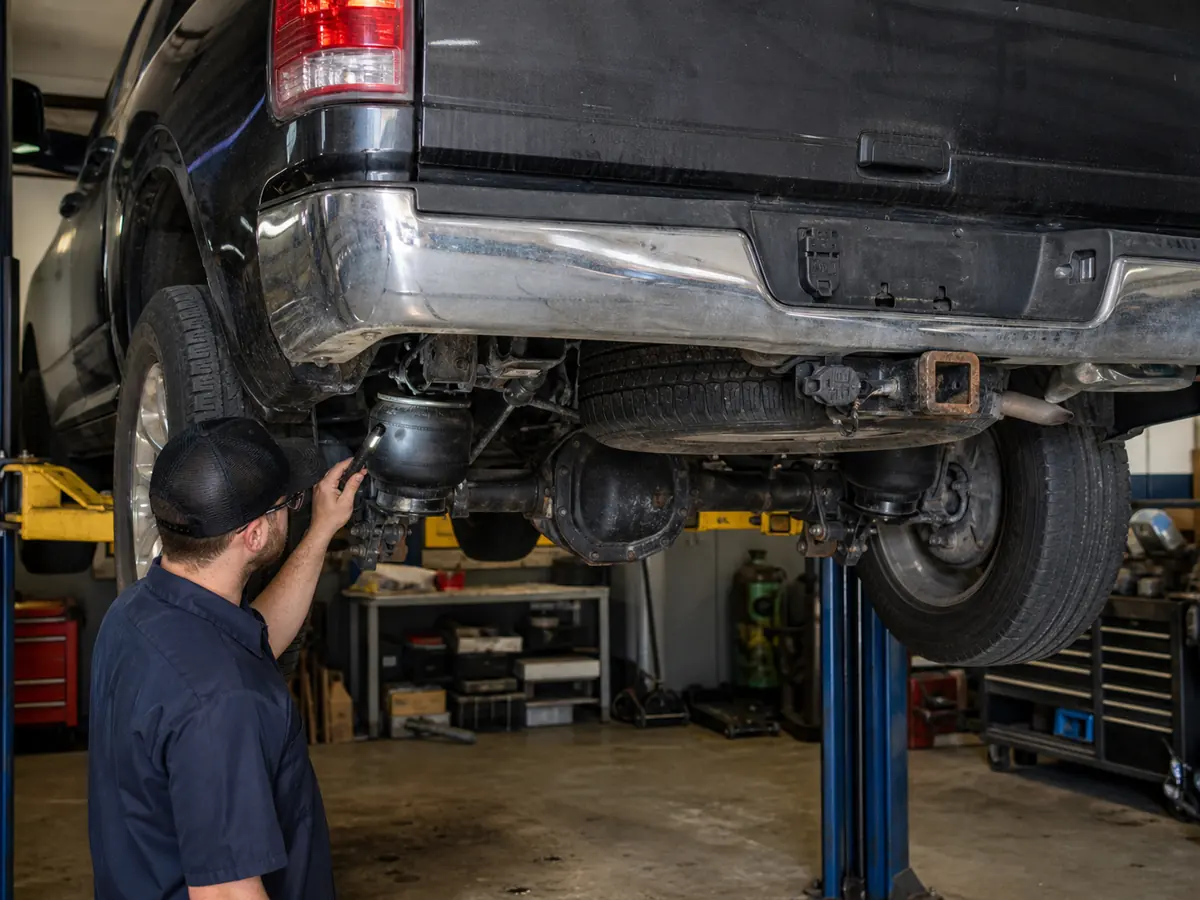
Then move into the cab. Scan all modules, test every camera and USB port, run the climate control through its modes, and inspect the rear-window frame.
Water can reach electronics before it leaves an obvious puddle.
Record the physical evidence:
- Photograph the VIN, door-jamb payload label, engine bay, and shifter
- Measure ride height at all four corners before and after cycling suspension modes
- Photograph hitch wear, trailer wiring, axle leaks, and mismatched tires
- Save the full scan before codes are cleared
- Match repair invoices to mileage, VIN, part numbers, and campaign numbers
The door sticker also protects the buying decision. A high-trim crew cab with four-wheel drive, panoramic glass, and air suspension can have less payload than a plain truck.
Use the exact payload number before comparing towing claims.
The rear-wheel-drive field explains why an unloaded truck may feel different from one carrying tongue weight. The new versus used checklist covers title, lien, finance, and seller records that a mechanical inspection cannot settle.
Stop when water damage, suspension height, scan results, or towing evidence contradicts the seller's explanation. The smooth ride that makes a Ram attractive can hide an expensive option list.
Complaint totals guide the inspection, not the verdict
RepairPal rates the Ram 1500 3.5 out of 5 and lists average annual repair cost at $691. It also reports 0.2 unscheduled shop visits per year and a 13 percent probability that a repair is severe.
Those figures combine model years, engines, and configurations, so they describe the whole nameplate rather than a particular used truck.
CarComplaints combines visitor reports with NHTSA data in its model-year displays. The site explains that its visitor complaints are organized by vehicle, component, and specific problem.
A NHTSA complaint may appear under more than one component when one event involves steering, electrical, and powertrain symptoms.
Use each source for the job it can do:
- CarComplaints shows where submitted reports concentrate by year and system
- NHTSA documents recalls, investigations, and manufacturer remedy details
- RepairPal gives nameplate-wide cost, frequency, and severity context
- Dealer history confirms campaign completion and warranty repairs for one VIN
- A pre-purchase inspection confirms the truck's condition today
This hierarchy prevents two common errors. A high complaint count does not prove every truck is defective.
A low count does not clear a newer year whose ownership history is still short.
The final choice should leave a short evidence file. Keep the VIN result, full scan, cold-start recording, underbody photographs, and named repair findings.
A truck with that proof is worth more than one supported only by low mileage and a clean cabin.