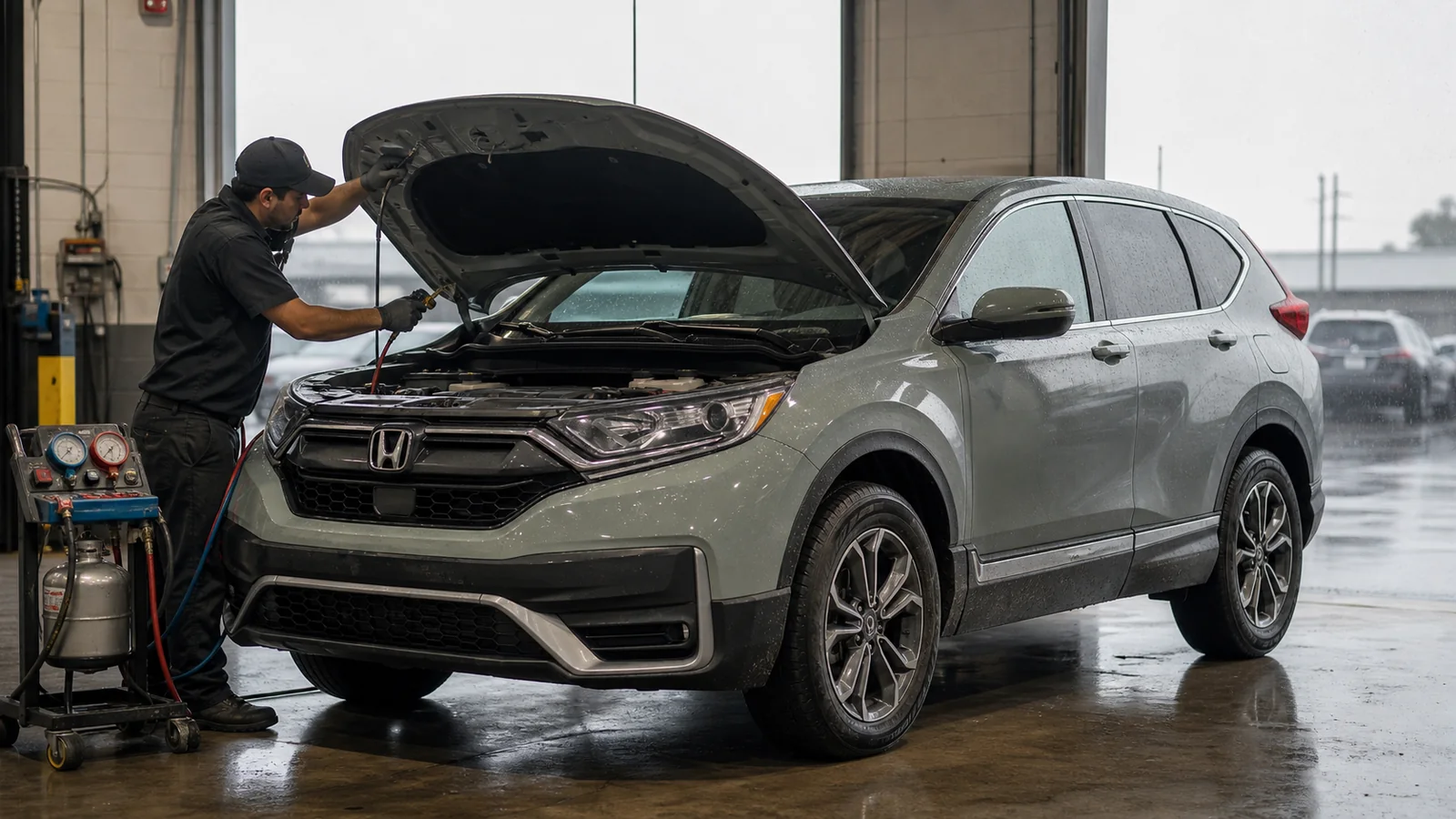
CR-V faults do not belong in one bucket
The CR-V earns its reputation. RepairPal ranks it above average for reliability, and CarComplaints shows most model years staying quiet.
That record is the trap. A buyer assumes every CR-V is a safe used pick, so a cheap listing from a bad year reads like a bargain instead of a repair bill waiting to land.
The problems cluster in three places, and the fault is different each time:
- 2002-2004Early A/C compressors self-destruct and send metal debris through the system
- 2007-2009A/C failures, airbag warning lights, door-lock actuators, and other electrical faults
- 2011CarComplaints' worst-rated year: heavy idle vibration and reports of unwanted acceleration while braking
- 2015The new direct-injection 2.4L drew idle-vibration complaints, addressed under TSB 15-046
- 2017-2018First 1.5L turbo years: gasoline dilutes the engine oil, worst in cold short-trip use
- 2016, 2019+The dependable years to target on a used lot
Oil dilution makes 2017-2018 the main turbo caution
The 2011 CR-V is the one CarComplaints flags as the worst year.
It is not the highest complaint count, that belongs to 2017, but the 2011 draws the most serious reports: a persistent shake at idle that dealers often called normal, and a smaller set of unwanted-acceleration-while-braking claims with repair estimates near $5,000.
Treat any 2011 with a rough idle or hesitation as a walk-away.
The 2007-2009 cars are a softer caution. Their A/C compressors can fail and send debris through the whole system, airbag lights switch on, and door-lock actuators and other electrical parts wear out.
The 2007 alone logged well over 200 complaints, most of them electrical rather than mechanical. None of that is catastrophic, but it adds up on a fifteen-year-old SUV, so budget a few hundred dollars for it before you sign.
The A/C compressor grenade also hit the earlier 2002-2004 cars, so treat weak or hot-only cooling on any of these years as a real cost, not a quick recharge.
| Year or group | Starting verdict | Evidence | Required check |
|---|---|---|---|
| 2002-2004 | Inspect carefully | A/C compressor failures can contaminate the system | Compressor history and cold vent temperature |
| 2007-2009 | Inspect carefully | A/C, door-lock, and warning-light reports | Full electrical and airbag scan |
| 2011 | Avoid unexplained behavior | Vibration and acceleration complaints drive severity | Brake test, mounts, throttle scan, and VIN lookup |
| 2015 | Inspect carefully | Direct-injection launch drew idle-vibration complaints | Warm idle with accessories on |
| 2016 | Target | Mature naturally aspirated fourth generation | Normal age and AWD-fluid checks |
| 2017-2018 1.5T | Avoid without update proof | Oil dilution in cold short-trip use | Oil level, fuel smell, software campaign, and service history |
| 2019+ | Consider by VIN | Later cars have fewer early turbo complaints | Fuel-pump, steering, and hybrid cable recalls |
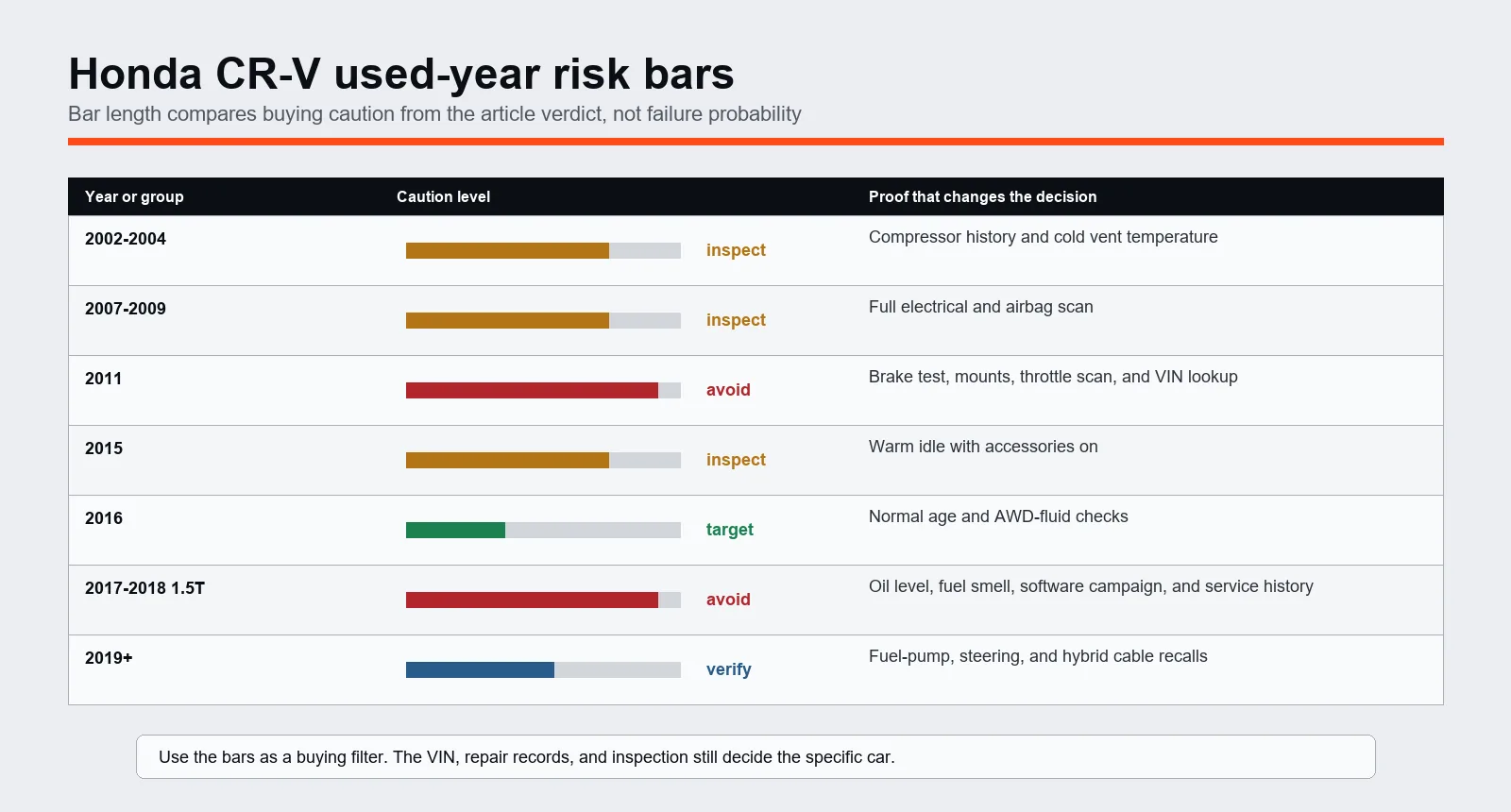
The CR-V matrix points each year toward a different test. It does not claim that all vehicles in a row share the defect.
Move a vehicle forward only when its VIN, repair history, and physical condition support the row.
Older A/C failures and the 2011 drive test
The good years are easy to name. The 2016 CR-V is the last of the naturally aspirated 2.4L generation, and by then the earlier vibration complaints were sorted, so you get a proven engine with no turbo to worry about.
The 2019-and-newer cars kept the 1.5L turbo but arrived after Honda reworked the cold-start fueling, and owner reports of dilution drop off sharply from 2019 on.
The dilution that remains tends to hit short-trip, cold-climate drivers hardest, so a 2019 or later that has spent its life on longer highway runs is a low-risk pick.
Both the 2016 and the post-2019 cars use a CVT that has held up well, hold their value near the top of the class, and share cheap, everywhere-stocked Honda parts that keep independent-shop repair bills low.
If you want the turbo economy without the first-year risk, a later CR-V or a post-2019 Honda Civic with clean oil-change records is the smarter buy than a 2017.
Why 2016 remains the simple target
A useful CR-V decision weighs engine type, climate, trip pattern, and campaign history.
Pros
- Buy a documented 2016 when a simple gasoline drivetrain matters
- Consider a later turbo after a cold oil check and VIN lookup
Cons
- Skip a 2017-2018 with rising oil level, fuel odor, or missing campaign records
Match the vehicle to the correct fault before using the buy signals.
That balance is why the CR-V stays near the top of most used family SUV shortlists, and why Honda holds its resale so well against the rest of the class.
Cold oil and matched tires decide an AWD example
Inspect a turbo CR-V before the engine warms. Pull the dipstick on level ground, note whether the oil sits above the full mark, and smell for gasoline without touching hot components.
Honda's 2017-2018 product update called for software updates and an oil change on eligible vehicles. A seller's claim that the problem was fixed is weaker than the VIN record and repair order.
The CR-V profile helps separate naturally aspirated, turbo, and hybrid versions before applying a year verdict. After the oil check, drive at low speed with the climate control on, then repeat with it off.
That comparison can separate an engine-mount vibration from the normal load of the compressor.
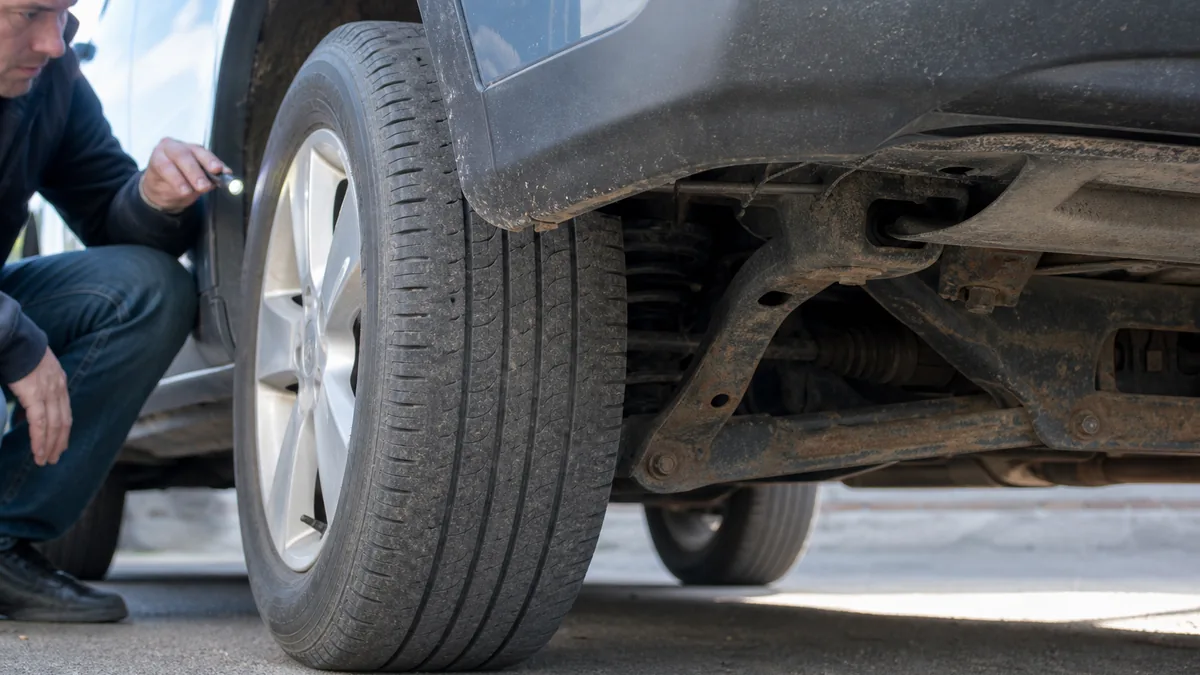
Inspect matching tire size and tread depth on AWD examples. A large difference in rolling circumference can load the AWD system, while cupping or inside-edge wear can reveal neglected alignment.
The broader SUV model field gives a price reference when a seller asks a premium for Honda resale alone.
Inspect the turbo and AWD hardware in this order:
- Cold-check oil level and fuel odor on every 1.5L turbo
- Test A/C output after the vehicle idles in warm air
- Scan engine, airbag, AWD, and steering modules
- Inspect rear differential service and matching tire tread on AWD examples
- Compare cargo needs in the family SUV field and verify paperwork with the used-car checklist
Missing paperwork does not prove that a repair was unnecessary. Pass when the oil level, AWD condition, or campaign record cannot be verified.
Oil-dilution proof starts before the CR-V is warmed up
The 2017-2018 turbo concern is easiest to investigate after the vehicle has sat overnight.
Check the dipstick before the seller starts it. An oil level above the full mark, a strong fuel odor, repeated short-trip use, or a history of rising oil level calls for closer diagnosis.
Honda's product update cited above explains why climate, driving pattern, and software or hardware work belong in the discussion.
It does not turn one dipstick reading into a failure rate.
Ask for update paperwork and oil-change dates, then compare them with mileage and use.
Frequent documented changes may be sensible for severe short-trip service. They can also hide an unresolved rise in level, so the explanation must match the records.
A warm engine at arrival removes the most useful starting point.
Reschedule if the cold condition cannot be verified.
Cold-start evidence
- Dipstick
- Level at or below full with normal oil consistency
- Service record
- Update work and intervals that match actual use
- Scan
- No stored misfire, fuel, AWD, ABS, or airbag faults
- Road test
- Clean warm-up, stable heat, and smooth CVT response
AWD condition can overturn a good-year verdict
Four matching tires matter on a CR-V because large circumference differences load the AWD system.
Measure tread depth rather than trusting the sidewall brand alone. Inspect the rear differential for leaks and ask when its fluid was serviced.
Binding, groaning, or hopping in a tight low-speed turn deserves diagnosis.
These checks apply even to the recommended 2015-2016 years.

Finish with normal used-SUV costs. Check wheel bearings, brakes, A/C output, suspension bushings, and underbody damage.
A reliable year with four worn tires and deferred brakes can still need immediate money. A newer turbo with complete update records and clean cold evidence may be a better car than an older example that was neglected.
Choose the vehicle that passes the correct cold test and the full inspection, not the year label by itself.
Write down the CR-V result as four separate decisions:
- Engine oil condition and update history
- CVT response from cold through full temperature
- AWD tire match, tight-turn behavior, and fluid history
- Ordinary wear in brakes, suspension, A/C, and wheel bearings
This separation keeps a fuel-smelling dipstick from being dismissed because the tires are new. It also keeps worn brakes from turning into a claim that the entire model year is unreliable.
If short-trip use dominates the history, ask how often the vehicle reached full operating temperature and how oil intervals were chosen.
A strong candidate has consistent evidence across use pattern, records, cold inspection, and hot drive.
Climate and trip length should be written into the CR-V assessment because winter use changes the meaning of the oil evidence.
A vehicle that routinely completes long trips has a different operating pattern from one driven two miles at a time.
That context does not erase an abnormal level or fuel odor.
It tells the inspector what to test next. Ask for the cold reading, scan result, and update record together so one favorable item cannot hide a conflicting one.
Short-trip history changes the CR-V maintenance decision
Ask the owner to describe a normal week of driving. Repeated cold starts followed by very short trips deserve more attention on a 2017-2018 turbo because the engine may spend little time fully warm.
Compare that use with oil-change dates, mileage between services, update work, and the cold dipstick reading.
The driving pattern provides context, but it cannot excuse an abnormal level or strong fuel odor.
A vehicle used for longer highway trips should still receive the same inspection. Its history may reduce one concern while exposing another, such as tire wear, windshield damage, or overdue drivetrain fluids.
The point is to match maintenance to actual use rather than assuming all mileage is equal.
Useful questions include:
- How long is the usual trip and how often does the engine fully warm
- Was oil level checked between changes or only at service visits
- Did the update change warm-up, cabin heat, or oil behavior
- Were four tires replaced together on the AWD model
- When were CVT and rear differential fluids serviced
A believable answer should agree with the invoices and physical condition. If the owner describes highway use but the records show low annual mileage and severe short-trip intervals, investigate the mismatch.
Consistent history is evidence, while a polished explanation without records is only a claim.