
The CR-V is dependable overall, with one turbo-era exception
The Honda CR-V has combined efficient four-cylinder engines, practical packaging, and broad service support since the 1990s. RepairPal rates it 4.5 out of 5, ranks it second among 26 compact SUVs, and reports about $407 in average annual repair cost.
Those numbers support a strong overall verdict, but they do not describe every use pattern. The largest modern exception is the 1.5-liter turbo in some 2017 and 2018 cars that spent repeated short trips in cold weather.
Older naturally aspirated CR-Vs have age-related air-conditioning, suspension, and corrosion concerns. Newer gas and hybrid cars move the questions toward campaign completion, electronics, cooling paths, and how the vehicle was driven.
Keep the CR-V on the shopping list, then make the individual car prove that its engine and climate history fit the good reputation.
Short cold trips explain the 2017 to 2018 oil-dilution risk
A turbo engine can allow some fuel to pass the piston rings during cold operation. When a trip ends before the oil becomes fully hot, that fuel has less opportunity to evaporate, so repeated winter errands can raise the oil level and thin the lubricant.
The pattern therefore depends on climate and use. A CR-V that did long highway commutes in a mild region is not the same exposure as one that made ten-minute school and shopping trips through a northern winter.
Honda's owner notice for affected 2017 and 2018 1.5-liter turbo CR-Vs named repeated short trips in very low temperatures as the key condition. It also listed misfire warnings, rich-running codes, a low-oil-pressure warning, and abnormal camshaft noise among possible symptoms, which gives the inspection more useful evidence than oil smell alone.
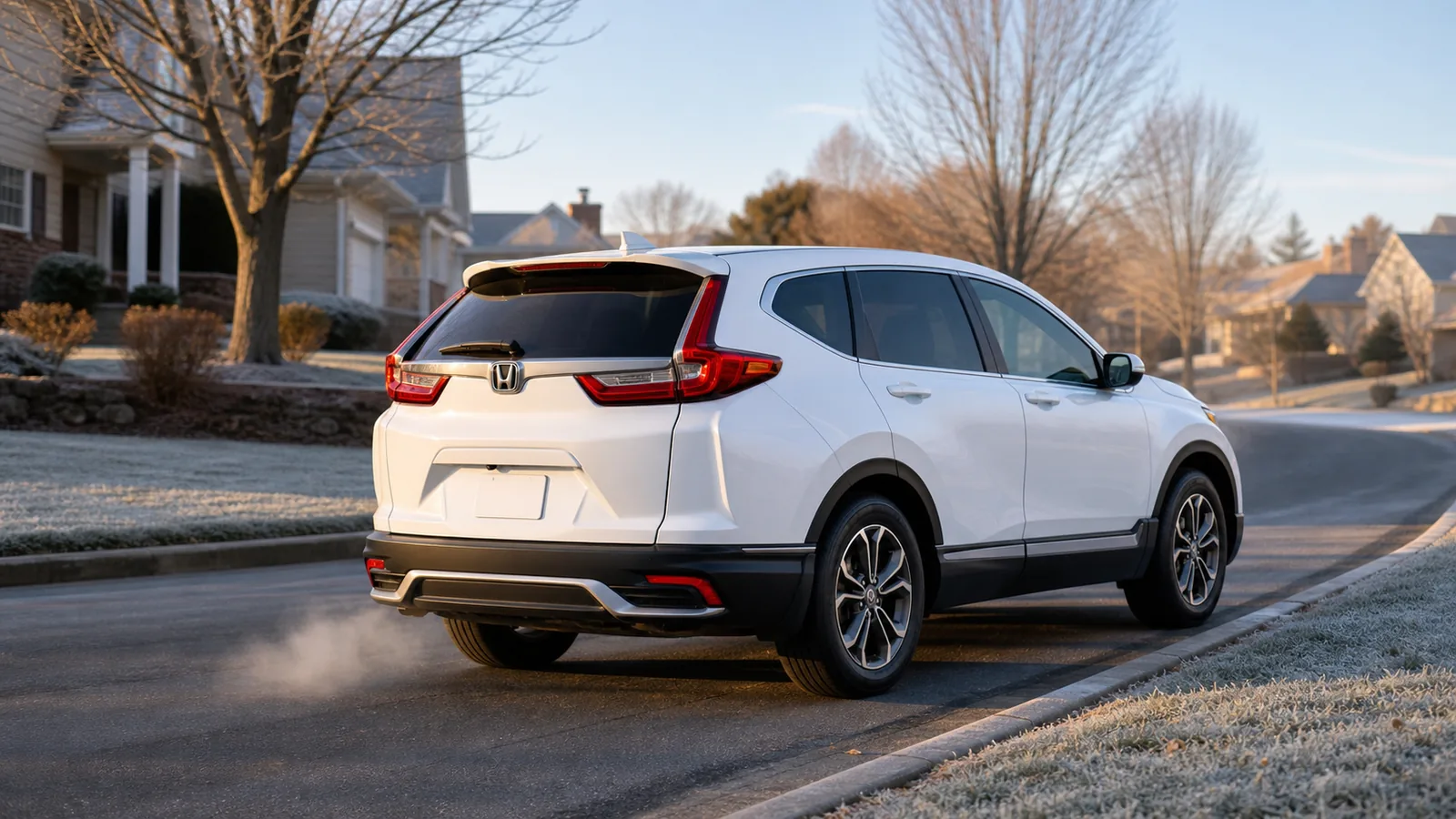
Honda issued service information including bulletin 19-038 to change warm-up behavior on affected vehicles. Verify completion by VIN, because a general statement that Honda fixed the issue does not prove the work reached the specific car.
Pull the dipstick before the engine runs. Oil above the full mark, a strong gasoline smell, a rough cold start, or missing oil-change history justifies an oil analysis or a different vehicle.
A clean dipstick and completed update do not guarantee the engine, but they answer the exact concern better than the model-year label. Continue with a scan, compression assessment when indicated, and a long road test.
Older air-conditioning failures and newer campaigns need separate checks
Older CR-V generations have owner reports of compressor and complete air-conditioning failures. Test maximum cooling after the car has idled in traffic, listen for compressor noise, and ask whether prior work replaced debris-contaminated components rather than only recharging refrigerant.
Newer campaign and recall questions should be checked through the VIN. A safety recall is different from a service bulletin, and a seller's receipt should identify the completed remedy rather than a diagnostic visit.
- Older generationsInspect compressor performance and previous system repairs
- 2017-2018 turboVerify oil-dilution update and cold-use history
- Later fifth generationConfirm all VIN campaigns and software updates
- Current hybrid eraScan hybrid controls and inspect cooling paths
Do not merge these records into one vague reliability problem. An older air-conditioning invoice describes comfort-system cost, while an open safety campaign changes whether the vehicle should be driven before the remedy.
A car with a professionally replaced AC system can be a better buy than an untouched example showing weak cooling. Completed work is useful evidence when the parts, date, mileage, and warranty are documented.
Matched tires and clean fluid matter more on an AWD CR-V
The CR-V's available AWD system depends on tires with closely matched circumference. A mismatched replacement can create speed differences that add heat and load, while uneven wear can also reveal alignment or suspension trouble.
Honda specifies rear differential fluid service, and neglected fluid can contribute to groaning or binding during slow, tight turns. Drive several circles in both directions after the vehicle is warm and listen for behavior that changes with steering angle.
AWD evidence
- Tire set
- Same size, similar tread depth, suitable load rating
- Rear differential
- Correct fluid service with no tight-turn groan
- Alignment
- Even wear across all four tires
- Underbody
- No leaks, impact damage, or structural corrosion
A fluid service may correct ordinary clutch chatter, but it should not be used to mask a persistent mechanical fault. If a seller says the noise is normal, have an independent Honda specialist reproduce it.
Front-wheel drive avoids this rear-system question and may suit buyers who do not need added traction. AWD remains durable when its tires and fluid were treated as a set rather than four unrelated purchases.
Gas and hybrid CR-Vs do not carry the same long-term questions
The gas CR-V uses a turbo engine and CVT in recent generations, so oil condition, warm-up history, boost response, and transmission-fluid service lead the inspection. The hybrid uses a two-motor system, changing the evidence toward power electronics, battery cooling, warning history, and a smooth handoff between electric and gasoline drive.
| System | Gas CR-V | Hybrid CR-V |
|---|---|---|
| Main engine question | Oil condition and cold-trip history | Normal engine service and smooth starts |
| Transmission question | CVT behavior and fluid history | Hybrid transaxle operation and warning scan |
| Battery question | 12-volt starting battery | Traction battery cooling plus 12-volt battery |
| Best use | Mixed and highway driving | Frequent city and stop-and-go driving |
A traction battery should not be judged by age alone. Request a system scan, check the cooling intake for blockage, and investigate large charge swings or persistent warnings rather than predicting failure from an internet lifespan number.
The gas model can be the lower-cost purchase for highway use, while the hybrid can reduce fuel use in urban driving. Reliability should remove examples with poor evidence, then operating pattern and price should choose between the survivors.
The $407 repair average still needs a mileage and climate adjustment
RepairPal reports about $407 per year, 0.3 unscheduled repair visits annually, and a 9 percent chance that a visit is severe. These are useful fleet-level comparisons, not a promise about the next twelve months.
Mileage adds tires, brakes, struts, bearings, mounts, fluids, and batteries. Climate adds corrosion, air-conditioning demand, cold starts, and road-salt exposure, so a first-year reserve should reflect the inspection rather than the national average.
Price overdue work before purchase. Four tires and brakes can consume several years of average repair spending without making the CR-V fundamentally unreliable.
A cold inspection decides whether the CR-V reputation applies
Meet the car cold, read stored and pending codes, check oil and coolant, then drive until every system is fully warm. Test low-speed CVT response, highway acceleration, braking, tight AWD turns, air conditioning, cameras, and driver-assistance warnings.
Review registration geography and service invoices together. Northern ownership strengthens the need for oil-dilution and corrosion evidence, while four mismatched tires reveal that AWD care was treated casually.
A pre-purchase inspection should answer the engine and drivetrain questions for that exact year. Generic reassurance is not a substitute for measured oil level, a code scan, tire readings, and a complete drive.
The CR-V is reliable when the individual vehicle's cold start, fluid history, tires, and VIN record support the claim.
Cargo, passengers, and mountain trips leave measurable wear

Cargo and passenger use add another layer to a high-mileage CR-V. A full cabin, roof load, or repeated mountain driving asks more from brakes, cooling, tires, and transmission fluid, so service intervals should match the work rather than the image of a light family SUV.
Inspect rear suspension height, cargo-floor moisture, hitch hardware, and brake condition when the vehicle shows signs of frequent hauling. These observations describe the life of the individual SUV without turning normal utility into a defect.
Collision quality matters on newer CR-Vs because cameras, radar, and alignment depend on correct body geometry and calibration. Ask for calibration invoices after windshield, bumper, or front-end repairs and verify the warning lights complete their startup check normally.
A higher-mile vehicle with steady service, matched tires, clean oil, and professional collision work can be the better purchase. A lower odometer cannot compensate for diluted oil, AWD neglect, structural rust, or unresolved electronic warnings.
Water and collision repairs create failures outside the engine
Water intrusion deserves a deliberate check because a practical SUV often carries wet cargo and may have had windshield, roof, or tailgate work. Lift the cargo floor, feel the carpet edges, inspect the spare-wheel well, and look for staining near the headliner and rear lamps.
Persistent moisture can damage connectors, create odors, and hide corrosion without affecting the first test drive. A dry interior after recent detailing is less persuasive than clean seams and no water marks beneath removable panels.
Windshield and front-bumper replacements on newer CR-Vs can require camera or radar calibration. Ask for the calibration record, then confirm lane, cruise, braking, and warning functions complete their checks without stored faults.
Water marks near the headliner, rear lamps, spare-wheel well, or electrical connectors reveal more than a recently cleaned carpet. Trace the entry point before purchase because recurring moisture can create corrosion and intermittent faults far from the original leak.
Turbo and hybrid behavior needs a repeatable warm test
On turbo cars, listen under moderate acceleration after the engine is warm. Hesitation, smoke, unusual whistle, boost-related codes, or coolant loss needs diagnosis, while normal turbo sound with stable fluids supports the service history.
Hybrid buyers should compare displayed fuel economy with temperature, trip length, speed, and tire condition before treating one low number as a fault. A proper scan and a repeatable drive provide stronger evidence than a reset dashboard average.
Honda's Maintenance Minder lists rear differential fluid as a separate service item on equipped models. It also calls for more frequent transmission-fluid changes when the vehicle is regularly driven at very low speeds in mountains or used for towing, with a 25,000-mile interval stated for that severe use.
That distinction matters on a used CR-V with a hitch or a mountain registration history. A clean ordinary schedule may still be incomplete when the vehicle repeatedly operated under the conditions that generate more transmission heat.
Compare the rear tires, cargo-area wear, hitch fasteners, and brake measurements with the seller's account. Agreement supports normal family utility, while heavy wear paired with no severe-use service record justifies a larger reserve or a different car.
Measure the rear brake pads and rotor condition instead of assuming highway travel preserved them. A loaded CR-V may use more braking on grades, while regenerative braking on a hybrid can leave the friction surfaces underused and rusty.
Ask when coolant, brake fluid, transmission fluid, and rear differential fluid were last serviced, then compare those dates with the vehicle's towing or mountain history. The answer shows whether the owner adjusted maintenance for harder use rather than following only the dashboard oil reminder.
On a hybrid, inspect the cabin cooling intake after looking at pet hair, cargo covers, and seat-back accessories. Blocked airflow is a use-related condition that a module scan may not explain by itself.
A long ownership plan should include periodic underbody inspection even outside the salt belt. Drain blockage, beach use, muddy roads, and previous off-pavement impacts can create localized corrosion or damage that geography alone will not predict.
Sources
- Ratings and cost data from RepairPal.
- Honda oil-dilution update details for 2017 to 2018 CR-Vs in the owner notice.
- Honda rear differential and transmission service items in the CR-V Maintenance Minder guide.
- Model-year complaint patterns from CarComplaints.
- Open recalls should be checked by VIN at NHTSA.