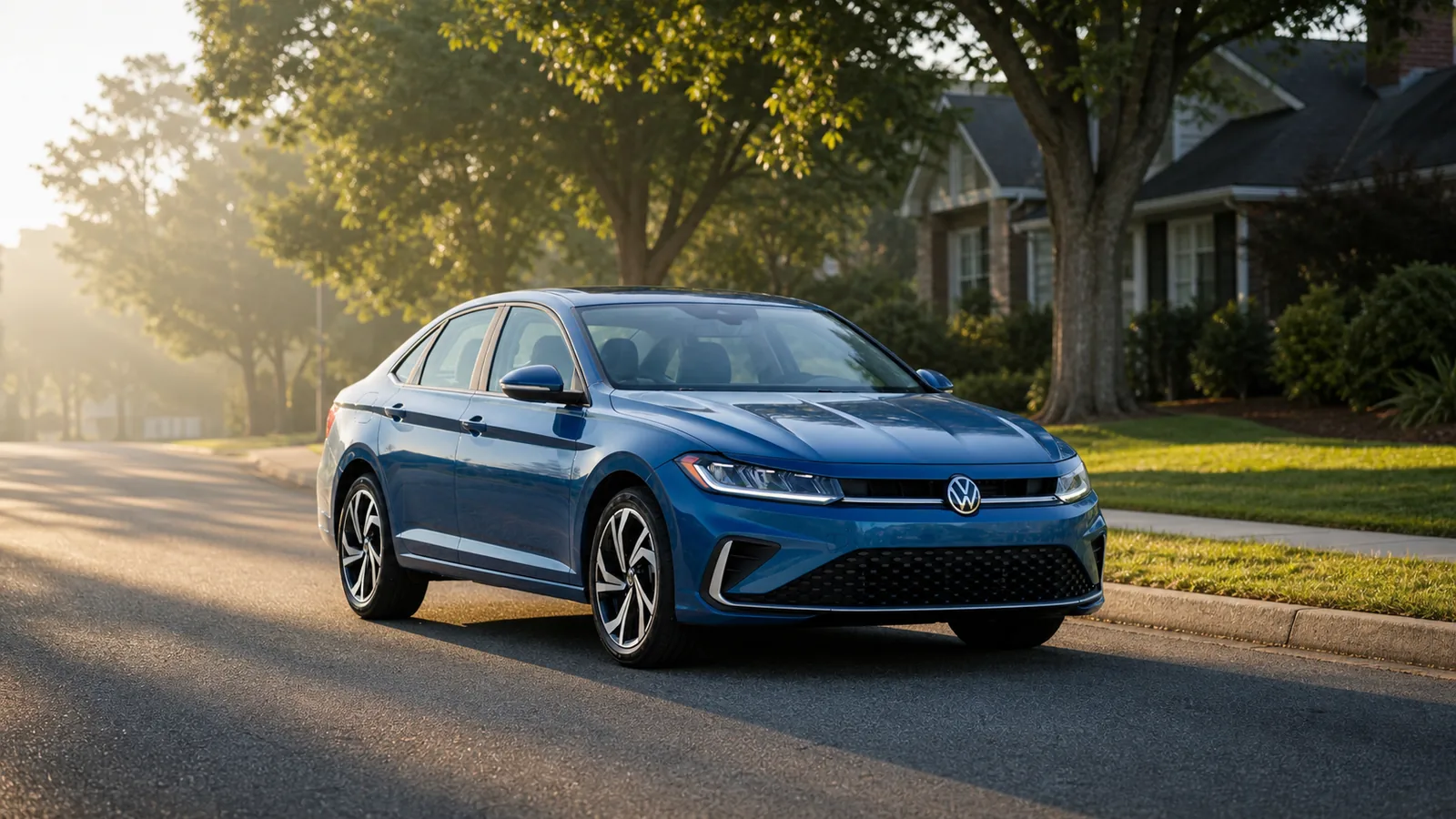
The regular Jetta and GLI answer different questions
The 2026 Volkswagen Jetta starts at $23,995 before destination, which puts it among the least expensive new compact sedans. The regular car's reason for existing is straightforward: strong low-rpm torque, a roomy cabin, and up to 40 highway mpg without paying hybrid money.
The Jetta GLI is a different product under the same body. It adds a 228 hp 2.0L turbo engine, independent rear suspension, stronger brakes, performance hardware, and a choice between a 6-speed manual and 7-speed DSG.
It starts at $33,745, almost $10,000 above the base Jetta.
This split prevents trim creep. A buyer who wants heated seats and nicer materials may reach SE or SEL.
That does not automatically make GLI the next step, because GLI adds a performance ownership pattern with wider tires, stronger brakes, and more temptation to buy a modified used car.
The regular Jetta also has a meaningful torque advantage over many non-turbo entry sedans. Its 184 lb-ft arrives low in the rev range, so normal merging and city gaps feel easier than the 158 hp number suggests.
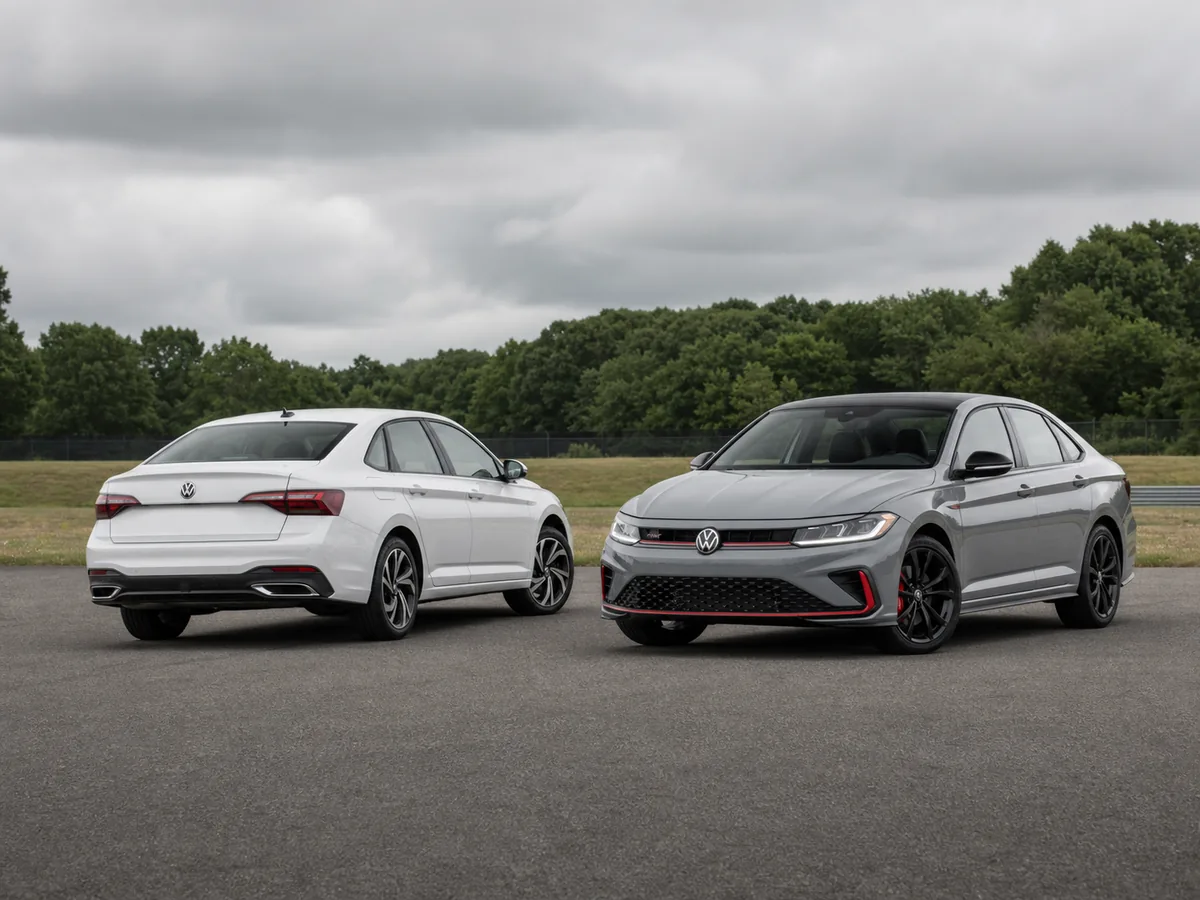
Compare the regular car with the Honda Civic and Hyundai Elantra. Compare GLI with performance compacts, not with a base Corolla.
The best Jetta decision begins by refusing to make one version justify the other.
Why the 1.5T works better than its horsepower suggests
Regular Jetta trims use a 1.5L turbo four-cylinder rated at 158 hp and 184 lb-ft, paired with an 8-speed automatic.
Volkswagen uses a modified Miller-cycle strategy to improve efficiency, and the car earns 29 mpg city and 40 highway.
S reaches 34 mpg combined, while Sport, SE, and SEL are rated at 33 combined.
The torque peak matters in normal traffic. You do not need to rev the engine hard to move away from a light or add speed on a ramp.
That makes the Jetta feel more relaxed than a naturally aspirated compact with similar horsepower.
The 8-speed automatic should shift cleanly and settle into a high gear on the highway. It may downshift when you ask for quick acceleration, but it should not bang into gear or hesitate repeatedly.
A used-car test should include crawling traffic, a full stop, a ramp, and steady highway speed.
The engine's efficiency gives the Jetta a strong highway case against a hybrid. City-heavy drivers can still save more fuel with a hybrid powertrain, while a 20,000-mile highway commuter may find that the Jetta's lower purchase price and 40 mpg rating produce better total math.
- Choose S when the lowest price and smallest wheels matter most
- Choose Sport for appearance and useful chassis details without a luxury price
- Choose SE when heated seats, power adjustment, keyless access, and sunroof earn the increase
- Choose SEL only when its comfort equipment is worth approaching midsize-sedan money
Every regular Jetta is front-wheel drive. Buyers who need regular snow traction should compare winter tires with true AWD options.
The right answer depends on hills, road clearing, tire storage, and annual weather, not on a badge.
The calibration suits ordinary traffic because the engine makes its peak torque before most drivers ask for full power.
A light throttle input can move the car without a downshift, and the eight-speed automatic keeps engine speed low on a steady highway.
That combination explains why the Jetta can feel relaxed and still return a 40 mpg highway estimate.
Test that advantage from a complete stop, during a 30 to 50 mph merge, and on a grade.
Power should build smoothly after a brief turbo response. Repeated surging, a warning light, smoke, or a sharp hesitation deserves a scan and a cold restart.
Do not let the seller warm the engine before you arrive because a cold start reveals more about battery strength, idle quality, and cooling-system leaks.
The Jetta is still front-wheel drive. Buyers who need winter traction should budget first for a complete set of quality winter tires rather than treating an expensive trim as a substitute.
The front-wheel-drive car guide shows other models that use the same basic traction layout.
For most buyers, the 1.5T's torque and highway economy are the Jetta's real luxury features.
Sport, SE, and SEL need a feature-by-feature price check
The Jetta range looks simple until equipment packages and wheel sizes enter the quote. Volkswagen refreshed the car for 2025, and 2026 adds wireless phone integration across the range, rear-seat pretensioners, a standard sunroof on SE, and revised audio equipment on upper trims.
Start with features you touch every day. The 8-inch touchscreen and digital instrument display are standard.
Heated seats begin above S, while SEL adds ventilation and rear-seat heat. Those are useful in the right climate, but they should be priced against the whole car.
| Trim | Best reason to buy | Cost or comfort tradeoff |
|---|---|---|
| S | Lowest price, 16-inch tires, best combined mpg | Basic seats and fewer convenience features |
| Sport | Sharper look and 17-inch wheels | Firmer tire package than S |
| SE | Heated seats, power seat, keyless access, sunroof | Higher price and more equipment to age |
| SEL | Ventilated seats, rear heat, premium audio | 18-inch tires and near-midsize pricing |
| GLI | Manual or DSG, 228 hp, performance chassis | Insurance, tires, brakes, and purchase price |
Touch-sensitive climate controls deserve a real test. Adjust temperature and fan while keeping your eyes on the road.
If the interface annoys you in five minutes, it will not become a benefit after five years.
Wheel size changes both ride and cost. The S uses 16-inch tires with more sidewall.
Sport and SE use 17-inch wheels, and SEL moves to 18s. Price a full set of the exact size before assuming the higher trim is only a monthly-payment difference.
The Volkswagen brand lineup gives the Jetta a clear role beneath the Golf GTI and larger SUVs.
Keep it there. If an SEL quote approaches a well-equipped Honda Accord or hybrid Camry, compare rear room, resale, fuel, and ride before choosing more equipment in a smaller car.
A dealer discount can make an upper trim sensible, but compare out-the-door prices with the same loan term. Buy the lowest trim that contains the seat, climate, and safety features you will use each week, then let wheel size break any tie.
Start with S, then write down the features you would pay to add.
Sport makes sense when its appearance and seat changes matter. SE is the practical step for buyers who want more comfort without moving to the highest price.
SEL needs a stricter test because every convenience feature raises the gap to larger sedans and certified used luxury cars.
Sit in the exact seat material before deciding. Softer upholstery, heating, ventilation, and power adjustment can matter on a long commute, but they do not improve acceleration, braking, or cargo room.
Confirm that every driver can obtain a comfortable steering-wheel and pedal position.
A feature has no value when the basic seating position is wrong.
Compare the final out-the-door totals, including dealer accessories and finance charges. A discounted SEL may be sensible, while an S loaded with mandatory packages can lose the Jetta's value advantage.
The correct trim is the least expensive one that solves needs you can name and demonstrate during the test drive.
The GLI earns its price through chassis hardware
The Jetta GLI uses Volkswagen's 2.0L EA888 turbo four-cylinder with 228 hp and 258 lb-ft. Buyers can choose a 6-speed manual or 7-speed dual-clutch DSG for the same starting MSRP.
That choice is rare enough to make GLI important for drivers who still want a practical manual sedan.
Power is only part of the upgrade. GLI adds an electronically controlled limited-slip differential, performance brakes, a sport suspension, and adaptive damping.
These parts help the car put power down, turn, and stop more confidently than a regular Jetta.
GLI hardware
- Engine
- 228 hp 2.0L turbo
- Torque
- 258 lb-ft
- Manual
- 6-speed
- Automatic
- 7-speed DSG
- Drive
- Front-wheel drive with electronic limited-slip differential
Choose the manual because you enjoy shifting, not because it is automatically cheaper or more durable.
Clutch wear depends heavily on traffic and the previous driver. Choose DSG when commute traffic and repeatable acceleration matter more, then follow the fluid-service schedule.
A used GLI needs a modification check. Look for aftermarket engine software, intake and exhaust parts, lowered suspension, nonstandard wheels, mismatched tires, and evidence of track use.
A well-executed modification can still increase uncertainty because warranty coverage and maintenance needs change.
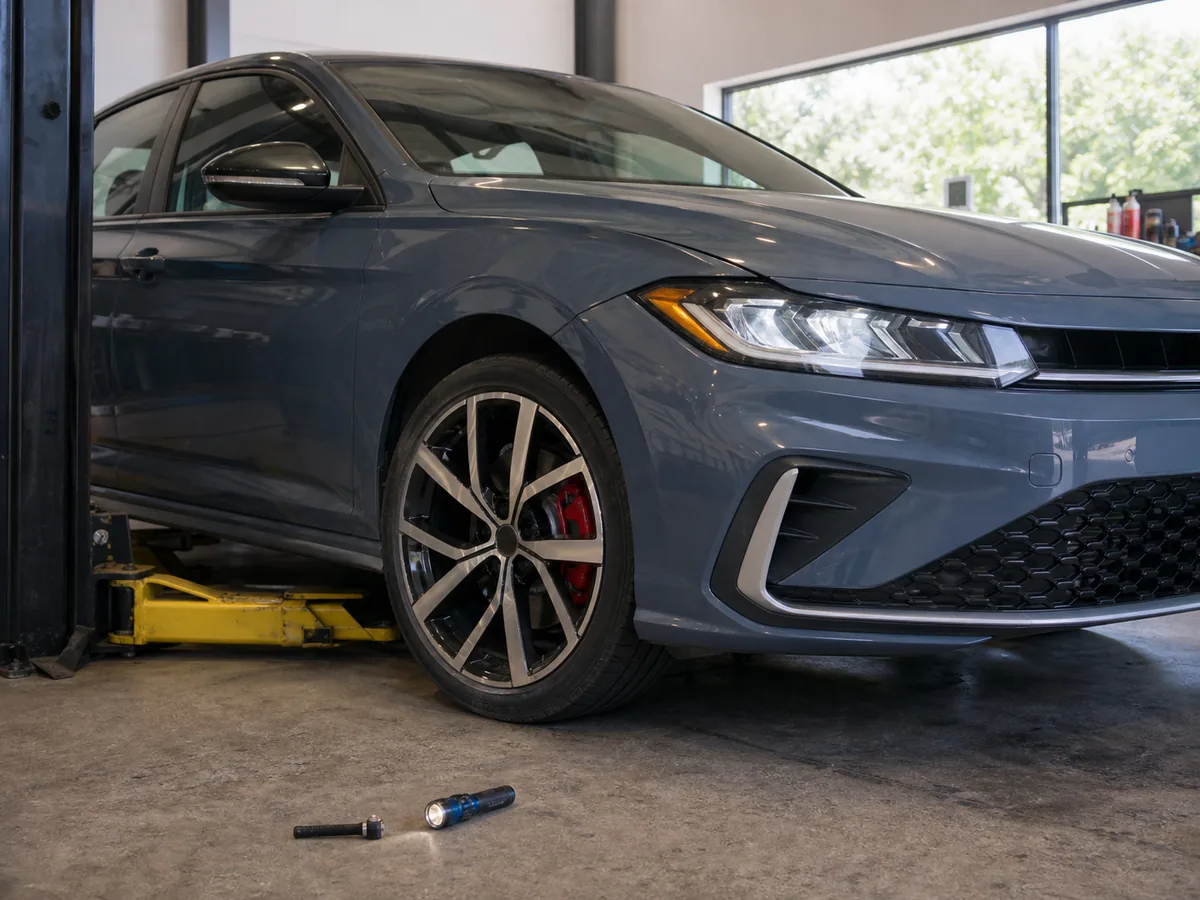
Insurance should be quoted before the deposit. GLI's performance classification, repair parts, and driver profile can produce a very different premium from a regular Jetta.
Tire replacement also moves from commuter pricing to 225/45R18 performance-sedan territory.
Drivers who only want a quick compact should compare the GLI with the Mazda3 Turbo and planned Civic comparisons. GLI is worth buying when its manual, differential, brakes, and suspension are the point, not when a salesperson simply calls it the best Jetta.
The GLI's independent rear suspension matters most on a rough corner, where it can control each rear wheel more precisely than the regular car's simpler setup.
Its stronger brakes and performance differential also support repeated fast driving. Those parts are useful hardware, but a calm commuter will rarely recover their extra cost through daily use.
Manual and DSG cars demand different checks. On a manual, test clutch take-up from a stop, listen for bearing noise, and accelerate in a high gear to check for slip.
On a DSG, drive from cold at parking speed and under moderate throttle.
Engagement should be predictable without warning lights or harsh repeated impacts. Service documentation carries more weight than a seller's claim that the gearbox is maintenance-free.
Inspect a used GLI for tuning software, nonstandard intake or exhaust parts, uneven tire wear, and heat-discolored brakes.
Modifications can be enjoyable when documented and installed well, but they add uncertainty to warranty coverage and prior use.
A stock car with matched tires and complete records is the safer baseline.
Safety is solid in structure but mixed in prevention details
IIHS gives the 2026 Jetta a Good small-overlap result and an Acceptable result in the updated side test. The structure performed well in the side evaluation, while some driver and rear-passenger injury measures prevented a Good overall score.
The standard Front Assist system received a Marginal pedestrian-prevention rating under the latest test. It avoided or reduced speed in several crossing tests but did not slow in the parallel-adult night scenarios.
Driver assistance is useful backup, not permission to reduce attention.
IIHS also rated the seat-belt reminder Poor because the audible warning was brief and not much louder than cabin background sound.
That score is about the reminder system, not the crash structure. It still matters because a reminder only helps when occupants notice and respond.
LATCH ease of use received an Acceptable rating. Families should install the actual child seat and check whether lower anchors are easy to reach around the upholstery.
Rear legroom is generous for a compact at 37.4 inches, but the seat and front-passenger position determine real fit.
Volkswagen includes blind-spot detection, lane-departure prevention, and rear automatic braking as standard safety features for 2026.
Confirm every warning indicator and camera function during the test drive.
A damaged bumper sensor or replacement windshield can affect calibration.
Compare current results rather than a badge from an older test. The Prius safety case is stronger under several current IIHS categories, while the Jetta can still win on price, torque, and sedan space.
Safety does not eliminate the Jetta from consideration, but it should stop buyers from assuming every modern driver aid performs at the top of the class.
Read the crash-test details instead of relying on one overall label. Strong occupant protection is the foundation, while headlight performance and driver-assistance behavior affect whether a collision is avoided in the first place.
Trim-level equipment can change those results, so confirm the VIN's installed features rather than assuming every Jetta has the same system.
During the drive, verify that the windshield area around the camera is clear and that no calibration warnings appear.
Test adaptive cruise and lane support only on a suitable marked road while remaining in control. A replaced windshield without correct camera calibration can leave a system present on the dashboard but unreliable in use.
Used Jettas need cooling, electronics, and transmission checks
The current Jetta generation began for 2019, and the 1.5L engine arrived later. That means online reliability stories can refer to different engines, software, and transmission behavior.
Match any complaint to the exact year and powertrain before treating it as universal.
Cooling-system clues deserve attention on any turbo Volkswagen. Check coolant level when cold, look for dried pink residue, smell for coolant after the drive, and inspect the undertray for fresh staining.
A low reservoir needs an explanation, not a refill from the seller.
- Start the engine cold and watch every warning light complete its check
- Test the 8-speed automatic or DSG from parking-lot crawl to highway speed
- Run climate control through hot, cold, and defrost settings
- Pair a phone, use the camera, and test every steering-wheel control
- Inspect all four tires for matching size and even wear
- Scan for stored codes and verify recall status by VIN
Regular Jettas should engage drive and reverse promptly and shift without harshness. GLI DSG cars may feel more mechanical at very low speed than a torque-converter automatic, but repeated shudder, delayed engagement, or warning messages need diagnosis.
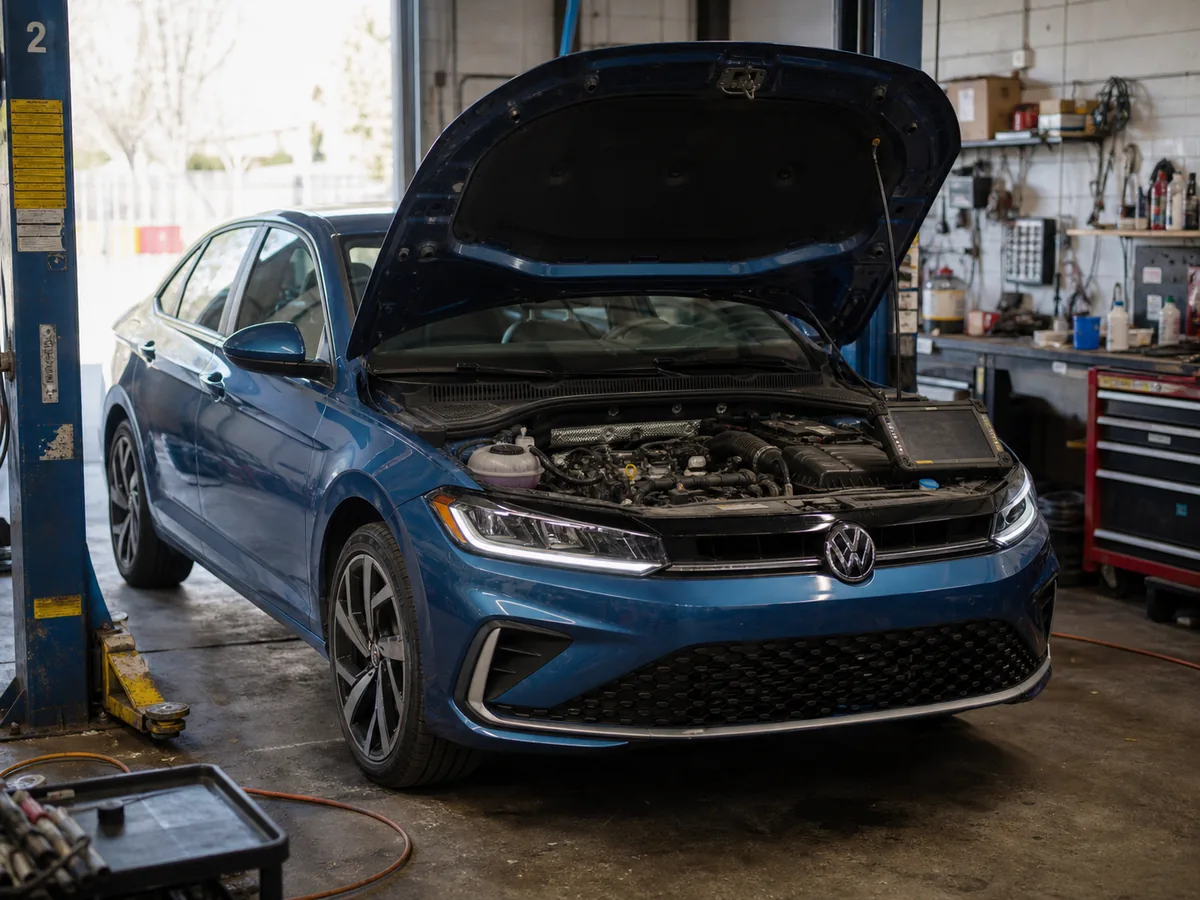
The cabin contains enough electronics that a weak 12-volt battery can create distracting faults. Test battery condition and charging voltage when the car has a slow crank, intermittent warnings, or a history of sitting.
Use the planned Jetta reliability breakdown for year detail and the Jetta recall lookup for the separate VIN question. A clean Jetta should have boring coolant level, boring electronics, boring shifts, and records that make those results believable.
Ownership cost changes sharply when you cross into GLI
The regular Jetta controls purchase price, highway fuel, and warranty risk well. Volkswagen covers new cars for four years or 50,000 miles and includes scheduled maintenance at one year or 10,000 miles and two years or 20,000 miles.
Remaining warranty is transferable.
That coverage is stronger than the basic three-year warranties on several rivals, but it should not justify an inflated deal. Compare out-the-door price, finance rate, insurance, fuel, tires, maintenance after the included period, and expected resale.
| Cost area | Regular Jetta | GLI |
|---|---|---|
| Fuel | Up to 40 highway mpg | More fuel used under performance driving |
| Tires | 16 to 18-inch all-season sizes | Wider 18-inch performance-oriented size |
| Transmission | 8-speed automatic | Manual clutch or DSG service |
| Insurance | Economy-sedan baseline | Performance classification may raise premium |
| Resale | Depends on price and condition | Enthusiast demand helps clean stock cars |
The regular Jetta's best financial pattern is a mid trim kept past the loan term. Highway commuters can use the 40 mpg rating without paying a hybrid premium, and 16- or 17-inch tires stay manageable.
GLI requires a separate reserve for tires, brakes, clutch wear on manuals, DSG service, and damage caused by modifications or hard use. It can still be a strong value among performance sedans, but it is not a cheap Jetta with free horsepower.
A used buyer should compare remaining warranty and maintenance history with the new-or-used decision. A two-year-old car with a high price and worn tires may be weaker than a new S or Sport with full coverage and a promotional rate.
The planned Jetta cost-to-own analysis can break down longer estimates. The immediate best practice is to quote the VIN, price tires, and calculate total loan interest.
The Jetta saves money when trim discipline remains intact, while GLI earns its higher cost only through performance you actually use.
Regular Jetta costs are built around fuel economy, modest wheel sizes, and conventional commuting. GLI costs add performance tires, larger brakes, and the possibility of more frequent transmission or brake service.
Ask for tire and brake quotes before buying because these wear items can erase an attractive discount on a used performance car.
Insurance quotes should use the exact VIN. Two cars with similar bodywork can carry different premiums when one is the performance model.
Add fuel using your annual miles, then add the next scheduled service and any immediate tire or brake work.
The planned Jetta real-world mpg report will cover route differences. For now, use 29 mpg for conservative mixed planning on the regular model rather than assuming the 40 mpg highway figure applies to every trip.
A longer ownership period favors the trim you genuinely like, but it does not excuse buying unused equipment.
Keep a regular Jetta when low running cost is the priority. Pay for GLI only when its manual option, differential, brakes, and chassis are central to the experience you want.
Who should buy each Jetta
Buy a regular Jetta if you drive substantial highway miles, want a roomy compact sedan, and prefer turbo torque to a high-revving base engine. Sport is the cleanest value choice for many buyers, while SE earns its price when heated seats, power adjustment, and keyless access solve daily annoyances.
Buy GLI if the manual transmission, differential, adaptive suspension, and stronger brakes are specific reasons for the purchase. It is a practical performance sedan, but practicality does not erase performance-car running costs.
City-heavy drivers should compare the Jetta with the hybrid Corolla and Prius. Families should check the rear seat and 14.1 cubic foot trunk against their real gear.
Snow-belt buyers should price winter tires before assuming a crossover is required.
Do not let European styling turn a value decision into a luxury payment. The Jetta's strongest argument is that it delivers useful torque, space, and highway economy at a low starting price.
Finish with a cold drive, an insurance quote, tire prices, and the full amount financed. The right Jetta feels more expensive than it is while keeping the ownership bill tied to the version you intended to buy.