Find the pin-weight threshold that forces the rear-axle choice
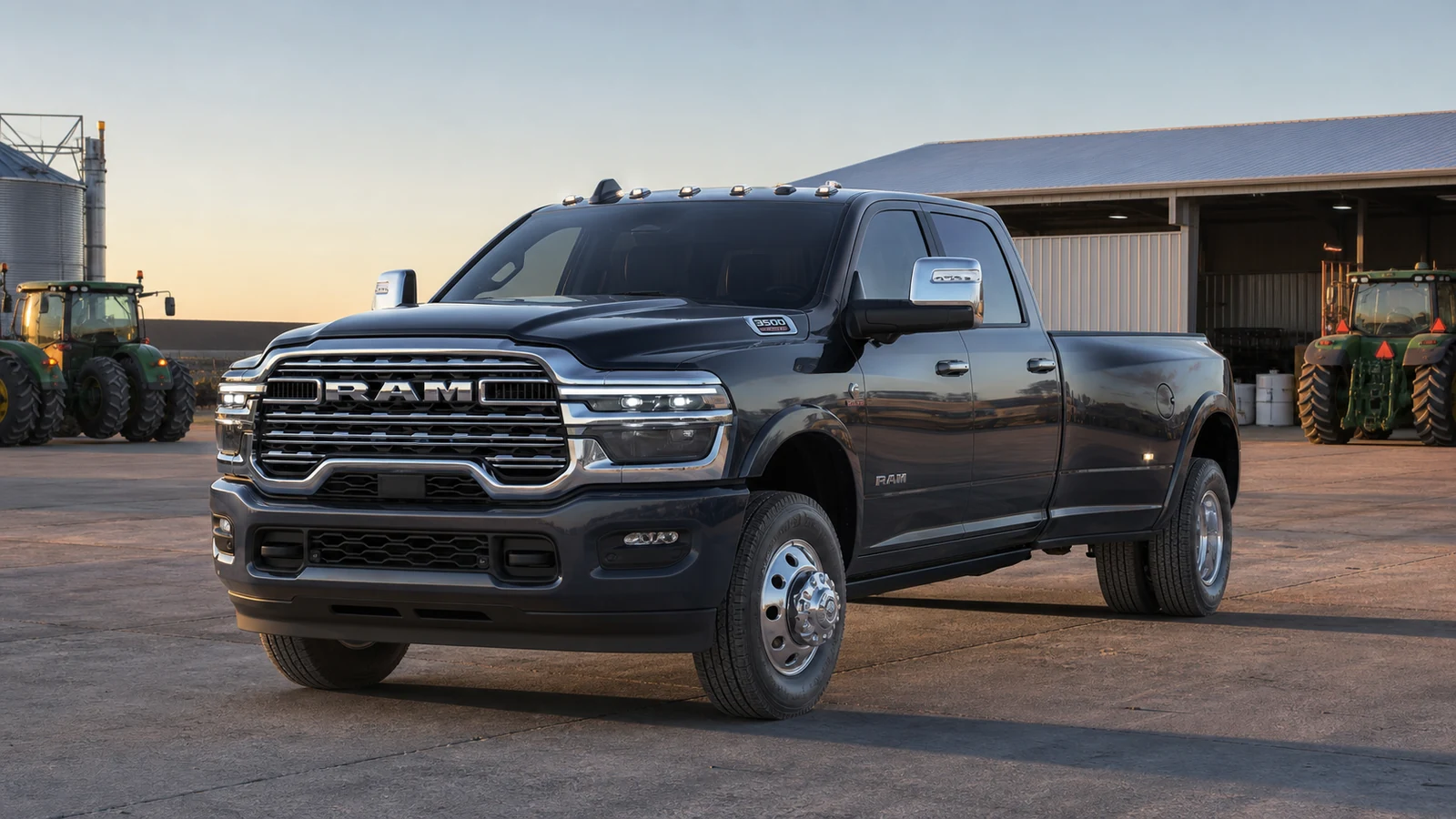
The 2027 Ram 3500 reviewed here is the factory-bed pickup, not a Ram 2500 or chassis cab. Its central decision is whether the actual payload and trailer pin weight fit a single-rear-wheel truck or require a dual-rear-wheel configuration.
Start with occupants, cab cargo, bed cargo, permanent accessories, hitch hardware, and the loaded trailer's tongue or pin weight. Every one of those items consumes the payload printed on the actual truck, even when the trailer remains below its headline rating.
Find the rear-axle threshold
- Record occupants and everything carried inside the cab
- Weigh normal bed cargo and installed accessories
- Obtain loaded trailer weight and measured tongue or pin weight
- Add hitch hardware carried by the truck
- Read payload, rear GAWR, tire, GVWR, and GCWR limits
- Keep operating margin for the route, weather, and work cycle
The threshold is not an advertised tow number. It is the point where a suitable SRW configuration cannot carry the complete truck-side load within payload, rear-axle, tire, and gross-vehicle limits at the same time.
A fifth-wheel or gooseneck trailer can place a large share of its loaded weight in the bed, so obtain a scale ticket or a defensible loaded pin figure rather than using dry brochure weight. Add the hitch itself, passengers, tools, auxiliary equipment, and anything kept in the bed.
The official 36,610-pound diesel towing and 7,590-pound gas payload headlines belong to different qualifying configurations. Neither proves that a Crew Cab, a particular trim, or the truck on a dealer lot has enough truck-side capacity for the intended trailer.
Order DRW only when measured payload, pin weight, or an exact rating shows why the suitable SRW build cannot do the job. That keeps extra width, rear tires, and daily access costs tied to a real requirement.
SRW preserves width while DRW creates a different load envelope
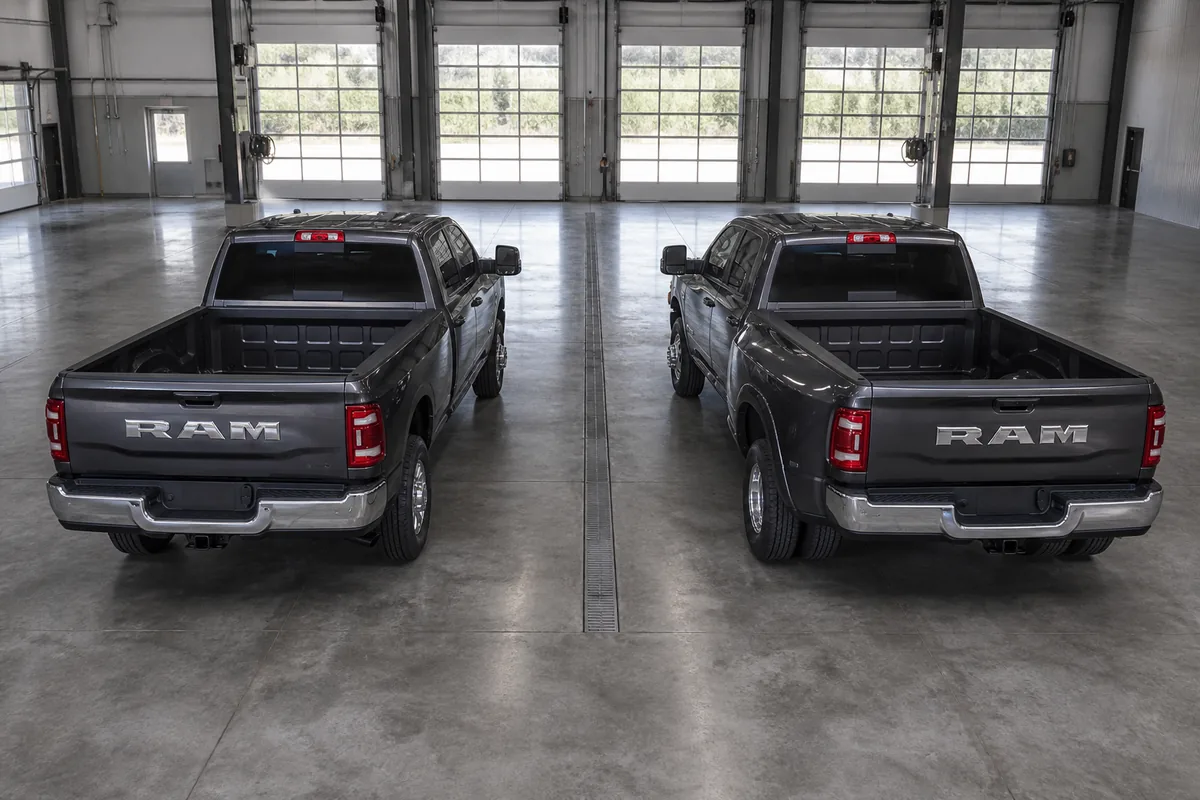
A single-rear-wheel Ram 3500 keeps a narrower rear body and fewer tires, which can simplify parking, gates, garages, tire replacement, and daily driving. A dual-rear-wheel build creates a different rear-axle and tire envelope for high truck-side loads.
DRW can add useful rear support and stability in the right loaded condition, but it is not automatically safer or better on every surface. Tire contact, load, pressure, road surface, speed, crosswind, and driver behavior still matter.
| Choice | Earns its place when | Daily consequence | Proof required |
|---|---|---|---|
| SRW | Exact labels clear the full truck-side load with margin | Narrower body and fewer tires | Door labels, scale weights, and route test |
| DRW | Pin weight or payload requires the appropriate wider build | More width, tires, and parking demand | Exact labels, loaded scale, and measured access |
Do not transfer the maximum of one cab, bed, axle, or drivetrain to another truck. The useful comparison begins with two real configurations that can be ordered and ends with their actual labels.
Choose DRW for a measured load or stability need, not for appearance. Keep SRW when it clears the work and the wider rear body would only make normal access harder.
Gas and Cummins change which limit arrives first
The 6.4-liter HEMI V8 produces 405 hp and 429 lb-ft, while the high-output 6.7-liter Cummins turbodiesel produces 430 hp and 1,075 lb-ft. Both use eight-speed automatic transmissions designed for their respective powertrains.
Gas power can support a payload-led configuration and avoids buying diesel hardware for work that does not repeatedly need diesel torque. The Cummins is aimed at sustained heavy trailer duty, but its own mass and exact configuration still affect payload.
Engine fit
6.4L HEMI V8
Start here when truck-side load matters, the exact gas build clears the trailer, and heavy grades are not a repeated diesel-level demand.
HO 6.7L Cummins
Choose it when repeated loaded grades and trailer work use 1,075 lb-ft often enough to justify the purchase and service consequences.
The official 2027 headline maximum is 36,610 pounds of towing for the qualifying configuration. The headline payload maximum is 7,590 pounds, and neither number describes every gas, diesel, SRW, DRW, cab, bed, or drivetrain combination.
Heavy-duty pickups have no EPA fuel-economy label. Match the engine to the limiting work, then verify what its weight does to the exact truck's remaining payload.
Cab, bed, trim and rear wheels must work before the rating matters
The 2027 Ram 3500 factory-bed pickup can be configured as a Regular Cab with an 8-foot bed, a Crew Cab with a 6-foot-4 or 8-foot bed, or a Mega Cab with a 6-foot-4 bed. Cab choice determines who can travel, bed choice determines the work envelope, and both change length, curb weight, turning room, and the rating available on an exact truck.
Regular Cab is the direct route to a work-focused two- or three-person truck and often appears in maximum-capability configurations. Crew Cab is the broad family and work-crew choice, while Mega Cab emphasizes reclining rear space and interior storage but narrows the available configuration matrix.
The cabin can use a 40/20/40 front bench or bucket seats depending on trim. Crew Cab models offer in-floor storage and a fold-flat rear floor, while Mega Cab rear seats can recline and fold flat, so test tools, child seats, laptops, work bags, and rear passengers before paying for extra cab length.
Higher trims add material quality and technology rather than a universal capacity increase. Available equipment includes a 12-inch digital cluster, 14.5-inch center touchscreen, 10.25-inch passenger display, digital rearview mirror, trailer-camera views, and dual wireless charging pads.
Build and verify a 2027 Ram 3500
- Fit the bodyChoose Regular, Crew, or Mega Cab and the shortest bed that carries the repeated load
- Choose the rear wheelsRetain SRW when labels pass, or select DRW when measured truck-side load requires it
- Choose tractionAdd 4x4 for repeated low-traction work, then account for its mass and exact rating
- Inspect the cabinTest seating, storage, screen glare, physical tow controls, mirrors, and camera coverage
- Read the labelsCapture payload, GVWR, rear GAWR, tire information, and VIN-specific equipment
- Verify the ratingUse current MY2027 information for the exact build and resolve any conflict in writing
Ram had not exposed a complete official 2027 trim, configuration, destination, and MSRP table as of August 11, 2026. Get a written window sticker after the cab, bed, trim, engine, drivetrain, rear wheels, axle, and tow equipment are fixed, because a generic starting price cannot represent that build.
Detailed MY2026 matrices remain useful carryover evidence for understanding which variables change a rating, but they are not exact MY2027 proof. Shortlist the cab, bed, trim, drivetrain, and rear-wheel layout that works every day, then let the VIN labels and current guide establish its capacity.
A 96.5-inch DRW truck changes every narrow-space decision
Ram lists the DRW truck at 96.5 inches wide, a dimension that changes garages, gates, parking spaces, drive-through lanes, worksite entrances, and narrow roads. The number matters every day, including days when the truck carries no trailer.
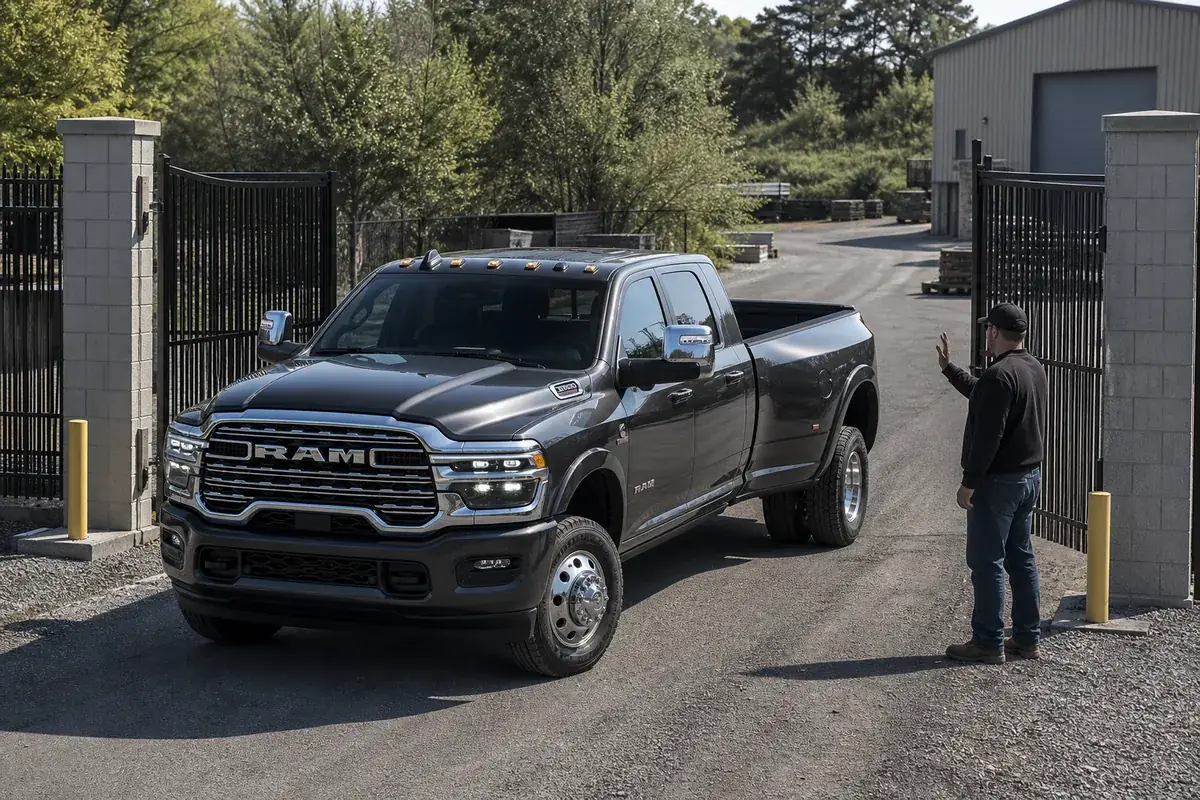
Measure the narrowest opening on the actual route and allow for mirrors, turns, posts, curbs, uneven approach angles, and a practical safety margin. A nominal opening wider than the truck does not prove that the turn into it works.
Repeat the parking and storage test where the truck will live, not only at an open dealer lot. Also price the complete rear tire set and confirm service access for the intended wheels and tires.
If 96.5 inches repeatedly blocks the route, DRW fails the job even when its load rating works. Choose SRW or a different vehicle when access is the harder constraint.
Test stability, traction and braking in the truck's real operating state
A Ram 3500 can behave differently when empty, carrying pin weight, or pulling a loaded trailer. Test the exact cab, bed, drivetrain, rear-wheel layout, tires, and powertrain rather than borrowing an impression from another build.
Begin with low-speed placement, steering effort, turning clearance, mirror coverage, camera views, and progressive brake response. The 96.5-inch DRW body needs deliberate lane placement and a wider turning plan, so include a fuel stop, narrow intersection, backing task, and parking space from the normal route.
A MotorTrend test of a refreshed 2025 Ram 3500 Laramie Crew Cab DRW 4x4 with the Cummins and 8-foot bed provides useful generation context. That exact truck reached 60 mph in 7.0 seconds, stopped from 60 mph in 135 feet, and showed pronounced understeer when pushed without a trailer.
The same test covered 2,342 miles while towing 22,500 pounds and reported about 9 mpg. It also found that the eight-speed selected useful lower gears on grades and that adaptive cruise, lane centering, and the automatic exhaust brake reduced workload, but the result belongs to that truck, trailer, route, and protocol.
Drive the candidate empty across broken pavement and at highway speed before adding representative legal load. Then repeat acceleration, grade holding, crosswind response, steering corrections, brake feel, mirror use, and camera use so the effect of rear load becomes visible.
A DRW truck may feel more settled when its rear axle is meaningfully loaded, but that does not make the empty ride, turning width, or tire cost disappear. SRW remains preferable when it clears every label and provides the easier daily route.
Heavy-duty pickups do not carry a consumer EPA MPG label. Choose the rear-wheel layout whose steering, braking, visibility, and loaded stability remain predictable in the state you repeat.
Towing technology cannot raise a label limit
Cameras, hitch views, trailer-brake controllers, alerts, and other towing aids can reduce workload. They do not add payload, rear-axle capacity, tire capacity, GVWR, GCWR, or trailer capacity.
Ram's available Trailer Tow Pages can show trailer-light checks and brake status within the cabin. The digital rearview mirror can use a wired Tow Mode Camera, while Tow Tech Plus can add left and right mirror-camera views that help the driver monitor a wide body and trailer.
The useful test begins from the normal seating position. Check mirror extension, blind areas beside the DRW fenders, center-screen glare, physical brake-controller reach, camera delay, trailer alignment, and the view through a full low-speed turn.
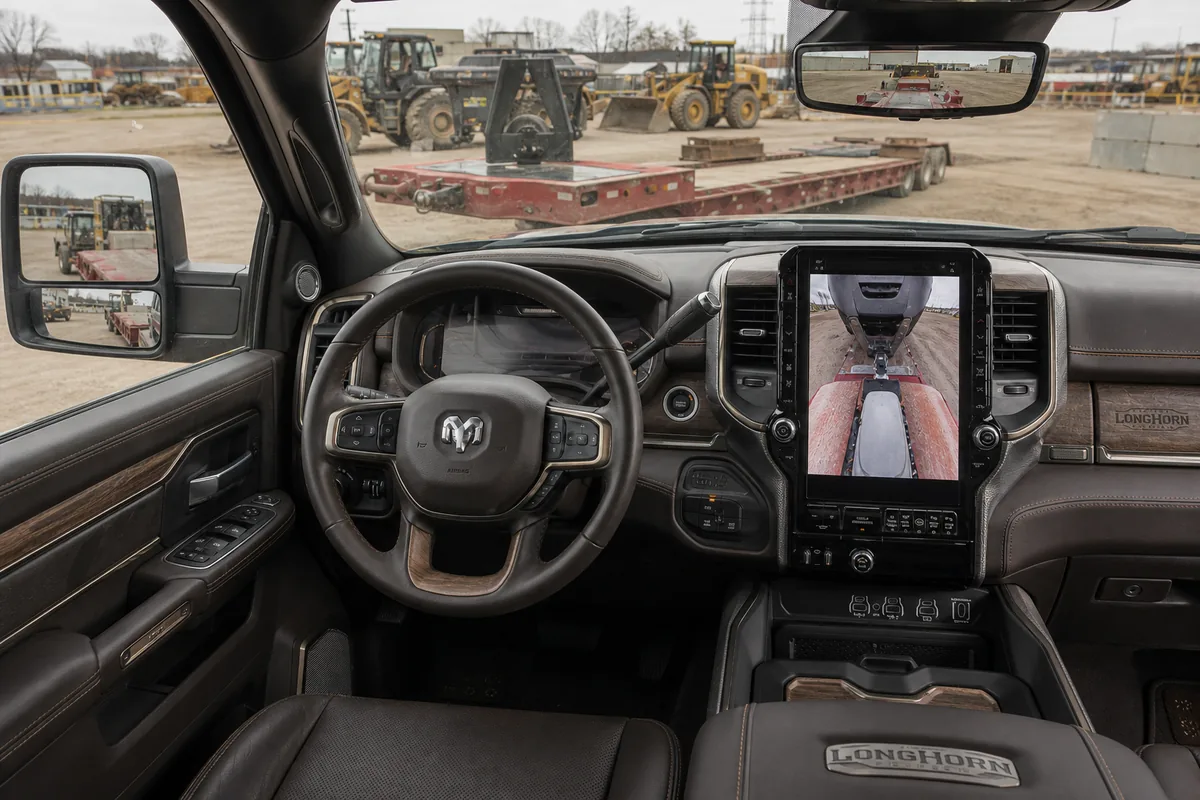
Test the installed equipment on the exact truck and trailer before a time-sensitive departure. Confirm lighting, brake-controller response, camera views, alerts, connection security, tailgate clearance, and cab-to-trailer clearance through the full turn range.
Use a suitable scale with the combination loaded as it travels. The trip is ready only when the hardware, measured axle and combination weights, current ratings, visibility aids, and operating checks all agree.
Safety and warranty evidence have hard 2027 boundaries
No applicable exact-year 2027 Ram 3500 crash score from NHTSA or IIHS was available as of August 11, 2026. Older scores are not transferred without an explicit applicability statement for the model year, cab, drivetrain, rear-wheel layout, and heavy-duty body.
IIHS published a limited driver-protection evaluation involving a 2026 Ram 3500, but it was a documentation and belt-reminder review rather than a crash test and it does not establish a 2027 crash rating. The missing exact-year rating remains uncertainty, not a favorable or unfavorable result.
Ram lists adaptive cruise control to 0 mph with a trailer and forward-collision warning with active braking as standard current equipment. Available LaneSense functions, drowsy-driver detection, traffic-sign recognition, surround view, and trailer cameras need to be confirmed and tested on the exact truck.
Mopar's current-model coverage lists 3 years or 36,000 miles for the basic vehicle, 5 years or 60,000 miles for the gas powertrain, and 5 years or 100,000 miles for the diesel powertrain. Confirm emissions coverage, roadside terms, commercial-use conditions, exclusions, and the original in-service date in the VIN-specific documents.
Ram's Powertrain Care extension describes 10-year or 100,000-mile powertrain coverage for the original retail owner of eligible 2026-model-year and newer trucks. It is not fully transferable, so a later owner retains the standard gas or diesel term rather than the original-owner extension.
The 2027 model year is too new for mature failure-frequency evidence. Inspect recall status, service records, leaks, warning lamps, electronics, cameras, brakes, tires, four-wheel-drive operation, diesel aftertreatment behavior, and transmission response on the individual truck.
Treat the absent crash rating as uncertainty and the warranty as a written coverage boundary. Neither becomes a reliability or safety score that the evidence cannot support.
Choose DRW only when the measured load proves its value
Choose a 2027 Ram 3500 SRW when its exact payload, axle, tire, towing, and combination limits clear the recurring load with margin. It preserves a narrower body and fewer rear tires when DRW capacity is unnecessary.
Choose DRW when measured pin weight or payload exceeds the suitable SRW configuration and the wider truck fits every normal route. Its value must survive the 96.5-inch access test, loaded road test, tire cost, and written configuration check.
Do not use the 36,610-pound towing or 7,590-pound payload headline as the specification for a random truck. Do not use a MY2026 detailed matrix as exact MY2027 proof.
Buy DRW only when the measured load requires it and the measured route accepts it. Otherwise the right answer is SRW or a different truck, not unused rear-axle capacity.